Japan In-Flight Entertainment Satcom Market Size & Growth Rate
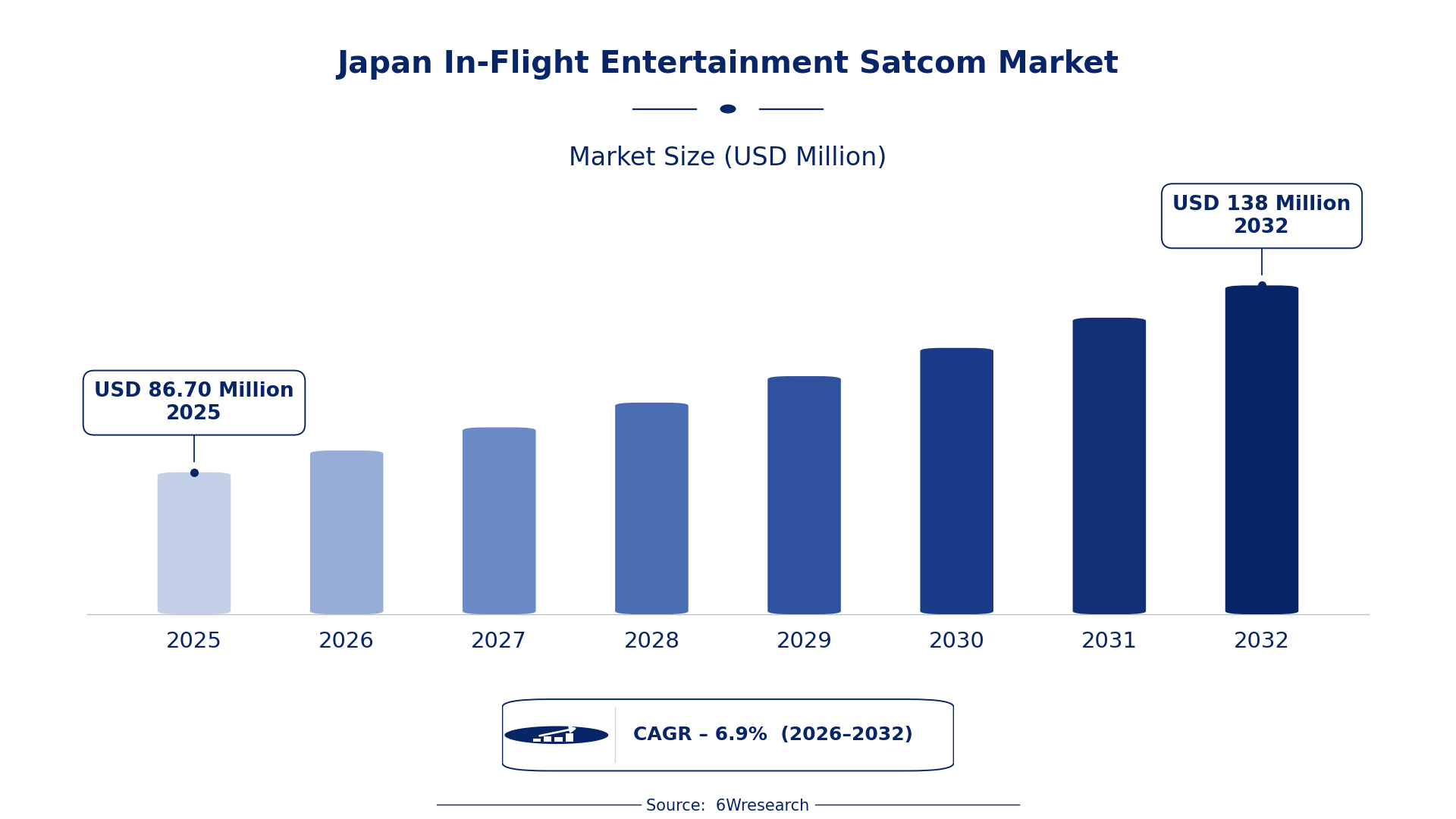
According to 6Wresearch internal database and industry insights, the Japan In-Flight Entertainment Satcom Market was valued at USD 86.70 Million in 2025 and is projected to reach USD 138 Million by 2032, growing at a CAGR of approximately 6.9% during 2026–2032.
Japan In-Flight Entertainment Satcom Market Highlights
| Report Metric | Details |
| Report Name | Japan In-Flight Entertainment Satcom Market (2026-2032) |
| Market Size 2025 | USD 86.70 Million |
| Market Size 2032 | USD 138 Million |
| Absolute Growth 2025–2032 | USD 51.30 Million |
| CAGR 2026–2032 | 6.9% |
| Peak Annual Growth | 7.7% in 2027 |
| Forecast Period | 2026–2032 |
| Historical Data | 2022–2025 |
| Base Year | 2025 |
| Leading Satcom Type, 2025 | GEO Satcom (50% share) |
| Leading Orbit Type, 2025 | Low-Latency Internet (47% share) |
| Leading Connectivity Mode, 2025 | Full Entertainment Stack (47% share) |
| Leading Distribution Channel, 2025 | Aircraft Connectivity Providers (38% share) |
| Fastest-Growing Satcom Type | LEO Satcom (10.2% CAGR) |
| Fastest-Growing Connectivity Mode | Gaming / Conferencing (9.4% CAGR) |
| Fastest-Growing Distribution Channel | Satellite Operators (8.8% CAGR) |
| Growing Sector | aviation |
| Key End Users | airlines, aircraft operators, entertainment providers |
Japan In-Flight Entertainment Satcom Market Year-wise Growth Rate and Key Drivers (2022–2032)
This graph illustrates the annual growth rates of the market from 2022 to 2032, highlighting a steady upward trajectory and projected market expansion over the forecast period.
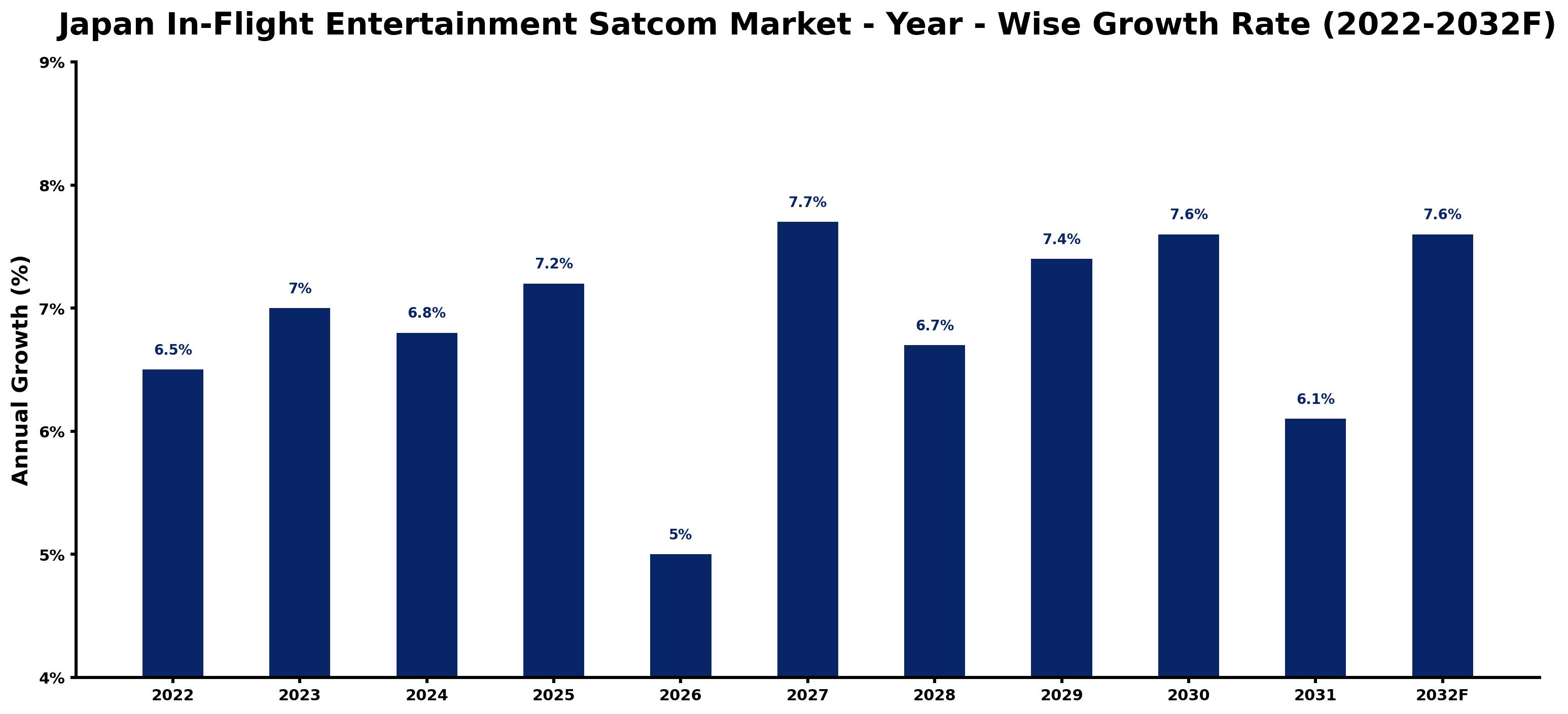
For each year, the table pairs the estimated growth rate with the leading influence on demand, showing how the drivers changed across the period.
| Year | Estimated Annual Growth (%) | Market Rationale |
| 2022 | 6.5 | The market showed steady growth as airlines upgraded their in-flight services. |
| 2023 | 7.0 | Demand increased due to higher passenger numbers and improved connectivity options. |
| 2024 | 6.8 | Growth slowed as airlines focused on cost management amid rising operational expenses. |
| 2025 | 7.2 | The market expanded with investments in Satcom technology by airlines. |
| 2026 | 5.0 | Growth is projected to slow as competition intensifies among service providers. |
| 2027 | 7.7 | Demand is expected to surge with the introduction of new low-latency services enhancing passenger experience. |
| 2028 | 6.7 | Growth is anticipated to slow slightly as airlines adjust to market saturation in certain segments. |
| 2029 | 7.4 | Demand will rise as more airlines adopt advanced entertainment systems for passengers. |
| 2030 | 7.6 | Growth will accelerate again due to increased consumer expectations for connectivity. |
| 2031 | 6.1 | The market will see a slowdown as airlines face challenges in maintaining service quality. |
| 2032 | 7.6 | Demand is projected to rise again with new technologies improving in-flight experiences. |
Note: Market size estimations and growth projections presented in this report are based on 6Wresearch's proprietary forecasting methodology, utilizing the latest available industry data, government publications, and primary research inputs.
Japan In-Flight Entertainment Satcom Market Synopsis
In-Flight Entertainment Satcom systems deliver satellite communication services that elevate passenger experiences through video streaming, gaming, and social media access during flights. With over 100 million annual air passengers, the Japan In-Flight Entertainment Satcom Market is expanding, fuelled by both domestic and international airlines. The rollout of low-latency internet services and extensive entertainment offerings is driving demand, as airlines make substantial investments in upgrading their in-flight connectivity solutions.
Market Dynamics Impact Analysis (2026–2032)
| Factor | Type | Impact | Primary Segment Affected |
| Growing passenger numbers and expectations for connectivity | Driver | High | Low-Latency Internet |
| Technological advancements in satellite communication systems | Driver | High | Full Entertainment Stack |
| Emerging demand for hybrid Satcom systems | Opportunity | Medium | Hybrid Satcom Systems |
| Increased investment in aviation digital connectivity | Opportunity | Medium | Aircraft Connectivity Providers |
| High operational costs affecting service expansion | Restraint | High | GEO Satcom |
| Limited frequency spectrum availability for satellite communication | Restraint | Medium | LEO Satcom |
| Intense competition among service providers | Challenge | High | Satellite Operators |
| Regulatory complexities in aviation communications | Challenge | Medium | OEM Aircraft Integrators |
Evaluation of Drivers in Japan In-Flight Entertainment Satcom Market (2026–2032)
Below are the drivers that matter most for revenue growth, with supporting evidence.
| Drivers | Primary Segment Affected | Why It Matters (Evidence) |
| Increasing air passenger traffic | Low-Latency Internet | Japan has over 100 million annual air passengers, driving demand for better in-flight connectivity. |
| Technological advancements in satellite systems | Full Entertainment Stack | The Japanese aviation market is projected to invest in Satcom technology by 2025. |
| Growing demand for video streaming services | Video Streaming | In-flight entertainment systems are installed in over 60% of aircraft in Japan, improving passenger experience. |
| Expansion of international routes by Japanese airlines | Gaming / Conferencing | The average flight time for domestic flights in Japan is around 1.5 hours, increasing demand for entertainment. |
| Adoption of hybrid Satcom systems for flexibility | Hybrid Satcom Systems | The government launched a program in 2023 to improve digital connectivity in aviation. |
The primary driver of demand is the rising air passenger traffic, with over 100 million annual air passengers creating a need for improved in-flight connectivity. The Japanese aviation market is expected to invest in Satcom technology by 2025, resulting in advancements in satellite systems. In-flight entertainment systems are present in over 60% of aircraft, which supports the demand for video streaming services. The average domestic flight time of approximately 1.5 hours heightens the necessity for engaging entertainment options. The introduction of hybrid Satcom systems will offer flexibility and improved services for passengers.
Evaluation of Restraints in Japan In-Flight Entertainment Satcom Market
The following restraints limit how fast demand can grow.
| Market Restraint | Primary Segment Affected | Why It Matters (Evidence) |
| High operational costs limiting service expansion | GEO Satcom | Rising operational expenses are affecting airlines' ability to invest in new technologies, restricting service upgrades. |
| Limited frequency spectrum availability for satellite communication | LEO Satcom | This scarcity restricts the deployment of new satellite services, impacting connectivity options for airlines. |
| Complex regulatory environment for aviation communications | OEM Aircraft Integrators | Regulatory requirements can delay the integration of new Satcom systems into aircraft, hindering service improvements. |
| Intense competition among service providers | Satellite Operators | Competition can lead to price wars, affecting profitability and service quality for providers in the market. |
| Market saturation in certain segments | Full Entertainment Stack | As more airlines adopt similar technologies, differentiation becomes challenging, limiting growth opportunities. |
Japan In-Flight Entertainment Satcom Market Challenges
Buyers encounter supply issues due to a limited number of satellite technology providers, which can delay service upgrades and affect passenger satisfaction. Producers face high costs associated with JIS standards, leading to operational expenses that may reduce profit margins by 15%. A shortage of skilled labour in the aviation sector hampers the effective integration of Satcom systems, prolonging project timelines and increasing training costs for airlines. Existing aircraft systems have technology limitations that restrict the deployment of low-latency internet services, impacting the overall passenger experience and diminishing competitiveness for airlines.
Trends in the Japan In-Flight Entertainment Satcom Market
These developments are changing demand patterns in the Japan In-Flight Entertainment Satcom Market.
- Shift from Traditional to Digital Entertainment: Airlines are increasingly embracing digital entertainment solutions, with over 60% of aircraft in Japan outfitted with advanced in-flight entertainment systems. This transition is particularly noticeable in Tokyo, where airlines are enhancing passenger experiences through improved connectivity options, reflecting a growing appetite for interactive services.
- Transition to Low-Latency Internet Services: The demand for low-latency internet services is on the rise, with a projected CAGR of 9.3% for this segment. The 2023 government initiative to enhance digital connectivity in aviation is prompting airlines to invest in technologies that support real-time applications, thereby improving overall passenger satisfaction.
- Emergence of Hybrid Satcom Systems: Hybrid Satcom systems are becoming more popular, merging the advantages of various satellite types for greater flexibility. This trend is particularly evident in Osaka, where airlines are adopting these systems to provide comprehensive entertainment offerings, catering to the diverse needs of passengers.
- Growth in Gaming and Conferencing Applications: Gaming and conferencing applications are increasingly favoured by passengers, with a projected CAGR of 9.4% for this segment. The surge in demand for these services is apparent in Japan's aviation sector, where airlines are prioritising in-flight connectivity solutions that support social media and gaming.
Investment Opportunities in the Japan In-Flight Entertainment Satcom Market
Several openings in the Japan In-Flight Entertainment Satcom Market merit attention from investors.
- Investment in Digital Connectivity: With the Japanese aviation market set to invest heavily in Satcom technology by 2025, there is a strong opportunity for partnerships with local firms to improve digital connectivity in aviation.
- Collaboration with Aircraft Connectivity Providers: Now is an opportune moment to invest in hybrid Satcom systems, as demand for flexible solutions continues to grow. Collaborating with Aircraft Connectivity Providers can facilitate market entry and service expansion.
- Focus on Low-Latency Internet Services: The increasing demand for low-latency internet services in aviation presents a valuable opportunity for suppliers. Targeting airlines in major hubs like Tokyo and Osaka can lead to successful partnerships.
- Development of Gaming and Conferencing Solutions: With gaming and conferencing gaining traction among passengers, suppliers can invest in customised solutions. Engaging with airlines that prioritise entertainment options will be crucial for capturing this market.
Government Initiatives in the Japan In-Flight Entertainment Satcom Market
The Industrial Standardization Act, amended in 2019, governs JIS product and test standards for communication equipment in aviation, ensuring safety and reliability for In-Flight Entertainment Satcom systems. The Act against Unjustifiable Premiums and Misleading Representations protects consumers by prohibiting misleading labelling and advertising, ensuring transparency in the market.
The Civil Aviation Bureau of Japan oversees regulations for satellite communication in aviation, approving necessary technologies and ensuring compliance. The Bureau also funds initiatives aimed at improving digital connectivity, supporting the growth of in-flight entertainment services.
Future Insight of the Japan In-Flight Entertainment Satcom Market
By 2032, buyers will benefit from advancements in digital connectivity programmes that enhance in-flight entertainment options. Anticipated investments in Satcom technology will lead to systems being installed in over 30 airlines. New regulatory frameworks will streamline compliance processes, enabling faster innovation. As demand for high-speed internet services increases, airlines will implement more sophisticated satellite communication technologies to improve passenger experiences.
Market Segmentation Analysis
Japan In-Flight Entertainment Satcom Market report covers a detailed analysis of the following market segments:
By Satcom Type – GEO Satcom Leads, LEO Satcom Expected to Grow Fastest
According to Saurav Kr Singh, Senior Research Analyst at 6Wresearch, in 2025, GEO Satcom led the satcom type split with a 50% share. GEO Satcom holds the largest share due to its ability to provide stable connectivity, which is essential for the large number of over 100 million annual air passengers in Japan. Airlines operating in major hubs like Tokyo and Osaka particularly rely on this sub-segment for its reliable services. LEO Satcom is projected to grow fastest, at a CAGR of 10.2% during 2026–2032. LEO Satcom is experiencing rapid growth because of the rising demand for low-latency communication, which significantly enhances the passenger experience during activities such as gaming. The government's 2023 programme aimed at improving digital connectivity in aviation will likely accelerate this segment's growth. Suppliers should focus on developing LEO Satcom solutions to address the increasing demand for low-latency services.
By Orbit Type – Low-Latency Internet Leads and Records the Fastest Growth
With 47% of orbit type revenue in 2025, Low-Latency Internet was the largest category. Low-Latency Internet leads this segment as it is vital for real-time applications like gaming, which are increasingly preferred by passengers during flights. The expected investment in Satcom technology by 2025 underscores the importance of this capability in improving passenger satisfaction. Its lead should widen, with a projected CAGR of 9.3% during 2026–2032, the highest in this split. The growth of Low-Latency Internet will continue as it meets passengers' expectations for seamless connectivity and real-time interactions. As more airlines implement advanced Satcom systems, this segment's prominence is likely to increase. Buyers can anticipate improved in-flight experiences as airlines adopt more Low-Latency Internet solutions.
By Connectivity Mode – Full Entertainment Stack Leads, Gaming / Conferencing Expected to Grow Fastest
Full Entertainment Stack accounted for 47% of the market by connectivity mode in 2025. The Full Entertainment Stack commands the largest share because it offers a comprehensive range of services that cater to the varied entertainment preferences of passengers. With over 60% of aircraft in Japan equipped with these systems, this segment is both established and widely embraced. Gaming / Conferencing is set to record the highest CAGR in this split, 9.4% over 2026–2032. Gaming and Conferencing are rapidly gaining traction due to their popularity among passengers seeking engaging in-flight activities. As airlines enhance their service offerings, this segment is expected to see accelerated adoption, further solidifying its position. Suppliers should consider expanding their offerings to include more gaming and conferencing options to attract airlines looking to enhance passenger engagement.
By Distribution Channel – Aircraft Connectivity Providers Lead, Satellite Operators Expected to Grow Fastest
The largest distribution channel category in 2025 was Aircraft Connectivity Providers, at 38% of revenue. Aircraft Connectivity Providers dominate this segment as they are crucial in delivering in-flight connectivity solutions, enabling airlines to serve over 100 million annual air passengers. Their established relationships with airlines facilitate the effective integration of advanced Satcom systems. The quickest growth will come from Satellite Operators, forecast to expand at a CAGR of 8.8% between 2026 and 2032. Satellite Operators are poised for significant growth as they are key providers of satellite services that support the expanding in-flight entertainment market. The aviation industry's increasing reliance on satellite technology suggests substantial future growth for this segment. Suppliers should strengthen partnerships with Satellite Operators to ensure a dependable supply of advanced connectivity solutions.
Key Attractiveness of the Report
- 10 Years of Market Numbers
- Historical Data Starting from 2022 to 2025
- Base Year 2025
- Forecast Data until 2032
- Key Performance Indicators Impacting the Market
- Major Upcoming Developments and Projects
Key Highlights of the Report:
- Japan In-Flight Entertainment Satcom Market Outlook
- Market Size of Japan In-Flight Entertainment Satcom Market, 2025
- Forecast of Japan In-Flight Entertainment Satcom Market, 2032
- Historical Data and Forecast of Japan In-Flight Entertainment Satcom Revenues & Volume for the Period 2022-2032F
- Japan In-Flight Entertainment Satcom Market Trend Evolution
- Japan In-Flight Entertainment Satcom Market Drivers and Challenges
- Japan In-Flight Entertainment Satcom Price Trends
- Japan In-Flight Entertainment Satcom Porter's Five Forces
- Japan In-Flight Entertainment Satcom Industry Life Cycle
- Historical Data and Forecast of Japan In-Flight Entertainment Satcom Market Revenues & Volume By Satcom Type for the Period 2022-2032F
- Historical Data and Forecast of Japan In-Flight Entertainment Satcom Market Revenues & Volume By GEO Satcom for the Period 2022-2032F
- Historical Data and Forecast of Japan In-Flight Entertainment Satcom Market Revenues & Volume By LEO Satcom for the Period 2022-2032F
- Historical Data and Forecast of Japan In-Flight Entertainment Satcom Market Revenues & Volume By MEO Satcom for the Period 2022-2032F
- Historical Data and Forecast of Japan In-Flight Entertainment Satcom Market Revenues & Volume By Hybrid Satcom Systems for the Period 2022-2032F
- Historical Data and Forecast of Japan In-Flight Entertainment Satcom Market Revenues & Volume By Orbit Type for the Period 2022-2032F
- Historical Data and Forecast of Japan In-Flight Entertainment Satcom Market Revenues & Volume By Fixed / Mobile for the Period 2022-2032F
- Historical Data and Forecast of Japan In-Flight Entertainment Satcom Market Revenues & Volume By Low-Latency Internet for the Period 2022-2032F
- Historical Data and Forecast of Japan In-Flight Entertainment Satcom Market Revenues & Volume By Mid-Range Coverage for the Period 2022-2032F
- Historical Data and Forecast of Japan In-Flight Entertainment Satcom Market Revenues & Volume By Multi-Orbit Links for the Period 2022-2032F
- Historical Data and Forecast of Japan In-Flight Entertainment Satcom Market Revenues & Volume By Connectivity Mode for the Period 2022-2032F
- Historical Data and Forecast of Japan In-Flight Entertainment Satcom Market Revenues & Volume By Video Streaming for the Period 2022-2032F
- Historical Data and Forecast of Japan In-Flight Entertainment Satcom Market Revenues & Volume By Gaming / Conferencing for the Period 2022-2032F
- Historical Data and Forecast of Japan In-Flight Entertainment Satcom Market Revenues & Volume By Social Media & VoIP for the Period 2022-2032F
- Historical Data and Forecast of Japan In-Flight Entertainment Satcom Market Revenues & Volume By Full Entertainment Stack for the Period 2022-2032F
- Historical Data and Forecast of Japan In-Flight Entertainment Satcom Market Revenues & Volume By Distribution Channel for the Period 2022-2032F
- Historical Data and Forecast of Japan In-Flight Entertainment Satcom Market Revenues & Volume By Satellite Operators for the Period 2022-2032F
- Historical Data and Forecast of Japan In-Flight Entertainment Satcom Market Revenues & Volume By OEM Aircraft Integrators for the Period 2022-2032F
- Historical Data and Forecast of Japan In-Flight Entertainment Satcom Market Revenues & Volume By Satcom Hardware Suppliers for the Period 2022-2032F
- Historical Data and Forecast of Japan In-Flight Entertainment Satcom Market Revenues & Volume By Aircraft Connectivity Providers for the Period 2022-2032F
- Japan In-Flight Entertainment Satcom Import Export Trade Statistics
- Market Opportunity Assessment By Satcom Type
- Market Opportunity Assessment By Orbit Type
- Market Opportunity Assessment By Connectivity Mode
- Market Opportunity Assessment By Distribution Channel
- Japan In-Flight Entertainment Satcom Top Companies Market Share
- Japan In-Flight Entertainment Satcom Competitive Benchmarking By Technical and Operational Parameters
- Japan In-Flight Entertainment Satcom Company Profiles
- Japan In-Flight Entertainment Satcom Key Strategic Recommendations
Market Covered
The study includes the following segmentation.
By Satcom Type
- GEO Satcom
- LEO Satcom
- MEO Satcom
- Hybrid Satcom Systems
By Orbit Type
- Fixed / Mobile
- Low-Latency Internet
- Mid-Range Coverage
- Multi-Orbit Links
By Connectivity Mode
- Video Streaming
- Gaming / Conferencing
- Social Media & VoIP
- Full Entertainment Stack
By Distribution Channel
- Satellite Operators
- OEM Aircraft Integrators
- Satcom Hardware Suppliers
- Aircraft Connectivity Providers































