Japan In-Flight Entertainment Systems Market Size & Growth Rate
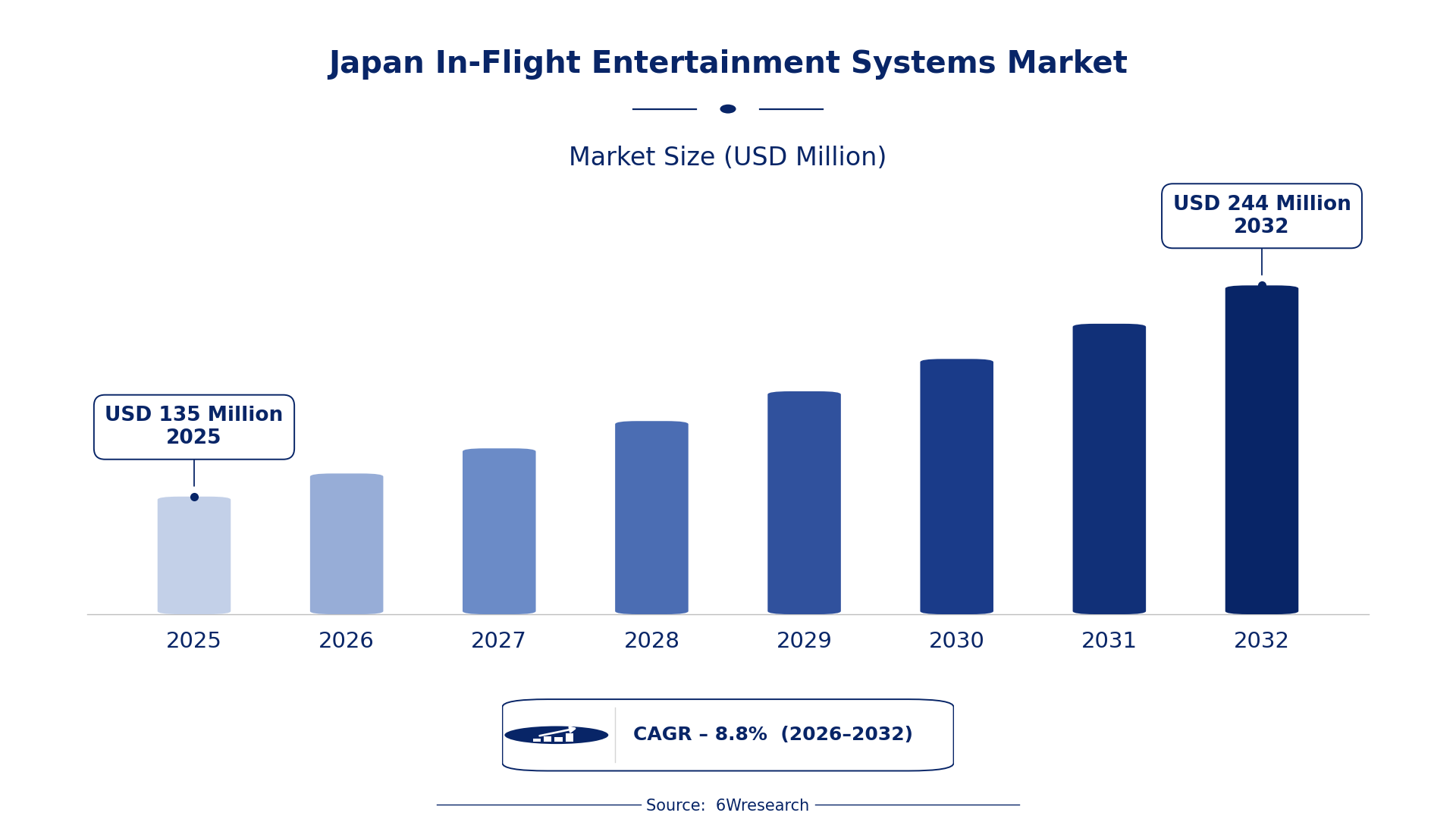
According to 6Wresearch internal database and industry insights, the Japan In-Flight Entertainment Systems Market was valued at USD 135 Million in 2025 and is projected to reach USD 244 Million by 2032, growing at a CAGR of approximately 8.8% during 2026–2032.
Japan In-Flight Entertainment Systems Market Highlights
| Report Metric | Details |
| Report Name | Japan In-Flight Entertainment Systems Market (2026-2032) |
| Market Size 2025 | USD 135 Million |
| Market Size 2032 | USD 244 Million |
| Absolute Growth 2025–2032 | USD 109 Million |
| CAGR 2026–2032 | 8.8% |
| Peak Annual Growth | 9.6% in 2032 |
| Forecast Period | 2026–2032 |
| Historical Data | 2022–2025 |
| Base Year | 2025 |
| Leading System Component, 2025 | Seat-Back Displays (46% share) |
| Leading Display Type, 2025 | Touchscreen / 4K (50% share) |
| Leading Aircraft Segment, 2025 | Widebody Aircraft (40% share) |
| Leading Distribution Channel, 2025 | OEM Vendors (35% share) |
| Fastest-Growing System Component | Server Units (12.3% CAGR) |
| Fastest-Growing Aircraft Segment | Narrowbody Aircraft (12.0% CAGR) |
| Fastest-Growing Distribution Channel | Direct to Airlines (11.4% CAGR) |
| Growing Sector | Aviation |
| Key End Users | Domestic airlines, international carriers, aviation technology suppliers |
Japan In-Flight Entertainment Systems Market Year-wise Growth Rate and Key Drivers (2022–2032)
This graph illustrates the annual growth rates of the market from 2022 to 2032, highlighting a steady upward trajectory and projected market expansion over the forecast period.
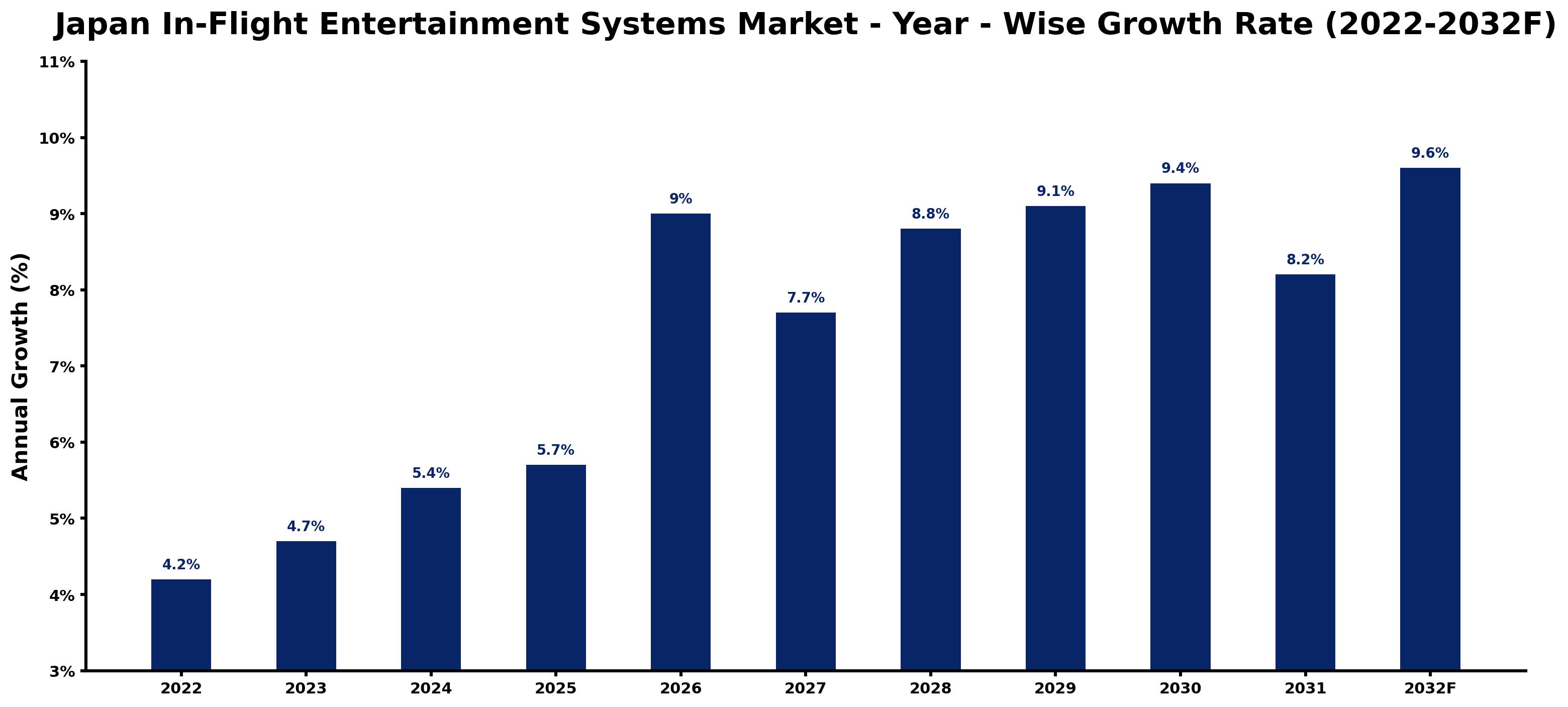
The table below sets out the estimated growth rate for each year and the main factor behind it.
| Year | Estimated Annual Growth (%) | Market Rationale |
| 2022 | 4.2 | The aviation sector served over 100 million passengers, indicating steady demand for entertainment systems. |
| 2023 | 4.7 | The Tokyo 2020 Olympics heightened the focus on passenger experience, boosting system integration. |
| 2024 | 5.4 | Airlines adopted more streaming services, increasing the need for advanced in-flight entertainment. |
| 2025 | 5.7 | The average flight duration of 1.5 hours supported demand for engaging entertainment options. |
| 2026 | 9.0 | Technological advancements in displays and Wi-Fi services will drive growth. |
| 2027 | 7.7 | The market experiences a slowdown in growth as airlines focus on sustainability initiatives. |
| 2028 | 8.8 | The integration of 4K displays in premium cabins will drive demand for enhanced user experience. |
| 2029 | 9.1 | The focus on improving passenger experience continues to support rising demand for systems. |
| 2030 | 9.4 | Investment in aviation technology is expected to increase, further boosting entertainment systems. |
| 2031 | 8.2 | The market growth slows as airlines balance technology upgrades with cost management. |
| 2032 | 9.6 | The demand for innovative in-flight solutions is projected to peak as travel resumes. |
Note: Market size estimations and growth projections presented in this report are based on 6Wresearch's proprietary forecasting methodology, utilizing the latest available industry data, government publications, and primary research inputs.
Japan In-Flight Entertainment Systems Market Synopsis
In-Flight Entertainment Systems provide audio-visual entertainment to passengers during flights, enriching their experience. The primary buyers in Japan include domestic airlines and international carriers servicing Japanese routes. The Japan In-Flight Entertainment Systems Market is expanding due to rising passenger traffic, technological advancements in display quality, and a shift towards integrated streaming services. With over 100 airports facilitating air travel and a focus on improving passenger experience, demand for these systems is expected to rise considerably in the coming years.
Market Dynamics Impact Analysis (2026–2032)
| Factor | Type | Impact | Primary Segment Affected |
| Rising passenger traffic in the Tokyo metropolitan area drives demand for in-flight entertainment systems. | Driver | High | Seat-Back Displays |
| The integration of Wi-Fi services enhances the functionality of in-flight entertainment systems. | Driver | High | Server Units |
| The growing preference for streaming services among passengers creates new opportunities for system upgrades. | Opportunity | High | Touchscreen / 4K |
| The Japanese government’s strategy to enhance aviation infrastructure by 2025 opens avenues for investment. | Opportunity | High | Narrowbody Aircraft |
| Regulatory compliance with JIS standards can increase operational costs for producers. | Restraint | Medium | HD/LED Panels |
| The average age of commercial aircraft in Japan is about 12 years, limiting system upgrades. | Restraint | Medium | Overhead Displays |
| Competition from emerging technologies may challenge traditional in-flight entertainment systems. | Challenge | High | Streaming Backbone |
| The need for continuous innovation in entertainment options increases pressure on suppliers. | Challenge | Medium | Passenger Control Units |
Evaluation of Drivers in Japan In-Flight Entertainment Systems Market (2026–2032)
The table below links each growth driver to the segment it affects and the evidence for it.
| Drivers | Primary Segment Affected | Why It Matters (Evidence) |
| Rising passenger traffic in the Tokyo area boosts demand for entertainment systems. | Seat-Back Displays | With over 100 million passengers in 2022, airlines are investing in more engaging systems. |
| Integration of Wi-Fi services improves the functionality of in-flight entertainment. | Server Units | As airlines adopt streaming services, demand for server units increases significantly. |
| The shift towards 4K displays improves the quality of passenger entertainment. | Touchscreen / 4K | The use of high-definition displays is becoming standard in premium class cabins. |
| The average flight duration of 1.5 hours encourages the need for engaging content. | Overhead Displays | Passengers seek entertainment options that make their flights more enjoyable. |
| Technological advancements in aviation technology drive system upgrades. | Narrowbody Aircraft | Airlines are investing billions annually in technology to improve passenger experience. |
Volumes grow on the back of rising passenger traffic, particularly in the Tokyo metropolitan area, which served over 100 million passengers in 2022. The integration of Wi-Fi services improves the functionality of in-flight entertainment systems, as airlines increasingly adopt streaming options. The shift towards 4K displays is improving the quality of passenger entertainment, with a growing preference for high-definition visuals in premium cabins. The average flight duration of 1.5 hours encourages the need for engaging content, prompting airlines to invest in advanced systems. Investments in aviation technology are driving system upgrades, with billions allocated annually to improve the in-flight experience.
Evaluation of Restraints in Japan In-Flight Entertainment Systems Market
The table below lists the restraints and the evidence behind each.
| Market Restraint | Primary Segment Affected | Why It Matters (Evidence) |
| Compliance with JIS standards can increase operational costs for producers. | HD/LED Panels | Producers must invest in testing and certification to meet regulatory requirements. |
| The average age of commercial aircraft in Japan is about 12 years, limiting system upgrades. | Overhead Displays | Older aircraft may not support modern entertainment technologies, restricting options. |
| Competition from alternative entertainment options may challenge traditional in-flight systems. | Streaming Backbone | New technologies may attract passenger interest away from conventional systems. |
| The need for continuous innovation in entertainment options increases pressure on suppliers. | Passenger Control Units | Suppliers must regularly update offerings to meet evolving passenger expectations. |
| High investment costs for advanced technology can deter smaller airlines from upgrading. | Server Units | Smaller airlines may struggle to justify the expense of new entertainment systems. |
Japan In-Flight Entertainment Systems Market Challenges
Airlines experience delays in deploying new in-flight entertainment systems due to stringent regulations from the Civil Aviation Bureau, which can extend approval times by up to six months. Suppliers struggle to source high-quality components because of limited local manufacturing, leading to increased lead times and higher costs for airlines reliant on these systems. Many aircraft, averaging 12 years old, lack the necessary infrastructure for advanced technology integration, hindering airlines from upgrading their entertainment offerings. Buyers often report dissatisfaction with the limited content variety, averaging only 50 films, which can negatively impact passenger retention and loyalty.
Trends in the Japan In-Flight Entertainment Systems Market
The following changes are redrawing the Japan In-Flight Entertainment Systems Market.
- Increased Adoption of Streaming Services: Domestic airlines are increasingly adopting streaming services for passenger entertainment, improving user experience. In 2022, over 50 films were available on average, reflecting this trend.
- Transition to 4K Displays in Premium Cabins: The use of 4K displays is becoming standard in premium class cabins, improving visual quality for passengers. This shift is occurring as airlines upgrade their systems to meet higher expectations.
- Emergence of Wi-Fi Integrated Systems: In-flight entertainment systems are increasingly being integrated with Wi-Fi services, allowing passengers to stream content on personal devices. This trend is supported by the growing demand for connectivity during flights.
- Focus on Enhancing Passenger Experience: The Tokyo 2020 Olympics increased focus on passenger experience, prompting airlines to invest in advanced entertainment systems. This initiative continues to influence market growth.
Investment Opportunities in the Japan In-Flight Entertainment Systems Market
The following areas offer the clearest openings for investors and suppliers in the Japan In-Flight Entertainment Systems Market.
- Investment in Advanced Technology: Now is the time to invest in advanced in-flight entertainment systems, as the average annual investment in aviation technology is estimated at billions. Targeting domestic airlines can yield strong returns.
- Forming Partnerships with Airlines: Creating joint ventures with domestic airlines can facilitate entry into the market, especially as they seek to improve passenger experience. The increasing demand for streaming services presents a timely opportunity.
- Expansion of Narrowbody Aircraft: The narrowbody aircraft segment is expected to grow, driven by increasing short-haul flights. Suppliers should focus on providing tailored entertainment solutions for this segment.
- Improving Premium Class Offerings: Airlines are focusing on enhancing entertainment options for premium passengers, with a growing demand for high-quality systems. Investing in touchscreen/4K displays can meet this need effectively.
Government Initiatives in the Japan In-Flight Entertainment Systems Market
The Electrical Appliance and Material Safety Act of 1961 regulates the safety of electrical appliances, including in-flight entertainment systems, ensuring compliance with safety standards. The Industrial Standardization Act, amended in 2019, governs JIS product and test standards, ensuring that systems meet established regulations in the aviation sector.
The Japan Airlines Association promotes advancements in in-flight entertainment, supporting innovation and quality in the industry. The Civil Aviation Bureau oversees the implementation of safety regulations, ensuring that systems meet established standards and enhancing the overall passenger experience.
Future Insight of the Japan In-Flight Entertainment Systems Market
The integration of Wi-Fi capabilities will transform demand for in-flight entertainment systems by 2032, allowing for more interactive experiences. A government strategy to upgrade aviation infrastructure by 2025 will facilitate the adoption of new technologies. As airlines adopt streaming services, passengers will enjoy a broader range of entertainment options, increasing engagement during flights. The annual investment in aviation technology, estimated at billions, will drive advancements in high-definition displays and interactive systems, improving the overall in-flight experience.
Market Segmentation Analysis
Japan In-Flight Entertainment Systems Market report covers a detailed analysis of the following market segments:
By System Component – Seat-Back Displays Lead, Server Units Expected to Grow Fastest
According to Saurav Kr Singh, Senior Research Analyst at 6Wresearch, Seat-Back Displays accounted for 46% of the market by system component in 2025. Seat-Back Displays dominate the market as they are vital for delivering direct entertainment to passengers during flights. With over 100 million passengers served in 2022, their role in enhancing the travel experience is crucial. Server Units are set to record the highest CAGR in this split, 12.3% over 2026–2032. Server Units are witnessing rapid growth as airlines increasingly implement streaming services for passenger entertainment. This shift towards diverse content delivery is indicative of changing consumer preferences and demands. Suppliers should enhance server capabilities to align with the rising demand for varied content.
By Display Type – Touchscreen / 4K Leads and Records the Fastest Growth
In 2025, Touchscreen / 4K led the display type split with a 50% share. Touchscreen / 4K displays lead the market due to their capacity to significantly improve user experience with high-quality visuals. Their widespread integration into premium class cabins has become a standard, attracting more passengers and driving demand. Its lead should widen, with a projected CAGR of 10.6% during 2026–2032, the highest in this split. The growth of Touchscreen / 4K displays is propelled by their rising adoption across multiple aircraft segments, particularly as airlines seek to elevate overall passenger satisfaction. This trend will likely solidify their leading position in the market. Buyers should invest in Touchscreen / 4K technology to stay competitive and meet passenger expectations.
By Aircraft Segment – Widebody Aircraft Leads, Narrowbody Aircraft Expected to Grow Fastest
Widebody Aircraft held 40% of the Japan In-Flight Entertainment Systems Market by aircraft segment in 2025. Widebody Aircraft hold the largest market share as they are primarily utilised for long-haul flights, which generally accommodate a higher number of passengers. The average age of commercial aircraft in Japan being about 12 years signifies a consistent demand for in-flight entertainment systems in this category. Over 2026–2032, Narrowbody Aircraft is expected to post the fastest growth, at a CAGR of 12.0%. Narrowbody Aircraft are experiencing rapid growth as they are increasingly favoured for short-haul flights, which are gaining popularity among airlines. This segment's expansion mirrors a shift in travel patterns as air travel resumes post-2023. Suppliers must tailor their offerings to meet the evolving needs of Narrowbody Aircraft operators.
By Distribution Channel – OEM Vendors Lead, Direct to Airlines Expected to Grow Fastest
OEM Vendors took 35% of distribution channel revenue in 2025, more than any other category. OEM Vendors are the primary suppliers to airlines, ensuring that in-flight entertainment systems are integrated during the manufacturing process. Their established relationships with airlines facilitate a steady demand for these systems. The quickest growth will come from Direct to Airlines, forecast to expand at a CAGR of 11.4% between 2026 and 2032. Direct to Airlines is emerging as a fast-growing distribution method, reflecting a trend where airlines seek more control over their in-flight entertainment solutions. This approach allows for tailored offerings that meet specific airline needs. Suppliers should consider strengthening direct relationships with airlines to capitalise on this distribution trend.
Key Attractiveness of the Report
- 10 Years of Market Numbers
- Historical Data Starting from 2022 to 2025
- Base Year 2025
- Forecast Data until 2032
- Key Performance Indicators Impacting the Market
- Major Upcoming Developments and Projects
Key Highlights of the Report:
- Japan In-Flight Entertainment Systems Market Outlook
- Market Size of Japan In-Flight Entertainment Systems Market, 2025
- Forecast of Japan In-Flight Entertainment Systems Market, 2032
- Historical Data and Forecast of Japan In-Flight Entertainment Systems Revenues & Volume for the Period 2022-2032F
- Japan In-Flight Entertainment Systems Market Trend Evolution
- Japan In-Flight Entertainment Systems Market Drivers and Challenges
- Japan In-Flight Entertainment Systems Price Trends
- Japan In-Flight Entertainment Systems Porter's Five Forces
- Japan In-Flight Entertainment Systems Industry Life Cycle
- Historical Data and Forecast of Japan In-Flight Entertainment Systems Market Revenues & Volume By System Component for the Period 2022-2032F
- Historical Data and Forecast of Japan In-Flight Entertainment Systems Market Revenues & Volume By Seat-Back Displays for the Period 2022-2032F
- Historical Data and Forecast of Japan In-Flight Entertainment Systems Market Revenues & Volume By Overhead Displays for the Period 2022-2032F
- Historical Data and Forecast of Japan In-Flight Entertainment Systems Market Revenues & Volume By Server Units for the Period 2022-2032F
- Historical Data and Forecast of Japan In-Flight Entertainment Systems Market Revenues & Volume By Passenger Control Units for the Period 2022-2032F
- Historical Data and Forecast of Japan In-Flight Entertainment Systems Market Revenues & Volume By Display Type for the Period 2022-2032F
- Historical Data and Forecast of Japan In-Flight Entertainment Systems Market Revenues & Volume By Touchscreen / 4K for the Period 2022-2032F
- Historical Data and Forecast of Japan In-Flight Entertainment Systems Market Revenues & Volume By HD/LED Panels for the Period 2022-2032F
- Historical Data and Forecast of Japan In-Flight Entertainment Systems Market Revenues & Volume By Streaming Backbone for the Period 2022-2032F
- Historical Data and Forecast of Japan In-Flight Entertainment Systems Market Revenues & Volume By Remote / Wired for the Period 2022-2032F
- Historical Data and Forecast of Japan In-Flight Entertainment Systems Market Revenues & Volume By Aircraft Segment for the Period 2022-2032F
- Historical Data and Forecast of Japan In-Flight Entertainment Systems Market Revenues & Volume By Widebody Aircraft for the Period 2022-2032F
- Historical Data and Forecast of Japan In-Flight Entertainment Systems Market Revenues & Volume By Narrowbody Aircraft for the Period 2022-2032F
- Historical Data and Forecast of Japan In-Flight Entertainment Systems Market Revenues & Volume By Long-Haul Flights for the Period 2022-2032F
- Historical Data and Forecast of Japan In-Flight Entertainment Systems Market Revenues & Volume By Premium Class for the Period 2022-2032F
- Historical Data and Forecast of Japan In-Flight Entertainment Systems Market Revenues & Volume By Distribution Channel for the Period 2022-2032F
- Historical Data and Forecast of Japan In-Flight Entertainment Systems Market Revenues & Volume By OEM Vendors for the Period 2022-2032F
- Historical Data and Forecast of Japan In-Flight Entertainment Systems Market Revenues & Volume By Direct to Airlines for the Period 2022-2032F
- Historical Data and Forecast of Japan In-Flight Entertainment Systems Market Revenues & Volume By Aircraft Tech Suppliers for the Period 2022-2032F
- Historical Data and Forecast of Japan In-Flight Entertainment Systems Market Revenues & Volume By Avionics Retailers for the Period 2022-2032F
- Japan In-Flight Entertainment Systems Import Export Trade Statistics
- Market Opportunity Assessment By System Component
- Market Opportunity Assessment By Display Type
- Market Opportunity Assessment By Aircraft Segment
- Market Opportunity Assessment By Distribution Channel
- Japan In-Flight Entertainment Systems Top Companies Market Share
- Japan In-Flight Entertainment Systems Competitive Benchmarking By Technical and Operational Parameters
- Japan In-Flight Entertainment Systems Company Profiles
- Japan In-Flight Entertainment Systems Key Strategic Recommendations
Market Covered
This report examines the market across the segments below.
By System Component
- Seat-Back Displays
- Overhead Displays
- Server Units
- Passenger Control Units
By Display Type
- Touchscreen / 4K
- HD/LED Panels
- Streaming Backbone
- Remote / Wired
By Aircraft Segment
- Widebody Aircraft
- Narrowbody Aircraft
- Long-Haul Flights
- Premium Class
By Distribution Channel
- OEM Vendors
- Direct to Airlines
- Aircraft Tech Suppliers
- Avionics Retailers































