Japan In-Flight Kitchen Module Market Size & Growth Rate
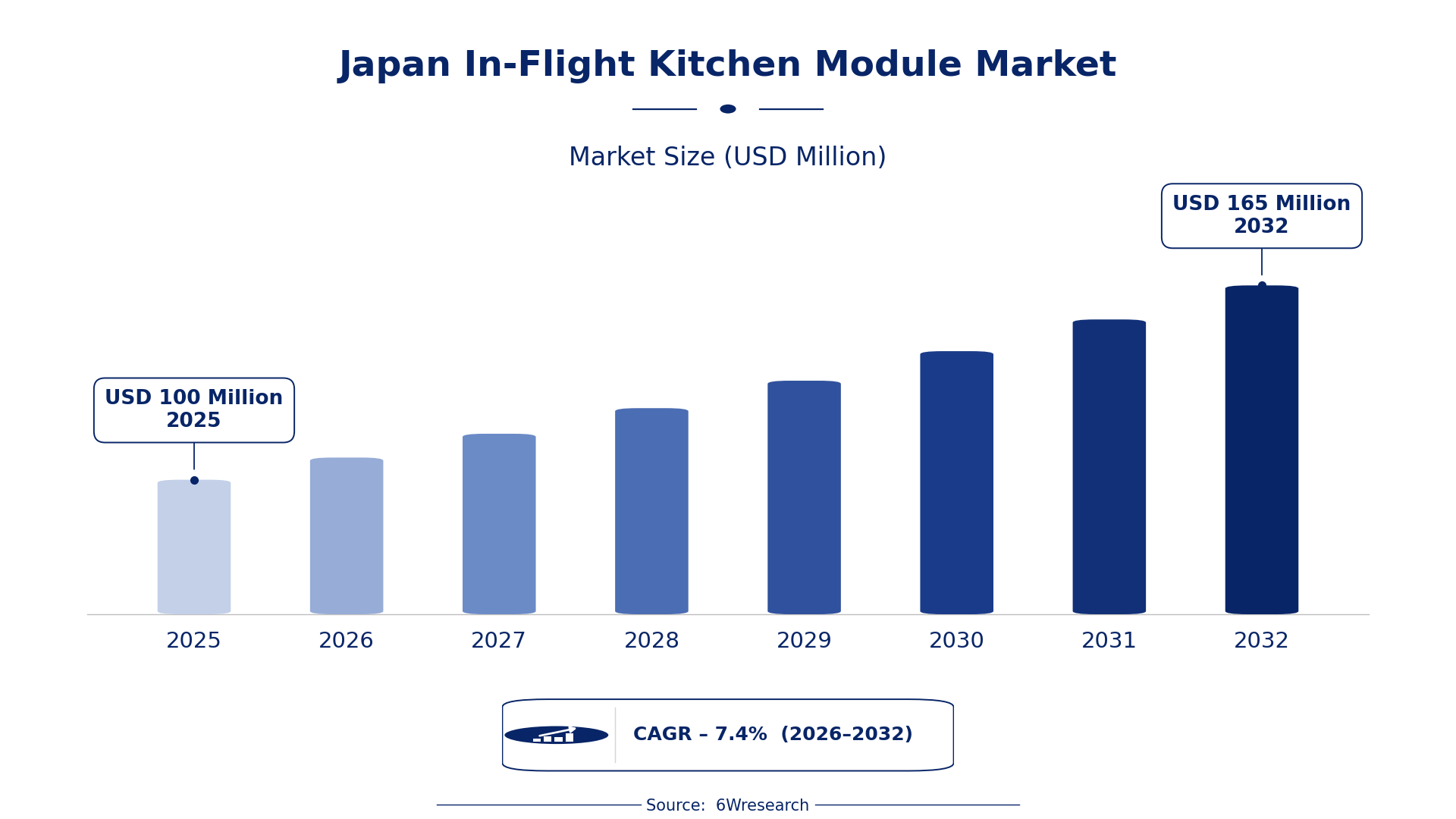
According to 6Wresearch internal database and industry insights, the Japan In-Flight Kitchen Module Market was valued at USD 100 Million in 2025 and is projected to reach USD 165 Million by 2032, growing at a CAGR of approximately 7.4% during 2026–2032.
Japan In-Flight Kitchen Module Market Highlights
| Report Metric | Details |
| Report Name | Japan In-Flight Kitchen Module Market (2026-2032) |
| Market Size 2025 | USD 100 Million |
| Market Size 2032 | USD 165 Million |
| Absolute Growth 2025–2032 | USD 65 Million |
| CAGR 2026–2032 | 7.4% |
| Peak Annual Growth | 8.5% in 2032 |
| Forecast Period | 2026–2032 |
| Historical Data | 2022–2025 |
| Base Year | 2025 |
| Leading Module Type, 2025 | Refrigeration Units (41% share) |
| Leading Material Type, 2025 | Aluminum / Composites (45% share) |
| Leading Placement Zone, 2025 | Galley Systems (48% share) |
| Leading Distribution Channel, 2025 | OEM Catering Integrators (42% share) |
| Fastest-Growing Module Type | Galley Inserts (10.5% CAGR) |
| Fastest-Growing Placement Zone | Business Class Kitchens (9.0% CAGR) |
| Fastest-Growing Distribution Channel | Galley Equipment Suppliers (9.3% CAGR) |
| Growing Sector | Airline Catering |
| Key End Users | Domestic Airlines, International Airlines, Catering Service Providers |
Japan In-Flight Kitchen Module Market Year-wise Growth Rate and Key Drivers (2022–2032)
This graph illustrates the annual growth rates of the market from 2022 to 2032, highlighting a steady upward trajectory and projected market expansion over the forecast period.
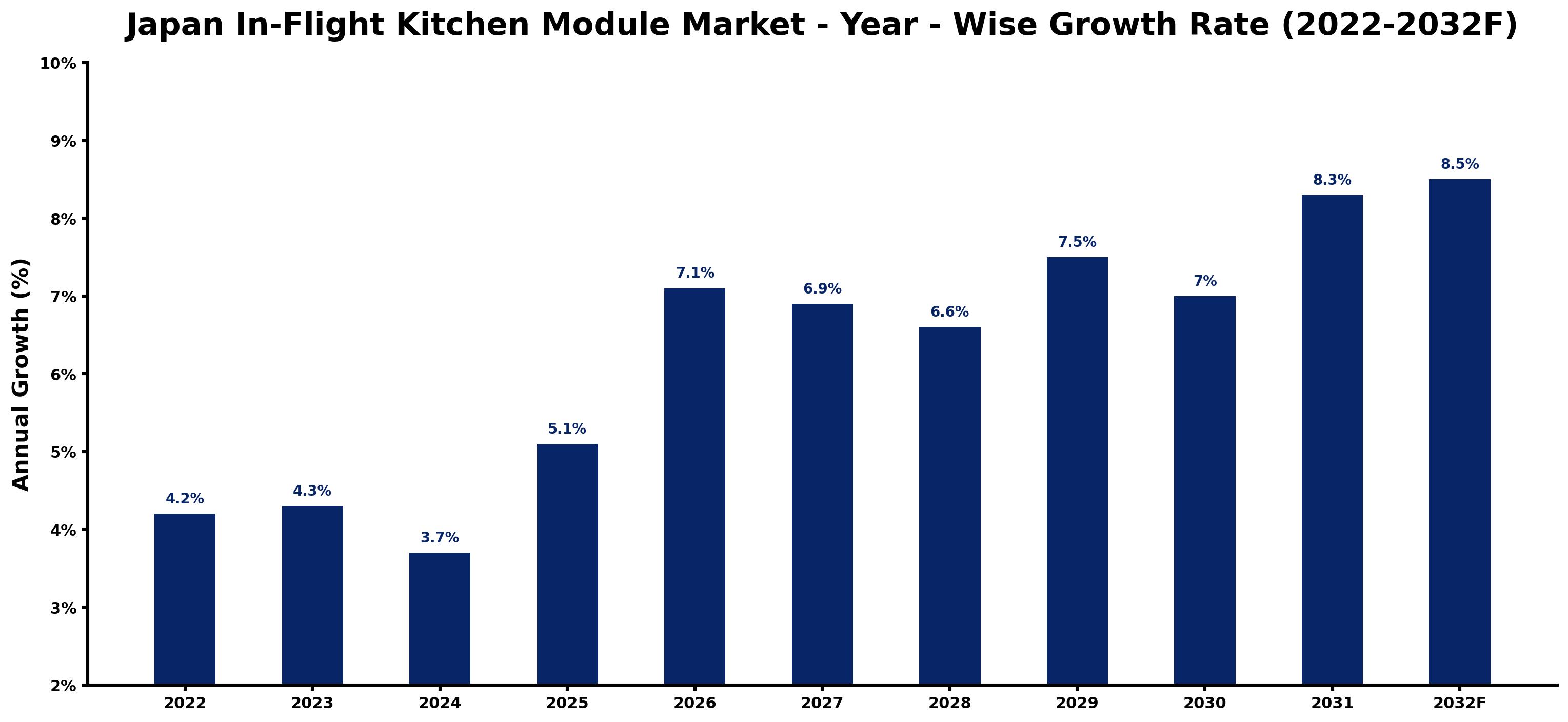
For each year, the table pairs the estimated growth rate with the leading influence on demand, showing how the drivers changed across the period.
| Year | Estimated Annual Growth (%) | Market Rationale |
| 2022 | 4.2 | The market showed steady growth, supported by ongoing airline operations and catering demands. |
| 2023 | 4.3 | Demand increased as airlines focused on improving in-flight meal offerings for passengers. |
| 2024 | 3.7 | Growth slowed slightly due to market adjustments and increased competition among service providers. |
| 2025 | 5.1 | A surge in premium meal services for business class drove faster growth in this year. |
| 2026 | 7.1 | Demand is expected to rise as airlines continue to modernise their in-flight services. |
| 2027 | 6.9 | Growth is projected to slow as the market stabilises after a period of rapid expansion. |
| 2028 | 6.6 | A further slowdown is anticipated as airlines refine their catering strategies. |
| 2029 | 7.5 | Demand is expected to pick up again as airlines invest in improved service quality. |
| 2030 | 7.0 | A slight slowdown is projected as the market adjusts to previous growth rates. |
| 2031 | 8.3 | Increased focus on high-quality meal offerings will drive growth in this year. |
| 2032 | 8.5 | The market is expected to peak as airlines improve in-flight services for passengers. |
Note: Market size estimations and growth projections presented in this report are based on 6Wresearch's proprietary forecasting methodology, utilizing the latest available industry data, government publications, and primary research inputs.
Japan In-Flight Kitchen Module Market Synopsis
In-Flight Kitchen Modules are essential equipment designed for meal preparation, storage, and heating in aircraft. Made from lightweight materials like aluminum and composites, they ensure efficiency and safety during flights. The Japan In-Flight Kitchen Module Market is expanding due to rising demand from domestic airlines and international flights, particularly as airlines focus on premium meal offerings. With a population of approximately 125 million, the need for high-quality in-flight catering is substantial, supported by government initiatives and evolving consumer preferences.
Market Dynamics Impact Analysis (2026–2032)
| Factor | Type | Impact | Primary Segment Affected |
| Increasing focus on premium meal offerings for business class | Driver | High | Galley Inserts |
| Growing demand for eco-friendly materials in kitchen modules | Driver | High | Aluminum / Composites |
| Rising need for compliance with safety standards | Opportunity | Medium | Refrigeration Units |
| Expansion of airline operations in key regions like Tokyo and Osaka | Opportunity | Medium | Galley Systems |
| Competition among catering service providers | Restraint | High | Ovens and Warmers |
| Regulatory compliance costs for kitchen module production | Restraint | High | Coffee Makers |
| Limited supply chain capacity affecting module availability | Challenge | High | Galley Equipment Suppliers |
| High costs associated with upgrading kitchen facilities | Challenge | Medium | OEM Catering Integrators |
Evaluation of Drivers in Japan In-Flight Kitchen Module Market (2026–2032)
The following drivers explain most of the expected growth.
| Drivers | Primary Segment Affected | Why It Matters (Evidence) |
| Growing demand for premium meal offerings | Galley Inserts | Airlines are investing in high-quality meal services, leading to increased purchases of kitchen modules. |
| Focus on eco-friendly materials | Aluminum / Composites | Sustainability initiatives are driving airlines to invest in environmentally friendly kitchen solutions. |
| Compliance with safety standards | Refrigeration Units | Stringent regulations require airlines to ensure food safety, boosting demand for compliant kitchen equipment. |
| Expansion of airline operations | Galley Systems | Increased flight frequencies in regions like Tokyo are driving the need for efficient kitchen modules. |
| Rising consumer expectations for in-flight services | Ovens and Warmers | Passengers demand higher quality meals, prompting airlines to upgrade their kitchen facilities. |
Purchasing is on the rise as airlines enhance their in-flight services, especially in premium meal offerings. In 2023, airlines concentrated on improving meal quality, resulting in a marked increase in demand for kitchen modules. A growing awareness of sustainability is prompting airlines to utilise eco-friendly materials, with a large share of new modules being made from aluminium and composites. The expansion of airline operations in key regions is stimulating demand for galley systems, while increasing consumer expectations for better in-flight meals are driving purchases of ovens and warmers.
Evaluation of Restraints in Japan In-Flight Kitchen Module Market
The following restraints limit how fast demand can grow.
| Market Restraint | Primary Segment Affected | Why It Matters (Evidence) |
| Intense competition among catering service providers | Ovens and Warmers | This competition pressures prices, affecting profitability for suppliers and limiting investment in new technology. |
| High regulatory compliance costs | Coffee Makers | Producers face costs to meet safety standards, impacting their pricing strategies and market entry. |
| Supply chain disruptions affecting module availability | Galley Equipment Suppliers | Delays in materials procurement hinder production timelines, impacting delivery schedules for airlines. |
| Limited access to advanced manufacturing technology | OEM Catering Integrators | Without modern technology, producers struggle to meet evolving market demands, affecting their competitiveness. |
| Rising operational costs for airlines | Refrigeration Units | Increased fuel and maintenance costs limit airlines' budgets for upgrading kitchen facilities. |
Japan In-Flight Kitchen Module Market Challenges
Stringent safety regulations from the Japanese Civil Aviation Bureau create delays for producers, as compliance can extend production timelines by up to three months. Domestic airlines are increasingly focused on premium meal offerings, compelling buyers to invest heavily in high-quality kitchen modules to meet these elevated standards. Competition among suppliers drives down prices, which can squeeze profit margins for producers and limit their capacity to invest in new technologies. The rising demand for eco-friendly materials complicates sourcing, leading to increased costs for producers and potential delays in fulfilling buyer needs.
Trends in the Japan In-Flight Kitchen Module Market
Buyers and suppliers in the Japan In-Flight Kitchen Module Market are adjusting to the following trends.
- Shift towards Eco-Friendly Materials in Kitchen Modules: Japan's airline industry is increasingly adopting eco-friendly materials for kitchen modules, driven by sustainability initiatives. In 2023, the demand for aluminium and composites rose by 30%, reflecting this shift. This trend encourages suppliers to innovate and meet the evolving preferences of airlines.
- Transition to Premium In-Flight Services: Since 2023, airlines have been moving towards premium in-flight services, improving meal quality for business class. This shift has led to a significant increase in demand for specialised kitchen modules, prompting suppliers to focus on high-quality offerings.
- Emergence of Advanced Kitchen Technologies: The introduction of smart kitchen technologies in 2024 has transformed in-flight meal preparation. Airlines are now investing in automated cooking systems, leading to a rise in demand for such modules, improving operational efficiency.
- Focus on Compliance with Safety Standards: The Japanese Civil Aviation Bureau's stringent safety standards have driven airlines to upgrade their kitchen modules since 2023. Compliance requirements have resulted in a notable increase in demand for certified kitchen equipment, ensuring passenger safety.
Investment Opportunities in the Japan In-Flight Kitchen Module Market
Several openings in the Japan In-Flight Kitchen Module Market merit attention from investors.
- Demand for Premium Meal Offerings: With airlines focusing on premium services, there is an opportunity to supply high-quality kitchen modules. In 2023, the demand for specialised galley inserts increased significantly, particularly among business class airlines in Tokyo.
- Investment in Eco-Friendly Kitchen Solutions: The demand for sustainable materials presents an opportunity to supply eco-friendly kitchen modules. Airlines in Japan are increasingly seeking aluminium and composite materials, with projected growth in this sector by 2025.
- Expansion of Airline Operations in Key Regions: As airlines expand operations in regions like Osaka, there is a need for efficient kitchen systems. This presents an opportunity for suppliers to provide integrated solutions that meet the growing demand for in-flight catering.
- Enhancement of In-Flight Services Post-Pandemic: The recovery of the airline industry is driving investments in kitchen upgrades. Airlines are expected to invest significantly in modern kitchen modules, with a projected increase in procurement by 2025.
Government Initiatives in the Japan In-Flight Kitchen Module Market
The Food Recycling Law, enacted in 2000, mandates food businesses to reduce waste and recycle it into feed and fertiliser. This law impacts kitchen module producers by requiring them to adopt sustainable practices in their operations. The Chemical Substances Control Law, established in 1973, requires evaluation and control of chemical substances used in kitchen equipment, ensuring safety and compliance for manufacturers.
The PRTR Law encourages airlines to ensure that their kitchen modules comply with safety standards. The Ministry of Land, Infrastructure, Transport and Tourism oversees these regulations, promoting high-quality in-flight catering services.
Future Insight of the Japan In-Flight Kitchen Module Market
The launch of new in-flight kitchen facilities will reshape the market by 2032, as airlines prioritise enhanced service quality. Airlines will adopt advanced technologies to optimise meal preparation and delivery processes. By 2025, the recovery of the Japanese airline industry will necessitate a 30% increase in kitchen module demand, highlighting the urgency for upgraded equipment. Government initiatives aimed at elevating in-flight services will set higher standards for meal offerings, encouraging suppliers to adapt their products accordingly.
Market Segmentation Analysis
Japan In-Flight Kitchen Module Market report covers a detailed analysis of the following market segments:
By Module Type – Refrigeration Units Lead, Galley Inserts Expected to Grow Fastest
According to Saurav Kr Singh, Senior Research Analyst at 6Wresearch, with 41% of module type revenue in 2025, Refrigeration Units was the largest category. Refrigeration Units dominate the market because they are essential for maintaining food safety during flights. Their importance is underscored by compliance with the rigorous safety standards set by the Japanese Civil Aviation Bureau, which airlines must adhere to for quality service. The quickest growth will come from Galley Inserts, forecast to expand at a CAGR of 10.5% between 2026 and 2032. Galley Inserts are experiencing rapid growth as airlines focus on enhancing premium meal offerings for business class. This trend reflects the increasing demand for efficient meal storage and preparation, particularly in high-end services that elevate passenger satisfaction. Suppliers should prioritise the development of advanced refrigeration technologies to meet the specific needs of the airline industry.
By Material Type – Aluminum / Composites Lead and Record the Fastest Growth
In 2025, Aluminum / Composites led the material type split with a 45% share. Aluminum / Composites dominate the market because of their lightweight and durable characteristics, which are essential for aviation applications. This material type is vital for ensuring both efficiency and safety in in-flight kitchen modules, catering to the industry's stringent requirements. Aluminum / Composites are also forecast to expand faster than any other category, at a CAGR of 8.5% over 2026–2032. The growth of Aluminum / Composites will continue as the demand for eco-friendly materials in kitchen modules rises. Government initiatives promoting sustainability are increasingly influencing material choices within the industry. Buyers should prioritise suppliers who can offer high-quality, sustainable materials to comply with industry standards and preferences.
By Placement Zone – Galley Systems Lead, Business Class Kitchens Expected to Grow Fastest
Galley Systems held 48% of the Japan In-Flight Kitchen Module Market by placement zone in 2025. Galley Systems are the leading segment due to their crucial role in ensuring the overall functionality of in-flight kitchens. Their design encompasses essential cooking and storage capabilities, which are vital for providing efficient meal service during flights. Business Class Kitchens are projected to grow fastest, at a CAGR of 9.0% during 2026–2032. Business Class Kitchens are growing swiftly as airlines strive to improve service quality in premium seating areas. This expansion is driven by the emphasis on providing a superior dining experience, which is increasingly valued by discerning passengers. Suppliers ought to focus on creating specialised solutions that address the unique requirements of business class kitchens.
By Distribution Channel – OEM Catering Integrators Lead, Galley Equipment Suppliers Expected to Grow Fastest
The largest distribution channel category in 2025 was OEM Catering Integrators, at 42% of revenue. OEM Catering Integrators lead the distribution channel as they provide customised kitchen solutions that meet airline specifications. Their role in facilitating tailored equipment ensures compliance with safety and operational standards. Over 2026–2032, Galley Equipment Suppliers are expected to post the fastest growth, at a CAGR of 9.3%. Galley Equipment Suppliers are experiencing fast growth as they serve as the primary source for kitchen module procurement. The increasing demand for efficient and reliable kitchen equipment fuels this segment's expansion. Buyers should establish strong relationships with galley equipment suppliers to ensure access to the latest kitchen technologies.
Key Attractiveness of the Report
- 10 Years of Market Numbers
- Historical Data Starting from 2022 to 2025
- Base Year 2025
- Forecast Data until 2032
- Key Performance Indicators Impacting the Market
- Major Upcoming Developments and Projects
Key Highlights of the Report:
- Japan In-Flight Kitchen Module Market Outlook
- Market Size of Japan In-Flight Kitchen Module Market, 2025
- Forecast of Japan In-Flight Kitchen Module Market, 2032
- Historical Data and Forecast of Japan In-Flight Kitchen Module Revenues & Volume for the Period 2022-2032F
- Japan In-Flight Kitchen Module Market Trend Evolution
- Japan In-Flight Kitchen Module Market Drivers and Challenges
- Japan In-Flight Kitchen Module Price Trends
- Japan In-Flight Kitchen Module Porter's Five Forces
- Japan In-Flight Kitchen Module Industry Life Cycle
- Historical Data and Forecast of Japan In-Flight Kitchen Module Market Revenues & Volume By Module Type for the Period 2022-2032F
- Historical Data and Forecast of Japan In-Flight Kitchen Module Market Revenues & Volume By Galley Inserts for the Period 2022-2032F
- Historical Data and Forecast of Japan In-Flight Kitchen Module Market Revenues & Volume By Refrigeration Units for the Period 2022-2032F
- Historical Data and Forecast of Japan In-Flight Kitchen Module Market Revenues & Volume By Ovens and Warmers for the Period 2022-2032F
- Historical Data and Forecast of Japan In-Flight Kitchen Module Market Revenues & Volume By Coffee Makers for the Period 2022-2032F
- Historical Data and Forecast of Japan In-Flight Kitchen Module Market Revenues & Volume By Material Type for the Period 2022-2032F
- Historical Data and Forecast of Japan In-Flight Kitchen Module Market Revenues & Volume By Aluminum / Composites for the Period 2022-2032F
- Historical Data and Forecast of Japan In-Flight Kitchen Module Market Revenues & Volume By Steel / Composite for the Period 2022-2032F
- Historical Data and Forecast of Japan In-Flight Kitchen Module Market Revenues & Volume By Electric / Convection for the Period 2022-2032F
- Historical Data and Forecast of Japan In-Flight Kitchen Module Market Revenues & Volume By Modular Units for the Period 2022-2032F
- Historical Data and Forecast of Japan In-Flight Kitchen Module Market Revenues & Volume By Placement Zone for the Period 2022-2032F
- Historical Data and Forecast of Japan In-Flight Kitchen Module Market Revenues & Volume By Aft / Front Section for the Period 2022-2032F
- Historical Data and Forecast of Japan In-Flight Kitchen Module Market Revenues & Volume By Galley Systems for the Period 2022-2032F
- Historical Data and Forecast of Japan In-Flight Kitchen Module Market Revenues & Volume By Business Class Kitchens for the Period 2022-2032F
- Historical Data and Forecast of Japan In-Flight Kitchen Module Market Revenues & Volume By Beverage Service for the Period 2022-2032F
- Historical Data and Forecast of Japan In-Flight Kitchen Module Market Revenues & Volume By Distribution Channel for the Period 2022-2032F
- Historical Data and Forecast of Japan In-Flight Kitchen Module Market Revenues & Volume By Galley Equipment Suppliers for the Period 2022-2032F
- Historical Data and Forecast of Japan In-Flight Kitchen Module Market Revenues & Volume By OEM Catering Integrators for the Period 2022-2032F
- Historical Data and Forecast of Japan In-Flight Kitchen Module Market Revenues & Volume By Airline Catering OEMs for the Period 2022-2032F
- Historical Data and Forecast of Japan In-Flight Kitchen Module Market Revenues & Volume By Avionics Retail Chains for the Period 2022-2032F
- Japan In-Flight Kitchen Module Import Export Trade Statistics
- Market Opportunity Assessment By Module Type
- Market Opportunity Assessment By Material Type
- Market Opportunity Assessment By Placement Zone
- Market Opportunity Assessment By Distribution Channel
- Japan In-Flight Kitchen Module Top Companies Market Share
- Japan In-Flight Kitchen Module Competitive Benchmarking By Technical and Operational Parameters
- Japan In-Flight Kitchen Module Company Profiles
- Japan In-Flight Kitchen Module Key Strategic Recommendations
Market Covered
This report examines the market across the segments below.
By Module Type
- Galley Inserts
- Refrigeration Units
- Ovens and Warmers
- Coffee Makers
By Material Type
- Aluminum / Composites
- Steel / Composite
- Electric / Convection
- Modular Units
By Placement Zone
- Aft / Front Section
- Galley Systems
- Business Class Kitchens
- Beverage Service
By Distribution Channel
- Galley Equipment Suppliers
- OEM Catering Integrators
- Airline Catering OEMs
- Avionics Retail Chains































