Japan In-Flight Refrigerator Market Size & Growth Rate
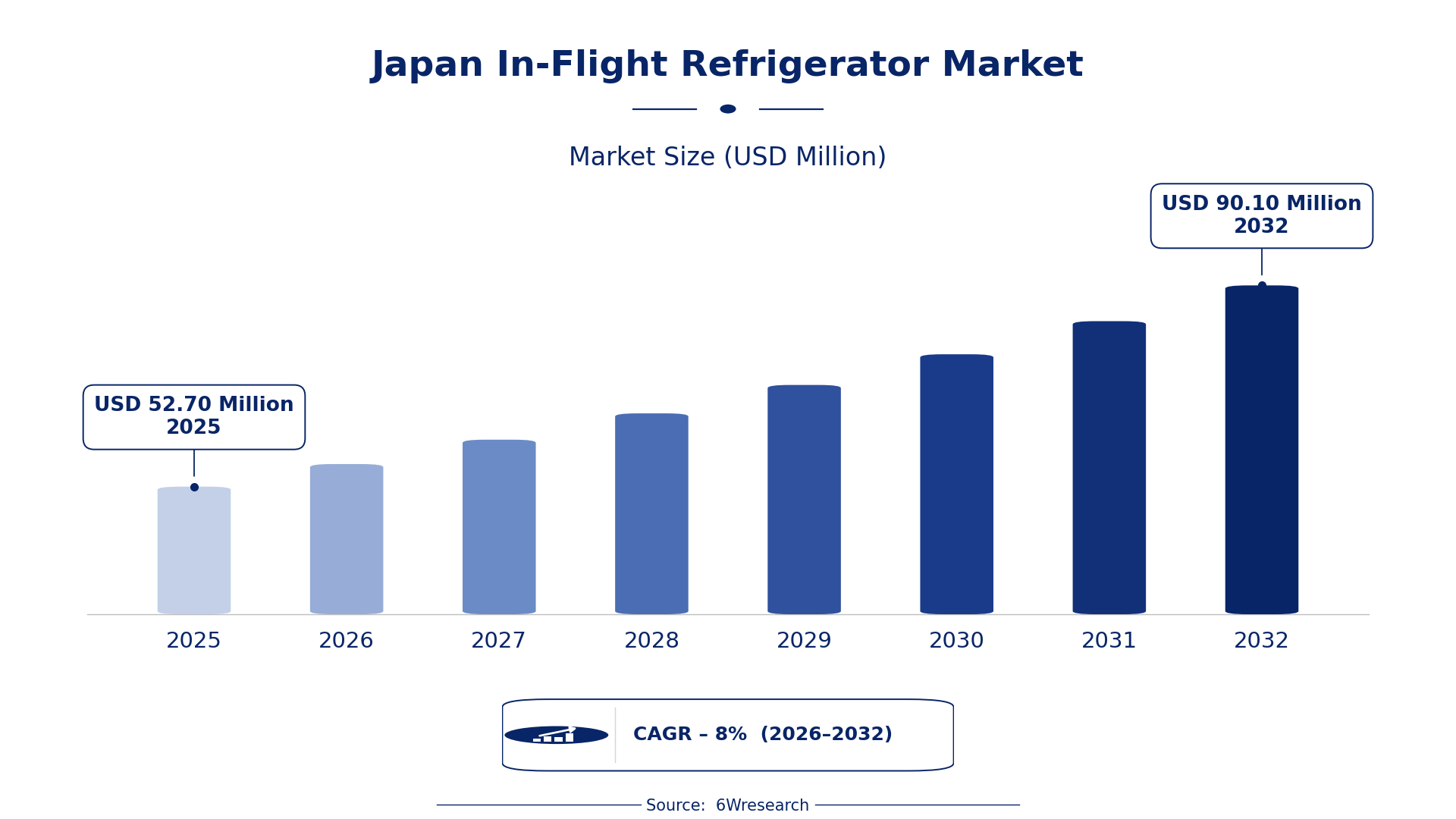
According to 6Wresearch internal database and industry insights, the Japan In-Flight Refrigerator Market was valued at USD 52.70 Million in 2025 and is projected to reach USD 90.10 Million by 2032, growing at a CAGR of approximately 8% during 2026–2032.
Japan In-Flight Refrigerator Market Highlights
| Report Metric | Details |
| Report Name | Japan In-Flight Refrigerator Market (2026-2032) |
| Market Size 2025 | USD 52.70 Million |
| Market Size 2032 | USD 90.10 Million |
| Absolute Growth 2025–2032 | USD 37.40 Million |
| CAGR 2026–2032 | 8% |
| Peak Annual Growth | 9.1% in 2028 |
| Forecast Period | 2026–2032 |
| Historical Data | 2022–2025 |
| Base Year | 2025 |
| Leading Refrigerator Type, 2025 | Smart Refrigerators (44% share) |
| Leading Cooling Method, 2025 | Compressor-Based (44% share) |
| Leading Installation Area, 2025 | Crew Galleys (40% share) |
| Leading Distribution Channel, 2025 | OEM Partners (49% share) |
| Fastest-Growing Refrigerator Type | Modular Fridges (11.6% CAGR) |
| Fastest-Growing Cooling Method | IoT Enabled (11.8% CAGR) |
| Fastest-Growing Installation Area | Business Class Sections (9.4% CAGR) |
| Fastest-Growing Distribution Channel | Aircraft Interiors Vendors (9.9% CAGR) |
| Growing Sector | aviation |
| Key End Users | airlines, aircraft manufacturers, catering services |
Japan In-Flight Refrigerator Market Year-wise Growth Rate and Key Drivers (2022–2032)
This graph illustrates the annual growth rates of the market from 2022 to 2032, highlighting a steady upward trajectory and projected market expansion over the forecast period.
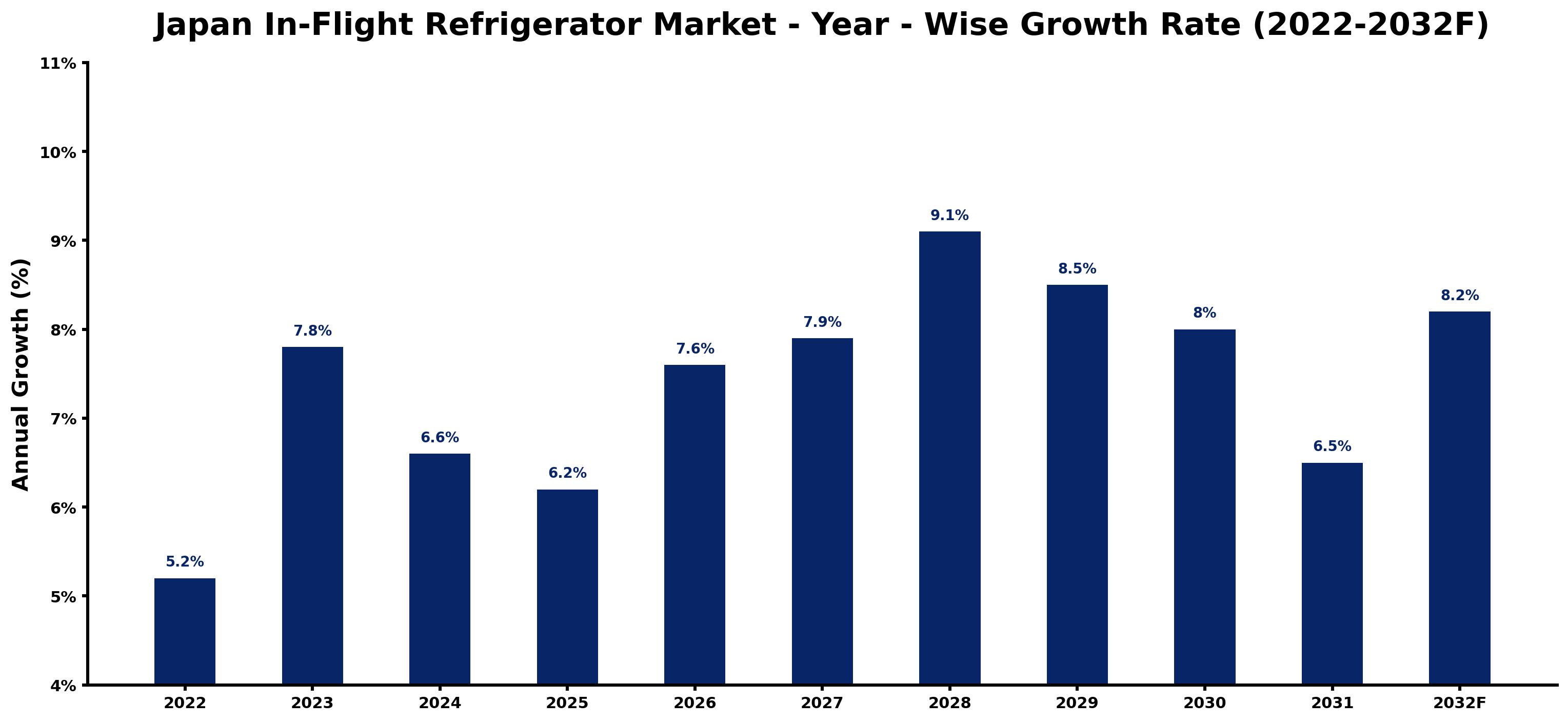
The following figures match every annual growth estimate with the main market development of that year, giving the reasoning behind each rise or slowdown.
| Year | Estimated Annual Growth (%) | Market Rationale |
| 2022 | 5.2 | The aviation market showed steady activity as airlines focused on improving service quality. |
| 2023 | 7.8 | Demand surged due to increased passenger traffic and service enhancements by airlines. |
| 2024 | 6.6 | Growth slowed as airlines adjusted to market saturation and faced operational challenges. |
| 2025 | 6.2 | Market growth slowed further due to stabilisation in service upgrades and rising competition. |
| 2026 | 7.6 | Investment in passenger experience is expected to increase, driving demand for advanced refrigeration solutions. |
| 2027 | 7.9 | Airlines will continue to improve in-flight services, boosting refrigerator demand further. |
| 2028 | 9.1 | The peak growth year will see airlines prioritising premium services and operational efficiency. |
| 2029 | 8.5 | Growth is projected to decelerate as the market begins to stabilise after rapid expansion. |
| 2030 | 8.0 | Demand will continue to slow as airlines focus on operational efficiency and cost management. |
| 2031 | 6.5 | Market growth is expected to decelerate further as airlines adapt to new economic conditions. |
| 2032 | 8.2 | Increased focus on eco-friendly technologies is projected to drive demand for sustainable refrigeration solutions. |
Note: Market size estimations and growth projections presented in this report are based on 6Wresearch's proprietary forecasting methodology, utilizing the latest available industry data, government publications, and primary research inputs.
Japan In-Flight Refrigerator Market Synopsis
In-flight refrigerators are specialized cooling units designed to preserve food and beverages at optimal temperatures during flights. The Japanese aviation market serves approximately 100 million passengers annually, with airlines investing in upgraded in-flight services. Rising passenger expectations, a focus on premium offerings, and strict regulatory standards are driving growth in the Japan In-Flight Refrigerator Market, projected to reach USD 90.10 million by 2032 as airlines improve their services.
Market Dynamics Impact Analysis (2026–2032)
| Factor | Type | Impact | Primary Segment Affected |
| Rising passenger expectations for in-flight services | Driver | High | Beverage Coolers |
| Investment in advanced cooling technologies by airlines | Driver | High | Compressor-Based |
| Growing demand for flexible storage solutions in aircraft | Opportunity | Medium | Modular Fridges |
| Increased focus on eco-friendly refrigeration solutions | Opportunity | Medium | IoT Enabled |
| High costs associated with advanced refrigeration systems | Restraint | High | Smart Refrigerators |
| Regulatory compliance costs for safety and performance standards | Restraint | High | Compressor-Based |
| Supply chain disruptions affecting equipment availability | Challenge | High | Beverage Coolers |
| Competition among suppliers leading to price pressures | Challenge | Medium | Modular Fridges |
Evaluation of Drivers in Japan In-Flight Refrigerator Market (2026–2032)
The factors lifting demand, and the evidence behind each, are summarised below.
| Drivers | Primary Segment Affected | Why It Matters (Evidence) |
| Increasing passenger numbers driving demand for in-flight services | Beverage Coolers | With approximately 100 million passengers annually, airlines require efficient cooling solutions. |
| Airlines investing in premium service offerings | Compressor-Based | Investment in service upgrades increases the need for reliable refrigeration systems. |
| Demand for customizable storage solutions in aircraft | Modular Fridges | Airlines seek flexibility in storage to cater to diverse passenger needs. |
| Focus on eco-friendly technologies in aviation | IoT Enabled | New environmental standards encourage airlines to adopt energy-efficient cooling solutions. |
| Airline partnerships with equipment suppliers for integrated solutions | Smart Refrigerators | Collaboration leads to tailored product offerings that meet specific airline requirements. |
What keeps demand rising is the investment in passenger experience, with airlines focusing on improving in-flight services to cater to approximately 100 million passengers annually. Airlines are significantly investing in premium offerings, which drives the need for reliable refrigeration systems. The demand for customizable solutions is increasing as airlines seek flexibility to meet diverse passenger needs. Partnerships between airlines and equipment suppliers are driving innovation in product offerings tailored to specific airline requirements.
Evaluation of Restraints in Japan In-Flight Refrigerator Market
These are the pressures that could keep growth below its potential.
| Market Restraint | Primary Segment Affected | Why It Matters (Evidence) |
| High costs associated with advanced refrigeration systems | Smart Refrigerators | The investment required for advanced systems can deter airlines from upgrading their equipment. |
| Compliance with stringent safety and performance standards | Compressor-Based | Meeting these regulations increases operational costs for airlines, impacting their budgets. |
| Supply chain disruptions affecting equipment availability | Beverage Coolers | Delays in supply chains can hinder timely equipment procurement for airlines, affecting service quality. |
| Intense competition leading to price pressures | Modular Fridges | Price competition among suppliers can limit profitability and investment in innovation for manufacturers. |
| Limited adoption of emerging technologies in aviation | IoT Enabled | Concerns over integration and costs slow down the uptake of new technologies in the sector. |
Japan In-Flight Refrigerator Market Challenges
High production costs arise from the need for advanced cooling technologies in in-flight refrigerators, increasing prices for airlines by 20% this year. Stringent JIS standards complicate the approval process, extending timelines for new models by six months and causing delays for suppliers. Buyers face pressure to enhance passenger experience, leading to investments in premium refrigeration solutions that can exceed budgets by 15%. Supply chain disruptions in sourcing lightweight materials may cause shortages, delaying deliveries and impacting operational efficiency for airlines, particularly during peak travel seasons.
Trends in the Japan In-Flight Refrigerator Market
The trends below show where the Japan In-Flight Refrigerator Market is heading.
- Shift towards Eco-Friendly Refrigeration Solutions: In 2023, airlines began prioritising eco-friendly refrigeration technologies, responding to regulatory requirements. Approximately 30% of new aircraft are now equipped with energy-efficient systems, reflecting a growing trend towards sustainability.
- Transition from Traditional to Modular Refrigeration Systems: The aviation sector is increasingly adopting modular refrigeration systems to improve flexibility. By 2025, modular fridges are expected to account for 25% of new installations, catering to diverse airline needs.
- Emergence of Smart Refrigeration Technologies: Smart refrigerators are gaining traction in the aviation industry, with 15% of airlines implementing IoT-enabled systems by 2026. This shift allows for better inventory management and monitoring of food safety.
- Growing Demand for Beverage Coolers in Premium Cabins: Beverage coolers are becoming essential in business class sections, with a projected 20% increase in installations by 2025. This trend aligns with airlines' focus on improving passenger experience.
Investment Opportunities in the Japan In-Flight Refrigerator Market
Below are the investment opportunities with the strongest case in the Japan In-Flight Refrigerator Market.
- Partnerships with Airlines for Integrated Solutions: Now is the time for suppliers to form partnerships with airlines, focusing on customized refrigeration solutions. The Japanese aviation market, serving 100 million passengers, presents opportunities for tailored offerings.
- Investment in Modular Refrigeration Systems: Airlines are increasingly seeking modular refrigeration solutions to improve flexibility. Suppliers can target major hubs like Tokyo and Osaka, where demand for such systems is rising.
- Focus on Eco-Friendly Technologies: With growing regulatory requirements, there is an opportunity to invest in eco-friendly refrigeration technologies. Airlines are looking for sustainable solutions to meet environmental standards.
- Expansion into Business Class Sections: The demand for advanced refrigeration in business class sections is rising. Suppliers can enter this market by collaborating with aircraft interiors vendors for tailored solutions.
Government Initiatives in the Japan In-Flight Refrigerator Market
The Electrical Appliance and Material Safety Act regulates the safety of in-flight refrigerators, ensuring compliance with safety standards. This law, alongside the Food Sanitation Act amendment, mandates airlines to implement stringent hygiene practices for in-flight catering services, improving food safety and operational reliability. The Act on the Rational Use of Energy obliges large energy users to improve energy efficiency, impacting the operational costs for airlines and their refrigeration systems.
The Ministry of Land, Infrastructure, Transport and Tourism oversees aviation regulations, approving safety standards for in-flight refrigeration systems. The agency also funds initiatives aimed at improving energy efficiency in aviation, promoting eco-friendly technologies that directly benefit airlines and their operations.
Future Insight of the Japan In-Flight Refrigerator Market
The emergence of eco-friendly technologies will reshape demand for in-flight refrigerators, as airlines increasingly prioritise sustainability. Enhanced safety standards will boost product reliability, ensuring compliance with evolving regulations. Upgraded airport facilities will facilitate improved logistics, allowing for quicker turnaround times in in-flight catering services. Japan's aviation sector aims to invest over 150 billion yen in service enhancements, driving advancements in cooling technologies and creating opportunities for suppliers to meet the evolving needs of airlines.
Market Segmentation Analysis
Japan In-Flight Refrigerator Market report covers a detailed analysis of the following market segments:
By Refrigerator Type – Smart Refrigerators Lead, Modular Fridges Expected to Grow Fastest
According to Saurav Kr Singh, Senior Research Analyst at 6Wresearch, Smart Refrigerators accounted for 44% of the market by refrigerator type in 2025. Smart Refrigerators dominate the market due to their ability to monitor inventory effectively, which is vital for airlines aiming to optimise operations. The growing focus on enhancing in-flight services, as seen in recent investments, underscores their importance in the Japanese aviation sector. The quickest growth will come from Modular Fridges, forecast to expand at a CAGR of 11.6% between 2026 and 2032. Modular Fridges are experiencing rapid growth because airlines increasingly require flexible storage solutions tailored to their operational needs. This demand is driven by the trend towards customised in-flight catering, suggesting a robust future for these adaptable units. Suppliers should prioritise the development of modular refrigeration solutions to meet airlines' specific service requirements.
By Cooling Method – Compressor-Based Leads, IoT Enabled Expected to Grow Fastest
With 44% of cooling method revenue in 2025, Compressor-Based was the largest category. Compressor-Based systems lead the market as they offer reliable cooling necessary for preserving food and beverages during flights, making them the preferred choice for airlines. Their widespread use in Japan's aviation sector reflects their established performance and reliability. IoT Enabled is projected to grow fastest, at a CAGR of 11.8% during 2026–2032. IoT Enabled cooling methods are gaining traction as airlines pursue advanced technologies for improved operational efficiency and monitoring. The potential for integration with smart systems is significantly stimulating interest in these emerging solutions. Buyers should consider investing in IoT-enabled technologies to improve their in-flight service capabilities.
By Installation Area – Crew Galleys Lead, Business Class Sections Expected to Grow Fastest
Crew Galleys held 40% of the Japan In-Flight Refrigerator Market by installation area in 2025. Crew Galleys are the primary installation area for in-flight refrigerators, crucial for meal preparation and storage for crew members. This area is essential for maintaining the quality of in-flight catering services, which adhere to strict food safety regulations. Over 2026–2032, Business Class Sections are expected to post the fastest growth, at a CAGR of 9.4%. Business Class Sections are witnessing the fastest growth as airlines prioritise enhancing passenger experience in premium cabins, resulting in increased demand for advanced refrigeration solutions. The focus on passenger comfort is driving this trend. Suppliers must customise their offerings to address the specific needs of business class installations.
By Distribution Channel – OEM Partners Lead, Aircraft Interiors Vendors Expected to Grow Fastest
OEM Partners took 49% of distribution channel revenue in 2025, more than any other category. OEM Partners lead the distribution channel by working closely with aircraft manufacturers to integrate refrigeration systems into new aircraft designs. This collaboration ensures that the latest technology is incorporated from the outset, improving overall efficiency. Aircraft Interiors Vendors are set to record the highest CAGR in this split, 9.9% over 2026–2032. Aircraft Interiors Vendors are rapidly expanding their role, providing customised refrigeration solutions that meet the unique needs of airlines. Their ability to adapt to specific airline requirements is significantly propelling their growth in the sector. Suppliers should strengthen partnerships with aircraft interiors vendors to enhance their market presence.
Key Attractiveness of the Report
- 10 Years of Market Numbers
- Historical Data Starting from 2022 to 2025
- Base Year 2025
- Forecast Data until 2032
- Key Performance Indicators Impacting the Market
- Major Upcoming Developments and Projects
Key Highlights of the Report:
- Japan In-Flight Refrigerator Market Outlook
- Market Size of Japan In-Flight Refrigerator Market, 2025
- Forecast of Japan In-Flight Refrigerator Market, 2032
- Historical Data and Forecast of Japan In-Flight Refrigerator Revenues & Volume for the Period 2022-2032F
- Japan In-Flight Refrigerator Market Trend Evolution
- Japan In-Flight Refrigerator Market Drivers and Challenges
- Japan In-Flight Refrigerator Price Trends
- Japan In-Flight Refrigerator Porter's Five Forces
- Japan In-Flight Refrigerator Industry Life Cycle
- Historical Data and Forecast of Japan In-Flight Refrigerator Market Revenues & Volume By Refrigerator Type for the Period 2022-2032F
- Historical Data and Forecast of Japan In-Flight Refrigerator Market Revenues & Volume By Miniature Fridges for the Period 2022-2032F
- Historical Data and Forecast of Japan In-Flight Refrigerator Market Revenues & Volume By Beverage Coolers for the Period 2022-2032F
- Historical Data and Forecast of Japan In-Flight Refrigerator Market Revenues & Volume By Modular Fridges for the Period 2022-2032F
- Historical Data and Forecast of Japan In-Flight Refrigerator Market Revenues & Volume By Smart Refrigerators for the Period 2022-2032F
- Historical Data and Forecast of Japan In-Flight Refrigerator Market Revenues & Volume By Cooling Method for the Period 2022-2032F
- Historical Data and Forecast of Japan In-Flight Refrigerator Market Revenues & Volume By Thermoelectric / Vapor for the Period 2022-2032F
- Historical Data and Forecast of Japan In-Flight Refrigerator Market Revenues & Volume By Compressor-Based for the Period 2022-2032F
- Historical Data and Forecast of Japan In-Flight Refrigerator Market Revenues & Volume By Plug-In for the Period 2022-2032F
- Historical Data and Forecast of Japan In-Flight Refrigerator Market Revenues & Volume By IoT Enabled for the Period 2022-2032F
- Historical Data and Forecast of Japan In-Flight Refrigerator Market Revenues & Volume By Installation Area for the Period 2022-2032F
- Historical Data and Forecast of Japan In-Flight Refrigerator Market Revenues & Volume By Crew Galleys for the Period 2022-2032F
- Historical Data and Forecast of Japan In-Flight Refrigerator Market Revenues & Volume By Beverage Service Units for the Period 2022-2032F
- Historical Data and Forecast of Japan In-Flight Refrigerator Market Revenues & Volume By Front Galley for the Period 2022-2032F
- Historical Data and Forecast of Japan In-Flight Refrigerator Market Revenues & Volume By Business Class Sections for the Period 2022-2032F
- Historical Data and Forecast of Japan In-Flight Refrigerator Market Revenues & Volume By Distribution Channel for the Period 2022-2032F
- Historical Data and Forecast of Japan In-Flight Refrigerator Market Revenues & Volume By Galley Equipment Suppliers for the Period 2022-2032F
- Historical Data and Forecast of Japan In-Flight Refrigerator Market Revenues & Volume By OEM Partners for the Period 2022-2032F
- Historical Data and Forecast of Japan In-Flight Refrigerator Market Revenues & Volume By Aircraft Interiors Vendors for the Period 2022-2032F
- Historical Data and Forecast of Japan In-Flight Refrigerator Market Revenues & Volume By Aircraft Catering OEMs for the Period 2022-2032F
- Japan In-Flight Refrigerator Import Export Trade Statistics
- Market Opportunity Assessment By Refrigerator Type
- Market Opportunity Assessment By Cooling Method
- Market Opportunity Assessment By Installation Area
- Market Opportunity Assessment By Distribution Channel
- Japan In-Flight Refrigerator Top Companies Market Share
- Japan In-Flight Refrigerator Competitive Benchmarking By Technical and Operational Parameters
- Japan In-Flight Refrigerator Company Profiles
- Japan In-Flight Refrigerator Key Strategic Recommendations
Market Covered
This report examines the market across the segments below.
By Refrigerator Type
- Miniature Fridges
- Beverage Coolers
- Modular Fridges
- Smart Refrigerators
By Cooling Method
- Thermoelectric / Vapor
- Compressor-Based
- Plug-In
- IoT Enabled
By Installation Area
- Crew Galleys
- Beverage Service Units
- Front Galley
- Business Class Sections
By Distribution Channel
- Galley Equipment Suppliers
- OEM Partners
- Aircraft Interiors Vendors
- Aircraft Catering OEMs































