Japan In-Flight Refueling Boom Market Size & Growth Rate
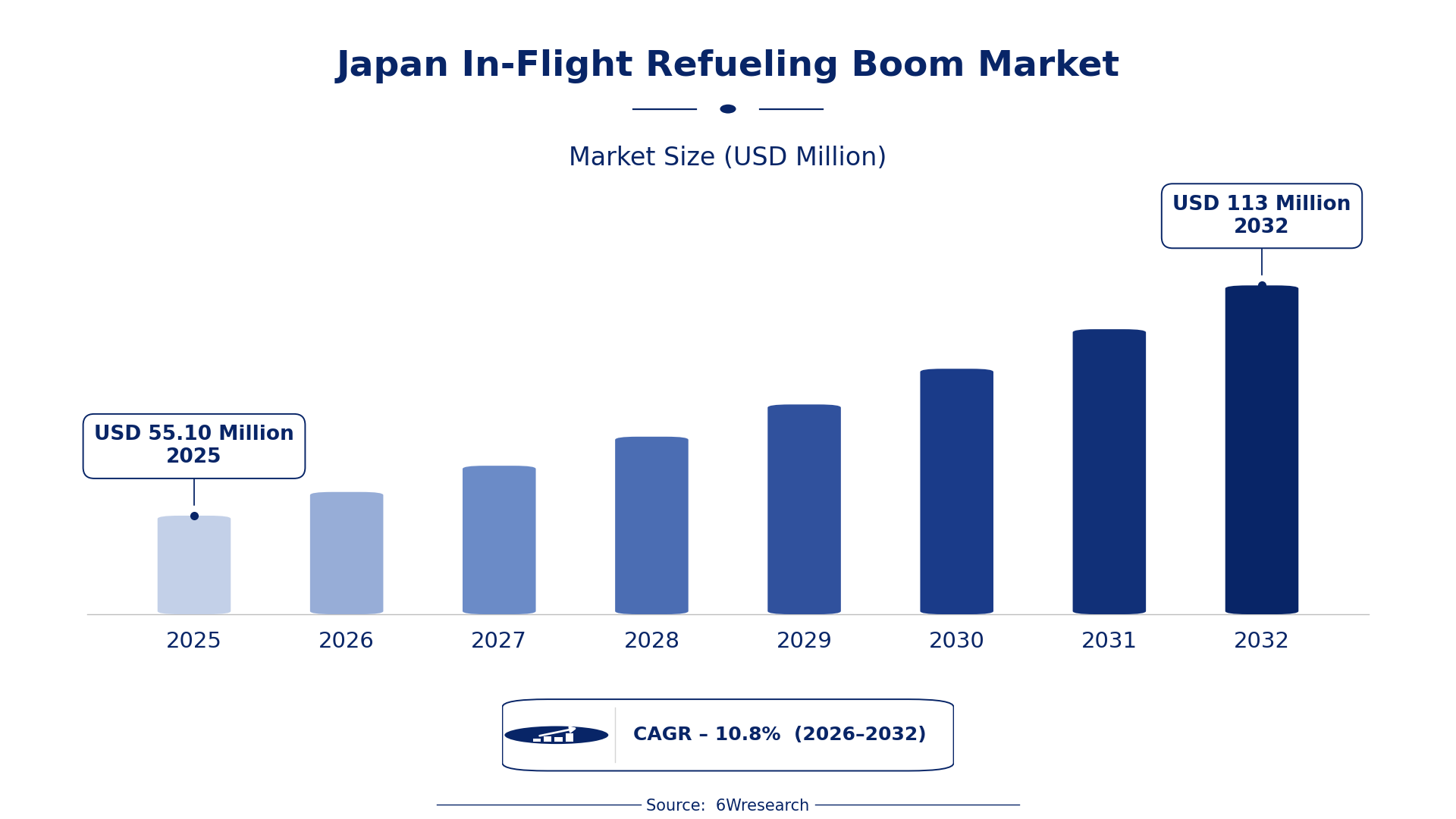
According to 6Wresearch internal database and industry insights, the Japan In-Flight Refueling Boom Market was valued at USD 55.10 Million in 2025 and is projected to reach USD 113 Million by 2032, growing at a CAGR of approximately 10.8% during 2026–2032.
Japan In-Flight Refueling Boom Market Highlights
| Report Metric | Details |
| Report Name | Japan In-Flight Refueling Boom Market (2026-2032) |
| Market Size 2025 | USD 55.10 Million |
| Market Size 2032 | USD 113 Million |
| Absolute Growth 2025–2032 | USD 57.90 Million |
| CAGR 2026–2032 | 10.8% |
| Peak Annual Growth | 12.5% in 2032 |
| Forecast Period | 2026–2032 |
| Historical Data | 2022–2025 |
| Base Year | 2025 |
| Leading Boom Type, 2025 | Rigid Boom (51% share) |
| Leading Aircraft Compatibility, 2025 | Tanker Aircraft (41% share) |
| Leading Mechanism Type, 2025 | Telescopic + Hydraulic (38% share) |
| Leading Distribution Channel, 2025 | Defense Aircraft Suppliers (46% share) |
| Fastest-Growing Boom Type | Probe-and-Drogue (15.1% CAGR) |
| Fastest-Growing Aircraft Compatibility | Helicopters / Jets (15.5% CAGR) |
| Fastest-Growing Mechanism Type | Flexible Fuel Transfer (15.6% CAGR) |
| Fastest-Growing Distribution Channel | Military OEMs (13.5% CAGR) |
| Growing Sector | military operations |
| Key End Users | military, defense contractors, government agencies |
Japan In-Flight Refueling Boom Market Year-wise Growth Rate and Key Drivers (2022–2032)
This graph illustrates the annual growth rates of the market from 2022 to 2032, highlighting a steady upward trajectory and projected market expansion over the forecast period.
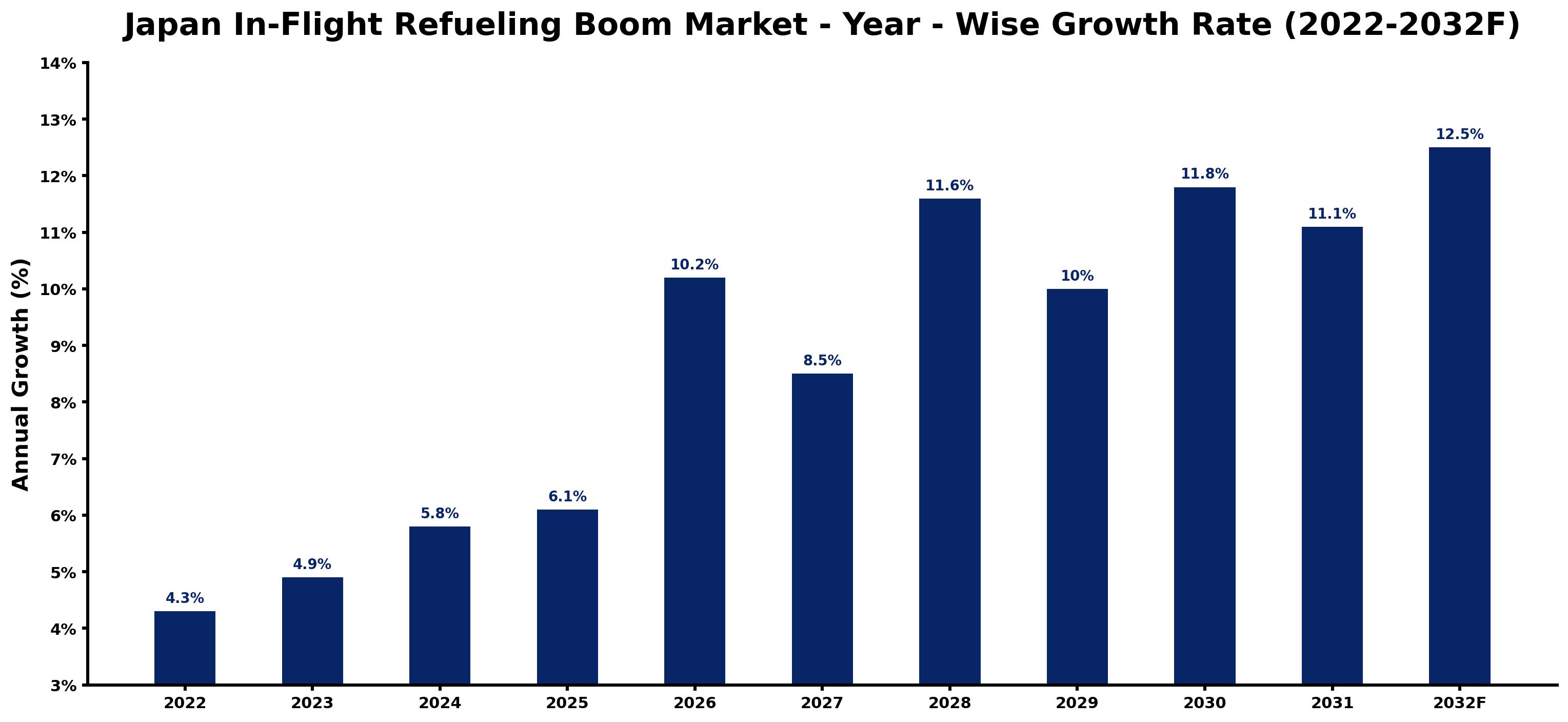
The yearly estimates that follow link every growth rate to its principal driver, so readers can see why the pace changed in each period.
| Year | Estimated Annual Growth (%) | Market Rationale |
| 2022 | 4.3 | The market showed steady demand from military operations and modernization efforts. |
| 2023 | 4.9 | Growth accelerated due to increased defense spending and modernization initiatives. |
| 2024 | 5.8 | Demand rose as Japan integrated new refueling technologies into its operations. |
| 2025 | 6.1 | The market peaked with investments in aerial refueling capabilities. |
| 2026 | 10.2 | Growth surged as the focus shifted towards advanced refueling systems. |
| 2027 | 8.5 | Growth is expected to slow as the market adjusts to previous high investment levels. |
| 2028 | 11.6 | Demand is projected to increase with a renewed focus on joint military exercises. |
| 2029 | 10.0 | Growth is expected to decelerate as supply chain constraints begin to surface. |
| 2030 | 11.8 | Demand will rise again due to technological advancements in refueling systems. |
| 2031 | 11.1 | Growth is projected to moderate as the market stabilises after rapid expansion. |
| 2032 | 12.5 | The market is expected to peak with heightened military collaborations and exercises. |
Note: Market size estimations and growth projections presented in this report are based on 6Wresearch's proprietary forecasting methodology, utilizing the latest available industry data, government publications, and primary research inputs.
Japan In-Flight Refueling Boom Market Synopsis
The In-Flight Refueling Boom is essential for transferring fuel mid-air between aircraft, primarily used in military operations to extend combat range. Japan's In-Flight Refueling Boom Market is experiencing growth driven by modernization of the Self-Defense Forces and increased defense budgets, with ¥6 trillion allocated in 2023 for modernization efforts. The integration of advanced technologies and partnerships with allied nations for joint exercises further stimulates demand, indicating a strong future for this market.
Market Dynamics Impact Analysis (2026–2032)
| Factor | Type | Impact | Primary Segment Affected |
| Growing demand from the Self-Defense Forces for advanced aerial refueling capabilities is driving market expansion, particularly in the Tanker Aircraft sub-segment. | Driver | High | Tanker Aircraft |
| The integration of digital boom control technologies enhances operational efficiency, leading to increased procurement by military logistics vendors. | Driver | High | Telescopic + Hydraulic |
| The need for compliance with ISO 9001 standards can slow production timelines, affecting suppliers' ability to meet demand in the Rigid Boom segment. | Restraint | High | Rigid Boom |
| The reliance on advanced technology may create barriers for smaller suppliers, limiting competition in the Probe-and-Drogue segment. | Restraint | Medium | Probe-and-Drogue |
| A shortage of skilled engineers in the defense sector hampers the development of innovative refueling systems, impacting production timelines. | Challenge | High | Fly-by-Wire Boom |
| Regulatory compliance costs can burden manufacturers, leading to increased prices for end-users in the Manual Booms segment. | Challenge | Medium | Manual Booms |
| The rising defense budget encourages investment in military refueling technologies, creating opportunities for suppliers in the Helipcopter / Jets segment. | Opportunity | High | Helicopters / Jets |
| The focus on enhancing UAV capabilities opens new avenues for investment in flexible refueling solutions, benefiting manufacturers in the Flexible Fuel Transfer segment. | Opportunity | Medium | Flexible Fuel Transfer |
Evaluation of Drivers in Japan In-Flight Refueling Boom Market (2026–2032)
These are the developments adding the most demand over the forecast period.
| Drivers | Primary Segment Affected | Why It Matters (Evidence) |
| Increased defense budget allocation for modernization. | Tanker Aircraft | Japan's defense budget allocated ¥6 trillion in 2023, boosting demand for aerial refueling capabilities. |
| Integration of Probe-and-Drogue systems improves operational flexibility. | Probe-and-Drogue | The JASDF has been integrating these systems since 2021, enhancing naval operational capabilities. |
| Growing focus on joint military exercises with allied nations. | Helicopters / Jets | Joint exercises increase the need for effective refueling solutions, particularly in the Tokyo region. |
| Technological advancements in digital boom control systems. | Telescopic + Hydraulic | The 2023 report highlights a focus on digital technologies for future aircraft, driving innovation. |
| Expansion of military logistics vendors supporting international operations. | Military Logistics Vendors | As of 2023, logistics vendors are enhancing capabilities to support expanded military operations. |
Spending rises because Japan's defense budget allocated ¥6 trillion in 2023, boosting demand for aerial refueling capabilities. The integration of advanced technologies improves operational flexibility for naval operations. Joint military exercises with allied nations increase the need for effective refueling solutions, particularly in the Tokyo region. A focus on digital boom control systems drives innovation in the market, while military logistics vendors are expanding capabilities to support international operations, further stimulating demand.
Evaluation of Restraints in Japan In-Flight Refueling Boom Market
The main factors holding the market back are set out below.
| Market Restraint | Primary Segment Affected | Why It Matters (Evidence) |
| Integration of advanced technologies may slow adoption rates due to required training. | Probe-and-Drogue | The need for specialized training can delay the implementation of new systems. |
| Supply chain challenges in procuring high-strength materials can limit production capacity. | Rigid Boom | Material shortages can hinder the timely production of refueling systems. |
| High costs associated with technological advancements may deter smaller manufacturers. | Fly-by-Wire Boom | Investment requirements for new technologies can be prohibitive for smaller entities. |
| Regulatory compliance for military equipment manufacturing can complicate processes. | Tanker Aircraft | Strict adherence to standards can slow down the production timeline. |
| Limited current deployment of UAV refueling systems restricts market expansion. | UAV / Next-Gen Aircraft | The emerging technology has not yet seen widespread adoption. |
Japan In-Flight Refueling Boom Market Challenges
Japan's defense budget allocated ¥6 trillion for modernization efforts in 2023, which pressures buyers to secure timely upgrades for aerial refueling capabilities. Strict adherence to ISO 9001 standards leads to production delays for suppliers, complicating timelines for military logistics vendors. Regulatory requirements from the Ministry of Defense slow the integration of advanced technologies, resulting in potential compliance costs for manufacturers. A shortage of skilled engineers in specialised fields hinders the development of new refueling systems, causing longer lead times for buyers seeking advanced solutions.
Trends in the Japan In-Flight Refueling Boom Market
Buyers and suppliers in the Japan In-Flight Refueling Boom Market are adjusting to the following trends.
- Shift towards Advanced Refueling Technologies: The 2023 report highlights a shift towards digital boom control technologies, enhancing operational efficiency. This trend is driving innovation in the refueling sector, with a growing emphasis on automation.
- Growing Integration of Probe-and-Drogue Systems: Japan's Self-Defense Forces have increasingly adopted Probe-and-Drogue systems since 2021, improving flexibility in naval operations. This trend is likely to expand as more aircraft implement this system, enhancing overall capabilities.
- Increased Focus on Joint Military Exercises: Joint exercises with allied nations are becoming more frequent, particularly around the Tokyo region, a hub for defense technology. This collaboration is expected to improve operational readiness and elevate demand for refueling systems.
- Expansion of Military Logistics Capabilities: As of 2023, military logistics vendors are broadening their capabilities to support international operations. This trend indicates a growing need for efficient refueling solutions to meet increased operational demands.
Investment Opportunities in the Japan In-Flight Refueling Boom Market
The following opportunities in the Japan In-Flight Refueling Boom Market pair current demand with a clear way in.
- Timing for Investment in Advanced Refueling Systems: With Japan's defense budget set to rise by 1% annually until 2025, there is an opportunity to invest in advanced refueling systems. Suppliers should target military OEMs to address this growing demand.
- Partnerships for Technological Development: Establishing joint ventures with local defense technology firms can facilitate market entry. The Tokyo region is ideal for collaboration, given its emphasis on defense technology development.
- Supply of Digital Boom Control Technologies: There is an opportunity to provide digital boom control technologies, as indicated by the 2023 report. Suppliers can engage with military OEMs to fulfil this demand.
- Enhancing UAV Refueling Capabilities: The rising interest in UAV refueling systems offers an opportunity to invest in specialised technologies. Collaborating with military logistics vendors can ease market entry.
Government Initiatives in the Japan In-Flight Refueling Boom Market
The Industrial Standardization Act governs the standards for manufacturing military equipment, including refueling systems. Compliance with ISO 9001 standards ensures that products meet quality requirements, impacting production timelines and costs. The act mandates rigorous testing and certification processes, which are essential for buyers in the defense sector.
Funding initiatives support advancements in military refueling technologies. The Aerospace and Defense Industry Association of Japan plays a role in approving projects that improve aerial refueling capabilities, ensuring that suppliers can meet the evolving demands of the Self-Defense Forces.
Future Insight of the Japan In-Flight Refueling Boom Market
Investment in aerial refueling technologies will surge, as Japan's commitment to modernising its defence capabilities generates substantial demand. The integration of advanced digital control systems will improve efficiency and precision for operations. A focus on UAV capabilities will create new opportunities for suppliers, enabling more flexible refueling solutions. With defense spending projected to rise by 1% annually until 2025, buyers will benefit from improved military capabilities and stronger international collaborations.
Market Segmentation Analysis
Japan In-Flight Refueling Boom Market report covers a detailed analysis of the following market segments:
By Boom Type – Rigid Boom Leads, Probe-and-Drogue Expected to Grow Fastest
According to Saurav Kr Singh, Senior Research Analyst at 6Wresearch, with 51% of boom type revenue in 2025, Rigid Boom was the largest category. The Rigid Boom commands the largest share because it is essential for precise fuel transfer in military operations. Japan's Self-Defense Forces rely on this technology, operating over 100 tanker aircraft equipped with Rigid Booms, which solidifies its market position. Over 2026–2032, Probe-and-Drogue is expected to post the fastest growth, at a CAGR of 15.1%. The Probe-and-Drogue system is rapidly gaining traction due to its increasing adoption in naval aviation for refueling missions. This growth is supported by the JASDF's integration of these systems for naval operations since 2021, indicating a shift in operational strategies. Suppliers should prioritise the development of Probe-and-Drogue systems to capitalise on the growing demand within naval operations.
By Aircraft Compatibility – Tanker Aircraft Leads, Helicopters / Jets Expected to Grow Fastest
Tanker Aircraft accounted for 41% of the market by aircraft compatibility in 2025. Tanker Aircraft dominate this segment as they are the primary platform for in-flight refueling, ensuring a steady demand from military operations. The integration of advanced refueling systems into over 100 tanker aircraft operated by Japan's Self-Defense Forces highlights their critical importance. The quickest growth will come from Helicopters / Jets, forecast to expand at a CAGR of 15.5% between 2026 and 2032. Helicopters and Jets are experiencing rapid growth due to their versatility in refueling various military aircraft. This is particularly evident as the Ministry of Defense's 2023 report indicates a focus on enhancing aerial refueling capabilities across different aircraft types. Suppliers must focus on developing adaptable refueling solutions to cater to the growing needs of helicopters and jets.
By Mechanism Type – Telescopic + Hydraulic Leads, Flexible Fuel Transfer Expected to Grow Fastest
Telescopic + Hydraulic took 38% of mechanism type revenue in 2025, more than any other category. The Telescopic + Hydraulic mechanism leads the market as it provides the necessary flexibility for effective fuel transfer during operations. This mechanism's reliability is essential for military applications, aligning with Japan's focus on modernizing its defense capabilities. Flexible Fuel Transfer is projected to grow fastest, at a CAGR of 15.6% during 2026–2032. Flexible Fuel Transfer is growing quickly, although it is used in specific applications rather than mainstream operations. This growth is partly due to advancements in technology that cater to unique refueling scenarios. Suppliers may need to explore niche markets for Flexible Fuel Transfer solutions to capitalise on their emerging demand.
By Distribution Channel – Defense Aircraft Suppliers Lead, Military OEMs Expected to Grow Fastest
In 2025, Defense Aircraft Suppliers led the distribution channel split with a 46% share. Defense Aircraft Suppliers are the leading distribution channel, providing essential refueling equipment to military clients. Their established relationships with the Self-Defense Forces facilitate a reliable supply chain, ensuring operational readiness. Military OEMs are set to record the highest CAGR in this split, 13.5% over 2026–2032. Military OEMs are rapidly growing as they play a crucial role in the manufacturing and integration of in-flight refueling systems. Their importance is underscored by Japan's commitment to modernising its defence capabilities, which drives demand for advanced refueling technologies. Suppliers should seek collaborations with Military OEMs to strengthen their market position and align with defence modernization initiatives.
Key Attractiveness of the Report
- 10 Years of Market Numbers
- Historical Data Starting from 2022 to 2025
- Base Year 2025
- Forecast Data until 2032
- Key Performance Indicators Impacting the Market
- Major Upcoming Developments and Projects
Key Highlights of the Report:
- Japan In-Flight Refueling Boom Market Outlook
- Market Size of Japan In-Flight Refueling Boom Market, 2025
- Forecast of Japan In-Flight Refueling Boom Market, 2032
- Historical Data and Forecast of Japan In-Flight Refueling Boom Revenues & Volume for the Period 2022-2032F
- Japan In-Flight Refueling Boom Market Trend Evolution
- Japan In-Flight Refueling Boom Market Drivers and Challenges
- Japan In-Flight Refueling Boom Price Trends
- Japan In-Flight Refueling Boom Porter's Five Forces
- Japan In-Flight Refueling Boom Industry Life Cycle
- Historical Data and Forecast of Japan In-Flight Refueling Boom Market Revenues & Volume By Boom Type for the Period 2022-2032F
- Historical Data and Forecast of Japan In-Flight Refueling Boom Market Revenues & Volume By Rigid Boom for the Period 2022-2032F
- Historical Data and Forecast of Japan In-Flight Refueling Boom Market Revenues & Volume By Probe-and-Drogue for the Period 2022-2032F
- Historical Data and Forecast of Japan In-Flight Refueling Boom Market Revenues & Volume By Fly-by-Wire Boom for the Period 2022-2032F
- Historical Data and Forecast of Japan In-Flight Refueling Boom Market Revenues & Volume By Manual Booms for the Period 2022-2032F
- Historical Data and Forecast of Japan In-Flight Refueling Boom Market Revenues & Volume By Aircraft Compatibility for the Period 2022-2032F
- Historical Data and Forecast of Japan In-Flight Refueling Boom Market Revenues & Volume By Tanker Aircraft for the Period 2022-2032F
- Historical Data and Forecast of Japan In-Flight Refueling Boom Market Revenues & Volume By Helicopters / Jets for the Period 2022-2032F
- Historical Data and Forecast of Japan In-Flight Refueling Boom Market Revenues & Volume By UAV / Next-Gen Aircraft for the Period 2022-2032F
- Historical Data and Forecast of Japan In-Flight Refueling Boom Market Revenues & Volume By Legacy Aircraft for the Period 2022-2032F
- Historical Data and Forecast of Japan In-Flight Refueling Boom Market Revenues & Volume By Mechanism Type for the Period 2022-2032F
- Historical Data and Forecast of Japan In-Flight Refueling Boom Market Revenues & Volume By Telescopic + Hydraulic for the Period 2022-2032F
- Historical Data and Forecast of Japan In-Flight Refueling Boom Market Revenues & Volume By Flexible Fuel Transfer for the Period 2022-2032F
- Historical Data and Forecast of Japan In-Flight Refueling Boom Market Revenues & Volume By Digital Boom Control for the Period 2022-2032F
- Historical Data and Forecast of Japan In-Flight Refueling Boom Market Revenues & Volume By Mechanical Arms for the Period 2022-2032F
- Historical Data and Forecast of Japan In-Flight Refueling Boom Market Revenues & Volume By Distribution Channel for the Period 2022-2032F
- Historical Data and Forecast of Japan In-Flight Refueling Boom Market Revenues & Volume By Defense Aircraft Suppliers for the Period 2022-2032F
- Historical Data and Forecast of Japan In-Flight Refueling Boom Market Revenues & Volume By Military OEMs for the Period 2022-2032F
- Historical Data and Forecast of Japan In-Flight Refueling Boom Market Revenues & Volume By Defense Tech Integrators for the Period 2022-2032F
- Historical Data and Forecast of Japan In-Flight Refueling Boom Market Revenues & Volume By Military Logistics Vendors for the Period 2022-2032F
- Japan In-Flight Refueling Boom Import Export Trade Statistics
- Market Opportunity Assessment By Boom Type
- Market Opportunity Assessment By Aircraft Compatibility
- Market Opportunity Assessment By Mechanism Type
- Market Opportunity Assessment By Distribution Channel
- Japan In-Flight Refueling Boom Top Companies Market Share
- Japan In-Flight Refueling Boom Competitive Benchmarking By Technical and Operational Parameters
- Japan In-Flight Refueling Boom Company Profiles
- Japan In-Flight Refueling Boom Key Strategic Recommendations
Market Covered
Segments analysed in this report are listed below.
By Boom Type
- Rigid Boom
- Probe-and-Drogue
- Fly-by-Wire Boom
- Manual Booms
By Aircraft Compatibility
- Tanker Aircraft
- Helicopters / Jets
- UAV / Next-Gen Aircraft
- Legacy Aircraft
By Mechanism Type
- Telescopic + Hydraulic
- Flexible Fuel Transfer
- Digital Boom Control
- Mechanical Arms
By Distribution Channel
- Defense Aircraft Suppliers
- Military OEMs
- Defense Tech Integrators
- Military Logistics Vendors































