Japan In-Flight Wi-Fi Provider Market Size & Growth Rate
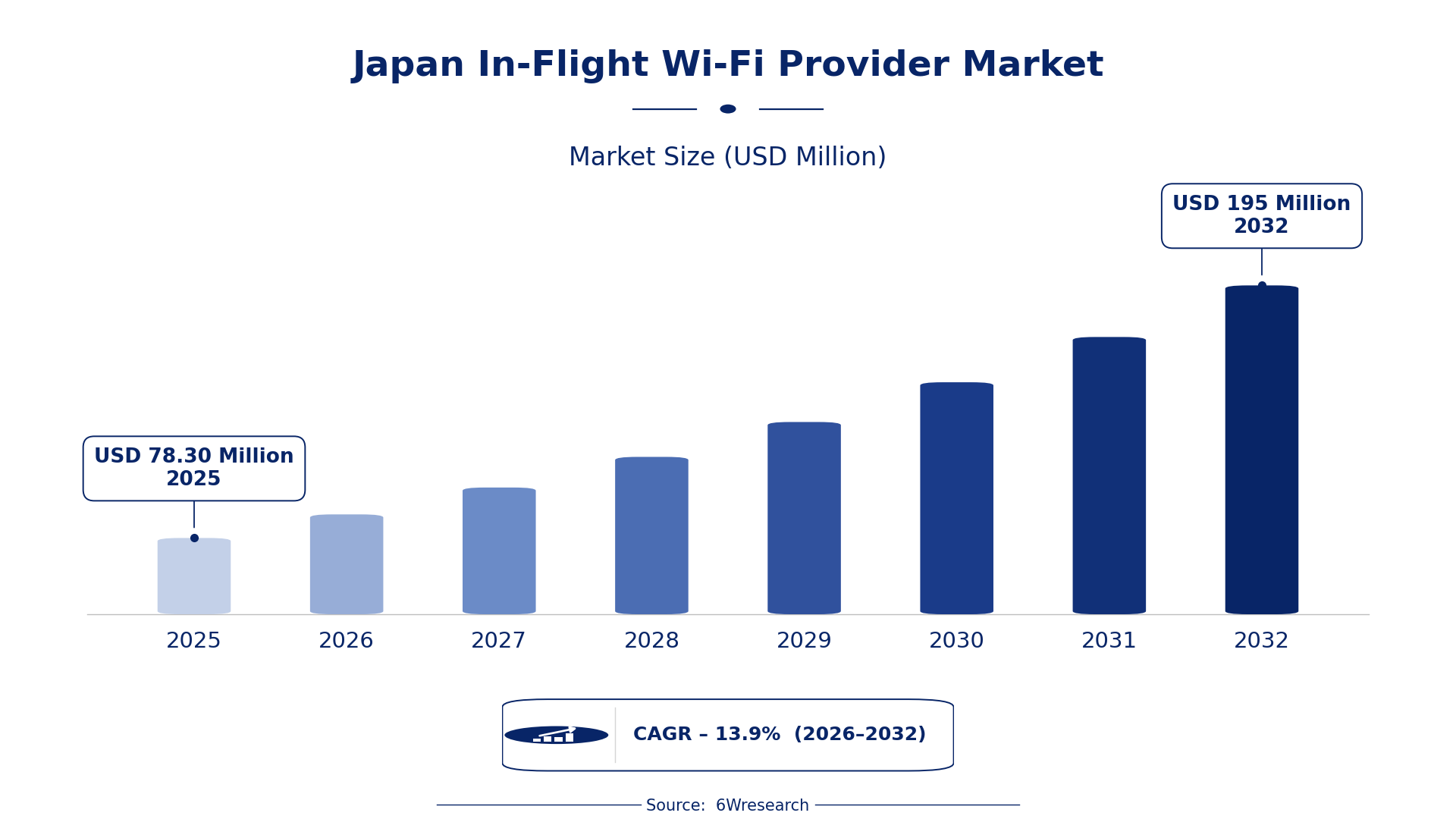
According to 6Wresearch internal database and industry insights, the Japan In-Flight Wi-Fi Provider Market was valued at USD 78.30 Million in 2025 and is projected to reach USD 195 Million by 2032, growing at a CAGR of approximately 13.9% during 2026–2032.
Japan In-Flight Wi-Fi Provider Market Highlights
| Report Metric | Details |
| Report Name | Japan In-Flight Wi-Fi Provider Market (2026-2032) |
| Market Size 2025 | USD 78.30 Million |
| Market Size 2032 | USD 195 Million |
| Absolute Growth 2025–2032 | USD 116.70 Million |
| CAGR 2026–2032 | 13.9% |
| Peak Annual Growth | 18.2% in 2032 |
| Forecast Period | 2026–2032 |
| Historical Data | 2022–2025 |
| Base Year | 2025 |
| Leading Provider Type, 2025 | Global Satcom Providers (46% share) |
| Leading Connectivity Model, 2025 | Ka / Ku Band (36% share) |
| Leading Target Airline Class, 2025 | International Airlines (45% share) |
| Leading Distribution Channel, 2025 | Direct Airline Contracts (46% share) |
| Fastest-Growing Provider Type | Regional Wi-Fi Providers (15.7% CAGR) |
| Fastest-Growing Connectivity Model | ATG / LTE Hybrid (19.4% CAGR) |
| Fastest-Growing Target Airline Class | Regional Carriers (18.3% CAGR) |
| Fastest-Growing Distribution Channel | Telco Integrators (18.4% CAGR) |
| Growing Sector | aviation connectivity |
| Key End Users | international airlines, regional carriers, budget airlines |
Japan In-Flight Wi-Fi Provider Market Year-wise Growth Rate and Key Drivers (2022–2032)
This graph illustrates the annual growth rates of the market from 2022 to 2032, highlighting a steady upward trajectory and projected market expansion over the forecast period.
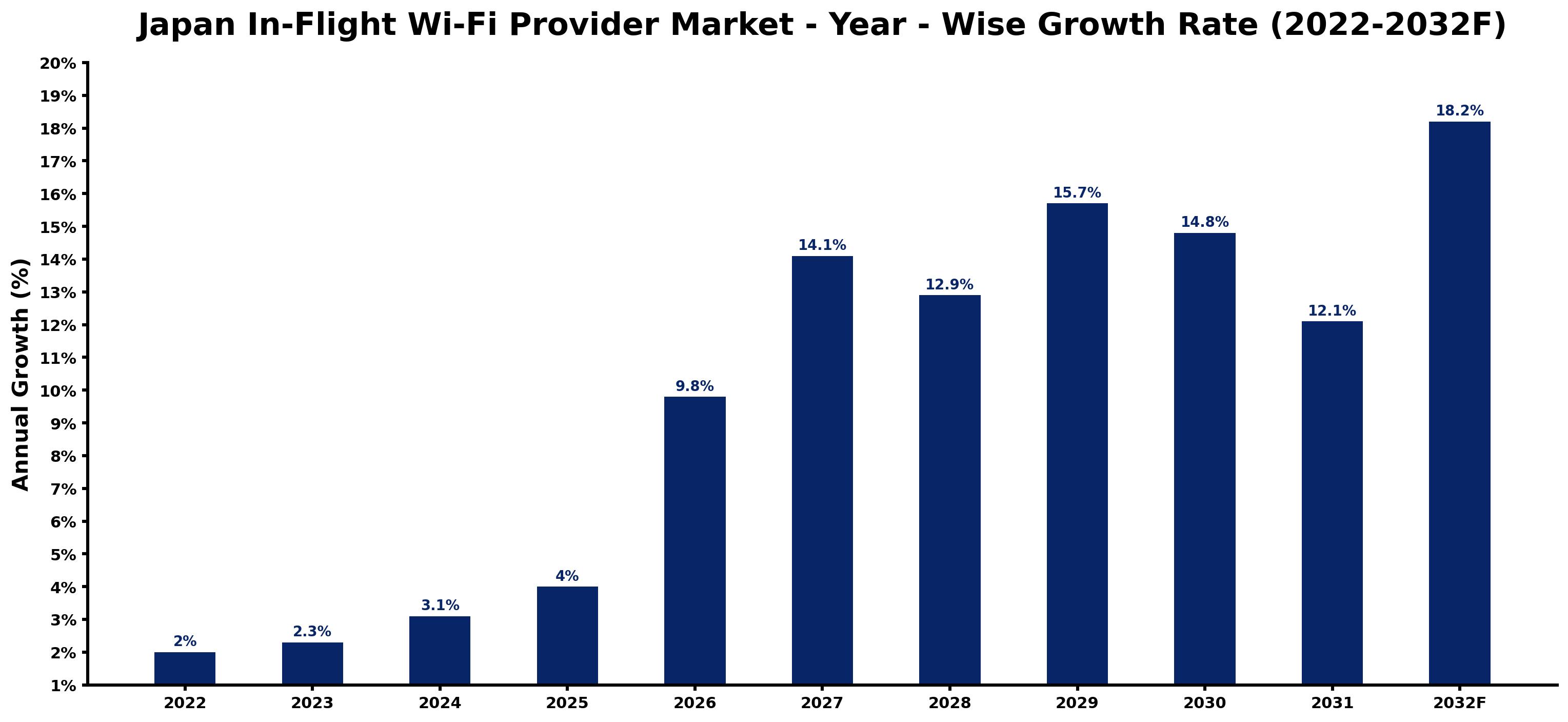
The yearly estimates that follow link every growth rate to its principal driver, so readers can see why the pace changed in each period.
| Year | Estimated Annual Growth (%) | Market Rationale |
| 2022 | 2.0 | The market exhibited steady growth as demand for connectivity increased among domestic airlines. |
| 2023 | 2.3 | Growth accelerated due to rising passenger expectations for in-flight internet services. |
| 2024 | 3.1 | Increased competition among airlines led to more investments in in-flight Wi-Fi solutions. |
| 2025 | 4.0 | The market reached its historical peak as international airlines expanded their connectivity offerings. |
| 2026 | 9.8 | Growth is expected to surge as over 30% of domestic flights begin offering Wi-Fi services. |
| 2027 | 14.1 | Demand will continue to rise, driven by advancements in satellite technology and service expansion. |
| 2028 | 12.9 | Growth is projected to slow slightly as market saturation begins to set in among established providers. |
| 2029 | 15.7 | A resurgence in demand is anticipated as regional airlines improve their Wi-Fi services to compete. |
| 2030 | 14.8 | The market will experience another slowdown as airlines focus on operational efficiency. |
| 2031 | 12.1 | Growth is expected to decelerate further as the market stabilises amid increased competition. |
| 2032 | 18.2 | The market is projected to peak with substantial investments in high-speed connectivity solutions. |
Note: Market size estimations and growth projections presented in this report are based on 6Wresearch's proprietary forecasting methodology, utilizing the latest available industry data, government publications, and primary research inputs.
Japan In-Flight Wi-Fi Provider Market Synopsis
In-Flight Wi-Fi provides internet connectivity to passengers on aircraft, utilising satellite communication systems or air-to-ground technology. The main buyer groups include international airlines, regional carriers, and budget airlines, all seeking to improve passenger experience. The Japan In-Flight Wi-Fi Provider Market is expanding due to rising passenger expectations, with over 100 million air passengers annually and strong government backing for aviation technology, which drives demand for connectivity solutions.
Market Dynamics Impact Analysis (2026–2032)
| Factor | Type | Impact | Primary Segment Affected |
| Increasing passenger demand for in-flight connectivity | Driver | High | International Airlines |
| Expansion of Wi-Fi services by regional airlines | Driver | High | Regional Carriers |
| Growing number of air passengers annually | Opportunity | High | Budget Airlines |
| Adoption of advanced satellite technologies | Opportunity | Medium | Ka / Ku Band |
| High costs associated with satellite infrastructure | Restraint | High | Global Satcom Providers |
| Regulatory compliance requirements for service providers | Restraint | Medium | Regional Wi-Fi Providers |
| Limited capacity of existing infrastructure | Challenge | High | OEM Hardware Providers |
| Compliance with international standards for connectivity | Challenge | Medium | B2B SaaS Providers |
Evaluation of Drivers in Japan In-Flight Wi-Fi Provider Market (2026–2032)
Demand rests on the following drivers, each shown with the segment it touches most.
| Drivers | Primary Segment Affected | Why It Matters (Evidence) |
| Rising passenger numbers | International Airlines | Japan has over 100 million air passengers annually, prompting airlines to invest in Wi-Fi services. |
| Expansion of regional airline services | Regional Carriers | Regional airlines are increasing Wi-Fi offerings to compete with international carriers, reflecting market trends with over 30% adoption. |
| Government support for aviation technology | Ka / Ku Band | The Japanese government promotes advancements in aviation technology, boosting demand for connectivity solutions through initiatives. |
| Growing interest in in-flight entertainment | Budget Airlines | Budget airlines are adopting Wi-Fi to attract more passengers and improve their service offerings, reflecting changing consumer preferences. |
| Adoption of Ka-band technology | Global Satcom Providers | Ka-band technology is increasingly favoured for high-speed connectivity, driving demand for satellite services across the aviation sector. |
Orders keep climbing as Japan's aviation sector aims to improve connectivity by 2025, with over 100 million air passengers annually. The increasing interest in in-flight entertainment drives airlines to invest in Wi-Fi services, leading to a rise in installations. Regional airlines are expanding their Wi-Fi offerings to compete with international carriers, reflecting shifts in passenger expectations. The adoption of Ka-band technology supports high-speed connectivity, making it a preferred choice for service providers.
Evaluation of Restraints in Japan In-Flight Wi-Fi Provider Market
These restraints slow adoption and weigh on supplier margins.
| Market Restraint | Primary Segment Affected | Why It Matters (Evidence) |
| High costs of satellite infrastructure | Global Satcom Providers | The average installed base of in-flight Wi-Fi systems is around 1,500 units, requiring considerable investment. |
| Regulatory compliance requirements | Regional Wi-Fi Providers | Service providers must adhere to strict regulations, which can delay service deployment by several months. |
| Limited capacity of existing infrastructure | OEM Hardware Providers | Current infrastructure struggles to meet the increasing demand for connectivity solutions, affecting service quality. |
| Market saturation among established providers | B2B SaaS Providers | As more airlines adopt Wi-Fi, competition intensifies, limiting growth opportunities for new entrants. |
| Dependence on technology imports | Ka / Ku Band | Reliance on imported technology can lead to supply chain vulnerabilities and delays in service. |
Japan In-Flight Wi-Fi Provider Market Challenges
Regulatory complexities burden producers, as compliance with ISO 9001 certification requires extensive documentation, delaying service launches for up to six months. Technology gaps challenge importers, since reliance on outdated systems prevents the adoption of high-speed Ka-band technology, causing competitive disadvantages for regional airlines. Skills shortages hinder buyers, as the lack of trained personnel in in-flight service management can lead to operational inefficiencies, costing airlines approximately 15% in potential revenue. Supply chain delays affect distributors, as setbacks in satellite communication advancements can extend project timelines by over a year, impacting service availability for airlines.
Trends in the Japan In-Flight Wi-Fi Provider Market
Below are the shifts with the largest effect on the Japan In-Flight Wi-Fi Provider Market.
- Initiative to Improve In-Flight Services: In 2023, the Japan Civil Aviation Bureau launched a programme aimed at increasing Wi-Fi adoption across domestic flights, focusing on enhancing passenger experience. This initiative is expected to significantly improve service quality.
- Shift Towards Ka-Band Technology: Ka-band technology is becoming the preferred choice for high-speed connectivity among Japanese airlines, with over 30% of domestic flights now offering it. This transition improves service quality and attracts more passengers.
- Expansion of Wi-Fi in Budget Airlines: Budget airlines in Japan are increasingly adopting Wi-Fi services to stay competitive, with a marked rise in installations. This trend is anticipated to grow as passenger expectations evolve, improving overall service offerings.
- Focus on Regional Airline Connectivity: Regional airlines are expanding their Wi-Fi services to compete with larger carriers, reflecting a growing trend in the market. This shift is driven by the necessity to enhance passenger experience and satisfaction.
Investment Opportunities in the Japan In-Flight Wi-Fi Provider Market
The openings below show where demand in the Japan In-Flight Wi-Fi Provider Market is visible and how suppliers can enter.
- Gap in In-Flight Connectivity: With over 100 million air passengers annually, there is a clear opportunity to expand in-flight Wi-Fi services. Investing in regional carriers can effectively meet this demand, targeting the growing passenger base.
- Partnerships with Regional Airlines: Now is an opportune moment to establish partnerships with regional airlines, as they look to improve their in-flight services. Collaborating with these carriers can open new market avenues and enhance service offerings.
- Supply of Advanced Satellite Technology: The demand for high-speed connectivity solutions presents an opportunity to supply advanced satellite technology. Engaging with the Ka-band technology segment can yield substantial returns as the market grows.
- Timing for Budget Airlines: As budget airlines adopt Wi-Fi to attract more passengers, suppliers can enter this segment by offering tailored solutions that address their specific needs and improve their competitive edge.
Government Initiatives in the Japan In-Flight Wi-Fi Provider Market
The Digital Agency, established in September 2021, spearheads Japan's government digital transformation efforts, setting common system standards for in-flight connectivity. This initiative strengthens the regulatory framework for service providers, ensuring compliance with modern technology standards and improving service delivery.
The Ministry of Internal Affairs and Communications oversees the implementation of the Industrial Standardization Act, which governs JIS product and test standards. This ensures that in-flight Wi-Fi providers meet quality benchmarks, benefiting both producers and consumers by improving service reliability.
Future Insight of the Japan In-Flight Wi-Fi Provider Market
Domestic airlines will expand their in-flight Wi-Fi offerings by 2032, significantly enhancing connectivity for over 100 million passengers annually. The recent programme initiated by the Japan Civil Aviation Bureau will drive upgrades in in-flight services, benefiting both buyers and suppliers. Regional airlines are set to broaden their Wi-Fi offerings, increasing competition and enhancing passenger experience. By 2025, the aviation sector's commitment to connectivity will ensure that more flights provide reliable internet access, meeting the growing demand from air travellers.
Market Segmentation Analysis
Japan In-Flight Wi-Fi Provider Market report covers a detailed analysis of the following market segments:
By Provider Type – Global Satcom Providers Lead, Regional Wi-Fi Providers Expected to Grow Fastest
According to Saurav Kr Singh, Senior Research Analyst at 6Wresearch, Global Satcom Providers held 46% of the Japan In-Flight Wi-Fi Provider Market by provider type in 2025. Global Satcom Providers dominate the market due to their ability to deliver essential satellite connectivity for in-flight services. Their extensive infrastructure and established relationships with major airlines ensure a consistent supply of services across both domestic and international routes. The quickest growth will come from Regional Wi-Fi Providers, forecast to expand at a CAGR of 15.7% between 2026 and 2032. Regional Wi-Fi Providers are experiencing rapid growth as they focus on specific regional markets and airlines, catering to the unique demands of local passengers. This targeted approach is reflected in the increasing number of regional airlines expanding their Wi-Fi offerings to compete effectively. Suppliers should consider partnerships with regional providers to tap into the growing demand for tailored connectivity solutions.
By Connectivity Model – Ka / Ku Band Leads, ATG / LTE Hybrid Expected to Grow Fastest
Ka / Ku Band accounted for 36% of the market by connectivity model in 2025. Ka / Ku Band technology leads the market due to its widespread application for high-speed satellite internet in-flight, catering to the demands of airlines and passengers alike. This technology is particularly prevalent among major airlines operating on both domestic and international routes, ensuring reliable connectivity. ATG / LTE Hybrid is set to record the highest CAGR in this split, 19.4% over 2026–2032. The ATG / LTE Hybrid model is growing rapidly as it combines ground and satellite technologies, offering airlines flexible connectivity solutions. This model is particularly appealing for airlines looking to enhance internet services on shorter regional flights, where demand is increasing. Suppliers must focus on developing advanced hybrid connectivity solutions to meet the growing expectations of airlines and passengers.
By Target Airline Class – International Airlines Lead, Regional Carriers Expected to Grow Fastest
The largest target airline class category in 2025 was International Airlines, at 45% of revenue. International Airlines dominate the market as they represent a substantial portion of in-flight Wi-Fi service users, addressing varied passenger needs during long-haul flights. Their commitment to enhancing passenger experience drives the demand for dependable and high-quality connectivity options. Over 2026–2032, Regional Carriers are expected to post the fastest growth, at a CAGR of 18.3%. Regional Carriers are experiencing the fastest growth as they increasingly implement in-flight Wi-Fi to elevate passenger experience, especially on shorter routes facing heightened competition. This trend is supported by the rising frequency of regional flights offering connectivity services. Suppliers should tailor their offerings to align with the unique demands of regional carriers to capitalise on this expanding segment.
By Distribution Channel – Direct Airline Contracts Lead, Telco Integrators Expected to Grow Fastest
With 46% of distribution channel revenue in 2025, Direct Airline Contracts was the largest category. Direct Airline Contracts are the primary method for service provision, enabling providers to supply their solutions directly to airlines. This approach fosters strong partnerships between service providers and airlines, ensuring effective service delivery and operational efficiency. Telco Integrators are projected to grow fastest, at a CAGR of 18.4% during 2026–2032. Telco Integrators are rapidly gaining traction as they facilitate the integration of connectivity solutions, linking technology providers with airlines. Their role is becoming increasingly vital as airlines seek comprehensive and streamlined solutions for in-flight connectivity. Suppliers should seek collaborations with telco integrators to expand their market reach and improve service offerings.
Key Attractiveness of the Report
- 10 Years of Market Numbers
- Historical Data Starting from 2022 to 2025
- Base Year 2025
- Forecast Data until 2032
- Key Performance Indicators Impacting the Market
- Major Upcoming Developments and Projects
Key Highlights of the Report:
- Japan In-Flight Wi-Fi Provider Market Outlook
- Market Size of Japan In-Flight Wi-Fi Provider Market, 2025
- Forecast of Japan In-Flight Wi-Fi Provider Market, 2032
- Historical Data and Forecast of Japan In-Flight Wi-Fi Provider Revenues & Volume for the Period 2022-2032F
- Japan In-Flight Wi-Fi Provider Market Trend Evolution
- Japan In-Flight Wi-Fi Provider Market Drivers and Challenges
- Japan In-Flight Wi-Fi Provider Price Trends
- Japan In-Flight Wi-Fi Provider Porter's Five Forces
- Japan In-Flight Wi-Fi Provider Industry Life Cycle
- Historical Data and Forecast of Japan In-Flight Wi-Fi Provider Market Revenues & Volume By Provider Type for the Period 2022-2032F
- Historical Data and Forecast of Japan In-Flight Wi-Fi Provider Market Revenues & Volume By Global Satcom Providers for the Period 2022-2032F
- Historical Data and Forecast of Japan In-Flight Wi-Fi Provider Market Revenues & Volume By Regional Wi-Fi Providers for the Period 2022-2032F
- Historical Data and Forecast of Japan In-Flight Wi-Fi Provider Market Revenues & Volume By B2B SaaS Providers for the Period 2022-2032F
- Historical Data and Forecast of Japan In-Flight Wi-Fi Provider Market Revenues & Volume By OEM Hardware Providers for the Period 2022-2032F
- Historical Data and Forecast of Japan In-Flight Wi-Fi Provider Market Revenues & Volume By Connectivity Model for the Period 2022-2032F
- Historical Data and Forecast of Japan In-Flight Wi-Fi Provider Market Revenues & Volume By Ka / Ku Band for the Period 2022-2032F
- Historical Data and Forecast of Japan In-Flight Wi-Fi Provider Market Revenues & Volume By ATG / LTE Hybrid for the Period 2022-2032F
- Historical Data and Forecast of Japan In-Flight Wi-Fi Provider Market Revenues & Volume By White-Label Services for the Period 2022-2032F
- Historical Data and Forecast of Japan In-Flight Wi-Fi Provider Market Revenues & Volume By End-to-End Solutions for the Period 2022-2032F
- Historical Data and Forecast of Japan In-Flight Wi-Fi Provider Market Revenues & Volume By Target Airline Class for the Period 2022-2032F
- Historical Data and Forecast of Japan In-Flight Wi-Fi Provider Market Revenues & Volume By International Airlines for the Period 2022-2032F
- Historical Data and Forecast of Japan In-Flight Wi-Fi Provider Market Revenues & Volume By Regional Carriers for the Period 2022-2032F
- Historical Data and Forecast of Japan In-Flight Wi-Fi Provider Market Revenues & Volume By Budget Airlines for the Period 2022-2032F
- Historical Data and Forecast of Japan In-Flight Wi-Fi Provider Market Revenues & Volume By Widebody Aircraft for the Period 2022-2032F
- Historical Data and Forecast of Japan In-Flight Wi-Fi Provider Market Revenues & Volume By Distribution Channel for the Period 2022-2032F
- Historical Data and Forecast of Japan In-Flight Wi-Fi Provider Market Revenues & Volume By Direct Airline Contracts for the Period 2022-2032F
- Historical Data and Forecast of Japan In-Flight Wi-Fi Provider Market Revenues & Volume By Telco Integrators for the Period 2022-2032F
- Historical Data and Forecast of Japan In-Flight Wi-Fi Provider Market Revenues & Volume By Subscription Platforms for the Period 2022-2032F
- Historical Data and Forecast of Japan In-Flight Wi-Fi Provider Market Revenues & Volume By Satellite Infrastructure for the Period 2022-2032F
- Japan In-Flight Wi-Fi Provider Import Export Trade Statistics
- Market Opportunity Assessment By Provider Type
- Market Opportunity Assessment By Connectivity Model
- Market Opportunity Assessment By Target Airline Class
- Market Opportunity Assessment By Distribution Channel
- Japan In-Flight Wi-Fi Provider Top Companies Market Share
- Japan In-Flight Wi-Fi Provider Competitive Benchmarking By Technical and Operational Parameters
- Japan In-Flight Wi-Fi Provider Company Profiles
- Japan In-Flight Wi-Fi Provider Key Strategic Recommendations
Market Covered
Coverage by segment is as follows.
By Provider Type
- Global Satcom Providers
- Regional Wi-Fi Providers
- B2B SaaS Providers
- OEM Hardware Providers
By Connectivity Model
- Ka / Ku Band
- ATG / LTE Hybrid
- White-Label Services
- End-to-End Solutions
By Target Airline Class
- International Airlines
- Regional Carriers
- Budget Airlines
- Widebody Aircraft
By Distribution Channel
- Direct Airline Contracts
- Telco Integrators
- Subscription Platforms
- Satellite Infrastructure































