Japan In-Line Air Detection Market Size & Growth Rate
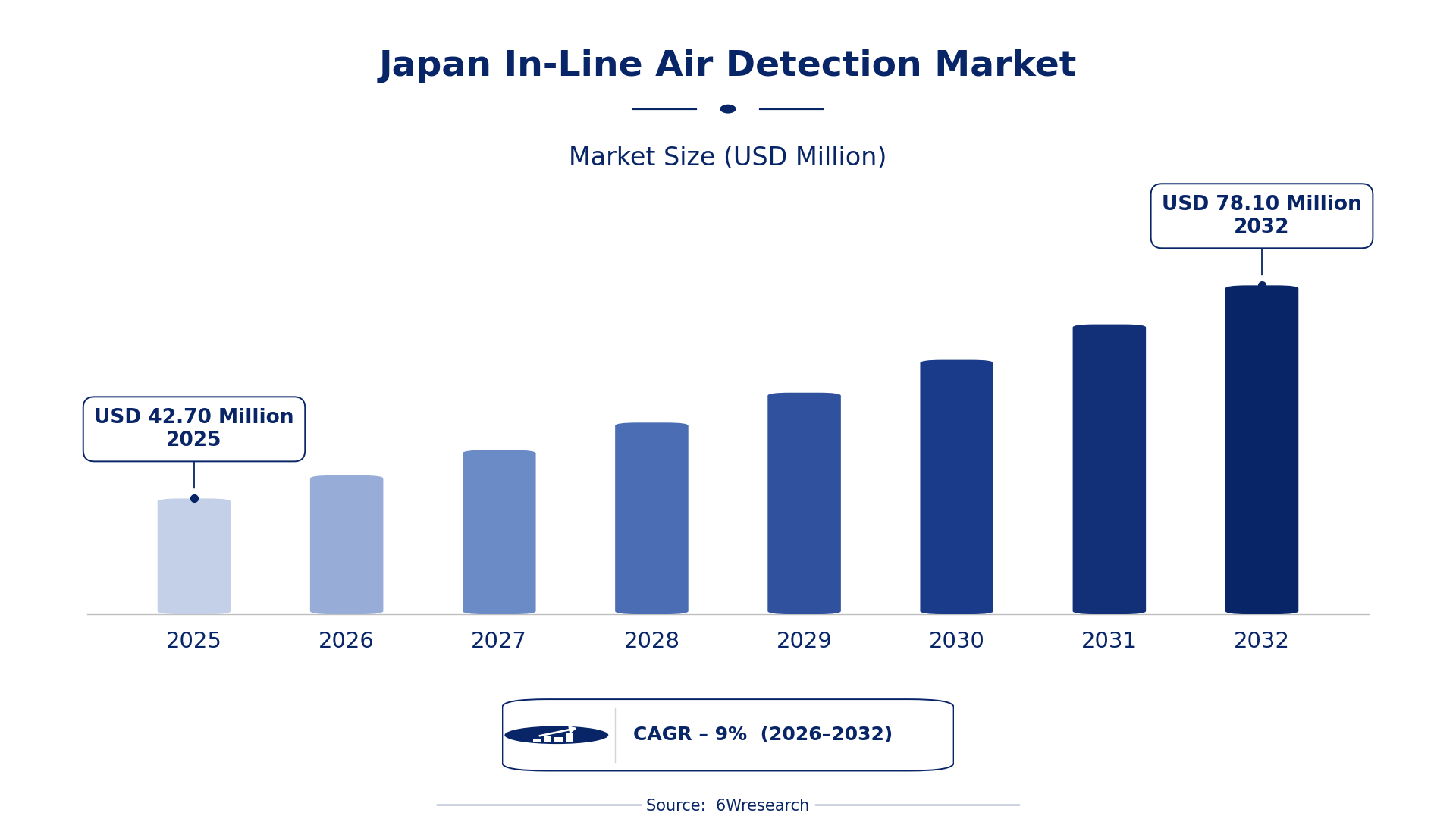
According to 6Wresearch internal database and industry insights, the Japan In-Line Air Detection Market was valued at USD 42.70 Million in 2025 and is projected to reach USD 78.10 Million by 2032, growing at a CAGR of approximately 9% during 2026–2032.
Japan In-Line Air Detection Market Highlights
| Report Metric | Details |
| Report Name | Japan In-Line Air Detection Market (2026-2032) |
| Market Size 2025 | USD 42.70 Million |
| Market Size 2032 | USD 78.10 Million |
| Absolute Growth 2025–2032 | USD 35.40 Million |
| CAGR 2026–2032 | 9% |
| Peak Annual Growth | 10.6% in 2027 |
| Forecast Period | 2026–2032 |
| Historical Data | 2022–2025 |
| Base Year | 2025 |
| Leading Detection Type, 2025 | Microbubble Detection (46% share) |
| Leading Application Area, 2025 | IV Infusion Lines (36% share) |
| Leading Sensor Technology, 2025 | Ultrasonic Sensors (53% share) |
| Leading Device Placement, 2025 | Bedside Devices (51% share) |
| Leading End User Sector, 2025 | Hospitals (50% share) |
| Fastest-Growing Detection Type | Air-in-Line Sensors (12.6% CAGR) |
| Fastest-Growing Application Area | Dialysis Machines (10.4% CAGR) |
| Fastest-Growing Sensor Technology | Optical Detectors (13.0% CAGR) |
| Fastest-Growing Device Placement | Device Integrated (11.3% CAGR) |
| Fastest-Growing End User Sector | Nephrology Centers (11.2% CAGR) |
| Growing Sector | Healthcare |
| Key End Users | Hospitals, Nephrology Centers, Critical Care Units, Imaging Clinics |
Japan In-Line Air Detection Market Year-wise Growth Rate and Key Drivers (2022–2032)
This graph illustrates the annual growth rates of the market from 2022 to 2032, highlighting a steady upward trajectory and projected market expansion over the forecast period.
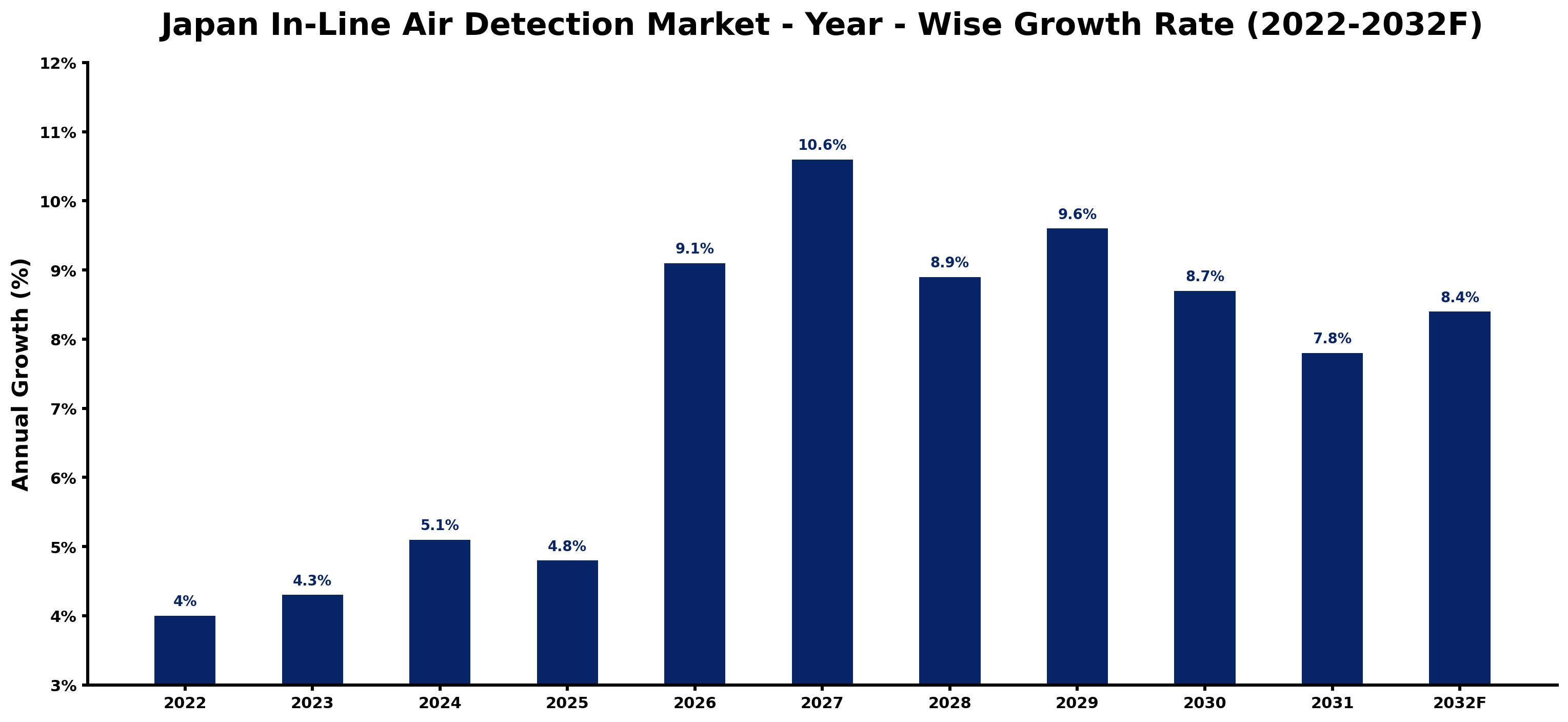
The table below sets out the estimated growth rate for each year and the main factor behind it.
| Year | Estimated Annual Growth (%) | Market Rationale |
| 2022 | 4.0 | The market showed steady growth as hospitals adopted new safety technologies. |
| 2023 | 4.3 | Demand increased due to heightened awareness of patient safety measures. |
| 2024 | 5.1 | Growth accelerated as hospitals expanded their critical care capabilities. |
| 2025 | 4.8 | Market growth slowed as hospitals faced budget constraints on new technologies. |
| 2026 | 9.1 | Investment surged with the introduction of advanced monitoring systems in hospitals. |
| 2027 | 10.6 | The peak growth year will be driven by healthcare technology investments. |
| 2028 | 8.9 | Growth is expected to moderate as hospitals begin to stabilise their technology investments. |
| 2029 | 9.6 | Demand will rise again as healthcare facilities upgrade their equipment. |
| 2030 | 8.7 | Growth is projected to slow as market saturation begins to take effect in urban areas. |
| 2031 | 7.8 | A further slowdown will occur as hospitals focus on operational efficiency. |
| 2032 | 8.4 | Demand is expected to rise as new technologies are integrated into care. |
Note: Market size estimations and growth projections presented in this report are based on 6Wresearch's proprietary forecasting methodology, utilizing the latest available industry data, government publications, and primary research inputs.
Japan In-Line Air Detection Market Synopsis
In-Line Air Detection technology is vital in medical settings, primarily for identifying air bubbles in IV and dialysis lines. This technology employs sensor types such as ultrasonic and optical detectors, ensuring patient safety during critical procedures. The Japan In-Line Air Detection Market is experiencing growth driven by the increasing number of hospitals, with a rising adoption rate of over 60% in hospitals. The national programme launched in 2023 to improve remote patient monitoring further stimulates demand, alongside the need for reliable systems in healthcare facilities.
Market Dynamics Impact Analysis (2026–2032)
| Factor | Type | Impact | Primary Segment Affected |
| Increased hospital admissions | Driver | High | IV Infusion Lines |
| Growing focus on patient safety | Driver | High | Air-in-Line Sensors |
| Expansion of nephrology centers | Opportunity | Medium | Dialysis Machines |
| Rising demand for remote monitoring | Opportunity | Medium | Remote Monitoring |
| Budget constraints in healthcare | Restraint | High | Hospitals |
| Slow adoption of new technologies | Restraint | Medium | Ventilators |
| High costs of advanced detection systems | Challenge | High | Bedside Devices |
| Regulatory compliance requirements | Challenge | Medium | Medical Imaging Contrast |
Evaluation of Drivers in Japan In-Line Air Detection Market (2026–2032)
The main growth drivers and the segments they affect most are set out below.
| Drivers | Primary Segment Affected | Why It Matters (Evidence) |
| Increased hospital admissions drive demand for IV infusion lines. | IV Infusion Lines | With over 70% of hospital admissions involving IV infusions, the need for reliable detection systems grows. |
| Focus on patient safety boosts Air-in-Line Sensors usage. | Air-in-Line Sensors | The emphasis on preventing air embolisms in critical care settings leads to higher sensor adoption. |
| Expansion of nephrology centers increases demand for dialysis machines. | Dialysis Machines | Approximately 1,500 nephrology centers in Japan require advanced detection for patient safety. |
| Rising remote monitoring needs increase demand for advanced technologies. | Remote Monitoring | By 2025, 30% of hospitals will implement remote technologies, increasing detection system requirements. |
| Technological advancements in ultrasonic sensors drive market growth. | Ultrasonic Sensors | These sensors are the most common for air detection, improving safety in medical applications. |
Much of the new demand traces back to the increasing number of hospital admissions, with over 70% of patients requiring IV infusion lines. The focus on patient safety has led to greater adoption of Air-in-Line Sensors, particularly in critical care environments. Remote monitoring technology is set to be implemented in 30% of hospitals by 2025, which will drive the demand for advanced detection systems. Technological advancements in ultrasonic sensors are improving their integration into medical devices, ensuring patient safety across various applications.
Evaluation of Restraints in Japan In-Line Air Detection Market
Several factors work against faster growth; the main ones are summarised below.
| Market Restraint | Primary Segment Affected | Why It Matters (Evidence) |
| Budget constraints limit hospital investments in new technologies. | Hospitals | With tight budgets, many hospitals are unable to upgrade their detection systems despite the need. |
| Slow adoption of new technologies hinders market growth. | Ventilators | Many facilities are hesitant to invest in new detection systems due to the costs involved. |
| High costs of advanced detection systems restrict access for smaller facilities. | Bedside Devices | Smaller hospitals may struggle to afford the latest in-line air detection technologies. |
| Regulatory compliance requirements can delay product approvals. | Medical Imaging Contrast | Strict regulations can slow the introduction of new technologies into the market. |
| Limited awareness of the technology's benefits affects uptake. | IV Infusion Lines | Some healthcare providers remain unaware of the advantages of in-line air detection. |
Japan In-Line Air Detection Market Challenges
Japan faces supply chain disruptions for In-Line Air Detection technology, delaying production timelines for manufacturers and affecting over 8,000 hospitals. High costs associated with compliance to ISO 13485 standards burden producers, resulting in increased prices for medical facilities. A shortage of skilled technicians in medical device maintenance raises operational risks, causing service delivery delays for clinics. Stringent regulations from the Ministry of Health, Labour and Welfare complicate market entry for new suppliers, limiting options for buyers and potentially jeopardising patient safety measures.
Trends in the Japan In-Line Air Detection Market
The shifts below are changing how Japan In-Line Air Detection Market products are bought and supplied.
- Shift in Focus to Remote Patient Monitoring: Healthcare facilities are increasingly adopting remote patient monitoring technologies, with 30% expected to implement them by 2025. This shift allows for real-time monitoring of critical conditions, improving patient outcomes.
- Transition from Traditional to Advanced Sensors: The integration of optical detectors into ventilator designs is becoming more common, reflecting a trend towards advanced sensor technologies. This change is seen as hospitals seek to improve patient safety and monitoring capabilities.
- Growing Adoption of Ultrasonic Sensors: Ultrasonic sensors are becoming the preferred choice for air detection in medical devices, with a market share of 53% in 2025. This trend is driven by their effectiveness in ensuring patient safety during procedures.
- Increased Emphasis on Patient Safety Standards: The adoption of ISO 13485 standards is becoming more prevalent among medical device manufacturers, ensuring quality management in production. This shift is critical for compliance and improving patient safety.
Investment Opportunities in the Japan In-Line Air Detection Market
Several openings in the Japan In-Line Air Detection Market merit attention from investors.
- Expansion of Nephrology Centers: The Tokyo metropolitan area, with its high concentration of nephrology centres, presents a key opportunity for suppliers. With approximately 1,500 centres, investing in advanced detection systems can enhance patient care.
- Supply of Advanced Detection Technologies: The demand for optical detectors is rising as hospitals seek to improve safety. Suppliers can focus on providing these technologies to meet the growing needs of healthcare facilities.
- Partnerships with Healthcare Facilities: Now is an ideal time for joint ventures with hospitals to supply in-line air detection systems. Collaborating with local healthcare providers can facilitate market entry and improve product adoption.
- Investment in Remote Monitoring Solutions: The push for remote monitoring technologies creates opportunities for suppliers to invest in advanced solutions. With 30% of hospitals expected to adopt these technologies by 2025, there is a clear market for sophisticated systems.
Government Initiatives in the Japan In-Line Air Detection Market
The Ministry of Health, Labour and Welfare regulates medical devices, ensuring that products meet strict safety standards. The Economic Security Promotion Act supports supply-chain resilience, which is important for the availability of in-line air detection technologies. This regulatory framework enhances the safety and reliability of medical devices in Japan, benefiting hospitals and healthcare providers.
The Ministry of Health, Labour and Welfare funds initiatives aimed at advancing healthcare technology, allocating ¥5 billion in 2023 for improvements. This funding supports the development and approval of modern medical devices, ensuring better patient care and safety in hospitals.
Future Insight of the Japan In-Line Air Detection Market
Hospitals will see a shift towards integrating advanced monitoring systems, improving patient safety and care. By 2032, over 60% of hospitals will adopt In-Line Air Detection systems, aligning with national healthcare strategies. The government’s investment in healthcare technology will drive advancements in medical devices, benefiting suppliers and improving patient outcomes. As remote monitoring technologies gain traction, suppliers will need to innovate to meet evolving safety standards.
Market Segmentation Analysis
Japan In-Line Air Detection Market report covers a detailed analysis of the following market segments:
By Detection Type – Microbubble Detection Leads, Air-in-Line Sensors Expected to Grow Fastest
According to Saurav Kr Singh, Senior Research Analyst at 6Wresearch, Microbubble Detection held 46% of the Japan In-Line Air Detection Market by detection type in 2025. Microbubble Detection is essential for patient safety during IV infusions, particularly in hospitals where over 70% of admissions involve IV lines. This technology is crucial in preventing air embolisms, making it a top priority in healthcare settings. The quickest growth will come from Air-in-Line Sensors, forecast to expand at a CAGR of 12.6% between 2026 and 2032. Air-in-Line Sensors are rapidly gaining traction as hospitals adopt advanced monitoring systems, with an adoption rate exceeding 60%. Their integration into existing IV lines is vital for improving patient safety during treatments. Suppliers should focus on developing and promoting Air-in-Line Sensors to meet the growing demand for enhanced patient safety.
By Application Area – IV Infusion Lines Lead, Dialysis Machines Expected to Grow Fastest
IV Infusion Lines took 36% of application area revenue in 2025, more than any other category. IV Infusion Lines dominate the market as they are widely used in hospitals for patient treatment, accounting for a significant portion of hospital admissions. The critical nature of these lines in delivering medications drives the demand for detection technologies. Dialysis Machines are projected to grow fastest, at a CAGR of 10.4% during 2026–2032. Dialysis Machines are witnessing the fastest growth due to the increasing number of nephrology centers, which number around 1,500 in Japan. The emphasis on improving safety in kidney treatment procedures is propelling the adoption of In-Line Air Detection. Buyers should prioritise the integration of In-Line Air Detection in dialysis machines to enhance patient safety and treatment efficacy.
By Sensor Technology – Ultrasonic Sensors Lead, Optical Detectors Expected to Grow Fastest
The largest sensor technology category in 2025 was Ultrasonic Sensors, at 53% of revenue. Ultrasonic Sensors lead the market as they are the most commonly used technology for bubble detection in medical devices, ensuring reliable performance in critical applications. Their established presence in hospitals supports their dominant share in the market. Optical Detectors are set to record the highest CAGR in this split, 13.0% over 2026–2032. Optical Detectors are growing rapidly as they are increasingly integrated into new monitoring devices, enhancing the functionality and safety of medical equipment. This trend is particularly evident in advanced ventilator designs that require precise air detection. Suppliers must invest in the development of Optical Detectors to capitalise on the rising demand for advanced safety features in medical devices.
By Device Placement – Bedside Devices Lead, Device Integrated Expected to Grow Fastest
In 2025, Bedside Devices led the device placement split with a 51% share. Bedside Devices represent the largest segment as they are crucial for real-time patient monitoring in hospitals, directly impacting patient outcomes. Their strategic placement allows for immediate detection of air bubbles during critical treatments. Over 2026–2032, Device Integrated is expected to post the fastest growth, at a CAGR of 11.3%. Device Integrated solutions are the fastest-growing segment, as hospitals seek to enhance the functionality of existing medical devices by incorporating In-Line Air Detection. This integration is essential for improving overall patient safety during procedures. Suppliers should focus on developing Device Integrated solutions to meet the increasing demand for multifunctional medical devices.
By End User Sector – Hospitals Lead, Nephrology Centers Expected to Grow Fastest
With 50% of end user sector revenue in 2025, Hospitals was the largest category. Hospitals are the primary users of In-Line Air Detection technology, utilising it extensively to ensure patient safety across various treatments. With over 8,000 hospitals in Japan, their demand significantly shapes the market landscape. The quickest growth will come from Nephrology Centers, forecast to expand at a CAGR of 11.2% between 2026 and 2032. Nephrology Centers are experiencing the fastest growth as they specialise in dialysis, where the need for air detection is critical for patient safety. The increasing focus on best practices in dialysis care is driving this growth. Buyers in nephrology should prioritise the adoption of In-Line Air Detection to enhance patient safety and treatment reliability.
Key Attractiveness of the Report
- 10 Years of Market Numbers
- Historical Data Starting from 2022 to 2025
- Base Year 2025
- Forecast Data until 2032
- Key Performance Indicators Impacting the Market
- Major Upcoming Developments and Projects
Key Highlights of the Report:
- Japan In-Line Air Detection Market Outlook
- Market Size of Japan In-Line Air Detection Market, 2025
- Forecast of Japan In-Line Air Detection Market, 2032
- Historical Data and Forecast of Japan In-Line Air Detection Revenues & Volume for the Period 2022-2032F
- Japan In-Line Air Detection Market Trend Evolution
- Japan In-Line Air Detection Market Drivers and Challenges
- Japan In-Line Air Detection Price Trends
- Japan In-Line Air Detection Porter's Five Forces
- Japan In-Line Air Detection Industry Life Cycle
- Historical Data and Forecast of Japan In-Line Air Detection Market Revenues & Volume By Detection Type for the Period 2022-2032F
- Historical Data and Forecast of Japan In-Line Air Detection Market Revenues & Volume By Microbubble Detection for the Period 2022-2032F
- Historical Data and Forecast of Japan In-Line Air Detection Market Revenues & Volume By Air-in-Line Sensors for the Period 2022-2032F
- Historical Data and Forecast of Japan In-Line Air Detection Market Revenues & Volume By Respiratory Line Monitoring for the Period 2022-2032F
- Historical Data and Forecast of Japan In-Line Air Detection Market Revenues & Volume By Medical Imaging Contrast for the Period 2022-2032F
- Historical Data and Forecast of Japan In-Line Air Detection Market Revenues & Volume By Application Area for the Period 2022-2032F
- Historical Data and Forecast of Japan In-Line Air Detection Market Revenues & Volume By IV Infusion Lines for the Period 2022-2032F
- Historical Data and Forecast of Japan In-Line Air Detection Market Revenues & Volume By Dialysis Machines for the Period 2022-2032F
- Historical Data and Forecast of Japan In-Line Air Detection Market Revenues & Volume By Ventilators for the Period 2022-2032F
- Historical Data and Forecast of Japan In-Line Air Detection Market Revenues & Volume By IV Contrast Agents for the Period 2022-2032F
- Historical Data and Forecast of Japan In-Line Air Detection Market Revenues & Volume By Sensor Technology for the Period 2022-2032F
- Historical Data and Forecast of Japan In-Line Air Detection Market Revenues & Volume By Ultrasonic Sensors for the Period 2022-2032F
- Historical Data and Forecast of Japan In-Line Air Detection Market Revenues & Volume By Optical Detectors for the Period 2022-2032F
- Historical Data and Forecast of Japan In-Line Air Detection Market Revenues & Volume By Capacitive Sensors for the Period 2022-2032F
- Historical Data and Forecast of Japan In-Line Air Detection Market Revenues & Volume By Piezoelectric for the Period 2022-2032F
- Historical Data and Forecast of Japan In-Line Air Detection Market Revenues & Volume By Device Placement for the Period 2022-2032F
- Historical Data and Forecast of Japan In-Line Air Detection Market Revenues & Volume By Bedside Devices for the Period 2022-2032F
- Historical Data and Forecast of Japan In-Line Air Detection Market Revenues & Volume By Device Integrated for the Period 2022-2032F
- Historical Data and Forecast of Japan In-Line Air Detection Market Revenues & Volume By Embedded for the Period 2022-2032F
- Historical Data and Forecast of Japan In-Line Air Detection Market Revenues & Volume By Remote Monitoring for the Period 2022-2032F
- Historical Data and Forecast of Japan In-Line Air Detection Market Revenues & Volume By End User Sector for the Period 2022-2032F
- Historical Data and Forecast of Japan In-Line Air Detection Market Revenues & Volume By Hospitals for the Period 2022-2032F
- Historical Data and Forecast of Japan In-Line Air Detection Market Revenues & Volume By Nephrology Centers for the Period 2022-2032F
- Historical Data and Forecast of Japan In-Line Air Detection Market Revenues & Volume By Critical Care Units for the Period 2022-2032F
- Historical Data and Forecast of Japan In-Line Air Detection Market Revenues & Volume By Imaging Clinics for the Period 2022-2032F
- Japan In-Line Air Detection Import Export Trade Statistics
- Market Opportunity Assessment By Detection Type
- Market Opportunity Assessment By Application Area
- Market Opportunity Assessment By Sensor Technology
- Market Opportunity Assessment By Device Placement
- Market Opportunity Assessment By End User Sector
- Japan In-Line Air Detection Top Companies Market Share
- Japan In-Line Air Detection Competitive Benchmarking By Technical and Operational Parameters
- Japan In-Line Air Detection Company Profiles
- Japan In-Line Air Detection Key Strategic Recommendations
Market Covered
Coverage by segment is as follows.
By Detection Type
- Microbubble Detection
- Air-in-Line Sensors
- Respiratory Line Monitoring
- Medical Imaging Contrast
By Application Area
- IV Infusion Lines
- Dialysis Machines
- Ventilators
- IV Contrast Agents
By Sensor Technology
- Ultrasonic Sensors
- Optical Detectors
- Capacitive Sensors
- Piezoelectric
By Device Placement
- Bedside Devices
- Device Integrated
- Embedded
- Remote Monitoring
By End User Sector
- Hospitals
- Nephrology Centers
- Critical Care Units
- Imaging Clinics































