Japan In-Tank Fuel Pump Market Size & Growth Rate
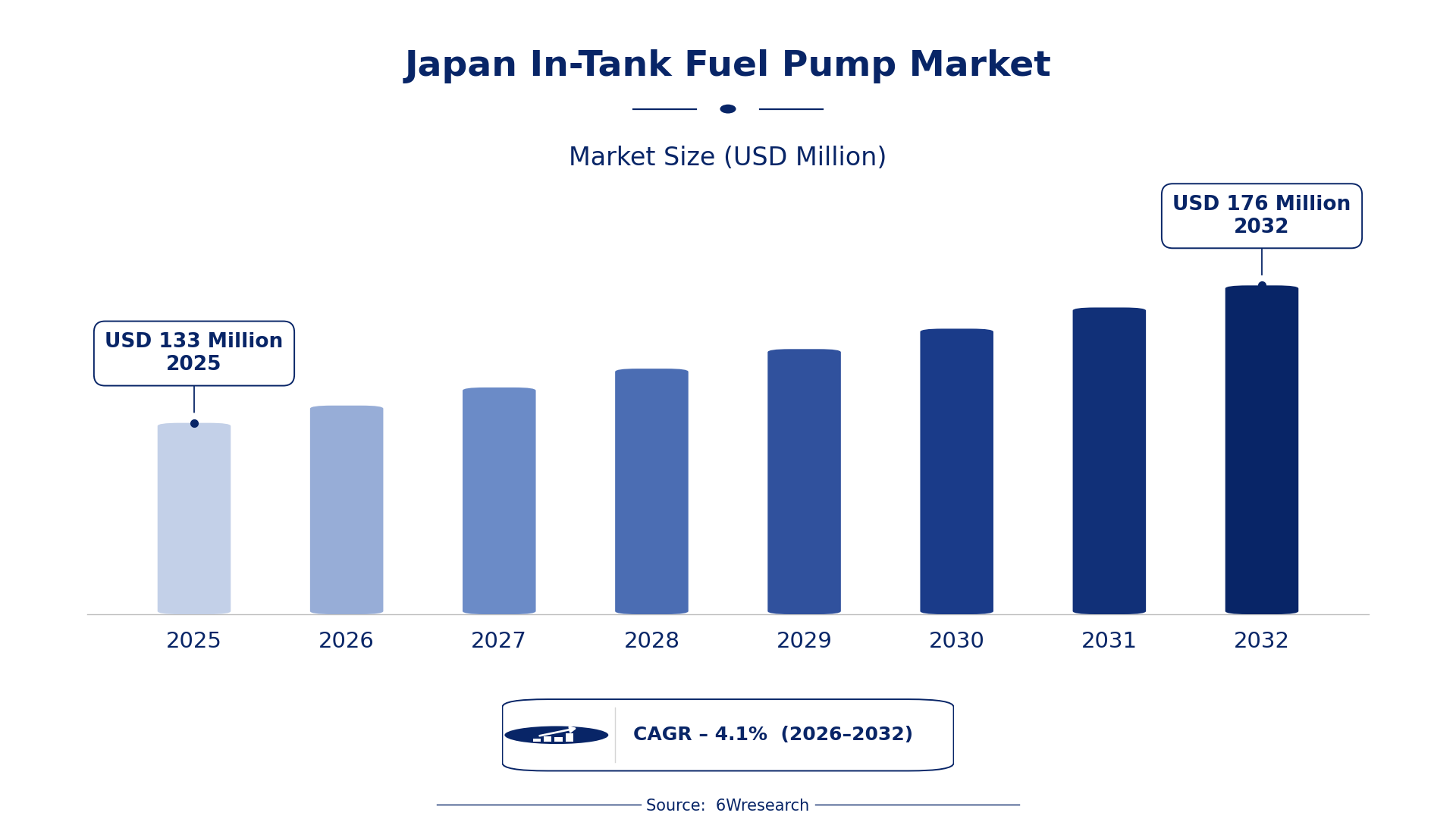
According to 6Wresearch internal database and industry insights, the Japan In-Tank Fuel Pump Market was valued at USD 133 Million in 2025 and is projected to reach USD 176 Million by 2032, growing at a CAGR of approximately 4.1% during 2026–2032.
Japan In-Tank Fuel Pump Market Highlights
| Report Metric | Details |
| Report Name | Japan In-Tank Fuel Pump Market (2026-2032) |
| Market Size 2025 | USD 133 Million |
| Market Size 2032 | USD 176 Million |
| Absolute Growth 2025–2032 | USD 43 Million |
| CAGR 2026–2032 | 4.1% |
| Peak Annual Growth | 5.2% in 2027 |
| Forecast Period | 2026–2032 |
| Historical Data | 2022–2025 |
| Base Year | 2025 |
| Leading Pump Type, 2025 | Electric Fuel Pump (50% share) |
| Leading Fuel Type, 2025 | Gasoline (34% share) |
| Leading Vehicle Type, 2025 | Passenger Cars (43% share) |
| Leading Distribution Channel, 2025 | OEMs (46% share) |
| Leading End User, 2025 | Auto Manufacturers (39% share) |
| Fastest-Growing Pump Type | Gerotor Pump (5.9% CAGR) |
| Fastest-Growing Fuel Type | Biofuel (6.1% CAGR) |
| Fastest-Growing Vehicle Type | Off-road Vehicles (5.8% CAGR) |
| Fastest-Growing Distribution Channel | Online Stores (5.4% CAGR) |
| Fastest-Growing End User | Specialty Modifiers (5.7% CAGR) |
| Growing Sector | automotive sector |
| Key End Users | Auto Manufacturers, Mechanics & Technicians, Fleet Owners, Specialty Modifiers |
Japan In-Tank Fuel Pump Market Year-wise Growth Rate and Key Drivers (2022–2032)
This graph illustrates the annual growth rates of the market from 2022 to 2032, highlighting a steady upward trajectory and projected market expansion over the forecast period.
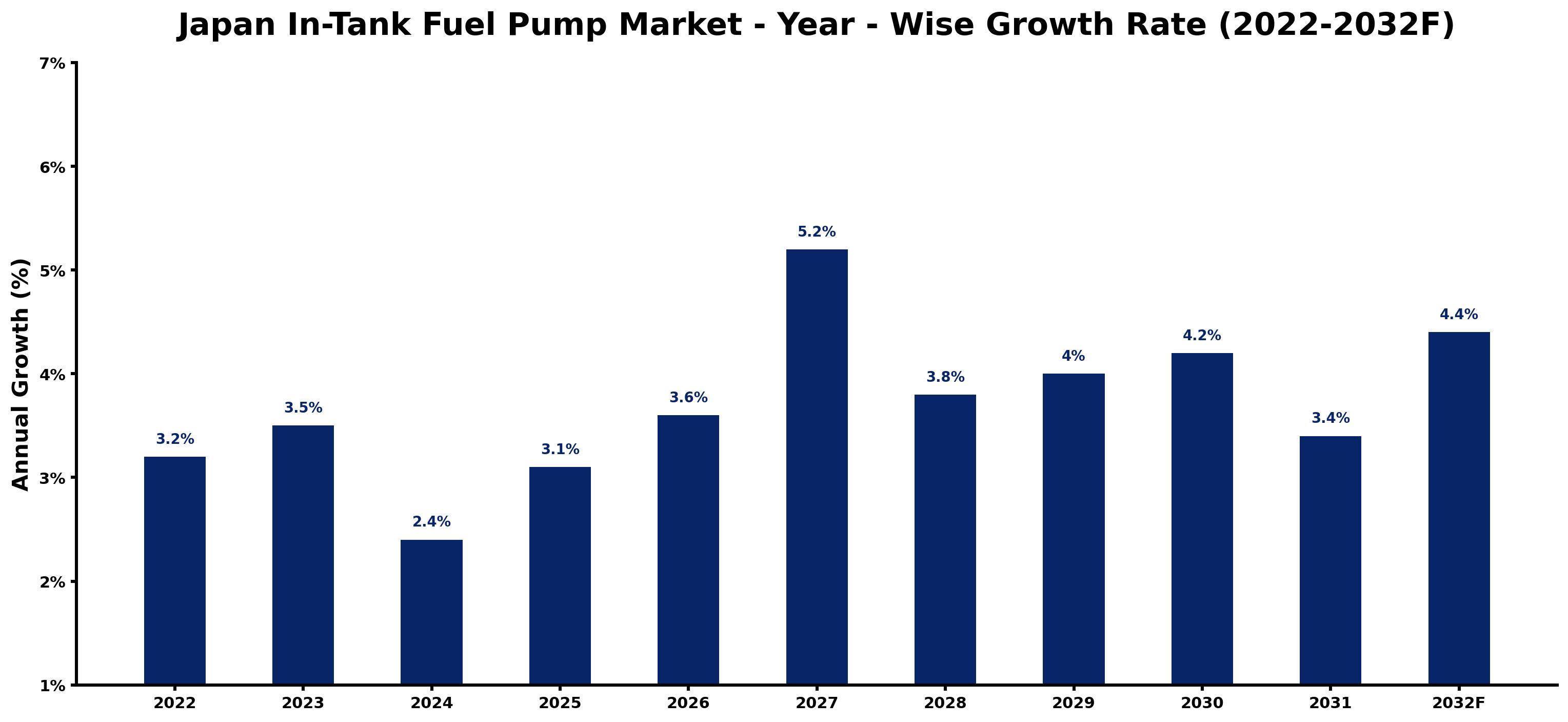
Below, each year's estimated growth is shown next to the factor that most influenced it.
| Year | Estimated Annual Growth (%) | Market Rationale |
| 2022 | 3.2 | The market experienced steady demand due to ongoing automotive activity. |
| 2023 | 3.5 | Growth was driven by increased production of electric fuel pumps for new vehicles. |
| 2024 | 2.4 | A slowdown occurred as production stabilised after previous peaks in demand. |
| 2025 | 3.1 | Demand rose again as the aftermarket for replacement parts expanded. |
| 2026 | 3.6 | Growth is expected to accelerate with rising investments in automotive technologies. |
| 2027 | 5.2 | The market is projected to peak as electric fuel pump adoption surges among new vehicles. |
| 2028 | 3.8 | Growth will slow as the market adjusts to previous high levels of demand. |
| 2029 | 4.0 | Increased vehicle population will support higher demand for fuel pumps. |
| 2030 | 4.2 | Advancements in fuel system technology will contribute to growth. |
| 2031 | 3.4 | A slowdown is anticipated as the market stabilises after rapid growth. |
| 2032 | 4.4 | Demand is expected to rise with continued investments in eco-friendly technologies. |
Note: Market size estimations and growth projections presented in this report are based on 6Wresearch's proprietary forecasting methodology, utilizing the latest available industry data, government publications, and primary research inputs.
Japan In-Tank Fuel Pump Market Synopsis
In-Tank Fuel Pumps are devices that deliver fuel from the tank to the engine in vehicles, primarily electric and made from various materials. The market is expanding due to the automotive sector, which employs over 5 million people and is experiencing growth from increased production of electric fuel pumps. Factors driving this growth include a strong aftermarket for replacement parts and substantial investments in research and development, with the sector projected to invest ¥2 trillion by 2025.
Market Dynamics Impact Analysis (2026–2032)
| Factor | Type | Impact | Primary Segment Affected |
| Rising vehicle population in Japan | Driver | High | Electric Fuel Pump |
| Increased production of electric vehicles | Driver | High | Gasoline |
| Growing demand for biofuels in vehicles | Opportunity | High | Biofuel |
| Expansion of online sales channels for fuel pumps | Opportunity | Medium | Online Stores |
| High competition affecting pricing strategies | Restraint | High | Aftermarket |
| Regulatory changes impacting fuel pump specifications | Restraint | Medium | Electric Fuel Pump |
| Supply chain disruptions affecting production schedules | Challenge | High | Commercial Vehicles |
| Technological advancements requiring constant adaptation | Challenge | Medium | Passenger Cars |
Evaluation of Drivers in Japan In-Tank Fuel Pump Market (2026–2032)
Below are the drivers that matter most for revenue growth, with supporting evidence.
| Drivers | Primary Segment Affected | Why It Matters (Evidence) |
| Increased production of electric vehicles | Electric Fuel Pump | In 2023, over 50% of new vehicles sold were equipped with electric fuel pumps, driving demand for these components. |
| Rising vehicle population | Gasoline | Japan's vehicle population reached approximately 78 million units in 2023, increasing the need for fuel delivery systems. |
| Growing aftermarket for replacement parts | Aftermarket | The Japanese automotive aftermarket was valued at ¥5 trillion in 2023, indicating strong demand for in-tank fuel pumps. |
| Technological advancements in fuel systems | Biofuel | The government initiated a program in 2023 to promote biofuel usage, increasing demand for compatible fuel pumps. |
| Expansion of online sales channels | Online Stores | The shift towards online purchasing is clear as consumers seek convenience and variety in replacement parts. |
Volumes grow on the back of a rising vehicle population, which reached approximately 78 million units in Japan by 2023, increasing the need for reliable fuel delivery systems. The automotive aftermarket, valued at ¥5 trillion in 2023, indicates strong replacement demand for in-tank fuel pumps. The expansion of online sales channels reflects changing consumer preferences, improving accessibility for replacement parts.
Evaluation of Restraints in Japan In-Tank Fuel Pump Market
The key brakes on demand, and where they bite hardest, are shown below.
| Market Restraint | Primary Segment Affected | Why It Matters (Evidence) |
| High competition impacting pricing strategies | Aftermarket | Intense competition among suppliers has led to price pressures, affecting profit margins for aftermarket parts. |
| Regulatory changes affecting specifications | Electric Fuel Pump | New standards under the JIS B 2401 regulation require compliance, increasing production costs for manufacturers. |
| Supply chain disruptions affecting production | Commercial Vehicles | Global supply chain issues have delayed the availability of essential components, impacting production schedules. |
| Technological advancements requiring adaptation | Passenger Cars | Rapid technological changes necessitate continuous investment in R&D, straining resources for manufacturers. |
| Limited awareness of biofuel options | Biofuel | Consumer unfamiliarity with biofuels may hinder adoption, affecting demand for compatible fuel pumps. |
Japan In-Tank Fuel Pump Market Challenges
Japan's vehicle population reached approximately 78 million units in 2023, resulting in supply shortages for in-tank fuel pumps. This high demand leads to production delays for automotive buyers, as suppliers cannot meet the increasing orders. Compliance with regulations like the JIS B 2401 standard raises manufacturing costs, which ultimately limits product availability for buyers. Suppliers face pressure from rapid technological changes, which can result in outdated products that do not meet the evolving needs of buyers, causing further dissatisfaction in the market.
Trends in the Japan In-Tank Fuel Pump Market
Buyers and suppliers in the Japan In-Tank Fuel Pump Market are adjusting to the following trends.
- Shift towards Electric Fuel Pumps: In 2023, over 50% of new vehicles sold in Japan featured electric fuel pumps, reflecting a shift towards energy-efficient technologies. This trend indicates a growing preference among consumers for sustainable automotive solutions.
- Increase in Biofuel Adoption: The Japanese government initiated a program in 2023 to promote biofuel usage, targeting a 46% reduction in greenhouse-gas emissions by 2030. This initiative is driving demand for compatible fuel systems and technology.
- Growth of Online Sales Channels: Online sales of automotive parts are expanding, with a notable increase in consumer preference for purchasing replacement fuel pumps online. This shift is reshaping the distribution model for automotive components.
- Rising Focus on Eco-Friendly Technologies: The automotive sector is increasingly investing in eco-friendly technologies, with a projected ¥2 trillion earmarked for R&D by 2025. This focus is driving innovation in fuel pump design and functionality.
Investment Opportunities in the Japan In-Tank Fuel Pump Market
Below are the investment opportunities with the strongest case in the Japan In-Tank Fuel Pump Market.
- Auto Manufacturers seeking reliable suppliers: Auto manufacturers in Japan are looking for reliable suppliers of electric fuel pumps, with over 50% of new vehicles featuring these components. This presents a strong opportunity for partnerships in the automotive sector.
- Rising Demand for Electric Fuel Pumps in Commercial Vehicles: The demand for electric fuel pumps in commercial vehicles is rising, supported by a vehicle population of 78 million units. Suppliers can enter this market through local partnerships and collaborations.
- Growing Biofuel Market: With the government targeting a 46% reduction in emissions by 2030, the biofuel market is expanding. Suppliers can capitalise on this trend by developing compatible fuel pumps for biofuel vehicles.
- Online Stores for Replacement Parts: The online sales channel is growing, with increasing consumer demand for convenience in purchasing replacement parts. Suppliers can establish e-commerce platforms to tap into this expanding market.
Government Initiatives in the Japan In-Tank Fuel Pump Market
The GX Basic Policy, adopted in 2023, outlines a substantial public-private investment of JPY 150 trillion over 10 years to support decarbonisation efforts. This measure encourages the adoption of cleaner fuel technologies, impacting fuel pump design and production.
The Ministry of Economy, Trade and Industry oversees automotive regulations, approving new technologies and funding initiatives that promote innovation in fuel systems. This includes support for R&D projects aimed at improving fuel pump efficiency.
Future Insight of the Japan In-Tank Fuel Pump Market
New automotive testing facilities are expected to revolutionise fuel pump technology by 2032, improving efficiency and reliability. Investment in R&D is projected to reach ¥2 trillion by 2025, driving advancements in fuel pump design. The government's biofuel programme will influence future specifications, creating new demand for innovative fuel solutions. As the average age of vehicles on Japanese roads is around 10 years, this will provide substantial opportunities for suppliers to upgrade their products and expand their reach in the aftermarket.
Market Segmentation Analysis
Japan In-Tank Fuel Pump Market report covers a detailed analysis of the following market segments:
By Pump Type – Electric Fuel Pump Leads, Gerotor Pump Expected to Grow Fastest
According to Saurav Kr Singh, Senior Research Analyst at 6Wresearch, Electric Fuel Pump accounted for 50% of the market by pump type in 2025. The Electric Fuel Pump commands the largest share owing to its prevalent application in modern vehicles for efficient fuel delivery. With over 50% of new vehicles sold in Japan in 2023 featuring electric fuel pumps, this segment showcases its market dominance. The quickest growth will come from Gerotor Pump, forecast to expand at a CAGR of 5.9% between 2026 and 2032. The Gerotor Pump is growing rapidly as it caters to niche applications in specialized vehicles, reflecting the rising demand for tailored fuel systems. Recent advancements highlighted at the Tokyo Motor Show 2023 indicate a promising future for this technology. Suppliers should prioritise the development of electric fuel pump technologies to align with market demands.
By Fuel Type – Gasoline Leads, Biofuel Expected to Grow Fastest
Gasoline held 34% of the Japan In-Tank Fuel Pump Market by fuel type in 2025. Gasoline is the leading fuel type as it remains the primary choice for most vehicles in Japan, reflecting consumer preferences and infrastructure. The vehicle population of approximately 78 million units in 2023 predominantly relies on gasoline for operation. Biofuel is set to record the highest CAGR in this split, 6.1% over 2026–2032. Biofuel is the fastest-growing segment, spurred by government initiatives promoting eco-friendly vehicles and alternative fuels. In 2023, the Japanese government initiated a program to promote biofuel usage, indicating a shift towards sustainable options. Buyers are likely to see a broader range of biofuel-compatible vehicles in the market as demand increases.
By Vehicle Type – Passenger Cars Lead, Off-road Vehicles Expected to Grow Fastest
Passenger Cars took 43% of vehicle type revenue in 2025, more than any other category. Passenger Cars dominate the market as they are the primary segment utilising in-tank pumps, driven by high sales volumes and consumer preferences. The vehicle population in Japan, which reached approximately 78 million units in 2023, underscores the sustained demand for this category. Over 2026–2032, Off-road Vehicles are expected to post the fastest growth, at a CAGR of 5.8%. Off-road Vehicles are witnessing the fastest growth, propelled by a surge in recreational activities and the need for specialised fuel systems. The increasing popularity of outdoor pursuits in Japan is expected to further boost this segment's expansion. Suppliers should focus on off-road vehicle manufacturers to leverage this growing market.
By Distribution Channel – OEMs Lead, Online Stores Expected to Grow Fastest
In 2025, OEMs led the distribution channel split with a 46% share. OEMs serve as the leading distribution channel, being the main source for in-tank fuel pump installations in new vehicles. Their established relationships with manufacturers ensure a reliable supply of electric fuel pumps for production. Online Stores are projected to grow fastest, at a CAGR of 5.4% during 2026–2032. Online Stores are rapidly gaining traction as a preferred distribution channel, catering to the rising consumer demand for replacement parts. The convenience of online shopping is attracting a broader customer base, particularly in the parts replacement sector. Suppliers need to enhance their online strategies to capitalise on the increasing trend of online purchases.
By End User – Auto Manufacturers Lead, Specialty Modifiers Expected to Grow Fastest
The largest end user category in 2025 was Auto Manufacturers, at 39% of revenue. Auto Manufacturers are the largest end users of in-tank fuel pumps, integrating these components into their production processes. Their substantial investment in automotive research and development, projected at ¥2 trillion by 2025, guarantees ongoing demand for fuel pumps. The quickest growth will come from Specialty Modifiers, forecast to expand at a CAGR of 5.7% between 2026 and 2032. Specialty Modifiers are experiencing the fastest growth, driven by a rising interest in customised fuel systems for niche markets. This trend aligns with consumer desires for unique vehicle modifications and improved performance capabilities. Suppliers should explore partnerships with specialty modifiers to tap into this emerging market opportunity.
Key Attractiveness of the Report
- 10 Years of Market Numbers
- Historical Data Starting from 2022 to 2025
- Base Year 2025
- Forecast Data until 2032
- Key Performance Indicators Impacting the Market
- Major Upcoming Developments and Projects
Key Highlights of the Report:
- Japan In-Tank Fuel Pump Market Outlook
- Market Size of Japan In-Tank Fuel Pump Market, 2025
- Forecast of Japan In-Tank Fuel Pump Market, 2032
- Historical Data and Forecast of Japan In-Tank Fuel Pump Revenues & Volume for the Period 2022-2032F
- Japan In-Tank Fuel Pump Market Trend Evolution
- Japan In-Tank Fuel Pump Market Drivers and Challenges
- Japan In-Tank Fuel Pump Price Trends
- Japan In-Tank Fuel Pump Porter's Five Forces
- Japan In-Tank Fuel Pump Industry Life Cycle
- Historical Data and Forecast of Japan In-Tank Fuel Pump Market Revenues & Volume By Pump Type for the Period 2022-2032F
- Historical Data and Forecast of Japan In-Tank Fuel Pump Market Revenues & Volume By Electric Fuel Pump for the Period 2022-2032F
- Historical Data and Forecast of Japan In-Tank Fuel Pump Market Revenues & Volume By Turbine Style Pump for the Period 2022-2032F
- Historical Data and Forecast of Japan In-Tank Fuel Pump Market Revenues & Volume By Rotary Vane Pump for the Period 2022-2032F
- Historical Data and Forecast of Japan In-Tank Fuel Pump Market Revenues & Volume By Gerotor Pump for the Period 2022-2032F
- Historical Data and Forecast of Japan In-Tank Fuel Pump Market Revenues & Volume By Fuel Type for the Period 2022-2032F
- Historical Data and Forecast of Japan In-Tank Fuel Pump Market Revenues & Volume By Gasoline for the Period 2022-2032F
- Historical Data and Forecast of Japan In-Tank Fuel Pump Market Revenues & Volume By Diesel for the Period 2022-2032F
- Historical Data and Forecast of Japan In-Tank Fuel Pump Market Revenues & Volume By Flex-Fuel for the Period 2022-2032F
- Historical Data and Forecast of Japan In-Tank Fuel Pump Market Revenues & Volume By Biofuel for the Period 2022-2032F
- Historical Data and Forecast of Japan In-Tank Fuel Pump Market Revenues & Volume By Vehicle Type for the Period 2022-2032F
- Historical Data and Forecast of Japan In-Tank Fuel Pump Market Revenues & Volume By Passenger Cars for the Period 2022-2032F
- Historical Data and Forecast of Japan In-Tank Fuel Pump Market Revenues & Volume By Commercial Vehicles for the Period 2022-2032F
- Historical Data and Forecast of Japan In-Tank Fuel Pump Market Revenues & Volume By Two-Wheelers for the Period 2022-2032F
- Historical Data and Forecast of Japan In-Tank Fuel Pump Market Revenues & Volume By Off-road Vehicles for the Period 2022-2032F
- Historical Data and Forecast of Japan In-Tank Fuel Pump Market Revenues & Volume By Distribution Channel for the Period 2022-2032F
- Historical Data and Forecast of Japan In-Tank Fuel Pump Market Revenues & Volume By OEMs for the Period 2022-2032F
- Historical Data and Forecast of Japan In-Tank Fuel Pump Market Revenues & Volume By Aftermarket for the Period 2022-2032F
- Historical Data and Forecast of Japan In-Tank Fuel Pump Market Revenues & Volume By Online Stores for the Period 2022-2032F
- Historical Data and Forecast of Japan In-Tank Fuel Pump Market Revenues & Volume By Auto Parts Dealers for the Period 2022-2032F
- Historical Data and Forecast of Japan In-Tank Fuel Pump Market Revenues & Volume By End User for the Period 2022-2032F
- Historical Data and Forecast of Japan In-Tank Fuel Pump Market Revenues & Volume By Auto Manufacturers for the Period 2022-2032F
- Historical Data and Forecast of Japan In-Tank Fuel Pump Market Revenues & Volume By Mechanics & Technicians for the Period 2022-2032F
- Historical Data and Forecast of Japan In-Tank Fuel Pump Market Revenues & Volume By Fleet Owners for the Period 2022-2032F
- Historical Data and Forecast of Japan In-Tank Fuel Pump Market Revenues & Volume By Specialty Modifiers for the Period 2022-2032F
- Japan In-Tank Fuel Pump Import Export Trade Statistics
- Market Opportunity Assessment By Pump Type
- Market Opportunity Assessment By Fuel Type
- Market Opportunity Assessment By Vehicle Type
- Market Opportunity Assessment By Distribution Channel
- Market Opportunity Assessment By End User
- Japan In-Tank Fuel Pump Top Companies Market Share
- Japan In-Tank Fuel Pump Competitive Benchmarking By Technical and Operational Parameters
- Japan In-Tank Fuel Pump Company Profiles
- Japan In-Tank Fuel Pump Key Strategic Recommendations
Market Covered
The following segment groups are covered in the report.
By Pump Type
- Electric Fuel Pump
- Turbine Style Pump
- Rotary Vane Pump
- Gerotor Pump
By Fuel Type
- Gasoline
- Diesel
- Flex-Fuel
- Biofuel
By Vehicle Type
- Passenger Cars
- Commercial Vehicles
- Two-Wheelers
- Off-road Vehicles
By Distribution Channel
- OEMs
- Aftermarket
- Online Stores
- Auto Parts Dealers
By End User
- Auto Manufacturers
- Mechanics & Technicians
- Fleet Owners
- Specialty Modifiers































