Japan In-Wheel Propulsion System Market Size & Growth Rate
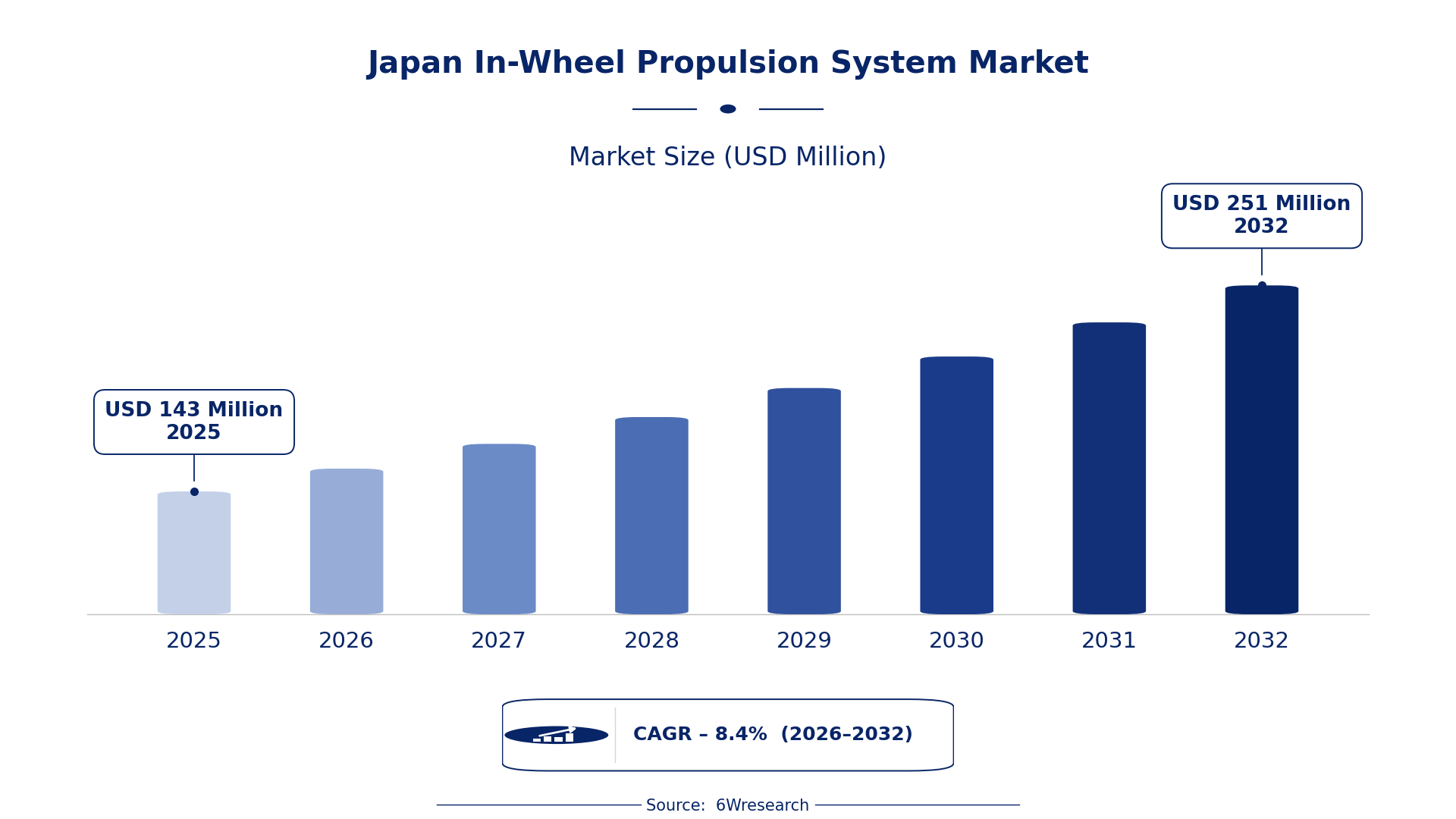
According to 6Wresearch internal database and industry insights, the Japan In-Wheel Propulsion System Market was valued at USD 143 Million in 2025 and is projected to reach USD 251 Million by 2032, growing at a CAGR of approximately 8.4% during 2026–2032.
Japan In-Wheel Propulsion System Market Highlights
| Report Metric | Details |
| Report Name | Japan In-Wheel Propulsion System Market (2026-2032) |
| Market Size 2025 | USD 143 Million |
| Market Size 2032 | USD 251 Million |
| Absolute Growth 2025–2032 | USD 108 Million |
| CAGR 2026–2032 | 8.4% |
| Peak Annual Growth | 9.5% in 2032 |
| Forecast Period | 2026–2032 |
| Historical Data | 2022–2025 |
| Base Year | 2025 |
| Leading Propulsion Type, 2025 | Electric Drive Unit (53% share) |
| Leading Power Source, 2025 | Battery Electric Vehicle (40% share) |
| Leading Vehicle Segment, 2025 | Mid-Size Cars (35% share) |
| Leading Control Architecture, 2025 | Centralized (40% share) |
| Leading End User, 2025 | EV Startups (37% share) |
| Fastest-Growing Propulsion Type | Hybrid Propulsion (12.5% CAGR) |
| Fastest-Growing Power Source | Plug-in Hybrid (12.3% CAGR) |
| Fastest-Growing Vehicle Segment | SUVs (11.0% CAGR) |
| Fastest-Growing Control Architecture | Distributed (11.6% CAGR) |
| Fastest-Growing End User | Vehicle OEMs (11.1% CAGR) |
| Growing Sector | Electric Vehicle Manufacturing |
| Key End Users | Electric Vehicle Manufacturers, Automotive OEMs, EV Startups, Performance Brands |
Japan In-Wheel Propulsion System Market Year-wise Growth Rate and Key Drivers (2022–2032)
This graph illustrates the annual growth rates of the market from 2022 to 2032, highlighting a steady upward trajectory and projected market expansion over the forecast period.
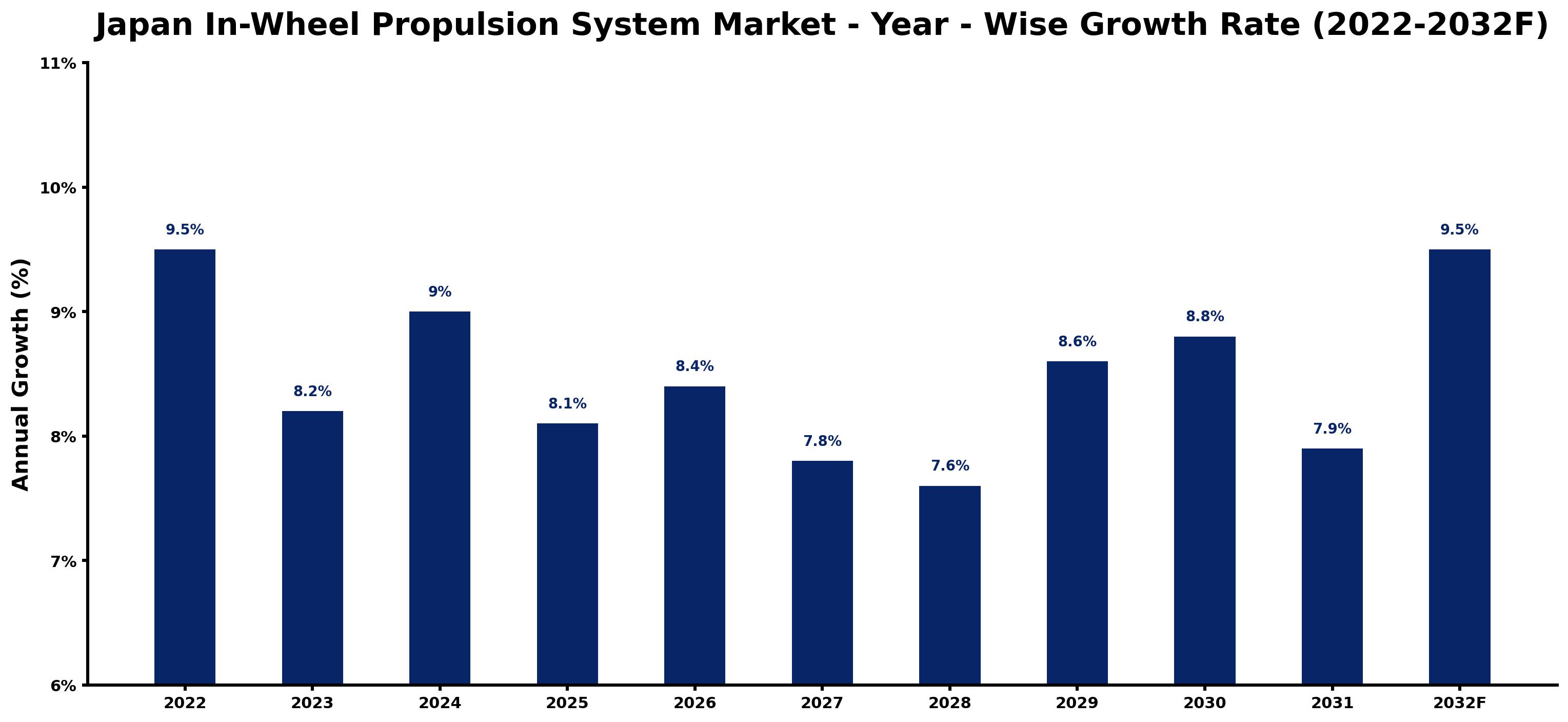
Each row of the following table gives one year's estimated growth and the event or demand shift that explains it.
| Year | Estimated Annual Growth (%) | Market Rationale |
| 2022 | 9.5 | The market experienced strong demand from electric vehicle manufacturers and users. |
| 2023 | 8.2 | Growth slowed slightly due to supply chain challenges affecting production rates. |
| 2024 | 9.0 | Demand increased as new electric vehicle models were introduced to the market. |
| 2025 | 8.1 | Growth moderated as manufacturers adjusted to changing market conditions. |
| 2026 | 8.4 | Investment in EV infrastructure is expected to drive higher demand for in-wheel systems. |
| 2027 | 7.8 | Market growth is projected to slow as competition intensifies among vehicle manufacturers. |
| 2028 | 7.6 | Demand will continue to slow as market saturation begins to set in. |
| 2029 | 8.6 | Growth is expected to accelerate again with the introduction of new technologies and models. |
| 2030 | 8.8 | Continued investment in electric vehicles will spur further demand for in-wheel systems. |
| 2031 | 7.9 | Growth is projected to slow as the market begins to stabilise after rapid expansion. |
| 2032 | 9.5 | Demand will surge again as manufacturers focus on advanced propulsion technologies. |
Note: Market size estimations and growth projections presented in this report are based on 6Wresearch's proprietary forecasting methodology, utilizing the latest available industry data, government publications, and primary research inputs.
Japan In-Wheel Propulsion System Market Synopsis
In-Wheel Propulsion Systems integrate electric motors directly into vehicle wheel hubs, improving vehicle performance and energy efficiency. The Japan In-Wheel Propulsion System Market is expanding due to rising electric vehicle sales, projected to reach 1.5 million units by 2025. Key factors driving this growth include government support for EV adoption and advancements in battery technology, creating a competitive environment for manufacturers and buyers alike. The thriving automotive sector in Japan, particularly in electric vehicle manufacturing, continues to fuel demand from domestic users and exports.
Market Dynamics Impact Analysis (2026–2032)
| Factor | Type | Impact | Primary Segment Affected |
| Rising electric vehicle sales driven by domestic demand and exports. | Driver | High | Battery Electric Vehicle |
| Investment in EV infrastructure development to support growing vehicle numbers. | Driver | High | Electric Drive Unit |
| Increasing demand for innovative propulsion technologies in urban areas. | Opportunity | Medium | Dual-Motor System |
| Growth in the automotive innovation hub of Chubu region. | Opportunity | Medium | Hybrid Propulsion |
| Supply chain challenges affecting component availability. | Restraint | High | Regenerative Propulsion |
| Competition among manufacturers leading to price pressures. | Restraint | Medium | Electric Drive Unit |
| High development costs for advanced propulsion technologies. | Challenge | High | Battery Electric Vehicle |
| Rapid technological advancements requiring continuous investment. | Challenge | Medium | Dual-Motor System |
Evaluation of Drivers in Japan In-Wheel Propulsion System Market (2026–2032)
The following drivers explain most of the expected growth.
| Drivers | Primary Segment Affected | Why It Matters (Evidence) |
| Increased electric vehicle sales in urban areas. | Battery Electric Vehicle | Japan's electric vehicle market is projected to reach 1.5 million units by 2025, driving demand for in-wheel systems. |
| Government support for EV infrastructure development. | Electric Drive Unit | The government allocated ¥100 billion for EV infrastructure in 2023, boosting the market for in-wheel propulsion. |
| Technological advancements in battery efficiency. | Dual-Motor System | The average range of battery electric vehicles is increasing to over 500 km, encouraging adoption of advanced systems. |
| Growing consumer preference for compact vehicle designs. | Hybrid Propulsion | The Tokyo metropolitan area has the highest concentration of electric vehicle users, increasing demand for compact designs. |
| Rising investments from automotive manufacturers in R&D. | Regenerative Propulsion | The Chubu region is a hub for automotive innovation, attracting investments in advanced technologies. |
Volumes grow on the back of increasing electric vehicle sales, projected to reach 1.5 million units by 2025, particularly in urban areas where adoption rates exceed 15%. Support for EV infrastructure, with ¥100 billion allocated in 2023, boosts the market for in-wheel systems. As battery electric vehicle ranges rise, manufacturers are encouraged to adopt advanced propulsion technologies. Consumer preferences for compact designs further increase demand for in-wheel propulsion systems in hybrid vehicles, leading to a competitive market environment.
Evaluation of Restraints in Japan In-Wheel Propulsion System Market
The main factors holding the market back are set out below.
| Market Restraint | Primary Segment Affected | Why It Matters (Evidence) |
| Supply chain disruptions affecting component availability. | Regenerative Propulsion | Manufacturers face delays due to shortages in critical components, impacting production timelines. |
| Intense competition leading to price pressures. | Electric Drive Unit | As more players enter the market, aggressive pricing strategies affect profit margins. |
| High development costs for advanced technologies. | Battery Electric Vehicle | Investments in R&D for in-wheel systems can exceed ¥10 million, limiting smaller players' market entry. |
| Market saturation in urban areas. | Dual-Motor System | As the number of electric vehicles increases, the market for in-wheel systems may become saturated. |
| Regulatory compliance costs for safety standards. | Hybrid Propulsion | Compliance with JIS D 6801 standards raises operational costs for manufacturers. |
Japan In-Wheel Propulsion System Market Challenges
Producers face high production costs due to the integration of advanced materials in the In-Wheel Propulsion System, increasing expenses by 20% and squeezing profit margins. Extensive testing and certification for compliance with JIS D 6801 delays product launches for manufacturers by an average of six months. Distributors encounter challenges with limited charging infrastructure, as over 30,000 stations are insufficient to support the expected 1.5 million electric vehicles by 2025, leading to range anxiety and potential sales losses. A shortage of skilled precision engineers hampers production efficiency, resulting in a 15% increase in lead times for manufacturers.
Trends in the Japan In-Wheel Propulsion System Market
Below are the shifts with the largest effect on the Japan In-Wheel Propulsion System Market.
- Shift towards Compact Vehicle Designs: In 2023, the average range of battery electric vehicles in Japan increased, prompting a shift towards compact designs. This trend is reflected in the growing number of mid-size cars integrating in-wheel propulsion systems, catering to urban consumers.
- Emergence of Advanced Propulsion Technologies: Since 2023, the adoption of dual-motor systems has accelerated, driven by consumer demand for improved vehicle performance. The Chubu region is leading this shift, with notable investments in automotive innovation.
- Focus on Sustainable Transport Initiatives: The 'Green Mobility' initiative launched in 2023 promotes sustainable transport solutions, encouraging the adoption of in-wheel propulsion systems. This aligns with Japan's goal for 100% electric vehicle sales by 2035.
- Growth of EV Charging Infrastructure: In 2023, Japan exceeded 30,000 EV charging stations, facilitating electric vehicle adoption. This expansion supports the integration of in-wheel propulsion systems, improving overall vehicle efficiency.
Investment Opportunities in the Japan In-Wheel Propulsion System Market
The following opportunities in the Japan In-Wheel Propulsion System Market pair current demand with a clear way in.
- Investment in EV Charging Networks: With over 30,000 EV charging stations in Japan, there is a notable opportunity for investment in charging infrastructure. Collaborating with local governments in urban areas can improve market access.
- Expansion in the Chubu Automotive Hub: The Chubu region's focus on automotive innovation presents opportunities for suppliers of in-wheel systems. Engaging with local vehicle OEMs can facilitate entry into this growing market.
- Collaboration with EV Startups: As EV startups lead in adopting new technologies, there is a gap for suppliers to provide in-wheel propulsion systems. Partnerships can be established to meet their specific needs.
- Development of Regenerative Propulsion Systems: With increasing emphasis on energy recovery, investing in regenerative propulsion technologies can meet growing demand. Targeting vehicle manufacturers focusing on sustainability can yield substantial returns.
Government Initiatives in the Japan In-Wheel Propulsion System Market
The Electrical Appliance and Material Safety Act of 1961 regulates the safety of electrical appliances, ensuring that in-wheel propulsion systems meet required standards. Additionally, the Hydrogen Society Promotion Act of 2024 supports low-carbon technologies, benefiting the in-wheel propulsion sector by promoting electric vehicle adoption.
In 2023, ¥100 billion was allocated for EV infrastructure development, administered by the Ministry of the Environment. This funding aims to improve charging networks and support the growth of electric vehicles, benefiting in-wheel propulsion system manufacturers.
Future Insight of the Japan In-Wheel Propulsion System Market
Urban buyers will increasingly adopt electric vehicles, driven by government subsidies and the 'Green Mobility' initiative, enhancing market penetration. By 2032, the average range of electric vehicles will surpass 500 km, boosting user confidence and encouraging broader adoption. Investment in EV charging networks will improve infrastructure, facilitating easier access for consumers. The Chubu region's focus on automotive innovation will attract suppliers, fostering collaboration and advancing technology in the In-Wheel Propulsion System.
Market Segmentation Analysis
Japan In-Wheel Propulsion System Market report covers a detailed analysis of the following market segments:
By Propulsion Type – Electric Drive Unit Leads, Hybrid Propulsion Expected to Grow Fastest
According to Saurav Kr Singh, Senior Research Analyst at 6Wresearch, with 53% of propulsion type revenue in 2025, Electric Drive Unit was the largest category. The Electric Drive Unit holds the largest share due to its essential role in in-wheel systems, which are increasingly adopted in electric vehicles. The Tokyo metropolitan area's high density of electric vehicle users illustrates the growing reliance on this technology for enhanced performance. Over 2026–2032, Hybrid Propulsion is expected to post the fastest growth, at a CAGR of 12.5%. Hybrid Propulsion is rapidly gaining traction as it appeals to consumers seeking a balance between electric and traditional engines. The government's financial incentives for electric vehicle adoption further fuel this segment's growth. Suppliers should focus on advancing hybrid propulsion technologies to meet the escalating demand from manufacturers.
By Power Source – Battery Electric Vehicle Leads, Plug-in Hybrid Expected to Grow Fastest
The largest power source category in 2025 was Battery Electric Vehicle, at 40% of revenue. Battery Electric Vehicles dominate the market as they are the primary application for in-wheel propulsion systems, vital for optimising electric vehicle performance. Japan's goal for 100% electric new car sales by 2035 underscores the significance of this segment. The quickest growth will come from Plug-in Hybrid, forecast to expand at a CAGR of 12.3% between 2026 and 2032. Plug-in Hybrids are experiencing robust growth as they offer consumers a flexible transition to electric vehicles while still utilising conventional engines. The increasing average range of battery electric vehicles supports this upward trajectory. Buyers will benefit from a wider selection of power source options, enhancing vehicle performance and efficiency.
By Vehicle Segment – Mid-Size Cars Lead, SUVs Expected to Grow Fastest
In 2025, Mid-Size Cars led the vehicle segment split with a 35% share. Mid-Size Cars represent the largest segment utilising in-wheel systems, as they balance performance and practicality for everyday users. This segment's popularity in urban areas, where electric vehicle adoption is over 15%, further solidifies its market position. SUVs are set to record the highest CAGR in this split, 11.0% over 2026–2032. SUVs are rapidly gaining traction due to their appeal for advanced propulsion technologies and consumer preferences for larger vehicles. The government's initiatives promoting sustainable transport also favour this segment's growth. Manufacturers should prioritise the development of in-wheel systems tailored for SUVs to capitalise on this growing market.
By Control Architecture – Centralized Leads, Distributed Expected to Grow Fastest
Centralized accounted for 40% of the market by control architecture in 2025. Centralized control architecture, though less common, retains a significant market share as it is incorporated into various in-wheel systems. Its reliability in managing vehicle dynamics appeals to specific manufacturers seeking consistency in performance. Distributed is projected to grow fastest, at a CAGR of 11.6% during 2026–2032. Distributed control architecture is rapidly gaining popularity as it allows for more efficient management of in-wheel propulsion systems, optimising overall vehicle performance. The increasing complexity of electric vehicles necessitates a shift towards distributed systems. Suppliers must prioritise the development of distributed control technologies to maintain competitiveness in the market.
By End User – EV Startups Lead, Vehicle OEMs Expected to Grow Fastest
EV Startups took 37% of end user revenue in 2025, more than any other category. EV Startups lead the market as they are early adopters of innovative propulsion technologies, driving demand for in-wheel systems. Their focus on electric vehicles aligns with Japan's commitment to sustainable transport solutions. Over 2026–2032, Vehicle OEMs are expected to post the fastest growth, at a CAGR of 11.1%. Vehicle OEMs are swiftly integrating in-wheel propulsion technology into their offerings, responding to the growing demand for electric vehicles. This trend is reinforced by government incentives for electric vehicle purchases, motivating OEMs to innovate. Suppliers should strengthen partnerships with vehicle OEMs to ensure their technologies meet the requirements of large-scale production.
Key Attractiveness of the Report
- 10 Years of Market Numbers
- Historical Data Starting from 2022 to 2025
- Base Year 2025
- Forecast Data until 2032
- Key Performance Indicators Impacting the Market
- Major Upcoming Developments and Projects
Key Highlights of the Report:
- Japan In-Wheel Propulsion System Market Outlook
- Market Size of Japan In-Wheel Propulsion System Market, 2025
- Forecast of Japan In-Wheel Propulsion System Market, 2032
- Historical Data and Forecast of Japan In-Wheel Propulsion System Revenues & Volume for the Period 2022-2032F
- Japan In-Wheel Propulsion System Market Trend Evolution
- Japan In-Wheel Propulsion System Market Drivers and Challenges
- Japan In-Wheel Propulsion System Price Trends
- Japan In-Wheel Propulsion System Porter's Five Forces
- Japan In-Wheel Propulsion System Industry Life Cycle
- Historical Data and Forecast of Japan In-Wheel Propulsion System Market Revenues & Volume By Propulsion Type for the Period 2022-2032F
- Historical Data and Forecast of Japan In-Wheel Propulsion System Market Revenues & Volume By Electric Drive Unit for the Period 2022-2032F
- Historical Data and Forecast of Japan In-Wheel Propulsion System Market Revenues & Volume By Hybrid Propulsion for the Period 2022-2032F
- Historical Data and Forecast of Japan In-Wheel Propulsion System Market Revenues & Volume By Dual-Motor System for the Period 2022-2032F
- Historical Data and Forecast of Japan In-Wheel Propulsion System Market Revenues & Volume By Regenerative Propulsion for the Period 2022-2032F
- Historical Data and Forecast of Japan In-Wheel Propulsion System Market Revenues & Volume By Power Source for the Period 2022-2032F
- Historical Data and Forecast of Japan In-Wheel Propulsion System Market Revenues & Volume By Battery Electric Vehicle for the Period 2022-2032F
- Historical Data and Forecast of Japan In-Wheel Propulsion System Market Revenues & Volume By Plug-in Hybrid for the Period 2022-2032F
- Historical Data and Forecast of Japan In-Wheel Propulsion System Market Revenues & Volume By Fuel Cell Electric for the Period 2022-2032F
- Historical Data and Forecast of Japan In-Wheel Propulsion System Market Revenues & Volume By BEV for the Period 2022-2032F
- Historical Data and Forecast of Japan In-Wheel Propulsion System Market Revenues & Volume By Vehicle Segment for the Period 2022-2032F
- Historical Data and Forecast of Japan In-Wheel Propulsion System Market Revenues & Volume By Mid-Size Cars for the Period 2022-2032F
- Historical Data and Forecast of Japan In-Wheel Propulsion System Market Revenues & Volume By SUVs for the Period 2022-2032F
- Historical Data and Forecast of Japan In-Wheel Propulsion System Market Revenues & Volume By Performance Cars for the Period 2022-2032F
- Historical Data and Forecast of Japan In-Wheel Propulsion System Market Revenues & Volume By Two-Wheelers for the Period 2022-2032F
- Historical Data and Forecast of Japan In-Wheel Propulsion System Market Revenues & Volume By Control Architecture for the Period 2022-2032F
- Historical Data and Forecast of Japan In-Wheel Propulsion System Market Revenues & Volume By Centralized for the Period 2022-2032F
- Historical Data and Forecast of Japan In-Wheel Propulsion System Market Revenues & Volume By Distributed for the Period 2022-2032F
- Historical Data and Forecast of Japan In-Wheel Propulsion System Market Revenues & Volume By Torque Vectoring for the Period 2022-2032F
- Historical Data and Forecast of Japan In-Wheel Propulsion System Market Revenues & Volume By Sensor-Based Control for the Period 2022-2032F
- Historical Data and Forecast of Japan In-Wheel Propulsion System Market Revenues & Volume By End User for the Period 2022-2032F
- Historical Data and Forecast of Japan In-Wheel Propulsion System Market Revenues & Volume By EV Startups for the Period 2022-2032F
- Historical Data and Forecast of Japan In-Wheel Propulsion System Market Revenues & Volume By Vehicle OEMs for the Period 2022-2032F
- Historical Data and Forecast of Japan In-Wheel Propulsion System Market Revenues & Volume By Performance Brands for the Period 2022-2032F
- Historical Data and Forecast of Japan In-Wheel Propulsion System Market Revenues & Volume By Micro Mobility Firms for the Period 2022-2032F
- Japan In-Wheel Propulsion System Import Export Trade Statistics
- Market Opportunity Assessment By Propulsion Type
- Market Opportunity Assessment By Power Source
- Market Opportunity Assessment By Vehicle Segment
- Market Opportunity Assessment By Control Architecture
- Market Opportunity Assessment By End User
- Japan In-Wheel Propulsion System Top Companies Market Share
- Japan In-Wheel Propulsion System Competitive Benchmarking By Technical and Operational Parameters
- Japan In-Wheel Propulsion System Company Profiles
- Japan In-Wheel Propulsion System Key Strategic Recommendations
Market Covered
The following segment groups are covered in the report.
By Propulsion Type
- Electric Drive Unit
- Hybrid Propulsion
- Dual-Motor System
- Regenerative Propulsion
By Power Source
- Battery Electric Vehicle
- Plug-in Hybrid
- Fuel Cell Electric
- BEV
By Vehicle Segment
- Mid-Size Cars
- SUVs
- Performance Cars
- Two-Wheelers
By Control Architecture
- Centralized
- Distributed
- Torque Vectoring
- Sensor-Based Control
By End User
- EV Startups
- Vehicle OEMs
- Performance Brands
- Micro Mobility Firms































