Japan Infectious Disease Vaccine Market Size & Growth Rate
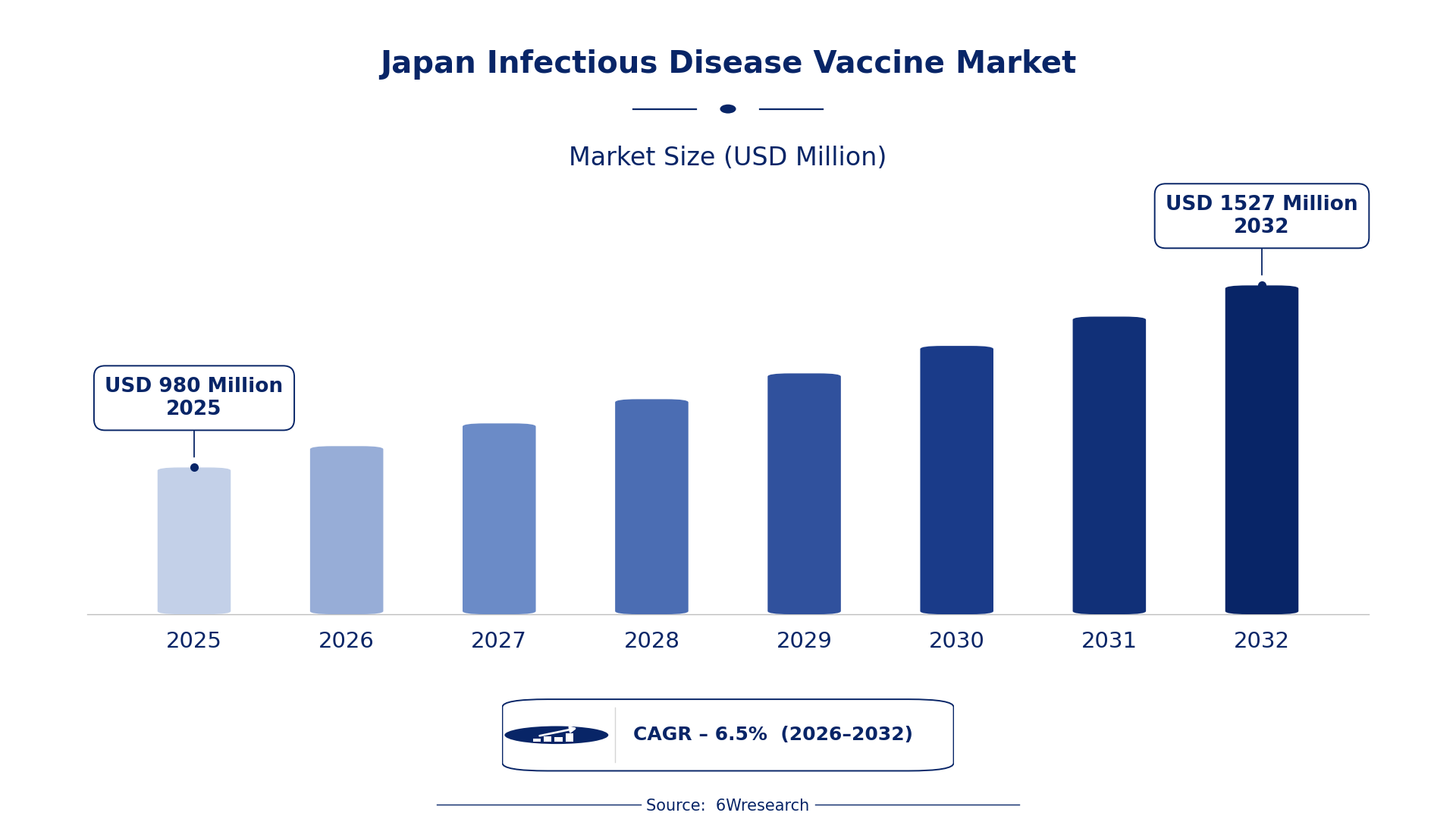
According to 6Wresearch internal database and industry insights, the Japan Infectious Disease Vaccine Market was valued at USD 980 Million in 2025 and is projected to reach USD 1,527 Million by 2032, growing at a CAGR of approximately 6.5% during 2026–2032.
Japan Infectious Disease Vaccine Market Highlights
| Report Metric | Details |
| Report Name | Japan Infectious Disease Vaccine Market (2026-2032) |
| Market Size 2025 | USD 980 Million |
| Market Size 2032 | USD 1,527 Million |
| Absolute Growth 2025–2032 | USD 547 Million |
| CAGR 2026–2032 | 6.5% |
| Peak Annual Growth | 7.8% in 2026 |
| Forecast Period | 2026–2032 |
| Historical Data | 2022–2025 |
| Base Year | 2025 |
| Leading Vaccine Type, 2025 | Viral Vaccines (36% share) |
| Leading Technology Platform, 2025 | mRNA-Based (47% share) |
| Leading Target Age Group, 2025 | Infants & Children (51% share) |
| Leading Distribution Channel, 2025 | National Immunization (39% share) |
| Fastest-Growing Vaccine Type | Bacterial Vaccines (8.8% CAGR) |
| Fastest-Growing Technology Platform | Protein Subunit (8.9% CAGR) |
| Fastest-Growing Target Age Group | Adults & Elderly (8.4% CAGR) |
| Fastest-Growing Distribution Channel | Hospitals (7.9% CAGR) |
| Growing Sector | Public Health |
| Key End Users | Hospitals, Government Health Agencies, Healthcare Providers |
Japan Infectious Disease Vaccine Market Year-wise Growth Rate and Key Drivers (2022–2032)
This graph illustrates the annual growth rates of the market from 2022 to 2032, highlighting a steady upward trajectory and projected market expansion over the forecast period.
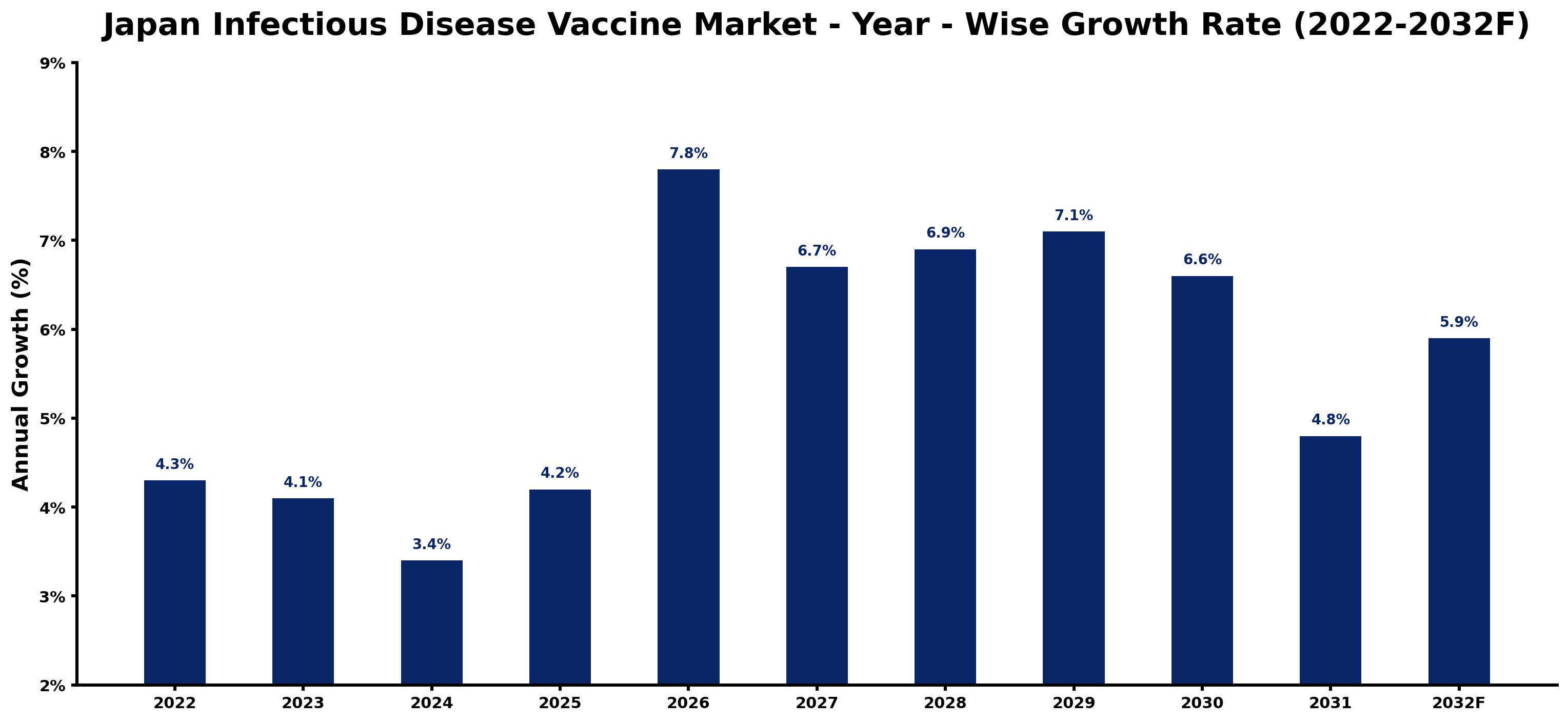
Year by year, the estimates below pair each growth rate with the development that shaped it.
| Year | Estimated Annual Growth (%) | Market Rationale |
| 2022 | 4.3 | The market showed steady growth, driven by ongoing public health initiatives. |
| 2023 | 4.1 | Growth slowed slightly as vaccination campaigns continued to stabilise. |
| 2024 | 3.4 | A further slowdown occurred as demand plateaued amid existing vaccination coverage. |
| 2025 | 4.2 | Growth accelerated again as new vaccines were introduced to the market. |
| 2026 | 7.8 | The peak growth year is driven by increased investment in vaccine development. |
| 2027 | 6.7 | Growth slowed as the market adjusted to the peak demand levels. |
| 2028 | 6.9 | A slight increase in growth occurred due to new vaccination programmes. |
| 2029 | 7.1 | Demand continued to rise with the introduction of additional vaccine types. |
| 2030 | 6.6 | Growth slowed as the market began to stabilise after rapid expansion. |
| 2031 | 4.8 | The market experienced a further slowdown as demand normalised. |
| 2032 | 5.9 | Growth picked up again as new technologies were adopted in vaccine production. |
Note: Market size estimations and growth projections presented in this report are based on 6Wresearch's proprietary forecasting methodology, utilizing the latest available industry data, government publications, and primary research inputs.
Japan Infectious Disease Vaccine Market Synopsis
Infectious disease vaccines are biological preparations that provide immunity against diseases such as influenza, measles, and hepatitis. The Japan Infectious Disease Vaccine Market is growing due to high vaccination rates, with approximately 95% for infants, and government investment, including ¥50 billion allocated for vaccine research in 2023. The introduction of new mRNA vaccines and public health initiatives are driving demand, particularly in major regions like Tokyo and Osaka, ensuring steady growth.
Market Dynamics Impact Analysis (2026–2032)
| Factor | Type | Impact | Primary Segment Affected |
| High vaccination rates among infants and children drive consistent demand. | Driver | High | Infants & Children |
| Investment in vaccine research and development enhances production capabilities. | Driver | High | Viral Vaccines |
| Growing awareness and education around vaccination create new demand. | Opportunity | High | National Immunization |
| Emerging technologies in vaccine development open new markets. | Opportunity | Medium | mRNA-Based |
| Limited production capacity for certain vaccines can restrict supply. | Restraint | High | Bacterial Vaccines |
| Dependence on imported vaccines for specific diseases can pose risks. | Restraint | Medium | Combination Vaccines |
| Supply chain disruptions can affect vaccine availability. | Challenge | High | Hospitals |
| Regulatory hurdles can delay vaccine approvals and distribution. | Challenge | Medium | Government Supply Chain |
Evaluation of Drivers in Japan Infectious Disease Vaccine Market (2026–2032)
Below are the drivers that matter most for revenue growth, with supporting evidence.
| Drivers | Primary Segment Affected | Why It Matters (Evidence) |
| High vaccination rates among infants and children create steady demand. | Infants & Children | Approximately 95% of infants are vaccinated, ensuring a consistent market. |
| Investment in vaccine research and development increases production capabilities. | Viral Vaccines | The government allocated ¥50 billion for vaccine research in 2023. |
| Public health campaigns raise awareness and participation in vaccination. | National Immunization | The Ministry of Health, Labour and Welfare oversees vaccination efforts. |
| Emerging mRNA technology allows rapid response to infectious diseases. | mRNA-Based | New mRNA vaccines for influenza were introduced in 2023. |
| Combination vaccines are recommended for children under 5 years of age. | Combination Vaccines | These vaccines simplify immunisation schedules and improve coverage. |
Spending rises because high vaccination rates among infants and children ensure steady demand, with approximately 95% of this demographic receiving vaccinations. Public health campaigns increase awareness and participation in vaccination. The introduction of new mRNA vaccines for influenza in 2023 demonstrates the potential of emerging technologies. Combination vaccines recommended for children under 5 simplify immunisation schedules, further driving demand.
Evaluation of Restraints in Japan Infectious Disease Vaccine Market
The following restraints limit how fast demand can grow.
| Market Restraint | Primary Segment Affected | Why It Matters (Evidence) |
| Limited production capacity for certain vaccines can restrict supply. | Bacterial Vaccines | Production limitations can lead to shortages, impacting vaccination rates. |
| Dependence on imported vaccines for specific diseases can pose risks. | Combination Vaccines | Import reliance can disrupt supply chains and affect availability. |
| Logistical challenges can delay vaccine distribution to healthcare facilities. | Hospitals | Supply chain disruptions can affect vaccine availability. |
| Regulatory hurdles can delay vaccine approvals and distribution. | Government Supply Chain | Complex approval processes can slow down the introduction of new vaccines. |
| Market saturation in certain vaccine types limits growth potential. | Viral Vaccines | Established vaccines may face competition from newer alternatives. |
Japan Infectious Disease Vaccine Market Challenges
Producers encounter increased production costs due to stringent ISO 9001 standards in vaccine manufacturing, which can delay timelines by up to six months and restrict supply for hospitals. Importers face a 15% price increase for certain imported vaccines, as they compete with domestic options, which burdens clinics that rely on these products. Buyers experience limited access to combination vaccines for children under 5, with only a few manufacturers supplying them, causing delays in immunisation schedules. Shortages of trained personnel in vaccine administration exist, as over 8,000 hospitals require skilled staff to meet vaccination demand.
Trends in the Japan Infectious Disease Vaccine Market
The trends below show where the Japan Infectious Disease Vaccine Market is heading.
- Shift from Traditional to mRNA Vaccines: Tokyo is experiencing a shift towards mRNA vaccines, particularly following the introduction of a new influenza vaccine in 2023. This change reflects a growing preference for rapid-response technologies, with mRNA vaccines expected to play a larger role in future immunisation strategies.
- Increase in Combination Vaccines Usage: In 2023, combination vaccines are increasingly recommended for children under 5 years of age, aiming to simplify immunisation schedules. This trend is supported by a vaccination rate of approximately 95% among infants, enhancing overall coverage.
- Growing Focus on Vaccine Education: The Japanese Society for Vaccinology is advocating for enhanced vaccine education and awareness. This initiative aims to increase public understanding of vaccination benefits, contributing to higher participation rates in immunisation programmes.
- Expansion of Hospital-Based Vaccination Programs: Hospitals are expanding their vaccination programs, with over 8,000 facilities nationwide. This growth is important for improving access to vaccines and ensuring comprehensive public health coverage.
Investment Opportunities in the Japan Infectious Disease Vaccine Market
Below are the investment opportunities with the strongest case in the Japan Infectious Disease Vaccine Market.
- Investment in mRNA Vaccine Development: With ¥50 billion allocated for vaccine research in 2023, there is an opportunity to invest in mRNA vaccine development. Hospitals and healthcare providers can benefit from these advancements as they improve immunisation capabilities.
- Expansion of National Immunization Programs: The National Immunization Program is set for expansion, driven by high vaccination rates. This presents opportunities for suppliers to engage with public health initiatives and deliver essential vaccines.
- Emerging Markets for Therapeutic Vaccines: As therapeutic vaccines continue to undergo clinical trials, there is potential for growth in this segment. Investment in research and development can attract interest from hospitals seeking innovative treatment options.
- Enhancing Vaccine Distribution Channels: The current infrastructure supports over 8,000 hospitals nationwide, indicating a need for improved distribution channels. Collaborating with local healthcare providers can streamline vaccine delivery and administration.
Government Initiatives in the Japan Infectious Disease Vaccine Market
The Economic Security Promotion Act, enacted in 2022, reinforces supply-chain resilience for critical products, including vaccines. This law complements the NHI drug price standard, which sets reimbursement prices for drugs used in Japanese medical care. Together, these measures ensure a solid framework for vaccine availability and distribution.
In 2023, the Japanese government allocated ¥50 billion for vaccine research, administered by the Ministry of Health, Labour and Welfare. This funding supports the development of new vaccines and technologies, ensuring that producers can meet the growing demand for immunisation.
Future Insight of the Japan Infectious Disease Vaccine Market
Hospitals will see higher vaccination rates by 2032 as new mRNA vaccines are introduced alongside increased government funding for research initiatives. Buyers will benefit from improved access to vaccines as educational efforts by the Japanese Society for Vaccinology raise awareness. Expansion of distribution networks in major urban areas will ensure timely access to immunisations. Continued clinical trials for new vaccine types will offer additional options, transforming treatment approaches for infectious diseases.
Market Segmentation Analysis
Japan Infectious Disease Vaccine Market report covers a detailed analysis of the following market segments:
By Vaccine Type – Viral Vaccines Lead, Bacterial Vaccines Expected to Grow Fastest
According to Prakhar Dixit, Senior Research Analyst at 6Wresearch, with 36% of vaccine type revenue in 2025, Viral Vaccines was the largest category. Viral vaccines hold the largest market share due to their essential role in preventing common viral diseases like influenza and hepatitis in Japan. The high vaccination rate of approximately 95% for infants reflects the effectiveness of public health strategies targeting these viral infections. The quickest growth will come from Bacterial Vaccines, forecast to expand at a CAGR of 8.8% between 2026 and 2032. Bacterial vaccines are experiencing rapid growth as they are crucial for preventing serious bacterial infections such as pneumonia and meningitis, particularly among vulnerable populations. Increased public awareness and focused vaccination campaigns are driving the demand for these vaccines. Suppliers must focus on developing bacterial vaccines to align with the growing market demand.
By Technology Platform – mRNA-Based Leads, Protein Subunit Expected to Grow Fastest
In 2025, mRNA-Based led the technology platform split with a 47% share. mRNA-based vaccines lead the market due to their importance in quickly addressing emerging infectious diseases, highlighted by the recent launch of a new mRNA influenza vaccine. The adaptability and effectiveness of this technology have reinforced its dominant position in the vaccine sector. Over 2026–2032, Protein Subunit is expected to post the fastest growth, at a CAGR of 8.9%. Protein subunit vaccines are seeing swift growth owing to their safety and effectiveness, as they utilise harmless components of the virus. The focus on developing vaccines with fewer side effects is driving the expansion of this segment. Suppliers should allocate resources towards protein subunit technology to align with market preferences.
By Target Age Group – Infants & Children Leads, Adults & Elderly Expected to Grow Fastest
Infants & Children took 51% of target age group revenue in 2025, more than any other category. Infants and children account for the largest market share as vaccination initiatives are specifically tailored to provide early protection against infectious diseases. With a considerable portion of the population eligible for vaccination, this demographic remains a focal point for public health strategies. Adults & Elderly is set to record the highest CAGR in this split, 8.4% over 2026–2032. Vaccination for adults and the elderly is expanding rapidly as it becomes increasingly vital to maintain immunity and prevent outbreaks in older populations. The ageing demographic in Japan necessitates focused vaccination efforts for this group, driving market growth. Suppliers need to create specialised vaccination solutions for adults and the elderly to cater to the growing demand.
By Distribution Channel – National Immunization Leads, Hospitals Expected to Grow Fastest
The largest distribution channel category in 2025 was National Immunization, at 39% of revenue. National immunization serves as the main distribution channel for vaccines, facilitating broad access throughout the population. This established system supports high vaccination rates across various demographic groups in Japan. Hospitals are projected to grow fastest, at a CAGR of 7.9% during 2026–2032. Hospitals are rapidly becoming the fastest-growing distribution channel as they are key sites for vaccine administration and public health oversight, especially in urban areas. The rising dependence on hospitals for vaccination services underscores their critical role in health initiatives. Suppliers should strengthen partnerships with hospitals to enhance vaccine distribution and administration.
Key Attractiveness of the Report
- 10 Years of Market Numbers
- Historical Data Starting from 2022 to 2025
- Base Year 2025
- Forecast Data until 2032
- Key Performance Indicators Impacting the Market
- Major Upcoming Developments and Projects
Key Highlights of the Report:
- Japan Infectious Disease Vaccine Market Outlook
- Market Size of Japan Infectious Disease Vaccine Market, 2025
- Forecast of Japan Infectious Disease Vaccine Market, 2032
- Historical Data and Forecast of Japan Infectious Disease Vaccine Revenues & Volume for the Period 2022-2032F
- Japan Infectious Disease Vaccine Market Trend Evolution
- Japan Infectious Disease Vaccine Market Drivers and Challenges
- Japan Infectious Disease Vaccine Price Trends
- Japan Infectious Disease Vaccine Porter's Five Forces
- Japan Infectious Disease Vaccine Industry Life Cycle
- Historical Data and Forecast of Japan Infectious Disease Vaccine Market Revenues & Volume By Vaccine Type for the Period 2022-2032F
- Historical Data and Forecast of Japan Infectious Disease Vaccine Market Revenues & Volume By Viral Vaccines for the Period 2022-2032F
- Historical Data and Forecast of Japan Infectious Disease Vaccine Market Revenues & Volume By Bacterial Vaccines for the Period 2022-2032F
- Historical Data and Forecast of Japan Infectious Disease Vaccine Market Revenues & Volume By Combination Vaccines for the Period 2022-2032F
- Historical Data and Forecast of Japan Infectious Disease Vaccine Market Revenues & Volume By Therapeutic Vaccines for the Period 2022-2032F
- Historical Data and Forecast of Japan Infectious Disease Vaccine Market Revenues & Volume By Vaccine Type for the Period 2022-2032F
- Historical Data and Forecast of Japan Infectious Disease Vaccine Market Revenues & Volume By Inactivated Virus for the Period 2022-2032F
- Historical Data and Forecast of Japan Infectious Disease Vaccine Market Revenues & Volume By Conjugate for the Period 2022-2032F
- Historical Data and Forecast of Japan Infectious Disease Vaccine Market Revenues & Volume By Multivalent for the Period 2022-2032F
- Historical Data and Forecast of Japan Infectious Disease Vaccine Market Revenues & Volume By Disease-Modifying for the Period 2022-2032F
- Historical Data and Forecast of Japan Infectious Disease Vaccine Market Revenues & Volume By Technology Platform for the Period 2022-2032F
- Historical Data and Forecast of Japan Infectious Disease Vaccine Market Revenues & Volume By mRNA-Based for the Period 2022-2032F
- Historical Data and Forecast of Japan Infectious Disease Vaccine Market Revenues & Volume By Protein Subunit for the Period 2022-2032F
- Historical Data and Forecast of Japan Infectious Disease Vaccine Market Revenues & Volume By Live Attenuated for the Period 2022-2032F
- Historical Data and Forecast of Japan Infectious Disease Vaccine Market Revenues & Volume By DNA/RNA Platform for the Period 2022-2032F
- Historical Data and Forecast of Japan Infectious Disease Vaccine Market Revenues & Volume By Target Age Group for the Period 2022-2032F
- Historical Data and Forecast of Japan Infectious Disease Vaccine Market Revenues & Volume By Infants & Children for the Period 2022-2032F
- Historical Data and Forecast of Japan Infectious Disease Vaccine Market Revenues & Volume By Adults & Elderly for the Period 2022-2032F
- Historical Data and Forecast of Japan Infectious Disease Vaccine Market Revenues & Volume By All Ages for the Period 2022-2032F
- Historical Data and Forecast of Japan Infectious Disease Vaccine Market Revenues & Volume By High-Risk Patients for the Period 2022-2032F
- Historical Data and Forecast of Japan Infectious Disease Vaccine Market Revenues & Volume By Distribution Channel for the Period 2022-2032F
- Historical Data and Forecast of Japan Infectious Disease Vaccine Market Revenues & Volume By National Immunization for the Period 2022-2032F
- Historical Data and Forecast of Japan Infectious Disease Vaccine Market Revenues & Volume By Hospitals for the Period 2022-2032F
- Historical Data and Forecast of Japan Infectious Disease Vaccine Market Revenues & Volume By Government Supply Chain for the Period 2022-2032F
- Historical Data and Forecast of Japan Infectious Disease Vaccine Market Revenues & Volume By Private Clinics for the Period 2022-2032F
- Japan Infectious Disease Vaccine Import Export Trade Statistics
- Market Opportunity Assessment By Vaccine Type
- Market Opportunity Assessment By Vaccine Type
- Market Opportunity Assessment By Technology Platform
- Market Opportunity Assessment By Target Age Group
- Market Opportunity Assessment By Distribution Channel
- Japan Infectious Disease Vaccine Top Companies Market Share
- Japan Infectious Disease Vaccine Competitive Benchmarking By Technical and Operational Parameters
- Japan Infectious Disease Vaccine Company Profiles
- Japan Infectious Disease Vaccine Key Strategic Recommendations
Market Covered
This report examines the market across the segments below.
By Vaccine Type
- Viral Vaccines
- Bacterial Vaccines
- Combination Vaccines
- Therapeutic Vaccines
By Technology Platform
- mRNA-Based
- Protein Subunit
- Live Attenuated
- DNA/RNA Platform
By Target Age Group
- Infants & Children
- Adults & Elderly
- All Ages
- High-Risk Patients
By Distribution Channel
- National Immunization
- Hospitals
- Government Supply Chain
- Private Clinics































