Japan Inference Appliance Market Size & Growth Rate
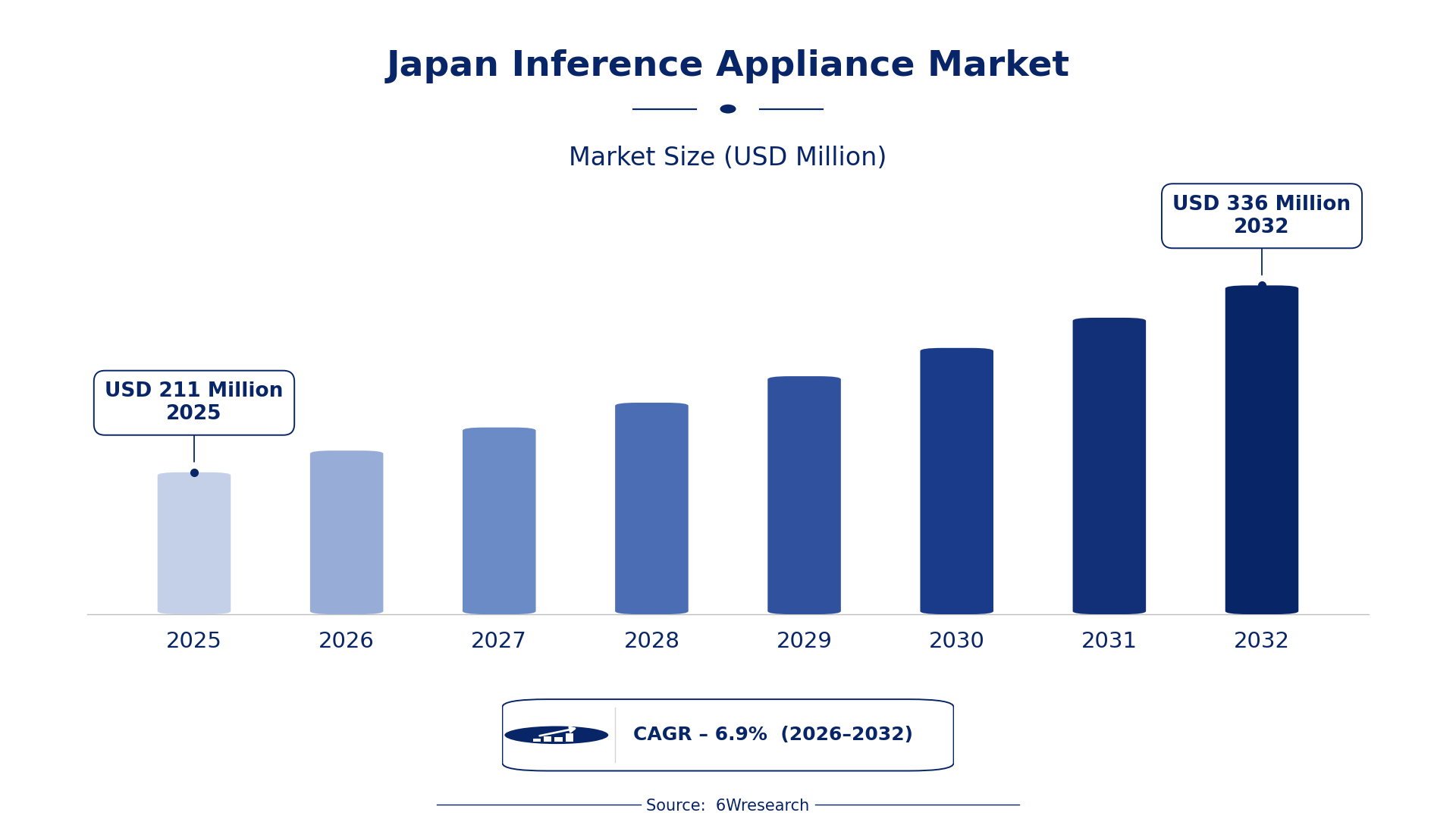
According to 6Wresearch internal database and industry insights, the Japan Inference Appliance Market was valued at USD 211 Million in 2025 and is projected to reach USD 336 Million by 2032, growing at a CAGR of approximately 6.9% during 2026–2032.
Japan Inference Appliance Market Highlights
| Report Metric | Details |
| Report Name | Japan Inference Appliance Market (2026-2032) |
| Market Size 2025 | USD 211 Million |
| Market Size 2032 | USD 336 Million |
| Absolute Growth 2025–2032 | USD 125 Million |
| CAGR 2026–2032 | 6.9% |
| Peak Annual Growth | 7.7% in 2026 |
| Forecast Period | 2026–2032 |
| Historical Data | 2022–2025 |
| Base Year | 2025 |
| Leading Appliance Type, 2025 | Server-Based Appliances (38% share) |
| Leading Integration Level, 2025 | Rack-Mounted (39% share) |
| Leading Use Case, 2025 | Deep Learning Inference (39% share) |
| Leading Distribution Channel, 2025 | AI Appliance Suppliers (48% share) |
| Fastest-Growing Appliance Type | Edge AI Appliances (10.0% CAGR) |
| Fastest-Growing Integration Level | Plug-and-Play (9.4% CAGR) |
| Fastest-Growing Use Case | Predictive Maintenance (10.3% CAGR) |
| Fastest-Growing Distribution Channel | System Integrators (8.8% CAGR) |
| Growing Sector | manufacturing |
| Key End Users | manufacturers, technology firms, healthcare providers, automotive companies |
Japan Inference Appliance Market Year-wise Growth Rate and Key Drivers (2022–2032)
This graph illustrates the annual growth rates of the market from 2022 to 2032, highlighting a steady upward trajectory and projected market expansion over the forecast period.
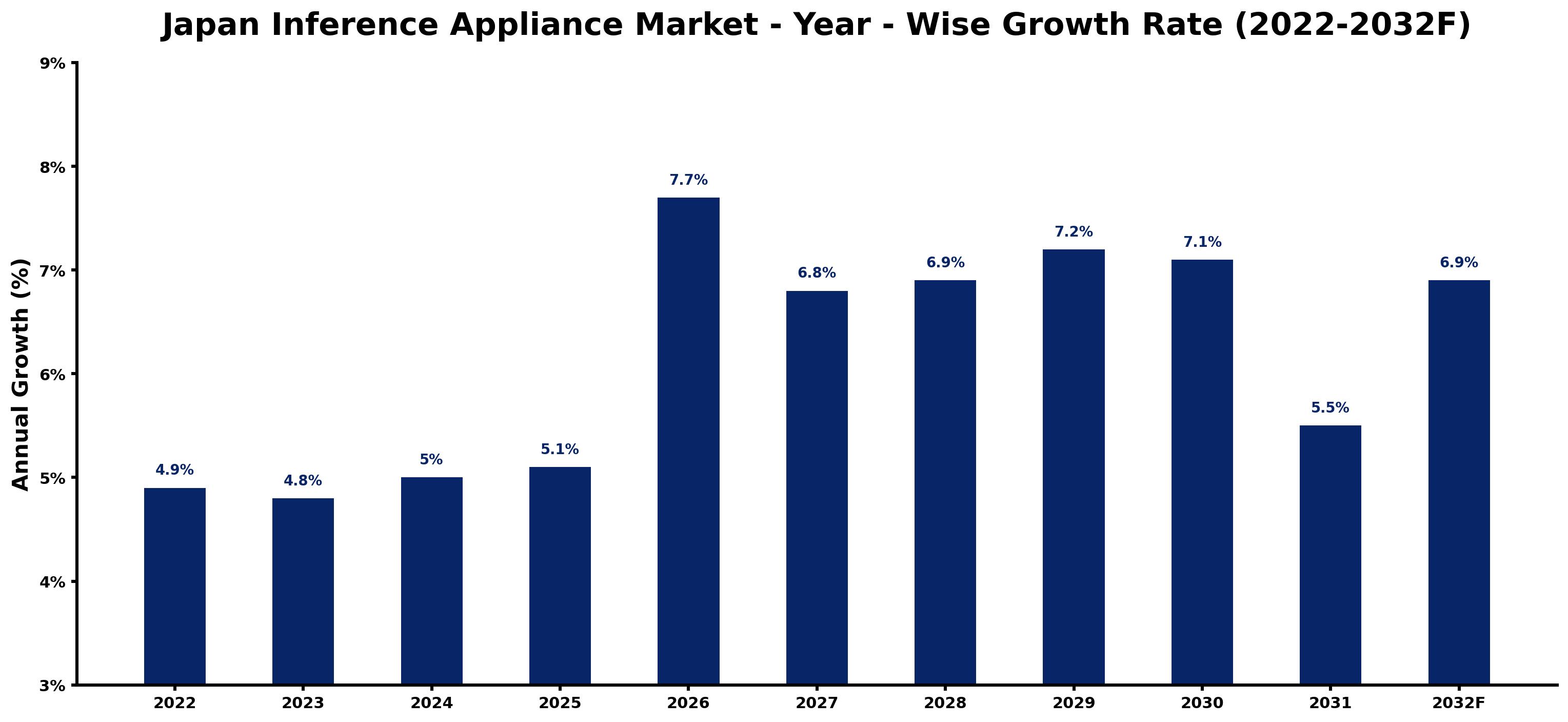
The yearly estimates that follow link every growth rate to its principal driver, so readers can see why the pace changed in each period.
| Year | Estimated Annual Growth (%) | Market Rationale |
| 2022 | 4.9 | The market experienced steady growth, driven by increasing adoption of AI technologies. |
| 2023 | 4.8 | Growth slowed slightly as companies adjusted to evolving AI technologies. |
| 2024 | 5.0 | Demand increased as enterprises sought to improve operational efficiencies with AI. |
| 2025 | 5.1 | The market continued to grow as investments in AI infrastructure rose. |
| 2026 | 7.7 | A surge in demand is expected due to advancements in deep learning applications. |
| 2027 | 6.8 | Growth is projected to slow as market saturation begins to affect new purchases. |
| 2028 | 6.9 | Demand is expected to increase again as industries adopt more AI solutions. |
| 2029 | 7.2 | The market will see continued growth due to technological advancements. |
| 2030 | 7.1 | Growth is anticipated to slow as companies focus on optimizing existing systems. |
| 2031 | 5.5 | The market will continue to grow, albeit at a slower pace than previous years. |
| 2032 | 6.9 | Demand is projected to rise as new AI applications emerge across various sectors. |
Note: Market size estimations and growth projections presented in this report are based on 6Wresearch's proprietary forecasting methodology, utilizing the latest available industry data, government publications, and primary research inputs.
Japan Inference Appliance Market Synopsis
Inference appliances are specialised hardware designed for executing machine learning models in real-time applications. The Japan Inference Appliance Market is thriving, driven by domestic users and ongoing investments in AI-driven solutions. The AI market is projected to reach approximately 1 trillion yen in 2023, supported by initiatives like the AI Strategy 2023, which aims to boost AI adoption in manufacturing by 30% by 2025 and increase the number of AI specialists by 100,000 by 2030.
Market Dynamics Impact Analysis (2026–2032)
| Factor | Type | Impact | Primary Segment Affected |
| Growing demand for real-time analytics and predictive maintenance solutions | Driver | High | Real-Time Analytics |
| Increased investments in AI technology and infrastructure | Driver | High | Deep Learning Inference |
| Expansion of AI applications in automotive and healthcare sectors | Opportunity | High | Deep Learning Inference |
| Rising need for AI solutions in manufacturing and IoT networks | Opportunity | High | IoT Networks |
| High costs associated with advanced AI appliance integration | Restraint | Medium | Server-Based Appliances |
| Limited awareness among smaller enterprises about AI benefits | Restraint | Medium | Edge AI Appliances |
| Challenges in meeting regulatory compliance for AI systems | Challenge | High | Rack-Mounted |
| Difficulty in sourcing skilled talent for AI development | Challenge | High | Industry-Specific |
Evaluation of Drivers in Japan Inference Appliance Market (2026–2032)
The factors lifting demand, and the evidence behind each, are summarised below.
| Drivers | Primary Segment Affected | Why It Matters (Evidence) |
| Increased demand for predictive maintenance solutions | Predictive Maintenance | This demand arises from the need to reduce equipment downtime, prompting manufacturers to invest in AI appliances. |
| Growing investments in AI technology | Deep Learning Inference | Investment in AI technology stems from the need for improved efficiency in sectors like healthcare, which is expected to reach 1 trillion yen in 2023. |
| Expansion of IoT networks | IoT Networks | The growth of IoT networks creates a need for AI appliances to process data effectively at the edge, with the IoT market projected to reach 6 trillion yen by 2025. |
| Rising focus on real-time analytics | Real-Time Analytics | Companies are increasingly adopting real-time analytics to make informed decisions quickly, driving appliance demand as the installed base exceeds 500,000 units. |
| Technological advancements in AI capabilities | Edge AI Appliances | Advancements in AI technology enable better performance, attracting more buyers to edge AI solutions. |
Orders keep climbing as the AI market in Japan is projected to reach approximately 1 trillion yen in 2023, prompting manufacturers to invest in advanced inference appliances. The adoption rate of AI in enterprises is around 20%, driving demand for predictive maintenance solutions in manufacturing. The installed base of AI appliances is estimated at over 500,000 units, reflecting the growing need for real-time analytics. The annual budget for AI research and development is approximately 200 billion yen, encouraging investments in deep learning technologies. With the goal of increasing AI adoption in manufacturing by 30% by 2025, companies are actively seeking effective solutions to improve operational efficiency.
Evaluation of Restraints in Japan Inference Appliance Market
The table below lists the restraints and the evidence behind each.
| Market Restraint | Primary Segment Affected | Why It Matters (Evidence) |
| High costs associated with AI appliance integration | Server-Based Appliances | Integration costs can deter smaller enterprises from adopting advanced AI solutions, limiting market growth. |
| Limited awareness about AI benefits among SMEs | Edge AI Appliances | Small and medium enterprises often lack knowledge about AI's advantages, hindering appliance adoption. |
| Regulatory compliance challenges for AI systems | Rack-Mounted | Meeting compliance standards can be complex and costly, affecting procurement decisions. |
| Shortage of skilled talent for AI development | Industry-Specific | The lack of qualified professionals can delay project timelines and increase operational costs. |
| Market saturation affecting new purchases | Deep Learning Inference | As more companies adopt AI, the market may experience slower growth due to saturation. |
Japan Inference Appliance Market Challenges
Japan's AI market is valued at around 1 trillion yen, yet regulatory hurdles impede the swift deployment of AI technologies, causing delays for producers in fulfilling market demand. A shortage of skilled workers persists, with the government targeting 100,000 AI specialists by 2030, which restricts innovation and limits the ability of clinics to adopt advanced solutions. Supply chain disruptions arise from reliance on imported semiconductor components, raising costs for manufacturers and delaying product launches. Competition from international markets intensifies, compelling local suppliers to revise pricing strategies, potentially resulting in a 20% reduction in profit margins for small enterprises.
Trends in the Japan Inference Appliance Market
These developments are changing demand patterns in the Japan Inference Appliance Market.
- Shift from Traditional to AI-Driven Manufacturing: Manufacturers are increasingly adopting AI technologies to improve production efficiency, particularly in the automotive sector. The market for AI-driven solutions is expected to reach 1 trillion yen by 2023.
- Transition from Centralized to Edge Computing: Tokyo is experiencing a shift towards edge computing solutions, which reduce latency in data processing. This trend is clear as the installed base of AI appliances exceeds 500,000 units, reflecting increased demand for real-time analytics.
- Emergence of Industry-Specific AI Solutions: Healthcare is prioritising tailored AI solutions to improve patient outcomes, with deep learning inference applications expected to expand. This sector's growth aligns with the government's goal of increasing AI adoption by 30% by 2025.
- Growing Focus on Predictive Maintenance: The manufacturing sector is increasingly investing in predictive maintenance solutions to anticipate equipment failures. This trend is supported by an annual budget of approximately 200 billion yen for AI research and development.
Investment Opportunities in the Japan Inference Appliance Market
Where to invest in the Japan Inference Appliance Market: the main openings are set out below.
- Tokyo's AI Research Facilities: Tokyo's AI research facilities present a growing opportunity for investment in AI appliances, with the market projected to reach 1 trillion yen by 2023. Collaborating with local research institutions can facilitate market entry.
- Manufacturing Sector's AI Adoption: The manufacturing sector is actively seeking AI solutions, aiming for 30% adoption by 2025. Suppliers can enter this market by partnering with industry associations to promote their products.
- Growing Demand for Predictive Maintenance: The demand for predictive maintenance solutions is expected to rise, with the installed base of AI appliances exceeding 500,000 units. Suppliers should focus on developing tailored solutions for this sector.
- Investment in AI Talent Development: With the government aiming to train 100,000 AI specialists by 2030, there is a growing opportunity for educational institutions to develop AI training programmes. This investment can create a skilled workforce for the AI appliance market.
Government Initiatives in the Japan Inference Appliance Market
The Electrical Appliance and Material Safety Act of 1961 regulates the safety of electrical appliances sold in Japan, ensuring that inference appliances meet safety standards. The Semiconductor and Digital Industry Strategy launched in June 2021 aims to secure domestic semiconductor manufacturing, which is critical for producing AI appliances.
In 2023, the government allocated approximately 200 billion yen for AI research and development, administered by the Ministry of Economy, Trade and Industry. This funding supports various initiatives, including the AI Strategy 2023, which promotes AI adoption across industries.
Future Insight of the Japan Inference Appliance Market
Emerging technologies will drive demand for inference appliances, particularly as the government prioritises AI adoption in manufacturing. By 2032, the annual investment in AI technology will exceed 300 billion yen, encouraging innovation across various sectors. The IoT market is projected to reach 6 trillion yen, enabling buyers to access integrated solutions that improve operational efficiency. The establishment of a national AI framework will streamline processes, benefiting both buyers and suppliers.
Market Segmentation Analysis
Japan Inference Appliance Market report covers a detailed analysis of the following market segments:
By Appliance Type – Server-Based Appliances Lead, Edge AI Appliances Expected to Grow Fastest
According to Saurav Kr Singh, Senior Research Analyst at 6Wresearch, Server-Based Appliances accounted for 38% of the market by appliance type in 2025. Server-based appliances dominate the market due to their ability to handle substantial computational tasks in data centres, which are critical for industries with high processing demands. Their extensive installed base of over 500,000 units reflects strong adoption among large enterprises requiring reliable processing capabilities. Over 2026–2032, Edge AI Appliances are expected to post the fastest growth, at a CAGR of 10.0%. Edge appliances are experiencing rapid growth as they facilitate data processing at the source, essential for applications needing low latency. This growth is particularly evident in sectors such as automotive and healthcare, where immediate data analysis is crucial for operational success. Suppliers must focus on developing edge solutions to meet the increasing demand for low-latency applications.
By Integration Level – Rack-Mounted Leads, Plug-and-Play Expected to Grow Fastest
The largest integration level category in 2025 was Rack-Mounted, at 39% of revenue. Rack-mounted appliances are prevalent in data centres, providing scalability and performance for enterprises looking to optimise their AI capabilities. Their established presence in major industrial regions like Tokyo and Osaka supports their leading position in the market. Plug-and-Play is set to record the highest CAGR in this split, 9.4% over 2026–2032. Plug-and-play solutions are gaining traction as they allow for easy integration into existing systems, appealing to businesses seeking quick deployment of AI technologies. The increasing push for automation in various industries further fuels this trend. Buyers will benefit from seeking out plug-and-play options to accelerate their AI implementation processes.
By Use Case – Deep Learning Inference Leads, Predictive Maintenance Expected to Grow Fastest
In 2025, Deep Learning Inference led the use case split with a 39% share. Deep learning inference is the leading use case as it is essential for executing complex models efficiently across various sectors. The government's initiative to boost AI adoption in manufacturing by 30% by 2025 underscores the increasing reliance on these capabilities. Predictive Maintenance is projected to grow fastest, at a CAGR of 10.3% during 2026–2032. Predictive maintenance is the fastest-growing use case, widely applied in manufacturing to anticipate equipment failures and reduce downtime. This trend aligns with rising investments in AI technologies, projected to exceed 300 billion yen annually. Suppliers should concentrate on creating solutions specifically for predictive maintenance to capitalise on this expanding market opportunity.
By Distribution Channel – AI Appliance Suppliers Lead, System Integrators Expected to Grow Fastest
AI Appliance Suppliers took 48% of distribution channel revenue in 2025, more than any other category. AI appliance suppliers are the primary distributors of inference appliances, establishing a robust presence in the market by meeting the diverse needs of various industries directly. Their role is vital in providing access to advanced technologies throughout Japan's industrial sectors. The quickest growth will come from System Integrators, forecast to expand at a CAGR of 8.8% between 2026 and 2032. System integrators are rapidly gaining prominence as they implement and customise solutions for end-users, addressing the demand for tailored applications. Their expertise is increasingly critical as companies seek to integrate advanced technologies seamlessly into their operations. Suppliers should consider partnerships with system integrators to strengthen their market presence and enhance service capabilities.
Key Attractiveness of the Report
- 10 Years of Market Numbers
- Historical Data Starting from 2022 to 2025
- Base Year 2025
- Forecast Data until 2032
- Key Performance Indicators Impacting the Market
- Major Upcoming Developments and Projects
Key Highlights of the Report:
- Japan Inference Appliance Market Outlook
- Market Size of Japan Inference Appliance Market, 2025
- Forecast of Japan Inference Appliance Market, 2032
- Historical Data and Forecast of Japan Inference Appliance Revenues & Volume for the Period 2022-2032F
- Japan Inference Appliance Market Trend Evolution
- Japan Inference Appliance Market Drivers and Challenges
- Japan Inference Appliance Price Trends
- Japan Inference Appliance Porter's Five Forces
- Japan Inference Appliance Industry Life Cycle
- Historical Data and Forecast of Japan Inference Appliance Market Revenues & Volume By Appliance Type for the Period 2022-2032F
- Historical Data and Forecast of Japan Inference Appliance Market Revenues & Volume By Edge AI Appliances for the Period 2022-2032F
- Historical Data and Forecast of Japan Inference Appliance Market Revenues & Volume By Server-Based Appliances for the Period 2022-2032F
- Historical Data and Forecast of Japan Inference Appliance Market Revenues & Volume By OEM AI Boxes for the Period 2022-2032F
- Historical Data and Forecast of Japan Inference Appliance Market Revenues & Volume By Micro-AI Devices for the Period 2022-2032F
- Historical Data and Forecast of Japan Inference Appliance Market Revenues & Volume By Integration Level for the Period 2022-2032F
- Historical Data and Forecast of Japan Inference Appliance Market Revenues & Volume By Plug-and-Play for the Period 2022-2032F
- Historical Data and Forecast of Japan Inference Appliance Market Revenues & Volume By Rack-Mounted for the Period 2022-2032F
- Historical Data and Forecast of Japan Inference Appliance Market Revenues & Volume By Industry-Specific for the Period 2022-2032F
- Historical Data and Forecast of Japan Inference Appliance Market Revenues & Volume By IoT Networks for the Period 2022-2032F
- Historical Data and Forecast of Japan Inference Appliance Market Revenues & Volume By Use Case for the Period 2022-2032F
- Historical Data and Forecast of Japan Inference Appliance Market Revenues & Volume By Real-Time Analytics for the Period 2022-2032F
- Historical Data and Forecast of Japan Inference Appliance Market Revenues & Volume By Deep Learning Inference for the Period 2022-2032F
- Historical Data and Forecast of Japan Inference Appliance Market Revenues & Volume By Predictive Maintenance for the Period 2022-2032F
- Historical Data and Forecast of Japan Inference Appliance Market Revenues & Volume By Sensor Data Processing for the Period 2022-2032F
- Historical Data and Forecast of Japan Inference Appliance Market Revenues & Volume By Distribution Channel for the Period 2022-2032F
- Historical Data and Forecast of Japan Inference Appliance Market Revenues & Volume By Cloud Vendors for the Period 2022-2032F
- Historical Data and Forecast of Japan Inference Appliance Market Revenues & Volume By AI Appliance Suppliers for the Period 2022-2032F
- Historical Data and Forecast of Japan Inference Appliance Market Revenues & Volume By System Integrators for the Period 2022-2032F
- Historical Data and Forecast of Japan Inference Appliance Market Revenues & Volume By VARs / Direct B2B Sales for the Period 2022-2032F
- Japan Inference Appliance Import Export Trade Statistics
- Market Opportunity Assessment By Appliance Type
- Market Opportunity Assessment By Integration Level
- Market Opportunity Assessment By Use Case
- Market Opportunity Assessment By Distribution Channel
- Japan Inference Appliance Top Companies Market Share
- Japan Inference Appliance Competitive Benchmarking By Technical and Operational Parameters
- Japan Inference Appliance Company Profiles
- Japan Inference Appliance Key Strategic Recommendations
Market Covered
Segments analysed in this report are listed below.
By Appliance Type
- Edge AI Appliances
- Server-Based Appliances
- OEM AI Boxes
- Micro-AI Devices
By Integration Level
- Plug-and-Play
- Rack-Mounted
- Industry-Specific
- IoT Networks
By Use Case
- Real-Time Analytics
- Deep Learning Inference
- Predictive Maintenance
- Sensor Data Processing
By Distribution Channel
- Cloud Vendors
- AI Appliance Suppliers
- System Integrators
- VARs / Direct B2B Sales































