Japan Inflammatory Disease Market Size & Growth Rate
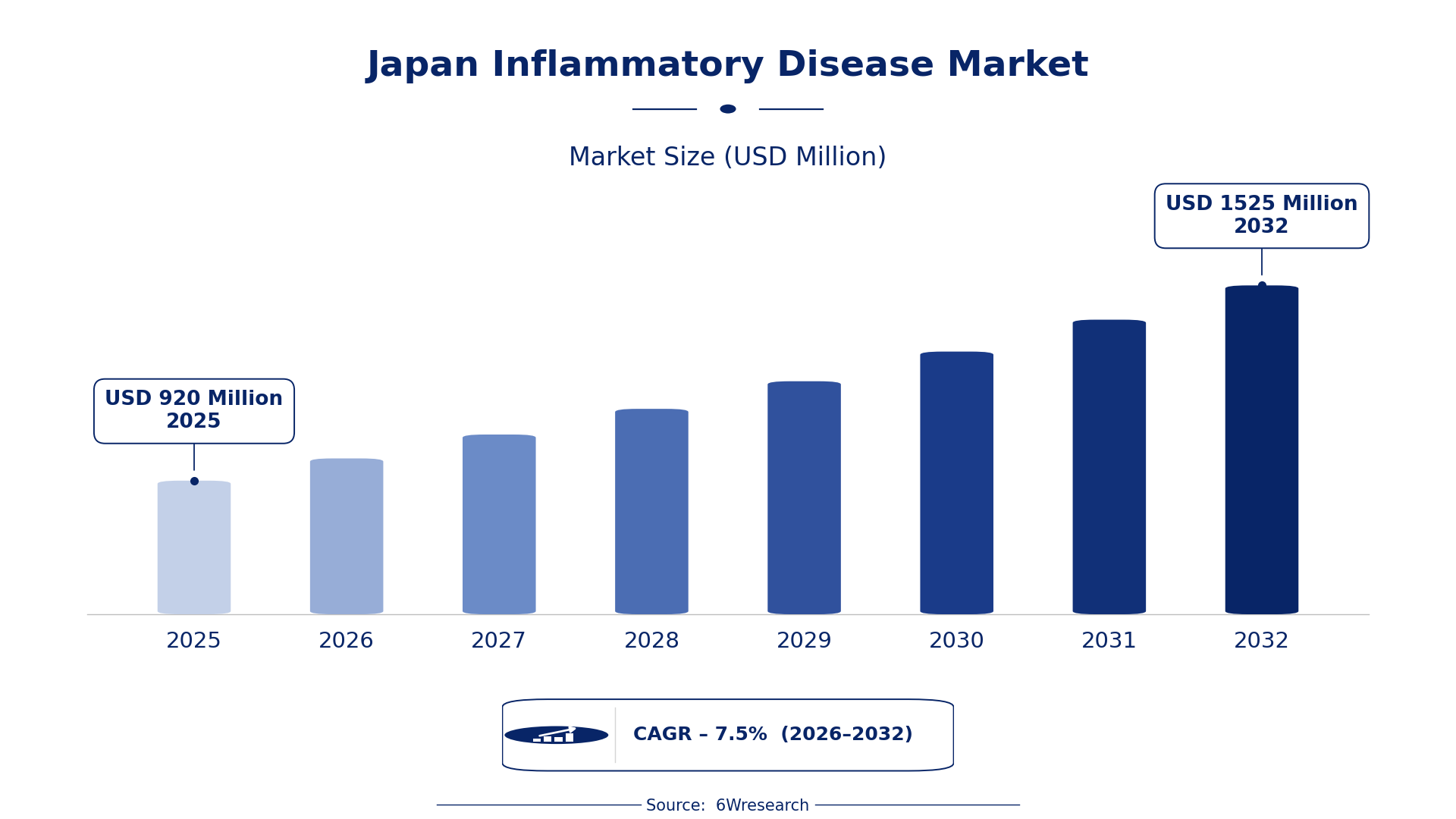
According to 6Wresearch internal database and industry insights, the Japan Inflammatory Disease Market was valued at USD 920 Million in 2025 and is projected to reach USD 1,525 Million by 2032, growing at a CAGR of approximately 7.5% during 2026–2032.
Japan Inflammatory Disease Market Highlights
| Report Metric | Details |
| Report Name | Japan Inflammatory Disease Market (2026-2032) |
| Market Size 2025 | USD 920 Million |
| Market Size 2032 | USD 1,525 Million |
| Absolute Growth 2025–2032 | USD 605 Million |
| CAGR 2026–2032 | 7.5% |
| Peak Annual Growth | 8.3% in 2027 |
| Forecast Period | 2026–2032 |
| Historical Data | 2022–2025 |
| Base Year | 2025 |
| Leading Disease Type, 2025 | Rheumatoid Arthritis (49% share) |
| Leading Affected Organ System, 2025 | Joints (38% share) |
| Leading Diagnosis Method, 2025 | Imaging + Blood Tests (36% share) |
| Leading Distribution Channel, 2025 | Hospitals & Clinics (43% share) |
| Fastest-Growing Disease Type | Inflammatory Bowel Disease (10.5% CAGR) |
| Fastest-Growing Affected Organ System | Gastrointestinal (10.8% CAGR) |
| Fastest-Growing Diagnosis Method | Colonoscopy / CRP Tests (11.1% CAGR) |
| Fastest-Growing Distribution Channel | Gastroenterology Centers (10.1% CAGR) |
| Growing Sector | Healthcare |
| Key End Users | Hospitals, Clinics, Gastroenterology Centers, Dermatology Clinics |
Japan Inflammatory Disease Market Year-wise Growth Rate and Key Drivers (2022–2032)
This graph illustrates the annual growth rates of the market from 2022 to 2032, highlighting a steady upward trajectory and projected market expansion over the forecast period.
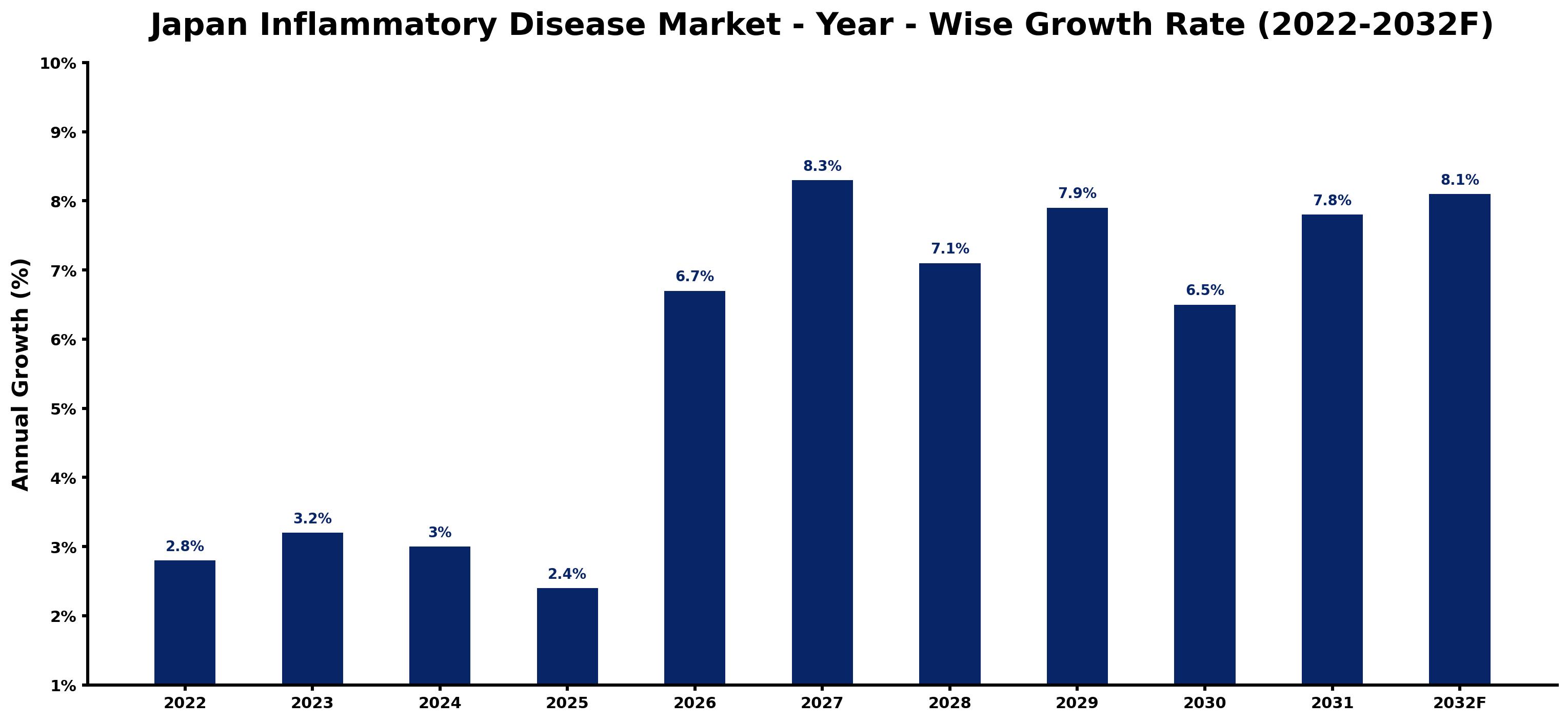
Year by year, the estimates below pair each growth rate with the development that shaped it.
| Year | Estimated Annual Growth (%) | Market Rationale |
| 2022 | 2.8 | The market experienced steady growth with a notable patient population. |
| 2023 | 3.2 | Demand increased as awareness of treatment options expanded among healthcare providers. |
| 2024 | 3.0 | Growth slowed slightly due to market saturation in some treatment areas. |
| 2025 | 2.4 | Continued growth was observed as new therapies entered the market. |
| 2026 | 6.7 | Demand surged with advancements in treatment protocols and patient management. |
| 2027 | 8.3 | The peak growth year saw heightened investments in healthcare infrastructure. |
| 2028 | 7.1 | Growth slowed as the market began to stabilise after rapid expansion. |
| 2029 | 7.9 | Increased patient awareness drove demand for new treatment options. |
| 2030 | 6.5 | Growth moderated as the market adjusted to new healthcare standards. |
| 2031 | 7.8 | Demand rebounded with improved access to treatment facilities. |
| 2032 | 8.1 | The market is expected to grow as new guidelines improve patient care. |
Note: Market size estimations and growth projections presented in this report are based on 6Wresearch's proprietary forecasting methodology, utilizing the latest available industry data, government publications, and primary research inputs.
Japan Inflammatory Disease Market Synopsis
Inflammatory diseases in Japan encompass conditions such as rheumatoid arthritis and inflammatory bowel disease, primarily resulting from immune system dysfunction. The Japan Inflammatory Disease Market is growing due to a large patient population, with around 1.5 million diagnosed with rheumatoid arthritis and over 200,000 with inflammatory bowel disease. The healthcare system prioritises advanced therapies and ongoing initiatives that support management and research, leading to a rising demand for effective treatments. The focus on improving patient outcomes fuels the need for new therapies and interventions.
Market Dynamics Impact Analysis (2026–2032)
| Factor | Type | Impact | Primary Segment Affected |
| High prevalence of rheumatoid arthritis driving treatment demand | Driver | High | Rheumatoid Arthritis |
| Increasing patient population for inflammatory bowel disease | Driver | High | Inflammatory Bowel Disease |
| Rising investment in gastroenterology centers | Opportunity | High | Gastroenterology Centers |
| Growing need for advanced imaging techniques | Opportunity | Medium | Imaging + Blood Tests |
| Limited access to specialized treatment facilities in rural areas | Restraint | High | Hospitals & Clinics |
| High healthcare expenditure limiting patient access to treatments | Restraint | Medium | Inflammatory Bowel Disease |
| High costs of advanced therapies affecting patient affordability | Challenge | High | Psoriasis |
| Shortage of trained healthcare professionals in specialized fields | Challenge | Medium | Dermatology Clinics |
Evaluation of Drivers in Japan Inflammatory Disease Market (2026–2032)
The main growth drivers and the segments they affect most are set out below.
| Drivers | Primary Segment Affected | Why It Matters (Evidence) |
| High prevalence of rheumatoid arthritis | Rheumatoid Arthritis | Approximately 1.5 million people in Japan are diagnosed, leading to increased treatment demand. |
| Growing patient base for inflammatory bowel disease | Inflammatory Bowel Disease | Over 200,000 patients reported in 2023, driving the need for effective therapies. |
| Investment in advanced imaging technologies | Imaging + Blood Tests | Healthcare expenditure exceeds ¥1 trillion annually, supporting diagnostic advancements. |
| Focus on improving treatment access | Gastroenterology Centers | The Ministry of Health, Labour and Welfare initiated a program in 2023 to enhance treatment accessibility. |
| Development of new treatment guidelines | Psoriasis | The Japanese Dermatological Association launched new guidelines in 2023, promoting updated treatment strategies. |
Volumes grow on the back of healthcare expenditure for inflammatory diseases exceeding ¥1 trillion annually, enabling investment in advanced imaging technologies. The significant patient population, with approximately 1.5 million diagnosed with rheumatoid arthritis, drives the demand for effective therapies. Investment in advanced imaging technologies supports diagnostic advancements, improving treatment outcomes. The launch of new treatment guidelines promotes updated strategies, further increasing demand for innovative therapies.
Evaluation of Restraints in Japan Inflammatory Disease Market
Several factors work against faster growth; the main ones are summarised below.
| Market Restraint | Primary Segment Affected | Why It Matters (Evidence) |
| Limited access to specialized treatment facilities in rural areas | Hospitals & Clinics | Patients in rural areas face challenges accessing specialized care, affecting treatment outcomes. |
| High healthcare expenditure limiting patient access to treatments | Inflammatory Bowel Disease | Annual healthcare spending exceeds ¥1 trillion, constraining affordability for many patients. |
| Complexity of treatment protocols for inflammatory diseases | Rheumatoid Arthritis | The intricate nature of treatment regimens can deter patient adherence and complicate management. |
| Shortage of trained healthcare professionals in specialized fields | Dermatology Clinics | A lack of specialists limits patient access to effective treatment options, impacting outcomes. |
| Regulatory hurdles for new therapies | Psoriasis | Stringent approval processes can delay the introduction of new treatments to the market. |
Japan Inflammatory Disease Market Challenges
In Japan, approximately 1.5 million individuals were diagnosed with rheumatoid arthritis in 2022, straining the supply of treatment resources. Limited access to advanced imaging technology hampers timely diagnoses, causing hospitals to delay effective treatment for patients. The annual healthcare expenditure for inflammatory diseases surpasses ¥1 trillion, compelling clinics to operate within tighter financial constraints. Variability in treatment protocols complicates care delivery for healthcare providers, resulting in inconsistent patient outcomes and escalating operational costs for hospitals.
Trends in the Japan Inflammatory Disease Market
Below are the shifts with the largest effect on the Japan Inflammatory Disease Market.
- Increased Adoption of Advanced Imaging Techniques: In 2023, the use of advanced imaging techniques like MRI and CT scans rose, supported by the Japan Radiological Society. This trend improves diagnostic accuracy, benefitting healthcare providers and patients alike.
- Growth of Specialized Clinics: Gastroenterology centers are becoming the primary choice for inflammatory bowel disease treatment, with over 300 centers established across Japan. This shift allows for more focused care, improving patient outcomes.
- Focus on Patient-Centric Care: The launch of new treatment guidelines in 2023 by the Japanese Dermatological Association marks a shift towards patient-centric care in psoriasis management. This trend is expected to improve treatment adherence and satisfaction.
- Collaboration in Clinical Research: The Japan Rheumatology Association's annual conferences facilitate collaboration on treatment advancements, promoting innovation in the field. This growing collaboration supports the development of new therapies.
Investment Opportunities in the Japan Inflammatory Disease Market
Several openings in the Japan Inflammatory Disease Market merit attention from investors.
- Gastroenterology Centers Seeking Advanced Treatments: Gastroenterology centres require new treatment options, driven by the expanding patient base exceeding 200,000. Suppliers can enter through local partnerships and certifications.
- Demand for Advanced Diagnostic Tools in Hospitals: Hospitals are seeking advanced imaging technologies to improve patient outcomes. The market's healthcare expenditure exceeding ¥1 trillion annually presents a substantial investment opportunity.
- Rising Demand for Psoriasis Treatments: With approximately 1 million individuals affected, the need for effective psoriasis treatments is considerable. Suppliers can engage with dermatology clinics to address this demand.
- Need for Specialized Training Programs: The shortage of trained professionals in specialised fields creates a demand for training programs. Investing in educational partnerships can help fill this gap.
Government Initiatives in the Japan Inflammatory Disease Market
The Medical Care Act of 1948 establishes standards for hospitals and clinics, ensuring quality treatment for inflammatory disease patients. This law mandates facilities to meet specific requirements, directly impacting treatment accessibility and quality. The Long-Term Care Insurance Act supports funding for nursing care and services, benefiting patients with inflammatory diseases by improving access to necessary care.
The Ministry of Health, Labour and Welfare oversees the implementation of healthcare policies, including funding for nursing care and support services under the Long-Term Care Insurance Act. This agency plays a critical role in improving patient care for inflammatory diseases.
Future Insight of the Japan Inflammatory Disease Market
Buyers will benefit from improved treatment access as the Ministry of Health, Labour and Welfare's 2023 programme expands resources for inflammatory diseases. By 2032, advancements in imaging technology will shorten diagnosis times, enabling quicker interventions. New guidelines from the Japanese Dermatological Association will standardise management for skin conditions, improving care consistency. With over 300 gastroenterology centres dedicated to inflammatory diseases, suppliers will encounter increased demand for specialised therapies and support services.
Market Segmentation Analysis
Japan Inflammatory Disease Market report covers a detailed analysis of the following market segments:
By Disease Type – Rheumatoid Arthritis Leads, Inflammatory Bowel Disease Expected to Grow Fastest
According to Saurav Kr Singh, Senior Research Analyst at 6Wresearch, the largest disease type category in 2025 was Rheumatoid Arthritis, at 49% of revenue. Rheumatoid arthritis holds the largest share due to its substantial patient base, with around 1.5 million individuals diagnosed in Japan. The ongoing healthcare initiatives focused on improving treatment access further solidify its dominant position in the market. Over 2026–2032, Inflammatory Bowel Disease is expected to post the fastest growth, at a CAGR of 10.5%. Inflammatory bowel disease is experiencing rapid growth, with more than 200,000 patients reported in 2023. This increase in diagnosed cases is expected to drive the expansion of treatment options, leading to further growth in this segment. Suppliers must focus on developing targeted therapies for inflammatory bowel disease to meet the rising demand.
By Affected Organ System – Joints Lead, Gastrointestinal Expected to Grow Fastest
With 38% of affected organ system revenue in 2025, Joints was the largest category. Joints are primarily affected in rheumatoid arthritis, which is the most prevalent inflammatory disease in Japan. The substantial number of patients experiencing joint-related issues fuels the demand for effective treatment solutions. The quickest growth will come from Gastrointestinal, forecast to expand at a CAGR of 10.8% between 2026 and 2032. The gastrointestinal system is experiencing the fastest growth due to the rising incidence of inflammatory bowel disease among patients. This trend indicates a shift in treatment focus within the healthcare sector towards gastrointestinal conditions. Buyers should explore specialised therapies that target gastrointestinal issues as the market continues to develop.
By Diagnosis Method – Imaging + Blood Tests Lead, Colonoscopy / CRP Tests Expected to Grow Fastest
Imaging + Blood Tests held 36% of the Japan Inflammatory Disease Market by diagnosis method in 2025. Imaging combined with blood tests is essential for diagnosing and monitoring inflammatory diseases, providing critical insights for treatment decisions. These methods are widely adopted in healthcare facilities, reinforcing their leading status in the market. Colonoscopy / CRP Tests are projected to grow fastest, at a CAGR of 11.1% during 2026–2032. Colonoscopy and CRP tests are increasingly important for diagnosing gastrointestinal conditions, especially inflammatory bowel disease, which is on the rise. The heightened focus on accurate diagnosis in this area is likely to boost the adoption of these methods. Suppliers should invest in advanced diagnostic technologies to address the growing need for precise and timely diagnoses.
By Distribution Channel – Hospitals & Clinics Lead, Gastroenterology Centers Expected to Grow Fastest
Hospitals & Clinics accounted for 43% of the market by distribution channel in 2025. Hospitals and clinics serve as the primary distribution channel for treatments, accommodating the majority of patients seeking care for inflammatory diseases. This established infrastructure ensures a steady flow of patients requiring ongoing treatment and management. Gastroenterology Centers are set to record the highest CAGR in this split, 10.1% over 2026–2032. Gastroenterology centers are rapidly becoming the fastest-growing distribution channel, providing specialised care for the increasing number of inflammatory bowel disease patients. Their focused approach to treatment is likely to attract more patients seeking expert care. Suppliers should strengthen partnerships with gastroenterology centers to capitalise on this growing distribution channel.
Key Attractiveness of the Report
- 10 Years of Market Numbers
- Historical Data Starting from 2022 to 2025
- Base Year 2025
- Forecast Data until 2032
- Key Performance Indicators Impacting the Market
- Major Upcoming Developments and Projects
Key Highlights of the Report:
- Japan Inflammatory Disease Market Outlook
- Market Size of Japan Inflammatory Disease Market, 2025
- Forecast of Japan Inflammatory Disease Market, 2032
- Historical Data and Forecast of Japan Inflammatory Disease Revenues & Volume for the Period 2022-2032F
- Japan Inflammatory Disease Market Trend Evolution
- Japan Inflammatory Disease Market Drivers and Challenges
- Japan Inflammatory Disease Price Trends
- Japan Inflammatory Disease Porter's Five Forces
- Japan Inflammatory Disease Industry Life Cycle
- Historical Data and Forecast of Japan Inflammatory Disease Market Revenues & Volume By Disease Type for the Period 2022-2032F
- Historical Data and Forecast of Japan Inflammatory Disease Market Revenues & Volume By Rheumatoid Arthritis for the Period 2022-2032F
- Historical Data and Forecast of Japan Inflammatory Disease Market Revenues & Volume By Inflammatory Bowel Disease for the Period 2022-2032F
- Historical Data and Forecast of Japan Inflammatory Disease Market Revenues & Volume By Psoriasis for the Period 2022-2032F
- Historical Data and Forecast of Japan Inflammatory Disease Market Revenues & Volume By Vasculitis for the Period 2022-2032F
- Historical Data and Forecast of Japan Inflammatory Disease Market Revenues & Volume By Affected Organ System for the Period 2022-2032F
- Historical Data and Forecast of Japan Inflammatory Disease Market Revenues & Volume By Joints for the Period 2022-2032F
- Historical Data and Forecast of Japan Inflammatory Disease Market Revenues & Volume By Gastrointestinal for the Period 2022-2032F
- Historical Data and Forecast of Japan Inflammatory Disease Market Revenues & Volume By Skin for the Period 2022-2032F
- Historical Data and Forecast of Japan Inflammatory Disease Market Revenues & Volume By Vascular System for the Period 2022-2032F
- Historical Data and Forecast of Japan Inflammatory Disease Market Revenues & Volume By Diagnosis Method for the Period 2022-2032F
- Historical Data and Forecast of Japan Inflammatory Disease Market Revenues & Volume By Imaging + Blood Tests for the Period 2022-2032F
- Historical Data and Forecast of Japan Inflammatory Disease Market Revenues & Volume By Colonoscopy / CRP Tests for the Period 2022-2032F
- Historical Data and Forecast of Japan Inflammatory Disease Market Revenues & Volume By Visual + Biopsy for the Period 2022-2032F
- Historical Data and Forecast of Japan Inflammatory Disease Market Revenues & Volume By Imaging / Lab Work for the Period 2022-2032F
- Historical Data and Forecast of Japan Inflammatory Disease Market Revenues & Volume By Distribution Channel for the Period 2022-2032F
- Historical Data and Forecast of Japan Inflammatory Disease Market Revenues & Volume By Hospitals & Clinics for the Period 2022-2032F
- Historical Data and Forecast of Japan Inflammatory Disease Market Revenues & Volume By Gastroenterology Centers for the Period 2022-2032F
- Historical Data and Forecast of Japan Inflammatory Disease Market Revenues & Volume By Dermatology Clinics for the Period 2022-2032F
- Historical Data and Forecast of Japan Inflammatory Disease Market Revenues & Volume By Specialty Healthcare Units for the Period 2022-2032F
- Japan Inflammatory Disease Import Export Trade Statistics
- Market Opportunity Assessment By Disease Type
- Market Opportunity Assessment By Affected Organ System
- Market Opportunity Assessment By Diagnosis Method
- Market Opportunity Assessment By Distribution Channel
- Japan Inflammatory Disease Top Companies Market Share
- Japan Inflammatory Disease Competitive Benchmarking By Technical and Operational Parameters
- Japan Inflammatory Disease Company Profiles
- Japan Inflammatory Disease Key Strategic Recommendations
Market Covered
Coverage by segment is as follows.
By Disease Type
- Rheumatoid Arthritis
- Inflammatory Bowel Disease
- Psoriasis
- Vasculitis
By Affected Organ System
- Joints
- Gastrointestinal
- Skin
- Vascular System
By Diagnosis Method
- Imaging + Blood Tests
- Colonoscopy / CRP Tests
- Visual + Biopsy
- Imaging / Lab Work
By Distribution Channel
- Hospitals & Clinics
- Gastroenterology Centers
- Dermatology Clinics
- Specialty Healthcare Units































