Japan Inflammatory Disorders Market Size & Growth Rate
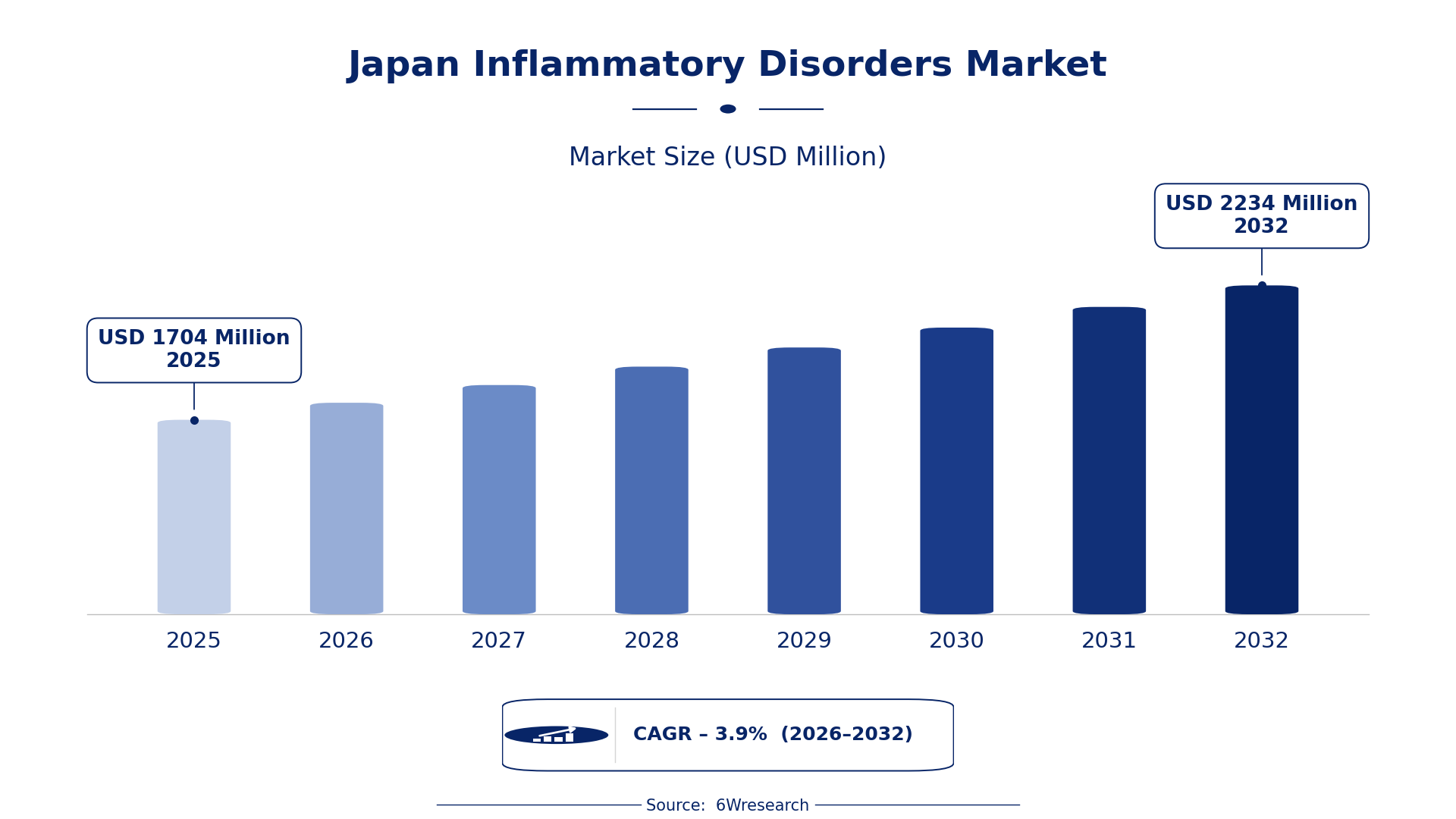
According to 6Wresearch internal database and industry insights, the Japan Inflammatory Disorders Market was valued at USD 1,704 Million in 2025 and is projected to reach USD 2,234 Million by 2032, growing at a CAGR of approximately 3.9% during 2026–2032.
Japan Inflammatory Disorders Market Highlights
| Report Metric | Details |
| Report Name | Japan Inflammatory Disorders Market (2026-2032) |
| Market Size 2025 | USD 1,704 Million |
| Market Size 2032 | USD 2,234 Million |
| Absolute Growth 2025–2032 | USD 530 Million |
| CAGR 2026–2032 | 3.9% |
| Peak Annual Growth | 4.4% in 2026 |
| Forecast Period | 2026–2032 |
| Historical Data | 2022–2025 |
| Base Year | 2025 |
| Leading Disorder Type, 2025 | Acute Inflammatory (40% share) |
| Leading Symptom Pattern, 2025 | Sudden Onset (43% share) |
| Leading Duration, 2025 | 6 Months (44% share) |
| Leading Distribution Channel, 2025 | Emergency Care Units (37% share) |
| Fastest-Growing Disorder Type | Chronic Inflammatory (5.4% CAGR) |
| Fastest-Growing Symptom Pattern | Progressive (5.0% CAGR) |
| Fastest-Growing Duration | Episodic (4.9% CAGR) |
| Fastest-Growing Distribution Channel | Internal Medicine Clinics (5.1% CAGR) |
| Growing Sector | Healthcare and Treatment Services |
| Key End Users | Healthcare providers, diagnostic centers, multispecialty hospitals, internal medicine clinics |
Japan Inflammatory Disorders Market Year-wise Growth Rate and Key Drivers (2022–2032)
This graph illustrates the annual growth rates of the market from 2022 to 2032, highlighting a steady upward trajectory and projected market expansion over the forecast period.
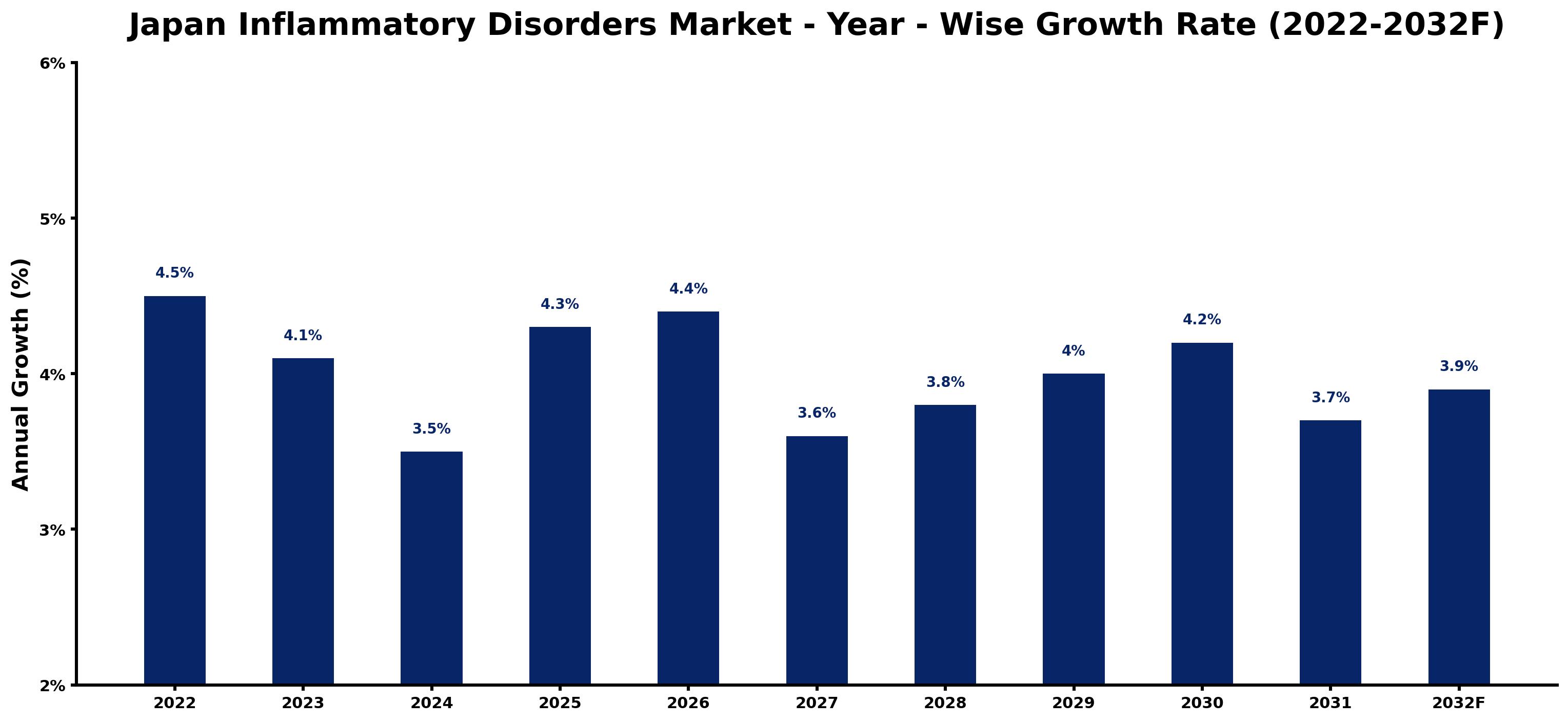
Below, each year's estimated growth is shown next to the factor that most influenced it.
| Year | Estimated Annual Growth (%) | Market Rationale |
| 2022 | 4.5 | The market experienced strong demand from healthcare providers and patients seeking effective treatments. |
| 2023 | 4.1 | Growth slowed due to market saturation and increased competition among treatment options available. |
| 2024 | 3.5 | Demand continued to grow, but at a slower pace as providers adjusted to new treatment protocols. |
| 2025 | 4.3 | A surge in treatment options led to faster growth as new therapies gained regulatory approval. |
| 2026 | 4.4 | The market is expected to peak due to heightened awareness and improved access to care for patients. |
| 2027 | 3.6 | Growth is projected to slow as the market stabilises following the peak demand year. |
| 2028 | 3.8 | Increased investments in healthcare infrastructure will lead to a rebound in growth for treatment options. |
| 2029 | 4.0 | Demand is expected to remain strong as new treatment modalities are introduced and adopted. |
| 2030 | 4.2 | The market will continue to grow as the ageing population increases the need for chronic care solutions. |
| 2031 | 3.7 | Growth is projected to slow slightly as the market matures and competition intensifies among providers. |
| 2032 | 3.9 | A resurgence in new therapies is expected to drive growth again in the treatment landscape. |
Note: Market size estimations and growth projections presented in this report are based on 6Wresearch's proprietary forecasting methodology, utilizing the latest available industry data, government publications, and primary research inputs.
Japan Inflammatory Disorders Market Synopsis
Inflammatory disorders are medical conditions characterised by inflammation, often resulting from immune responses. Approximately 10 million patients in Japan suffer from chronic inflammatory disorders, leading to a growing demand for effective treatments. Factors contributing to this growth include advancements in treatment protocols and increased funding for research, highlighted by a ¥2 billion allocation in 2023 for inflammatory disorder research initiatives.
Market Dynamics Impact Analysis (2026–2032)
| Factor | Type | Impact | Primary Segment Affected |
| Rising patient population | Driver | High | Chronic Inflammatory |
| Advancements in treatment protocols | Driver | High | Acute Inflammatory |
| Increasing prevalence of localized inflammatory disorders | Opportunity | Medium | Localized Inflammatory |
| Growing demand for comprehensive care in multispecialty hospitals | Opportunity | High | Systemic Disorders |
| Limited access to specialized care in rural areas | Restraint | High | Chronic Inflammatory |
| High treatment costs for advanced therapies | Restraint | Medium | Localized Inflammatory |
| Competition among treatment providers | Challenge | High | Acute Inflammatory |
| Regulatory hurdles for new therapies | Challenge | Medium | Systemic Disorders |
Evaluation of Drivers in Japan Inflammatory Disorders Market (2026–2032)
The following drivers explain most of the expected growth.
| Drivers | Primary Segment Affected | Why It Matters (Evidence) |
| Increasing patient visits to internal medicine clinics | Chronic Inflammatory | Internal medicine clinics report treating over 5 million patients annually, driving demand for chronic care solutions and management. |
| Emergency care units handling acute cases | Acute Inflammatory | With over 1 million visits annually, emergency care units are essential for immediate treatment of acute inflammatory cases, increasing demand for effective solutions. |
| Rising demand for diagnostic tests | Localized Inflammatory | Diagnostic centers report a 20% increase in tests for inflammatory markers, indicating heightened awareness and need for accurate diagnosis among patients. |
| Government funding for research initiatives | Systemic Disorders | In 2023, the government allocated ¥2 billion for research, improving treatment options and attracting investment in systemic disorder therapies and management. |
| Advancements in treatment technology | Acute Inflammatory | Emerging treatment modalities improve patient outcomes and increase the willingness of providers to invest in new solutions for effective management. |
Buyers are adding capacity as the patient population for chronic inflammatory disorders in Japan reaches approximately 10 million. The demand for chronic care solutions is rising, prompting healthcare providers to enhance their testing capabilities. Increased visits to internal medicine clinics, which treat over 5 million patients annually, are driving the need for comprehensive care solutions. As a result, emergency care units, managing over 1 million visits annually, are vital in treating acute cases, leading to increased demand for effective treatments.
Evaluation of Restraints in Japan Inflammatory Disorders Market
The table below lists the restraints and the evidence behind each.
| Market Restraint | Primary Segment Affected | Why It Matters (Evidence) |
| Limited access to specialized care in rural areas | Chronic Inflammatory | Patients in rural areas face challenges accessing specialized treatment, limiting their options for effective care and management. |
| High treatment costs for advanced therapies | Localized Inflammatory | The rising costs associated with advanced therapies deter some patients from seeking necessary treatment options. |
| Intense competition among treatment providers | Acute Inflammatory | Increased competition can lead to price wars, affecting profitability for providers and potentially limiting service quality for patients. |
| Regulatory hurdles for new therapies | Systemic Disorders | Stringent regulations can delay the introduction of new treatments, impacting patient access to effective options. |
| Inconsistent patient education on available treatments | Chronic Inflammatory | Lack of awareness among patients about treatment options can hinder timely access to necessary care and management. |
Japan Inflammatory Disorders Market Challenges
Diagnostic centres struggle with outdated testing technology for inflammatory markers, leading to delays in results that affect over 1 million emergency care visits annually. Regulatory barriers slow the approval of new treatment protocols, creating a backlog at multispecialty hospitals that serve around 10 million patients with chronic inflammatory disorders. High costs associated with advanced therapies burden buyers, as the average treatment duration of 12 months can exceed ¥1 million per patient. Urban clinics face a rising prevalence of localized inflammatory disorders, forcing them to manage over 5 million patients each year with constrained resources.
Trends in the Japan Inflammatory Disorders Market
Four trends stand out in the Japan Inflammatory Disorders Market.
- Shift Towards Advanced Treatment Protocols: The shift towards advanced treatment protocols is occurring in Japan, with a 20% increase in diagnostic tests reported in 2023, indicating a growing focus on precision medicine for inflammatory disorders.
- Rise in Telemedicine for Chronic Care: Since 2022, there has been a notable increase in telemedicine services, particularly in urban areas, facilitating access to care for chronic inflammatory conditions, which has risen by 15%.
- Emphasis on Geriatric Care: The average patient age for systemic inflammatory disorders is 55 years, highlighting the growing emphasis on geriatric care programmes to address the needs of an ageing population in Japan.
- Integration of AI in Diagnostics: Beginning in 2023, the integration of AI technologies in diagnostic centres has improved the accuracy of inflammatory disorder diagnoses, with a reported 30% increase in diagnostic efficiency.
Investment Opportunities in the Japan Inflammatory Disorders Market
Where to invest in the Japan Inflammatory Disorders Market: the main openings are set out below.
- Joint Ventures with Local Healthcare Providers: Establishing partnerships with local healthcare providers is a timely opportunity as demand for chronic care solutions rises, with 10 million patients needing effective treatment options.
- Investment in Diagnostic Centers: Investing in diagnostic centres is essential now, given the 20% increase in tests for inflammatory markers, indicating a growing demand for accurate diagnosis in urban areas.
- Expansion of Emergency Care Facilities: Expanding emergency care facilities is crucial, especially with over 1 million annual visits, to improve acute care for inflammatory disorders in densely populated regions.
- Development of Targeted Therapies: The rising prevalence of localized inflammatory disorders presents an opportunity for developing targeted therapies, particularly in urban areas where demand is increasing.
Government Initiatives in the Japan Inflammatory Disorders Market
The Ministry of Health, Labour and Welfare oversees the approval of new treatments and funds research initiatives. In 2023, it allocated ¥2 billion for research on inflammatory disorders, supporting advancements in treatment and improving patient access to care.
The Clinical Trials Act (2017) ensures rigorous testing of new therapies before they reach the market, administered by the Ministry of Health, Labour and Welfare, which maintains treatment standards and quality.
Future Insight of the Japan Inflammatory Disorders Market
Advanced diagnostic tools will transform treatment approaches by 2032, enabling faster detection of inflammatory disorders. The implementation of updated JIS standards will simplify treatment protocols, improving patient outcomes in healthcare facilities. Increased government funding for research will drive breakthroughs in therapies, benefiting both buyers and suppliers. Enhanced geriatric care initiatives will address the needs of the ageing population, with the average patient age for systemic inflammatory disorders being 55 years.
Market Segmentation Analysis
Japan Inflammatory Disorders Market report covers a detailed analysis of the following market segments:
By Disorder Type – Acute Inflammatory Leads, Chronic Inflammatory Expected to Grow Fastest
According to Saurav Kr Singh, Senior Research Analyst at 6Wresearch, Acute Inflammatory took 40% of disorder type revenue in 2025, more than any other category. Acute Inflammatory conditions account for a large share due to their urgent nature, necessitating immediate medical attention in emergency settings. For instance, emergency care units in Japan handle over 1 million visits annually for acute inflammatory cases. The quickest growth will come from Chronic Inflammatory, forecast to expand at a CAGR of 5.4% between 2026 and 2032. The growth of Chronic Inflammatory conditions is propelled by the increasing patient population, with over 5 million patients treated annually in internal medicine clinics. This trend indicates a rising demand for ongoing management solutions. Suppliers should focus on developing long-term treatment options to cater to the growing chronic inflammatory patient base.
By Symptom Pattern – Sudden Onset Leads, Progressive Expected to Grow Fastest
With 43% of symptom pattern revenue in 2025, Sudden Onset was the largest category. Sudden Onset symptoms hold the largest share as they necessitate immediate medical attention, resulting in a high volume of acute care cases. This is particularly evident in emergency care units, which are equipped to handle such urgent situations. Progressive is projected to grow fastest, at a CAGR of 5.0% during 2026–2032. Progressive symptoms are witnessing rapid growth due to the increasing need for long-term treatment strategies, particularly as the prevalence of chronic inflammatory conditions rises. The demand for ongoing management is expected to escalate as awareness among patients improves. Suppliers should develop solutions that cater to both acute and chronic treatment needs.
By Duration – 6 Months Lead, Episodic Expected to Grow Fastest
The largest duration category in 2025 was 6 Months, at 44% of revenue. The 6 Months duration is prevalent as many inflammatory conditions require consistent monitoring and treatment within this timeframe. This aligns with the average treatment duration reported in various clinical practices across Japan. Episodic is set to record the highest CAGR in this split, 4.9% over 2026–2032. Episodic conditions are growing quickly as they tend to flare up intermittently, necessitating flexible and responsive treatment approaches. The rise in episodic cases underscores the importance of adaptable management strategies for healthcare providers. Providers should focus on creating products that support both regular and episodic treatment regimens.
By Distribution Channel – Emergency Care Units Lead, Internal Medicine Clinics Expected to Grow Fastest
In 2025, Emergency Care Units led the distribution channel split with a 37% share. Emergency Care Units dominate the distribution channel as they serve as the first point of contact for acute inflammatory cases, ensuring timely access to necessary treatments. Their critical role in managing sudden health crises contributes significantly to their market share. Over 2026–2032, Internal Medicine Clinics are expected to post the fastest growth, at a CAGR of 5.1%. Internal Medicine Clinics are rapidly expanding as they are increasingly utilised for chronic management, with over 5 million patients treated annually. This trend reflects a shift towards outpatient care for ongoing inflammatory conditions. Suppliers must enhance their offerings in internal medicine to address the growing demand for chronic care services.
Key Attractiveness of the Report
- 10 Years of Market Numbers
- Historical Data Starting from 2022 to 2025
- Base Year 2025
- Forecast Data until 2032
- Key Performance Indicators Impacting the Market
- Major Upcoming Developments and Projects
Key Highlights of the Report:
- Japan Inflammatory Disorders Market Outlook
- Market Size of Japan Inflammatory Disorders Market, 2025
- Forecast of Japan Inflammatory Disorders Market, 2032
- Historical Data and Forecast of Japan Inflammatory Disorders Revenues & Volume for the Period 2022-2032F
- Japan Inflammatory Disorders Market Trend Evolution
- Japan Inflammatory Disorders Market Drivers and Challenges
- Japan Inflammatory Disorders Price Trends
- Japan Inflammatory Disorders Porter's Five Forces
- Japan Inflammatory Disorders Industry Life Cycle
- Historical Data and Forecast of Japan Inflammatory Disorders Market Revenues & Volume By Disorder Type for the Period 2022-2032F
- Historical Data and Forecast of Japan Inflammatory Disorders Market Revenues & Volume By Acute Inflammatory for the Period 2022-2032F
- Historical Data and Forecast of Japan Inflammatory Disorders Market Revenues & Volume By Chronic Inflammatory for the Period 2022-2032F
- Historical Data and Forecast of Japan Inflammatory Disorders Market Revenues & Volume By Localized Inflammatory for the Period 2022-2032F
- Historical Data and Forecast of Japan Inflammatory Disorders Market Revenues & Volume By Systemic Disorders for the Period 2022-2032F
- Historical Data and Forecast of Japan Inflammatory Disorders Market Revenues & Volume By Symptom Pattern for the Period 2022-2032F
- Historical Data and Forecast of Japan Inflammatory Disorders Market Revenues & Volume By Sudden Onset for the Period 2022-2032F
- Historical Data and Forecast of Japan Inflammatory Disorders Market Revenues & Volume By Progressive for the Period 2022-2032F
- Historical Data and Forecast of Japan Inflammatory Disorders Market Revenues & Volume By Specific Organs for the Period 2022-2032F
- Historical Data and Forecast of Japan Inflammatory Disorders Market Revenues & Volume By Whole Body Involvement for the Period 2022-2032F
- Historical Data and Forecast of Japan Inflammatory Disorders Market Revenues & Volume By Duration for the Period 2022-2032F
- Historical Data and Forecast of Japan Inflammatory Disorders Market Revenues & Volume By <6 Weeks for the Period 2022-2032F
- Historical Data and Forecast of Japan Inflammatory Disorders Market Revenues & Volume By >6 Months for the Period 2022-2032F
- Historical Data and Forecast of Japan Inflammatory Disorders Market Revenues & Volume By Episodic for the Period 2022-2032F
- Historical Data and Forecast of Japan Inflammatory Disorders Market Revenues & Volume By Long-Term for the Period 2022-2032F
- Historical Data and Forecast of Japan Inflammatory Disorders Market Revenues & Volume By Distribution Channel for the Period 2022-2032F
- Historical Data and Forecast of Japan Inflammatory Disorders Market Revenues & Volume By Emergency Care Units for the Period 2022-2032F
- Historical Data and Forecast of Japan Inflammatory Disorders Market Revenues & Volume By Internal Medicine Clinics for the Period 2022-2032F
- Historical Data and Forecast of Japan Inflammatory Disorders Market Revenues & Volume By Diagnostic Centers for the Period 2022-2032F
- Historical Data and Forecast of Japan Inflammatory Disorders Market Revenues & Volume By Multispecialty Hospitals for the Period 2022-2032F
- Japan Inflammatory Disorders Import Export Trade Statistics
- Market Opportunity Assessment By Disorder Type
- Market Opportunity Assessment By Symptom Pattern
- Market Opportunity Assessment By Duration
- Market Opportunity Assessment By Distribution Channel
- Japan Inflammatory Disorders Top Companies Market Share
- Japan Inflammatory Disorders Competitive Benchmarking By Technical and Operational Parameters
- Japan Inflammatory Disorders Company Profiles
- Japan Inflammatory Disorders Key Strategic Recommendations
Market Covered
The report covers the following segments.
By Disorder Type
- Acute Inflammatory
- Chronic Inflammatory
- Localized Inflammatory
- Systemic Disorders
By Symptom Pattern
- Sudden Onset
- Progressive
- Specific Organs
- Whole Body Involvement
By Duration
- 6 Months
- Episodic
- Long-Term
By Distribution Channel
- Emergency Care Units
- Internal Medicine Clinics
- Diagnostic Centers
- Multispecialty Hospitals































