Japan Inflight Passenger Comfort Market Size & Growth Rate
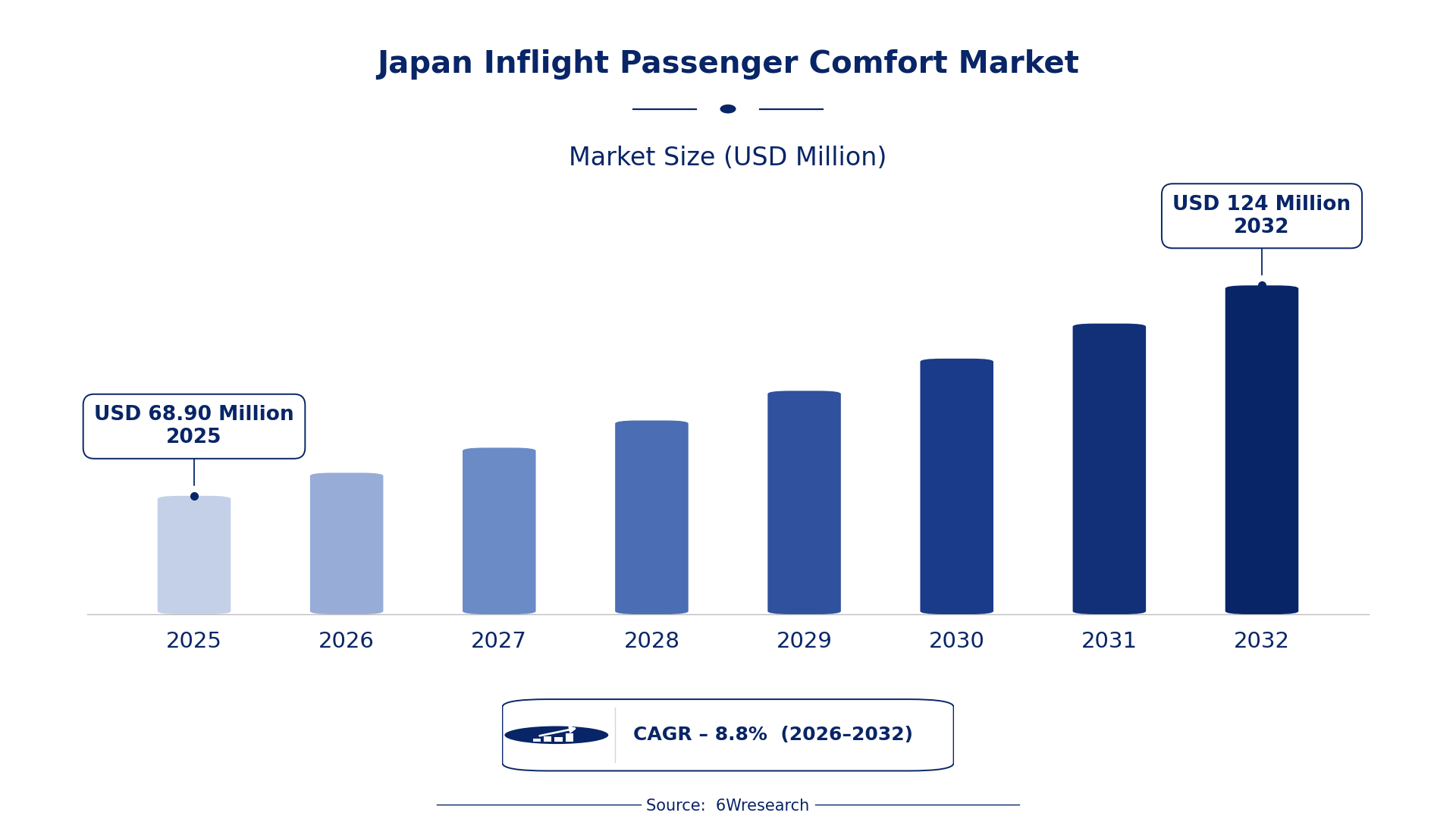
According to 6Wresearch internal database and industry insights, the Japan Inflight Passenger Comfort Market was valued at USD 68.90 Million in 2025 and is projected to reach USD 124 Million by 2032, growing at a CAGR of approximately 8.8% during 2026–2032.
Japan Inflight Passenger Comfort Market Highlights
| Report Metric | Details |
| Report Name | Japan Inflight Passenger Comfort Market (2026-2032) |
| Market Size 2025 | USD 68.90 Million |
| Market Size 2032 | USD 124 Million |
| Absolute Growth 2025–2032 | USD 55.10 Million |
| CAGR 2026–2032 | 8.8% |
| Peak Annual Growth | 9.9% in 2029 |
| Forecast Period | 2026–2032 |
| Historical Data | 2022–2025 |
| Base Year | 2025 |
| Leading Comfort Solution, 2025 | Enhanced Seat Padding (45% share) |
| Leading Technology Type, 2025 | Memory Foam / Gel (44% share) |
| Leading Seat Class, 2025 | Business / First Class (53% share) |
| Leading Distribution Channel, 2025 | Aircraft Seating OEMs (46% share) |
| Fastest-Growing Comfort Solution | Ambient Lighting (11.3% CAGR) |
| Fastest-Growing Technology Type | LED / Mood Lighting (13.6% CAGR) |
| Fastest-Growing Seat Class | All Cabins (12.1% CAGR) |
| Fastest-Growing Distribution Channel | Cabin Interior Providers (10.9% CAGR) |
| Growing Sector | Airline passenger comfort solutions |
| Key End Users | Airlines, cabin interior providers, aircraft seating manufacturers |
Japan Inflight Passenger Comfort Market Year-wise Growth Rate and Key Drivers (2022–2032)
This graph illustrates the annual growth rates of the market from 2022 to 2032, highlighting a steady upward trajectory and projected market expansion over the forecast period.
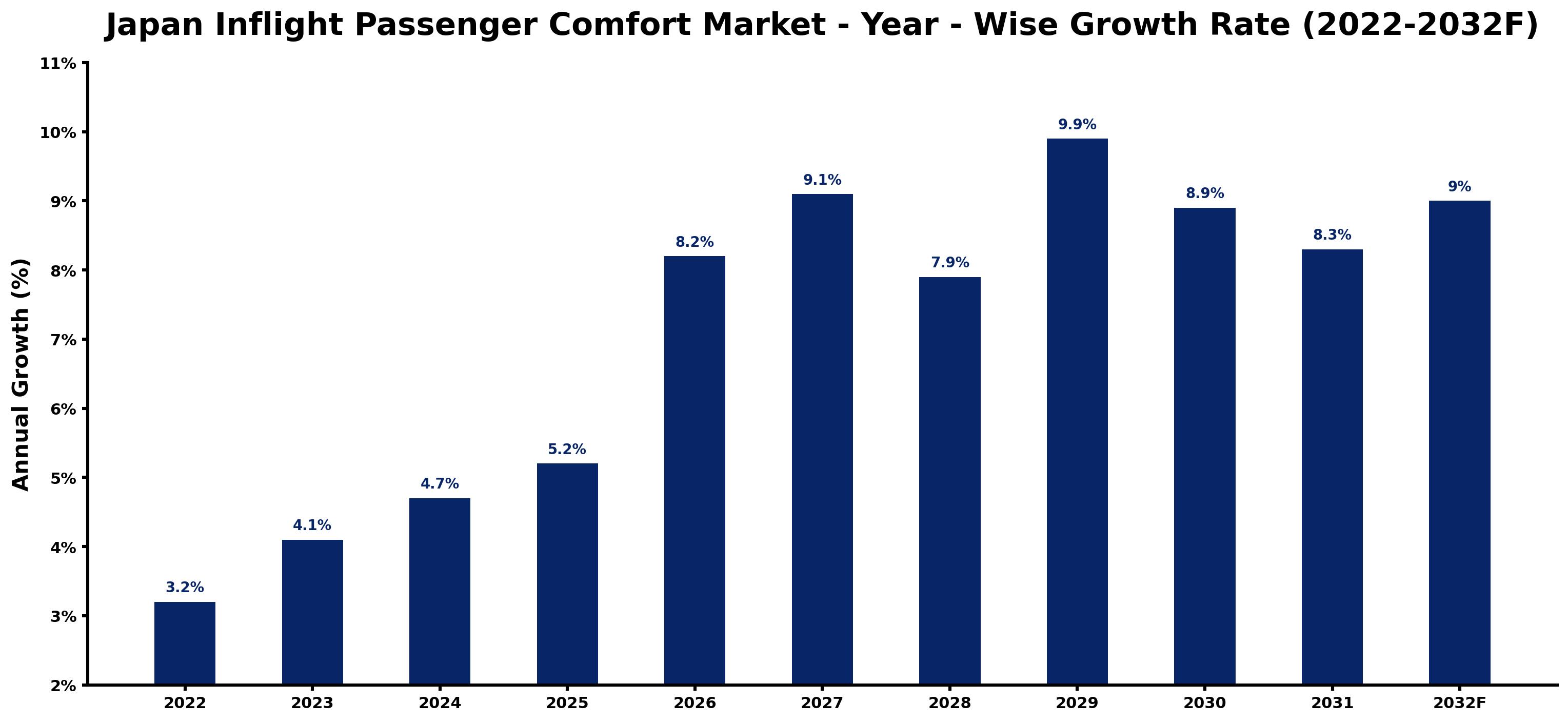
For each year, the table pairs the estimated growth rate with the leading influence on demand, showing how the drivers changed across the period.
| Year | Estimated Annual Growth (%) | Market Rationale |
| 2022 | 3.2 | The market showed steady growth with increasing passenger numbers and demand for comfort solutions. |
| 2023 | 4.1 | Growth accelerated as airlines improved passenger experiences amid rising competition. |
| 2024 | 4.7 | Demand continued to rise, driven by upgrades in seating and cabin technologies. |
| 2025 | 5.2 | Growth peaked as airlines focused on improving comfort for premium passengers. |
| 2026 | 8.2 | The market is projected to expand due to technological advancements in seating materials. |
| 2027 | 9.1 | Demand is expected to rise further as airlines invest in passenger comfort solutions. |
| 2028 | 7.9 | Growth is anticipated to slow slightly as the market stabilises after rapid expansion. |
| 2029 | 9.9 | A surge in demand is projected as airlines introduce new comfort features. |
| 2030 | 8.9 | Growth is likely to slow as market saturation begins to take effect. |
| 2031 | 8.3 | The market will continue to grow, driven by ongoing investments in passenger comfort. |
| 2032 | 9.0 | Demand is expected to rise as airlines enhance their offerings for all classes. |
Note: Market size estimations and growth projections presented in this report are based on 6Wresearch's proprietary forecasting methodology, utilizing the latest available industry data, government publications, and primary research inputs.
Japan Inflight Passenger Comfort Market Synopsis
Inflight Passenger Comfort refers to technologies and solutions designed to improve passenger comfort during air travel, including innovations in seating, lighting, and climate control. The Japan Inflight Passenger Comfort Market is expanding, driven by over 100 million annual passengers and investments from domestic airlines. Factors such as the upgrade of business class seating and the introduction of LED mood lighting contribute to this growth. The 2025 aviation strategy highlights cabin comfort as a key focus area, indicating strong future demand from both domestic and international airlines.
Market Dynamics Impact Analysis (2026–2032)
| Factor | Type | Impact | Primary Segment Affected |
| Increased passenger numbers drive demand for enhanced comfort solutions. | Driver | High | Enhanced Seat Padding |
| Technological advancements in seating materials boost comfort levels. | Driver | High | Memory Foam / Gel |
| Growing focus on passenger experience creates opportunities for innovative solutions. | Opportunity | High | Ambient Lighting |
| Rising competition among airlines encourages investment in comfort features. | Opportunity | High | Reclining Systems |
| High costs of advanced materials may limit some airlines' investments. | Restraint | Medium | Temperature Control |
| Regulatory compliance for safety standards can delay product implementation. | Restraint | Medium | LED / Mood Lighting |
| High investment costs for upgrading fleets can deter smaller airlines. | Challenge | High | Business / First Class |
| Limited availability of skilled workforce affects production capabilities. | Challenge | Medium | Aircraft Seating OEMs |
Evaluation of Drivers in Japan Inflight Passenger Comfort Market (2026–2032)
Below are the drivers that matter most for revenue growth, with supporting evidence.
| Drivers | Primary Segment Affected | Why It Matters (Evidence) |
| Rising passenger numbers increase the demand for comfort solutions. | Enhanced Seat Padding | Japan's airline industry serves over 100 million passengers annually, leading to higher purchases of comfort solutions. |
| Technological advancements in materials improve seating comfort. | Memory Foam / Gel | The adoption of memory foam seats in premium economy classes reflects the shift towards better passenger comfort. |
| Airlines are investing in new technologies to improve passenger experience. | LED / Mood Lighting | Airlines are increasingly investing in LED mood lighting to create a more inviting cabin ambiance and attract more passengers. |
| Long-haul routes necessitate improved comfort for passengers. | Reclining Systems | The average flight duration for long-haul routes from Japan is approximately 10 hours, increasing the need for comfort features. |
| Focus on premium services drives demand for high-quality comfort solutions. | Business / First Class | Japan Airlines announced an upgrade to its business class seating, reflecting the demand for improved comfort. |
Orders keep climbing as airlines invest in passenger comfort through new technologies. The adoption of memory foam seats in premium economy classes reflects a shift towards better comfort, with airlines investing in LED mood lighting to create a more inviting cabin environment. Japan's airline industry serves over 100 million passengers annually, driving demand for improved seating solutions. The average flight duration for long-haul routes from Japan is approximately 10 hours, necessitating advanced comfort features. As a result, airlines are focusing on upgrading their business class offerings to attract high-paying passengers.
Evaluation of Restraints in Japan Inflight Passenger Comfort Market
Below are the constraints most often cited by buyers and suppliers, with the segment each affects.
| Market Restraint | Primary Segment Affected | Why It Matters (Evidence) |
| High costs of advanced materials limit some airlines' investments in comfort solutions. | Temperature Control | The increased costs associated with advanced materials can restrict budget allocations for comfort solutions. |
| Regulatory compliance can delay the introduction of new comfort technologies. | LED / Mood Lighting | Compliance with the JIS Z 8401 standard for cabin materials can slow down the implementation of new lighting solutions. |
| Limited availability of skilled workforce affects production capabilities. | Memory Foam / Gel | A shortage of skilled workers in Japan can hinder the production of advanced seating technologies. |
| High investment costs for upgrading fleets can deter smaller airlines. | Business / First Class | Smaller airlines may struggle to afford the necessary upgrades to compete in the premium market. |
| Market saturation may slow down growth rates in the coming years. | All Cabins | As more airlines adopt similar comfort features, differentiation becomes challenging. |
Japan Inflight Passenger Comfort Market Challenges
Japan's airline industry serves over 100 million passengers annually, yet supply chain disruptions can delay the delivery of cabin comfort solutions, forcing airlines to postpone upgrades. A shrinking workforce leads to skills shortages in advanced material engineering, complicating the development of new seating technologies and resulting in slower product rollouts for airlines. Domestic airlines face intensified competition from international carriers that adopt comfort technologies faster, risking market share loss. Compliance with the JIS Z 8401 standard for cabin materials can increase operational expenses by up to 15%, limiting airlines' ability to invest in passenger comfort solutions.
Trends in the Japan Inflight Passenger Comfort Market
Four trends stand out in the Japan Inflight Passenger Comfort Market.
- Shift Towards Improved Cabin Ambiance: Airlines are increasingly adopting LED mood lighting to enhance passenger experience, with notable investments in the Tokyo Metropolitan area. This trend boosts overall satisfaction for millions of passengers each year.
- Focus on Premium Economy Comfort: The rollout of memory foam seats in premium economy classes commenced in 2023, illustrating a shift towards greater comfort. This development addresses the rising demand for improved seating solutions among travellers.
- Increased Investment in Long-Haul Comfort Solutions: Airlines are prioritising comfort solutions for long-haul routes, which average approximately 10 hours. This emphasis on passenger comfort is reflected in recent upgrades to business class seating by major airlines.
- Expansion of Comfort Solutions Across All Classes: The trend of enhancing comfort is extending to all cabins, with a marked increase in investments in comfort solutions. The 2025 aviation strategy highlights the significance of cabin comfort for all passengers.
Investment Opportunities in the Japan Inflight Passenger Comfort Market
Several openings in the Japan Inflight Passenger Comfort Market merit attention from investors.
- Gap in Comfort Solutions: With the market anticipated to reach USD 124 million by 2032, a notable gap in comfort solutions exists. Suppliers can concentrate on enhancing ambient lighting for airlines aiming to improve passenger experiences.
- Investment in Advanced Seating Technologies: Airlines are increasingly pursuing advanced seating solutions, particularly in premium classes. Suppliers can capitalise on this demand by offering memory foam technologies to boost passenger comfort.
- Demand for All Cabin Comfort Solutions: The growing emphasis on comfort across all cabins creates an opportunity for suppliers to provide comprehensive solutions. Cabin interior providers can play a crucial role in this expanding market segment.
- Timing for Upgrading Cabin Comfort: With airlines making substantial investments in passenger comfort, now presents an ideal opportunity for suppliers to enter the market. Collaborating with aircraft seating OEMs can facilitate access to this burgeoning sector.
Government Initiatives in the Japan Inflight Passenger Comfort Market
The Electrical Appliance and Material Safety Act of 1961 ensures that inflight comfort solutions meet stringent safety standards, regulating the safety of materials used in aircraft. Compliance with this law is essential for producers and suppliers of inflight comfort technologies to operate within the market and ensure passenger safety.
The Civil Aviation Bureau oversees safety regulations for airline operations in Japan, approving new comfort solutions and ensuring compliance with safety standards. This agency plays a key role in funding projects aimed at improving passenger comfort across the airline industry.
Future Insight of the Japan Inflight Passenger Comfort Market
LED mood lighting will transform passenger experience by 2032, as airlines increasingly adopt this technology to create a more relaxing environment. The 2025 aviation strategy will prioritise cabin comfort solutions, prompting airlines to invest in advanced seating options like memory foam to attract premium travellers. By 2032, over 200 aircraft in the All Nippon Airways fleet will feature upgraded seating solutions, reflecting a broader trend across the industry. Stricter safety regulations from the Civil Aviation Bureau will drive improvements in cabin materials, ensuring higher quality standards for passenger comfort.
Market Segmentation Analysis
Japan Inflight Passenger Comfort Market report covers a detailed analysis of the following market segments:
By Comfort Solution – Enhanced Seat Padding Leads, Ambient Lighting Expected to Grow Fastest
According to Saurav Kr Singh, Senior Research Analyst at 6Wresearch, in 2025, Enhanced Seat Padding led the comfort solution split with a 45% share. Enhanced seat padding holds the largest share as it is vital for providing physical comfort to passengers, especially in premium classes where satisfaction is paramount. Airlines are increasingly adopting memory foam seats to cater to the expectations of their high-paying customers, reflecting strong demand for these comfort solutions. The quickest growth will come from Ambient Lighting, forecast to expand at a CAGR of 11.3% between 2026 and 2032. The ambient lighting segment is growing rapidly as airlines invest in LED mood lighting to enhance the cabin's aesthetic and mood, thereby improving the overall passenger experience. This trend is highlighted by recent upgrades announced by airlines to their cabin environments, indicating a shift towards more inviting atmospheres. Suppliers should prioritise the development of advanced comfort solutions to align with the rising expectations of airlines and passengers.
By Technology Type – Memory Foam / Gel Leads, LED / Mood Lighting Expected to Grow Fastest
With 44% of technology type revenue in 2025, Memory Foam / Gel was the largest category. Memory foam and gel technologies dominate the market due to their critical role in seat construction, offering better support and comfort for passengers during long flights. This is particularly important in business and first class, where there is a high demand for premium seating solutions that enhance the travel experience. Over 2026–2032, LED / Mood Lighting is expected to post the fastest growth, at a CAGR of 13.6%. LED and mood lighting technologies are gaining traction as airlines recognise their potential to improve cabin ambiance, which directly elevates passenger experience. The increasing implementation of these solutions by airlines reflects a growing commitment to enhancing the overall flight environment. Buyers should invest in advanced lighting technologies to significantly improve passenger comfort and satisfaction.
By Seat Class – Business / First Class Leads, All Cabins Expected to Grow Fastest
The largest seat class category in 2025 was Business / First Class, at 53% of revenue. Business and first class seating solutions capture the largest share as they feature premium comfort solutions specifically designed for high-paying passengers, ensuring a superior travel experience. The focus on enhancing comfort in these classes is crucial for airlines aiming to attract affluent customers seeking quality. All Cabins are set to record the highest CAGR in this split, 12.1% over 2026–2032. The all cabins segment is experiencing rapid growth as airlines expand their comfort solutions to include all passenger classes, demonstrating a commitment to improving the overall travel experience. This trend indicates a market shift towards inclusivity in passenger comfort across various seating categories. Suppliers must expand their offerings to meet the increasing demand for comfort solutions across all passenger classes.
By Distribution Channel – Aircraft Seating OEMs Lead, Cabin Interior Providers Expected to Grow Fastest
Aircraft Seating OEMs took 46% of distribution channel revenue in 2025, more than any other category. Aircraft seating OEMs lead the market as they are the primary manufacturers of seating solutions, directly supplying airlines with essential products that enhance passenger comfort. Their established relationships with airlines ensure a consistent demand for their offerings, solidifying their market position. Cabin Interior Providers are projected to grow fastest, at a CAGR of 10.9% during 2026–2032. Cabin interior providers are witnessing the fastest growth as they supply a diverse range of comfort solutions for cabin design, addressing the rising focus on passenger experience. This trend is propelled by airlines seeking to differentiate their services through improved cabin environments that attract more passengers. Suppliers should strengthen partnerships with cabin interior providers to seize emerging opportunities in the market.
Key Attractiveness of the Report
- 10 Years of Market Numbers
- Historical Data Starting from 2022 to 2025
- Base Year 2025
- Forecast Data until 2032
- Key Performance Indicators Impacting the Market
- Major Upcoming Developments and Projects
Key Highlights of the Report:
- Japan Inflight Passenger Comfort Market Outlook
- Market Size of Japan Inflight Passenger Comfort Market, 2025
- Forecast of Japan Inflight Passenger Comfort Market, 2032
- Historical Data and Forecast of Japan Inflight Passenger Comfort Revenues & Volume for the Period 2022-2032F
- Japan Inflight Passenger Comfort Market Trend Evolution
- Japan Inflight Passenger Comfort Market Drivers and Challenges
- Japan Inflight Passenger Comfort Price Trends
- Japan Inflight Passenger Comfort Porter's Five Forces
- Japan Inflight Passenger Comfort Industry Life Cycle
- Historical Data and Forecast of Japan Inflight Passenger Comfort Market Revenues & Volume By Comfort Solution for the Period 2022-2032F
- Historical Data and Forecast of Japan Inflight Passenger Comfort Market Revenues & Volume By Enhanced Seat Padding for the Period 2022-2032F
- Historical Data and Forecast of Japan Inflight Passenger Comfort Market Revenues & Volume By Ambient Lighting for the Period 2022-2032F
- Historical Data and Forecast of Japan Inflight Passenger Comfort Market Revenues & Volume By Temperature Control for the Period 2022-2032F
- Historical Data and Forecast of Japan Inflight Passenger Comfort Market Revenues & Volume By Reclining Systems for the Period 2022-2032F
- Historical Data and Forecast of Japan Inflight Passenger Comfort Market Revenues & Volume By Technology Type for the Period 2022-2032F
- Historical Data and Forecast of Japan Inflight Passenger Comfort Market Revenues & Volume By Memory Foam / Gel for the Period 2022-2032F
- Historical Data and Forecast of Japan Inflight Passenger Comfort Market Revenues & Volume By LED / Mood Lighting for the Period 2022-2032F
- Historical Data and Forecast of Japan Inflight Passenger Comfort Market Revenues & Volume By Smart Vents / Sensors for the Period 2022-2032F
- Historical Data and Forecast of Japan Inflight Passenger Comfort Market Revenues & Volume By Mechanical / Electric for the Period 2022-2032F
- Historical Data and Forecast of Japan Inflight Passenger Comfort Market Revenues & Volume By Seat Class for the Period 2022-2032F
- Historical Data and Forecast of Japan Inflight Passenger Comfort Market Revenues & Volume By Business / First Class for the Period 2022-2032F
- Historical Data and Forecast of Japan Inflight Passenger Comfort Market Revenues & Volume By All Cabins for the Period 2022-2032F
- Historical Data and Forecast of Japan Inflight Passenger Comfort Market Revenues & Volume By Long Haul Routes for the Period 2022-2032F
- Historical Data and Forecast of Japan Inflight Passenger Comfort Market Revenues & Volume By Premium Economy for the Period 2022-2032F
- Historical Data and Forecast of Japan Inflight Passenger Comfort Market Revenues & Volume By Distribution Channel for the Period 2022-2032F
- Historical Data and Forecast of Japan Inflight Passenger Comfort Market Revenues & Volume By Aircraft Seating OEMs for the Period 2022-2032F
- Historical Data and Forecast of Japan Inflight Passenger Comfort Market Revenues & Volume By Cabin Interior Providers for the Period 2022-2032F
- Historical Data and Forecast of Japan Inflight Passenger Comfort Market Revenues & Volume By Airline OEM Systems for the Period 2022-2032F
- Historical Data and Forecast of Japan Inflight Passenger Comfort Market Revenues & Volume By Cabin Comfort Vendors for the Period 2022-2032F
- Japan Inflight Passenger Comfort Import Export Trade Statistics
- Market Opportunity Assessment By Comfort Solution
- Market Opportunity Assessment By Technology Type
- Market Opportunity Assessment By Seat Class
- Market Opportunity Assessment By Distribution Channel
- Japan Inflight Passenger Comfort Top Companies Market Share
- Japan Inflight Passenger Comfort Competitive Benchmarking By Technical and Operational Parameters
- Japan Inflight Passenger Comfort Company Profiles
- Japan Inflight Passenger Comfort Key Strategic Recommendations
Market Covered
The report covers the following segments.
By Comfort Solution
- Enhanced Seat Padding
- Ambient Lighting
- Temperature Control
- Reclining Systems
By Technology Type
- Memory Foam / Gel
- LED / Mood Lighting
- Smart Vents / Sensors
- Mechanical / Electric
By Seat Class
- Business / First Class
- All Cabins
- Long Haul Routes
- Premium Economy
By Distribution Channel
- Aircraft Seating OEMs
- Cabin Interior Providers
- Airline OEM Systems
- Cabin Comfort Vendors































