Japan Infrastructure Development Market Size & Growth Rate
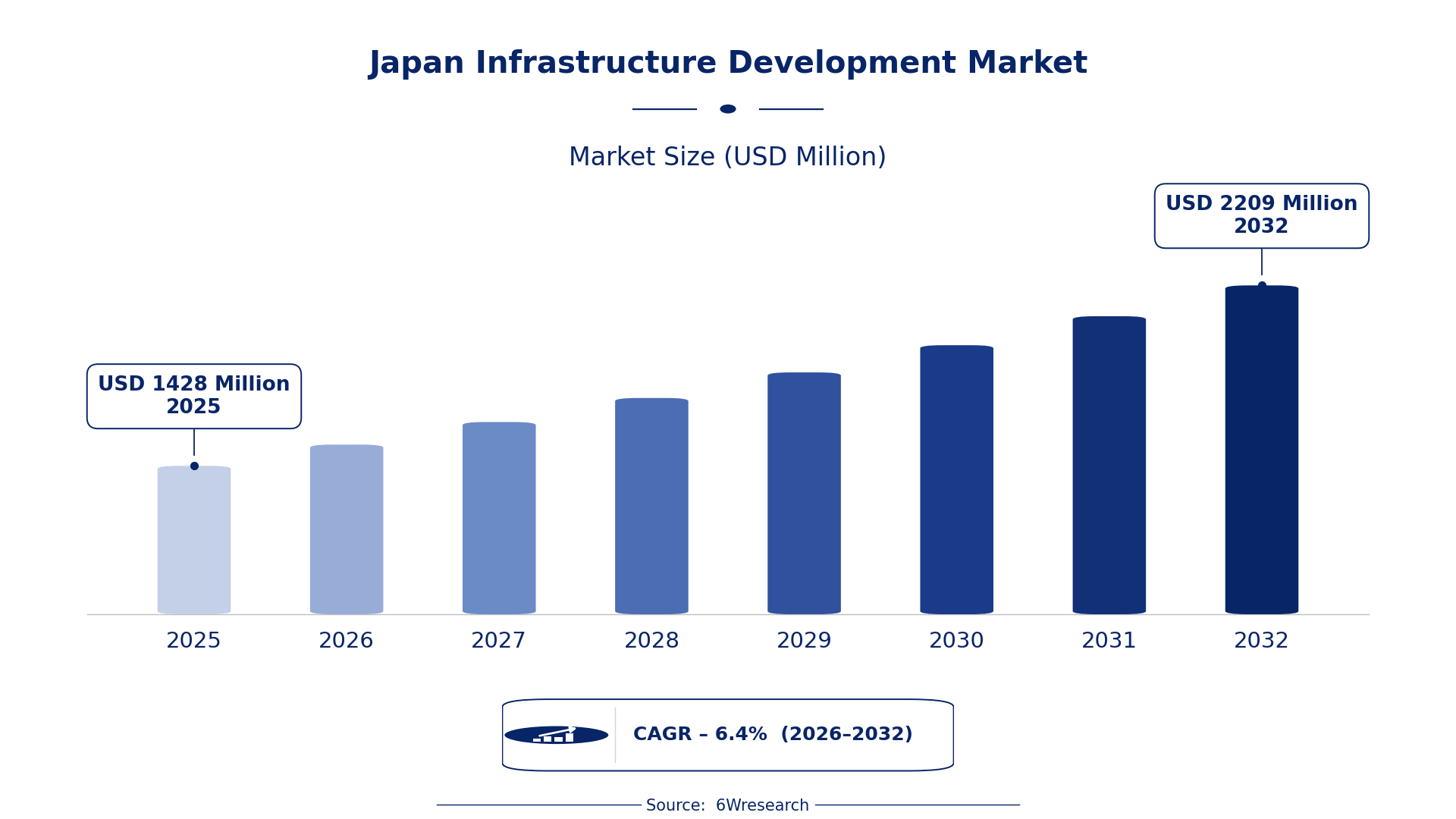
According to 6Wresearch internal database and industry insights, the Japan Infrastructure Development Market was valued at USD 1,428 Million in 2025 and is projected to reach USD 2,209 Million by 2032, growing at a CAGR of approximately 6.4% during 2026–2032.
Japan Infrastructure Development Market Highlights
| Report Metric | Details |
| Report Name | Japan Infrastructure Development Market (2026-2032) |
| Market Size 2025 | USD 1,428 Million |
| Market Size 2032 | USD 2,209 Million |
| Absolute Growth 2025–2032 | USD 781 Million |
| CAGR 2026–2032 | 6.4% |
| Peak Annual Growth | 7.1% in 2028 |
| Forecast Period | 2026–2032 |
| Historical Data | 2022–2025 |
| Base Year | 2025 |
| Leading Development Type, 2025 | Transport Infrastructure (33% share) |
| Leading Project Type, 2025 | Roads / Airports (40% share) |
| Leading End Use Sector, 2025 | Public Sector (40% share) |
| Leading Distribution Channel, 2025 | EPC Contractors (52% share) |
| Fastest-Growing Development Type | Energy Infrastructure (8.8% CAGR) |
| Fastest-Growing Project Type | Power / Renewable (9.6% CAGR) |
| Fastest-Growing End Use Sector | Utilities (8.1% CAGR) |
| Fastest-Growing Distribution Channel | Govt Tenders (7.9% CAGR) |
| Growing Sector | Public Sector |
| Key End Users | Government agencies, Private investors, EPC contractors, Municipalities |
Japan Infrastructure Development Market Year-wise Growth Rate and Key Drivers (2022–2032)
This graph illustrates the annual growth rates of the market from 2022 to 2032, highlighting a steady upward trajectory and projected market expansion over the forecast period.
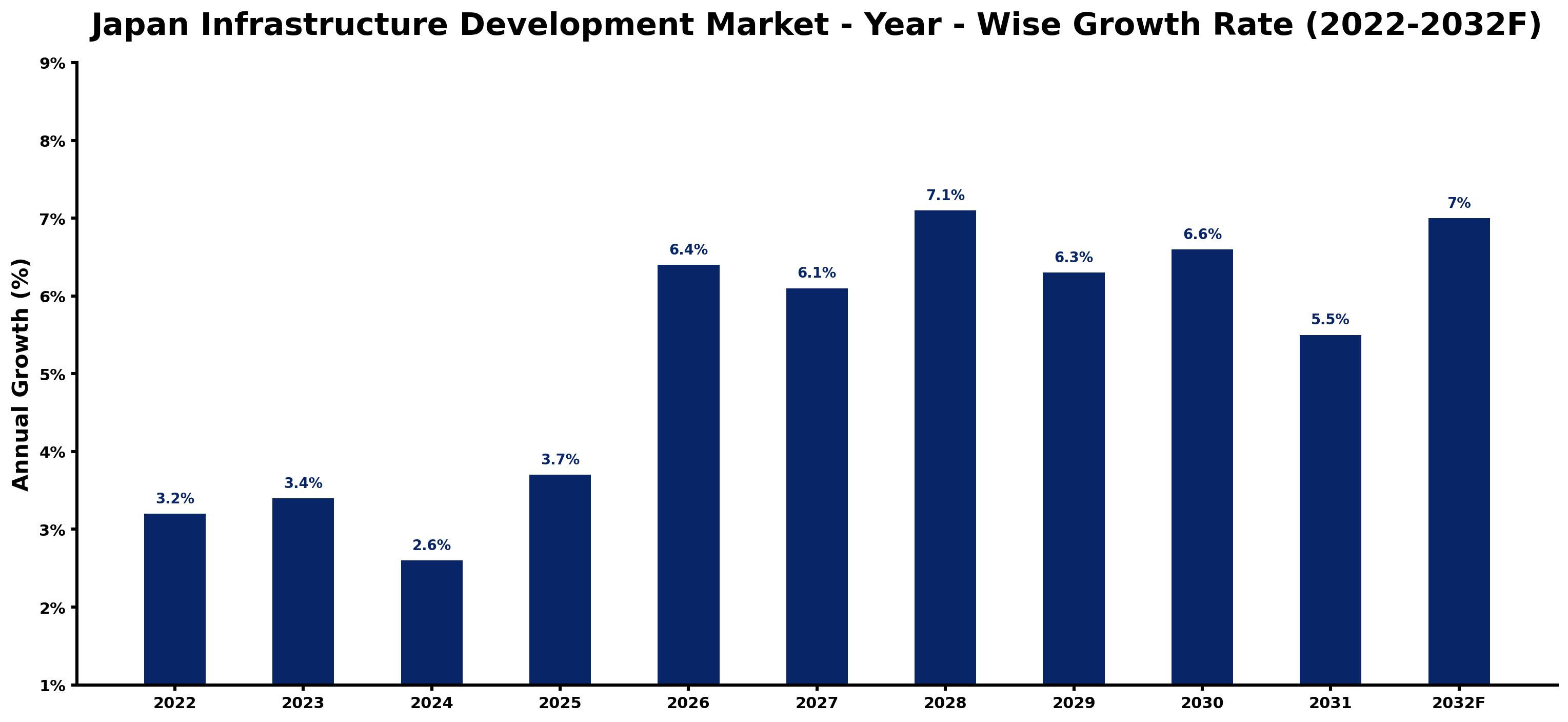
Each row of the following table gives one year's estimated growth and the event or demand shift that explains it.
| Year | Estimated Annual Growth (%) | Market Rationale |
| 2022 | 3.2 | Demand was driven by ongoing urban infrastructure projects and public sector investments. |
| 2023 | 3.4 | Growth accelerated due to increased funding for transport infrastructure in the Tokyo metropolitan area. |
| 2024 | 2.6 | A slowdown occurred as some projects faced delays in approvals and funding allocation. |
| 2025 | 3.7 | Investment in urban infrastructure surged following the Tokyo 2020 Olympics, boosting growth. |
| 2026 | 6.4 | The market is expected to grow as renewable energy projects gain traction under the 2030 Energy Plan. |
| 2027 | 6.1 | Growth will slow slightly as some projects reach completion and new ones are initiated. |
| 2028 | 7.1 | The peak growth year will be driven by strong public-private partnerships in urban development. |
| 2029 | 6.3 | A slight slowdown is anticipated as the market adjusts to completed projects and new initiatives. |
| 2030 | 6.6 | Growth is expected to rise again as smart city initiatives expand in cities like Fukuoka. |
| 2031 | 5.5 | The market will see a slowdown as some infrastructure projects face funding challenges. |
| 2032 | 7.0 | Growth will accelerate again due to increased investments in energy infrastructure. |
Note: Market size estimations and growth projections presented in this report are based on 6Wresearch's proprietary forecasting methodology, utilizing the latest available industry data, government publications, and primary research inputs.
Japan Infrastructure Development Market Synopsis
Infrastructure development in Japan involves constructing and improving essential physical structures for economic activities, including transport, energy, and urban infrastructures. The Japan Infrastructure Development Market is expanding due to substantial government funding, with ¥4 trillion allocated for infrastructure projects in 2023. Smart city initiatives in regions like Fukuoka are driving demand, as urbanisation and energy solutions become essential for sustainable growth.
Market Dynamics Impact Analysis (2026–2032)
| Factor | Type | Impact | Primary Segment Affected |
| Government funding for infrastructure projects | Driver | High | Public Sector |
| Rising investments in renewable energy | Driver | High | Energy Infrastructure |
| Increasing demand for urban infrastructure | Opportunity | High | Urban Infrastructure |
| Public-private partnerships for project execution | Opportunity | High | EPC Contractors |
| Delays in project approvals | Restraint | Medium | Transport Infrastructure |
| High costs associated with compliance | Restraint | Medium | Energy Infrastructure |
| Competition for government tenders | Challenge | High | Govt Tenders |
| Technological advancements in infrastructure | Challenge | Medium | Smart Cities / Housing |
Evaluation of Drivers in Japan Infrastructure Development Market (2026–2032)
The following drivers explain most of the expected growth.
| Drivers | Primary Segment Affected | Why It Matters (Evidence) |
| Increased government funding for infrastructure projects | Public Sector | The government allocated ¥4 trillion for infrastructure projects in 2023, prompting more investments. |
| Growing investments in renewable energy projects | Energy Infrastructure | Renewable energy projects are prioritised, leading to increased infrastructure development under national plans. |
| Urbanisation driving demand for infrastructure | Urban Infrastructure | Japan's population of approximately 125 million necessitates extensive development to support urban growth. |
| Public-private partnerships improving project execution | EPC Contractors | Public-private partnerships are increasingly used, facilitating faster project delivery and execution. |
| Smart city initiatives expanding infrastructure needs | Smart Cities / Housing | Cities like Fukuoka are implementing smart city initiatives, increasing demand for advanced solutions. |
Urban growth necessitates extensive development, particularly in urban areas. Investments in renewable energy projects are driving demand, while public-private partnerships facilitate faster project execution, further boosting the market's growth potential. The Tokyo metropolitan area is a prime example of where these trends are clear, leading to increased infrastructure spending.
Evaluation of Restraints in Japan Infrastructure Development Market
The table below lists the restraints and the evidence behind each.
| Market Restraint | Primary Segment Affected | Why It Matters (Evidence) |
| Delays in project approvals | Transport Infrastructure | Delays in obtaining necessary approvals can slow project timelines, impacting overall market growth. |
| High compliance costs for energy projects | Energy Infrastructure | Compliance with stringent regulations increases costs for energy infrastructure projects, limiting investment. |
| Intense competition for government tenders | Govt Tenders | Competition for limited government tenders can reduce profit margins for contractors. |
| Technological adaptation costs | Smart Cities / Housing | The need for advanced technology in smart city projects raises costs, affecting project feasibility. |
| Limited skilled workforce availability | EPC Contractors | A shortage of skilled workers in the construction sector can delay project execution and increase costs. |
Japan Infrastructure Development Market Challenges
Contractors face escalating compliance costs due to stringent regulations, increasing project budgets by 15% for developers. Material shortages disrupt supply chains, delaying project timelines by three months for producers. Rapid technological advancements necessitate ongoing investment in training, costing firms around ¥500 million annually to maintain competitiveness. Local suppliers encounter pressure from emerging markets, compelling them to lower prices and potentially diminishing profit margins by 10%.
Trends in the Japan Infrastructure Development Market
Several trends are reshaping the Japan Infrastructure Development Market; the most important are set out below.
- Shift towards Smart City Initiatives: Cities like Fukuoka are implementing smart city initiatives, which are driving demand for advanced infrastructure solutions. This trend is backed by a projected investment of ¥1 trillion by 2030.
- Expansion of Renewable Energy Projects: The focus on renewable energy is growing, with investments under the 2030 Energy Plan. Approximately 150 GWh of domestic battery manufacturing capacity is targeted by 2030, driving infrastructure development.
- Increased Public-Private Partnerships: Public-private partnerships are becoming more prevalent in urban infrastructure projects, improving project delivery. This trend is supported by the government's allocation of ¥4 trillion for infrastructure in 2023.
- Focus on Energy Efficiency Standards: The Building Energy Efficiency Act mandates that new buildings meet energy standards from April 2025. This requirement is driving demand for compliant infrastructure solutions across the sector.
Investment Opportunities in the Japan Infrastructure Development Market
Where to invest in the Japan Infrastructure Development Market: the main openings are set out below.
- Joint Ventures for Infrastructure Projects: Collaborations in infrastructure development are essential, particularly in urban areas. Public sector projects in the Tokyo metropolitan area present significant partnership opportunities, especially with a budget of ¥4 trillion allocated for 2023.
- Investment in Renewable Energy Infrastructure: Private enterprises are increasingly investing in renewable energy infrastructure, particularly in solar and wind projects. With a target of 150 GWh of battery capacity by 2030, opportunities abound for suppliers.
- Expansion of Urban Infrastructure: Urban infrastructure demand is surging due to population growth. Municipalities are seeking solutions, particularly in cities like Yokohama, which is investing heavily in urban upgrades.
- Approval Pathways for Smart City Projects: The current focus on smart cities presents opportunities for certification and partnerships. With government backing, cities like Fukuoka are paving the way for practical infrastructure solutions.
Government Initiatives in the Japan Infrastructure Development Market
The Hydrogen Society Promotion Act, enacted in 2024, supports low-carbon hydrogen supply chains with price-gap support to encourage development. This law is important for producers and buyers of hydrogen-related infrastructure, ensuring compliance with new energy standards. Additionally, the Building Energy Efficiency Act mandates that all new buildings meet energy standards from April 2025, impacting project planning and execution.
The Ministry of Land, Infrastructure, Transport and Tourism oversees development policies, approving projects that align with national strategies. The agency funds urban infrastructure projects, with a budget of ¥4 trillion allocated for 2023.
Future Insight of the Japan Infrastructure Development Market
Smart city technologies will reshape infrastructure demand by 2032, as cities like Fukuoka and Yokohama implement advanced systems. The government will emphasise resilience against natural disasters, with a projected ¥4 trillion allocated for infrastructure projects. Renewable energy initiatives will gain momentum under Japan's 2030 Energy Plan, creating new opportunities for suppliers. Public-private partnerships will increasingly drive collaborative urban projects, benefiting both buyers and suppliers.
Market Segmentation Analysis
Japan Infrastructure Development Market report covers a detailed analysis of the following market segments:
By Development Type – Transport Infrastructure Leads, Energy Infrastructure Expected to Grow Fastest
According to Saurav Kr Singh, Senior Research Analyst at 6Wresearch, Transport Infrastructure accounted for 33% of the market by development type in 2025. Transport infrastructure holds the largest share due to its critical role in ensuring connectivity and mobility across Japan's densely populated regions. The ongoing projects in the Tokyo metropolitan area exemplify the sustained demand for such essential infrastructure. Energy Infrastructure is set to record the highest CAGR in this split, 8.8% over 2026–2032. Energy infrastructure is experiencing rapid growth as Japan prioritises renewable energy projects in accordance with its 2030 Energy Plan. The significant investments directed towards sustainable power solutions are driving this sector's swift expansion. Suppliers should align their strategies with the increasing focus on renewable energy initiatives to capture emerging opportunities.
By Project Type – Roads / Airports Lead, Power / Renewable Expected to Grow Fastest
Roads / Airports took 40% of project type revenue in 2025, more than any other category. Roads and airports dominate the market as they are vital for transportation and logistics, enabling the efficient movement of goods and people. The government's substantial budget allocation for infrastructure projects underscores the importance of this segment. Power / Renewable is projected to grow fastest, at a CAGR of 9.6% during 2026–2032. Power and renewable projects are growing quickly as Japan seeks to enhance its energy supply sustainably. This emphasis on renewable initiatives is a direct response to environmental concerns and the necessity for energy security. Buyers must adapt their procurement approaches to accommodate the rising importance of renewable energy projects.
By End Use Sector – Public Sector Leads, Utilities Expected to Grow Fastest
Public Sector held 40% of the Japan Infrastructure Development Market by end use sector in 2025. The public sector leads the market as it is a major contributor to government projects, particularly in infrastructure development. Government initiatives and funding play a crucial role in driving the demand for infrastructure services. Over 2026–2032, Utilities are expected to post the fastest growth, at a CAGR of 8.1%. Utilities are the fastest-growing sector, essential for service provision and infrastructure maintenance as urban areas continue to expand. The increasing need for reliable utility services is accelerating growth in this segment. Suppliers should concentrate on utility companies to capitalise on the rising demand for infrastructure maintenance and development.
By Distribution Channel – EPC Contractors Lead, Govt Tenders Expected to Grow Fastest
In 2025, EPC Contractors led the distribution channel split with a 52% share. EPC contractors are the leading distribution channel as they are central to project execution, managing the complexities of infrastructure projects. Their expertise ensures that projects are delivered efficiently and effectively. The quickest growth will come from Govt Tenders, forecast to expand at a CAGR of 7.9% between 2026 and 2032. Government tenders are growing quickly as they represent the primary source of public sector projects, particularly in infrastructure development. The increasing reliance on government funding for infrastructure initiatives is driving this trend. Suppliers should engage with government channels to secure contracts and align with public sector project requirements.
Key Attractiveness of the Report
- 10 Years of Market Numbers
- Historical Data Starting from 2022 to 2025
- Base Year 2025
- Forecast Data until 2032
- Key Performance Indicators Impacting the Market
- Major Upcoming Developments and Projects
Key Highlights of the Report:
- Japan Infrastructure Development Market Outlook
- Market Size of Japan Infrastructure Development Market, 2025
- Forecast of Japan Infrastructure Development Market, 2032
- Historical Data and Forecast of Japan Infrastructure Development Revenues & Volume for the Period 2022-2032F
- Japan Infrastructure Development Market Trend Evolution
- Japan Infrastructure Development Market Drivers and Challenges
- Japan Infrastructure Development Price Trends
- Japan Infrastructure Development Porter's Five Forces
- Japan Infrastructure Development Industry Life Cycle
- Historical Data and Forecast of Japan Infrastructure Development Market Revenues & Volume By Development Type for the Period 2022-2032F
- Historical Data and Forecast of Japan Infrastructure Development Market Revenues & Volume By Transport Infrastructure for the Period 2022-2032F
- Historical Data and Forecast of Japan Infrastructure Development Market Revenues & Volume By Energy Infrastructure for the Period 2022-2032F
- Historical Data and Forecast of Japan Infrastructure Development Market Revenues & Volume By Urban Infrastructure for the Period 2022-2032F
- Historical Data and Forecast of Japan Infrastructure Development Market Revenues & Volume By Industrial Infrastructure for the Period 2022-2032F
- Historical Data and Forecast of Japan Infrastructure Development Market Revenues & Volume By Project Type for the Period 2022-2032F
- Historical Data and Forecast of Japan Infrastructure Development Market Revenues & Volume By Roads / Airports for the Period 2022-2032F
- Historical Data and Forecast of Japan Infrastructure Development Market Revenues & Volume By Power / Renewable for the Period 2022-2032F
- Historical Data and Forecast of Japan Infrastructure Development Market Revenues & Volume By Smart Cities / Housing for the Period 2022-2032F
- Historical Data and Forecast of Japan Infrastructure Development Market Revenues & Volume By Factories / Parks for the Period 2022-2032F
- Historical Data and Forecast of Japan Infrastructure Development Market Revenues & Volume By End Use Sector for the Period 2022-2032F
- Historical Data and Forecast of Japan Infrastructure Development Market Revenues & Volume By Public Sector for the Period 2022-2032F
- Historical Data and Forecast of Japan Infrastructure Development Market Revenues & Volume By Utilities for the Period 2022-2032F
- Historical Data and Forecast of Japan Infrastructure Development Market Revenues & Volume By Municipalities for the Period 2022-2032F
- Historical Data and Forecast of Japan Infrastructure Development Market Revenues & Volume By Private Enterprises for the Period 2022-2032F
- Historical Data and Forecast of Japan Infrastructure Development Market Revenues & Volume By Distribution Channel for the Period 2022-2032F
- Historical Data and Forecast of Japan Infrastructure Development Market Revenues & Volume By EPC Contractors for the Period 2022-2032F
- Historical Data and Forecast of Japan Infrastructure Development Market Revenues & Volume By Govt Tenders for the Period 2022-2032F
- Historical Data and Forecast of Japan Infrastructure Development Market Revenues & Volume By Infrastructure Firms for the Period 2022-2032F
- Historical Data and Forecast of Japan Infrastructure Development Market Revenues & Volume By Private Investors for the Period 2022-2032F
- Japan Infrastructure Development Import Export Trade Statistics
- Market Opportunity Assessment By Development Type
- Market Opportunity Assessment By Project Type
- Market Opportunity Assessment By End Use Sector
- Market Opportunity Assessment By Distribution Channel
- Japan Infrastructure Development Top Companies Market Share
- Japan Infrastructure Development Competitive Benchmarking By Technical and Operational Parameters
- Japan Infrastructure Development Company Profiles
- Japan Infrastructure Development Key Strategic Recommendations
Market Covered
Segments analysed in this report are listed below.
By Development Type
- Transport Infrastructure
- Energy Infrastructure
- Urban Infrastructure
- Industrial Infrastructure
By Project Type
- Roads / Airports
- Power / Renewable
- Smart Cities / Housing
- Factories / Parks
By End Use Sector
- Public Sector
- Utilities
- Municipalities
- Private Enterprises
By Distribution Channel
- EPC Contractors
- Govt Tenders
- Infrastructure Firms
- Private Investors































