Japan Infrastructure Monitoring AI Market Size & Growth Rate
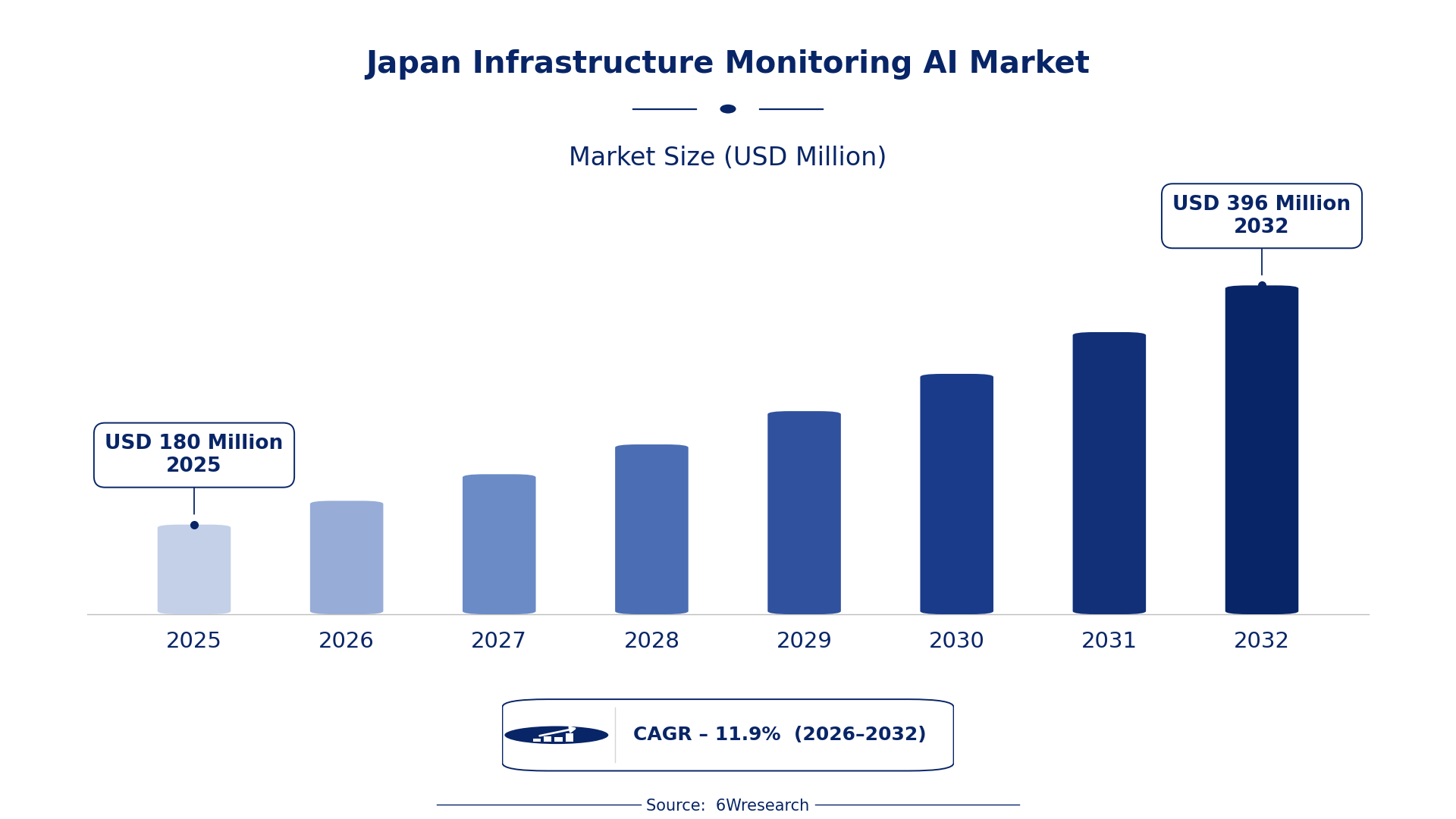
According to 6Wresearch internal database and industry insights, the Japan Infrastructure Monitoring AI Market was valued at USD 180 Million in 2025 and is projected to reach USD 396 Million by 2032, growing at a CAGR of approximately 11.9% during 2026–2032.
Japan Infrastructure Monitoring AI Market Highlights
| Report Metric | Details |
| Report Name | Japan Infrastructure Monitoring AI Market (2026-2032) |
| Market Size 2025 | USD 180 Million |
| Market Size 2032 | USD 396 Million |
| Absolute Growth 2025–2032 | USD 216 Million |
| CAGR 2026–2032 | 11.9% |
| Peak Annual Growth | 12.6% in 2029 |
| Forecast Period | 2026–2032 |
| Historical Data | 2022–2025 |
| Base Year | 2025 |
| Leading AI Type, 2025 | Predictive Analytics AI (42% share) |
| Leading Monitoring Focus, 2025 | Bridges / Roads (37% share) |
| Leading Technology Used, 2025 | ML / Computer Vision (48% share) |
| Leading Distribution Channel, 2025 | SaaS Providers (38% share) |
| Fastest-Growing AI Type | Structural Health AI (17.1% CAGR) |
| Fastest-Growing Monitoring Focus | Building Foundations (15.8% CAGR) |
| Fastest-Growing Technology Used | IoT + AI (18.0% CAGR) |
| Fastest-Growing Distribution Channel | Civil Tech Consultants (15.2% CAGR) |
| Growing Sector | civil engineering |
| Key End Users | civil engineering firms, utilities, transportation authorities, government agencies |
Japan Infrastructure Monitoring AI Market Year-wise Growth Rate and Key Drivers (2022–2032)
This graph illustrates the annual growth rates of the market from 2022 to 2032, highlighting a steady upward trajectory and projected market expansion over the forecast period.
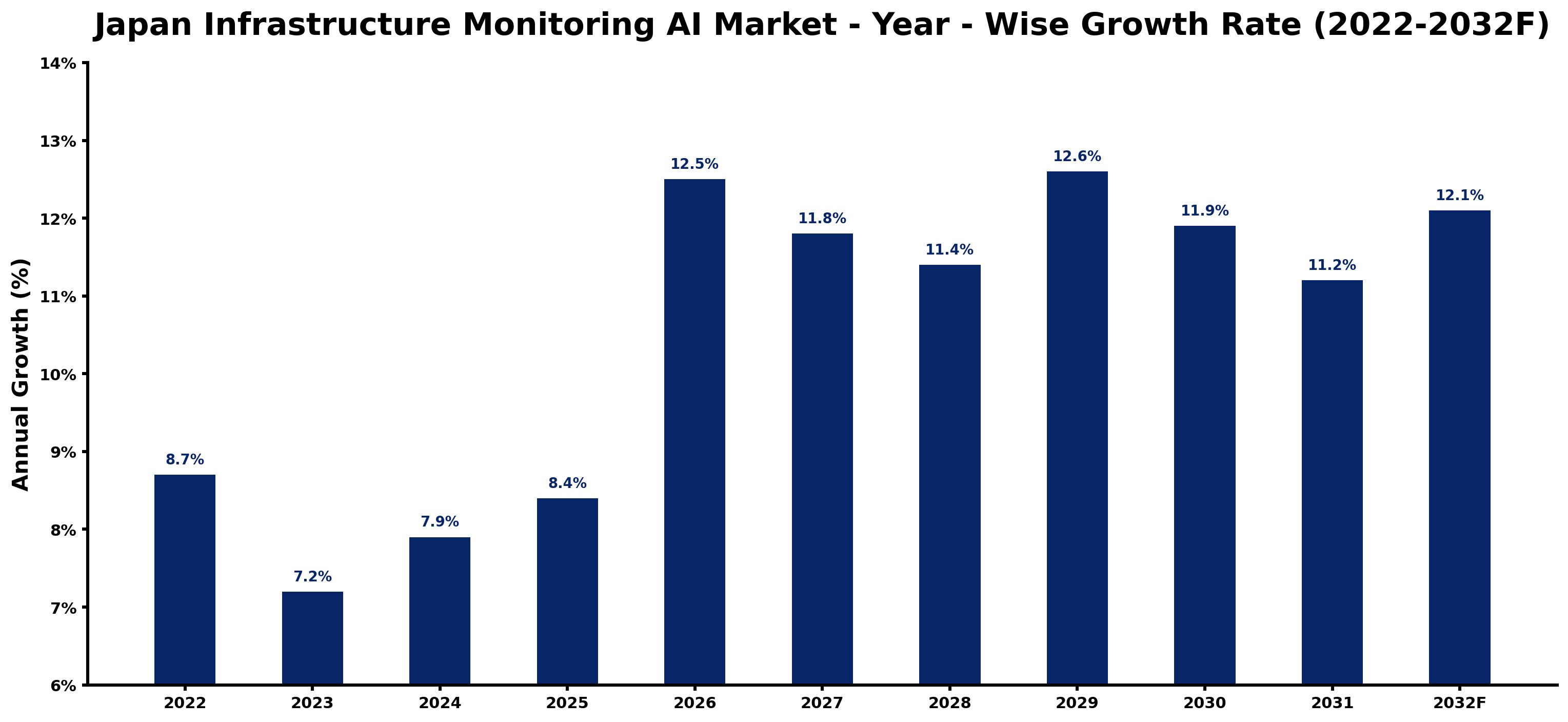
The yearly estimates that follow link every growth rate to its principal driver, so readers can see why the pace changed in each period.
| Year | Estimated Annual Growth (%) | Market Rationale |
| 2022 | 8.7 | The market experienced strong growth due to increased adoption of AI technologies in infrastructure monitoring. |
| 2023 | 7.2 | Growth slowed as firms adjusted to AI implementations and the associated standards. |
| 2024 | 7.9 | Demand rose as more infrastructure projects began integrating AI solutions for efficiency. |
| 2025 | 8.4 | Growth accelerated with rising investments in smart infrastructure initiatives across sectors. |
| 2026 | 12.5 | The market is set to surge as AI adoption becomes widespread in civil engineering. |
| 2027 | 11.8 | Growth will slow slightly as the market begins to stabilise after rapid expansion. |
| 2028 | 11.4 | Demand is projected to continue slowing as companies focus on optimising existing systems and technologies. |
| 2029 | 12.6 | The market will peak as infrastructure resilience programmes gain momentum and funding. |
| 2030 | 11.9 | Growth is expected to decelerate as the market matures and competition intensifies. |
| 2031 | 11.2 | Demand will slow further as saturation in certain segments becomes apparent and firms adapt. |
| 2032 | 12.1 | Growth is projected to pick up again as new technologies emerge and expanded applications are found. |
Note: Market size estimations and growth projections presented in this report are based on 6Wresearch's proprietary forecasting methodology, utilizing the latest available industry data, government publications, and primary research inputs.
Japan Infrastructure Monitoring AI Market Synopsis
Infrastructure Monitoring AI employs advanced technologies to evaluate and analyse the condition of essential infrastructure such as bridges, roads, and utilities. Its main applications encompass predictive maintenance, structural health assessment, and real-time monitoring. The Japan Infrastructure Monitoring AI Market is growing due to increasing demand from civil engineering and utilities sectors, spurred by government initiatives like the Economic Security Promotion Act of 2022 and funding for modernisation projects that incorporate AI technologies.
Market Dynamics Impact Analysis (2026–2032)
| Factor | Type | Impact | Primary Segment Affected |
| Increasing demand for predictive maintenance solutions | Driver | High | Predictive Analytics AI |
| Rising investments in smart infrastructure projects | Driver | High | Bridges / Roads |
| Growing need for energy efficiency in distribution networks | Opportunity | Medium | Energy Grid Monitoring |
| Emerging demand for real-time monitoring solutions | Opportunity | Medium | Water Pipeline AI |
| High initial investment costs for AI systems | Restraint | High | Structural Health AI |
| Limited awareness of AI benefits among smaller firms | Restraint | Medium | Building Foundations |
| Shortage of skilled professionals in AI and infrastructure | Challenge | High | AI Sensor Networks |
| Technological integration challenges across legacy systems | Challenge | Medium | IoT + AI |
Evaluation of Drivers in Japan Infrastructure Monitoring AI Market (2026–2032)
The table below links each growth driver to the segment it affects and the evidence for it.
| Drivers | Primary Segment Affected | Why It Matters (Evidence) |
| Growing investment in predictive maintenance solutions | Predictive Analytics AI | The installed base of AI monitoring systems in Japan's energy sector is projected to exceed 5,000 units by 2025, prompting utilities to enhance operational efficiency. |
| Increased funding for infrastructure resilience projects | Structural Health AI | A programme launched in 2023 aims to strengthen infrastructure resilience, leading to higher demand for advanced monitoring solutions. |
| Rising adoption of AI in civil engineering practices | Bridges / Roads | The Japan Society of Civil Engineers promotes AI integration, encouraging civil engineering firms to implement innovative monitoring technologies. |
| Demand for smart water management solutions | Water Pipeline AI | The Ministry of the Environment's programme for smart water management using AI technologies drives investment in leak detection and quality monitoring. |
| Expansion of AI technologies in urban infrastructure | Energy Grid Monitoring | The Smart City Strategy initiated in 2020 emphasises AI integration, leading to increased demand from urban planners and utility providers. |
Several shifts outside the market lift sales. The installed base of AI monitoring systems in Japan's energy sector is projected to exceed 5,000 units by 2025, prompting energy utilities to invest in advanced monitoring solutions. Approximately 30% of major railway systems in Japan are adopting AI-driven predictive maintenance, which improves operational reliability. The growing population of around 125 million fuels demand for reliable monitoring, compelling civil engineering firms to seek new solutions.
Evaluation of Restraints in Japan Infrastructure Monitoring AI Market
The key brakes on demand, and where they bite hardest, are shown below.
| Market Restraint | Primary Segment Affected | Why It Matters (Evidence) |
| Compliance with regulatory standards | Structural Health AI | Regulatory standards like JIS Q 15001 create compliance hurdles that prolong project timelines for contractors. |
| High costs of implementing advanced monitoring systems | Bridges / Roads | Buyers face increased costs due to outdated systems, with some projects experiencing budget overruns of up to ¥500 million. |
| Limited availability of skilled professionals | Predictive Analytics AI | A lack of skilled professionals in AI technologies restricts the expertise available for implementing advanced monitoring systems. |
| Slow adoption of new technologies | Water Pipeline AI | The cautious approach of some utility providers in adopting AI technologies delays the implementation of efficient monitoring solutions. |
| Budget constraints in public infrastructure projects | Energy Grid Monitoring | Budgetary limitations impact the ability of public agencies to invest in necessary AI monitoring technologies. |
Japan Infrastructure Monitoring AI Market Challenges
In Tokyo, real-time traffic monitoring using AI has uncovered delays in infrastructure upgrades. Buyers in the civil engineering sector are facing rising costs due to outdated systems, with some projects experiencing budget overruns of up to ¥500 million. Regulatory standards like JIS Q 15001 present compliance challenges that extend project timelines, affecting contractors who must navigate extensive approval processes. A shortage of skilled professionals in AI technologies restricts the expertise available for implementing advanced monitoring systems, causing suppliers to delay projects and miss opportunities in a rapidly evolving market.
Trends in the Japan Infrastructure Monitoring AI Market
Four trends stand out in the Japan Infrastructure Monitoring AI Market.
- Shift towards Real-Time Monitoring Solutions: In 2023, the Tokyo metropolitan area adopted AI for real-time traffic monitoring on major roads, enhancing traffic management efficiency. This shift is poised to stimulate demand for similar solutions throughout Japan.
- Emergence of Smart Water Management: A programme for smart water management using AI technologies commenced in 2022, promoting sustainable practices. This initiative is anticipated to improve water quality monitoring across various regions.
- Transition to Predictive Maintenance Practices: AI-driven predictive maintenance is currently employed in 30% of Japan's major railway systems, improving operational reliability. This trend is likely to extend into other sectors, boosting overall market demand.
- Integration of AI in Urban Infrastructure: The Economic Security Promotion Act of 2022 underscores AI integration in urban infrastructure projects, driving innovation. This focus is expected to create new opportunities for technology providers.
Investment Opportunities in the Japan Infrastructure Monitoring AI Market
The openings below show where demand in the Japan Infrastructure Monitoring AI Market is visible and how suppliers can enter.
- Infrastructure Monitoring AI Solutions: The demand for advanced monitoring solutions is on the rise, with a projected market size of USD 180 million by 2025. Civil engineering firms are actively seeking technologies to enhance infrastructure resilience.
- Predictive Maintenance Technologies: With 30% of major railway systems employing AI for predictive maintenance, a notable market gap exists. Companies can invest in AI solutions to address this growing demand from transportation sectors.
- Real-Time Monitoring Systems: The need for real-time monitoring solutions is increasing, driven by urbanisation. The Tokyo metropolitan area exemplifies this trend, creating opportunities for technology providers.
- Smart Water Management Technologies: A programme for smart water management underscores a rising demand for AI solutions. Companies can enter this market by collaborating with local governments.
Government Initiatives in the Japan Infrastructure Monitoring AI Market
The Economic Security Promotion Act of 2022 supports supply-chain resilience for critical products, directly benefiting buyers of infrastructure monitoring AI. This law encourages investments in domestic technologies and promotes the use of AI in infrastructure projects, ensuring compliance with national standards and improving overall project efficiency.
In 2023, ¥2 billion was allocated for infrastructure modernization projects incorporating AI. This funding aims to improve the resilience of systems, with the ministry overseeing the implementation and approval of related projects.
Future Insight of the Japan Infrastructure Monitoring AI Market
AI-driven predictive maintenance will revolutionise infrastructure monitoring by 2032, facilitating more efficient operations. The government’s ¥2 billion investment in modernisation projects will strengthen infrastructure resilience and reliability. By 2025, the installed base of AI monitoring systems in Japan's energy sector will exceed 5,000 units, creating new opportunities for suppliers. Programmes for smart water management will further accelerate the integration of AI technologies, generating demand for practical solutions that benefit both buyers and suppliers.
Market Segmentation Analysis
Japan Infrastructure Monitoring AI Market report covers a detailed analysis of the following market segments:
By AI Type – Predictive Analytics AI Leads, Structural Health AI Expected to Grow Fastest
According to Saurav Kr Singh, Senior Research Analyst at 6Wresearch, Predictive Analytics AI took 42% of ai type revenue in 2025, more than any other category. Predictive Analytics holds the largest share as it is extensively used for forecasting infrastructure failures and maintenance needs. This technology is integral to initiatives like the Ministry of Land, Infrastructure, Transport and Tourism's recent programme aimed at enhancing infrastructure resilience. The quickest growth will come from Structural Health AI, forecast to expand at a CAGR of 17.1% between 2026 and 2032. Structural Health is experiencing rapid growth due to its critical role in assessing the integrity of structures, particularly in urban areas. The increasing number of infrastructure projects in Japan, influenced by the Smart City Strategy, significantly contributes to this trend. Suppliers should focus on developing advanced solutions for structural health assessments to capitalise on this growing demand.
By Monitoring Focus – Bridges / Roads Lead, Building Foundations Expected to Grow Fastest
The largest monitoring focus category in 2025 was Bridges / Roads, at 37% of revenue. Bridges / Roads dominate the market as they are critical for maintaining transportation infrastructure, with over 1,200 bridges currently monitored using AI technologies. The Tokyo metropolitan area's implementation of AI for traffic monitoring further underscores the importance of this focus area. Over 2026–2032, Building Foundations are expected to post the fastest growth, at a CAGR of 15.8%. Building Foundations is the fastest-growing segment, driven by the increasing necessity for evaluating structural stability in new construction projects. The heightened awareness of safety and compliance standards is propelling this growth. Buyers will need to prioritise solutions that ensure the integrity of building foundations to meet regulatory requirements.
By Technology Used – ML / Computer Vision Leads, IoT + AI Expected to Grow Fastest
With 48% of technology used revenue in 2025, ML / Computer Vision was the largest category. ML and Computer Vision lead the market as they are widely employed for analysing visual data from infrastructure, ensuring accurate assessments of conditions. This technology is essential for numerous existing monitoring systems across Japan's infrastructure. IoT + AI is projected to grow fastest, at a CAGR of 18.0% during 2026–2032. IoT combined with technology is witnessing rapid growth as it integrates data from various sensors for comprehensive monitoring solutions. The rising adoption of smart technologies in urban planning significantly drives this trend. Suppliers must invest in IoT-enabled solutions to stay competitive in the evolving market.
By Distribution Channel – SaaS Providers Lead, Civil Tech Consultants Expected to Grow Fastest
In 2025, SaaS Providers led the distribution channel split with a 38% share. SaaS Providers capture the largest share by delivering monitoring solutions via cloud platforms, making them accessible to a diverse range of users. This model aligns well with the demand for scalable and flexible infrastructure monitoring solutions. Civil Tech Consultants are set to record the highest CAGR in this split, 15.2% over 2026–2032. Civil Tech Consultants are experiencing the fastest growth as they offer essential expertise in infrastructure projects, particularly regarding technology integration. The increasing complexity of infrastructure projects is propelling this demand for specialised consulting services. Buyers should consider engaging with civil tech consultants to ensure successful implementation of technologies in their projects.
Key Attractiveness of the Report
- 10 Years of Market Numbers
- Historical Data Starting from 2022 to 2025
- Base Year 2025
- Forecast Data until 2032
- Key Performance Indicators Impacting the Market
- Major Upcoming Developments and Projects
Key Highlights of the Report:
- Japan Infrastructure Monitoring AI Market Outlook
- Market Size of Japan Infrastructure Monitoring AI Market, 2025
- Forecast of Japan Infrastructure Monitoring AI Market, 2032
- Historical Data and Forecast of Japan Infrastructure Monitoring AI Revenues & Volume for the Period 2022-2032F
- Japan Infrastructure Monitoring AI Market Trend Evolution
- Japan Infrastructure Monitoring AI Market Drivers and Challenges
- Japan Infrastructure Monitoring AI Price Trends
- Japan Infrastructure Monitoring AI Porter's Five Forces
- Japan Infrastructure Monitoring AI Industry Life Cycle
- Historical Data and Forecast of Japan Infrastructure Monitoring AI Market Revenues & Volume By AI Type for the Period 2022-2032F
- Historical Data and Forecast of Japan Infrastructure Monitoring AI Market Revenues & Volume By Predictive Analytics AI for the Period 2022-2032F
- Historical Data and Forecast of Japan Infrastructure Monitoring AI Market Revenues & Volume By Structural Health AI for the Period 2022-2032F
- Historical Data and Forecast of Japan Infrastructure Monitoring AI Market Revenues & Volume By Energy Grid Monitoring for the Period 2022-2032F
- Historical Data and Forecast of Japan Infrastructure Monitoring AI Market Revenues & Volume By Water Pipeline AI for the Period 2022-2032F
- Historical Data and Forecast of Japan Infrastructure Monitoring AI Market Revenues & Volume By Monitoring Focus for the Period 2022-2032F
- Historical Data and Forecast of Japan Infrastructure Monitoring AI Market Revenues & Volume By Bridges / Roads for the Period 2022-2032F
- Historical Data and Forecast of Japan Infrastructure Monitoring AI Market Revenues & Volume By Building Foundations for the Period 2022-2032F
- Historical Data and Forecast of Japan Infrastructure Monitoring AI Market Revenues & Volume By Substations / Lines for the Period 2022-2032F
- Historical Data and Forecast of Japan Infrastructure Monitoring AI Market Revenues & Volume By Flow / Leakage Detection for the Period 2022-2032F
- Historical Data and Forecast of Japan Infrastructure Monitoring AI Market Revenues & Volume By Technology Used for the Period 2022-2032F
- Historical Data and Forecast of Japan Infrastructure Monitoring AI Market Revenues & Volume By ML / Computer Vision for the Period 2022-2032F
- Historical Data and Forecast of Japan Infrastructure Monitoring AI Market Revenues & Volume By IoT + AI for the Period 2022-2032F
- Historical Data and Forecast of Japan Infrastructure Monitoring AI Market Revenues & Volume By AI Sensor Networks for the Period 2022-2032F
- Historical Data and Forecast of Japan Infrastructure Monitoring AI Market Revenues & Volume By Edge AI for the Period 2022-2032F
- Historical Data and Forecast of Japan Infrastructure Monitoring AI Market Revenues & Volume By Distribution Channel for the Period 2022-2032F
- Historical Data and Forecast of Japan Infrastructure Monitoring AI Market Revenues & Volume By SaaS Providers for the Period 2022-2032F
- Historical Data and Forecast of Japan Infrastructure Monitoring AI Market Revenues & Volume By Civil Tech Consultants for the Period 2022-2032F
- Historical Data and Forecast of Japan Infrastructure Monitoring AI Market Revenues & Volume By Smart Infra Integrators for the Period 2022-2032F
- Historical Data and Forecast of Japan Infrastructure Monitoring AI Market Revenues & Volume By Infrastructure Utilities for the Period 2022-2032F
- Japan Infrastructure Monitoring AI Import Export Trade Statistics
- Market Opportunity Assessment By AI Type
- Market Opportunity Assessment By Monitoring Focus
- Market Opportunity Assessment By Technology Used
- Market Opportunity Assessment By Distribution Channel
- Japan Infrastructure Monitoring AI Top Companies Market Share
- Japan Infrastructure Monitoring AI Competitive Benchmarking By Technical and Operational Parameters
- Japan Infrastructure Monitoring AI Company Profiles
- Japan Infrastructure Monitoring AI Key Strategic Recommendations
Market Covered
Coverage by segment is as follows.
By AI Type
- Predictive Analytics AI
- Structural Health AI
- Energy Grid Monitoring
- Water Pipeline AI
By Monitoring Focus
- Bridges / Roads
- Building Foundations
- Substations / Lines
- Flow / Leakage Detection
By Technology Used
- ML / Computer Vision
- IoT + AI
- AI Sensor Networks
- Edge AI
By Distribution Channel
- SaaS Providers
- Civil Tech Consultants
- Smart Infra Integrators
- Infrastructure Utilities































