Japan Ingredient Handling Market Size & Growth Rate
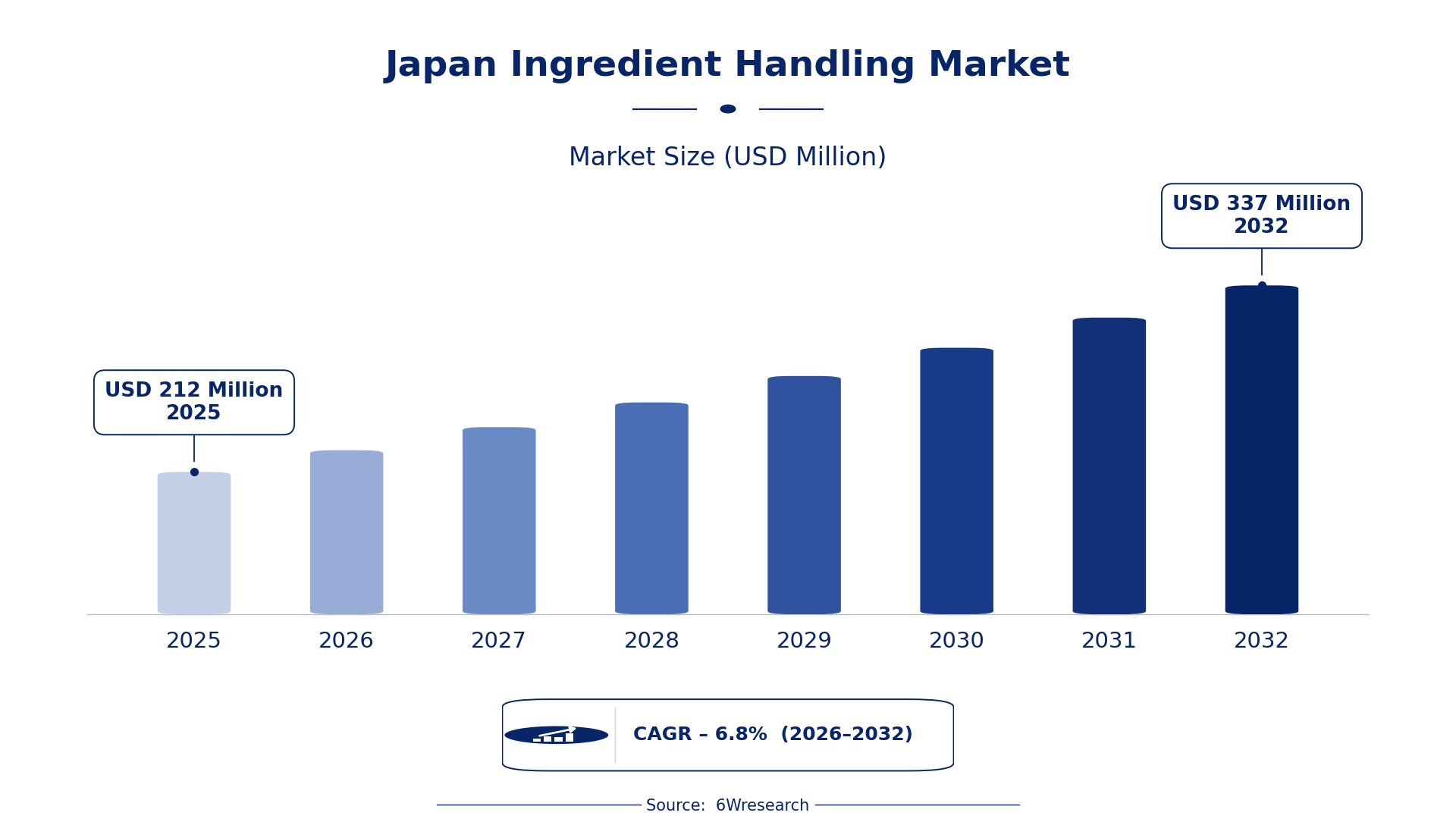
According to 6Wresearch internal database and industry insights, the Japan Ingredient Handling Market was valued at USD 212 Million in 2025 and is projected to reach USD 337 Million by 2032, growing at a CAGR of approximately 6.8% during 2026–2032.
Japan Ingredient Handling Market Highlights
| Report Metric | Details |
| Report Name | Japan Ingredient Handling Market (2026-2032) |
| Market Size 2025 | USD 212 Million |
| Market Size 2032 | USD 337 Million |
| Absolute Growth 2025–2032 | USD 125 Million |
| CAGR 2026–2032 | 6.8% |
| Peak Annual Growth | 7.7% in 2030 |
| Forecast Period | 2026–2032 |
| Historical Data | 2022–2025 |
| Base Year | 2025 |
| Leading Handling System Type, 2025 | Bulk Handling Systems (45% share) |
| Leading Material Form, 2025 | Powders / Granules (32% share) |
| Leading Industry Application, 2025 | Food / Chemical Plants (42% share) |
| Leading Distribution Channel, 2025 | Industrial Equipment Dealers (36% share) |
| Fastest-Growing Handling System Type | Liquid Ingredient Handling (9.7% CAGR) |
| Fastest-Growing Material Form | Viscous / Fluid (9.8% CAGR) |
| Fastest-Growing Industry Application | Nutraceuticals (9.2% CAGR) |
| Fastest-Growing Distribution Channel | OEM Manufacturers (9.1% CAGR) |
| Growing Sector | Nutraceuticals |
| Key End Users | Food manufacturers, pharmaceutical companies, nutraceutical producers, chemical plants |
Japan Ingredient Handling Market Year-wise Growth Rate and Key Drivers (2022–2032)
This graph illustrates the annual growth rates of the market from 2022 to 2032, highlighting a steady upward trajectory and projected market expansion over the forecast period.
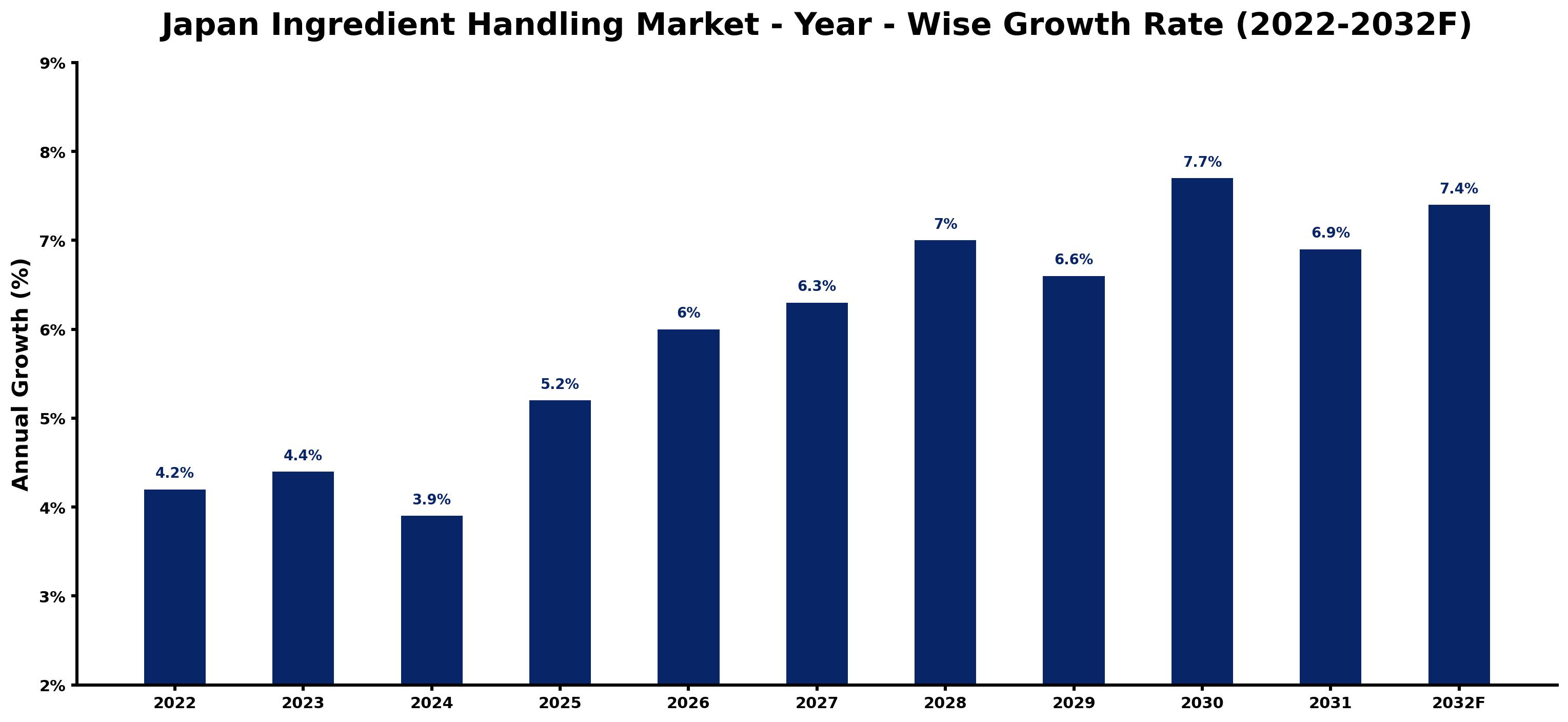
For each year, the table pairs the estimated growth rate with the leading influence on demand, showing how the drivers changed across the period.
| Year | Estimated Annual Growth (%) | Market Rationale |
| 2022 | 4.2 | The market experienced steady growth due to strong domestic demand in the food sector. |
| 2023 | 4.4 | Growth continued as the pharmaceutical sector expanded, increasing ingredient handling needs. |
| 2024 | 3.9 | Growth slowed slightly as manufacturers adjusted to market conditions and demand stabilised. |
| 2025 | 5.2 | A surge in food processing activity drove faster growth as companies upgraded systems. |
| 2026 | 6.0 | Demand is expected to increase as investments in food safety standards improve ingredient handling capabilities. |
| 2027 | 6.3 | Growth is projected to accelerate with rising consumer interest in nutraceuticals boosting ingredient handling needs. |
| 2028 | 7.0 | The market is expected to expand further as technological advancements improve handling efficiency. |
| 2029 | 6.6 | Growth will slow as market saturation begins to affect new investments and orders. |
| 2030 | 7.7 | A peak in demand is projected, driven by substantial investments in food and beverage production. |
| 2031 | 6.9 | Growth is expected to moderate as the market stabilises, reflecting a maturing industry. |
| 2032 | 7.4 | Demand will rise again as new regulations and standards drive further investments. |
Note: Market size estimations and growth projections presented in this report are based on 6Wresearch's proprietary forecasting methodology, utilizing the latest available industry data, government publications, and primary research inputs.
Japan Ingredient Handling Market Synopsis
Ingredient handling encompasses the technology and systems for managing the movement, storage, and processing of ingredients across various industries. The Japan Ingredient Handling Market is expanding, driven by the food processing industry valued at approximately 20 trillion yen and the pharmaceutical sector's demand. The rise of the nutraceuticals market, projected to grow substantially, along with the implementation of stringent food safety standards, are key factors propelling this growth.
Market Dynamics Impact Analysis (2026–2032)
| Factor | Type | Impact | Primary Segment Affected |
| Increasing demand for bulk handling systems in food processing | Driver | High | Bulk Handling Systems |
| Rising interest in nutraceuticals boosting ingredient handling needs | Driver | High | Liquid Ingredient Handling |
| Expansion of food safety initiatives creating demand for new systems | Opportunity | Medium | Dosing & Weighing Units |
| Growth in the pharmaceutical sector leading to higher ingredient handling requirements | Opportunity | High | Vacuum Conveyors |
| Regulatory compliance costs affecting smaller manufacturers | Restraint | High | Powders / Granules |
| Market saturation limiting new investments in ingredient handling systems | Restraint | Medium | Viscous / Fluid |
| High initial investment costs for advanced handling systems | Challenge | High | Hygienic Powder Transfer |
| Technological advancements requiring constant upgrades | Challenge | Medium | Food / Chemical Plants |
Evaluation of Drivers in Japan Ingredient Handling Market (2026–2032)
The factors lifting demand, and the evidence behind each, are summarised below.
| Drivers | Primary Segment Affected | Why It Matters (Evidence) |
| Strong domestic demand in food processing | Bulk Handling Systems | Japan's food processing industry, valued at approximately 20 trillion yen, drives demand for efficient bulk handling solutions. |
| Growth in the pharmaceutical sector | Liquid Ingredient Handling | The pharmaceutical sector's size, valued at over 10 trillion yen, requires advanced liquid handling systems to ensure quality and compliance. |
| Rising consumer interest in nutraceuticals | Dosing & Weighing Units | The projected growth of the nutraceuticals market, expected to reach 1 trillion yen by 2025, increases the need for precise dosing and weighing equipment. |
| Implementation of stringent food safety standards | Vacuum Conveyors | The JIS Z 2801 standard promotes hygiene, boosting demand for vacuum conveyors in food production, ensuring compliance with safety regulations. |
| Technological advancements in ingredient handling | Hygienic Powder Transfer | Innovations in handling technology improve efficiency and cleanliness, driving demand for hygienic powder transfer systems. |
Behind the steady rise in orders lies the growing demand from Japan's food processing industry, valued at approximately 20 trillion yen, which necessitates efficient bulk handling systems. The pharmaceutical sector, one of the largest globally, also drives demand for liquid ingredient handling solutions, ensuring quality and compliance. The nutraceuticals market is projected to grow substantially, increasing the need for precise dosing and weighing units. The implementation of stringent food safety standards boosts demand for vacuum conveyors, ensuring hygiene in food production. Technological advancements in ingredient handling systems are improving efficiency and hygiene, leading to increased orders across the industry.
Evaluation of Restraints in Japan Ingredient Handling Market
These restraints slow adoption and weigh on supplier margins.
| Market Restraint | Primary Segment Affected | Why It Matters (Evidence) |
| Compliance costs for food safety regulations | Powders / Granules | The need to adhere to strict regulations increases operational costs for manufacturers, impacting profitability by up to 15%. |
| Market saturation limiting growth opportunities | Viscous / Fluid | As the market matures, finding new investment opportunities becomes challenging for suppliers, affecting growth potential. |
| High initial investment costs for advanced systems | Hygienic Powder Transfer | The substantial upfront costs deter smaller manufacturers from upgrading their equipment, limiting market participation. |
| Technological advancements requiring regular upgrades | Food / Chemical Plants | The rapid pace of innovation necessitates ongoing investment, straining financial resources for some companies. |
| Limited access to skilled workforce for handling systems | Dosing & Weighing Units | The shortage of trained personnel affects the installation and maintenance of sophisticated handling systems. |
Japan Ingredient Handling Market Challenges
Ingredient availability suffers due to reliance on a limited number of local suppliers, leading to delays that can increase costs by up to 15% for manufacturers. A lack of skilled workers constrains suppliers, causing production delays that extend lead times by several weeks, which disrupts delivery schedules for food and pharmaceutical companies. Regulatory compliance with food safety standards set by the Ministry of Health, Labour and Welfare raises operational costs for producers, reducing their profitability. Rising raw material costs from global market fluctuations can inflate ingredient prices by 10%, impacting profit margins for food manufacturers.
Trends in the Japan Ingredient Handling Market
Four trends stand out in the Japan Ingredient Handling Market.
- Shift from Manual to Automated Handling Systems: Since 2023, food and beverage manufacturers have increasingly adopted automated ingredient handling systems, improving efficiency and reducing labour costs. This shift is visible in Tokyo, where over 30% of new installations are automated.
- Emergence of Hygienic Standards in Ingredient Handling: The introduction of new hygiene standards in 2023 has prompted manufacturers to prioritise cleanliness in ingredient handling systems. This trend is reshaping practices across food processing facilities, enhancing safety and quality assurance.
- Growth of Nutraceuticals Driving Ingredient Handling Innovation: The rising popularity of nutraceuticals since 2023 has led to innovations in ingredient handling systems. This is particularly visible in Osaka, where demand for specialised handling solutions has surged, increasing by over 25%.
- Increased Investment in Food Safety Initiatives: Since 2023, the Tokyo Metropolitan Government has launched initiatives to enhance food safety standards, leading to a rise in demand for ingredient handling systems that comply with new regulations, with funding exceeding 1 billion yen.
Investment Opportunities in the Japan Ingredient Handling Market
The following areas offer the clearest openings for investors and suppliers in the Japan Ingredient Handling Market.
- Local Partnerships for System Integration: Forming joint ventures with local firms can facilitate entry into Japan's ingredient handling market, where demand is growing. The Tokyo region shows a 20% gap in supply for advanced systems.
- Investment in Hygienic Handling Solutions: The increasing focus on hygiene presents an opportunity to supply advanced hygienic handling systems. Food manufacturers in Osaka are actively seeking solutions to meet new safety standards, with a projected market growth of 15%.
- Expansion into the Nutraceuticals Sector: With the nutraceuticals market projected to grow substantially, there is a strong opportunity for suppliers of specialised ingredient handling systems. Collaborating with health product manufacturers can yield substantial returns, with the sector expected to reach 1 trillion yen.
- Development of Automated Systems for Food Processing: The shift towards automation in food processing creates a demand for advanced ingredient handling systems. Investment in automated solutions can be particularly beneficial for manufacturers in Tokyo, where over 30% of new installations are automated.
Government Initiatives in the Japan Ingredient Handling Market
The PRTR Law, enacted in 1999, mandates businesses to report the release of designated chemical substances, ensuring transparency and safety in ingredient handling. Additionally, the Chemical Substances Control Law requires evaluation and control of new chemical substances, impacting ingredient handling practices and affecting over 10,000 manufacturers.
In 2023, the government launched a programme to improve food safety standards, overseen by the Ministry of Health, Labour and Welfare. This initiative aims to improve ingredient handling practices across the food industry, ensuring compliance with safety regulations and benefiting over 5,000 businesses.
Future Insight of the Japan Ingredient Handling Market
Investment in advanced ingredient handling technologies will rise as the government implements a programme to improve food safety standards. This will create demand for over 50,000 new dosing and weighing units by 2032, facilitating more precise production processes. The growth of the pharmaceutical sector will drive suppliers to adopt updated hygiene standards across their facilities. As Tokyo and Osaka enhance their industrial capabilities, buyers will benefit from improved efficiency and quality assurance in ingredient handling.
Market Segmentation Analysis
Japan Ingredient Handling Market report covers a detailed analysis of the following market segments:
By Handling System Type – Bulk Handling Systems Lead, Liquid Ingredient Handling Expected to Grow Fastest
According to Saurav Kr Singh, Senior Research Analyst at 6Wresearch, with 45% of handling system type revenue in 2025, Bulk Handling Systems was the largest category. Bulk handling systems dominate the market as they are essential for efficiently transporting large quantities of materials in major industrial regions like Tokyo and Osaka. Their widespread use is supported by the installed base of over 50,000 units, reflecting strong demand in various sectors. Liquid Ingredient Handling is set to record the highest CAGR in this split, 9.7% over 2026–2032. Liquid ingredient handling is witnessing rapid growth due to increasing requirements in the food and pharmaceutical industries, which are critical to Japan's economy. The government's recent programme aimed at enhancing food safety standards further boosts the demand for these advanced solutions. Suppliers should focus on developing innovative liquid handling solutions to capitalise on the growing needs of the food and pharmaceutical sectors.
By Material Form – Powders / Granules Lead, Viscous / Fluid Expected to Grow Fastest
Powders / Granules held 32% of the Japan Ingredient Handling Market by material form in 2025. Powders and granules hold the largest share as they are integral to food and chemical production processes, which are foundational to Japan's economy. Their extensive use in various applications ensures a steady demand for handling systems designed for these materials. Viscous / Fluid is projected to grow fastest, at a CAGR of 9.8% during 2026–2032. Viscous and fluid materials are experiencing the fastest growth due to the rising popularity of liquid products in the nutraceutical sector. This shift is evidenced by the increasing consumer interest in health supplements, which require specialised handling solutions. Buyers should consider investing in systems that accommodate viscous materials to stay competitive in the nutraceutical market.
By Industry Application – Food / Chemical Plants Lead, Nutraceuticals Expected to Grow Fastest
The largest industry application category in 2025 was Food / Chemical Plants, at 42% of revenue. Food and chemical plants lead the market as they are the primary users of ingredient handling systems, driven by the robust demand from Japan's food processing industry valued at approximately 20 trillion yen. These industries rely heavily on efficient systems to ensure production quality and compliance with safety regulations. The quickest growth will come from Nutraceuticals, forecast to expand at a CAGR of 9.2% between 2026 and 2032. The nutraceuticals sector is rapidly growing, creating a demand for specialised ingredient handling solutions that meet its unique processing needs. This growth indicates a shift towards more customised handling systems to accommodate diverse formulations and applications. Suppliers must adapt their product offerings to meet the specific requirements of the expanding nutraceuticals market.
By Distribution Channel – Industrial Equipment Dealers Lead, OEM Manufacturers Expected to Grow Fastest
Industrial Equipment Dealers took 36% of distribution channel revenue in 2025, more than any other category. Industrial equipment dealers play a crucial role in the distribution of ingredient handling systems, providing access to a wide range of products across various industries. Their established networks ensure that handling solutions are readily available to end-users throughout Japan. Over 2026–2032, OEM Manufacturers are expected to post the fastest growth, at a CAGR of 9.1%. OEM manufacturers are experiencing the fastest growth as they produce specialised equipment tailored to the evolving needs of the ingredient handling market. Their ability to innovate and respond to market demands positions them well in this competitive environment. Suppliers should enhance partnerships with OEM manufacturers to improve their market reach and product offerings.
Key Attractiveness of the Report
- 10 Years of Market Numbers
- Historical Data Starting from 2022 to 2025
- Base Year 2025
- Forecast Data until 2032
- Key Performance Indicators Impacting the Market
- Major Upcoming Developments and Projects
Key Highlights of the Report:
- Japan Ingredient Handling Market Outlook
- Market Size of Japan Ingredient Handling Market, 2025
- Forecast of Japan Ingredient Handling Market, 2032
- Historical Data and Forecast of Japan Ingredient Handling Revenues & Volume for the Period 2022-2032F
- Japan Ingredient Handling Market Trend Evolution
- Japan Ingredient Handling Market Drivers and Challenges
- Japan Ingredient Handling Price Trends
- Japan Ingredient Handling Porter's Five Forces
- Japan Ingredient Handling Industry Life Cycle
- Historical Data and Forecast of Japan Ingredient Handling Market Revenues & Volume By Handling System Type for the Period 2022-2032F
- Historical Data and Forecast of Japan Ingredient Handling Market Revenues & Volume By Bulk Handling Systems for the Period 2022-2032F
- Historical Data and Forecast of Japan Ingredient Handling Market Revenues & Volume By Liquid Ingredient Handling for the Period 2022-2032F
- Historical Data and Forecast of Japan Ingredient Handling Market Revenues & Volume By Dosing & Weighing Units for the Period 2022-2032F
- Historical Data and Forecast of Japan Ingredient Handling Market Revenues & Volume By Vacuum Conveyors for the Period 2022-2032F
- Historical Data and Forecast of Japan Ingredient Handling Market Revenues & Volume By Material Form for the Period 2022-2032F
- Historical Data and Forecast of Japan Ingredient Handling Market Revenues & Volume By Powders / Granules for the Period 2022-2032F
- Historical Data and Forecast of Japan Ingredient Handling Market Revenues & Volume By Viscous / Fluid for the Period 2022-2032F
- Historical Data and Forecast of Japan Ingredient Handling Market Revenues & Volume By Pre-mix Solutions for the Period 2022-2032F
- Historical Data and Forecast of Japan Ingredient Handling Market Revenues & Volume By Hygienic Powder Transfer for the Period 2022-2032F
- Historical Data and Forecast of Japan Ingredient Handling Market Revenues & Volume By Industry Application for the Period 2022-2032F
- Historical Data and Forecast of Japan Ingredient Handling Market Revenues & Volume By Food / Chemical Plants for the Period 2022-2032F
- Historical Data and Forecast of Japan Ingredient Handling Market Revenues & Volume By Beverages / Pharma for the Period 2022-2032F
- Historical Data and Forecast of Japan Ingredient Handling Market Revenues & Volume By Nutraceuticals for the Period 2022-2032F
- Historical Data and Forecast of Japan Ingredient Handling Market Revenues & Volume By Cosmetics / Bakery for the Period 2022-2032F
- Historical Data and Forecast of Japan Ingredient Handling Market Revenues & Volume By Distribution Channel for the Period 2022-2032F
- Historical Data and Forecast of Japan Ingredient Handling Market Revenues & Volume By Industrial Equipment Dealers for the Period 2022-2032F
- Historical Data and Forecast of Japan Ingredient Handling Market Revenues & Volume By OEM Manufacturers for the Period 2022-2032F
- Historical Data and Forecast of Japan Ingredient Handling Market Revenues & Volume By Process Engineering Firms for the Period 2022-2032F
- Historical Data and Forecast of Japan Ingredient Handling Market Revenues & Volume By Specialty System Integrators for the Period 2022-2032F
- Japan Ingredient Handling Import Export Trade Statistics
- Market Opportunity Assessment By Handling System Type
- Market Opportunity Assessment By Material Form
- Market Opportunity Assessment By Industry Application
- Market Opportunity Assessment By Distribution Channel
- Japan Ingredient Handling Top Companies Market Share
- Japan Ingredient Handling Competitive Benchmarking By Technical and Operational Parameters
- Japan Ingredient Handling Company Profiles
- Japan Ingredient Handling Key Strategic Recommendations
Market Covered
This report examines the market across the segments below.
By Handling System Type
- Bulk Handling Systems
- Liquid Ingredient Handling
- Dosing & Weighing Units
- Vacuum Conveyors
By Material Form
- Powders / Granules
- Viscous / Fluid
- Pre-mix Solutions
- Hygienic Powder Transfer
By Industry Application
- Food / Chemical Plants
- Beverages / Pharma
- Nutraceuticals
- Cosmetics / Bakery
By Distribution Channel
- Industrial Equipment Dealers
- OEM Manufacturers
- Process Engineering Firms
- Specialty System Integrators































