Japan Inhalation Therapy Devices Market Size & Growth Rate
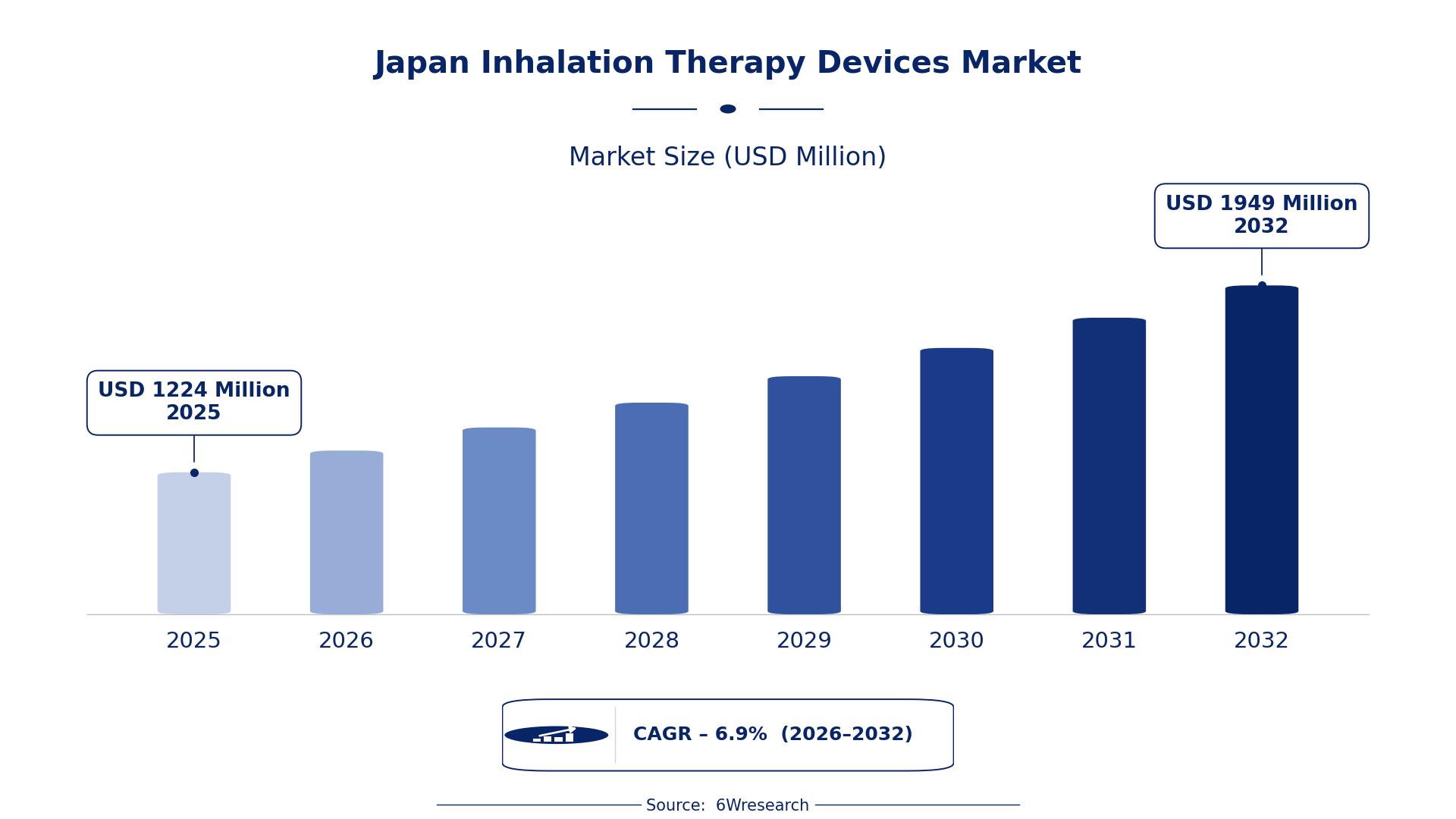
According to 6Wresearch internal database and industry insights, the Japan Inhalation Therapy Devices Market was valued at USD 1,224 Million in 2025 and is projected to reach USD 1,949 Million by 2032, growing at a CAGR of approximately 6.9% during 2026–2032.
Japan Inhalation Therapy Devices Market Highlights
| Report Metric | Details |
| Report Name | Japan Inhalation Therapy Devices Market (2026-2032) |
| Market Size 2025 | USD 1,224 Million |
| Market Size 2032 | USD 1,949 Million |
| Absolute Growth 2025–2032 | USD 725 Million |
| CAGR 2026–2032 | 6.9% |
| Peak Annual Growth | 7.5% in 2026 |
| Forecast Period | 2026–2032 |
| Historical Data | 2022–2025 |
| Base Year | 2025 |
| Leading Device Type, 2025 | Dry Powder Inhalers (38% share) |
| Leading Inhalation Method, 2025 | Breath-Activated (46% share) |
| Leading Patient Use Case, 2025 | Chronic Use (41% share) |
| Leading Distribution Channel, 2025 | Clinics / Pharmacies (45% share) |
| Fastest-Growing Device Type | Nebulizers (9.3% CAGR) |
| Fastest-Growing Inhalation Method | Compressor / Ultrasonic (9.8% CAGR) |
| Fastest-Growing Patient Use Case | Pediatric & Elderly (9.2% CAGR) |
| Fastest-Growing Distribution Channel | Homecare Medical Suppliers (8.7% CAGR) |
| Growing Sector | respiratory therapy |
| Key End Users | hospitals, clinics, homecare providers, pharmacies |
Japan Inhalation Therapy Devices Market Year-wise Growth Rate and Key Drivers (2022–2032)
This graph illustrates the annual growth rates of the market from 2022 to 2032, highlighting a steady upward trajectory and projected market expansion over the forecast period.
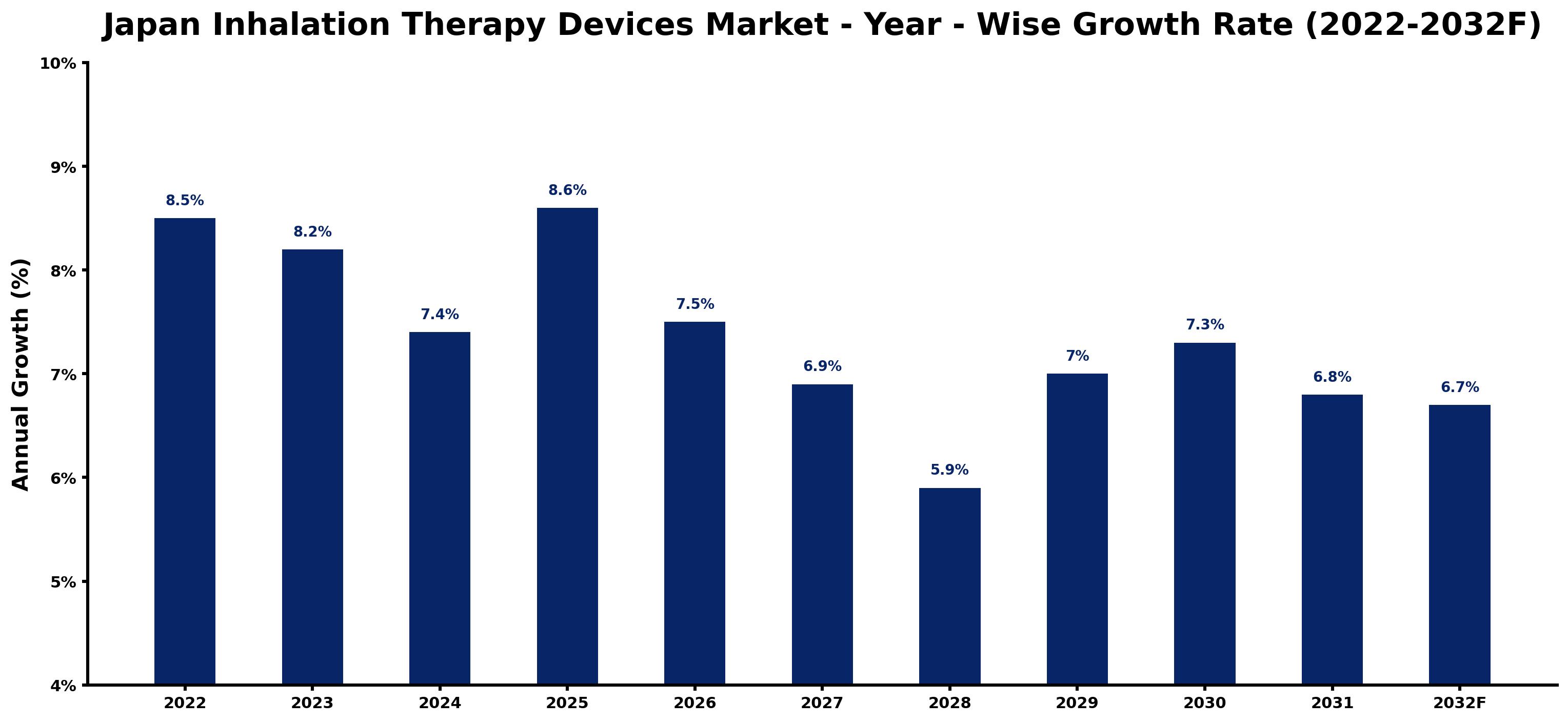
The following figures match every annual growth estimate with the main market development of that year, giving the reasoning behind each rise or slowdown.
| Year | Estimated Annual Growth (%) | Market Rationale |
| 2022 | 8.5 | The market experienced strong demand driven by a high number of asthma patients. |
| 2023 | 8.2 | Growth slowed slightly due to market saturation in certain device types. |
| 2024 | 7.4 | The market continued to grow, supported by increasing healthcare expenditure. |
| 2025 | 8.6 | Demand surged as awareness programs for asthma management gained traction. |
| 2026 | 7.5 | Growth is expected to slow as the market stabilises after rapid expansion. |
| 2027 | 6.9 | The market is projected to see further slowing, reflecting a maturing competitive environment. |
| 2028 | 5.9 | Growth is anticipated to decelerate as innovation in devices becomes less frequent. |
| 2029 | 7.0 | Demand will increase again as new patient demographics begin using inhalation devices. |
| 2030 | 7.3 | The market is expected to rise due to improved distribution channels. |
| 2031 | 6.8 | Growth will slow as the market reaches a more stable phase. |
| 2032 | 6.7 | The market is projected to continue growing, albeit at a slower rate than previous years. |
Note: Market size estimations and growth projections presented in this report are based on 6Wresearch's proprietary forecasting methodology, utilizing the latest available industry data, government publications, and primary research inputs.
Japan Inhalation Therapy Devices Market Synopsis
Inhalation therapy devices are medical instruments designed to deliver medication directly to the lungs, primarily for respiratory conditions. These devices, including metered-dose inhalers and nebulizers, are manufactured using advanced technology to ensure precise dosage. The Japan Inhalation Therapy Devices Market is expanding due to rising asthma prevalence, increased healthcare spending, and initiatives to improve device accessibility in rural areas. With approximately 1.5 million asthma patients in Japan, the demand for effective inhalation therapies is expected to continue increasing, particularly in urban regions like Tokyo. The focus on paediatric patients and the expansion of homecare solutions further drive market growth.
Market Dynamics Impact Analysis (2026–2032)
| Factor | Type | Impact | Primary Segment Affected |
| Increasing prevalence of respiratory diseases | Driver | High | Chronic Use |
| Government initiatives to improve asthma management | Driver | High | Pediatric & Elderly |
| Growing demand for homecare solutions | Opportunity | High | Homecare Medical Suppliers |
| Expansion of healthcare facilities in rural areas | Opportunity | Medium | Clinics / Pharmacies |
| High competition among device manufacturers | Restraint | High | Metered-Dose Inhalers |
| Regulatory compliance costs for new devices | Restraint | Medium | Nebulizers |
| Rising costs of production materials | Challenge | High | Dry Powder Inhalers |
| Capacity constraints in manufacturing | Challenge | Medium | Soft Mist Inhalers |
Evaluation of Drivers in Japan Inhalation Therapy Devices Market (2026–2032)
The factors lifting demand, and the evidence behind each, are summarised below.
| Drivers | Primary Segment Affected | Why It Matters (Evidence) |
| Rising asthma prevalence | Chronic Use | Approximately 1.5 million asthma patients in Japan drive demand for inhalation devices. |
| Increased healthcare expenditure | Pediatric & Elderly | Japan's national medical care expenditure reached JPY 46.7 trillion in fiscal 2022, boosting device purchases. |
| Awareness programs for asthma management | General Population | The 2023 government initiative increased awareness, leading to higher inhaler prescriptions. |
| Technological advancements in inhalation devices | Metered-Dose Inhalers | Innovations in device design improve usability, attracting more patients. |
| Growth in homecare medical suppliers | Homecare Medical Suppliers | The trend of at-home treatments encourages demand for portable inhalation devices. |
Volumes grow on the back of rising asthma prevalence, with approximately 1.5 million patients in Japan requiring effective inhalation therapy. Japan's national medical care expenditure reached JPY 46.7 trillion in fiscal 2022, supporting the purchase of advanced devices. Technological advancements in inhalation devices improve usability, attracting a wider patient base. The growth of homecare medical suppliers aligns with the trend of at-home treatments, driving demand for portable inhalation solutions.
Evaluation of Restraints in Japan Inhalation Therapy Devices Market
The main factors holding the market back are set out below.
| Market Restraint | Primary Segment Affected | Why It Matters (Evidence) |
| Intense competition among manufacturers | Metered-Dose Inhalers | Over 40% market share in inhalation devices leads to price pressures. |
| High regulatory compliance costs | Nebulizers | Manufacturers face costs to meet stringent PMDA standards, impacting profitability. |
| Rising production material costs | Dry Powder Inhalers | Increased costs of raw materials affect profit margins for producers. |
| Limited manufacturing capacity | Soft Mist Inhalers | Capacity constraints hinder the ability to meet growing demand. |
| Consumer awareness of device options | Chronic Use | Patients may not fully understand available inhalation therapies, affecting sales. |
Japan Inhalation Therapy Devices Market Challenges
In 2023, over 40% of inhalation devices in Japan are metered-dose inhalers, leading to intense competition that reduces profit margins for producers. Rising costs of advanced materials have increased production expenses, delaying product availability for hospitals and impacting patient care. Supply chain disruptions for specialised inhalation devices have resulted in longer delivery times, forcing healthcare facilities to manage shortages and affecting treatment timelines for asthma patients. Stringent regulations from the Pharmaceuticals and Medical Devices Agency require extensive testing, raising costs for manufacturers and ultimately increasing prices for buyers.
Trends in the Japan Inhalation Therapy Devices Market
The following changes are redrawing the Japan Inhalation Therapy Devices Market.
- Launch of Asthma Management Awareness Initiative: In 2023, the Ministry of Health initiated a program to improve asthma management awareness, targeting over 1.5 million asthma patients in Japan. This initiative aims to increase the prescription rates of inhalation devices.
- Growth in Homecare Medical Suppliers: The homecare medical suppliers segment is expanding, with an expected CAGR of 8.7% by 2032. This shift reflects a broader trend towards at-home healthcare solutions, particularly in urban areas.
- Focus on Pediatric Patients: The number of paediatric patients using inhalation devices is increasing, particularly with Soft Mist Inhalers. This segment is projected to grow at a CAGR of 9.2% as awareness of asthma in children rises.
- Shift Towards Advanced Inhalation Technologies: Technological advancements are transforming inhalation devices, focusing on user-friendly designs. The introduction of new metered-dose inhalers is projected to improve patient adherence to therapy.
Investment Opportunities in the Japan Inhalation Therapy Devices Market
Where to invest in the Japan Inhalation Therapy Devices Market: the main openings are set out below.
- Gap in Device Accessibility: With approximately 29.3% of Japan's population aged 65 or older, there is a growing need for accessible inhalation devices. Targeting elderly patients in rural areas presents a market opportunity.
- Demand for Pediatric Inhalation Devices: The increasing number of paediatric asthma patients creates a need for specialised inhalation devices. Collaborating with healthcare providers can facilitate entry into this growing market segment.
- Expansion of Homecare Solutions: The rise in homecare medical suppliers indicates a need for portable inhalation devices. Establishing partnerships with local suppliers can enhance market penetration.
- Investment in Innovative Technologies: Investing in advanced inhalation technologies can meet the evolving needs of patients. Focusing on user-friendly designs will attract a broader customer base.
Government Initiatives in the Japan Inhalation Therapy Devices Market
The PMDA's ongoing review process for inhalation devices ensures that manufacturers comply with safety and quality standards. This measure, alongside the PMD Act, strengthens the regulatory framework established in 1960, promoting better compliance among producers. In 2023, the government allocated JPY 5 billion to improve access to inhalation devices in rural areas, administered by the Ministry of Health. This funding aims to increase the availability of essential medical devices for underserved populations.
The Pharmaceuticals and Medical Devices Agency (PMDA) reviews inhalation devices and monitors post-market safety. The Japan Agency for Medical Research and Development (AMED) funds medical research, supporting innovation in device development.
Future Insight of the Japan Inhalation Therapy Devices Market
By 2032, hospitals will see improved access to inhalation therapy devices, driven by government initiatives aimed at enhancing rural healthcare. The launch of new awareness programmes for asthma management will likely increase demand for inhalation devices, especially among the aging population, with 29.3% aged 65 or older. Technological advancements in device design will enhance usability, particularly for paediatric patients. The promotion of best practices by the Japan Respiratory Society will standardise treatment protocols, leading to better patient outcomes.
Market Segmentation Analysis
Japan Inhalation Therapy Devices Market report covers a detailed analysis of the following market segments:
By Device Type – Dry Powder Inhalers Lead, Nebulizers Expected to Grow Fastest
According to Saurav Kr Singh, Senior Research Analyst at 6Wresearch, Dry Powder Inhalers took 38% of device type revenue in 2025, more than any other category. Dry Powder Inhalers hold the largest share due to their effectiveness in managing chronic respiratory conditions, with over 1.5 million asthma patients in Japan relying on them. Their design allows for precise dosage, making them a preferred choice in both hospitals and outpatient settings. Over 2026–2032, Nebulizers are expected to post the fastest growth, at a CAGR of 9.3%. Nebulizers are experiencing rapid growth as they are commonly used in hospitals for severe cases, reflecting an increasing demand for effective treatment in acute situations. The government's focus on improving access to inhalation devices further supports this segment's expansion. Suppliers should prioritise production and distribution of nebulizers to meet the rising demand in healthcare facilities.
By Inhalation Method – Breath-Activated Leads, Compressor / Ultrasonic Expected to Grow Fastest
Breath-Activated accounted for 46% of the market by inhalation method in 2025. Breath-Activated devices dominate the market as they cater to specific patient populations, providing ease of use for those with coordination difficulties. Their design aligns well with the needs of patients who require reliable and efficient medication delivery. Compressor / Ultrasonic is set to record the highest CAGR in this split, 9.8% over 2026–2032. Compressor / Ultrasonic devices are growing quickly due to their effectiveness in delivering medication in less common homecare settings, appealing to patients seeking alternatives. The increasing awareness of asthma management is likely to drive further adoption of these devices. Buyers may benefit from exploring a wider range of inhalation methods to find the best fit for their treatment needs.
By Patient Use Case – Chronic Use Leads, Pediatric & Elderly Expected to Grow Fastest
With 41% of patient use case revenue in 2025, Chronic Use was the largest category. Chronic Use holds the largest share as it is vital for managing long-term respiratory conditions, with approximately 1.5 million asthma patients in Japan relying on these devices. This segment's importance is underscored by the average age of asthma patients, which is around 50 years, indicating a sustained need for chronic management. Pediatric & Elderly is projected to grow fastest, at a CAGR of 9.2% during 2026–2032. The Pediatric & Elderly segment is growing quickly due to the increasing number of pediatric patients using inhalation devices, which highlights the need for specific solutions tailored to these vulnerable groups. The government's focus on asthma management awareness further drives this segment's growth. This trend suggests that suppliers should prioritise product development aimed at the unique needs of pediatric and elderly patients.
By Distribution Channel – Clinics / Pharmacies Lead, Homecare Medical Suppliers Expected to Grow Fastest
Clinics / Pharmacies held 45% of the Japan Inhalation Therapy Devices Market by distribution channel in 2025. Clinics and pharmacies hold the largest share as they are the primary access points for patients needing inhalation therapy devices. Their integral role in the healthcare system, particularly in urban areas like Tokyo, ensures steady availability and support for users. The quickest growth will come from Homecare Medical Suppliers, forecast to expand at a CAGR of 8.7% between 2026 and 2032. Homecare medical suppliers are witnessing rapid growth as more patients prefer managing their respiratory conditions at home, driven by a national programme launched in 2023 to promote asthma management. This shift towards at-home care is further supported by increased government funding for device access in rural regions. This trend indicates that suppliers must enhance partnerships with homecare medical suppliers to meet the rising demand for home-based therapy solutions.
Key Attractiveness of the Report
- 10 Years of Market Numbers
- Historical Data Starting from 2022 to 2025
- Base Year 2025
- Forecast Data until 2032
- Key Performance Indicators Impacting the Market
- Major Upcoming Developments and Projects
Key Highlights of the Report:
- Japan Inhalation Therapy Devices Market Outlook
- Market Size of Japan Inhalation Therapy Devices Market, 2025
- Forecast of Japan Inhalation Therapy Devices Market, 2032
- Historical Data and Forecast of Japan Inhalation Therapy Devices Revenues & Volume for the Period 2022-2032F
- Japan Inhalation Therapy Devices Market Trend Evolution
- Japan Inhalation Therapy Devices Market Drivers and Challenges
- Japan Inhalation Therapy Devices Price Trends
- Japan Inhalation Therapy Devices Porter's Five Forces
- Japan Inhalation Therapy Devices Industry Life Cycle
- Historical Data and Forecast of Japan Inhalation Therapy Devices Market Revenues & Volume By Device Type for the Period 2022-2032F
- Historical Data and Forecast of Japan Inhalation Therapy Devices Market Revenues & Volume By Dry Powder Inhalers for the Period 2022-2032F
- Historical Data and Forecast of Japan Inhalation Therapy Devices Market Revenues & Volume By Nebulizers for the Period 2022-2032F
- Historical Data and Forecast of Japan Inhalation Therapy Devices Market Revenues & Volume By Metered-Dose Inhalers for the Period 2022-2032F
- Historical Data and Forecast of Japan Inhalation Therapy Devices Market Revenues & Volume By Soft Mist Inhalers for the Period 2022-2032F
- Historical Data and Forecast of Japan Inhalation Therapy Devices Market Revenues & Volume By Inhalation Method for the Period 2022-2032F
- Historical Data and Forecast of Japan Inhalation Therapy Devices Market Revenues & Volume By Breath-Activated for the Period 2022-2032F
- Historical Data and Forecast of Japan Inhalation Therapy Devices Market Revenues & Volume By Compressor / Ultrasonic for the Period 2022-2032F
- Historical Data and Forecast of Japan Inhalation Therapy Devices Market Revenues & Volume By Propellant-Based for the Period 2022-2032F
- Historical Data and Forecast of Japan Inhalation Therapy Devices Market Revenues & Volume By Mechanical for the Period 2022-2032F
- Historical Data and Forecast of Japan Inhalation Therapy Devices Market Revenues & Volume By Patient Use Case for the Period 2022-2032F
- Historical Data and Forecast of Japan Inhalation Therapy Devices Market Revenues & Volume By Chronic Use for the Period 2022-2032F
- Historical Data and Forecast of Japan Inhalation Therapy Devices Market Revenues & Volume By Pediatric & Elderly for the Period 2022-2032F
- Historical Data and Forecast of Japan Inhalation Therapy Devices Market Revenues & Volume By General Population for the Period 2022-2032F
- Historical Data and Forecast of Japan Inhalation Therapy Devices Market Revenues & Volume By Respiratory Therapy for the Period 2022-2032F
- Historical Data and Forecast of Japan Inhalation Therapy Devices Market Revenues & Volume By Distribution Channel for the Period 2022-2032F
- Historical Data and Forecast of Japan Inhalation Therapy Devices Market Revenues & Volume By Clinics / Pharmacies for the Period 2022-2032F
- Historical Data and Forecast of Japan Inhalation Therapy Devices Market Revenues & Volume By Homecare Medical Suppliers for the Period 2022-2032F
- Historical Data and Forecast of Japan Inhalation Therapy Devices Market Revenues & Volume By Hospitals & Retail for the Period 2022-2032F
- Historical Data and Forecast of Japan Inhalation Therapy Devices Market Revenues & Volume By Medical Equipment Vendors for the Period 2022-2032F
- Japan Inhalation Therapy Devices Import Export Trade Statistics
- Market Opportunity Assessment By Device Type
- Market Opportunity Assessment By Inhalation Method
- Market Opportunity Assessment By Patient Use Case
- Market Opportunity Assessment By Distribution Channel
- Japan Inhalation Therapy Devices Top Companies Market Share
- Japan Inhalation Therapy Devices Competitive Benchmarking By Technical and Operational Parameters
- Japan Inhalation Therapy Devices Company Profiles
- Japan Inhalation Therapy Devices Key Strategic Recommendations
Market Covered
Coverage by segment is as follows.
By Device Type
- Dry Powder Inhalers
- Nebulizers
- Metered-Dose Inhalers
- Soft Mist Inhalers
By Inhalation Method
- Breath-Activated
- Compressor / Ultrasonic
- Propellant-Based
- Mechanical
By Patient Use Case
- Chronic Use
- Pediatric & Elderly
- General Population
- Respiratory Therapy
By Distribution Channel
- Clinics / Pharmacies
- Homecare Medical Suppliers
- Hospitals & Retail
- Medical Equipment Vendors































