Japan Inhalational Devices Market Size & Growth Rate
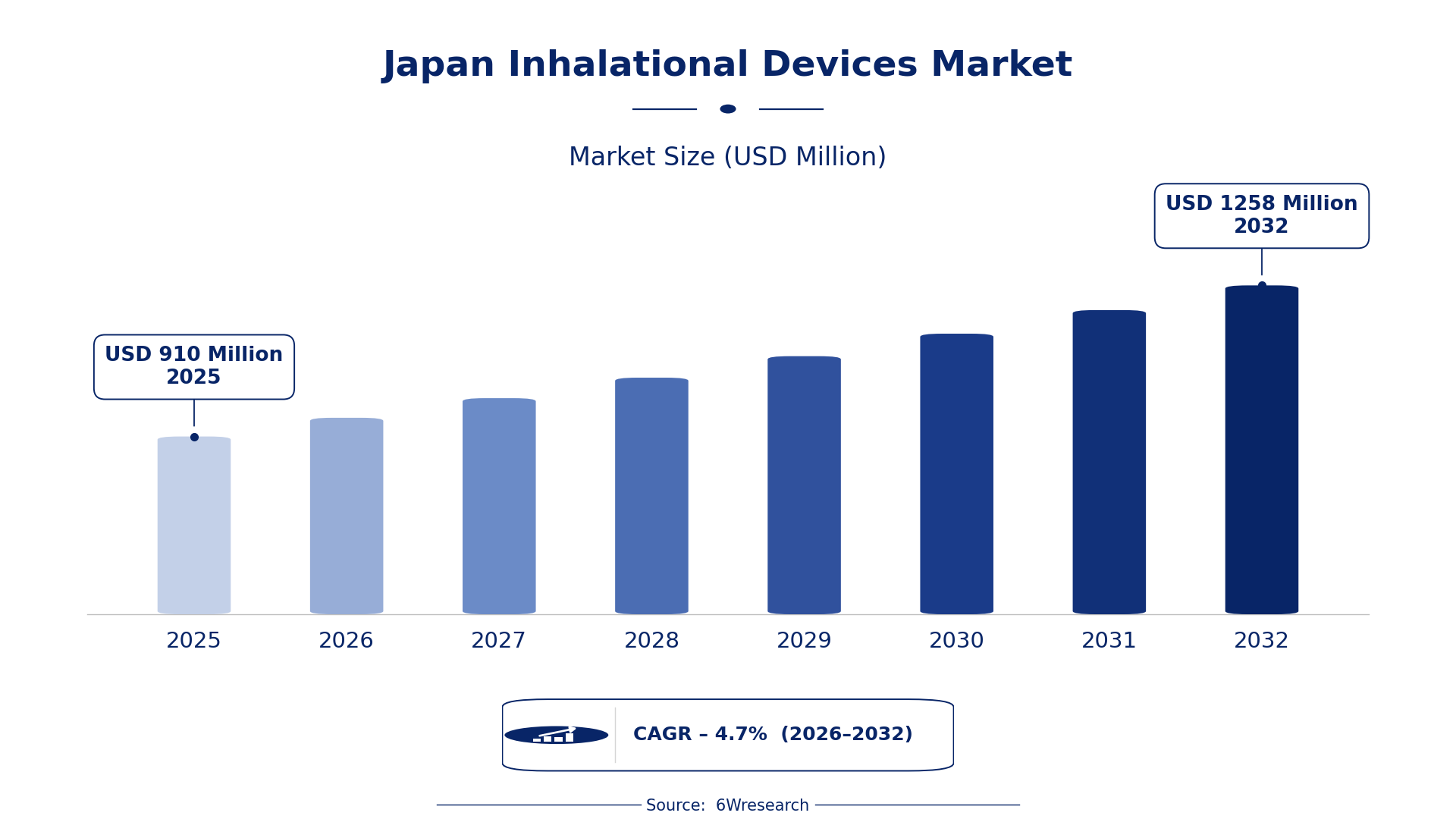
According to 6Wresearch internal database and industry insights, the Japan Inhalational Devices Market was valued at USD 910 Million in 2025 and is projected to reach USD 1,258 Million by 2032, growing at a CAGR of approximately 4.7% during 2026–2032.
Japan Inhalational Devices Market Highlights
| Report Metric | Details |
| Report Name | Japan Inhalational Devices Market (2026-2032) |
| Market Size 2025 | USD 910 Million |
| Market Size 2032 | USD 1,258 Million |
| Absolute Growth 2025–2032 | USD 348 Million |
| CAGR 2026–2032 | 4.7% |
| Peak Annual Growth | 6.0% in 2032 |
| Forecast Period | 2026–2032 |
| Historical Data | 2022–2025 |
| Base Year | 2025 |
| Leading Device Form, 2025 | Handheld Inhalers (41% share) |
| Leading Technology Base, 2025 | MDI / DPI (51% share) |
| Leading Portability, 2025 | High (49% share) |
| Leading Distribution Channel, 2025 | Pharmacy / OTC (48% share) |
| Fastest-Growing Device Form | Home Nebulizers (7.0% CAGR) |
| Fastest-Growing Technology Base | Electric Compressor (7.4% CAGR) |
| Fastest-Growing Portability | Low (6.4% CAGR) |
| Fastest-Growing Distribution Channel | Medical Equipment Stores (6.1% CAGR) |
| Growing Sector | respiratory health |
| Key End Users | hospitals, clinics, home care providers, health tech suppliers |
Japan Inhalational Devices Market Year-wise Growth Rate and Key Drivers (2022–2032)
This graph illustrates the annual growth rates of the market from 2022 to 2032, highlighting a steady upward trajectory and projected market expansion over the forecast period.
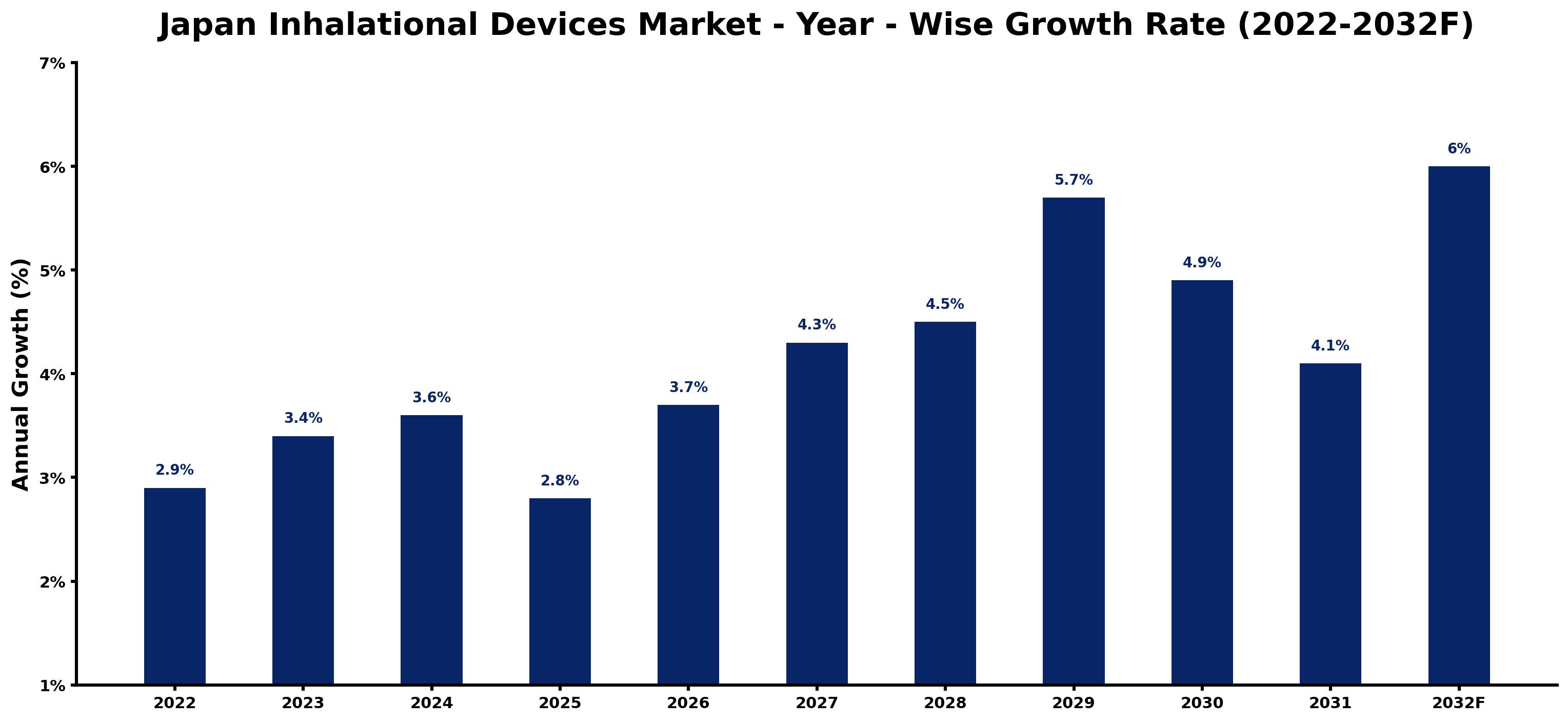
The following figures match every annual growth estimate with the main market development of that year, giving the reasoning behind each rise or slowdown.
| Year | Estimated Annual Growth (%) | Market Rationale |
| 2022 | 2.9 | The market experienced steady growth due to rising awareness of respiratory conditions among the population. |
| 2023 | 3.4 | Demand rose as more patients sought effective management options for asthma and COPD. |
| 2024 | 3.6 | Growth accelerated with improved healthcare access and support for inhalational device usage. |
| 2025 | 2.8 | A slight slowdown occurred as market saturation began to affect growth rates. |
| 2026 | 3.7 | Demand is expected to rise again as new technologies enter the market. |
| 2027 | 4.3 | Growth will be driven by increased health expenditures and an aging population. |
| 2028 | 4.5 | Purchasing is projected to rise as home care options gain popularity. |
| 2029 | 5.7 | Growth will be supported by advancements in smart inhaler technology and patient adherence. |
| 2030 | 4.9 | A slowdown is anticipated as competition intensifies among existing products. |
| 2031 | 4.1 | Market growth is expected to decelerate as regulatory challenges impact new product introductions. |
| 2032 | 6.0 | Demand is projected to peak as the market adapts to evolving patient needs and technologies. |
Note: Market size estimations and growth projections presented in this report are based on 6Wresearch's proprietary forecasting methodology, utilizing the latest available industry data, government publications, and primary research inputs.
Japan Inhalational Devices Market Synopsis
Inhalational devices are medical instruments designed for delivering medication directly to the lungs, primarily for treating respiratory conditions such as asthma and COPD. The Japan Inhalational Devices Market is expanding, driven by approximately 2.5 million asthma patients in 2023. This growth is supported by technological advancements, increased healthcare spending, and a healthcare system that encourages the adoption of these devices. The Tokyo region accounts for 30% of the total demand, highlighting notable regional variations in usage and investment.
Market Dynamics Impact Analysis (2026–2032)
| Factor | Type | Impact | Primary Segment Affected |
| Aging population increasing the prevalence of respiratory diseases | Driver | High | Handheld Inhalers |
| Rising healthcare expenditure supporting advanced treatment options | Driver | High | Home Nebulizers |
| Growing market for smart inhalers due to technology integration | Opportunity | Medium | Smart Inhalers |
| Increased adoption of home nebulizers driven by patient preference | Opportunity | High | Home Nebulizers |
| Market saturation limiting growth potential for existing products | Restraint | Medium | Hospital-Based Units |
| Regulatory challenges impacting new product approvals | Restraint | High | MDI / DPI |
| Competition from alternative therapies affecting market share | Challenge | High | Electric Compressor |
| Supply chain disruptions affecting availability of devices | Challenge | Medium | High Volume Nebulizers |
Evaluation of Drivers in Japan Inhalational Devices Market (2026–2032)
The main growth drivers and the segments they affect most are set out below.
| Drivers | Primary Segment Affected | Why It Matters (Evidence) |
| Increasing number of asthma patients | Home Nebulizers | Japan had approximately 2.5 million asthma patients in 2023, boosting demand for home nebulizers. |
| Integration of smart inhalers into treatment plans | Smart Inhalers | Smart inhalers are projected to increase by 25% by 2025, enhancing patient adherence. |
| Support for asthma education initiatives | Hospital-Based Units | Programs from the Japan Respiratory Society aim to improve inhaler usage and awareness. |
| Preference for ease of use among elderly patients | MDI / DPI | DPI devices are favoured for their simplicity, particularly among Japan's aging population. |
| Rising healthcare expenditure | Handheld Inhalers | Japan's national medical care expenditure was about JPY 46.7 trillion in 2022, supporting inhaler purchases. |
Purchasing is picking up as the number of asthma patients in Japan reaches approximately 2.5 million, creating strong demand for handheld inhalers. National medical care expenditure, which was about JPY 46.7 trillion in 2022, supports the growth of home nebulizers as patients seek effective treatment options. The integration of smart inhalers into treatment plans is gaining traction, improving patient adherence. Increased health expenditures among the aging population further boost demand for MDI and DPI devices, ensuring consistent purchasing patterns.
Evaluation of Restraints in Japan Inhalational Devices Market
These restraints slow adoption and weigh on supplier margins.
| Market Restraint | Primary Segment Affected | Why It Matters (Evidence) |
| Market saturation limiting growth potential | Hospital-Based Units | With over 8,100 hospitals in Japan, the market for hospital-based units faces saturation, limiting growth opportunities. |
| Regulatory hurdles delaying new product launches | MDI / DPI | Regulatory challenges from the PMD Act can delay the introduction of new inhalational devices. |
| Limited awareness of smart inhalers | Smart Inhalers | Despite their benefits, limited awareness among patients restricts the growth of smart inhalers. |
| High competition from alternative therapies | Electric Compressor | The presence of alternative therapies for respiratory conditions affects the market share of electric compressors. |
| Supply chain disruptions impacting availability | High Volume Nebulizers | Supply chain issues can lead to delays in the availability of high volume nebulizers for critical care. |
Japan Inhalational Devices Market Challenges
Japan's healthcare system encounters a shortage of skilled professionals, which hampers effective inhaler training and results in improper medication delivery for 2.5 million asthma patients. Fierce competition among suppliers leads to price cuts that can undermine the quality of inhalational devices, negatively impacting treatment outcomes in hospitals. Supply chain challenges from global material shortages delay the availability of advanced devices, prolonging treatment timelines for patients. Buyers face escalating costs as the average lifespan of inhalational devices is around three years, compelling clinics and hospitals to allocate budgets for frequent replacements.
Trends in the Japan Inhalational Devices Market
Below are the shifts with the largest effect on the Japan Inhalational Devices Market.
- Shift in Patient Preference to Home Care: Patients are increasingly opting for home nebulizers for respiratory treatment, with a reported 15% rise in home care adoption in 2023. This trend reflects a growing desire for convenience and self-management in respiratory care.
- Transition to Smart Inhalers: The integration of smart inhalers into treatment plans is gaining traction, with pilot programs in urban hospitals. Adoption of these devices is projected to increase by 25% by 2025, improving patient adherence and monitoring.
- Growing Focus on Asthma Education: The Tokyo Medical Association promotes inhalational devices in local clinics, reflecting a shift towards better asthma management. This initiative aims to improve patient outcomes through education and proper inhaler use.
- Emergence of IoT Connected Devices: IoT connected inhalational devices are becoming more prevalent, particularly in urban areas. The projected increase in adoption by 25% by 2025 indicates a trend towards technology-driven healthcare solutions.
Investment Opportunities in the Japan Inhalational Devices Market
The following areas offer the clearest openings for investors and suppliers in the Japan Inhalational Devices Market.
- Investment in Home Care Facilities: The Osaka region's 10% increase in nebulizer prescriptions indicates a need for home care facilities. Investing in these facilities can cater to the rising demand for home nebulizers.
- Supply of Smart Inhalers: With the projected 25% increase in smart inhaler adoption by 2025, suppliers should focus on developing these devices. Targeting urban hospitals can facilitate entry into this growing market.
- Focus on Training Programs: Support for asthma education programs creates opportunities for training providers. Investing in training initiatives can improve the effective use of inhalational devices.
- Development of IoT Connected Devices: The increasing adoption of IoT connected devices presents an opportunity for innovation. Suppliers can invest in this technology to meet the evolving needs of patients.
Government Initiatives in the Japan Inhalational Devices Market
The PMD Act regulates the approval, manufacture, and quality of inhalational devices, ensuring safety and efficacy for users. Compliance with strict standards can lead to increased costs for producers, impacting product development and production. The government has allocated 500 million yen for respiratory health initiatives in 2023, supporting advancements in inhalational therapy and patient education programs.
The Pharmaceuticals and Medical Devices Agency (PMDA) reviews inhalational devices for safety and effectiveness. This agency's oversight ensures that buyers can trust the quality of products available in the market, enhancing consumer confidence.
Future Insight of the Japan Inhalational Devices Market
By 2032, clinics will benefit from enhanced treatment options as smart inhalers gain traction, driven by pilot programs in urban hospitals. The adoption of IoT connected devices is expected to increase by 25%, improving patient monitoring and adherence. Training initiatives supported by the Japan Respiratory Society will elevate healthcare provider expertise, enabling better management of respiratory conditions. Government funding of 500 million yen for respiratory health initiatives will further stimulate advancements in inhalational therapy.
Market Segmentation Analysis
Japan Inhalational Devices Market report covers a detailed analysis of the following market segments:
By Device Form – Handheld Inhalers Lead, Home Nebulizers Expected to Grow Fastest
According to Saurav Kr Singh, Senior Research Analyst at 6Wresearch, the largest device form category in 2025 was Handheld Inhalers, at 41% of revenue. Handheld inhalers dominate the market due to their prevalent use in treating asthma and COPD, with a strong presence among patients. They are frequently prescribed in over 8,100 hospitals across Japan, contributing to their widespread adoption. The quickest growth will come from Home Nebulizers, forecast to expand at a CAGR of 7.0% between 2026 and 2032. Home nebulizers are rapidly gaining traction as patients increasingly prefer home treatment options, highlighted by a 15% rise in home care adoption in 2023. This shift towards convenience indicates that demand for these devices will continue to grow. Suppliers should prioritise the availability and support for home nebulizers to align with the increasing consumer preference for home treatment.
By Technology Base – MDI / DPI Leads, Electric Compressor Expected to Grow Fastest
MDI / DPI took 51% of technology base revenue in 2025, more than any other category. MDI / DPI technologies dominate the market as standard delivery methods for inhaled medications, widely accepted in clinical practices. Their established presence is supported by guidelines from the Japanese Society of Allergology, ensuring consistent usage. Electric Compressor is projected to grow fastest, at a CAGR of 7.4% during 2026–2032. Electric compressors are gaining traction due to their specific applications in certain cases, although they remain a minor choice overall. Their adoption is likely to increase as more patients seek tailored solutions for their respiratory needs. Suppliers may need to diversify their product offerings to include electric compressors alongside MDIs and DPIs to cater to varying patient preferences.
By Portability – High Leads, Low Expected to Grow Fastest
In 2025, High led the portability split with a 49% share. High portability devices are preferred for their ease of use, making them the go-to choice for patients managing respiratory conditions. This preference is particularly strong among the elderly, who require convenient options for daily medication. Over 2026–2032, Low is expected to post the fastest growth, at a CAGR of 6.4%. Low portability devices are less preferred, primarily due to their limited functionality and convenience compared to high portability options. As the market focuses on user-friendly designs, this segment may struggle to gain traction. Manufacturers should prioritise the development of portable inhalational devices to align with consumer preferences for convenience.
By Distribution Channel – Pharmacy / OTC Leads, Medical Equipment Stores Expected to Grow Fastest
With 48% of distribution channel revenue in 2025, Pharmacy / OTC was the largest category. Pharmacy and OTC channels are the leading distribution method for inhalational devices, providing essential access for consumers. This channel benefits from high foot traffic and direct consumer engagement, which facilitates easier procurement of necessary medications. Medical Equipment Stores are set to record the highest CAGR in this split, 6.1% over 2026–2032. Medical equipment stores are experiencing growth as they meet the specific needs for specialised equipment, although they remain less common. This trend suggests a rising demand for tailored solutions among particular patient demographics. Suppliers should explore partnerships with medical equipment stores to effectively reach this specialised market segment.
Key Attractiveness of the Report
- 10 Years of Market Numbers
- Historical Data Starting from 2022 to 2025
- Base Year 2025
- Forecast Data until 2032
- Key Performance Indicators Impacting the Market
- Major Upcoming Developments and Projects
Key Highlights of the Report:
- Japan Inhalational Devices Market Outlook
- Market Size of Japan Inhalational Devices Market, 2025
- Forecast of Japan Inhalational Devices Market, 2032
- Historical Data and Forecast of Japan Inhalational Devices Revenues & Volume for the Period 2022-2032F
- Japan Inhalational Devices Market Trend Evolution
- Japan Inhalational Devices Market Drivers and Challenges
- Japan Inhalational Devices Price Trends
- Japan Inhalational Devices Porter's Five Forces
- Japan Inhalational Devices Industry Life Cycle
- Historical Data and Forecast of Japan Inhalational Devices Market Revenues & Volume By Device Form for the Period 2022-2032F
- Historical Data and Forecast of Japan Inhalational Devices Market Revenues & Volume By Handheld Inhalers for the Period 2022-2032F
- Historical Data and Forecast of Japan Inhalational Devices Market Revenues & Volume By Home Nebulizers for the Period 2022-2032F
- Historical Data and Forecast of Japan Inhalational Devices Market Revenues & Volume By Hospital-Based Units for the Period 2022-2032F
- Historical Data and Forecast of Japan Inhalational Devices Market Revenues & Volume By Smart Inhalers for the Period 2022-2032F
- Historical Data and Forecast of Japan Inhalational Devices Market Revenues & Volume By Technology Base for the Period 2022-2032F
- Historical Data and Forecast of Japan Inhalational Devices Market Revenues & Volume By MDI / DPI for the Period 2022-2032F
- Historical Data and Forecast of Japan Inhalational Devices Market Revenues & Volume By Electric Compressor for the Period 2022-2032F
- Historical Data and Forecast of Japan Inhalational Devices Market Revenues & Volume By High Volume Nebulizers for the Period 2022-2032F
- Historical Data and Forecast of Japan Inhalational Devices Market Revenues & Volume By IoT Connected for the Period 2022-2032F
- Historical Data and Forecast of Japan Inhalational Devices Market Revenues & Volume By Portability for the Period 2022-2032F
- Historical Data and Forecast of Japan Inhalational Devices Market Revenues & Volume By High for the Period 2022-2032F
- Historical Data and Forecast of Japan Inhalational Devices Market Revenues & Volume By Low for the Period 2022-2032F
- Historical Data and Forecast of Japan Inhalational Devices Market Revenues & Volume By Non-portable for the Period 2022-2032F
- Historical Data and Forecast of Japan Inhalational Devices Market Revenues & Volume By Moderate for the Period 2022-2032F
- Historical Data and Forecast of Japan Inhalational Devices Market Revenues & Volume By Distribution Channel for the Period 2022-2032F
- Historical Data and Forecast of Japan Inhalational Devices Market Revenues & Volume By Pharmacy / OTC for the Period 2022-2032F
- Historical Data and Forecast of Japan Inhalational Devices Market Revenues & Volume By Medical Equipment Stores for the Period 2022-2032F
- Historical Data and Forecast of Japan Inhalational Devices Market Revenues & Volume By Hospital Procurement for the Period 2022-2032F
- Historical Data and Forecast of Japan Inhalational Devices Market Revenues & Volume By Health Tech Suppliers for the Period 2022-2032F
- Japan Inhalational Devices Import Export Trade Statistics
- Market Opportunity Assessment By Device Form
- Market Opportunity Assessment By Technology Base
- Market Opportunity Assessment By Portability
- Market Opportunity Assessment By Distribution Channel
- Japan Inhalational Devices Top Companies Market Share
- Japan Inhalational Devices Competitive Benchmarking By Technical and Operational Parameters
- Japan Inhalational Devices Company Profiles
- Japan Inhalational Devices Key Strategic Recommendations
Market Covered
Coverage by segment is as follows.
By Device Form
- Handheld Inhalers
- Home Nebulizers
- Hospital-Based Units
- Smart Inhalers
By Technology Base
- MDI / DPI
- Electric Compressor
- High Volume Nebulizers
- IoT Connected
By Portability
- High
- Low
- Non-portable
- Moderate
By Distribution Channel
- Pharmacy / OTC
- Medical Equipment Stores
- Hospital Procurement
- Health Tech Suppliers































