Japan Injectable Anesthetic Drug Market Size & Growth Rate
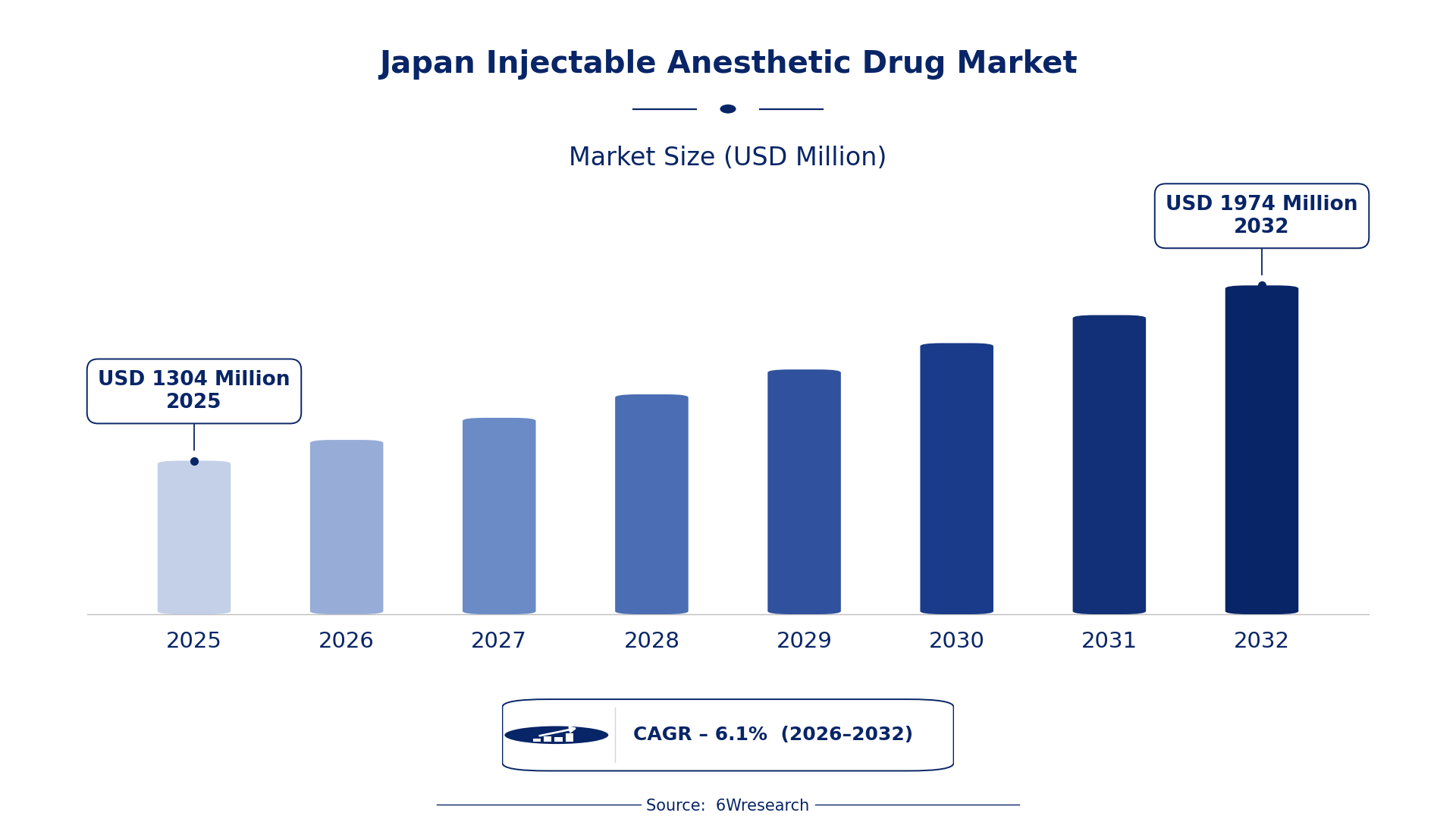
According to 6Wresearch internal database and industry insights, the Japan Injectable Anesthetic Drug Market was valued at USD 1,304 Million in 2025 and is projected to reach USD 1,974 Million by 2032, growing at a CAGR of approximately 6.1% during 2026–2032.
Japan Injectable Anesthetic Drug Market Highlights
| Report Metric | Details |
| Report Name | Japan Injectable Anesthetic Drug Market (2026-2032) |
| Market Size 2025 | USD 1,304 Million |
| Market Size 2032 | USD 1,974 Million |
| Absolute Growth 2025–2032 | USD 670 Million |
| CAGR 2026–2032 | 6.1% |
| Peak Annual Growth | 7.0% in 2028 |
| Forecast Period | 2026–2032 |
| Historical Data | 2022–2025 |
| Base Year | 2025 |
| Leading Anesthetic Type, 2025 | General Anesthetics (42% share) |
| Leading Usage Category, 2025 | Surgery (40% share) |
| Leading Onset Duration, 2025 | Rapid / IV (45% share) |
| Leading Distribution Channel, 2025 | Hospital Pharmacies (42% share) |
| Fastest-Growing Anesthetic Type | Conscious Sedation Drugs (8.5% CAGR) |
| Fastest-Growing Usage Category | Minor Procedures (8.3% CAGR) |
| Fastest-Growing Onset Duration | Fast-Acting (8.1% CAGR) |
| Fastest-Growing Distribution Channel | Ambulatory Care Providers (7.7% CAGR) |
| Growing Sector | Veterinary Anesthetics |
| Key End Users | Hospitals, Clinics, Veterinary Practices |
Japan Injectable Anesthetic Drug Market Year-wise Growth Rate and Key Drivers (2022–2032)
This graph illustrates the annual growth rates of the market from 2022 to 2032, highlighting a steady upward trajectory and projected market expansion over the forecast period.
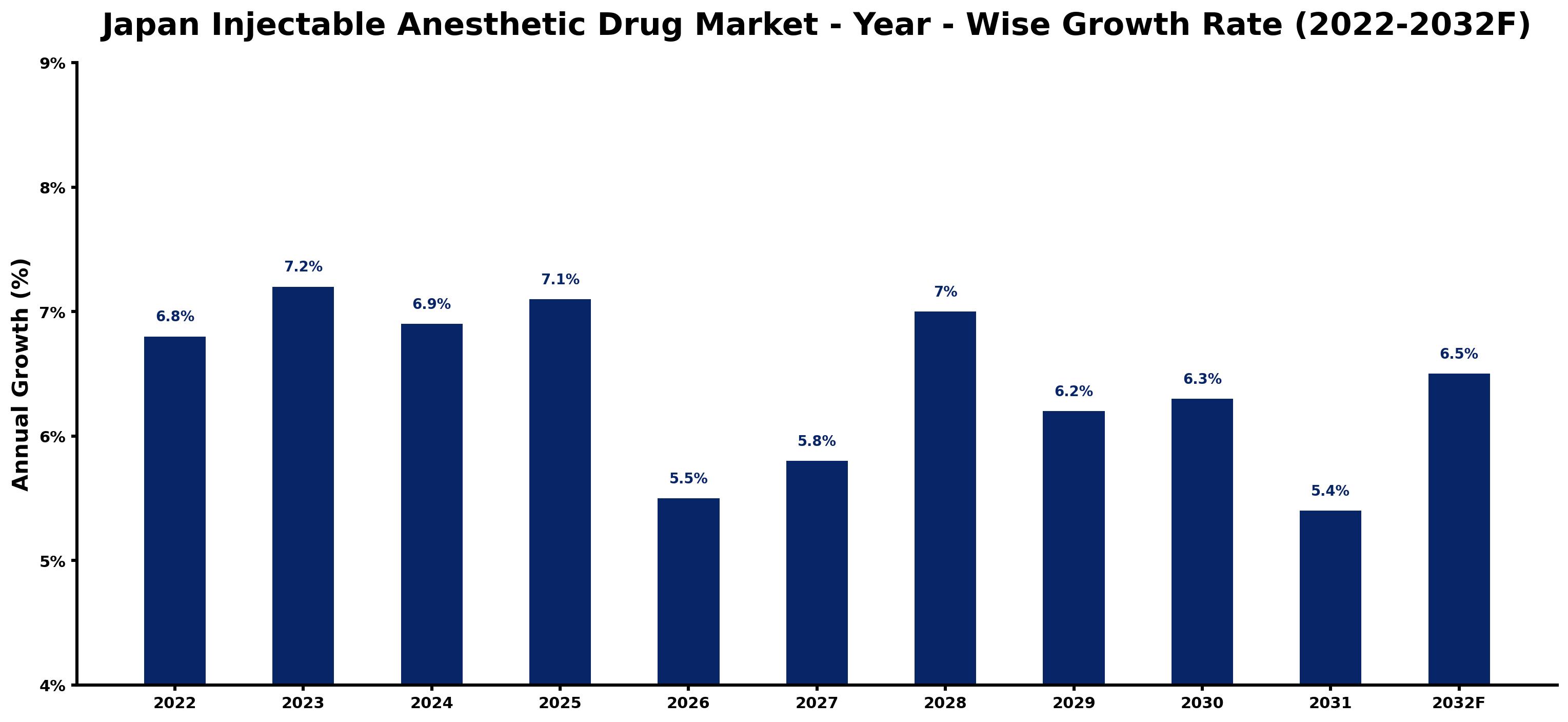
For each year, the table pairs the estimated growth rate with the leading influence on demand, showing how the drivers changed across the period.
| Year | Estimated Annual Growth (%) | Market Rationale |
| 2022 | 6.8 | The market experienced steady growth due to increased surgical procedures and dental visits. |
| 2023 | 7.2 | Growth was driven by heightened demand for anesthetics in hospitals and clinics across Japan. |
| 2024 | 6.9 | A slight slowdown occurred as the market adjusted to previous high growth rates. |
| 2025 | 7.1 | Demand surged again, supported by rising surgical and dental procedures nationwide. |
| 2026 | 5.5 | Growth is expected to slow as the market stabilises after rapid expansion in prior years. |
| 2027 | 5.8 | The market is projected to rebound with increased adoption of anesthetics in outpatient settings. |
| 2028 | 7.0 | A peak in growth is anticipated as safety standards improve, boosting buyer confidence. |
| 2029 | 6.2 | Growth is expected to slow again as the market begins to normalise after previous peaks. |
| 2030 | 6.3 | Demand will rise as the average age of surgical patients continues to increase. |
| 2031 | 5.4 | A further slowdown is projected as the market adjusts to changing healthcare needs. |
| 2032 | 6.5 | Growth is expected to pick up again, driven by innovations in anesthetic formulations. |
Note: Market size estimations and growth projections presented in this report are based on 6Wresearch's proprietary forecasting methodology, utilizing the latest available industry data, government publications, and primary research inputs.
Japan Injectable Anesthetic Drug Market Synopsis
Injectable anesthetic drugs are pharmaceutical agents used to induce anesthesia during medical procedures, including surgeries and dental work. These drugs are synthesized through chemical processes and are important in both human and veterinary healthcare. The Japan Injectable Anesthetic Drug Market is expanding due to rising surgical procedures, a notable increase in dental visits, and a growing veterinary market influenced by pet ownership. In 2022, approximately 80 million dental visits occurred, highlighting the demand for local anesthetics, while the Tokyo region leads in surgical procedures requiring these drugs.
Market Dynamics Impact Analysis (2026–2032)
| Factor | Type | Impact | Primary Segment Affected |
| Increased surgical procedures drive demand for general anesthetics. | Driver | High | Surgery |
| Growing dental visits boost the need for local anesthetics. | Driver | High | Dental / Dermatology |
| Rising pet ownership creates demand for veterinary anesthetics. | Opportunity | Medium | Veterinary Anesthetics |
| Expansion of outpatient services increases demand for fast-acting anesthetics. | Opportunity | Medium | Fast-Acting |
| Regulatory compliance can slow down the approval process for new anesthetics. | Restraint | High | General Anesthetics |
| Cost pressures in healthcare may limit budget allocations for anesthetics. | Restraint | Medium | Local Anesthetics |
| Rising production costs impact pricing strategies for anesthetic drugs. | Challenge | High | Conscious Sedation Drugs |
| Capacity constraints in manufacturing may affect supply levels. | Challenge | Medium | Veterinary Anesthetics |
Evaluation of Drivers in Japan Injectable Anesthetic Drug Market (2026–2032)
The main growth drivers and the segments they affect most are set out below.
| Drivers | Primary Segment Affected | Why It Matters (Evidence) |
| Rising number of surgical procedures increases demand for general anesthetics. | General Anesthetics | In 2023, Japan had approximately 1,200 hospitals utilizing injectable anesthetics. |
| Increasing dental visits boost the demand for local anesthetics. | Local Anesthetics | In 2022, there were around 80 million dental visits in Japan. |
| Increase in pet ownership drives demand for veterinary anesthetics. | Veterinary Anesthetics | The veterinary market for anesthetics is expanding due to rising pet ownership, which has increased by 20%. |
| Shift towards outpatient procedures increases demand for fast-acting anesthetics. | Fast-Acting | Ambulatory care providers are increasingly utilizing these anesthetics for various procedures, with a 25% rise in usage. |
| Technological advancements improve anesthetic formulations and delivery methods. | Conscious Sedation Drugs | ISO 13485 standard ensures quality in the production of medical devices, including anesthetics, enhancing safety and efficacy. |
Behind the steady rise in orders is the increasing number of surgical procedures, with approximately 1,200 hospitals in Japan utilising injectable anesthetics. The dental sector, accounting for about 30% of anesthetic use, experienced around 80 million visits in 2022, driving demand for local anesthetics. The growing veterinary market, influenced by a 20% rise in pet ownership, is expanding the need for veterinary anesthetics. The shift towards outpatient procedures is increasing demand for fast-acting anesthetics, which are now used in 25% more cases. Advancements in technology are improving anesthetic formulations and delivery methods, reshaping the market environment and leading to more purchases by healthcare providers.
Evaluation of Restraints in Japan Injectable Anesthetic Drug Market
These are the pressures that could keep growth below its potential.
| Market Restraint | Primary Segment Affected | Why It Matters (Evidence) |
| Regulatory compliance can delay the introduction of new anesthetics. | General Anesthetics | The Ministry of Health, Labour and Welfare oversees strict regulations that impact approval timelines, potentially extending them by several months. |
| Cost pressures in healthcare may limit budgets for anesthetic procurement. | Local Anesthetics | Healthcare institutions face financial constraints that affect spending on anesthetic drugs, limiting available budgets by up to 10%. |
| Production costs are rising, impacting pricing strategies for anesthetics. | Conscious Sedation Drugs | Increased raw material costs are affecting overall production expenses, raising prices by approximately 5%. |
| Capacity constraints in manufacturing may lead to supply shortages. | Veterinary Anesthetics | The growing demand from veterinary practices is straining existing production capabilities, potentially leading to a 15% shortfall in supply. |
| Market saturation in certain regions may limit growth potential. | Fast-Acting | High competition in metropolitan areas like Tokyo can restrict market expansion, with 30% of suppliers facing challenges. |
Japan Injectable Anesthetic Drug Market Challenges
Japan's 1,200 hospitals face rising costs due to stringent regulations from the Ministry of Health, Labour and Welfare, which can delay the introduction of new injectable anesthetic drugs by up to six months. Producers struggle with compliance to ISO 13485 standards, resulting in increased production costs that elevate prices for hospitals, forcing them to allocate larger budgets for anesthetics. The slow adoption of advanced anesthetic delivery technologies can extend surgical times by an average of 15 minutes, negatively impacting patient throughput for clinics. An increasing aging population necessitates specialised training for anesthesiologists, creating a skills gap that delays procedures and reduces service availability for buyers.
Trends in the Japan Injectable Anesthetic Drug Market
Buyers and suppliers in the Japan Injectable Anesthetic Drug Market are adjusting to the following trends.
- Shift from Traditional to Fast-Acting Anesthetics: Since 2023, there has been a noticeable shift towards fast-acting anesthetics in outpatient settings. The Tokyo region is leading this change, with a growing preference for rapid administration methods, resulting in a 30% increase in demand for these products.
- Emergence of Conscious Sedation Drugs: Beginning in 2026, conscious sedation drugs are gaining prominence in various medical procedures. The Japanese Society of Anesthesiologists promotes their use, reflecting a shift towards safer, less invasive options, with a projected 15% increase in market share.
- Increase in Veterinary Anesthetic Usage: From 2024, the veterinary market has seen a rise in anesthetic usage due to increased pet ownership. Veterinary suppliers are responding to this demand, leading to a 25% growth in specialised anesthetic products for animal care.
- Focus on Anesthesia Safety Standards: In 2023, the government launched a program to improve anesthesia safety standards. This initiative is impacting hospitals and clinics nationwide, ensuring higher safety protocols in anesthetic administration, which is important for patient trust and compliance, with a target of 50% adherence by 2025.
Investment Opportunities in the Japan Injectable Anesthetic Drug Market
Investors looking at the Japan Injectable Anesthetic Drug Market should consider the following areas.
- Veterinary Suppliers Seeking Anesthetic Solutions: With the veterinary market growing, suppliers can invest in specialised anesthetic products. The increase in pet ownership has led to a notable rise in demand, creating opportunities for veterinary suppliers to enter this expanding market, which is projected to grow by 20%.
- Outpatient Care Providers Needing Fast-Acting Solutions: As outpatient services expand, there is a pressing need for fast-acting anesthetics. The market gap is clear, with demand rising sharply by 25%, providing opportunities for suppliers to cater to ambulatory care providers.
- Growing Dental Sector Demands Local Anesthetics: The dental sector accounts for about 30% of anesthetic use, indicating a strong market for local anesthetics. Suppliers can capitalise on this trend by focusing on specialised products tailored for dental practices, which are expected to grow by 15%.
- Investment in Anesthetic Safety Technologies: With the government's recent focus on anesthesia safety standards, there is a need for investment in related technologies. Suppliers can engage with hospitals and clinics to provide solutions that meet these enhanced safety requirements, with a projected market growth of 10%.
Government Initiatives in the Japan Injectable Anesthetic Drug Market
The NHI drug price standard, revised by the Ministry of Health, Labour and Welfare, sets reimbursement prices for anesthetic drugs used in Japanese medical care. This measure directly impacts buyers by determining the pricing structure for injectable anesthetics, influencing procurement decisions across hospitals and clinics. Additionally, the Clinical Trials Act establishes guidelines for the testing and approval of new anesthetic drugs, ensuring they meet safety and efficacy standards before market entry.
The Pharmaceuticals and Medical Devices Agency (PMDA) reviews pharmaceuticals and medical devices, ensuring compliance with safety standards. This agency plays a crucial role in approving new anesthetic drugs, impacting market entry for suppliers and ensuring that buyers have access to safe and effective products. The Agency for Medical Research and Development (AMED) also funds medical research, supporting advancements in anesthetic technologies, with a focus on enhancing patient safety and efficacy.
Future Insight of the Japan Injectable Anesthetic Drug Market
By 2032, a policy-driven initiative aimed at improving anesthesia safety standards will drive advancements in anesthetic technologies, prompting suppliers to invest in modern delivery systems. The veterinary market will continue to grow as pet ownership rises, leading to increased demand for injectable anesthetics in animal care. With 80 million dental visits recorded in 2022, the dental sector will see a surge in demand for effective formulations, encouraging suppliers to innovate. As surgical patients age, there will be a greater emphasis on tailored anesthetic approaches to improve patient outcomes.
Market Segmentation Analysis
Japan Injectable Anesthetic Drug Market report covers a detailed analysis of the following market segments:
By Anesthetic Type – General Anesthetics Lead, Conscious Sedation Drugs Expected to Grow Fastest
According to Saurav Kr Singh, Senior Research Analyst at 6Wresearch, the largest anesthetic type category in 2025 was General Anesthetics, at 42% of revenue. General anesthetics dominate the market as they are essential for surgical procedures, with hospitals being the primary users. The reliance of approximately 1,200 hospitals in Japan on these anesthetics highlights their critical role in the healthcare system. The quickest growth will come from Conscious Sedation Drugs, forecast to expand at a CAGR of 8.5% between 2026 and 2032. The growth of conscious sedation drugs is attributed to their rising use in outpatient settings, aligning with the trend towards minimally invasive procedures. The increase in dental visits, reaching around 80 million in 2022, is a key factor driving this segment's expansion. Suppliers should consider broadening their product offerings to include conscious sedation drugs to cater to the increasing demand in outpatient care.
By Usage Category – Surgery Leads, Minor Procedures Expected to Grow Fastest
Surgery held 40% of the Japan Injectable Anesthetic Drug Market by usage category in 2025. Surgery is the leading usage category for injectable anesthetics, encompassing a wide range of procedures that necessitate general anesthesia. The high volume of surgical operations performed in hospitals reinforces the importance of this category for suppliers. Over 2026–2032, Minor Procedures are expected to post the fastest growth, at a CAGR of 8.3%. Minor procedures are experiencing rapid growth as more patients seek outpatient care, leading to a rise in demand for efficient anesthetic solutions. This trend indicates a shift towards less invasive interventions, which require tailored anesthetic options. Suppliers need to adapt their product lines to address the growing requirements for anesthetics specifically designed for minor procedures.
By Onset Duration – Rapid / IV Leads, Fast-Acting Expected to Grow Fastest
With 45% of onset duration revenue in 2025, Rapid / IV was the largest category. Rapid IV anesthetics are preferred for their immediate onset, which is crucial during surgeries that demand quick induction. The average duration of general anesthesia in Japan, approximately 90 minutes, highlights the necessity for effective rapid-acting options. Fast-Acting is projected to grow fastest, at a CAGR of 8.1% during 2026–2032. Fast-acting anesthetics are gaining popularity as they enable quicker induction, which is vital in both surgical and outpatient contexts. The focus on efficiency in medical procedures is driving the growth of this segment. Suppliers should prioritise the development of fast-acting anesthetics to meet the increasing market demand for prompt and effective solutions.
By Distribution Channel – Hospital Pharmacies Lead, Ambulatory Care Providers Expected to Grow Fastest
In 2025, Hospital Pharmacies led the distribution channel split with a 42% share. Hospital pharmacies serve as the primary distribution channel for injectable anesthetics, providing essential access for hospitals. This central role is reinforced by the high volume of surgical procedures conducted in these healthcare facilities. Ambulatory Care Providers are set to record the highest CAGR in this split, 7.7% over 2026–2032. Ambulatory care providers are rapidly emerging as the fastest-growing distribution channel, reflecting the increase in outpatient procedures. This trend indicates a shift towards more decentralised healthcare delivery models, necessitating adaptation from suppliers. Suppliers need to strengthen their relationships with ambulatory care providers to effectively tap into the expanding outpatient market.
Key Attractiveness of the Report
- 10 Years of Market Numbers
- Historical Data Starting from 2022 to 2025
- Base Year 2025
- Forecast Data until 2032
- Key Performance Indicators Impacting the Market
- Major Upcoming Developments and Projects
Key Highlights of the Report:
- Japan Injectable Anesthetic Drug Market Outlook
- Market Size of Japan Injectable Anesthetic Drug Market, 2025
- Forecast of Japan Injectable Anesthetic Drug Market, 2032
- Historical Data and Forecast of Japan Injectable Anesthetic Drug Revenues & Volume for the Period 2022-2032F
- Japan Injectable Anesthetic Drug Market Trend Evolution
- Japan Injectable Anesthetic Drug Market Drivers and Challenges
- Japan Injectable Anesthetic Drug Price Trends
- Japan Injectable Anesthetic Drug Porter's Five Forces
- Japan Injectable Anesthetic Drug Industry Life Cycle
- Historical Data and Forecast of Japan Injectable Anesthetic Drug Market Revenues & Volume By Anesthetic Type for the Period 2022-2032F
- Historical Data and Forecast of Japan Injectable Anesthetic Drug Market Revenues & Volume By General Anesthetics for the Period 2022-2032F
- Historical Data and Forecast of Japan Injectable Anesthetic Drug Market Revenues & Volume By Local Anesthetics for the Period 2022-2032F
- Historical Data and Forecast of Japan Injectable Anesthetic Drug Market Revenues & Volume By Conscious Sedation Drugs for the Period 2022-2032F
- Historical Data and Forecast of Japan Injectable Anesthetic Drug Market Revenues & Volume By Veterinary Anesthetics for the Period 2022-2032F
- Historical Data and Forecast of Japan Injectable Anesthetic Drug Market Revenues & Volume By Usage Category for the Period 2022-2032F
- Historical Data and Forecast of Japan Injectable Anesthetic Drug Market Revenues & Volume By Surgery for the Period 2022-2032F
- Historical Data and Forecast of Japan Injectable Anesthetic Drug Market Revenues & Volume By Dental / Dermatology for the Period 2022-2032F
- Historical Data and Forecast of Japan Injectable Anesthetic Drug Market Revenues & Volume By Minor Procedures for the Period 2022-2032F
- Historical Data and Forecast of Japan Injectable Anesthetic Drug Market Revenues & Volume By Animal Surgery for the Period 2022-2032F
- Historical Data and Forecast of Japan Injectable Anesthetic Drug Market Revenues & Volume By Onset Duration for the Period 2022-2032F
- Historical Data and Forecast of Japan Injectable Anesthetic Drug Market Revenues & Volume By Rapid / IV for the Period 2022-2032F
- Historical Data and Forecast of Japan Injectable Anesthetic Drug Market Revenues & Volume By Short for the Period 2022-2032F
- Historical Data and Forecast of Japan Injectable Anesthetic Drug Market Revenues & Volume By Moderate for the Period 2022-2032F
- Historical Data and Forecast of Japan Injectable Anesthetic Drug Market Revenues & Volume By Fast-Acting for the Period 2022-2032F
- Historical Data and Forecast of Japan Injectable Anesthetic Drug Market Revenues & Volume By Distribution Channel for the Period 2022-2032F
- Historical Data and Forecast of Japan Injectable Anesthetic Drug Market Revenues & Volume By Hospital Pharmacies for the Period 2022-2032F
- Historical Data and Forecast of Japan Injectable Anesthetic Drug Market Revenues & Volume By Clinics for the Period 2022-2032F
- Historical Data and Forecast of Japan Injectable Anesthetic Drug Market Revenues & Volume By Ambulatory Care Providers for the Period 2022-2032F
- Historical Data and Forecast of Japan Injectable Anesthetic Drug Market Revenues & Volume By Veterinary Suppliers for the Period 2022-2032F
- Japan Injectable Anesthetic Drug Import Export Trade Statistics
- Market Opportunity Assessment By Anesthetic Type
- Market Opportunity Assessment By Usage Category
- Market Opportunity Assessment By Onset Duration
- Market Opportunity Assessment By Distribution Channel
- Japan Injectable Anesthetic Drug Top Companies Market Share
- Japan Injectable Anesthetic Drug Competitive Benchmarking By Technical and Operational Parameters
- Japan Injectable Anesthetic Drug Company Profiles
- Japan Injectable Anesthetic Drug Key Strategic Recommendations
Market Covered
The report covers the following segments.
By Anesthetic Type
- General Anesthetics
- Local Anesthetics
- Conscious Sedation Drugs
- Veterinary Anesthetics
By Usage Category
- Surgery
- Dental / Dermatology
- Minor Procedures
- Animal Surgery
By Onset Duration
- Rapid / IV
- Short
- Moderate
- Fast-Acting
By Distribution Channel
- Hospital Pharmacies
- Clinics
- Ambulatory Care Providers
- Veterinary Suppliers































