Japan Injectable Drug Delivery Systems Market Size & Growth Rate
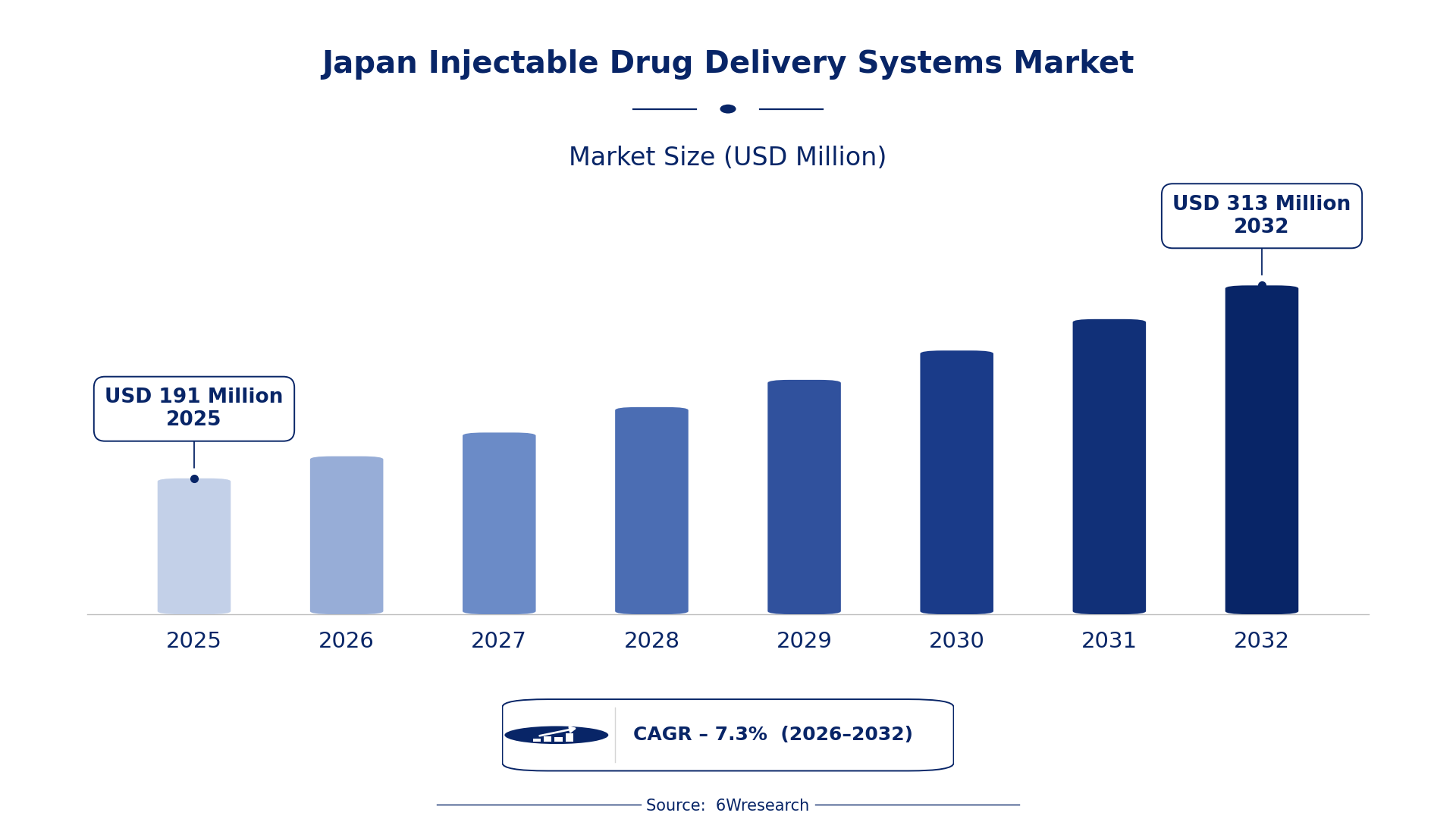
According to 6Wresearch internal database and industry insights, the Japan Injectable Drug Delivery Systems Market was valued at USD 191 Million in 2025 and is projected to reach USD 313 Million by 2032, growing at a CAGR of approximately 7.3% during 2026–2032.
Japan Injectable Drug Delivery Systems Market Highlights
| Report Metric | Details |
| Report Name | Japan Injectable Drug Delivery Systems Market (2026-2032) |
| Market Size 2025 | USD 191 Million |
| Market Size 2032 | USD 313 Million |
| Absolute Growth 2025–2032 | USD 122 Million |
| CAGR 2026–2032 | 7.3% |
| Peak Annual Growth | 8.1% in 2030 |
| Forecast Period | 2026–2032 |
| Historical Data | 2022–2025 |
| Base Year | 2025 |
| Leading System Type, 2025 | Prefilled Syringes (45% share) |
| Leading Device Design, 2025 | Disposable (42% share) |
| Leading Application Area, 2025 | Chronic Diseases (39% share) |
| Leading Drug Stability, 2025 | Biologics (35% share) |
| Leading End User, 2025 | Hospitals (46% share) |
| Fastest-Growing System Type | Wearable Injectors (10.7% CAGR) |
| Fastest-Growing Device Design | On-body Delivery (9.5% CAGR) |
| Fastest-Growing Drug Stability | Continuous Release (9.7% CAGR) |
| Fastest-Growing End User | Homecare (9.9% CAGR) |
| Growing Sector | Chronic Diseases |
| Key End Users | Hospitals, Clinics, Homecare, Specialty Pharmacies |
Japan Injectable Drug Delivery Systems Market Year-wise Growth Rate and Key Drivers (2022–2032)
This graph illustrates the annual growth rates of the market from 2022 to 2032, highlighting a steady upward trajectory and projected market expansion over the forecast period.
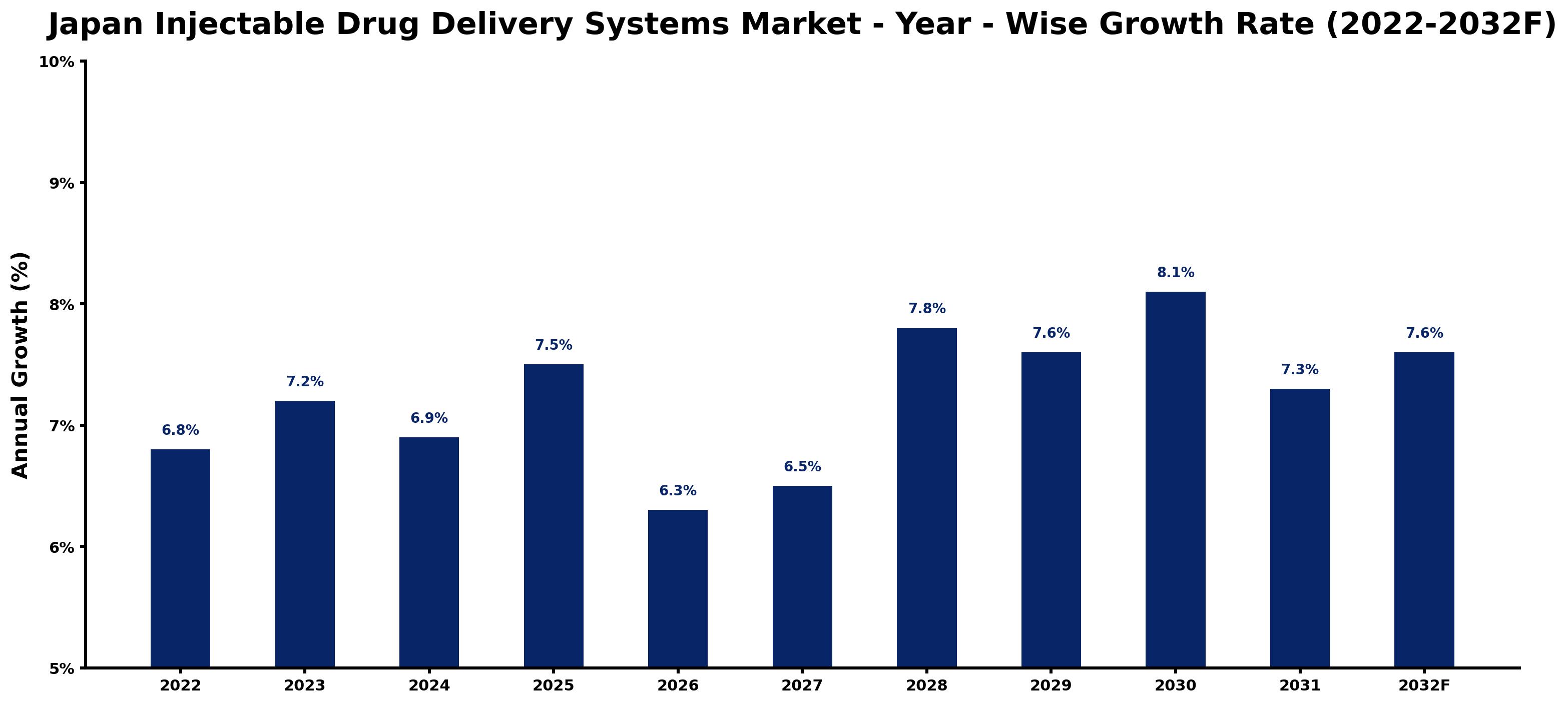
Each row of the following table gives one year's estimated growth and the event or demand shift that explains it.
| Year | Estimated Annual Growth (%) | Market Rationale |
| 2022 | 6.8 | The market experienced steady growth, supported by an increase in healthcare spending. |
| 2023 | 7.2 | Demand rose as the population aged, particularly impacting chronic disease management. |
| 2024 | 6.9 | Growth slowed slightly due to market saturation in certain segments, yet remained positive. |
| 2025 | 7.5 | The market peaked as hospitals expanded their use of advanced delivery systems. |
| 2026 | 6.3 | A slowdown is expected as new product introductions face regulatory delays. |
| 2027 | 6.5 | Growth is projected to resume as healthcare infrastructure improvements take effect. |
| 2028 | 7.8 | Demand is expected to surge with rising diabetes cases, boosting pen and auto-injector usage. |
| 2029 | 7.6 | Growth is projected to slow slightly as competition intensifies among delivery system manufacturers. |
| 2030 | 8.1 | The market is expected to peak again as new technologies gain traction in hospitals. |
| 2031 | 7.3 | A slowdown is projected as the market stabilises after rapid technological adoption. |
| 2032 | 7.6 | Demand is expected to increase as patient preferences shift towards more convenient delivery methods. |
Note: Market size estimations and growth projections presented in this report are based on 6Wresearch's proprietary forecasting methodology, utilizing the latest available industry data, government publications, and primary research inputs.
Japan Injectable Drug Delivery Systems Market Synopsis
Injectable Drug Delivery Systems are advanced medical devices designed to administer drugs directly into the body via injection, commonly used for managing chronic diseases, emergency medications, and hormone therapies. The Japan Injectable Drug Delivery Systems Market is expanding due to a growing elderly population of approximately 126 million and a rise in diabetes patients, exceeding 10 million in 2023. The Tokyo region leads healthcare innovation, while government initiatives to improve digital health technologies in hospitals drive further demand for these devices.
Market Dynamics Impact Analysis (2026–2032)
| Factor | Type | Impact | Primary Segment Affected |
| Rising elderly population increases the need for chronic disease management solutions. | Driver | High | Chronic Diseases |
| Growing prevalence of diabetes drives demand for pen injectors and auto-injectors. | Driver | High | Diabetes |
| Increased funding for healthcare infrastructure improves access to injectable systems in rural areas. | Opportunity | High | Hospitals |
| Technological advancements in drug delivery systems create new market segments. | Opportunity | Medium | Wearable Injectors |
| Regulatory hurdles can delay the introduction of innovative products. | Restraint | High | Auto-Injectors |
| Market saturation in certain segments limits growth potential for existing products. | Restraint | Medium | Prefilled Syringes |
| High competition among manufacturers pressures pricing and profit margins. | Challenge | High | Pen Injectors |
| Technological integration challenges can hinder market entry for new players. | Challenge | Medium | Wearable Injectors |
Evaluation of Drivers in Japan Injectable Drug Delivery Systems Market (2026–2032)
Demand rests on the following drivers, each shown with the segment it touches most.
| Drivers | Primary Segment Affected | Why It Matters (Evidence) |
| Increasing healthcare expenditure supports the adoption of advanced medical devices. | Hospitals | Japan's healthcare expenditure reached approximately 42 trillion yen in 2023, leading to higher investments in injectable systems. |
| Rising diabetes prevalence drives the need for effective insulin delivery solutions. | Diabetes | With over 10 million diabetes patients in Japan, demand for pen injectors has surged. |
| Government initiatives promote the adoption of digital health technologies in hospitals. | Clinics | In 2023, the government launched a program aimed at improving digital health technologies, increasing demand for injectable systems. |
| Growing focus on patient safety leads to a preference for disposable devices. | Disposable | The Japanese healthcare system prioritises safety, driving the use of single-use devices. |
| Technological advancements in biologics necessitate sophisticated delivery systems. | Biologics | The surge in biologics usage requires advanced injectable systems for precise drug delivery. |
Buyers are adding capacity as Japan's healthcare expenditure reached approximately 42 trillion yen in 2023, prompting hospitals to invest in advanced medical devices. The rising prevalence of diabetes, with over 10 million patients reported in 2023, boosts demand for pen injectors. An emphasis on patient safety drives the preference for disposable devices, ensuring higher sales volumes. The surge in biologics usage necessitates advanced injectable systems for precise drug delivery, creating new opportunities for manufacturers.
Evaluation of Restraints in Japan Injectable Drug Delivery Systems Market
The table below lists the restraints and the evidence behind each.
| Market Restraint | Primary Segment Affected | Why It Matters (Evidence) |
| Regulatory hurdles can delay product approvals, impacting market entry. | Auto-Injectors | The PMD Act regulates the approval process, which can prolong time to market for new devices. |
| Market saturation limits growth potential for established products. | Prefilled Syringes | With widespread adoption, growth in this segment has begun to plateau, reducing overall market expansion. |
| High competition among manufacturers pressures pricing and profit margins. | Pen Injectors | Intense competition leads to price wars, affecting profitability for suppliers. |
| Limited awareness of new technologies can slow adoption rates. | Wearable Injectors | Despite advancements, many healthcare providers remain hesitant to adopt wearable injectors. |
| Complexity of integration with existing healthcare systems can hinder uptake. | Biologics | Challenges in integrating new delivery systems with current practices can delay implementation. |
Japan Injectable Drug Delivery Systems Market Challenges
Healthcare buyers face a skills shortage in the medical device sector, as a declining workforce reduces the pool of qualified technicians, leading to production delays that can reach six months. Rising material costs, driven by global supply chain issues, inflate prices for injectable systems, impacting healthcare buyers who must manage these increased expenses. Technological advancements often outpace regulatory updates, causing compliance delays that can extend product launch timelines by up to two years, restricting options for clinics and patients. Additionally, the increasing complexity of drug delivery systems requires more extensive training for healthcare staff, further straining resources in hospitals.
Trends in the Japan Injectable Drug Delivery Systems Market
Below are the shifts with the largest effect on the Japan Injectable Drug Delivery Systems Market.
- Shift from Traditional to Advanced Delivery Systems: The Japanese healthcare sector is transitioning towards advanced injectable systems, as evidenced by the increasing use of biologics. In 2023, the adoption of prefilled syringes rose significantly, reflecting this trend as hospitals seek more efficient drug delivery methods.
- Rising Demand for Disposable Devices: The preference for disposable injectable systems has surged, particularly in hospitals. In 2023, disposable devices accounted for 42% of the market, driven by a focus on patient safety and infection control.
- Increased Focus on Digital Health Technologies: The healthcare sector is evolving with a growing emphasis on digital health technologies. In 2023, the government launched a program to improve these technologies in hospitals, promoting the integration of new drug delivery systems.
- Emergence of Homecare Solutions: Homecare solutions are gaining traction as patients seek convenience in drug administration. In 2023, the number of patients using auto-injectors at home increased, reflecting a shift towards self-administration.
Investment Opportunities in the Japan Injectable Drug Delivery Systems Market
Where to invest in the Japan Injectable Drug Delivery Systems Market: the main openings are set out below.
- Timing for Investment in Digital Health: With the government's recent program to improve digital health technologies, now is an opportune time to invest in drug delivery systems. Hospitals are increasingly seeking these solutions to improve patient care.
- Supply of Advanced Biologics Delivery Systems: The rising use of biologics presents a significant opportunity for suppliers of advanced injectable systems. Hospitals are looking for effective delivery methods to manage complex treatments.
- Focus on Rural Healthcare Infrastructure: The government's funding for healthcare infrastructure improvements in rural areas creates opportunities for suppliers. Partnering with local healthcare providers can facilitate market entry.
- Entry into Homecare Market: The growing trend of self-administration in homecare solutions offers a lucrative opportunity. Establishing joint ventures with homecare service providers can improve market access.
Government Initiatives in the Japan Injectable Drug Delivery Systems Market
The NHI drug price standard, revised regularly, sets reimbursement prices for injectable systems, ensuring affordability for buyers. The PMD Act regulates the approval and quality of medical devices, impacting how producers develop and market their products.
The Pharmaceuticals and Medical Devices Agency (PMDA) reviews and approves new injectable systems, ensuring they meet safety standards. The Japan Agency for Medical Research and Development (AMED) funds research, supporting advancements in drug delivery technologies.
Future Insight of the Japan Injectable Drug Delivery Systems Market
By 2032, a government initiative will drive the integration of digital health technologies, enhancing the efficiency of injectable drug delivery systems in patient care. Increased funding for healthcare infrastructure will improve access to injectable systems, particularly in rural areas, benefiting patients who previously faced challenges. The rise of advanced injectors is expected to streamline chronic disease management, providing patients with more convenient treatment options. In 2023, Japan's healthcare expenditure reached approximately 42 trillion yen, reflecting a commitment to advancing medical technologies and improving patient outcomes.
Market Segmentation Analysis
Japan Injectable Drug Delivery Systems Market report covers a detailed analysis of the following market segments:
By System Type – Prefilled Syringes Lead, Wearable Injectors Expected to Grow Fastest
According to Saurav Kr Singh, Senior Research Analyst at 6Wresearch, Prefilled Syringes held 45% of the Japan Injectable Drug Delivery Systems Market by system type in 2025. Prefilled syringes dominate the market because they are extensively utilised for vaccines and biologics, which are essential in Japan's healthcare system. Their widespread adoption in over 8,000 hospitals across the country ensures consistent demand, particularly for managing chronic diseases. Wearable Injectors are projected to grow fastest, at a CAGR of 10.7% during 2026–2032. Wearable injectors are experiencing rapid growth as they offer the capability for continuous drug delivery, addressing the needs of patients with chronic conditions. The ongoing advancements in technology are likely to further boost their integration into healthcare practices. This trend indicates that suppliers should focus on enhancing their offerings of wearable injectors to meet the rising demand for continuous delivery systems.
By Device Design – Disposable Leads, On-body Delivery Expected to Grow Fastest
In 2025, Disposable led the device design split with a 42% share. Disposable devices are preferred in Japan as they ensure safety and prevent contamination, making them the standard choice in healthcare settings. Their widespread use in hospitals highlights the importance of infection control and patient safety in medical practices. Over 2026–2032, On-body Delivery is expected to post the fastest growth, at a CAGR of 9.5%. On-body delivery systems are emerging as a key technology for chronic disease management, allowing for convenient self-administration of medications. The rising incidence of chronic diseases is anticipated to fuel the growth of this segment in the coming years. Manufacturers should focus on advancing on-body delivery systems to meet the growing needs of chronic disease management.
By Application Area – Chronic Diseases Lead and Record the Fastest Growth
Chronic Diseases accounted for 39% of the market by application area in 2025. Chronic diseases represent the largest application area for injectable drug delivery systems, reflecting the need for long-term treatment solutions in Japan's ageing population. This segment's significance is underscored by the increasing number of patients requiring ongoing therapy. Chronic Diseases are also forecast to expand faster than any other category, at a CAGR of 8.9% over 2026–2032. The chronic diseases segment is also the fastest-growing area, driven by the rising incidence of conditions that require consistent management. The ongoing healthcare initiatives to improve access to treatment will further accelerate this growth. Stakeholders should prioritise chronic disease solutions to align with the expanding market opportunities in this area.
By Drug Stability – Biologics Lead, Continuous Release Expected to Grow Fastest
With 35% of drug stability revenue in 2025, Biologics was the largest category. Biologics lead the market as they are essential for complex drug formulations that require precise delivery mechanisms. Their critical role in treating various conditions ensures a steady demand within the healthcare system. The quickest growth will come from Continuous Release, forecast to expand at a CAGR of 9.7% between 2026 and 2032. Continuous release systems are becoming increasingly important for therapies that require sustained drug delivery, reflecting a shift towards more effective treatment modalities. This trend is likely to gain momentum as healthcare providers seek better patient outcomes. Suppliers must focus on developing continuous release technologies to meet the evolving needs of healthcare providers.
By End User – Hospitals Lead, Homecare Expected to Grow Fastest
The largest end user category in 2025 was Hospitals, at 46% of revenue. Hospitals are the primary end users of injectable drug delivery systems, utilising them extensively for patient care in various treatment scenarios. The high volume of patients treated in over 8,000 hospitals across Japan underscores this segment's dominance. Homecare is projected to grow fastest, at a CAGR of 9.9% during 2026–2032. Homecare is emerging as a rapidly growing segment due to the increasing trend of self-administration among patients, particularly for chronic conditions. This shift reflects a broader movement towards patient empowerment in healthcare. Providers should explore partnerships with homecare services to tap into the growing demand for self-administration solutions.
Key Attractiveness of the Report
- 10 Years of Market Numbers
- Historical Data Starting from 2022 to 2025
- Base Year 2025
- Forecast Data until 2032
- Key Performance Indicators Impacting the Market
- Major Upcoming Developments and Projects
Key Highlights of the Report:
- Japan Injectable Drug Delivery Systems Market Outlook
- Market Size of Japan Injectable Drug Delivery Systems Market, 2025
- Forecast of Japan Injectable Drug Delivery Systems Market, 2032
- Historical Data and Forecast of Japan Injectable Drug Delivery Systems Revenues & Volume for the Period 2022-2032F
- Japan Injectable Drug Delivery Systems Market Trend Evolution
- Japan Injectable Drug Delivery Systems Market Drivers and Challenges
- Japan Injectable Drug Delivery Systems Price Trends
- Japan Injectable Drug Delivery Systems Porter's Five Forces
- Japan Injectable Drug Delivery Systems Industry Life Cycle
- Historical Data and Forecast of Japan Injectable Drug Delivery Systems Market Revenues & Volume By System Type for the Period 2022-2032F
- Historical Data and Forecast of Japan Injectable Drug Delivery Systems Market Revenues & Volume By Prefilled Syringes for the Period 2022-2032F
- Historical Data and Forecast of Japan Injectable Drug Delivery Systems Market Revenues & Volume By Auto-Injectors for the Period 2022-2032F
- Historical Data and Forecast of Japan Injectable Drug Delivery Systems Market Revenues & Volume By Pen Injectors for the Period 2022-2032F
- Historical Data and Forecast of Japan Injectable Drug Delivery Systems Market Revenues & Volume By Wearable Injectors for the Period 2022-2032F
- Historical Data and Forecast of Japan Injectable Drug Delivery Systems Market Revenues & Volume By Device Design for the Period 2022-2032F
- Historical Data and Forecast of Japan Injectable Drug Delivery Systems Market Revenues & Volume By Disposable for the Period 2022-2032F
- Historical Data and Forecast of Japan Injectable Drug Delivery Systems Market Revenues & Volume By Single-Use for the Period 2022-2032F
- Historical Data and Forecast of Japan Injectable Drug Delivery Systems Market Revenues & Volume By Reusable for the Period 2022-2032F
- Historical Data and Forecast of Japan Injectable Drug Delivery Systems Market Revenues & Volume By On-body Delivery for the Period 2022-2032F
- Historical Data and Forecast of Japan Injectable Drug Delivery Systems Market Revenues & Volume By Application Area for the Period 2022-2032F
- Historical Data and Forecast of Japan Injectable Drug Delivery Systems Market Revenues & Volume By Chronic Diseases for the Period 2022-2032F
- Historical Data and Forecast of Japan Injectable Drug Delivery Systems Market Revenues & Volume By Emergency Medication for the Period 2022-2032F
- Historical Data and Forecast of Japan Injectable Drug Delivery Systems Market Revenues & Volume By Hormone Therapy for the Period 2022-2032F
- Historical Data and Forecast of Japan Injectable Drug Delivery Systems Market Revenues & Volume By Cancer, Diabetes for the Period 2022-2032F
- Historical Data and Forecast of Japan Injectable Drug Delivery Systems Market Revenues & Volume By Drug Stability for the Period 2022-2032F
- Historical Data and Forecast of Japan Injectable Drug Delivery Systems Market Revenues & Volume By Biologics for the Period 2022-2032F
- Historical Data and Forecast of Japan Injectable Drug Delivery Systems Market Revenues & Volume By Long-Term Storage for the Period 2022-2032F
- Historical Data and Forecast of Japan Injectable Drug Delivery Systems Market Revenues & Volume By Temp-Controlled for the Period 2022-2032F
- Historical Data and Forecast of Japan Injectable Drug Delivery Systems Market Revenues & Volume By Continuous Release for the Period 2022-2032F
- Historical Data and Forecast of Japan Injectable Drug Delivery Systems Market Revenues & Volume By End User for the Period 2022-2032F
- Historical Data and Forecast of Japan Injectable Drug Delivery Systems Market Revenues & Volume By Hospitals for the Period 2022-2032F
- Historical Data and Forecast of Japan Injectable Drug Delivery Systems Market Revenues & Volume By Clinics for the Period 2022-2032F
- Historical Data and Forecast of Japan Injectable Drug Delivery Systems Market Revenues & Volume By Homecare for the Period 2022-2032F
- Historical Data and Forecast of Japan Injectable Drug Delivery Systems Market Revenues & Volume By Specialty Pharmacies for the Period 2022-2032F
- Japan Injectable Drug Delivery Systems Import Export Trade Statistics
- Market Opportunity Assessment By System Type
- Market Opportunity Assessment By Device Design
- Market Opportunity Assessment By Application Area
- Market Opportunity Assessment By Drug Stability
- Market Opportunity Assessment By End User
- Japan Injectable Drug Delivery Systems Top Companies Market Share
- Japan Injectable Drug Delivery Systems Competitive Benchmarking By Technical and Operational Parameters
- Japan Injectable Drug Delivery Systems Company Profiles
- Japan Injectable Drug Delivery Systems Key Strategic Recommendations
Market Covered
This report examines the market across the segments below.
By System Type
- Prefilled Syringes
- Auto-Injectors
- Pen Injectors
- Wearable Injectors
By Device Design
- Disposable
- Single-Use
- Reusable
- On-body Delivery
By Application Area
- Chronic Diseases
- Emergency Medication
- Hormone Therapy
- Cancer
- Diabetes
By Drug Stability
- Biologics
- Long-Term Storage
- Temp-Controlled
- Continuous Release
By End User
- Hospitals
- Clinics
- Homecare
- Specialty Pharmacies































