Japan Injection Molding Plastics Market Size & Growth Rate
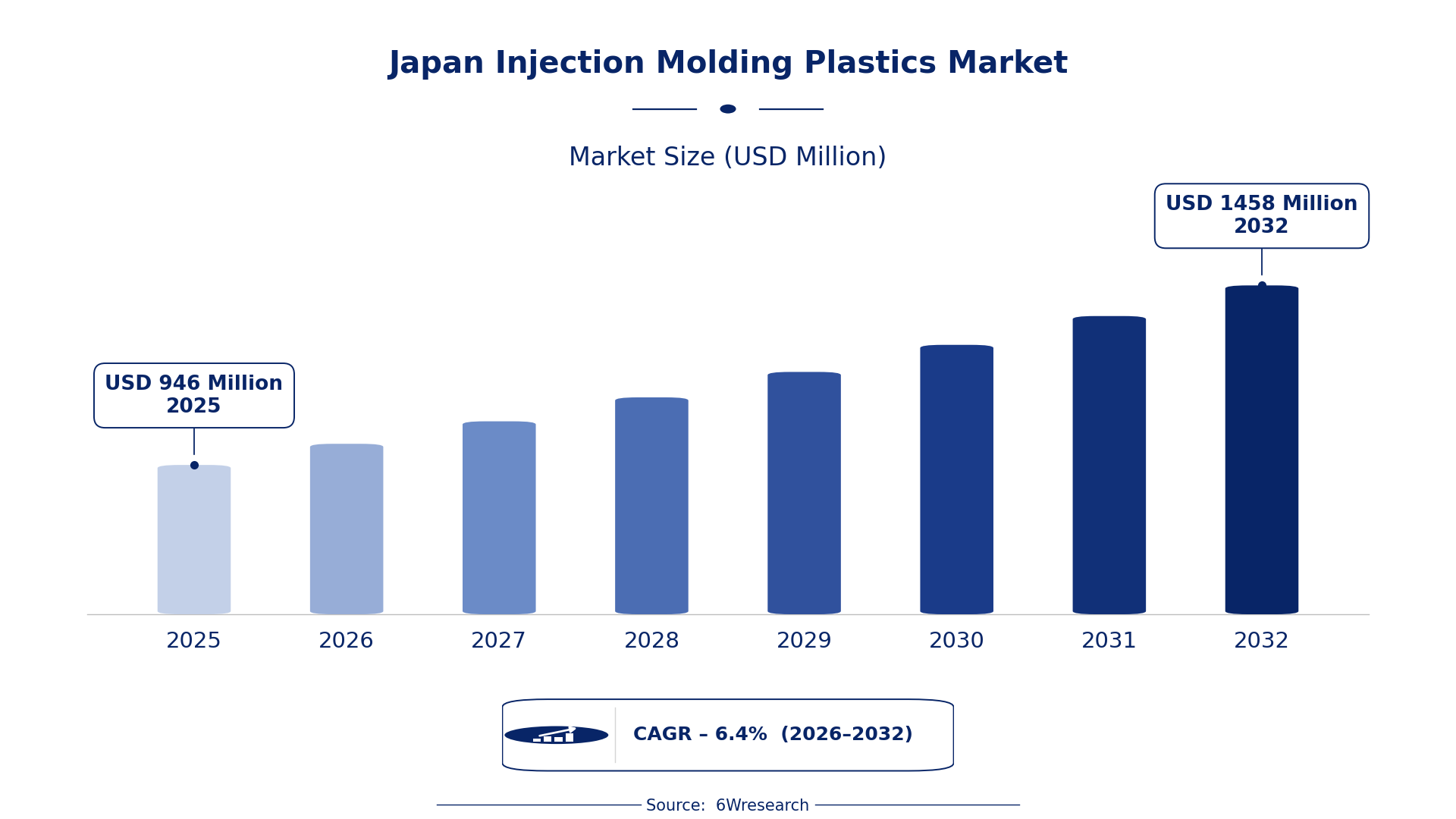
According to 6Wresearch internal database and industry insights, the Japan Injection Molding Plastics Market was valued at USD 946 Million in 2025 and is projected to reach USD 1,458 Million by 2032, growing at a CAGR of approximately 6.4% during 2026–2032.
Japan Injection Molding Plastics Market Highlights
| Report Metric | Details |
| Report Name | Japan Injection Molding Plastics Market (2026-2032) |
| Market Size 2025 | USD 946 Million |
| Market Size 2032 | USD 1,458 Million |
| Absolute Growth 2025–2032 | USD 512 Million |
| CAGR 2026–2032 | 6.4% |
| Peak Annual Growth | 7.3% in 2028 |
| Forecast Period | 2026–2032 |
| Historical Data | 2022–2025 |
| Base Year | 2025 |
| Leading Polymer Type, 2025 | Polypropylene (PP) (52% share) |
| Leading End Use Industry, 2025 | Automotive (42% share) |
| Leading Processing Type, 2025 | Thermoplastic (42% share) |
| Leading Application Type, 2025 | Car Bumpers (41% share) |
| Leading Mold Cycle Time, 2025 | Fast (48% share) |
| Fastest-Growing Polymer Type | HDPE (9.2% CAGR) |
| Fastest-Growing End Use Industry | Medical Devices (8.3% CAGR) |
| Fastest-Growing Application Type | Syringes (9.7% CAGR) |
| Fastest-Growing Mold Cycle Time | High-Speed (8.4% CAGR) |
| Growing Sector | Medical Devices |
| Key End Users | Automotive, Electronics, Packaging, Medical Devices |
Japan Injection Molding Plastics Market Year-wise Growth Rate and Key Drivers (2022–2032)
This graph illustrates the annual growth rates of the market from 2022 to 2032, highlighting a steady upward trajectory and projected market expansion over the forecast period.
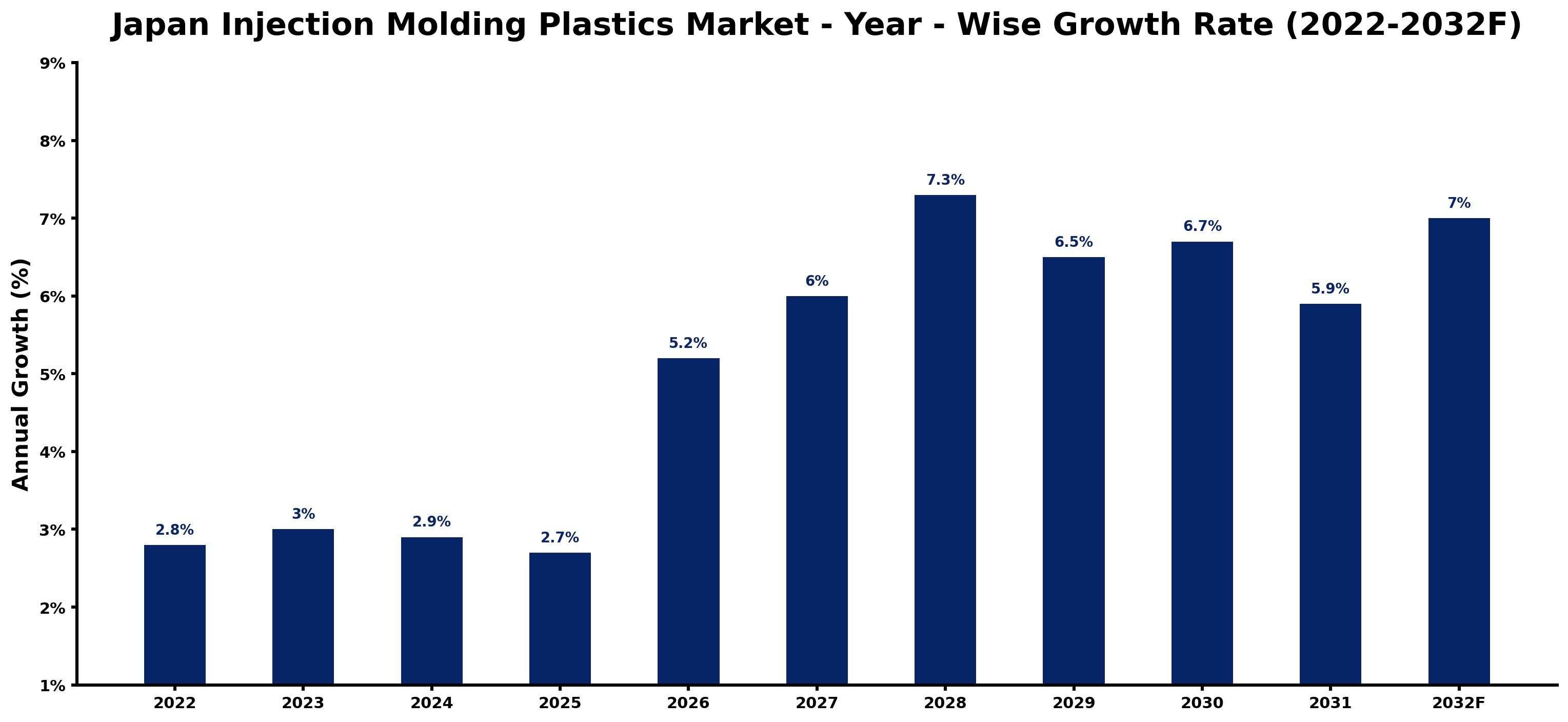
Year by year, the estimates below pair each growth rate with the development that shaped it.
| Year | Estimated Annual Growth (%) | Market Rationale |
| 2022 | 2.8 | The market showed steady growth, driven by consistent demand from various sectors. |
| 2023 | 3.0 | Growth accelerated as the automotive industry increased its reliance on injection molding plastics. |
| 2024 | 2.9 | A slight slowdown occurred as the market adjusted to previous high growth rates. |
| 2025 | 2.7 | Demand continued to grow, albeit at a slower pace due to market saturation. |
| 2026 | 5.2 | Growth is expected to resume as investments in lightweight materials surge in the automotive sector. |
| 2027 | 6.0 | The market is projected to expand further, supported by rising demand in medical devices and packaging. |
| 2028 | 7.3 | A peak in growth is anticipated, driven by technological advancements in production processes. |
| 2029 | 6.5 | Growth is expected to slow slightly as the market stabilises after reaching peak levels. |
| 2030 | 6.7 | Demand is projected to increase again, supported by ongoing investments in sustainable practices. |
| 2031 | 5.9 | A modest slowdown is expected as the market adjusts to new regulations. |
| 2032 | 7.0 | Growth is projected to rise as the focus on recycling and sustainability intensifies. |
Note: Market size estimations and growth projections presented in this report are based on 6Wresearch's proprietary forecasting methodology, utilizing the latest available industry data, government publications, and primary research inputs.
Japan Injection Molding Plastics Market Synopsis
Injection molding plastics are thermoplastic materials essential for manufacturing various products through injection molding technology. The Japan Injection Molding Plastics Market is growing due to increased investments in lightweight materials, particularly in the automotive sector, and rising demand for sustainable plastic solutions. The automotive sector accounts for 35% of the market, while the government targets a 25% reduction in plastic waste by 2030, driving further growth in the industry.
Market Dynamics Impact Analysis (2026–2032)
| Factor | Type | Impact | Primary Segment Affected |
| Increased investment in lightweight materials | Driver | High | Automotive |
| Growing demand for medical devices | Driver | High | Medical Devices |
| Emerging opportunities in sustainable packaging | Opportunity | High | Packaging |
| Expansion of the electronics sector | Opportunity | Medium | Electronics |
| Regulatory pressures on plastic waste management | Restraint | High | Polypropylene (PP) |
| Market saturation in automotive applications | Restraint | Medium | Automotive |
| Challenges in adapting to new sustainability regulations | Challenge | High | Polypropylene (PP) |
| Competition from alternative materials | Challenge | Medium | Polypropylene (PP) |
Evaluation of Drivers in Japan Injection Molding Plastics Market (2026–2032)
The table below links each growth driver to the segment it affects and the evidence for it.
| Drivers | Primary Segment Affected | Why It Matters (Evidence) |
| Investment in lightweight materials | Automotive | The automotive industry is expected to invest heavily in lightweight materials, driving demand for injection molding plastics, with a projected investment of billions by 2025. |
| Growing demand for medical devices | Medical Devices | The medical devices sector is projected to grow, increasing the need for injection molded components, with over 500 registered manufacturers in Japan. |
| Expansion of the packaging industry | Packaging | The packaging industry is a key driver, with a significant share of injection molding plastics used for various solutions, contributing to substantial market growth. |
| Advancements in production technology | Polypropylene (PP) | Improvements in injection molding technology enhance efficiency, leading to increased production rates and lower costs, benefiting manufacturers across sectors. |
| Shift towards sustainable practices | Polypropylene (PP) | The push for sustainable practices in manufacturing is driving demand for biodegradable and recyclable injection molding plastics, aligning with government targets for waste reduction. |
Spending rises as the automotive industry invests heavily in lightweight materials, with projections exceeding billions by 2025. This investment fuels demand for injection molding plastics, particularly for automotive parts. The medical devices sector is also growing, with over 500 registered manufacturers heightening the need for injection molded components. The packaging industry contributes significantly, utilising a large share of injection molding plastics for various applications, thus further increasing demand.
Evaluation of Restraints in Japan Injection Molding Plastics Market
The main factors holding the market back are set out below.
| Market Restraint | Primary Segment Affected | Why It Matters (Evidence) |
| Outdated technology limits efficiency | Automotive | Producers face increased production time due to reliance on older machinery, impacting overall output and costs. |
| Compliance costs from regulations | Packaging | Strict regulations under the Food Sanitation Act impose additional costs on manufacturers, delaying product launches. |
| Long lead times for medical devices | Medical Devices | The average lifespan of injection molds, around 5-10 years, results in longer lead times for buyers. |
| Market saturation in automotive | Automotive | As the market matures, growth rates are slowing, affecting investment decisions and production planning. |
| Cost pressures from raw materials | Packaging | Fluctuations in raw material prices increase costs for manufacturers, impacting profitability and pricing strategies. |
Japan Injection Molding Plastics Market Challenges
Japan produced 1.5 million tons of injection molding plastics in 2022, yet outdated technology leads to inefficiencies, causing delays for producers. Rising costs emerge as the automotive sector, accounting for 35% of the market, requires manufacturers to invest in modern machinery to stay competitive. Strict regulations under the Food Sanitation Act impose financial burdens on producers, resulting in delayed product launches for buyers in the food packaging sector. Buyers in the medical devices market experience longer lead times due to the average lifespan of injection molds, which is around 5-10 years, complicating their supply chain management.
Trends in the Japan Injection Molding Plastics Market
Four trends stand out in the Japan Injection Molding Plastics Market.
- Shift towards Sustainable Plastics: Japan is increasingly adopting sustainable practices in the injection molding sector, as manufacturers explore biodegradable materials, aligning with the target to reduce plastic waste by 25% by 2030. This change follows the government's 2023 programme to support sustainable plastic use.
- Transition from Traditional to Advanced Technologies: The injection molding industry is moving towards advanced technologies, such as high-speed molding processes, which began gaining traction in 2023. This change improves efficiency and production capabilities, allowing manufacturers to meet demand more effectively.
- Emergence of Biodegradable Materials: The trend towards biodegradable materials is gaining momentum, with manufacturers focusing on eco-friendly options. This shift is supported by the Plastic Resource Circulation Act, promoting alternatives that align with sustainability goals and consumer preferences.
- Increased Investment in Medical Devices: Investment in the medical devices sector is rising, particularly in injection molded components, which started in 2023. This trend is driven by the growing need for high-quality medical products, supported by over 500 registered manufacturers in Japan.
Investment Opportunities in the Japan Injection Molding Plastics Market
The following areas offer the clearest openings for investors and suppliers in the Japan Injection Molding Plastics Market.
- Timing for Sustainable Solutions: With the government's target to reduce plastic waste by 25% by 2030, there is an opportunity for suppliers of biodegradable injection molding plastics. Collaborating with local manufacturers can facilitate market entry and compliance with new regulations.
- Investment in Lightweight Automotive Parts: The automotive industry's projected investment of billions in lightweight materials presents an opportunity for suppliers of injection molding plastics. Focusing on partnerships with automotive manufacturers can strengthen market presence.
- Growth in Medical Device Manufacturing: The projected growth of the medical devices sector by 2025 creates opportunities for injection molding plastics suppliers. Engaging with medical device manufacturers can lead to increased sales and market share.
- Expansion in Packaging Solutions: The packaging industry's ongoing expansion offers a chance for suppliers of injection molding plastics to meet rising demand. Establishing connections with packaging companies can facilitate entry into this promising market.
Government Initiatives in the Japan Injection Molding Plastics Market
The Plastic Resource Circulation Act, revised in 2021, promotes the reduction, reuse, and recycling of plastics. This law mandates that manufacturers adopt sustainable practices, ensuring compliance with environmental standards and encouraging innovation in materials. The act targets a 25% reduction in plastic waste by 2030, benefiting both producers and consumers.
In 2023, the government allocated funding of $100 million to support sustainable plastic initiatives, administered by the Ministry of the Environment. This programme aims to facilitate research and development in biodegradable materials, benefiting manufacturers and promoting eco-friendly practices.
Future Insight of the Japan Injection Molding Plastics Market
A recent policy shift will encourage sustainable practices in the injection molding sector, prompting suppliers to explore eco-friendly materials. By 2032, the automotive industry will channel investments into lightweight materials, improving product offerings for buyers. The medical devices sector will see substantial growth, boosting demand for high-quality injection molding plastics. New standards from the Japan Standards Association will provide suppliers with clearer guidelines to meet buyer expectations.
Market Segmentation Analysis
Japan Injection Molding Plastics Market report covers a detailed analysis of the following market segments:
By Polymer Type – Polypropylene (PP) Leads, HDPE Expected to Grow Fastest
According to Saurav Kr Singh, Senior Research Analyst at 6Wresearch, the largest polymer type category in 2025 was Polypropylene (PP), at 52% of revenue. Polypropylene is the most widely used polymer in Japan due to its extensive applications in automotive and packaging sectors. Its cost-effectiveness and adaptability make it a preferred choice among manufacturers in regions with significant automotive activity. Over 2026–2032, HDPE is expected to post the fastest growth, at a CAGR of 9.2%. High-density polyethylene is rapidly gaining traction because of its significant use in containers and bottles, with increasing consumer preference for eco-friendly packaging. The government's initiative to reduce plastic waste by 25% by 2030 is driving this segment's growth. Suppliers should focus on sustainable production methods to meet evolving market demands.
By End Use Industry – Automotive Leads, Medical Devices Expected to Grow Fastest
Automotive accounted for 42% of the market by end use industry in 2025. The automotive industry is the largest end user of injection molding plastics in Japan, driven by the high demand for plastic components in vehicles. This sector's prominence is particularly evident in industrial regions like Aichi, where automotive manufacturing is concentrated. Medical Devices are projected to grow fastest, at a CAGR of 8.3% during 2026–2032. The medical devices sector is poised for rapid growth, primarily due to the increasing need for syringes and housings in healthcare. With over 500 registered medical device manufacturers, this sector is well-prepared for significant advancements. Buyers in the medical devices sector should prepare for intensified competition and innovation in product offerings.
By Processing Type – Thermoplastic Leads and Records the Fastest Growth
Thermoplastic took 42% of processing type revenue in 2025, more than any other category. Thermoplastic is the leading processing type for injection molding in Japan, valued for its efficiency and versatility across various applications. Its widespread use ensures a dependable supply chain that meets diverse manufacturing needs. Its lead should widen, with a projected CAGR of 9.0% during 2026–2032, the highest in this split. Thermoplastic will maintain its growth trajectory as the primary processing type, with manufacturers focused on improving production efficiency and reducing costs. The continuous demand across multiple sectors will reinforce its dominant position. Suppliers must adhere to high-quality standards to meet the rising expectations of manufacturers.
By Application Type – Car Bumpers Lead, Syringes Expected to Grow Fastest
Car Bumpers held 41% of the Japan Injection Molding Plastics Market by application type in 2025. Car bumpers are a common application in the automotive industry, driving a large share of the injection molding plastics market. The high volume of vehicles produced in Japan contributes to the sustained demand for this specific application. Syringes are set to record the highest CAGR in this split, 9.7% over 2026–2032. Syringes are experiencing rapid growth due to their critical role in medical applications, particularly as healthcare demands increase. The focus on healthcare innovation is expected to propel this segment further. Manufacturers should invest in advanced technologies to meet the rising demand for medical applications.
By Mold Cycle Time – Fast Leads, High-Speed Expected to Grow Fastest
In 2025, Fast led the mold cycle time split with a 48% share. Fast mold cycle times are essential for mass production, making this the preferred option for manufacturers in Japan. The efficiency associated with fast cycles meets the high demand for quick production turnaround in various industries. Over 2026–2032, High-Speed is expected to post the fastest growth, at a CAGR of 8.4%. High-speed mold cycle times are increasingly favoured as manufacturers seek to improve efficiency and reduce production costs. The trend towards faster production methods is likely to continue as competition intensifies. Suppliers should invest in high-speed technologies to meet the evolving needs of manufacturers.
Key Attractiveness of the Report
- 10 Years of Market Numbers
- Historical Data Starting from 2022 to 2025
- Base Year 2025
- Forecast Data until 2032
- Key Performance Indicators Impacting the Market
- Major Upcoming Developments and Projects
Key Highlights of the Report:
- Japan Injection Molding Plastics Market Outlook
- Market Size of Japan Injection Molding Plastics Market, 2025
- Forecast of Japan Injection Molding Plastics Market, 2032
- Historical Data and Forecast of Japan Injection Molding Plastics Revenues & Volume for the Period 2022-2032F
- Japan Injection Molding Plastics Market Trend Evolution
- Japan Injection Molding Plastics Market Drivers and Challenges
- Japan Injection Molding Plastics Price Trends
- Japan Injection Molding Plastics Porter's Five Forces
- Japan Injection Molding Plastics Industry Life Cycle
- Historical Data and Forecast of Japan Injection Molding Plastics Market Revenues & Volume By Polymer Type for the Period 2022-2032F
- Historical Data and Forecast of Japan Injection Molding Plastics Market Revenues & Volume By Polypropylene (PP) for the Period 2022-2032F
- Historical Data and Forecast of Japan Injection Molding Plastics Market Revenues & Volume By ABS for the Period 2022-2032F
- Historical Data and Forecast of Japan Injection Molding Plastics Market Revenues & Volume By HDPE for the Period 2022-2032F
- Historical Data and Forecast of Japan Injection Molding Plastics Market Revenues & Volume By PC/PMMA for the Period 2022-2032F
- Historical Data and Forecast of Japan Injection Molding Plastics Market Revenues & Volume By End Use Industry for the Period 2022-2032F
- Historical Data and Forecast of Japan Injection Molding Plastics Market Revenues & Volume By Automotive for the Period 2022-2032F
- Historical Data and Forecast of Japan Injection Molding Plastics Market Revenues & Volume By Electronics for the Period 2022-2032F
- Historical Data and Forecast of Japan Injection Molding Plastics Market Revenues & Volume By Packaging for the Period 2022-2032F
- Historical Data and Forecast of Japan Injection Molding Plastics Market Revenues & Volume By Medical Devices for the Period 2022-2032F
- Historical Data and Forecast of Japan Injection Molding Plastics Market Revenues & Volume By Processing Type for the Period 2022-2032F
- Historical Data and Forecast of Japan Injection Molding Plastics Market Revenues & Volume By Thermoplastic for the Period 2022-2032F
- Historical Data and Forecast of Japan Injection Molding Plastics Market Revenues & Volume By High-Pressure for the Period 2022-2032F
- Historical Data and Forecast of Japan Injection Molding Plastics Market Revenues & Volume By Cold Runner for the Period 2022-2032F
- Historical Data and Forecast of Japan Injection Molding Plastics Market Revenues & Volume By Clean Room Molding for the Period 2022-2032F
- Historical Data and Forecast of Japan Injection Molding Plastics Market Revenues & Volume By Application Type for the Period 2022-2032F
- Historical Data and Forecast of Japan Injection Molding Plastics Market Revenues & Volume By Car Bumpers, Dashboards for the Period 2022-2032F
- Historical Data and Forecast of Japan Injection Molding Plastics Market Revenues & Volume By Casings, Enclosures for the Period 2022-2032F
- Historical Data and Forecast of Japan Injection Molding Plastics Market Revenues & Volume By Bottles, Caps for the Period 2022-2032F
- Historical Data and Forecast of Japan Injection Molding Plastics Market Revenues & Volume By Syringes, Housings for the Period 2022-2032F
- Historical Data and Forecast of Japan Injection Molding Plastics Market Revenues & Volume By Mold Cycle Time for the Period 2022-2032F
- Historical Data and Forecast of Japan Injection Molding Plastics Market Revenues & Volume By Fast for the Period 2022-2032F
- Historical Data and Forecast of Japan Injection Molding Plastics Market Revenues & Volume By Medium for the Period 2022-2032F
- Historical Data and Forecast of Japan Injection Molding Plastics Market Revenues & Volume By High-Speed for the Period 2022-2032F
- Historical Data and Forecast of Japan Injection Molding Plastics Market Revenues & Volume By Sterile for the Period 2022-2032F
- Japan Injection Molding Plastics Import Export Trade Statistics
- Market Opportunity Assessment By Polymer Type
- Market Opportunity Assessment By End Use Industry
- Market Opportunity Assessment By Processing Type
- Market Opportunity Assessment By Application Type
- Market Opportunity Assessment By Mold Cycle Time
- Japan Injection Molding Plastics Top Companies Market Share
- Japan Injection Molding Plastics Competitive Benchmarking By Technical and Operational Parameters
- Japan Injection Molding Plastics Company Profiles
- Japan Injection Molding Plastics Key Strategic Recommendations
Market Covered
Segments analysed in this report are listed below.
By Polymer Type
- Polypropylene (PP)
- ABS
- HDPE
- PC/PMMA
By End Use Industry
- Automotive
- Electronics
- Packaging
- Medical Devices
By Processing Type
- Thermoplastic
- High-Pressure
- Cold Runner
- Clean Room Molding
By Application Type
- Car Bumpers
- Dashboards
- Casings
- Enclosures
- Bottles
- Caps
- Syringes
- Housings
By Mold Cycle Time
- Fast
- Medium
- High-Speed
- Sterile































