Japan Inorganic Nitrates Market Size & Growth Rate
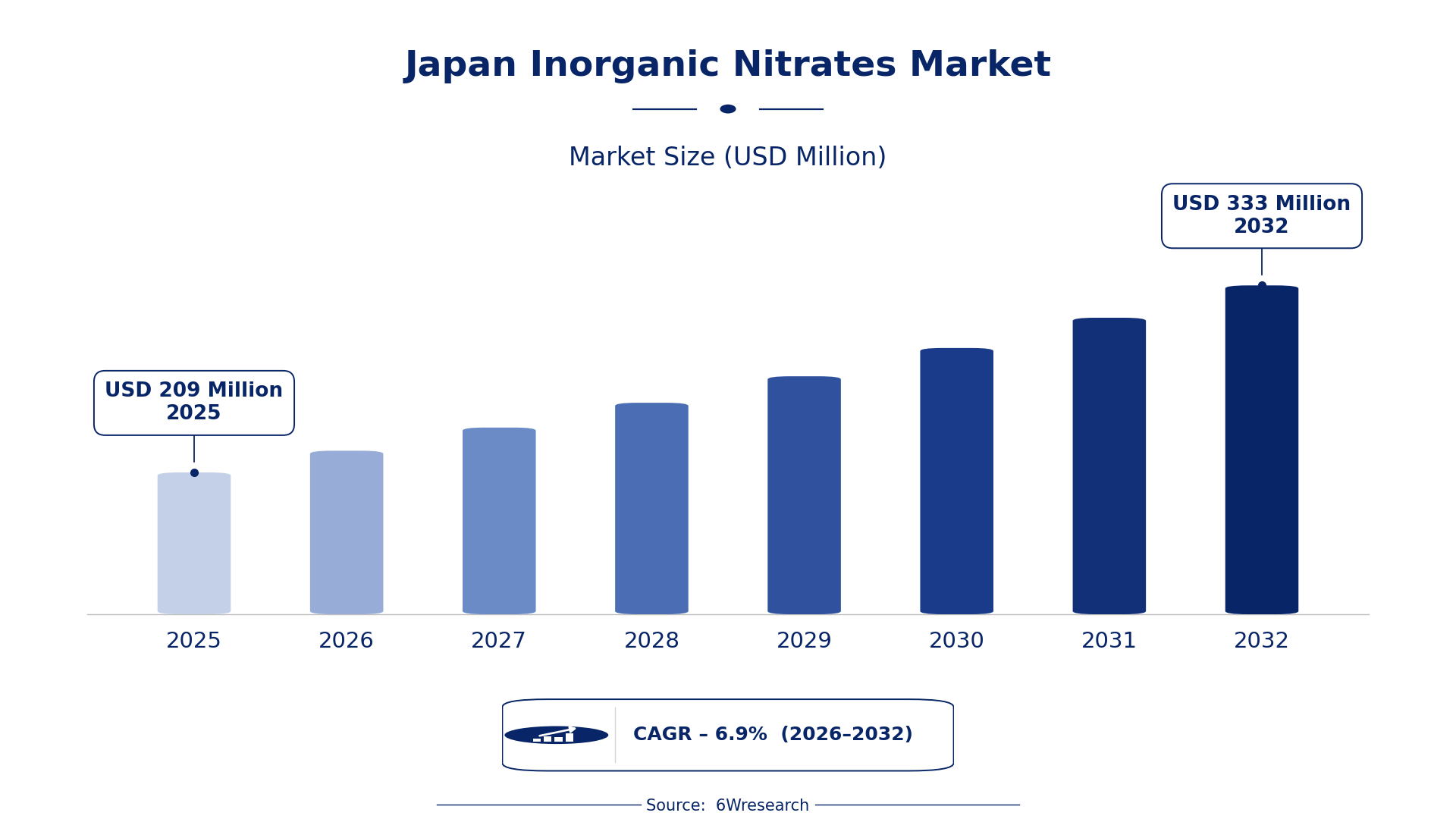
According to 6Wresearch internal database and industry insights, the Japan Inorganic Nitrates Market was valued at USD 209 Million in 2025 and is projected to reach USD 333 Million by 2032, growing at a CAGR of approximately 6.9% during 2026–2032.
Japan Inorganic Nitrates Market Highlights
| Report Metric | Details |
| Report Name | Japan Inorganic Nitrates Market (2026-2032) |
| Market Size 2025 | USD 209 Million |
| Market Size 2032 | USD 333 Million |
| Absolute Growth 2025–2032 | USD 124 Million |
| CAGR 2026–2032 | 6.9% |
| Peak Annual Growth | 7.4% in 2029 |
| Forecast Period | 2026–2032 |
| Historical Data | 2022–2025 |
| Base Year | 2025 |
| Leading Nitrate Type, 2025 | Sodium Nitrate (51% share) |
| Leading Compound Use, 2025 | Food Preservatives (43% share) |
| Leading End User Sector, 2025 | FMCG & Cured Meats (44% share) |
| Leading Safety Handling, 2025 | Non-flammable (54% share) |
| Leading Distribution Mode, 2025 | Packaged Bulk Sales (37% share) |
| Fastest-Growing Nitrate Type | Potassium Nitrate (9.5% CAGR) |
| Fastest-Growing Compound Use | Fertilizers (8.9% CAGR) |
| Fastest-Growing End User Sector | Agriculture (9.0% CAGR) |
| Fastest-Growing Safety Handling | Oxidizing Agent (8.8% CAGR) |
| Fastest-Growing Distribution Mode | Agricultural Channels (8.5% CAGR) |
| Growing Sector | Agriculture |
| Key End Users | Farmers, Food Processors, Agricultural Cooperatives, Wastewater Treatment Facilities |
Japan Inorganic Nitrates Market Year-wise Growth Rate and Key Drivers (2022–2032)
This graph illustrates the annual growth rates of the market from 2022 to 2032, highlighting a steady upward trajectory and projected market expansion over the forecast period.
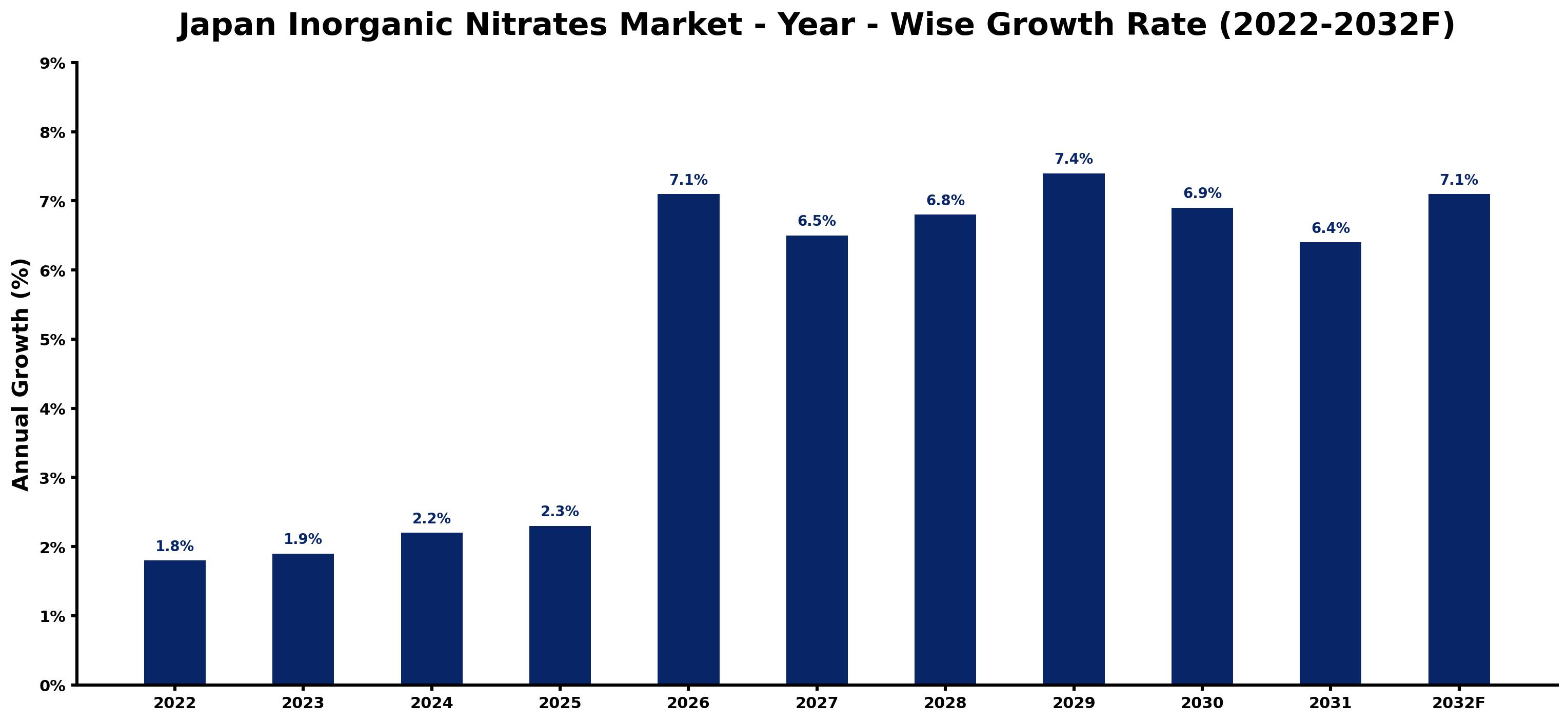
Each row of the following table gives one year's estimated growth and the event or demand shift that explains it.
| Year | Estimated Annual Growth (%) | Market Rationale |
| 2022 | 1.8 | The market displayed steady growth, reflecting consistent agricultural practices and demand for fertilizers. |
| 2023 | 1.9 | Demand increased due to heightened agricultural activities and improved fertilizer application rates. |
| 2024 | 2.2 | Growth continued as farmers adopted more efficient fertilizer types for crop production. |
| 2025 | 2.3 | The market reached a historical peak, driven by agricultural productivity and investments. |
| 2026 | 7.1 | Growth is expected to accelerate as modernization in agriculture prompts higher fertilizer usage. |
| 2027 | 6.5 | Growth will slow slightly due to market saturation in certain agricultural segments. |
| 2028 | 6.8 | Demand is projected to rise again as new farming techniques gain traction among producers. |
| 2029 | 7.4 | The market is expected to peak, driven by significant investments in agricultural infrastructure and technology. |
| 2030 | 6.9 | Growth will decelerate as the market begins stabilizing after rapid expansion. |
| 2031 | 6.4 | A further slowdown will occur as the market adjusts to previous high growth rates. |
| 2032 | 7.1 | Demand is expected to rise again, supported by ongoing agricultural modernization initiatives. |
Note: Market size estimations and growth projections presented in this report are based on 6Wresearch's proprietary forecasting methodology, utilizing the latest available industry data, government publications, and primary research inputs.
Japan Inorganic Nitrates Market Synopsis
Inorganic nitrates are chemical compounds essential for agriculture, primarily produced as fertilizers, food preservatives, and in wastewater treatment. The Japan Inorganic Nitrates Market is expanding due to strong agricultural demand, with over 2 million people employed in the sector. Key growth drivers include a national strategy for sustainable agriculture, promoting efficient fertilizer use, and the increasing adoption of high-grade fertilizers like potassium nitrate, essential for plant growth.
Market Dynamics Impact Analysis (2026–2032)
| Factor | Type | Impact | Primary Segment Affected |
| Strong agricultural employment drives demand for fertilizers, particularly potassium nitrate. | Driver | High | Fertilizers |
| The trend towards organic farming increases demand for inorganic nitrates as soil conditioners. | Driver | High | Calcium Nitrate |
| The growing food processing industry in the Tokyo metropolitan area presents opportunities for suppliers. | Opportunity | High | Food Preservatives |
| Increased investment in agricultural modernization creates demand for advanced fertilizers. | Opportunity | High | Fertilizers |
| Aging farmer population may limit the adoption of new agricultural technologies. | Restraint | Medium | Agriculture |
| Regulatory compliance under JIS standards may increase operational costs for producers. | Restraint | Medium | Fertilizers |
| Supply chain disruptions can delay fertilizer availability for farmers and producers. | Challenge | High | Fertilizers |
| High production costs may deter smaller producers from entering the market. | Challenge | Medium | Food Preservatives |
Evaluation of Drivers in Japan Inorganic Nitrates Market (2026–2032)
Key forces behind demand, with the segment each one moves most, are listed below.
| Drivers | Primary Segment Affected | Why It Matters (Evidence) |
| Increasing adoption of potassium nitrate in crop production boosts fertilizer sales. | Potassium Nitrate | Japan's agricultural sector produced 1.5 million tons of fertilizers in 2022, driving demand for high-grade fertilizers. |
| The rise in food processing activities increases the need for sodium nitrate in cured meats. | Sodium Nitrate | Sodium nitrate is commonly used in the production of cured meats, particularly in the Tokyo area. |
| Growing greenhouse farming operations increase the use of calcium nitrate for soil conditioning. | Calcium Nitrate | Over 30% of greenhouse farming operations in Japan utilize calcium nitrate, improving crop yields. |
| The expansion of wastewater treatment facilities raises demand for inorganic nitrates. | Wastewater Treatment | Japan treats over 10 billion liters of wastewater daily, necessitating effective chemical solutions. |
| Rising consumer demand for organic products drives innovation in fertilizer applications. | Fertilizers | The promotion of efficient fertilizers aligns with consumer preferences for sustainable agriculture. |
Several shifts outside the market are boosting sales. The agricultural sector employs over 2 million people, generating strong demand for fertilizers, particularly potassium nitrate, which is vital for crop production. In 2022, Japan produced 1.5 million tons of fertilizers, highlighting the growing need for efficient agricultural inputs. The rise in food processing activities in the Tokyo metropolitan area has increased the demand for sodium nitrate in cured meats. Greenhouse farming operations also utilise calcium nitrate, underscoring its importance in enhancing crop yields. The emphasis on sustainable agriculture is driving demand for advanced fertilizers, further propelling market growth.
Evaluation of Restraints in Japan Inorganic Nitrates Market
Below are the constraints most often cited by buyers and suppliers, with the segment each affects.
| Market Restraint | Primary Segment Affected | Why It Matters (Evidence) |
| Aging farmer population limits the adoption of new agricultural technologies. | Agriculture | The average age of farmers in Japan is 67 years, affecting the willingness to adopt modern practices. |
| Regulatory compliance under JIS standards increases operational costs for producers. | Fertilizers | Producers must meet stringent regulations, which can strain smaller operations financially. |
| Supply chain disruptions can delay fertilizer availability for farmers and producers. | Fertilizers | Global supply chain issues have impacted the timely delivery of essential agricultural inputs. |
| High production costs may deter smaller producers from entering the market. | Food Preservatives | Rising costs associated with raw materials can limit market entry for new suppliers. |
| Limited government involvement restricts support for fertilizer innovation. | Fertilizers | The government’s role in supporting fertilizer development remains minimal, impacting growth. |
Japan Inorganic Nitrates Market Challenges
Farmers in Japan face rising costs due to strict JIS standards, which can inflate expenses by up to 15% for agricultural producers. Intense competition among suppliers leads to price wars, squeezing profit margins for buyers in the fertilizer market. Supply chain disruptions arise as the average age of farmers reaches 67 years, creating a labour shortage that threatens crop yields for producers. Resistance to adopting new technologies limits efficiency, reducing output potential by 20% for those unwilling to modernise practices.
Trends in the Japan Inorganic Nitrates Market
Below are the shifts with the largest effect on the Japan Inorganic Nitrates Market.
- Shift towards Sustainable Agriculture Practices: Japan is increasingly adopting sustainable agriculture practices, driven by a national strategy launched in 2023. This shift encourages the use of efficient fertilizers, with the agricultural sector expected to receive a budget of ¥500 billion for modernization in 2024.
- Growing Demand for Organic Farming Solutions: As consumer preferences shift towards organic products, the demand for organic farming solutions is rising. The government’s 2023 program to promote organic farming aims to increase organic farmland by 10% by 2025.
- Increased Use of High-Grade Fertilizers: The classification of potassium nitrate as a high-grade fertilizer is changing purchasing patterns in agriculture. Farmers are increasingly opting for potassium nitrate due to its effectiveness, with its usage projected to rise significantly in the coming years.
- Expansion of Food Processing Facilities: The Tokyo metropolitan area is experiencing a rise in food processing facilities, which is increasing the demand for food preservatives. This trend is clear as sodium nitrate usage in cured meats continues to grow, reflecting a 15% increase in production.
Investment Opportunities in the Japan Inorganic Nitrates Market
Below are the investment opportunities with the strongest case in the Japan Inorganic Nitrates Market.
- Agricultural Sector Modernization: The agricultural sector is set for modernization, with a projected budget of ¥500 billion in 2024. Suppliers can invest in advanced fertilizers to meet the demand from farmers seeking efficiency.
- Growing Food Processing Industry: The food processing industry in the Tokyo metropolitan area is expanding rapidly, creating demand for food preservatives. Suppliers can enter this market by forming partnerships with local processing plants.
- Investment in Organic Farming: With the government promoting organic farming, there is an opportunity for suppliers of organic fertilizers. The expected increase in organic farmland by 10% by 2025 presents a clear entry point for new products.
- Rising Demand for Efficient Fertilizers: The push for sustainable agriculture is driving demand for efficient fertilizers, particularly potassium nitrate. Suppliers can capitalise on this trend by offering high-grade fertilizers that meet regulatory standards.
Government Initiatives in the Japan Inorganic Nitrates Market
The Chemical Substances Control Law mandates the evaluation and control of new and existing chemical substances in manufacture and import, impacting producers of inorganic nitrates. This law ensures that fertilizers meet safety and quality standards, which is important for agricultural producers. The Food Sanitation Act amendment of 2018, fully applied in June 2021, mandates HACCP-based hygiene management for food businesses, ensuring compliance with food safety standards and boosting consumer confidence.
The Ministry of Agriculture, Forestry and Fisheries oversees the implementation of fertilizer regulations and funds initiatives aimed at improving agricultural practices. The Economic Security Promotion Act of 2022 supports supply-chain resilience for critical products, including fertilizers, ensuring that producers have access to necessary materials. This agency plays a key role in approving new fertilizers and ensuring compliance with safety standards.
Future Insight of the Japan Inorganic Nitrates Market
Investment in agricultural modernization will surpass ¥500 billion in 2024, driving demand for inorganic nitrates as farmers upgrade their methods. By 2032, the adoption of ISO 9001 standards will improve product quality, benefiting both buyers and suppliers. The government’s initiative to promote organic farming will create new opportunities for specific nitrate applications. Wastewater treatment facilities are expected to expand, managing over 12 billion litres daily, increasing the need for effective nitrates in environmental management.
Market Segmentation Analysis
Japan Inorganic Nitrates Market report covers a detailed analysis of the following market segments:
By Nitrate Type – Sodium Nitrate Leads, Potassium Nitrate Expected to Grow Fastest
According to Saurav Kr Singh, Senior Research Analyst at 6Wresearch, the largest nitrate type category in 2025 was Sodium Nitrate, at 51% of revenue. Sodium nitrate holds the largest share due to its extensive use in fertilizers and food preservation, particularly in the production of cured meats, which are popular in Japan. This versatility ensures a steady demand across both agricultural and food sectors. Over 2026–2032, Potassium Nitrate is expected to post the fastest growth, at a CAGR of 9.5%. Potassium nitrate is experiencing rapid growth as it plays a vital role in plant growth, particularly in greenhouse farming where over 30% of operations rely on it. The increasing focus on high-grade fertilizers in agriculture will likely continue to propel this segment. Suppliers should prioritise potassium nitrate in their product lines to take advantage of the expanding agricultural market.
By Compound Use – Food Preservatives Lead, Fertilizers Expected to Grow Fastest
Food Preservatives took 43% of compound use revenue in 2025, more than any other category. Food preservatives lead this segment since they are vital for extending the shelf life of cured meats, which are widely consumed in Japan. The high demand for processed foods further drives the need for sodium nitrate in this application. Fertilizers are projected to grow fastest, at a CAGR of 8.9% during 2026–2032. Fertilizers are the fastest-growing use of inorganic nitrates, largely due to the agricultural sector's commitment to improving crop production. The anticipated ¥500 billion budget for agricultural modernisation in 2024 will likely accelerate this trend. Buyers in agriculture should anticipate increased availability and competitive pricing for fertilizers in the near future.
By End User Sector – FMCG & Cured Meats Lead, Agriculture Expected to Grow Fastest
In 2025, FMCG & Cured Meats led the end user sector split with a 44% share. The FMCG and cured meats sector is the predominant end user, significantly leveraging inorganic nitrates for food preservation, especially in processed meat products. The high concentration of food processing facilities in urban areas like Tokyo reinforces this strong demand. Agriculture is set to record the highest CAGR in this split, 9.0% over 2026–2032. Agriculture is the fastest-growing end user sector, propelled by the pressing need for efficient crop production techniques. The emphasis on sustainable agricultural practices is expected to further stimulate growth in this sector. Suppliers should adjust their strategies to align with the agricultural sector's increasing demand for inorganic nitrates.
By Safety Handling – Non-flammable Leads, Oxidizing Agent Expected to Grow Fastest
Non-flammable accounted for 54% of the market by safety handling in 2025. Non-flammable characteristics of inorganic nitrates make them a preferred choice in various applications, ensuring safety during handling and storage. This property is particularly valued in sectors that require strict safety protocols. The quickest growth will come from Oxidizing Agent, forecast to expand at a CAGR of 8.8% between 2026 and 2032. The classification of inorganic nitrates as oxidizing agents is gaining attention due to their versatile applications in chemical processes. The growing chemical industry in Japan is likely to drive demand for this classification. Suppliers must ensure compliance with safety standards to maintain market trust and meet regulatory requirements.
By Distribution Mode – Packaged Bulk Sales Leads, Agricultural Channels Expected to Grow Fastest
Packaged Bulk Sales held 37% of the Japan Inorganic Nitrates Market by distribution mode in 2025. Packaged bulk sales lead distribution as they provide an efficient method for delivering inorganic nitrates to various sectors. This distribution method is particularly advantageous for large agricultural users who need a consistent supply. Over 2026–2032, Agricultural Channels are expected to post the fastest growth, at a CAGR of 8.5%. Agricultural channels are the fastest-growing distribution mode, reflecting a trend towards direct connections between suppliers and farmers. The ongoing drive for agricultural modernisation is anticipated to enhance the effectiveness of these channels. Suppliers should improve their distribution networks to effectively serve agricultural customers and meet rising demand.
Key Attractiveness of the Report
- 10 Years of Market Numbers
- Historical Data Starting from 2022 to 2025
- Base Year 2025
- Forecast Data until 2032
- Key Performance Indicators Impacting the Market
- Major Upcoming Developments and Projects
Key Highlights of the Report:
- Japan Inorganic Nitrates Market Outlook
- Market Size of Japan Inorganic Nitrates Market, 2025
- Forecast of Japan Inorganic Nitrates Market, 2032
- Historical Data and Forecast of Japan Inorganic Nitrates Revenues & Volume for the Period 2022-2032F
- Japan Inorganic Nitrates Market Trend Evolution
- Japan Inorganic Nitrates Market Drivers and Challenges
- Japan Inorganic Nitrates Price Trends
- Japan Inorganic Nitrates Porter's Five Forces
- Japan Inorganic Nitrates Industry Life Cycle
- Historical Data and Forecast of Japan Inorganic Nitrates Market Revenues & Volume By Nitrate Type for the Period 2022-2032F
- Historical Data and Forecast of Japan Inorganic Nitrates Market Revenues & Volume By Sodium Nitrate for the Period 2022-2032F
- Historical Data and Forecast of Japan Inorganic Nitrates Market Revenues & Volume By Potassium Nitrate for the Period 2022-2032F
- Historical Data and Forecast of Japan Inorganic Nitrates Market Revenues & Volume By Calcium Nitrate for the Period 2022-2032F
- Historical Data and Forecast of Japan Inorganic Nitrates Market Revenues & Volume By Ammonium Nitrate for the Period 2022-2032F
- Historical Data and Forecast of Japan Inorganic Nitrates Market Revenues & Volume By Compound Use for the Period 2022-2032F
- Historical Data and Forecast of Japan Inorganic Nitrates Market Revenues & Volume By Food Preservatives for the Period 2022-2032F
- Historical Data and Forecast of Japan Inorganic Nitrates Market Revenues & Volume By Fertilizers for the Period 2022-2032F
- Historical Data and Forecast of Japan Inorganic Nitrates Market Revenues & Volume By Wastewater Treatment for the Period 2022-2032F
- Historical Data and Forecast of Japan Inorganic Nitrates Market Revenues & Volume By Explosives, Fertilizer for the Period 2022-2032F
- Historical Data and Forecast of Japan Inorganic Nitrates Market Revenues & Volume By End User Sector for the Period 2022-2032F
- Historical Data and Forecast of Japan Inorganic Nitrates Market Revenues & Volume By FMCG & Cured Meats for the Period 2022-2032F
- Historical Data and Forecast of Japan Inorganic Nitrates Market Revenues & Volume By Agriculture for the Period 2022-2032F
- Historical Data and Forecast of Japan Inorganic Nitrates Market Revenues & Volume By Utilities for the Period 2022-2032F
- Historical Data and Forecast of Japan Inorganic Nitrates Market Revenues & Volume By Mining & Agri for the Period 2022-2032F
- Historical Data and Forecast of Japan Inorganic Nitrates Market Revenues & Volume By Safety Handling for the Period 2022-2032F
- Historical Data and Forecast of Japan Inorganic Nitrates Market Revenues & Volume By Non-flammable for the Period 2022-2032F
- Historical Data and Forecast of Japan Inorganic Nitrates Market Revenues & Volume By Oxidizing Agent for the Period 2022-2032F
- Historical Data and Forecast of Japan Inorganic Nitrates Market Revenues & Volume By Corrosive Material for the Period 2022-2032F
- Historical Data and Forecast of Japan Inorganic Nitrates Market Revenues & Volume By Hazardous for the Period 2022-2032F
- Historical Data and Forecast of Japan Inorganic Nitrates Market Revenues & Volume By Distribution Mode for the Period 2022-2032F
- Historical Data and Forecast of Japan Inorganic Nitrates Market Revenues & Volume By Packaged Bulk Sales for the Period 2022-2032F
- Historical Data and Forecast of Japan Inorganic Nitrates Market Revenues & Volume By Agricultural Channels for the Period 2022-2032F
- Historical Data and Forecast of Japan Inorganic Nitrates Market Revenues & Volume By Government Supply for the Period 2022-2032F
- Historical Data and Forecast of Japan Inorganic Nitrates Market Revenues & Volume By Secure Freight for the Period 2022-2032F
- Japan Inorganic Nitrates Import Export Trade Statistics
- Market Opportunity Assessment By Nitrate Type
- Market Opportunity Assessment By Compound Use
- Market Opportunity Assessment By End User Sector
- Market Opportunity Assessment By Safety Handling
- Market Opportunity Assessment By Distribution Mode
- Japan Inorganic Nitrates Top Companies Market Share
- Japan Inorganic Nitrates Competitive Benchmarking By Technical and Operational Parameters
- Japan Inorganic Nitrates Company Profiles
- Japan Inorganic Nitrates Key Strategic Recommendations
Market Covered
This report examines the market across the segments below.
By Nitrate Type
- Sodium Nitrate
- Potassium Nitrate
- Calcium Nitrate
- Ammonium Nitrate
By Compound Use
- Food Preservatives
- Fertilizers
- Wastewater Treatment
- Explosives
- Fertilizer
By End User Sector
- FMCG & Cured Meats
- Agriculture
- Utilities
- Mining & Agri
By Safety Handling
- Non-flammable
- Oxidizing Agent
- Corrosive Material
- Hazardous
By Distribution Mode
- Packaged Bulk Sales
- Agricultural Channels
- Government Supply
- Secure Freight































