Japan Insect Biocontrol Market Size & Growth Rate
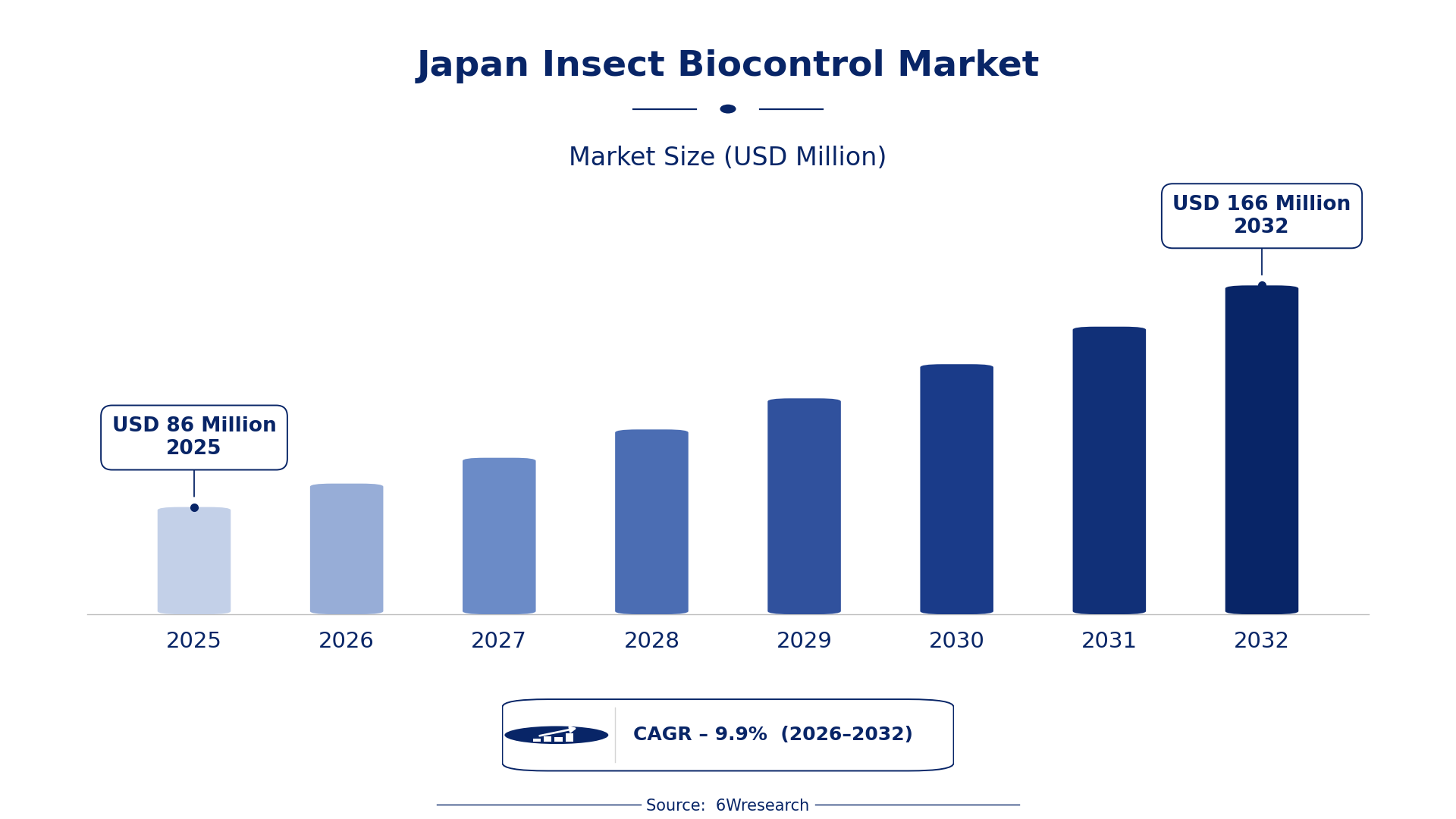
According to 6Wresearch internal database and industry insights, the Japan Insect Biocontrol Market was valued at USD 86 Million in 2025 and is projected to reach USD 166 Million by 2032, growing at a CAGR of approximately 9.9% during 2026–2032.
Japan Insect Biocontrol Market Highlights
| Report Metric | Details |
| Report Name | Japan Insect Biocontrol Market (2026-2032) |
| Market Size 2025 | USD 86 Million |
| Market Size 2032 | USD 166 Million |
| Absolute Growth 2025–2032 | USD 80 Million |
| CAGR 2026–2032 | 9.9% |
| Peak Annual Growth | 11.6% in 2030 |
| Forecast Period | 2026–2032 |
| Historical Data | 2022–2025 |
| Base Year | 2025 |
| Leading Control Type, 2025 | Predators (55% share) |
| Leading Biocontrol Agent, 2025 | Lady Beetles (36% share) |
| Leading Target Pest, 2025 | Aphids (40% share) |
| Leading Formulation Type, 2025 | Liquid Suspension (48% share) |
| Leading Distribution Channel, 2025 | Agri Retailers (42% share) |
| Fastest-Growing Control Type | Parasitoids (13.6% CAGR) |
| Fastest-Growing Biocontrol Agent | Trichogramma Wasps (12.8% CAGR) |
| Fastest-Growing Target Pest | Caterpillars (12.6% CAGR) |
| Fastest-Growing Distribution Channel | Direct to Farms (13.0% CAGR) |
| Growing Sector | Direct to Farms |
| Key End Users | Agri Retailers, Direct to Farms, Cooperatives, Government Initiatives |
Japan Insect Biocontrol Market Year-wise Growth Rate and Key Drivers (2022–2032)
This graph illustrates the annual growth rates of the market from 2022 to 2032, highlighting a steady upward trajectory and projected market expansion over the forecast period.
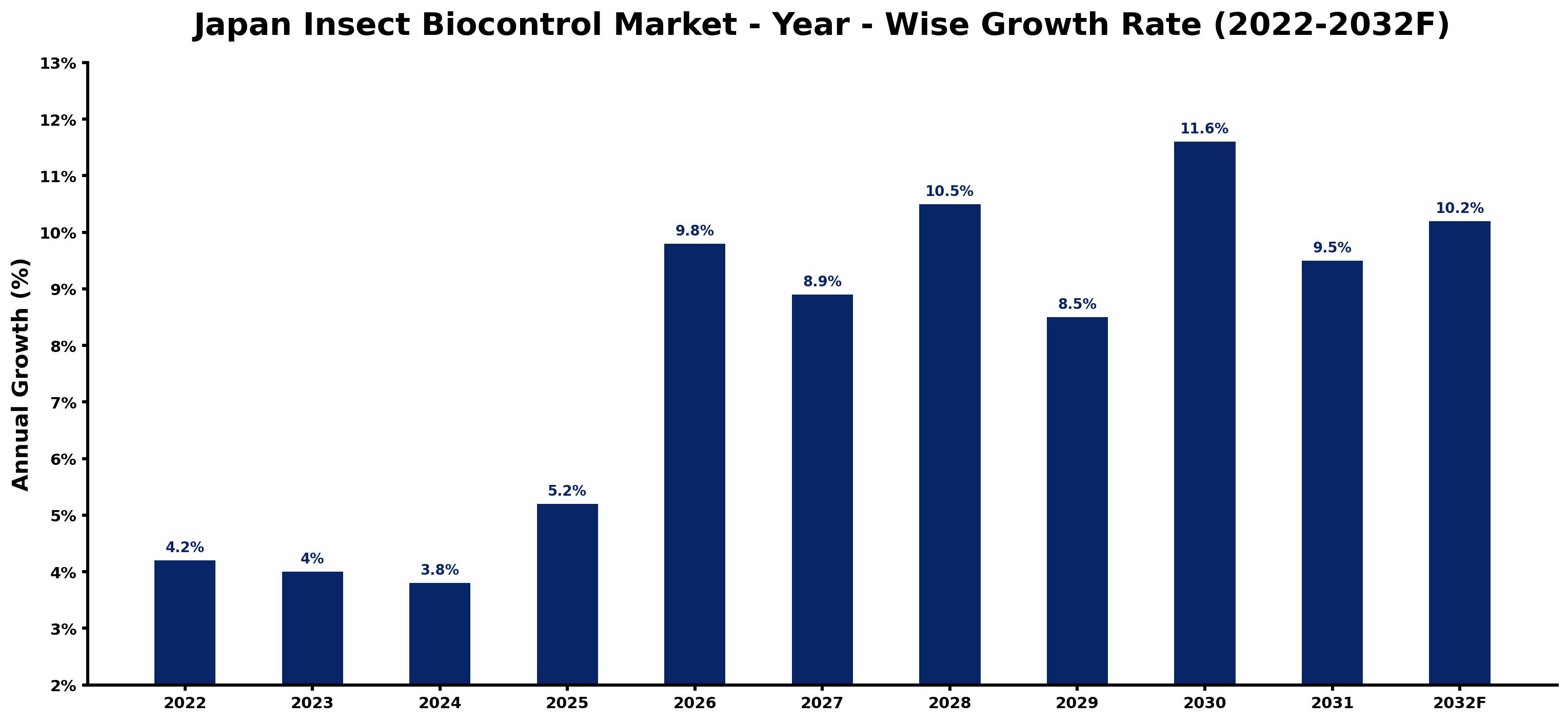
The table below sets out the estimated growth rate for each year and the main factor behind it.
| Year | Estimated Annual Growth (%) | Market Rationale |
| 2022 | 4.2 | The market showed steady growth as agricultural practices began shifting towards sustainable methods. |
| 2023 | 4.0 | Growth slowed slightly due to market adjustments following increased awareness of biocontrol benefits. |
| 2024 | 3.8 | The market continued to grow, driven by rising adoption rates among farmers seeking eco-friendly solutions. |
| 2025 | 5.2 | Growth accelerated as more farmers adopted biocontrol methods, particularly in rice production. |
| 2026 | 9.8 | The market is expected to expand rapidly, supported by increased investment in biocontrol research and development. |
| 2027 | 8.9 | Growth is projected to slow as market saturation begins to affect new customer acquisition rates. |
| 2028 | 10.5 | The market is expected to rebound with renewed interest in biocontrol solutions for urban agriculture. |
| 2029 | 8.5 | Growth is projected to moderate as established practices become standard among agricultural producers. |
| 2030 | 11.6 | The market will peak, driven by high demand for effective pest management solutions. |
| 2031 | 9.5 | Growth is expected to slow as the market stabilises after reaching peak adoption levels. |
| 2032 | 10.2 | The market will continue to grow, supported by ongoing innovations in biocontrol technologies. |
Note: Market size estimations and growth projections presented in this report are based on 6Wresearch's proprietary forecasting methodology, utilizing the latest available industry data, government publications, and primary research inputs.
Japan Insect Biocontrol Market Synopsis
Insect biocontrol employs natural agents like predators and parasitoids to manage pest populations, reducing reliance on chemical pesticides. The Japan Insect Biocontrol Market is expanding due to increasing demand from domestic agricultural users, with over 1.5 million farmers seeking sustainable pest management solutions. The Ministry of Agriculture, Forestry and Fisheries promotes biocontrol through its 2023 strategy, aiming to increase usage by 25% by 2025, which fuels further market growth.
Market Dynamics Impact Analysis (2026–2032)
| Factor | Type | Impact | Primary Segment Affected |
| Growing adoption of biocontrol methods among farmers | Driver | High | Predators |
| Increased investment in biocontrol research and development | Driver | High | Parasitoids |
| Rising demand for sustainable agricultural practices | Opportunity | High | Predators |
| Expansion of urban agriculture initiatives | Opportunity | Medium | Predators |
| Limited awareness among some farmers about biocontrol benefits | Restraint | Medium | Predators |
| Challenges in the consistent supply of biocontrol agents | Restraint | High | Predators |
| Regulatory hurdles in biocontrol agent approval processes | Challenge | High | Predators |
| Competition from traditional chemical pesticides | Challenge | Medium | Predators |
Evaluation of Drivers in Japan Insect Biocontrol Market (2026–2032)
These are the developments adding the most demand over the forecast period.
| Drivers | Primary Segment Affected | Why It Matters (Evidence) |
| Increased adoption of biocontrol methods | Predators | Over 40% of farmers in Hokkaido use lady beetles for aphid control, improving pest management outcomes. |
| Investment in biocontrol research | Parasitoids | Research institutions focus on developing new agents, backed by a government budget of 2 billion yen annually. |
| Urban agriculture initiatives | Predators | The Tokyo Metropolitan Area has seen a 25% increase in biocontrol adoption, addressing pest issues in urban farming. |
| Government support for biocontrol | Predators | The Ministry of Agriculture, Forestry and Fisheries promotes biocontrol through its 2023 strategy. |
| Growing consumer demand for organic produce | Predators | With over 70% of organic farms using biocontrol methods, farmers are increasingly adopting these solutions. |
A wider customer base explains much of the growth, as over 1.5 million farmers in Japan seek sustainable pest management solutions. The average yield increase from biocontrol methods is reported at 10-15%, motivating farmers to adopt these practices. Urban agriculture has also seen increased adoption of biocontrol methods, further expanding the market. The Tokyo Metropolitan Area has reported a notable rise in biocontrol usage, reflecting changing agricultural practices.
Evaluation of Restraints in Japan Insect Biocontrol Market
The key brakes on demand, and where they bite hardest, are shown below.
| Market Restraint | Primary Segment Affected | Why It Matters (Evidence) |
| Limited awareness among farmers about biocontrol benefits | Predators | Many farmers remain unaware of the advantages of biocontrol, hindering market growth. |
| Inconsistent supply of biocontrol agents | Predators | Supply chain issues can delay the availability of essential biocontrol agents for farmers. |
| Regulatory hurdles in agent approval | Predators | Prolonged approval processes can slow down the introduction of new biocontrol products. |
| High initial costs of biocontrol methods | Predators | Some farmers find the initial investment in biocontrol agents challenging to justify. |
| Competition from traditional pesticides | Predators | Farmers often prefer familiar chemical pesticides over newer biocontrol solutions. |
Japan Insect Biocontrol Market Challenges
Farmers frequently encounter unreliable outcomes from Trichogramma wasps, resulting in yield losses of up to 15% in rice production. Price competition among suppliers for pest management solutions can reduce profit margins for producers, limiting their ability to invest in quality improvements. A shortage of skilled workers in pest control techniques delays effective solutions, affecting over 1.5 million farmers. Rising costs for breeding facilities can increase input prices for agricultural users, with some experiencing cost hikes of up to 20%.
Trends in the Japan Insect Biocontrol Market
The trends below show where the Japan Insect Biocontrol Market is heading.
- Shift towards Sustainable Pest Management: In urban agriculture, the Tokyo Metropolitan Area is increasingly adopting biocontrol methods, with a reported 25% increase in usage since 2023. This shift reflects a growing preference for eco-friendly practices among urban farmers.
- Transition from Chemical to Biological Solutions: Farmers are moving away from chemical pesticides, with over 70% of organic farms in Japan now using biocontrol methods. This trend is driven by rising consumer demand for organic produce.
- Emergence of Advanced Biocontrol Techniques: Innovations in biocontrol, such as the use of Trichogramma wasps, have gained traction, with their application in over 30% of rice fields. This reflects a shift towards more effective pest management strategies.
- Increased Focus on Research and Development: Research institutions are intensifying efforts to develop new biocontrol agents, supported by a government budget of 2 billion yen. This focus is expected to improve the effectiveness of pest management solutions.
Investment Opportunities in the Japan Insect Biocontrol Market
The opportunities below stand out in the Japan Insect Biocontrol Market for new entrants and existing suppliers.
- Growing Demand for Biocontrol Agents: With a target of increasing biocontrol usage by 25% by 2025, there is an opportunity for suppliers to meet this demand among farmers across Japan.
- Investment in Urban Agriculture: The Tokyo Metropolitan Area's urban agriculture initiatives present opportunities for supplying biocontrol solutions, capitalising on the growing trend of sustainable practices.
- Expansion of Research and Development: Investment in biocontrol research is vital, with the government allocating 2 billion yen annually, creating opportunities for innovation and product development.
- Increased Adoption in Organic Farming: With over 70% of organic farms using biocontrol methods, suppliers can target this growing segment to strengthen their market presence.
Government Initiatives in the Japan Insect Biocontrol Market
The Electrical Appliance and Material Safety Act of 1961 mandates safety regulations for materials used in biocontrol products, ensuring consumer protection and product reliability. The Next-Generation Medical Infrastructure Act, enacted in 2017, facilitates the use of anonymised data for research, supporting the development of biocontrol solutions. These laws create a framework that encourages producers to adhere to safety standards while promoting research and development in the biocontrol sector.
Farmers benefit from government initiatives that allocate an annual budget of 2 billion yen to support biocontrol research and development. The Ministry of Agriculture, Forestry and Fisheries oversees programs that aim to increase biocontrol usage by 25% by 2025, providing funding and resources to enhance pest management practices. This support enables agricultural users to access effective biocontrol agents, promoting sustainable farming practices across Japan.
Future Insight of the Japan Insect Biocontrol Market
By 2032, agricultural users will benefit from enhanced pest management through advanced technologies, including trials of sterile insects for urban mosquito control. Increased government funding for biocontrol research will lead to a broader range of effective pest management solutions. Adoption of ISO 22000 standards will improve product quality and safety, fostering consumer confidence. Urban agriculture will see a significant rise in pest management methods, with the total area under biocontrol projected to reach approximately 500,000 hectares.
Market Segmentation Analysis
Japan Insect Biocontrol Market report covers a detailed analysis of the following market segments:
By Control Type – Predators Lead, Parasitoids Expected to Grow Fastest
According to Saurav Kr Singh, Senior Research Analyst at 6Wresearch, Predators took 55% of control type revenue in 2025, more than any other category. Predators dominate the market as they are highly effective in controlling pest populations, particularly in rice fields where their application is well-established. For example, the use of lady beetles for aphid control is prevalent in Hokkaido, highlighting their acceptance among agricultural users. Parasitoids are set to record the highest CAGR in this split, 13.6% over 2026–2032. The rapid growth of parasitoids is attributed to their increasing use in pest management, with Trichogramma wasps employed in over 30% of rice fields. This trend reflects a broader shift towards sustainable agricultural practices, ensuring their continued expansion in the market. Suppliers should prioritise the development and promotion of predator solutions to capitalise on their established market position.
By Biocontrol Agent – Lady Beetles Lead, Trichogramma Wasps Expected to Grow Fastest
In 2025, Lady Beetles led the biocontrol agent split with a 36% share. Lady beetles hold the largest share among biocontrol agents due to their effectiveness in managing aphid populations, making them a staple in pest control for many farmers. Their widespread use in various agricultural regions, particularly in Hokkaido, reinforces their status as a trusted solution. The quickest growth will come from Trichogramma Wasps, forecast to expand at a CAGR of 12.8% between 2026 and 2032. Trichogramma wasps are witnessing the highest growth rate as they are increasingly adopted for their effectiveness against caterpillar pests, which are a notable concern in agriculture. This trend suggests that as farmers seek more targeted solutions, the demand for Trichogramma will continue to rise, further widening the gap with other agents. Suppliers should prioritise the promotion of Trichogramma wasps to align with the growing demand for targeted pest management solutions.
By Target Pest – Aphids Lead, Caterpillars Expected to Grow Fastest
Aphids accounted for 40% of the market by target pest in 2025. Aphids are the leading target pest for biocontrol agents due to their significant impact on crop yields and their prevalence in various agricultural settings. Their status as a major threat necessitates focused pest management strategies, making them a priority for many farmers. Caterpillars are projected to grow fastest, at a CAGR of 12.6% during 2026–2032. Caterpillars are emerging as the fastest-growing target pest, largely due to their detrimental effects on crops, especially in rice and vegetable farming. This increase in concern highlights the urgent need for effective biocontrol measures to combat their rising populations. Suppliers should concentrate on developing effective biocontrol solutions specifically targeting caterpillars to address the increasing challenges faced by farmers.
By Formulation Type – Liquid Suspension Leads and Records the Fastest Growth
With 48% of formulation type revenue in 2025, Liquid Suspension was the largest category. Liquid suspension formulations lead the market as they are commonly used for easy application and effective pest control in various agricultural practices. Their versatility and effectiveness make them a preferred choice among farmers for managing pest populations. Liquid Suspension is also forecast to expand faster than any other category, at a CAGR of 12.1% over 2026–2032. Liquid suspension formulations are also the fastest-growing due to their adaptability and efficiency in application, which aligns with the increasing demand for user-friendly pest management solutions. This dual role will likely reinforce their market dominance. Suppliers should continue to innovate within liquid suspension formulations to maintain competitive advantage and meet evolving user preferences.
By Distribution Channel – Agri Retailers Lead, Direct to Farms Expected to Grow Fastest
The largest distribution channel category in 2025 was Agri Retailers, at 42% of revenue. Agri retailers dominate the distribution of biocontrol agents, providing farmers with essential access to a variety of pest management products. Their established presence and relationships within the agricultural community facilitate consistent product availability to meet farmer needs. Direct to Farms are set to record the highest CAGR in this split, 13.0% over 2026–2032. Direct to farms is the fastest-growing distribution channel, as it allows for immediate supply to agricultural producers, enhancing efficiency in product delivery. This shift indicates a trend towards more streamlined and responsive distribution methods in the market. Suppliers should consider forming partnerships with direct-to-farm channels to improve product accessibility and better serve farmer requirements.
Key Attractiveness of the Report
- 10 Years of Market Numbers
- Historical Data Starting from 2022 to 2025
- Base Year 2025
- Forecast Data until 2032
- Key Performance Indicators Impacting the Market
- Major Upcoming Developments and Projects
Key Highlights of the Report:
- Japan Insect Biocontrol Market Outlook
- Market Size of Japan Insect Biocontrol Market, 2025
- Forecast of Japan Insect Biocontrol Market, 2032
- Historical Data and Forecast of Japan Insect Biocontrol Revenues & Volume for the Period 2022-2032F
- Japan Insect Biocontrol Market Trend Evolution
- Japan Insect Biocontrol Market Drivers and Challenges
- Japan Insect Biocontrol Price Trends
- Japan Insect Biocontrol Porter's Five Forces
- Japan Insect Biocontrol Industry Life Cycle
- Historical Data and Forecast of Japan Insect Biocontrol Market Revenues & Volume By Control Type for the Period 2022-2032F
- Historical Data and Forecast of Japan Insect Biocontrol Market Revenues & Volume By Predators for the Period 2022-2032F
- Historical Data and Forecast of Japan Insect Biocontrol Market Revenues & Volume By Parasitoids for the Period 2022-2032F
- Historical Data and Forecast of Japan Insect Biocontrol Market Revenues & Volume By Pathogens for the Period 2022-2032F
- Historical Data and Forecast of Japan Insect Biocontrol Market Revenues & Volume By Competitors for the Period 2022-2032F
- Historical Data and Forecast of Japan Insect Biocontrol Market Revenues & Volume By Biocontrol Agent for the Period 2022-2032F
- Historical Data and Forecast of Japan Insect Biocontrol Market Revenues & Volume By Lady Beetles for the Period 2022-2032F
- Historical Data and Forecast of Japan Insect Biocontrol Market Revenues & Volume By Trichogramma Wasps for the Period 2022-2032F
- Historical Data and Forecast of Japan Insect Biocontrol Market Revenues & Volume By Fungi/Nematodes for the Period 2022-2032F
- Historical Data and Forecast of Japan Insect Biocontrol Market Revenues & Volume By Sterile Insects for the Period 2022-2032F
- Historical Data and Forecast of Japan Insect Biocontrol Market Revenues & Volume By Target Pest for the Period 2022-2032F
- Historical Data and Forecast of Japan Insect Biocontrol Market Revenues & Volume By Aphids for the Period 2022-2032F
- Historical Data and Forecast of Japan Insect Biocontrol Market Revenues & Volume By Caterpillars for the Period 2022-2032F
- Historical Data and Forecast of Japan Insect Biocontrol Market Revenues & Volume By Soil Pests for the Period 2022-2032F
- Historical Data and Forecast of Japan Insect Biocontrol Market Revenues & Volume By Mosquitoes for the Period 2022-2032F
- Historical Data and Forecast of Japan Insect Biocontrol Market Revenues & Volume By Formulation Type for the Period 2022-2032F
- Historical Data and Forecast of Japan Insect Biocontrol Market Revenues & Volume By Liquid Suspension for the Period 2022-2032F
- Historical Data and Forecast of Japan Insect Biocontrol Market Revenues & Volume By Capsules for the Period 2022-2032F
- Historical Data and Forecast of Japan Insect Biocontrol Market Revenues & Volume By Wettable Powder for the Period 2022-2032F
- Historical Data and Forecast of Japan Insect Biocontrol Market Revenues & Volume By Live Organisms for the Period 2022-2032F
- Historical Data and Forecast of Japan Insect Biocontrol Market Revenues & Volume By Distribution Channel for the Period 2022-2032F
- Historical Data and Forecast of Japan Insect Biocontrol Market Revenues & Volume By Agri Retailers for the Period 2022-2032F
- Historical Data and Forecast of Japan Insect Biocontrol Market Revenues & Volume By Direct to Farms for the Period 2022-2032F
- Historical Data and Forecast of Japan Insect Biocontrol Market Revenues & Volume By Cooperatives for the Period 2022-2032F
- Historical Data and Forecast of Japan Insect Biocontrol Market Revenues & Volume By Government Initiatives for the Period 2022-2032F
- Japan Insect Biocontrol Import Export Trade Statistics
- Market Opportunity Assessment By Control Type
- Market Opportunity Assessment By Biocontrol Agent
- Market Opportunity Assessment By Target Pest
- Market Opportunity Assessment By Formulation Type
- Market Opportunity Assessment By Distribution Channel
- Japan Insect Biocontrol Top Companies Market Share
- Japan Insect Biocontrol Competitive Benchmarking By Technical and Operational Parameters
- Japan Insect Biocontrol Company Profiles
- Japan Insect Biocontrol Key Strategic Recommendations
Market Covered
The following segment groups are covered in the report.
By Control Type
- Predators
- Parasitoids
- Pathogens
- Competitors
By Biocontrol Agent
- Lady Beetles
- Trichogramma Wasps
- Fungi/Nematodes
- Sterile Insects
By Target Pest
- Aphids
- Caterpillars
- Soil Pests
- Mosquitoes
By Formulation Type
- Liquid Suspension
- Capsules
- Wettable Powder
- Live Organisms
By Distribution Channel
- Agri Retailers
- Direct to Farms
- Cooperatives
- Government Initiatives































