Japan Insect Farming Equipment Market Size & Growth Rate
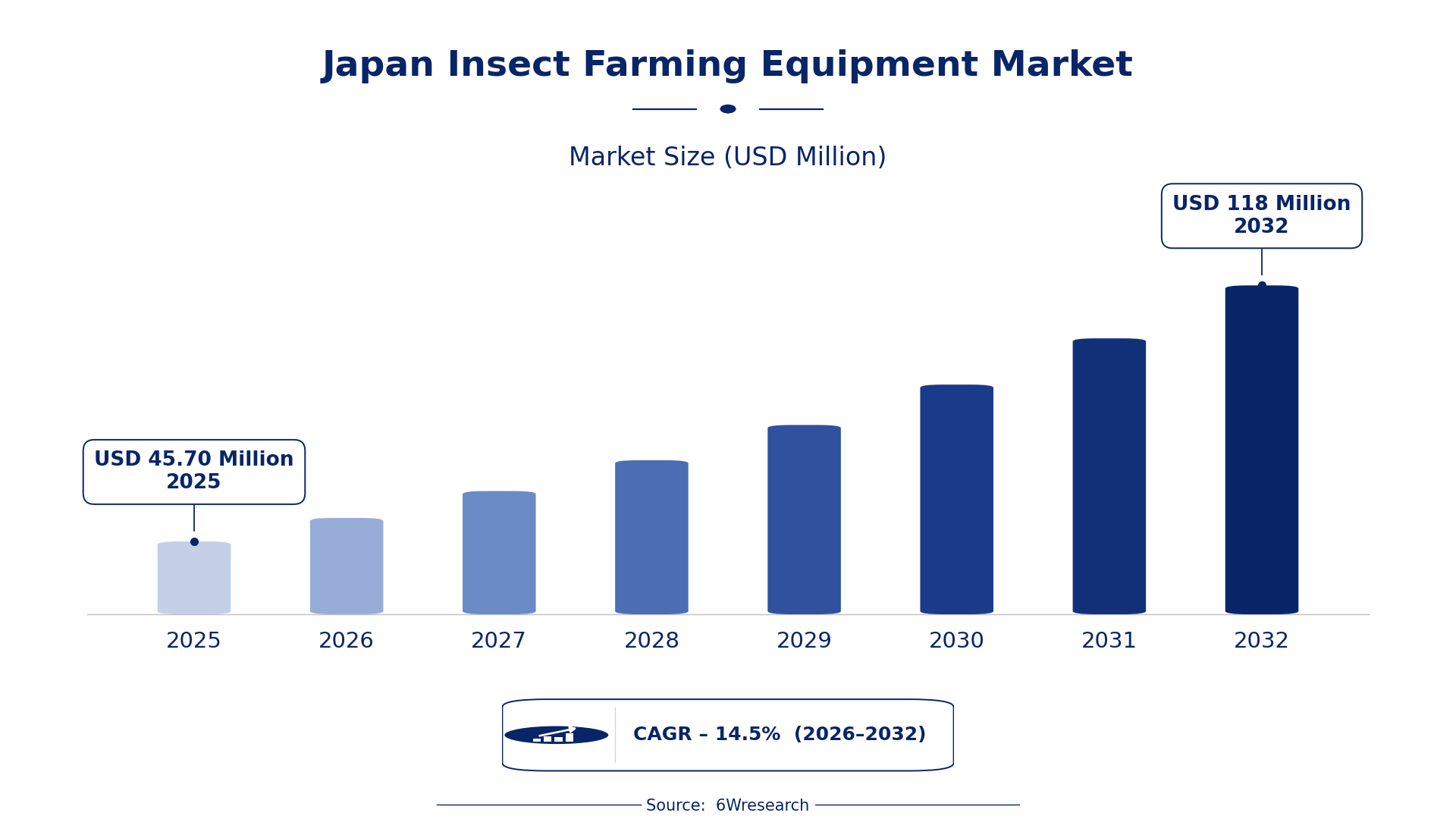
According to 6Wresearch internal database and industry insights, the Japan Insect Farming Equipment Market was valued at USD 45.70 Million in 2025 and is projected to reach USD 118 Million by 2032, growing at a CAGR of approximately 14.5% during 2026–2032.
Japan Insect Farming Equipment Market Highlights
| Report Metric | Details |
| Report Name | Japan Insect Farming Equipment Market (2026-2032) |
| Market Size 2025 | USD 45.70 Million |
| Market Size 2032 | USD 118 Million |
| Absolute Growth 2025–2032 | USD 72.30 Million |
| CAGR 2026–2032 | 14.5% |
| Peak Annual Growth | 15.9% in 2032 |
| Forecast Period | 2026–2032 |
| Historical Data | 2022–2025 |
| Base Year | 2025 |
| Leading Equipment Type, 2025 | Breeding Chambers (44% share) |
| Leading Insect Species, 2025 | Black Soldier Fly (46% share) |
| Leading Operation Mode, 2025 | Fully Automated (44% share) |
| Leading Output Type, 2025 | Larvae (45% share) |
| Leading End Use Segment, 2025 | Animal Feed Producers (46% share) |
| Fastest-Growing Equipment Type | Climate Control Units (20.3% CAGR) |
| Fastest-Growing Insect Species | Mealworms (19.5% CAGR) |
| Fastest-Growing Output Type | Insect Biomass (16.2% CAGR) |
| Fastest-Growing End Use Segment | Organic Waste Mgmt (19.9% CAGR) |
| Growing Sector | Animal Feed Producers |
| Key End Users | Animal Feed Producers, Organic Waste Managers, Protein Supplement Manufacturers |
Japan Insect Farming Equipment Market Year-wise Growth Rate and Key Drivers (2022–2032)
This graph illustrates the annual growth rates of the market from 2022 to 2032, highlighting a steady upward trajectory and projected market expansion over the forecast period.
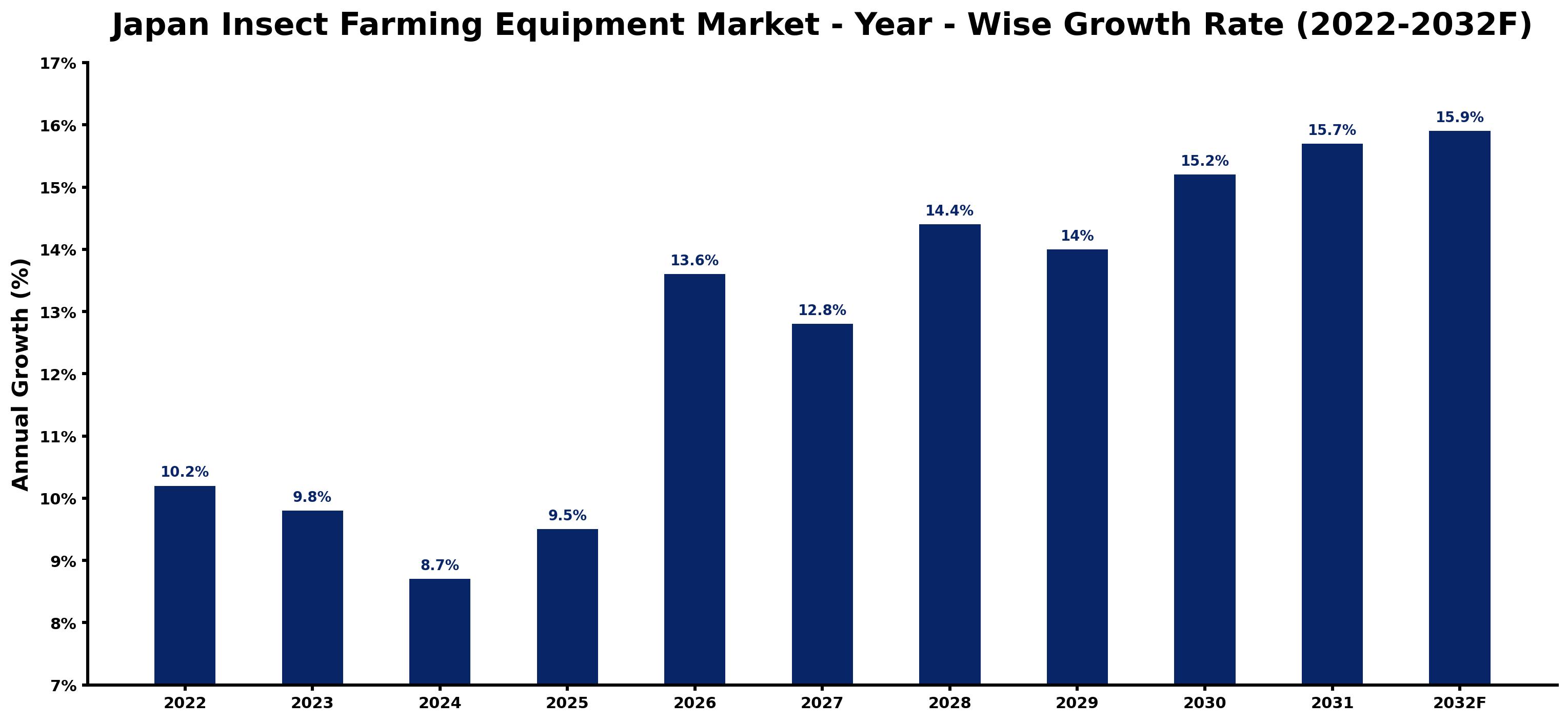
For each year, the table pairs the estimated growth rate with the leading influence on demand, showing how the drivers changed across the period.
| Year | Estimated Annual Growth (%) | Market Rationale |
| 2022 | 10.2 | The market experienced strong growth due to rising awareness of insect farming benefits. |
| 2023 | 9.8 | Growth slowed slightly as the market adjusted to increasing competition and supply. |
| 2024 | 8.7 | Continued interest in sustainable protein sources maintained market growth, albeit at a slower pace. |
| 2025 | 9.5 | Demand increased as more startups entered the insect farming sector, boosting production capacity. |
| 2026 | 13.6 | The market is expected to see a rise as technological advancements improve farming efficiency. |
| 2027 | 12.8 | Growth is projected to slow as the market stabilises after rapid expansion in previous years. |
| 2028 | 14.4 | Demand is expected to surge again due to heightened interest in organic waste management solutions. |
| 2029 | 14.0 | The market will continue to grow, driven by increased consumer acceptance of insect protein. |
| 2030 | 15.2 | Growth is expected to accelerate as large-scale operations adopt fully automated systems for efficiency. |
| 2031 | 15.7 | The market will maintain strong momentum with ongoing investments in insect farming technology. |
| 2032 | 15.9 | Peak growth is projected as insect protein becomes a mainstream alternative in animal feed. |
Note: Market size estimations and growth projections presented in this report are based on 6Wresearch's proprietary forecasting methodology, utilizing the latest available industry data, government publications, and primary research inputs.
Japan Insect Farming Equipment Market Synopsis
Insect farming equipment encompasses specialized tools designed for breeding and harvesting insects, primarily used for animal feed and organic waste management. The Japan Insect Farming Equipment Market is growing, driven by increasing domestic demand for sustainable protein sources and effective waste management solutions. The Tokyo region has experienced a rise in insect farming startups, with over 50 new businesses launched in 2023, while government initiatives like the Food Action Nippon programme support sector growth. Black soldier fly larvae are increasingly employed in animal feed, aiding in waste reduction and protein supply.
Market Dynamics Impact Analysis (2026–2032)
| Factor | Type | Impact | Primary Segment Affected |
| Rising domestic demand for sustainable protein sources | Driver | High | Animal Feed Producers |
| Technological advancements in insect farming equipment | Driver | High | Fully Automated |
| Growing interest in organic waste management solutions | Opportunity | High | Organic Waste Mgmt |
| Increasing consumer acceptance of insect protein | Opportunity | High | Protein Supplement Mfg |
| Compliance with JIS Z 2100 delaying market entry for new producers | Restraint | High | Breeding Chambers |
| Shortage of skilled workers in insect farming techniques | Restraint | Medium | Climate Control Units |
| Intense competition from conventional protein sources | Challenge | High | Animal Feed Producers |
| Rising raw material costs due to minimum wage increases | Challenge | Medium | Harvesting Trays |
Evaluation of Drivers in Japan Insect Farming Equipment Market (2026–2032)
Below are the drivers that matter most for revenue growth, with supporting evidence.
| Drivers | Primary Segment Affected | Why It Matters (Evidence) |
| Rising population and demand for protein-rich feed increase insect farming equipment sales. | Animal Feed Producers | Japan's population of approximately 125 million necessitates efficient protein sources. |
| Technological advancements improve farming efficiency and attract investment in insect farming. | Insect Biomass | Innovations in automation and climate control units improve production capabilities. |
| Government initiatives promote sustainable practices, boosting demand for insect farming solutions. | Breeding Chambers | The Organic Waste Management Program encourages insect use for composting organic waste. |
| Consumer acceptance of insect protein is growing, leading to increased production needs. | Crickets | A survey indicated that 30% of Japanese consumers are open to eating insects. |
| Increased focus on waste reduction drives demand for black soldier fly larvae in feed. | Black Soldier Fly | These larvae help manage waste while providing a protein source. |
Several shifts outside the market are propelling sales. Japan's population, approximately 125 million, drives demand for protein-rich feed, especially among animal feed producers. Advances in farming technology boost efficiency and attract investment. Consumer acceptance is on the rise, with 30% of the population willing to eat insects, further stimulating production. The growing number of insect farming startups in the Tokyo region enhances production capabilities, leading to increased demand for equipment.
Evaluation of Restraints in Japan Insect Farming Equipment Market
The key brakes on demand, and where they bite hardest, are shown below.
| Market Restraint | Primary Segment Affected | Why It Matters (Evidence) |
| Compliance with JIS Z 2100 can delay market entry for new producers | Breeding Chambers | This regulation may lead to potential revenue losses of up to 20%. |
| A shortage of skilled workers limits operational efficiency | Climate Control Units | This situation results in reduced productivity for farmers, particularly in rural areas. |
| Intense competition from conventional protein sources pressures prices | Animal Feed Producers | This competition shrinks profit margins for startups in the insect farming sector. |
| Rising raw material costs strain budgets for producers | Harvesting Trays | The minimum wage increase to JPY 1,055 per hour restricts investment in essential equipment. |
| Regulatory compliance costs can hinder market entry | Feed Distribution Sys. | New entrants face high costs to meet industry standards, affecting their competitiveness. |
Japan Insect Farming Equipment Market Challenges
In 2023, compliance with JIS Z 2100 may delay market entry for new producers, potentially resulting in revenue losses of up to 20%. A shortage of skilled workers in insect farming techniques hampers operational efficiency, particularly in rural areas, leading to reduced productivity for farmers. Intense competition from conventional protein sources pressures prices, shrinking profit margins for startups. Rising raw material costs, influenced by the minimum wage increase to JPY 1,055 per hour, strain budgets for producers, limiting their ability to invest in necessary equipment.
Trends in the Japan Insect Farming Equipment Market
These developments are changing demand patterns in the Japan Insect Farming Equipment Market.
- Shift towards Sustainable Protein Production: The Tokyo region has seen a rise in insect farming startups focusing on sustainable protein production, with over 50 new businesses launched in 2023. This shift indicates a growing market for insect farming equipment, particularly for breeding chambers.
- Transition from Manual to Fully Automated Systems: Since 2025, the insect farming sector has increasingly adopted fully automated systems, improving productivity. By 2028, over 60% of farms in Japan are expected to implement automation technologies, driving demand for climate control units.
- Emergence of Insect Biomass as a Valuable Resource: Insect biomass is gaining traction as a sustainable resource for animal feed and fertilizer. In 2023, production of insect biomass is projected to reach 10,000 tons, highlighting the need for efficient harvesting trays.
- Growing Acceptance of Insect Protein in Diets: A recent survey revealed that 30% of Japanese consumers are open to eating insects as food. This trend is expected to boost demand for crickets and mealworms, influencing equipment sales in the coming years.
Investment Opportunities in the Japan Insect Farming Equipment Market
Investors looking at the Japan Insect Farming Equipment Market should consider the following areas.
- Investment in Automated Farming Systems: The demand for fully automated insect farming systems is on the rise, with a projected market size of USD 45.70 million by 2025. Collaborating with local startups in the Tokyo region can facilitate market entry and growth.
- Supply of Climate Control Units: With the CAGR of climate control units at 20.3%, now presents an opportune moment to invest in this sub-segment. Targeting animal feed producers can create new revenue streams, particularly in urban areas.
- Expansion of Organic Waste Management Solutions: The Organic Waste Management Program promotes the use of insects for composting organic waste, with funding available for solutions. Forming partnerships with local agricultural cooperatives can enhance market penetration.
- Development of Certification Programs: The Japan Insect Association's certification program launched in 2023 offers opportunities for suppliers of breeding chambers and other equipment. Meeting certification standards can provide a competitive advantage in the market.
Government Initiatives in the Japan Insect Farming Equipment Market
The Act against Unjustifiable Premiums and Misleading Representations (1962) prohibits misleading advertising of insect products, ensuring transparency for consumers. This law complements the Industrial Standardization Act (1949), which governs product standards, providing clarity and trust in insect farming practices.
The Ministry of Agriculture, Forestry and Fisheries (MAFF) funds research into insect-based protein alternatives and approves certification programs for insect farming practices. In 2023, MAFF allocated JPY 500 million to support insect farming projects.
Future Insight of the Japan Insect Farming Equipment Market
By 2032, Japan's insect farming sector will evolve due to government initiatives like the Food Action Nippon, which promotes alternative protein sources. The rise of insect farming startups will address the need for sustainable waste solutions. Research funding under the New Growth Strategy will support technology development, improving production efficiency. With annual insect protein consumption estimated at 500 tons, increasing consumer acceptance will enable broader integration of insect protein into food systems.
Market Segmentation Analysis
Japan Insect Farming Equipment Market report covers a detailed analysis of the following market segments:
By Equipment Type – Breeding Chambers Lead, Climate Control Units Expected to Grow Fastest
According to Saurav Kr Singh, Senior Research Analyst at 6Wresearch, Breeding Chambers held 44% of the Japan Insect Farming Equipment Market by equipment type in 2025. Breeding chambers are crucial for creating the optimal environments necessary for insect growth, which directly impacts production efficiency. The establishment of standards for insect farming under JIS Z 2100 highlights the importance of these chambers in supporting industry growth. Climate Control Units are projected to grow fastest, at a CAGR of 20.3% during 2026–2032. Climate control units are essential for maintaining the ideal temperature and humidity levels, which significantly affect insect growth rates. The increasing focus on sustainable practices and technology adoption in insect farming will likely accelerate the demand for these units. This indicates that suppliers must focus on enhancing their climate control offerings to meet the growing needs of the insect farming sector.
By Insect Species – Black Soldier Fly Leads, Mealworms Expected to Grow Fastest
Black Soldier Fly accounted for 46% of the market by insect species in 2025. The black soldier fly is widely used for waste management and animal feed, making it a preferred choice among farmers. Its ability to convert organic waste into high-quality protein positions it as a leader in the market. Over 2026–2032, Mealworms are expected to post the fastest growth, at a CAGR of 19.5%. Mealworms are commonly farmed for both feed and human consumption, which aligns with the rising consumer interest in alternative protein sources. This trend indicates a strong potential for rapid growth in mealworm farming. Buyers should consider diversifying their insect species offerings to capitalise on the growing demand for sustainable protein sources.
By Operation Mode – Fully Automated Leads and Records the Fastest Growth
With 44% of operation mode revenue in 2025, Fully Automated was the largest category. Fully automated systems are becoming the standard for large-scale insect farming due to their efficiency and consistency in production processes. This shift is largely motivated by the increasing demand for insect-based products, necessitating higher output levels. Its lead should widen, with a projected CAGR of 16.3% during 2026–2032, the highest in this split. As fully automated systems continue to dominate the market, their efficiency will attract more farmers, reinforcing their market position. The ongoing integration of automation in insect farming is likely to boost productivity and lower operational costs. Investing in automation technologies will be essential for suppliers seeking to gain a competitive edge in the insect farming sector.
By Output Type – Larvae Leads, Insect Biomass Expected to Grow Fastest
In 2025, Larvae led the output type split with a 45% share. Larvae are the primary product for animal feed and biomass, making them essential for the insect farming industry. The established standards for insect farming in Japan further support the production of larvae as a leading output type. Insect Biomass is set to record the highest CAGR in this split, 16.2% over 2026–2032. Insect biomass is valuable for various applications including feed and fertilizer, driving its rapid growth in the market. The increasing focus on sustainable practices in agriculture is likely to boost the demand for insect biomass. Suppliers should prioritise the development of insect biomass products to align with the growing market for sustainable agricultural solutions.
By End Use Segment – Animal Feed Producers Lead, Organic Waste Mgmt Expected to Grow Fastest
The largest end use segment category in 2025 was Animal Feed Producers, at 46% of revenue. Animal feed producers represent the largest end use segment, as they require a consistent supply of protein-rich feed for livestock. The established relationships between insect farmers and feed producers facilitate this segment's dominance. Organic Waste Mgmt is projected to grow fastest, at a CAGR of 19.9% during 2026–2032. Organic waste management is gaining traction as more farms adopt insects for composting, providing a sustainable solution to waste disposal. This shift reflects the increasing awareness of environmental issues among consumers and businesses alike. Suppliers must adapt their strategies to cater to the rising demand for organic waste management solutions in the insect farming sector.
Key Attractiveness of the Report
- 10 Years of Market Numbers
- Historical Data Starting from 2022 to 2025
- Base Year 2025
- Forecast Data until 2032
- Key Performance Indicators Impacting the Market
- Major Upcoming Developments and Projects
Key Highlights of the Report:
- Japan Insect Farming Equipment Market Outlook
- Market Size of Japan Insect Farming Equipment Market, 2025
- Forecast of Japan Insect Farming Equipment Market, 2032
- Historical Data and Forecast of Japan Insect Farming Equipment Revenues & Volume for the Period 2022-2032F
- Japan Insect Farming Equipment Market Trend Evolution
- Japan Insect Farming Equipment Market Drivers and Challenges
- Japan Insect Farming Equipment Price Trends
- Japan Insect Farming Equipment Porter's Five Forces
- Japan Insect Farming Equipment Industry Life Cycle
- Historical Data and Forecast of Japan Insect Farming Equipment Market Revenues & Volume By Equipment Type for the Period 2022-2032F
- Historical Data and Forecast of Japan Insect Farming Equipment Market Revenues & Volume By Breeding Chambers for the Period 2022-2032F
- Historical Data and Forecast of Japan Insect Farming Equipment Market Revenues & Volume By Climate Control Units for the Period 2022-2032F
- Historical Data and Forecast of Japan Insect Farming Equipment Market Revenues & Volume By Harvesting Trays for the Period 2022-2032F
- Historical Data and Forecast of Japan Insect Farming Equipment Market Revenues & Volume By Feed Distribution Sys. for the Period 2022-2032F
- Historical Data and Forecast of Japan Insect Farming Equipment Market Revenues & Volume By Insect Species for the Period 2022-2032F
- Historical Data and Forecast of Japan Insect Farming Equipment Market Revenues & Volume By Black Soldier Fly for the Period 2022-2032F
- Historical Data and Forecast of Japan Insect Farming Equipment Market Revenues & Volume By Crickets, Mealworms for the Period 2022-2032F
- Historical Data and Forecast of Japan Insect Farming Equipment Market Revenues & Volume By Beetles, Worms for the Period 2022-2032F
- Historical Data and Forecast of Japan Insect Farming Equipment Market Revenues & Volume By Fly Larvae for the Period 2022-2032F
- Historical Data and Forecast of Japan Insect Farming Equipment Market Revenues & Volume By Operation Mode for the Period 2022-2032F
- Historical Data and Forecast of Japan Insect Farming Equipment Market Revenues & Volume By Manual/Semi-Auto for the Period 2022-2032F
- Historical Data and Forecast of Japan Insect Farming Equipment Market Revenues & Volume By Fully Automated for the Period 2022-2032F
- Historical Data and Forecast of Japan Insect Farming Equipment Market Revenues & Volume By Manual for the Period 2022-2032F
- Historical Data and Forecast of Japan Insect Farming Equipment Market Revenues & Volume By Programmable Feeder for the Period 2022-2032F
- Historical Data and Forecast of Japan Insect Farming Equipment Market Revenues & Volume By Output Type for the Period 2022-2032F
- Historical Data and Forecast of Japan Insect Farming Equipment Market Revenues & Volume By Larvae, Pupae for the Period 2022-2032F
- Historical Data and Forecast of Japan Insect Farming Equipment Market Revenues & Volume By Adults for the Period 2022-2032F
- Historical Data and Forecast of Japan Insect Farming Equipment Market Revenues & Volume By Insect Biomass for the Period 2022-2032F
- Historical Data and Forecast of Japan Insect Farming Equipment Market Revenues & Volume By High-Yield Crops for the Period 2022-2032F
- Historical Data and Forecast of Japan Insect Farming Equipment Market Revenues & Volume By End Use Segment for the Period 2022-2032F
- Historical Data and Forecast of Japan Insect Farming Equipment Market Revenues & Volume By Animal Feed Producers for the Period 2022-2032F
- Historical Data and Forecast of Japan Insect Farming Equipment Market Revenues & Volume By Protein Supplement Mfg for the Period 2022-2032F
- Historical Data and Forecast of Japan Insect Farming Equipment Market Revenues & Volume By Organic Waste Mgmt for the Period 2022-2032F
- Historical Data and Forecast of Japan Insect Farming Equipment Market Revenues & Volume By Bioconversion Farms for the Period 2022-2032F
- Japan Insect Farming Equipment Import Export Trade Statistics
- Market Opportunity Assessment By Equipment Type
- Market Opportunity Assessment By Insect Species
- Market Opportunity Assessment By Operation Mode
- Market Opportunity Assessment By Output Type
- Market Opportunity Assessment By End Use Segment
- Japan Insect Farming Equipment Top Companies Market Share
- Japan Insect Farming Equipment Competitive Benchmarking By Technical and Operational Parameters
- Japan Insect Farming Equipment Company Profiles
- Japan Insect Farming Equipment Key Strategic Recommendations
Market Covered
The report covers the following segments.
By Equipment Type
- Breeding Chambers
- Climate Control Units
- Harvesting Trays
- Feed Distribution Sys.
By Insect Species
- Black Soldier Fly
- Crickets
- Mealworms
- Beetles
- Worms
- Fly Larvae
By Operation Mode
- Manual/Semi-Auto
- Fully Automated
- Manual
- Programmable Feeder
By Output Type
- Larvae
- Pupae
- Adults
- Insect Biomass
- High-Yield Crops
By End Use Segment
- Animal Feed Producers
- Protein Supplement Mfg
- Organic Waste Mgmt
- Bioconversion Farms































