Japan Institutional Hygiene Market Size & Growth Rate
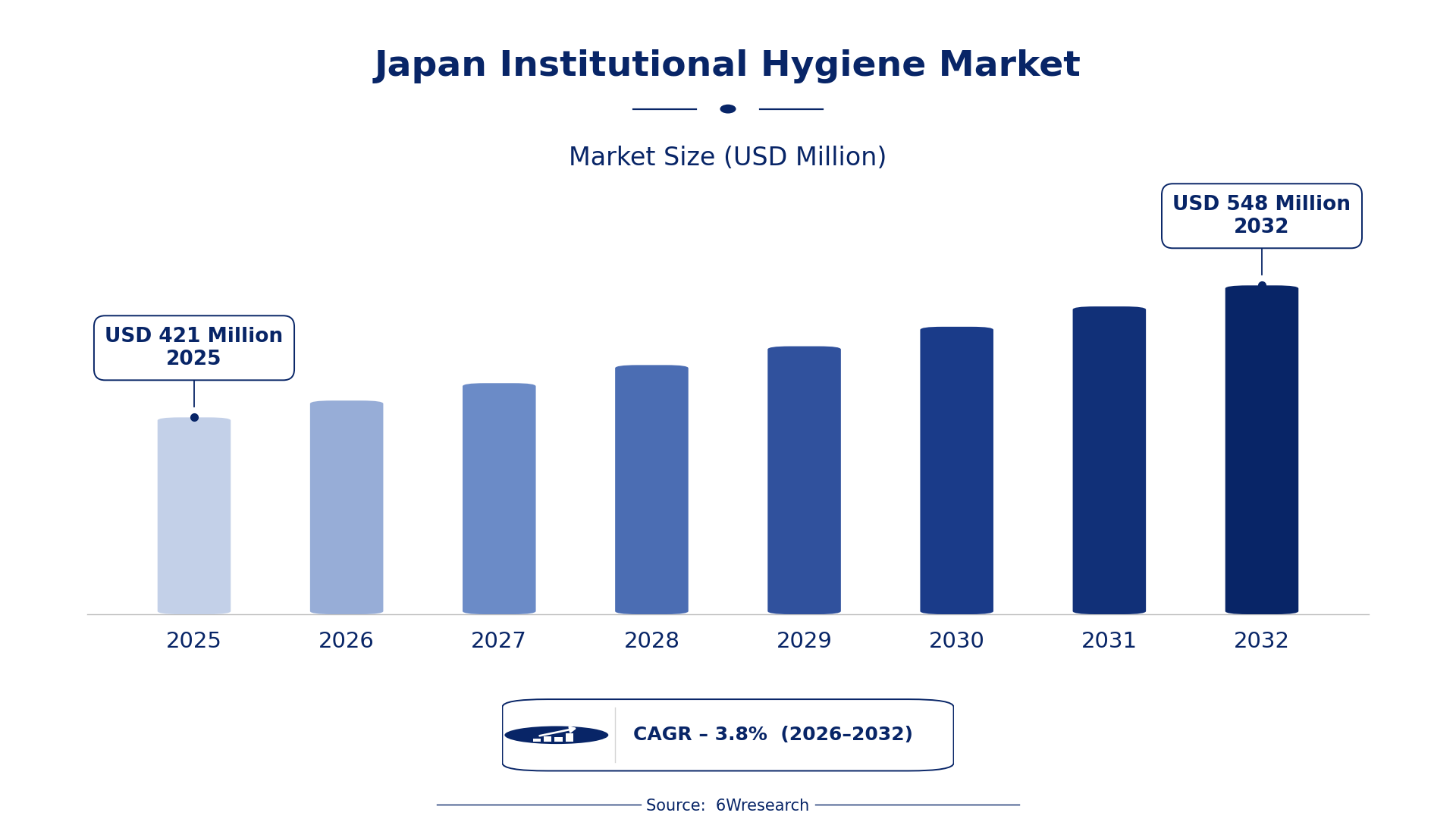
According to 6Wresearch internal database and industry insights, the Japan Institutional Hygiene Market was valued at USD 421 Million in 2025 and is projected to reach USD 548 Million by 2032, growing at a CAGR of approximately 3.8% during 2026–2032.
Japan Institutional Hygiene Market Highlights
| Report Metric | Details |
| Report Name | Japan Institutional Hygiene Market (2026-2032) |
| Market Size 2025 | USD 421 Million |
| Market Size 2032 | USD 548 Million |
| Absolute Growth 2025–2032 | USD 127 Million |
| CAGR 2026–2032 | 3.8% |
| Peak Annual Growth | 4.9% in 2032 |
| Forecast Period | 2026–2032 |
| Historical Data | 2022–2025 |
| Base Year | 2025 |
| Leading Hygiene Solution, 2025 | Surface Sanitizers (40% share) |
| Leading Product Format, 2025 | Liquid/Disinfectant (41% share) |
| Leading Application Area, 2025 | Schools (42% share) |
| Leading Active Agent, 2025 | Quaternary Ammonium (43% share) |
| Leading End Use Institution, 2025 | Educational (50% share) |
| Fastest-Growing Hygiene Solution | Air Fresheners (5.0% CAGR) |
| Fastest-Growing Product Format | Aerosol (5.6% CAGR) |
| Fastest-Growing Application Area | Offices (4.8% CAGR) |
| Fastest-Growing Active Agent | Fragrance (5.1% CAGR) |
| Fastest-Growing End Use Institution | Hotels (5.3% CAGR) |
| Growing Sector | Healthcare |
| Key End Users | Educational institutions, Healthcare facilities, Hotels, Government buildings |
Japan Institutional Hygiene Market Year-wise Growth Rate and Key Drivers (2022–2032)
This graph illustrates the annual growth rates of the market from 2022 to 2032, highlighting a steady upward trajectory and projected market expansion over the forecast period.
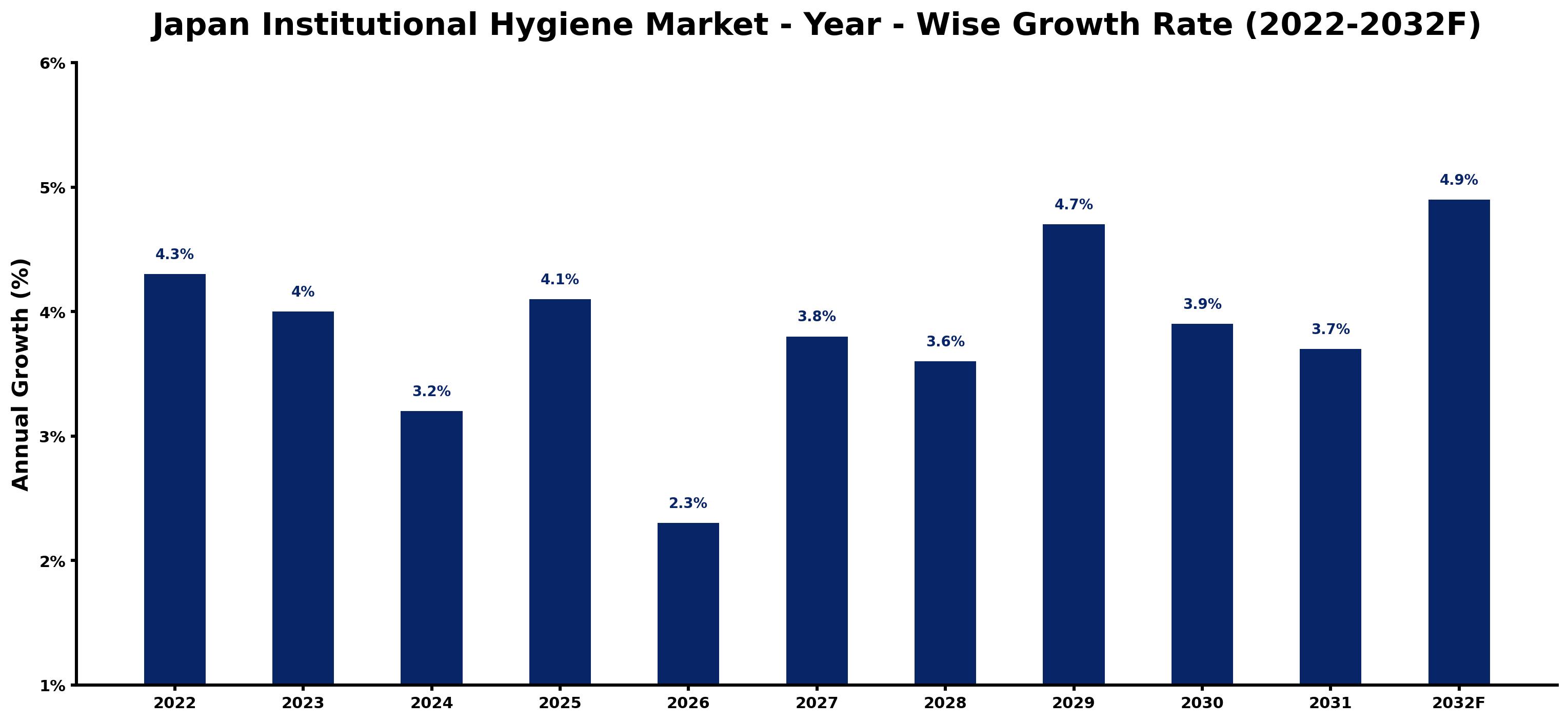
For each year, the table pairs the estimated growth rate with the leading influence on demand, showing how the drivers changed across the period.
| Year | Estimated Annual Growth (%) | Market Rationale |
| 2022 | 4.3 | The market experienced strong demand due to heightened awareness of hygiene practices. |
| 2023 | 4.0 | Growth slowed slightly as the market adjusted to changing consumption patterns. |
| 2024 | 3.2 | Demand continued to moderate as consumers became accustomed to hygiene products. |
| 2025 | 4.1 | Growth accelerated again as educational institutions increased hygiene standards. |
| 2026 | 2.3 | The market growth rate is expected to slow as competition intensifies among hygiene product suppliers. |
| 2027 | 3.8 | Demand is projected to rise as businesses expand their hygiene protocols in workplaces. |
| 2028 | 3.6 | Growth is anticipated to decelerate slightly as market saturation begins to set in. |
| 2029 | 4.7 | An increase in public health campaigns is expected to boost hygiene product consumption. |
| 2030 | 3.9 | Growth will slow as consumer preferences shift towards eco-friendly products. |
| 2031 | 3.7 | The market is projected to experience a slight slowdown as price sensitivity affects purchases. |
| 2032 | 4.9 | The market is expected to peak as hygiene standards continue to rise. |
Note: Market size estimations and growth projections presented in this report are based on 6Wresearch's proprietary forecasting methodology, utilizing the latest available industry data, government publications, and primary research inputs.
Japan Institutional Hygiene Market Synopsis
Institutional hygiene products in Japan include various cleaning and sanitizing agents essential for maintaining cleanliness in public and private institutions. The Japan Institutional Hygiene Market is expanding due to increased awareness of hygiene, particularly in schools and healthcare facilities. In 2023, Japan's population of approximately 125 million drives demand, while initiatives like the hygiene awareness campaign target schools and public institutions, influencing purchasing behaviours and encouraging the adoption of effective hygiene solutions.
Market Dynamics Impact Analysis (2026–2032)
| Factor | Type | Impact | Primary Segment Affected |
| Growing awareness of hygiene standards in educational institutions | Driver | High | Schools |
| Increase in hospital admissions requiring stringent hygiene protocols | Driver | High | Healthcare |
| Rising demand for eco-friendly cleaning agents | Opportunity | Medium | Liquid/Disinfectant |
| Expansion of hygiene product usage in hotels due to tourism recovery | Opportunity | Medium | Hotels |
| Intense competition among suppliers leading to price wars | Restraint | High | Surface Sanitizers |
| Regulatory compliance costs for manufacturers of hygiene products | Restraint | Medium | Surface Sanitizers |
| High costs of eco-friendly product formulations | Challenge | High | Liquid/Disinfectant |
| Capacity constraints in production facilities due to increased demand | Challenge | Medium | Surface Sanitizers |
Evaluation of Drivers in Japan Institutional Hygiene Market (2026–2032)
The main growth drivers and the segments they affect most are set out below.
| Drivers | Primary Segment Affected | Why It Matters (Evidence) |
| Increased focus on hygiene in schools post-2023 | Schools | The average number of students in Japanese schools is approximately 8 million, driving demand for hygiene products. |
| High patient turnover in hospitals necessitating effective sanitization | Healthcare | The average number of patients in Japanese hospitals is around 1.2 million daily, requiring stringent hygiene solutions. |
| Government campaigns promoting hand hygiene in public spaces | Hand Hygiene | The Ministry of Health, Labour and Welfare promotes hand hygiene practices in schools and healthcare facilities. |
| Rising tourist numbers in the Tokyo metropolitan area | Hotels | The Tokyo region has a high concentration of hotels, increasing demand for hygiene products. |
| Growing awareness of environmental impact of cleaning agents | Liquid/Disinfectant | Government initiatives focus on promoting eco-friendly cleaning agents in public institutions. |
Spending rises because the average number of students in Japanese schools is approximately 8 million, leading to increased demand for hygiene products. High patient turnover in hospitals, with around 1.2 million patients daily, necessitates effective sanitization solutions. Campaigns promoting hand hygiene practices in public spaces further drive demand. The Tokyo region's high concentration of hotels boosts the need for hygiene products. Awareness of the environmental impact of cleaning agents encourages consumers to opt for eco-friendly options, influencing purchasing behaviour.
Evaluation of Restraints in Japan Institutional Hygiene Market
The following restraints limit how fast demand can grow.
| Market Restraint | Primary Segment Affected | Why It Matters (Evidence) |
| Intense competition leading to price wars among suppliers | Surface Sanitizers | The competitive environment pressures suppliers to reduce prices, affecting profit margins. |
| Regulatory compliance costs for manufacturers of hygiene products | Surface Sanitizers | Manufacturers face increased costs to meet stringent regulations on product formulations. |
| High costs associated with developing eco-friendly products | Liquid/Disinfectant | Investments in sustainable practices can strain financial resources for smaller manufacturers. |
| Limited production capacity in response to rising demand | Surface Sanitizers | Manufacturers may struggle to scale operations quickly enough to meet market needs. |
| Supply chain disruptions affecting raw material availability | Hand Hygiene | Global supply chain issues can lead to delays in sourcing essential ingredients. |
Japan Institutional Hygiene Market Challenges
Healthcare buyers encounter rising costs due to outdated cleaning technology, which can delay product availability by six months and impede effective hygiene practices. Producers face challenges from a shortage of skilled labour, resulting in operational inefficiencies that may increase production costs by 15% and affect product quality. Distributors contend with intense competition from local brands, leading to price reductions that can diminish profit margins by 20%, complicating their financial stability. Buyers in educational institutions face escalating expenses from compliance with hygiene regulations, inflating their budgets by 10% and restricting their purchasing power.
Trends in the Japan Institutional Hygiene Market
The shifts below are changing how Japan Institutional Hygiene Market products are bought and supplied.
- Shift from Conventional to Eco-Friendly Cleaning Products: In 2023, a hygiene awareness campaign aimed at schools promoted eco-friendly cleaning agents. This initiative has resulted in a noticeable increase in demand for sustainable products, with a reported 20% rise in eco-friendly product sales.
- Transition from Surface Cleaning to Integrated Hygiene Solutions: Beginning in 2023, institutions are embracing comprehensive hygiene protocols that incorporate air quality management. The estimated average number of restrooms in public buildings in Japan, over 100,000, necessitates regular cleaning and maintenance, driving demand for integrated hygiene solutions.
- Emergence of Automated Hygiene Solutions in Healthcare: In 2023, hospitals started implementing automated sanitisation systems to improve infection control. This change has led to a marked increase in demand for advanced cleaning technologies in healthcare environments.
- Increased Focus on Hand Hygiene in Educational Institutions: Since 2023, schools have intensified their efforts to promote hand hygiene among students. The average number of students in Japanese schools, approximately 8 million, has resulted in a surge in hand sanitiser usage.
Investment Opportunities in the Japan Institutional Hygiene Market
Several openings in the Japan Institutional Hygiene Market merit attention from investors.
- Supply of Eco-Friendly Cleaning Agents: With government initiatives advocating eco-friendly products, a gap exists in the market for sustainable cleaning agents. Educational institutions are increasingly pursuing these products, presenting an opportunity for suppliers to collaborate with local manufacturers.
- Investment in Automated Hygiene Solutions: The healthcare sector is making substantial investments in automated sanitisation technologies, with a projected growth rate of 15% in this area. Suppliers can enter this market by forming joint ventures with technology providers.
- Expansion of Hygiene Products in Hotels: As tourism in the Tokyo metropolitan area recovers, hotels are seeking to elevate hygiene standards. Suppliers can seize this opportunity by offering tailored hygiene solutions to address specific hotel requirements.
- Development of Integrated Hygiene Protocols: The growing emphasis on hygiene in public spaces generates demand for comprehensive hygiene solutions. Government buildings are looking for suppliers who can deliver integrated cleaning systems to uphold high hygiene standards.
Government Initiatives in the Japan Institutional Hygiene Market
The Long-Term Care Insurance Act, in force since 2000, mandates stringent hygiene standards in healthcare facilities, strengthening the regulatory framework for hygiene products. This law complements the Medical Care Act of 1948, which sets essential standards for hospitals and clinics, ensuring that hygiene practices are consistently upheld.
In 2023, the government allocated USD 10 million for hygiene awareness campaigns targeting schools and public institutions. The Ministry of Health, Labour and Welfare oversees these initiatives, aiming to improve hygiene standards across various sectors.
Future Insight of the Japan Institutional Hygiene Market
By 2032, government initiatives will facilitate a shift towards eco-friendly cleaning agents, prompting suppliers to adjust their offerings. Hygiene awareness campaigns will expand, driving increased demand for institutional hygiene products in public facilities. Standards such as JIS Z 2801 will enhance antimicrobial effectiveness, improving safety for buyers. With over 100,000 public restrooms requiring regular cleaning, the adoption of advanced sanitisation technologies will encourage suppliers to invest in new solutions.
Market Segmentation Analysis
Japan Institutional Hygiene Market report covers a detailed analysis of the following market segments:
By Hygiene Solution – Surface Sanitizers Lead, Air Fresheners Expected to Grow Fastest
According to Saurav Kr Singh, Senior Research Analyst at 6Wresearch, Surface Sanitizers accounted for 40% of the market by hygiene solution in 2025. Surface sanitizers hold the largest share as they are essential for disinfecting surfaces in institutions, particularly in high-traffic areas like schools. The Tokyo metropolitan area, with its dense population, significantly drives the demand for these products. The quickest growth will come from Air Fresheners, forecast to expand at a CAGR of 5.0% between 2026 and 2032. Air fresheners are witnessing rapid growth due to increased awareness of the importance of pleasant environments in public spaces, particularly following hygiene campaigns launched in 2023. This trend indicates a sustained focus on enhancing user experience in institutional settings. Suppliers should consider expanding their product lines to include air fresheners to capitalise on the growing market demand.
By Product Format – Liquid/Disinfectant Leads, Aerosol Expected to Grow Fastest
The largest product format category in 2025 was Liquid/Disinfectant, at 41% of revenue. Liquid disinfectants are the leading format as they are widely used for surface cleaning and disinfection across various institutional environments. Their effectiveness and ease of use make them the preferred choice among buyers in sectors such as education and healthcare. Aerosol is set to record the highest CAGR in this split, 5.6% over 2026–2032. Aerosol products are experiencing the fastest growth due to their convenience in application, especially in settings that require quick and efficient cleaning solutions. This trend is expected to continue as institutions aim for effective hygiene practices. Buyers may benefit from exploring aerosol options to improve their cleaning efficiency.
By Application Area – Schools Lead, Offices Expected to Grow Fastest
With 42% of application area revenue in 2025, Schools was the largest category. Schools represent the largest application area for institutional hygiene products, driven by the high demand for maintaining cleanliness among approximately 8 million students. The focus on health and hygiene in educational settings further solidifies this segment's lead. Over 2026–2032, Offices are expected to post the fastest growth, at a CAGR of 4.8%. Offices are the fastest-growing application area, as the increasing number of employees, around 30 million, necessitates effective hygiene solutions to ensure workplace cleanliness and employee health. This growth reflects a heightened awareness of hygiene in professional environments. Suppliers should prioritise office hygiene solutions to tap into this expanding market.
By Active Agent – Quaternary Ammonium Leads, Fragrance Expected to Grow Fastest
Quaternary Ammonium held 43% of the Japan Institutional Hygiene Market by active agent in 2025. Quaternary ammonium compounds are the dominant active agents in institutional hygiene products because of their proven effectiveness as disinfectants. Their extensive use in environments such as schools and hospitals reinforces their leading position in the market. Fragrance is projected to grow fastest, at a CAGR of 5.1% during 2026–2032. Fragrance is the fastest-growing active agent, as it enhances user experience and is increasingly incorporated into hygiene products to boost their appeal. This trend suggests a shift towards creating more pleasant cleaning environments. Suppliers should consider integrating fragrances into their products to align with changing consumer preferences.
By End Use Institution – Educational Leads, Hotels Expected to Grow Fastest
In 2025, Educational led the end use institution split with a 50% share. Educational institutions represent the largest end-use segment for hygiene products, driven by the critical need for cleanliness in schools to safeguard the health of millions of students. The focus on hygiene in educational settings ensures a steady demand for these products. The quickest growth will come from Hotels, forecast to expand at a CAGR of 5.3% between 2026 and 2032. Hotels are experiencing the fastest growth as the hospitality sector prioritises guest hygiene and satisfaction, particularly in light of increased health awareness. This trend underscores the necessity of maintaining high hygiene standards within the industry. Suppliers should aim to develop customised hygiene solutions for the hotel sector to capitalise on this growth opportunity.
Key Attractiveness of the Report
- 10 Years of Market Numbers
- Historical Data Starting from 2022 to 2025
- Base Year 2025
- Forecast Data until 2032
- Key Performance Indicators Impacting the Market
- Major Upcoming Developments and Projects
Key Highlights of the Report:
- Japan Institutional Hygiene Market Outlook
- Market Size of Japan Institutional Hygiene Market, 2025
- Forecast of Japan Institutional Hygiene Market, 2032
- Historical Data and Forecast of Japan Institutional Hygiene Revenues & Volume for the Period 2022-2032F
- Japan Institutional Hygiene Market Trend Evolution
- Japan Institutional Hygiene Market Drivers and Challenges
- Japan Institutional Hygiene Price Trends
- Japan Institutional Hygiene Porter's Five Forces
- Japan Institutional Hygiene Industry Life Cycle
- Historical Data and Forecast of Japan Institutional Hygiene Market Revenues & Volume By Hygiene Solution for the Period 2022-2032F
- Historical Data and Forecast of Japan Institutional Hygiene Market Revenues & Volume By Surface Sanitizers for the Period 2022-2032F
- Historical Data and Forecast of Japan Institutional Hygiene Market Revenues & Volume By Air Fresheners for the Period 2022-2032F
- Historical Data and Forecast of Japan Institutional Hygiene Market Revenues & Volume By Hand Hygiene for the Period 2022-2032F
- Historical Data and Forecast of Japan Institutional Hygiene Market Revenues & Volume By Toilet Cleaners for the Period 2022-2032F
- Historical Data and Forecast of Japan Institutional Hygiene Market Revenues & Volume By Product Format for the Period 2022-2032F
- Historical Data and Forecast of Japan Institutional Hygiene Market Revenues & Volume By Liquid/Disinfectant for the Period 2022-2032F
- Historical Data and Forecast of Japan Institutional Hygiene Market Revenues & Volume By Aerosol, Dispensers for the Period 2022-2032F
- Historical Data and Forecast of Japan Institutional Hygiene Market Revenues & Volume By Soaps, Sanitizers for the Period 2022-2032F
- Historical Data and Forecast of Japan Institutional Hygiene Market Revenues & Volume By Thick Gel for the Period 2022-2032F
- Historical Data and Forecast of Japan Institutional Hygiene Market Revenues & Volume By Application Area for the Period 2022-2032F
- Historical Data and Forecast of Japan Institutional Hygiene Market Revenues & Volume By Schools, Offices for the Period 2022-2032F
- Historical Data and Forecast of Japan Institutional Hygiene Market Revenues & Volume By Washrooms, Halls for the Period 2022-2032F
- Historical Data and Forecast of Japan Institutional Hygiene Market Revenues & Volume By Hospitals for the Period 2022-2032F
- Historical Data and Forecast of Japan Institutional Hygiene Market Revenues & Volume By Restrooms for the Period 2022-2032F
- Historical Data and Forecast of Japan Institutional Hygiene Market Revenues & Volume By Active Agent for the Period 2022-2032F
- Historical Data and Forecast of Japan Institutional Hygiene Market Revenues & Volume By Quaternary Ammonium for the Period 2022-2032F
- Historical Data and Forecast of Japan Institutional Hygiene Market Revenues & Volume By Fragrance, VOC for the Period 2022-2032F
- Historical Data and Forecast of Japan Institutional Hygiene Market Revenues & Volume By Alcohol-Based for the Period 2022-2032F
- Historical Data and Forecast of Japan Institutional Hygiene Market Revenues & Volume By Bleach-Based for the Period 2022-2032F
- Historical Data and Forecast of Japan Institutional Hygiene Market Revenues & Volume By End Use Institution for the Period 2022-2032F
- Historical Data and Forecast of Japan Institutional Hygiene Market Revenues & Volume By Educational for the Period 2022-2032F
- Historical Data and Forecast of Japan Institutional Hygiene Market Revenues & Volume By Hotels for the Period 2022-2032F
- Historical Data and Forecast of Japan Institutional Hygiene Market Revenues & Volume By Healthcare for the Period 2022-2032F
- Historical Data and Forecast of Japan Institutional Hygiene Market Revenues & Volume By Government Buildings for the Period 2022-2032F
- Japan Institutional Hygiene Import Export Trade Statistics
- Market Opportunity Assessment By Hygiene Solution
- Market Opportunity Assessment By Product Format
- Market Opportunity Assessment By Application Area
- Market Opportunity Assessment By Active Agent
- Market Opportunity Assessment By End Use Institution
- Japan Institutional Hygiene Top Companies Market Share
- Japan Institutional Hygiene Competitive Benchmarking By Technical and Operational Parameters
- Japan Institutional Hygiene Company Profiles
- Japan Institutional Hygiene Key Strategic Recommendations
Market Covered
Coverage by segment is as follows.
By Hygiene Solution
- Surface Sanitizers
- Air Fresheners
- Hand Hygiene
- Toilet Cleaners
By Product Format
- Liquid/Disinfectant
- Aerosol
- Dispensers
- Soaps
- Sanitizers
- Thick Gel
By Application Area
- Schools
- Offices
- Washrooms
- Halls
- Hospitals
- Restrooms
By Active Agent
- Quaternary Ammonium
- Fragrance
- VOC
- Alcohol-Based
- Bleach-Based
By End Use Institution
- Educational
- Hotels
- Healthcare
- Government Buildings































