Japan Insulin Resistance Treatment Market Size & Growth Rate
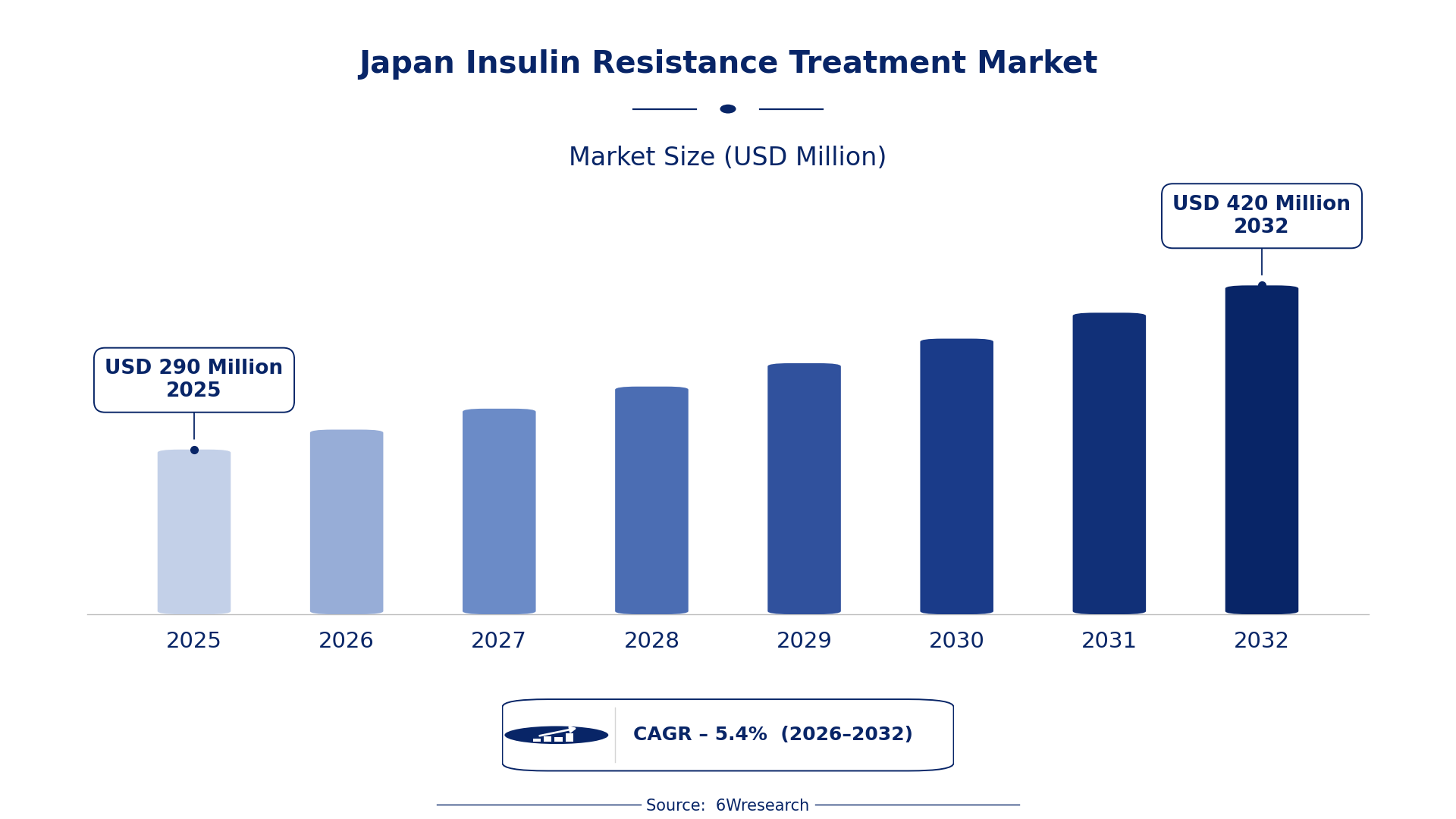
According to 6Wresearch internal database and industry insights, the Japan Insulin Resistance Treatment Market was valued at USD 290 Million in 2025 and is projected to reach USD 420 Million by 2032, growing at a CAGR of approximately 5.4% during 2026–2032.
Japan Insulin Resistance Treatment Market Highlights
| Report Metric | Details |
| Report Name | Japan Insulin Resistance Treatment Market (2026-2032) |
| Market Size 2025 | USD 290 Million |
| Market Size 2032 | USD 420 Million |
| Absolute Growth 2025–2032 | USD 130 Million |
| CAGR 2026–2032 | 5.4% |
| Peak Annual Growth | 6.4% in 2028 |
| Forecast Period | 2026–2032 |
| Historical Data | 2022–2025 |
| Base Year | 2025 |
| Leading Treatment Type, 2025 | Metformin Therapy (52% share) |
| Leading Drug Class, 2025 | Biguanides (51% share) |
| Leading Delivery Method, 2025 | Oral (44% share) |
| Leading Distribution Channel, 2025 | Hospital Pharmacies (49% share) |
| Leading End User, 2025 | Endocrinologists (45% share) |
| Fastest-Growing Treatment Type | Lifestyle Medication (7.6% CAGR) |
| Fastest-Growing Drug Class | Herbal/Nutraceuticals (7.2% CAGR) |
| Fastest-Growing Delivery Method | Subcutaneous (7.8% CAGR) |
| Fastest-Growing Distribution Channel | Wellness Stores (7.1% CAGR) |
| Fastest-Growing End User | Wellness Clinics (7.0% CAGR) |
| Growing Sector | Diabetes management |
| Key End Users | Endocrinologists, Wellness Clinics, Diabetic Centers |
Japan Insulin Resistance Treatment Market Year-wise Growth Rate and Key Drivers (2022–2032)
This graph illustrates the annual growth rates of the market from 2022 to 2032, highlighting a steady upward trajectory and projected market expansion over the forecast period.
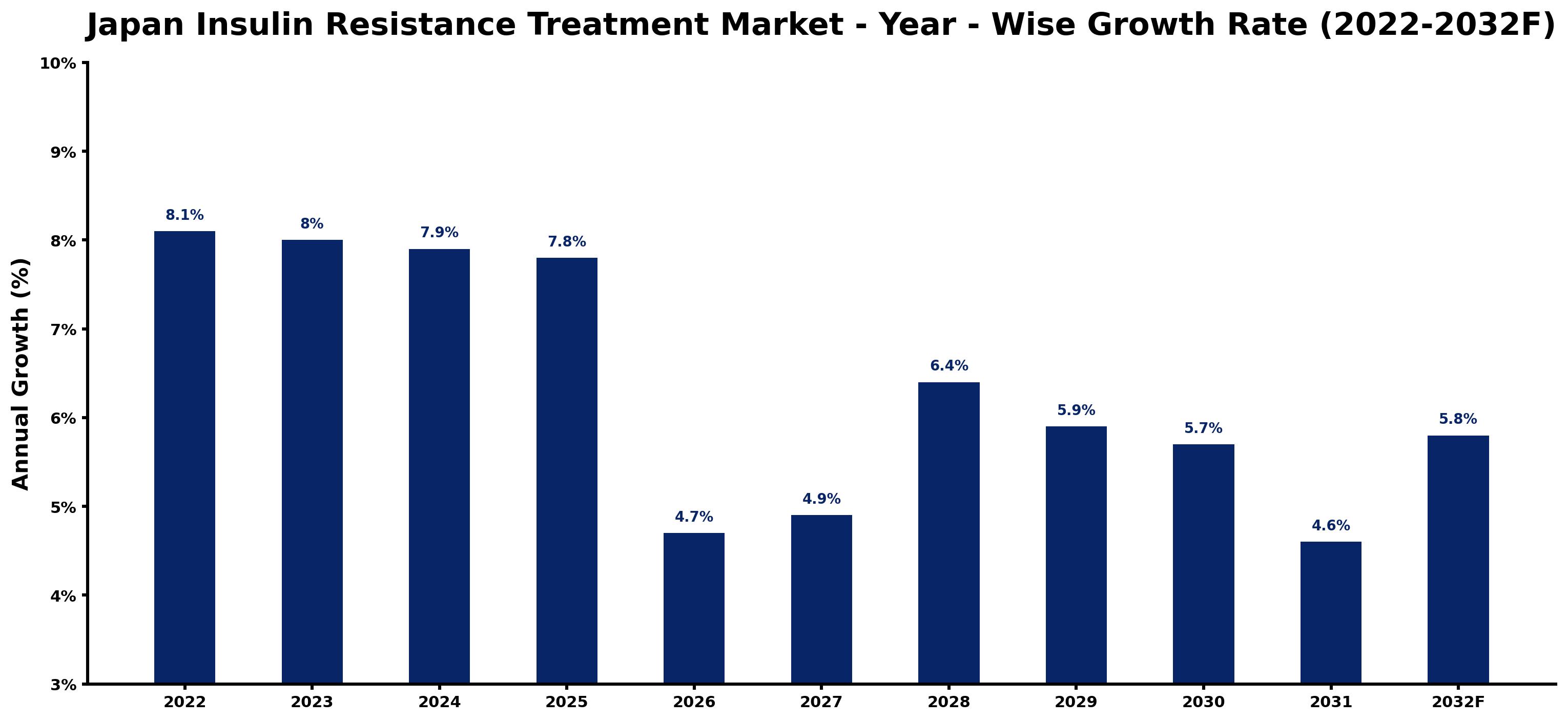
Below, each year's estimated growth is shown next to the factor that most influenced it.
| Year | Estimated Annual Growth (%) | Market Rationale |
| 2022 | 8.1 | The market experienced strong demand due to rising diabetes prevalence among adults over 40. |
| 2023 | 8.0 | Growth slowed slightly as the market adjusted to previous high levels of demand. |
| 2024 | 7.9 | A continued rise in insulin resistance cases contributed to ongoing market expansion. |
| 2025 | 7.8 | Market growth remained steady, supported by increasing healthcare initiatives for diabetes management. |
| 2026 | 4.7 | Growth is expected to slow as the market begins to stabilise after rapid expansion in previous years. |
| 2027 | 4.9 | Demand will increase as healthcare providers adopt new treatment protocols and therapies. |
| 2028 | 6.4 | The market is projected to peak due to heightened awareness and improved treatment options for diabetes. |
| 2029 | 5.9 | Growth will decelerate as the market adjusts to saturation in certain treatment areas. |
| 2030 | 5.7 | Demand is expected to continue slowing as competition intensifies among treatment options. |
| 2031 | 4.6 | Market growth will remain moderate as healthcare providers focus on cost-effective solutions. |
| 2032 | 5.8 | Demand is expected to rise again as new therapies and lifestyle interventions gain traction. |
Note: Market size estimations and growth projections presented in this report are based on 6Wresearch's proprietary forecasting methodology, utilizing the latest available industry data, government publications, and primary research inputs.
Japan Insulin Resistance Treatment Market Synopsis
Insulin resistance treatment includes medications and lifestyle changes aimed at improving insulin sensitivity, primarily for managing type 2 diabetes. The Japan Insulin Resistance Treatment Market is growing, driven by over 7 million diagnosed diabetes patients and increasing awareness among healthcare providers. Key growth drivers include the rising prevalence of insulin resistance, the popularity of combination therapies, and government campaigns that promote diabetes education and management, which stimulate demand for effective treatment options.
Market Dynamics Impact Analysis (2026–2032)
| Factor | Type | Impact | Primary Segment Affected |
| Rising diabetes prevalence among adults over 40 drives demand for effective treatments. | Driver | High | Metformin Therapy |
| Combination therapies are gaining traction among healthcare providers for improved efficacy. | Driver | High | Combination Therapies |
| Growing investment in diabetes management education creates opportunities for new programs. | Opportunity | High | Lifestyle Medication |
| Increased sales through online pharmacies present a significant market entry point. | Opportunity | Medium | Online Pharmacies |
| High competition among treatment options may limit market share for individual therapies. | Restraint | High | Injectable GLP-1 Agonists |
| Rising costs of diabetes medications could hinder access for some patients. | Restraint | Medium | Metformin Therapy |
| Regulatory compliance can delay the introduction of new treatment options. | Challenge | High | Combination Therapies |
| Capacity constraints in healthcare facilities may limit patient access to treatments. | Challenge | Medium | Endocrinologists |
Evaluation of Drivers in Japan Insulin Resistance Treatment Market (2026–2032)
The factors lifting demand, and the evidence behind each, are summarised below.
| Drivers | Primary Segment Affected | Why It Matters (Evidence) |
| Increased prevalence of diabetes among adults leads to higher demand for insulin resistance treatments. | Metformin Therapy | In 2023, over 7 million diagnosed diabetes patients in Japan are seeking effective management options. |
| Healthcare providers are adopting combination therapies for better patient outcomes. | Combination Therapies | Combination therapies are increasingly popular, supported by the Japanese Diabetes Society's guidelines. |
| Government campaigns are raising awareness about diabetes management and prevention. | Lifestyle Medication | The Ministry of Health launched a campaign in 2023 to promote diabetes awareness. |
| Online pharmacies are expanding access to diabetes medications, increasing sales. | Online Pharmacies | Sales of diabetes medications through online pharmacies increased by 20% in 2023. |
| Endocrinologists are actively prescribing insulin resistance treatments, driving demand. | Injectable GLP-1 Agonists | With over 10,000 endocrinologists in Japan, there is a strong push for effective diabetes management. |
The strongest pull on demand comes from the rising prevalence of diabetes, with over 7 million diagnosed patients seeking effective treatments. Healthcare providers are increasingly adopting combination therapies, improving patient outcomes. Campaigns promoting diabetes awareness further stimulate demand. The expansion of online pharmacies has led to increased sales of diabetes medications, improving access for patients. A significant number of endocrinologists actively prescribe insulin resistance treatments, driving market growth.
Evaluation of Restraints in Japan Insulin Resistance Treatment Market
The main factors holding the market back are set out below.
| Market Restraint | Primary Segment Affected | Why It Matters (Evidence) |
| Intense competition among treatment options limits individual therapy market share. | Injectable GLP-1 Agonists | With numerous therapies available, healthcare providers may opt for more established treatments. |
| Increasing medication costs can restrict access for some patients, affecting treatment adherence. | Metformin Therapy | Higher costs may deter patients from purchasing necessary medications for diabetes management. |
| Regulatory hurdles can delay the introduction of new therapies into the market. | Combination Therapies | Compliance with regulations can extend the time required for new treatments to reach patients. |
| Capacity constraints in healthcare facilities may limit the availability of treatments. | Endocrinologists | Limited resources can affect the number of patients that can be treated effectively. |
| Market saturation in certain treatment areas can slow overall growth rates. | Lifestyle Medication | As more options become available, the market may struggle to maintain high growth rates. |
Japan Insulin Resistance Treatment Market Challenges
Buyers of insulin resistance treatments are facing rising medication costs, which strain their budgets given the over 7 million diagnosed diabetes patients in Japan. Regulatory guidelines from the Japanese Diabetes Society impose strict protocols, causing delays in patient access to necessary medications by several weeks. A shortage of trained healthcare professionals complicates diabetes management, as the average age of diagnosis is around 65 years, creating a demand for experienced endocrinologists. The overall costs of diabetes care burden patients, with the National Health Insurance covering only a portion of expenses, resulting in substantial out-of-pocket payments for many individuals.
Trends in the Japan Insulin Resistance Treatment Market
Four trends stand out in the Japan Insulin Resistance Treatment Market.
- Shift towards Combination Therapies: In 2023, combination therapies gained popularity among healthcare providers, reflecting a 15% increase in prescriptions. This trend indicates a move towards more effective diabetes management strategies in facilities across Tokyo.
- Rise of Online Pharmacies: Online pharmacies in Japan saw a 25% increase in diabetes medication sales in 2023, demonstrating a shift in consumer purchasing habits. This change allows patients greater access to essential treatments.
- Growing Focus on Lifestyle Changes: The Tokyo Metropolitan Government initiated a health program in 2023 focusing on lifestyle changes for diabetes prevention, targeting a 30% reduction in new diabetes cases by 2025. This initiative highlights the importance of holistic management.
- Increased Investment in Diabetes Education: In 2023, the Japanese government allocated 1 billion yen for diabetes management education programs, aiming to improve patient knowledge and adherence. This investment is expected to improve treatment outcomes.
Investment Opportunities in the Japan Insulin Resistance Treatment Market
The openings below show where demand in the Japan Insulin Resistance Treatment Market is visible and how suppliers can enter.
- Increased Demand for Lifestyle Medication: With a rising prevalence of insulin resistance, there is an opportunity for lifestyle medication providers. The Japanese Diabetes Prevention Program aims to reduce new diabetes cases by 30% by 2025, creating a market gap for effective solutions.
- Expansion of Online Pharmacies: The growing trend of online pharmacies offers an opportunity to supply diabetes medications. Collaborating with local partners can facilitate entry into this expanding distribution channel, especially in urban areas.
- Investment in Combination Therapies: As healthcare providers increasingly adopt combination therapies, there is a need for suppliers to invest in these solutions. Endocrinologists are actively seeking effective treatment options, generating demand for new products.
- Government Support for Diabetes Programs: The Japanese government has allocated 1 billion yen for diabetes management education programs, creating opportunities for stakeholders. Engaging with local healthcare providers can enhance market entry and product adoption.
Government Initiatives in the Japan Insulin Resistance Treatment Market
The NHI drug price standard, revised regularly, directly influences the pricing and reimbursement of diabetes medications, ensuring treatment remains accessible to patients. This standard encourages manufacturers to maintain competitive pricing, ultimately benefiting consumers.
In 2023, the Japanese government allocated 1 billion yen for diabetes management education programs through the Ministry of Health, which oversees the implementation of these initiatives. This funding aims to improve patient knowledge and adherence to treatment.
Future Insight of the Japan Insulin Resistance Treatment Market
The investment pipeline for diabetes management will expand, driven by government funding for prevention programs and awareness campaigns. This will create demand for integrated care services, particularly in high-density areas like Tokyo and Osaka. Clinical research will flourish, with over 50 ongoing studies likely to produce new treatment options. The implementation of ISO 15197 standards will improve the accuracy of blood glucose monitoring devices, supporting effective management of insulin resistance.
Market Segmentation Analysis
Japan Insulin Resistance Treatment Market report covers a detailed analysis of the following market segments:
By Treatment Type – Metformin Therapy Leads, Lifestyle Medication Expected to Grow Fastest
According to Saurav Kr Singh, Senior Research Analyst at 6Wresearch, with 52% of treatment type revenue in 2025, Metformin Therapy was the largest category. Metformin therapy holds the largest share as it is extensively prescribed for managing insulin resistance, particularly among Japan's over 7 million diagnosed diabetes patients. This medication is widely accepted and recommended by healthcare providers following the guidelines set by the Japanese Diabetes Society. The quickest growth will come from Lifestyle Medication, forecast to expand at a CAGR of 7.6% between 2026 and 2032. Lifestyle medication is rapidly gaining traction, driven by initiatives such as the Ministry of Health's campaign promoting dietary changes and exercise among the population. This shift towards preventive care strategies indicates a growing emphasis on lifestyle modifications in diabetes management. Suppliers should incorporate lifestyle solutions into their product offerings to meet the rising demand for comprehensive diabetes management.
By Drug Class – Biguanides Lead, Herbal/Nutraceuticals Expected to Grow Fastest
The largest drug class category in 2025 was Biguanides, at 51% of revenue. Biguanides are the dominant drug class for insulin resistance, with Metformin being the most prescribed medication across Japan. Its established effectiveness in managing type 2 diabetes reinforces its leading market position. Over 2026–2032, Herbal/Nutraceuticals are expected to post the fastest growth, at a CAGR of 7.2%. Herbal and nutraceuticals are gaining popularity as complementary therapies, driven by a rising consumer interest in natural treatment options. This growth reflects a broader acceptance of holistic approaches in diabetes management among healthcare professionals. Suppliers should expand their product lines to include herbal and nutraceutical options to capture the emerging market segment.
By Delivery Method – Oral Leads, Subcutaneous Expected to Grow Fastest
Oral held 44% of the Japan Insulin Resistance Treatment Market by delivery method in 2025. Oral delivery is the most common method for administering insulin resistance treatments, reflecting its convenience and ease of use for patients. This method supports adherence to treatment regimens among the substantial population of diabetes patients in Japan. Subcutaneous is set to record the highest CAGR in this split, 7.8% over 2026–2032. Subcutaneous delivery is experiencing growth as it is increasingly used for specific injectable therapies that provide targeted treatment options. Technological advancements in delivery systems are enhancing patient experiences and driving this trend forward. Manufacturers should focus on developing innovative delivery systems to align with the changing preferences of patients and healthcare providers.
By Distribution Channel – Hospital Pharmacies Lead, Wellness Stores Expected to Grow Fastest
Hospital Pharmacies took 49% of distribution channel revenue in 2025, more than any other category. Hospital pharmacies are the primary distribution channel for insulin resistance treatments, ensuring direct access to medications for patients under care. This channel is vital as it allows endocrinologists to easily prescribe and dispense necessary treatments. Wellness Stores are projected to grow fastest, at a CAGR of 7.1% during 2026–2032. Wellness stores are rapidly expanding their range of lifestyle products, reflecting a consumer shift towards preventive health measures. This growth is fuelled by the increasing demand for integrated health solutions that address diabetes management holistically. Distributors should strengthen partnerships with wellness stores to tap into the growing market for lifestyle-oriented diabetes management products.
By End User – Endocrinologists Lead, Wellness Clinics Expected to Grow Fastest
In 2025, Endocrinologists led the end user split with a 45% share. Endocrinologists are the primary prescribers of insulin resistance treatments, playing a vital role in managing diabetes care for millions of patients in Japan. Their specialised knowledge ensures that patients receive personalised treatment plans based on established medical guidelines. The quickest growth will come from Wellness Clinics, forecast to expand at a CAGR of 7.0% between 2026 and 2032. Wellness clinics are emerging as a rapidly growing segment, providing integrated care services that combine medical treatment with lifestyle changes. This trend reflects the increasing focus on holistic approaches to diabetes management and patient care. Healthcare providers should explore partnerships with wellness clinics to improve patient care and broaden their service offerings.
Key Attractiveness of the Report
- 10 Years of Market Numbers
- Historical Data Starting from 2022 to 2025
- Base Year 2025
- Forecast Data until 2032
- Key Performance Indicators Impacting the Market
- Major Upcoming Developments and Projects
Key Highlights of the Report:
- Japan Insulin Resistance Treatment Market Outlook
- Market Size of Japan Insulin Resistance Treatment Market, 2025
- Forecast of Japan Insulin Resistance Treatment Market, 2032
- Historical Data and Forecast of Japan Insulin Resistance Treatment Revenues & Volume for the Period 2022-2032F
- Japan Insulin Resistance Treatment Market Trend Evolution
- Japan Insulin Resistance Treatment Market Drivers and Challenges
- Japan Insulin Resistance Treatment Price Trends
- Japan Insulin Resistance Treatment Porter's Five Forces
- Japan Insulin Resistance Treatment Industry Life Cycle
- Historical Data and Forecast of Japan Insulin Resistance Treatment Market Revenues & Volume By Treatment Type for the Period 2022-2032F
- Historical Data and Forecast of Japan Insulin Resistance Treatment Market Revenues & Volume By Metformin Therapy for the Period 2022-2032F
- Historical Data and Forecast of Japan Insulin Resistance Treatment Market Revenues & Volume By Lifestyle Medication for the Period 2022-2032F
- Historical Data and Forecast of Japan Insulin Resistance Treatment Market Revenues & Volume By Injectable GLP-1 Agonists for the Period 2022-2032F
- Historical Data and Forecast of Japan Insulin Resistance Treatment Market Revenues & Volume By Combination Therapies for the Period 2022-2032F
- Historical Data and Forecast of Japan Insulin Resistance Treatment Market Revenues & Volume By Drug Class for the Period 2022-2032F
- Historical Data and Forecast of Japan Insulin Resistance Treatment Market Revenues & Volume By Biguanides for the Period 2022-2032F
- Historical Data and Forecast of Japan Insulin Resistance Treatment Market Revenues & Volume By Herbal/Nutraceuticals for the Period 2022-2032F
- Historical Data and Forecast of Japan Insulin Resistance Treatment Market Revenues & Volume By Incretin Mimetics for the Period 2022-2032F
- Historical Data and Forecast of Japan Insulin Resistance Treatment Market Revenues & Volume By Mixed Agents for the Period 2022-2032F
- Historical Data and Forecast of Japan Insulin Resistance Treatment Market Revenues & Volume By Delivery Method for the Period 2022-2032F
- Historical Data and Forecast of Japan Insulin Resistance Treatment Market Revenues & Volume By Oral for the Period 2022-2032F
- Historical Data and Forecast of Japan Insulin Resistance Treatment Market Revenues & Volume By Oral for the Period 2022-2032F
- Historical Data and Forecast of Japan Insulin Resistance Treatment Market Revenues & Volume By Subcutaneous for the Period 2022-2032F
- Historical Data and Forecast of Japan Insulin Resistance Treatment Market Revenues & Volume By Mixed for the Period 2022-2032F
- Historical Data and Forecast of Japan Insulin Resistance Treatment Market Revenues & Volume By Distribution Channel for the Period 2022-2032F
- Historical Data and Forecast of Japan Insulin Resistance Treatment Market Revenues & Volume By Hospital Pharmacies for the Period 2022-2032F
- Historical Data and Forecast of Japan Insulin Resistance Treatment Market Revenues & Volume By Wellness Stores for the Period 2022-2032F
- Historical Data and Forecast of Japan Insulin Resistance Treatment Market Revenues & Volume By Online Pharmacies for the Period 2022-2032F
- Historical Data and Forecast of Japan Insulin Resistance Treatment Market Revenues & Volume By Direct Sales for the Period 2022-2032F
- Historical Data and Forecast of Japan Insulin Resistance Treatment Market Revenues & Volume By End User for the Period 2022-2032F
- Historical Data and Forecast of Japan Insulin Resistance Treatment Market Revenues & Volume By Endocrinologists for the Period 2022-2032F
- Historical Data and Forecast of Japan Insulin Resistance Treatment Market Revenues & Volume By Wellness Clinics for the Period 2022-2032F
- Historical Data and Forecast of Japan Insulin Resistance Treatment Market Revenues & Volume By Diabetic Centers for the Period 2022-2032F
- Historical Data and Forecast of Japan Insulin Resistance Treatment Market Revenues & Volume By Clinical Research Orgs for the Period 2022-2032F
- Japan Insulin Resistance Treatment Import Export Trade Statistics
- Market Opportunity Assessment By Treatment Type
- Market Opportunity Assessment By Drug Class
- Market Opportunity Assessment By Delivery Method
- Market Opportunity Assessment By Distribution Channel
- Market Opportunity Assessment By End User
- Japan Insulin Resistance Treatment Top Companies Market Share
- Japan Insulin Resistance Treatment Competitive Benchmarking By Technical and Operational Parameters
- Japan Insulin Resistance Treatment Company Profiles
- Japan Insulin Resistance Treatment Key Strategic Recommendations
Market Covered
The study includes the following segmentation.
By Treatment Type
- Metformin Therapy
- Lifestyle Medication
- Injectable GLP-1 Agonists
- Combination Therapies
By Drug Class
- Biguanides
- Herbal/Nutraceuticals
- Incretin Mimetics
- Mixed Agents
By Delivery Method
- Oral
- Subcutaneous
- Mixed
By Distribution Channel
- Hospital Pharmacies
- Wellness Stores
- Online Pharmacies
- Direct Sales
By End User
- Endocrinologists
- Wellness Clinics
- Diabetic Centers
- Clinical Research Orgs































