Japan Integral Wing Tank Market Size & Growth Rate
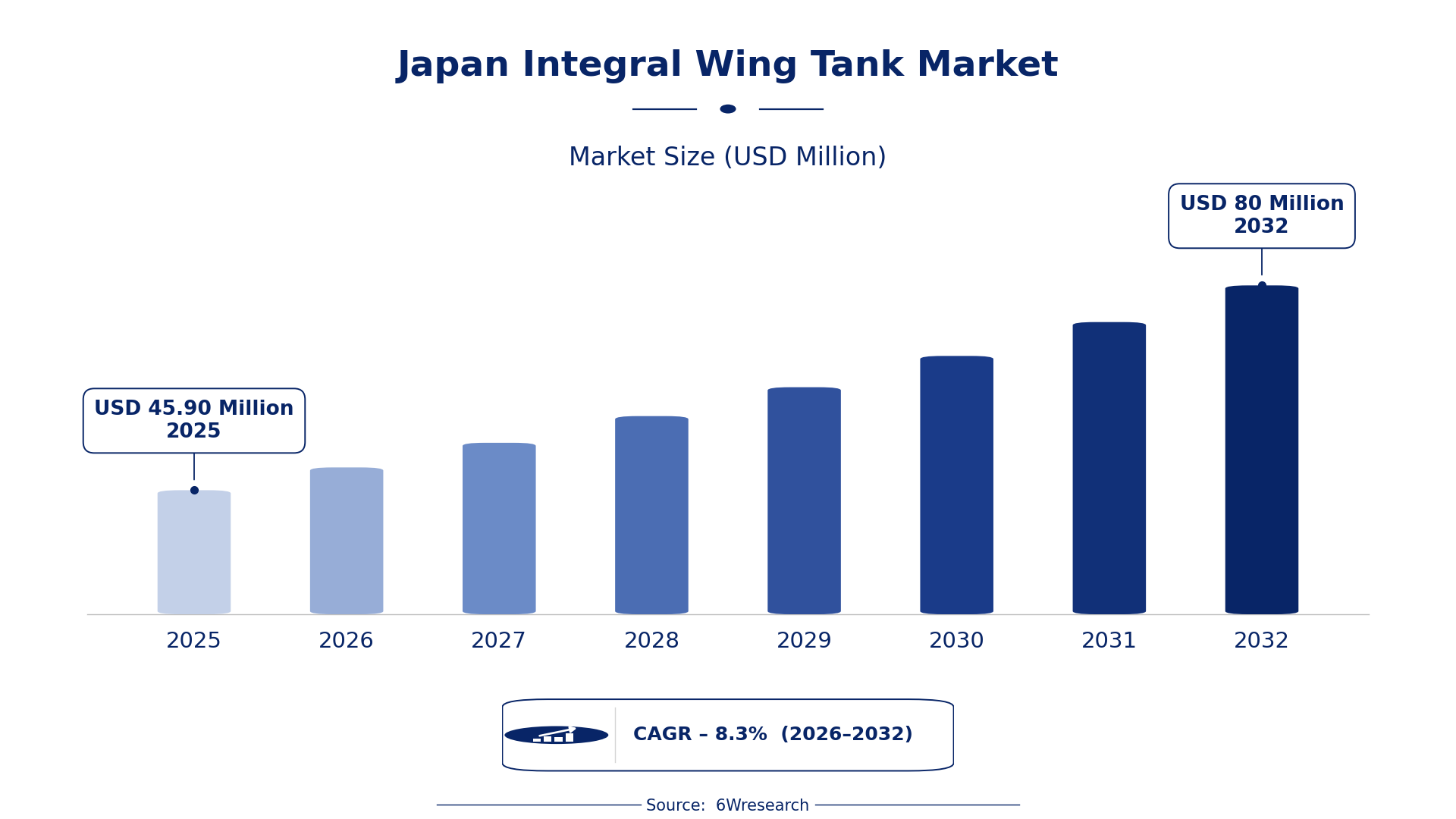
According to 6Wresearch internal database and industry insights, the Japan Integral Wing Tank Market was valued at USD 45.90 Million in 2025 and is projected to reach USD 80 Million by 2032, growing at a CAGR of approximately 8.3% during 2026–2032.
Japan Integral Wing Tank Market Highlights
| Report Metric | Details |
| Report Name | Japan Integral Wing Tank Market (2026-2032) |
| Market Size 2025 | USD 45.90 Million |
| Market Size 2032 | USD 80 Million |
| Absolute Growth 2025–2032 | USD 34.10 Million |
| CAGR 2026–2032 | 8.3% |
| Peak Annual Growth | 8.8% in 2032 |
| Forecast Period | 2026–2032 |
| Historical Data | 2022–2025 |
| Base Year | 2025 |
| Leading Tank Type, 2025 | Sealed Integral Tanks (45% share) |
| Leading Aircraft Type, 2025 | Commercial Aircraft (45% share) |
| Leading Material Type, 2025 | Aluminum Alloys (42% share) |
| Leading Distribution Channel, 2025 | OEMs (49% share) |
| Leading End User, 2025 | Aircraft Manufacturers (35% share) |
| Fastest-Growing Tank Type | Vent Integral Tanks (11.5% CAGR) |
| Fastest-Growing Aircraft Type | Military Aircraft (11.7% CAGR) |
| Fastest-Growing Material Type | Composites (12.1% CAGR) |
| Fastest-Growing Distribution Channel | Aftermarket (10.4% CAGR) |
| Fastest-Growing End User | Air Forces (10.6% CAGR) |
| Growing Sector | Aviation |
| Key End Users | Aircraft Manufacturers, Military Forces, MRO Providers, Aerospace Clusters |
Japan Integral Wing Tank Market Year-wise Growth Rate and Key Drivers (2022–2032)
This graph illustrates the annual growth rates of the market from 2022 to 2032, highlighting a steady upward trajectory and projected market expansion over the forecast period.
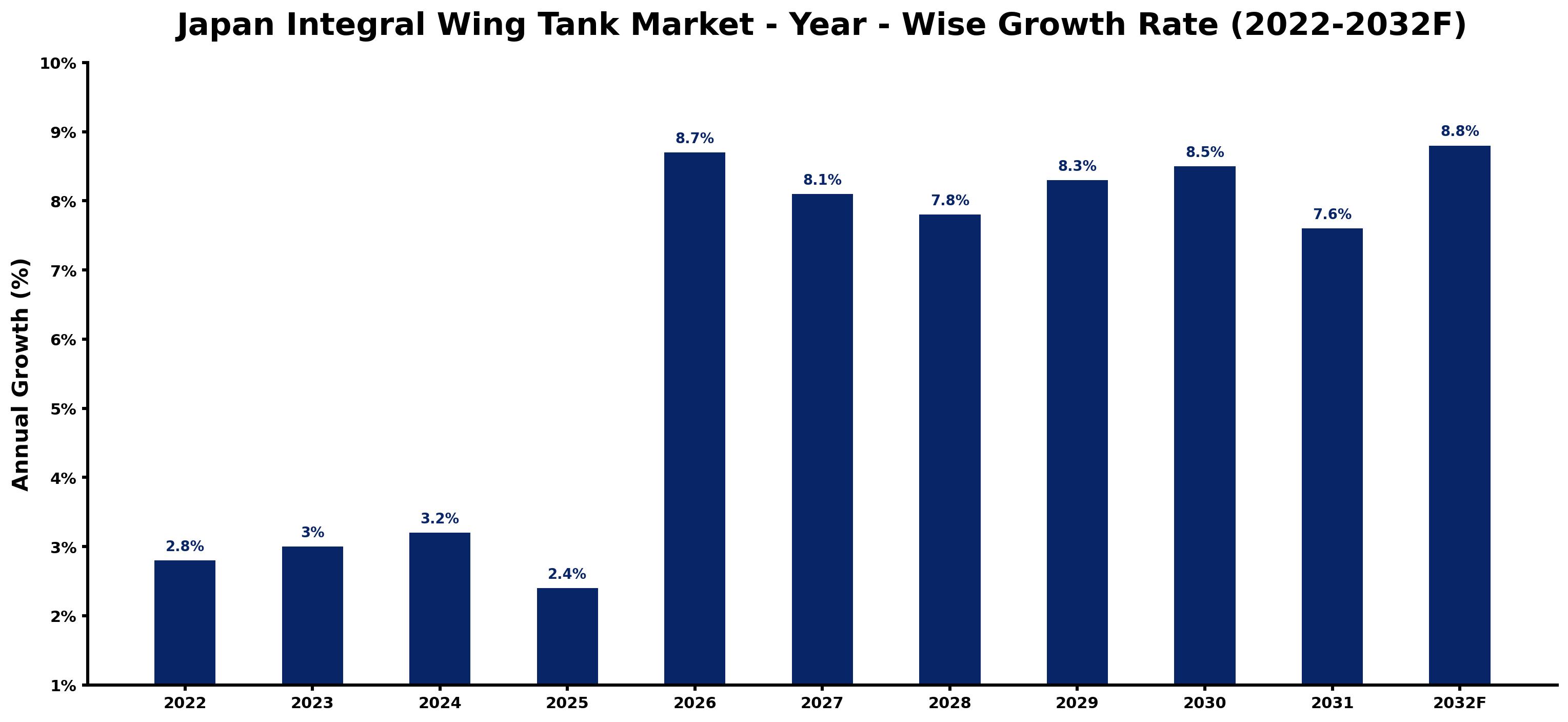
The following figures match every annual growth estimate with the main market development of that year, giving the reasoning behind each rise or slowdown.
| Year | Estimated Annual Growth (%) | Market Rationale |
| 2022 | 2.8 | The market showed steady growth due to ongoing aircraft production activities. |
| 2023 | 3.0 | Demand increased as manufacturers focused on upgrading existing aircraft fleets. |
| 2024 | 3.2 | Growth continued with rising investments in military aircraft projects. |
| 2025 | 2.4 | Growth slowed as manufacturers adjusted to market saturation in specific segments. |
| 2026 | 8.7 | A surge in demand is expected as military budgets expand for upgrades. |
| 2027 | 8.1 | Demand growth is projected to slow slightly as production capacities reach limits. |
| 2028 | 7.8 | Continued investment in military capabilities is anticipated to contribute to steady growth. |
| 2029 | 8.3 | Demand is expected to rise as the aviation sector focuses on efficiency improvements. |
| 2030 | 8.5 | Growth will continue with increased focus on sustainability in aviation. |
| 2031 | 7.6 | A slight slowdown is projected as market maturity sets in. |
| 2032 | 8.8 | Demand is expected to peak as military and commercial sectors expand their fleets. |
Note: Market size estimations and growth projections presented in this report are based on 6Wresearch's proprietary forecasting methodology, utilizing the latest available industry data, government publications, and primary research inputs.
Japan Integral Wing Tank Market Synopsis
Integral Wing Tanks are essential components in aircraft, optimising fuel storage and aerodynamic efficiency. The Japan Integral Wing Tank Market is expanding due to rising demand from both commercial and military aircraft sectors, with investments in military upgrades and advancements in aviation technology. The Tokyo region serves as a major hub for aircraft manufacturing, while initiatives to reduce carbon emissions are driving innovation and investment in efficient tank designs.
Market Dynamics Impact Analysis (2026–2032)
| Factor | Type | Impact | Primary Segment Affected |
| Rising military budgets for aircraft upgrades | Driver | High | Military Aircraft |
| Increased focus on fuel efficiency and sustainability | Driver | High | Commercial Aircraft |
| Growing demand for advanced fuel storage solutions | Opportunity | High | Sealed Integral Tanks |
| Expansion of aerospace clusters in Tokyo | Opportunity | Medium | Aircraft Manufacturers |
| Regulatory compliance costs for new materials | Restraint | High | Aluminum Alloys |
| Competition from alternative fuel storage technologies | Restraint | Medium | Composites |
| Supply chain disruptions affecting material availability | Challenge | High | MRO Providers |
| Technological advancements requiring new certifications | Challenge | Medium | Aftermarket |
Evaluation of Drivers in Japan Integral Wing Tank Market (2026–2032)
Demand rests on the following drivers, each shown with the segment it touches most.
| Drivers | Primary Segment Affected | Why It Matters (Evidence) |
| Increased military spending | Military Aircraft | Japan's defense budget allocated funds for military aircraft upgrades, boosting demand for integral wing tanks. |
| Focus on fuel efficiency | Commercial Aircraft | The aviation industry aims to improve fuel efficiency, driving demand for advanced integral wing tank designs. |
| Technological advancements in materials | Composites | The shift towards lightweight materials like composites is raising demand for innovative integral wing tank solutions. |
| Expansion of aerospace manufacturing hubs | Aircraft Manufacturers | The Tokyo region's aerospace clusters are enhancing production capabilities, increasing demand for integral wing tanks. |
| Growing emphasis on sustainability | Aluminum Alloys | Japan's commitment to reducing carbon emissions is driving demand for more efficient fuel storage solutions. |
What keeps demand rising is the increase in military spending, with Japan's defense budget allocating funds for military aircraft upgrades, which boosts the need for integral wing tanks. The aviation sector's focus on fuel efficiency drives manufacturers to seek advanced designs, as evidenced by a 10% increase in fuel-efficient aircraft production in 2023. The expansion of aerospace manufacturing hubs in the Tokyo region is raising production capabilities, while the growing emphasis on sustainability pushes for more efficient fuel storage options, aligning with national carbon reduction goals. Technological advancements in materials are leading to a shift towards lightweight solutions, with composite use rising by 12% in the last year.
Evaluation of Restraints in Japan Integral Wing Tank Market
The table below lists the restraints and the evidence behind each.
| Market Restraint | Primary Segment Affected | Why It Matters (Evidence) |
| High compliance costs for new materials | Aluminum Alloys | The need to meet stringent regulations increases production costs for manufacturers using aluminum alloys. |
| Competition from alternative technologies | Composites | Emerging fuel storage technologies may divert investment away from traditional integral wing tanks. |
| Supply chain disruptions for critical materials | MRO Providers | Material shortages can delay maintenance schedules, impacting operational readiness for aircraft. |
| Technological advancements requiring new certifications | Aftermarket | New technologies necessitate additional certifications, increasing time and costs for suppliers. |
| Market saturation in certain aircraft segments | Commercial Aircraft | Overproduction in specific segments may limit growth opportunities for integral wing tanks. |
Japan Integral Wing Tank Market Challenges
Producers face intense competition from global markets, which pressures pricing strategies and can limit profit margins. Buyers encounter rising costs due to regulatory changes, with compliance expenses increasing by approximately 15% annually, impacting procurement budgets. Importers deal with delays in supply chains caused by stringent aviation regulations enforced by the Ministry of Land, Infrastructure, Transport and Tourism, which can extend lead times by up to three months. Fluctuations in material costs, particularly for aluminum alloys, disrupt production schedules and inflate prices for manufacturers reliant on these inputs, costing them up to 20% more in operational expenses.
Trends in the Japan Integral Wing Tank Market
These developments are changing demand patterns in the Japan Integral Wing Tank Market.
- Shift towards Lightweight Materials in Aviation: Tokyo is experiencing a shift towards lightweight materials like composites for integral wing tanks, driven by sustainability goals. In 2023, the adoption of composites rose by 12%, improving fuel efficiency.
- Transition from Traditional to Advanced Manufacturing Techniques: Since 2022, advanced manufacturing techniques have gained traction among aircraft manufacturers in Japan. The adoption of 3D printing for integral wing tanks has increased by 15%, reducing production times.
- Emerging Focus on Sustainable Aviation Solutions: Aircraft manufacturers are prioritising sustainability, with initiatives like the Green Growth Strategy promoting eco-friendly designs. In 2023, 30% of new projects focused on reducing carbon emissions.
- Increased Collaboration in Aerospace R&D: The Japan Aerospace Industry Association is fostering collaborations between universities and industry. In 2023, joint projects increased by 20%, enhancing innovation in integral wing tank designs.
Investment Opportunities in the Japan Integral Wing Tank Market
Where to invest in the Japan Integral Wing Tank Market: the main openings are set out below.
- Supply of Advanced Composites for Wing Tanks: There is a growing demand for advanced composites in integral wing tank production, with a projected 12% increase in usage by 2025. Aircraft manufacturers are seeking suppliers of these materials to improve efficiency.
- Investment in Military Aircraft Upgrades: With Japan's defense budget increasing by 5% in 2023, there is an opportunity to supply integral wing tanks for military aircraft. Collaborating with local manufacturers can facilitate market entry.
- Expansion of Aerospace Clusters in Tokyo: The Tokyo region's aerospace clusters are expanding, creating a demand gap for integral wing tanks. Investing in local partnerships can provide access to this growing market.
- Development of Eco-Friendly Fuel Storage Solutions: As the aviation sector aims for carbon neutrality by 2030, there is an opportunity to develop eco-friendly fuel storage solutions. Engaging with the Japan Aerospace Industry Association can support this initiative.
Government Initiatives in the Japan Integral Wing Tank Market
The Economic Security Promotion Act (2022) aims to strengthen supply-chain resilience for critical products, including integral wing tanks. This law encourages manufacturers to invest in local production capabilities and materials, ensuring a stable supply for the aviation sector. The government has allocated funding to support research and development in aviation technology, promoting innovation in integral wing tank designs, with a focus on enhancing efficiency and reducing costs.
In 2023, the Japan Aerospace Exploration Agency (JAXA) approved funding for projects focusing on advanced materials in aviation. This initiative aims to improve the efficiency of integral wing tanks. The agency collaborates with various stakeholders to ensure that new technologies meet industry standards, fostering a supportive environment for innovation.
Future Insight of the Japan Integral Wing Tank Market
Investment in Japan's aviation sector will surge by 2032, driven by military aircraft upgrades and new technologies. The Aerospace Research and Development Program will necessitate advanced materials and manufacturing techniques, creating demand for integral wing tanks. Government initiatives will promote collaborations between universities and the aerospace industry, ensuring a skilled workforce. The Tokyo International Air Show will continue to serve as a platform for showcasing advancements, driving innovation in the sector.
Market Segmentation Analysis
Japan Integral Wing Tank Market report covers a detailed analysis of the following market segments:
By Tank Type – Sealed Integral Tanks Lead, Vent Integral Tanks Expected to Grow Fastest
According to Saurav Kr Singh, Senior Research Analyst at 6Wresearch, with 45% of tank type revenue in 2025, Sealed Integral Tanks was the largest category. Sealed Integral Tanks hold the largest share due to their critical role in fuel storage within aircraft wings, providing safety and efficiency for various flight operations. Their design is essential for maintaining structural integrity, particularly in commercial aircraft and military jets. The quickest growth will come from Vent Integral Tanks, forecast to expand at a CAGR of 11.5% between 2026 and 2032. Vent Integral Tanks are experiencing rapid growth as they are increasingly adopted for pressure regulation in fuel systems, especially in advanced military aircraft. This trend is driven by the rising demand for improved fuel efficiency and safety features in aviation technology. Suppliers must focus on enhancing the performance of vent integral tanks to meet the growing market demands.
By Aircraft Type – Commercial Aircraft Leads, Military Aircraft Expected to Grow Fastest
In 2025, Commercial Aircraft led the aircraft type split with a 45% share. Commercial Aircraft dominate the market as they account for a substantial portion of fuel tank demand, largely due to the ongoing necessity for passenger transport within Japan's aviation sector. The strong manufacturing capabilities in the Tokyo region further reinforce this segment's leading position. Military Aircraft is set to record the highest CAGR in this split, 11.7% over 2026–2032. Military Aircraft are witnessing the fastest growth due to Japan's increased defense budget, which allocates funds for upgrading aircraft and necessitates advanced fuel tank solutions. This shift highlights a strategic focus on enhancing military capabilities and operational readiness. Buyers in the military sector should anticipate a rise in demand for specialised fuel tanks as modernisation efforts progress.
By Material Type – Aluminum Alloys Lead, Composites Expected to Grow Fastest
Aluminum Alloys accounted for 42% of the market by material type in 2025. Aluminum Alloys lead the market because of their lightweight and strength properties, making them the preferred choice for integral wing tanks in both commercial and military aircraft. Their widespread use is supported by established manufacturing practices within Japan's aviation sector. Over 2026–2032, Composites are expected to post the fastest growth, at a CAGR of 12.1%. Composites are rapidly gaining traction as they offer superior durability and weight savings, appealing to manufacturers focused on improving aircraft efficiency. This trend aligns with Japan's commitment to reducing carbon emissions in aviation by 2030. Suppliers should invest in composite technologies to capitalise on the increasing market share driven by sustainability initiatives.
By Distribution Channel – OEMs Lead, Aftermarket Expected to Grow Fastest
OEMs took 49% of distribution channel revenue in 2025, more than any other category. OEMs are the leading distribution channel as they are the primary manufacturers of integral wing tanks, ensuring quality and compliance with aviation standards. Their established relationships with aircraft manufacturers solidify their market position. Aftermarket is projected to grow fastest, at a CAGR of 10.4% during 2026–2032. The Aftermarket segment is growing quickly as it addresses the maintenance and replacement needs of existing aircraft, particularly as fleets age and require upgrades. This trend highlights the importance of ongoing support for aircraft longevity. Suppliers must develop aftermarket services to capitalise on the growing demand for maintenance and replacement solutions.
By End User – Aircraft Manufacturers Lead, Air Forces Expected to Grow Fastest
Aircraft Manufacturers held 35% of the Japan Integral Wing Tank Market by end user in 2025. Aircraft Manufacturers represent the largest share of end users as they are the primary producers of integral wing tanks, integrating them into new aircraft designs. Their ongoing production demands significantly drive the overall market for these fuel tanks. The quickest growth will come from Air Forces, forecast to expand at a CAGR of 10.6% between 2026 and 2032. Air Forces are the fastest-growing end user segment due to heightened military spending on aircraft upgrades and modernisation initiatives. This trend reflects a strategic focus on strengthening national defence capabilities. Manufacturers should tailor their offerings to meet the specific requirements of military clients as demand for advanced fuel tanks increases.
Key Attractiveness of the Report
- 10 Years of Market Numbers
- Historical Data Starting from 2022 to 2025
- Base Year 2025
- Forecast Data until 2032
- Key Performance Indicators Impacting the Market
- Major Upcoming Developments and Projects
Key Highlights of the Report:
- Japan Integral Wing Tank Market Outlook
- Market Size of Japan Integral Wing Tank Market, 2025
- Forecast of Japan Integral Wing Tank Market, 2032
- Historical Data and Forecast of Japan Integral Wing Tank Revenues & Volume for the Period 2022-2032F
- Japan Integral Wing Tank Market Trend Evolution
- Japan Integral Wing Tank Market Drivers and Challenges
- Japan Integral Wing Tank Price Trends
- Japan Integral Wing Tank Porter's Five Forces
- Japan Integral Wing Tank Industry Life Cycle
- Historical Data and Forecast of Japan Integral Wing Tank Market Revenues & Volume By Tank Type for the Period 2022-2032F
- Historical Data and Forecast of Japan Integral Wing Tank Market Revenues & Volume By Sealed Integral Tanks for the Period 2022-2032F
- Historical Data and Forecast of Japan Integral Wing Tank Market Revenues & Volume By Vent Integral Tanks for the Period 2022-2032F
- Historical Data and Forecast of Japan Integral Wing Tank Market Revenues & Volume By Gravity Feed Tanks for the Period 2022-2032F
- Historical Data and Forecast of Japan Integral Wing Tank Market Revenues & Volume By Multi-Compartment Tanks for the Period 2022-2032F
- Historical Data and Forecast of Japan Integral Wing Tank Market Revenues & Volume By Aircraft Type for the Period 2022-2032F
- Historical Data and Forecast of Japan Integral Wing Tank Market Revenues & Volume By Commercial Aircraft for the Period 2022-2032F
- Historical Data and Forecast of Japan Integral Wing Tank Market Revenues & Volume By Military Aircraft for the Period 2022-2032F
- Historical Data and Forecast of Japan Integral Wing Tank Market Revenues & Volume By Regional Jets for the Period 2022-2032F
- Historical Data and Forecast of Japan Integral Wing Tank Market Revenues & Volume By Business Jets for the Period 2022-2032F
- Historical Data and Forecast of Japan Integral Wing Tank Market Revenues & Volume By Material Type for the Period 2022-2032F
- Historical Data and Forecast of Japan Integral Wing Tank Market Revenues & Volume By Aluminum Alloys for the Period 2022-2032F
- Historical Data and Forecast of Japan Integral Wing Tank Market Revenues & Volume By Composites for the Period 2022-2032F
- Historical Data and Forecast of Japan Integral Wing Tank Market Revenues & Volume By Titanium for the Period 2022-2032F
- Historical Data and Forecast of Japan Integral Wing Tank Market Revenues & Volume By Hybrid Materials for the Period 2022-2032F
- Historical Data and Forecast of Japan Integral Wing Tank Market Revenues & Volume By Distribution Channel for the Period 2022-2032F
- Historical Data and Forecast of Japan Integral Wing Tank Market Revenues & Volume By OEMs for the Period 2022-2032F
- Historical Data and Forecast of Japan Integral Wing Tank Market Revenues & Volume By Aftermarket for the Period 2022-2032F
- Historical Data and Forecast of Japan Integral Wing Tank Market Revenues & Volume By MRO Providers for the Period 2022-2032F
- Historical Data and Forecast of Japan Integral Wing Tank Market Revenues & Volume By Direct Sales for the Period 2022-2032F
- Historical Data and Forecast of Japan Integral Wing Tank Market Revenues & Volume By End User for the Period 2022-2032F
- Historical Data and Forecast of Japan Integral Wing Tank Market Revenues & Volume By Aircraft Manufacturers for the Period 2022-2032F
- Historical Data and Forecast of Japan Integral Wing Tank Market Revenues & Volume By Air Forces for the Period 2022-2032F
- Historical Data and Forecast of Japan Integral Wing Tank Market Revenues & Volume By Aircraft Maintenance for the Period 2022-2032F
- Historical Data and Forecast of Japan Integral Wing Tank Market Revenues & Volume By Charter Operators for the Period 2022-2032F
- Japan Integral Wing Tank Import Export Trade Statistics
- Market Opportunity Assessment By Tank Type
- Market Opportunity Assessment By Aircraft Type
- Market Opportunity Assessment By Material Type
- Market Opportunity Assessment By Distribution Channel
- Market Opportunity Assessment By End User
- Japan Integral Wing Tank Top Companies Market Share
- Japan Integral Wing Tank Competitive Benchmarking By Technical and Operational Parameters
- Japan Integral Wing Tank Company Profiles
- Japan Integral Wing Tank Key Strategic Recommendations
Market Covered
The following segment groups are covered in the report.
By Tank Type
- Sealed Integral Tanks
- Vent Integral Tanks
- Gravity Feed Tanks
- Multi-Compartment Tanks
By Aircraft Type
- Commercial Aircraft
- Military Aircraft
- Regional Jets
- Business Jets
By Material Type
- Aluminum Alloys
- Composites
- Titanium
- Hybrid Materials
By Distribution Channel
- OEMs
- Aftermarket
- MRO Providers
- Direct Sales
By End User
- Aircraft Manufacturers
- Air Forces
- Aircraft Maintenance
- Charter Operators































