Japan Integrated Air Surveillance Radar Market Size & Growth Rate
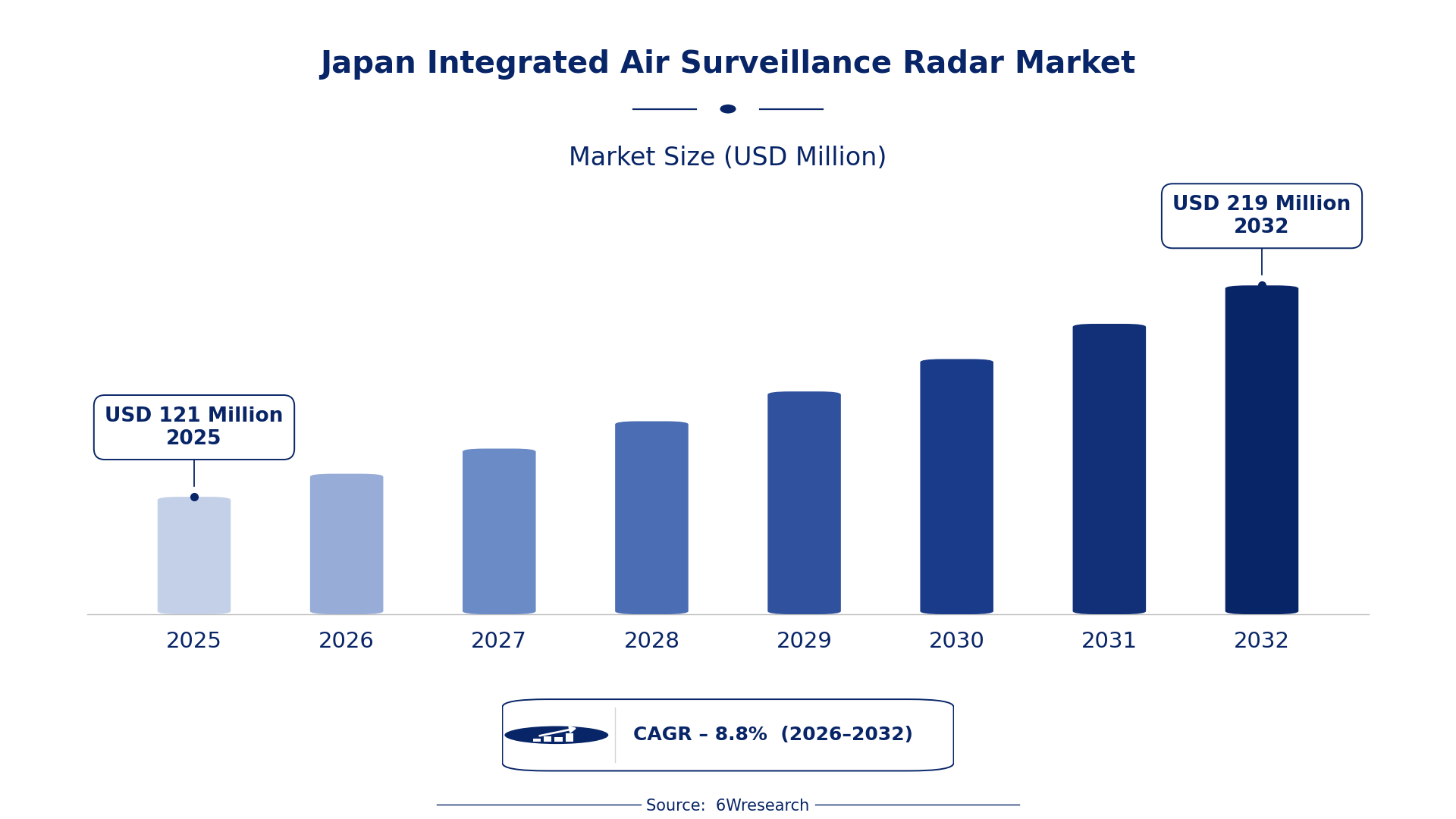
According to 6Wresearch internal database and industry insights, the Japan Integrated Air Surveillance Radar Market was valued at USD 121 Million in 2025 and is projected to reach USD 219 Million by 2032, growing at a CAGR of approximately 8.8% during 2026–2032.
Japan Integrated Air Surveillance Radar Market Highlights
| Report Metric | Details |
| Report Name | Japan Integrated Air Surveillance Radar Market (2026-2032) |
| Market Size 2025 | USD 121 Million |
| Market Size 2032 | USD 219 Million |
| Absolute Growth 2025–2032 | USD 98 Million |
| CAGR 2026–2032 | 8.8% |
| Peak Annual Growth | 10.2% in 2028 |
| Forecast Period | 2026–2032 |
| Historical Data | 2022–2025 |
| Base Year | 2025 |
| Leading Radar Type, 2025 | Ground-Based Radar (53% share) |
| Leading Frequency Band, 2025 | L-Band (50% share) |
| Leading Platform Type, 2025 | Stationary (39% share) |
| Leading Detection Range, 2025 | Long Range (55% share) |
| Leading End User, 2025 | Military Bases (48% share) |
| Fastest-Growing Radar Type | Mobile Radar Units (12.5% CAGR) |
| Fastest-Growing Frequency Band | X-Band (11.0% CAGR) |
| Fastest-Growing Platform Type | Aircraft (11.9% CAGR) |
| Fastest-Growing Detection Range | Medium Range (11.2% CAGR) |
| Fastest-Growing End User | Defense Agencies (10.9% CAGR) |
| Growing Sector | military surveillance |
| Key End Users | military bases, defense agencies, emergency services |
Japan Integrated Air Surveillance Radar Market Year-wise Growth Rate and Key Drivers (2022–2032)
This graph illustrates the annual growth rates of the market from 2022 to 2032, highlighting a steady upward trajectory and projected market expansion over the forecast period.
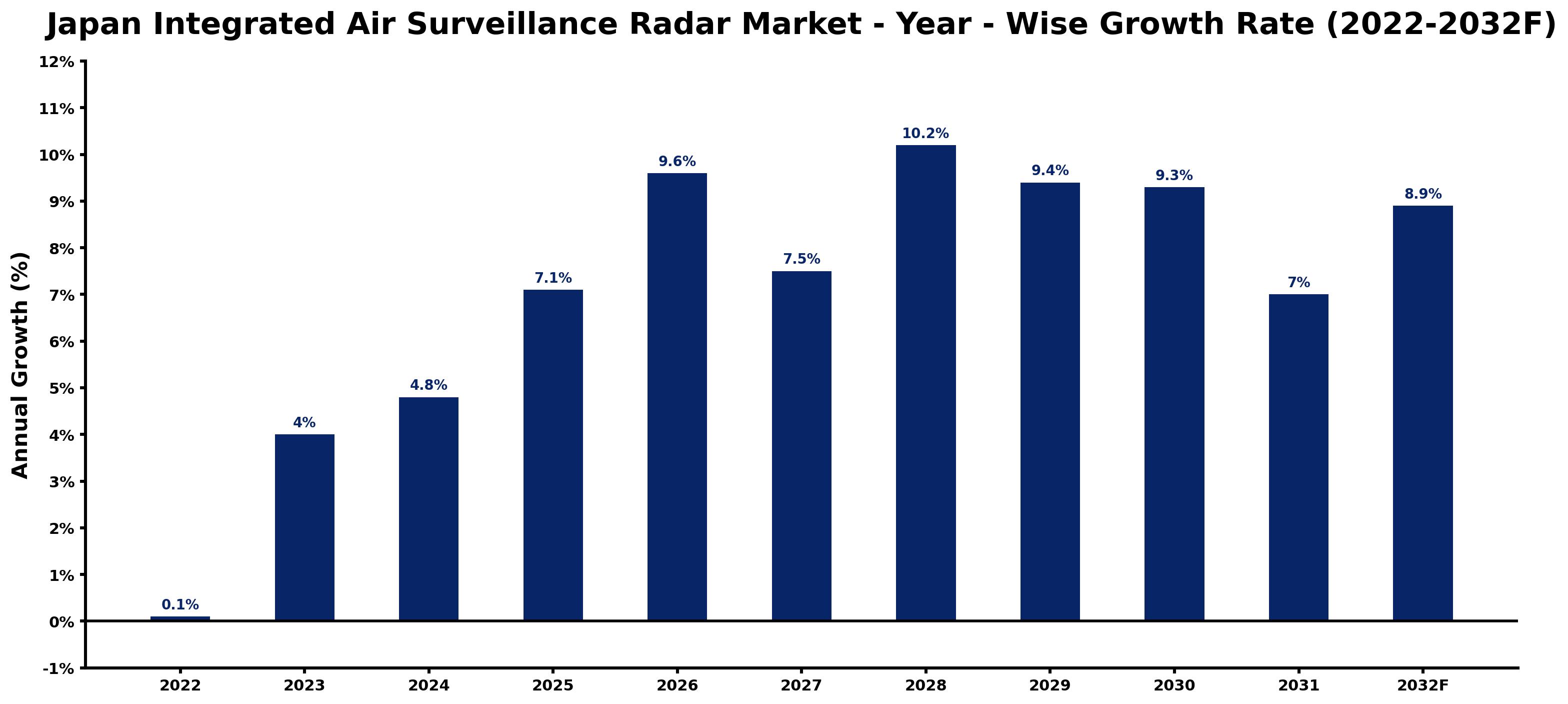
Each row of the following table gives one year's estimated growth and the event or demand shift that explains it.
| Year | Estimated Annual Growth (%) | Market Rationale |
| 2022 | 0.1 | The market experienced minimal growth due to existing installations and limited upgrades. |
| 2023 | 4.0 | Demand increased as military bases began implementing new radar systems for improved surveillance. |
| 2024 | 4.8 | Growth continued as the Japan Self-Defense Forces expanded their radar capabilities. |
| 2025 | 7.1 | A rise occurred as budgets for radar upgrades were allocated by the Ministry of Defense. |
| 2026 | 9.6 | Demand is expected to surge with the introduction of advanced radar technologies in military exercises. |
| 2027 | 7.5 | Growth is projected to slow as the market adjusts to previous high investments and upgrades. |
| 2028 | 10.2 | A peak in growth is anticipated as new defense strategies emphasise advanced radar capabilities. |
| 2029 | 9.4 | Demand growth is expected to slow as military bases complete upgrades to existing systems. |
| 2030 | 9.3 | Market growth is projected to stabilise as the focus shifts towards maintenance and operational efficiency. |
| 2031 | 7.0 | A further slowdown is expected as the market adjusts to previous high growth rates. |
| 2032 | 8.9 | Demand is expected to rise again as new technologies are integrated into existing systems. |
Note: Market size estimations and growth projections presented in this report are based on 6Wresearch's proprietary forecasting methodology, utilizing the latest available industry data, government publications, and primary research inputs.
Japan Integrated Air Surveillance Radar Market Synopsis
Integrated Air Surveillance Radar detects and tracks aerial objects using advanced electronic components and algorithms. Its primary applications include military surveillance, air traffic control, and border security. The Japan Integrated Air Surveillance Radar Market is expanding due to increased investments in national defense, with military bases and defense agencies driving demand. In 2023, the Ministry of Defense allocated budgets for radar upgrades, stimulating market growth as Japan improves its airspace safety and surveillance capabilities.
Market Dynamics Impact Analysis (2026–2032)
| Factor | Type | Impact | Primary Segment Affected |
| Increased defense spending and modernization of military capabilities | Driver | High | Ground-Based Radar |
| Growing demand for high-resolution tracking in air traffic management | Driver | High | X-Band |
| Expansion of military bases in key regions | Opportunity | High | Military Bases |
| Integration of radar systems into new aircraft models | Opportunity | High | Aircraft |
| Challenges in maintaining aging radar systems | Restraint | Medium | Ground-Based Radar |
| Dependence on foreign technology for certain radar components | Restraint | Medium | Airborne Radar |
| Limited domestic production capacity for advanced radar systems | Challenge | High | Naval Radar |
| High costs associated with upgrading existing radar infrastructure | Challenge | Medium | Mobile Radar Units |
Evaluation of Drivers in Japan Integrated Air Surveillance Radar Market (2026–2032)
These are the developments adding the most demand over the forecast period.
| Drivers | Primary Segment Affected | Why It Matters (Evidence) |
| Increased military budgets for radar technology upgrades | Ground-Based Radar | The Ministry of Defense allocated budgets for radar upgrades in 2023, resulting in more purchases by military bases. |
| Rising air traffic necessitating advanced tracking systems | X-Band | With Japan's population of 126 million, the need for precise air traffic control drives demand for high-resolution radar. |
| Focus on national security and border surveillance | L-Band | The emphasis on airspace safety boosts demand for long-range detection capabilities. |
| Integration of radar systems into modern aircraft | Airborne Radar | Increased oversight of radar integration raises demand for airborne radar systems. |
| Deployment of mobile radar units for disaster response | Mobile Radar Units | Emergency services increasingly utilise mobile radar units, improving their operational capabilities during disasters. |
This investment leads military bases to purchase more radar systems, improving their surveillance capabilities. Rising air traffic necessitates advanced tracking systems, driving demand for high-resolution radar. The focus on national security boosts the need for long-range detection capabilities, while the integration of radar systems into modern aircraft increases demand for airborne radar. Emergency services are deploying mobile radar units for effective disaster response.
Evaluation of Restraints in Japan Integrated Air Surveillance Radar Market
The following restraints limit how fast demand can grow.
| Market Restraint | Primary Segment Affected | Why It Matters (Evidence) |
| Challenges in maintaining aging radar systems | Ground-Based Radar | Many military bases face difficulties in upgrading old radar systems, resulting in potential gaps in surveillance capabilities. |
| Dependence on foreign technology for certain radar components | Airborne Radar | Reliance on imported technology can delay upgrades and increase costs for defense agencies. |
| Limited domestic production capacity for advanced radar systems | Naval Radar | A shortage of local manufacturers restricts the ability to meet rising demand for naval surveillance. |
| High costs associated with upgrading existing radar infrastructure | Mobile Radar Units | Budget constraints hinder emergency services from investing in modern mobile radar units. |
| Regulatory hurdles in radar technology integration | X-Band | Compliance with strict standards can delay the deployment of new radar technologies. |
Japan Integrated Air Surveillance Radar Market Challenges
High production costs stem from the specialised electronic components required for integrated air surveillance radar, raising procurement expenses for military agencies. Regulatory requirements imposed by the Ministry of Defense complicate the acquisition process, causing delays in upgrades for military bases and affecting their operational readiness. Domestic competition pressures suppliers to lower prices, which can compromise quality and impact end users relying on reliable surveillance. Rapid technological advancements necessitate continuous R&D investments, straining budgets for agencies that depend on effective radar systems for airspace safety.
Trends in the Japan Integrated Air Surveillance Radar Market
The trends below show where the Japan Integrated Air Surveillance Radar Market is heading.
- Military Bases Prioritising Advanced Surveillance Technology: Military bases are increasingly adopting advanced radar technologies to improve surveillance capabilities. In 2023, the Ministry of Defense allocated budgets for upgrades, resulting in a 7.1% growth in the market.
- Shift Towards Mobile Radar Units for Disaster Response: Emergency services are transitioning to mobile radar units for rapid response during disasters. In 2023, these units were deployed extensively, reflecting a growing need for flexibility in operations.
- Integration of Radar Systems into New Aircraft Models: The integration of radar systems into new aircraft models is becoming standard practice. This process ensures improved aerial monitoring capabilities, enhancing overall operational effectiveness.
- Increasing Demand for High-Resolution Tracking: The demand for high-resolution tracking systems is rising, particularly for air traffic management. The S-Band radar is widely used for this purpose, ensuring effective airspace control.
Investment Opportunities in the Japan Integrated Air Surveillance Radar Market
Several openings in the Japan Integrated Air Surveillance Radar Market merit attention from investors.
- Partnerships for Radar Technology Development: There is an opportunity for partnerships in radar technology development, especially in Tokyo and Kanagawa, key regions for innovation. With a budget allocation of JPY 150 trillion for public-private investment, collaboration can improve capabilities.
- Defense Agencies Seeking Advanced Surveillance Solutions: Defense agencies are actively seeking advanced surveillance solutions to strengthen national security. With a growing emphasis on airspace safety, suppliers can enter through joint ventures or local partnerships.
- Investment in Mobile Radar Units for Emergency Services: Now is an opportune time to invest in mobile radar units, as emergency services increasingly rely on them for disaster response. The integration of these units can improve operational efficiency.
- Focus on Long-Range Detection Capabilities: The demand for long-range detection capabilities is increasing, particularly for military applications. Suppliers can target military bases and defense agencies to meet this growing need.
Government Initiatives in the Japan Integrated Air Surveillance Radar Market
The legal framework governing radar technology in Japan includes the 2008 Defense Procurement Act and the 2023 GX Promotion Act, which promote advanced radar capabilities. These laws mandate that producers adhere to strict quality standards and invest in technology upgrades to meet national security requirements.
The Japan Defense Agency oversees the approval and funding of radar technology projects. In 2023, the agency allocated budgets for radar upgrades, facilitating the integration of advanced systems into military operations.
Future Insight of the Japan Integrated Air Surveillance Radar Market
By 2032, a strategic shift towards advanced radar capabilities will transform the market, prompting suppliers to innovate in radar technology. Increased collaboration between research institutions and manufacturers will drive advancements in radar systems. Investment in mobile units for disaster response will expand, ensuring better preparedness for emergencies. Budgets allocated for radar upgrades are expected to rise by 15% compared to 2023, reflecting a commitment to enhancing national security.
Market Segmentation Analysis
Japan Integrated Air Surveillance Radar Market report covers a detailed analysis of the following market segments:
By Radar Type – Ground-Based Radar Leads, Mobile Radar Units Expected to Grow Fastest
According to Saurav Kr Singh, Senior Research Analyst at 6Wresearch, Ground-Based Radar held 53% of the Japan Integrated Air Surveillance Radar Market by radar type in 2025. Ground-Based Radar holds the largest share as it is extensively utilised at Japan's military bases for stationary surveillance of airspace. With over 50 military bases employing these systems, they are crucial for maintaining national security. Mobile Radar Units are projected to grow fastest, at a CAGR of 12.5% during 2026–2032. Mobile Radar Units are experiencing rapid growth due to their deployment for flexible and rapid response in various situations, particularly in disaster management. The increasing emphasis on quick deployment capabilities is propelling this segment's expansion. Suppliers should focus on advancing mobile radar unit capabilities to address the rising demand for rapid response solutions.
By Frequency Band – L-Band Leads, X-Band Expected to Grow Fastest
The largest frequency band category in 2025 was L-Band, at 50% of revenue. L-Band radar leads the market owing to its preference for long-range detection capabilities, essential for national defence. Its effectiveness in identifying aerial threats at considerable distances makes it vital for military operations. X-Band is set to record the highest CAGR in this split, 11.0% over 2026–2032. X-Band technology is growing swiftly as it is effective for high-resolution tracking, increasingly necessary for advanced military applications. As aerial threats become more sophisticated, the demand for precise tracking solutions will continue to rise. Buyers will gain from investing in X-Band technology to enhance tracking accuracy and response times in military operations.
By Platform Type – Stationary Leads, Aircraft Expected to Grow Fastest
Stationary took 39% of platform type revenue in 2025, more than any other category. Stationary radar systems dominate the market as they provide fixed installations for continuous airspace monitoring, vital for national defense. Their reliability and effectiveness in surveillance make them the preferred choice for military bases. Over 2026–2032, Aircraft is expected to post the fastest growth, at a CAGR of 11.9%. Aircraft platforms are gaining traction rapidly as they integrate advanced radar systems for both military and civilian applications. The increasing focus on airborne surveillance capabilities is driving this segment's growth. Suppliers should consider developing integrated radar solutions specifically for aircraft to capture the growing demand in this segment.
By Detection Range – Long Range Leads, Medium Range Expected to Grow Fastest
Long Range accounted for 55% of the market by detection range in 2025. Long Range detection systems dominate the market as they are critical for national defence strategies, enabling early identification of aerial threats. Their strategic significance is highlighted by the substantial budgets allocated for upgrades by the Ministry of Defence. The quickest growth will come from Medium Range, forecast to expand at a CAGR of 11.2% between 2026 and 2032. Medium Range systems are witnessing the fastest growth as they are suitable for regional airspace monitoring, which is becoming increasingly vital for local defence strategies. The need for effective regional surveillance is driving this segment's growth. Investing in medium-range radar technology can provide buyers with improved capabilities for regional airspace management.
By End User – Military Bases Lead, Defense Agencies Expected to Grow Fastest
In 2025, Military Bases led the end user split with a 48% share. Military Bases constitute the largest user group for integrated radar systems, being the primary operators of these technologies for surveillance and defence. Their considerable investment in radar capabilities underscores the importance of this segment. Defense Agencies are projected to grow fastest, at a CAGR of 10.9% during 2026–2032. Defense Agencies are experiencing the fastest growth as they are responsible for national security and airspace management, which is becoming more complex. The evolving security environment necessitates enhanced radar capabilities for these agencies. Suppliers should tailor their offerings to meet the specific requirements of defence agencies to capitalise on this growing market segment.
Key Attractiveness of the Report
- 10 Years of Market Numbers
- Historical Data Starting from 2022 to 2025
- Base Year 2025
- Forecast Data until 2032
- Key Performance Indicators Impacting the Market
- Major Upcoming Developments and Projects
Key Highlights of the Report:
- Japan Integrated Air Surveillance Radar Market Outlook
- Market Size of Japan Integrated Air Surveillance Radar Market, 2025
- Forecast of Japan Integrated Air Surveillance Radar Market, 2032
- Historical Data and Forecast of Japan Integrated Air Surveillance Radar Revenues & Volume for the Period 2022-2032F
- Japan Integrated Air Surveillance Radar Market Trend Evolution
- Japan Integrated Air Surveillance Radar Market Drivers and Challenges
- Japan Integrated Air Surveillance Radar Price Trends
- Japan Integrated Air Surveillance Radar Porter's Five Forces
- Japan Integrated Air Surveillance Radar Industry Life Cycle
- Historical Data and Forecast of Japan Integrated Air Surveillance Radar Market Revenues & Volume By Radar Type for the Period 2022-2032F
- Historical Data and Forecast of Japan Integrated Air Surveillance Radar Market Revenues & Volume By Ground-Based Radar for the Period 2022-2032F
- Historical Data and Forecast of Japan Integrated Air Surveillance Radar Market Revenues & Volume By Airborne Radar for the Period 2022-2032F
- Historical Data and Forecast of Japan Integrated Air Surveillance Radar Market Revenues & Volume By Naval Radar for the Period 2022-2032F
- Historical Data and Forecast of Japan Integrated Air Surveillance Radar Market Revenues & Volume By Mobile Radar Units for the Period 2022-2032F
- Historical Data and Forecast of Japan Integrated Air Surveillance Radar Market Revenues & Volume By Frequency Band for the Period 2022-2032F
- Historical Data and Forecast of Japan Integrated Air Surveillance Radar Market Revenues & Volume By L-Band for the Period 2022-2032F
- Historical Data and Forecast of Japan Integrated Air Surveillance Radar Market Revenues & Volume By X-Band for the Period 2022-2032F
- Historical Data and Forecast of Japan Integrated Air Surveillance Radar Market Revenues & Volume By S-Band for the Period 2022-2032F
- Historical Data and Forecast of Japan Integrated Air Surveillance Radar Market Revenues & Volume By C-Band for the Period 2022-2032F
- Historical Data and Forecast of Japan Integrated Air Surveillance Radar Market Revenues & Volume By Platform Type for the Period 2022-2032F
- Historical Data and Forecast of Japan Integrated Air Surveillance Radar Market Revenues & Volume By Stationary for the Period 2022-2032F
- Historical Data and Forecast of Japan Integrated Air Surveillance Radar Market Revenues & Volume By Aircraft for the Period 2022-2032F
- Historical Data and Forecast of Japan Integrated Air Surveillance Radar Market Revenues & Volume By Warships for the Period 2022-2032F
- Historical Data and Forecast of Japan Integrated Air Surveillance Radar Market Revenues & Volume By Vehicles for the Period 2022-2032F
- Historical Data and Forecast of Japan Integrated Air Surveillance Radar Market Revenues & Volume By Detection Range for the Period 2022-2032F
- Historical Data and Forecast of Japan Integrated Air Surveillance Radar Market Revenues & Volume By Medium Range for the Period 2022-2032F
- Historical Data and Forecast of Japan Integrated Air Surveillance Radar Market Revenues & Volume By Long Range for the Period 2022-2032F
- Historical Data and Forecast of Japan Integrated Air Surveillance Radar Market Revenues & Volume By Medium Range for the Period 2022-2032F
- Historical Data and Forecast of Japan Integrated Air Surveillance Radar Market Revenues & Volume By Tactical Range for the Period 2022-2032F
- Historical Data and Forecast of Japan Integrated Air Surveillance Radar Market Revenues & Volume By End User for the Period 2022-2032F
- Historical Data and Forecast of Japan Integrated Air Surveillance Radar Market Revenues & Volume By Military Bases for the Period 2022-2032F
- Historical Data and Forecast of Japan Integrated Air Surveillance Radar Market Revenues & Volume By Defense Agencies for the Period 2022-2032F
- Historical Data and Forecast of Japan Integrated Air Surveillance Radar Market Revenues & Volume By Naval Forces for the Period 2022-2032F
- Historical Data and Forecast of Japan Integrated Air Surveillance Radar Market Revenues & Volume By Emergency Services for the Period 2022-2032F
- Japan Integrated Air Surveillance Radar Import Export Trade Statistics
- Market Opportunity Assessment By Radar Type
- Market Opportunity Assessment By Frequency Band
- Market Opportunity Assessment By Platform Type
- Market Opportunity Assessment By Detection Range
- Market Opportunity Assessment By End User
- Japan Integrated Air Surveillance Radar Top Companies Market Share
- Japan Integrated Air Surveillance Radar Competitive Benchmarking By Technical and Operational Parameters
- Japan Integrated Air Surveillance Radar Company Profiles
- Japan Integrated Air Surveillance Radar Key Strategic Recommendations
Market Covered
The report covers the following segments.
By Radar Type
- Ground-Based Radar
- Airborne Radar
- Naval Radar
- Mobile Radar Units
By Frequency Band
- L-Band
- X-Band
- S-Band
- C-Band
By Platform Type
- Stationary
- Aircraft
- Warships
- Vehicles
By Detection Range
- Medium Range
- Long Range
- Tactical Range
By End User
- Military Bases
- Defense Agencies
- Naval Forces
- Emergency Services































