Japan Integrated Airport Systems Market Size & Growth Rate
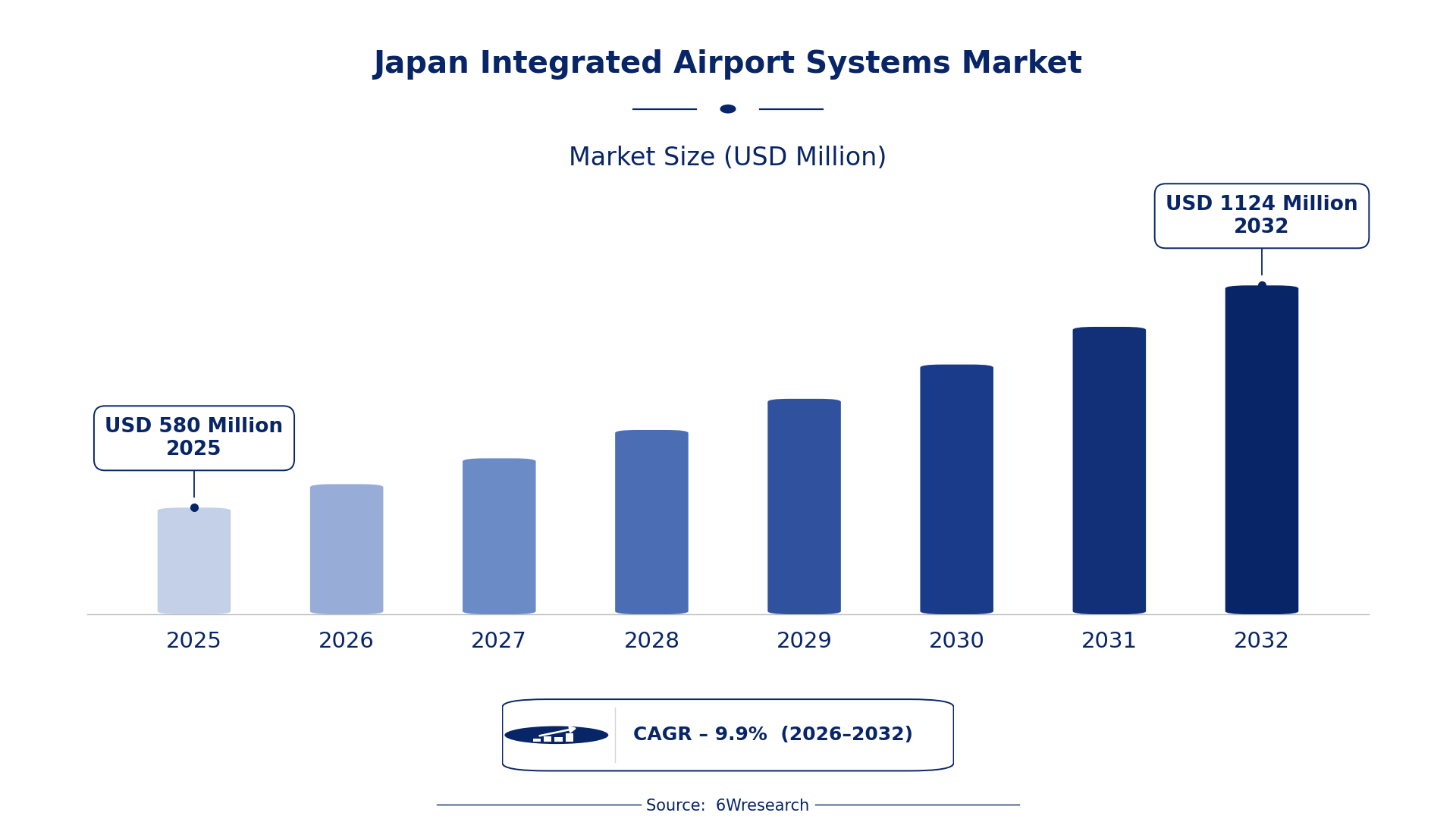
According to 6Wresearch internal database and industry insights, the Japan Integrated Airport Systems Market was valued at USD 580 Million in 2025 and is projected to reach USD 1,124 Million by 2032, growing at a CAGR of approximately 9.9% during 2026–2032.
Japan Integrated Airport Systems Market Highlights
| Report Metric | Details |
| Report Name | Japan Integrated Airport Systems Market (2026-2032) |
| Market Size 2025 | USD 580 Million |
| Market Size 2032 | USD 1,124 Million |
| Absolute Growth 2025–2032 | USD 544 Million |
| CAGR 2026–2032 | 9.9% |
| Peak Annual Growth | 11.3% in 2026 |
| Forecast Period | 2026–2032 |
| Historical Data | 2022–2025 |
| Base Year | 2025 |
| Leading System Type, 2025 | Airport Management (49% share) |
| Leading Application Area, 2025 | Operations Control (48% share) |
| Leading Technology Type, 2025 | Cloud-Based (44% share) |
| Leading End User, 2025 | Airport Authorities (41% share) |
| Leading Distribution Channel, 2025 | System Integrators (38% share) |
| Fastest-Growing System Type | Passenger Processing (13.5% CAGR) |
| Fastest-Growing Technology Type | AI/ML Integrated (14.2% CAGR) |
| Fastest-Growing End User | Ground Handlers (12.4% CAGR) |
| Fastest-Growing Distribution Channel | SaaS Providers (12.8% CAGR) |
| Growing Sector | Airport Operations |
| Key End Users | Airport Authorities, Airlines, Ground Handlers, Government Agencies |
Japan Integrated Airport Systems Market Year-wise Growth Rate and Key Drivers (2022–2032)
This graph illustrates the annual growth rates of the market from 2022 to 2032, highlighting a steady upward trajectory and projected market expansion over the forecast period.
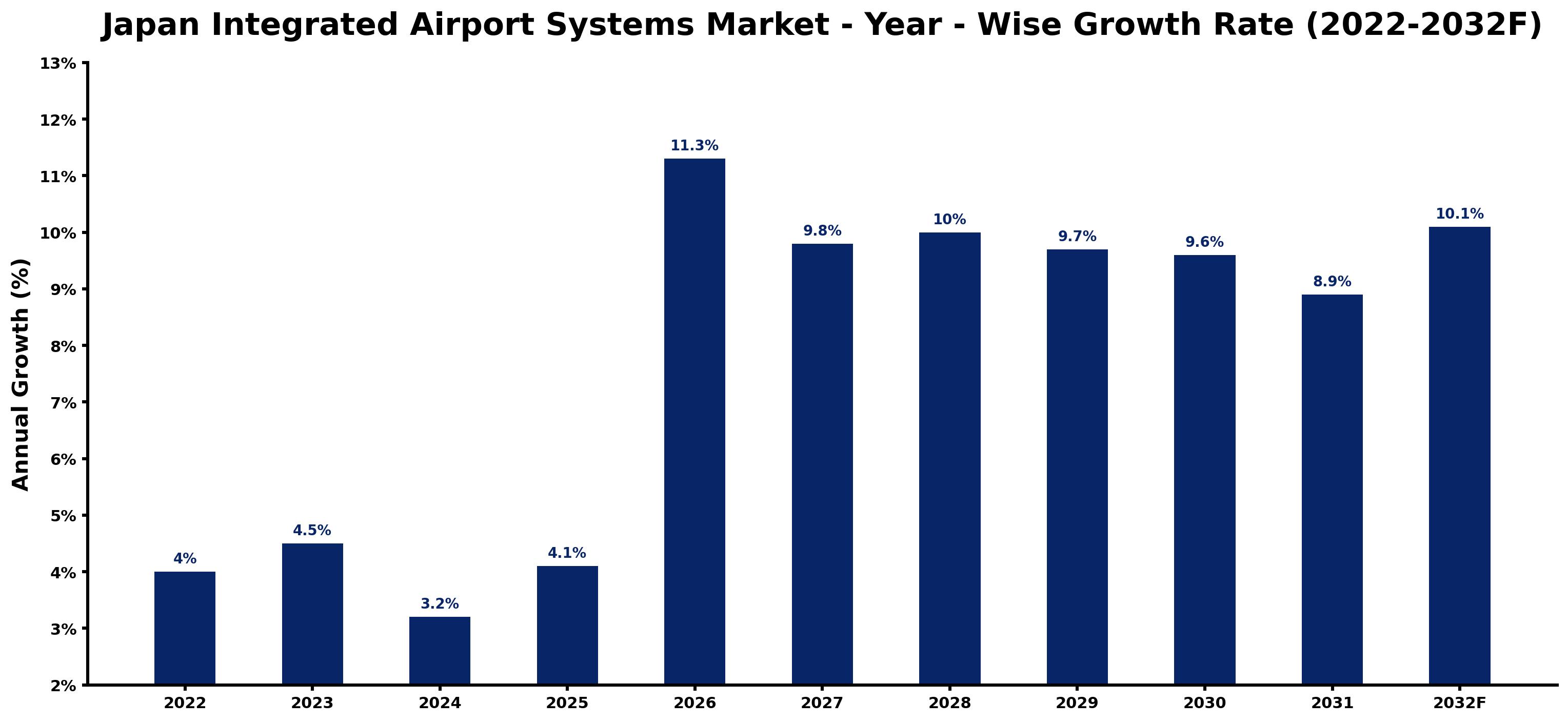
For each year, the table pairs the estimated growth rate with the leading influence on demand, showing how the drivers changed across the period.
| Year | Estimated Annual Growth (%) | Market Rationale |
| 2022 | 4.0 | The market showed steady growth, supported by ongoing airport operations and investments. |
| 2023 | 4.5 | Growth accelerated due to increased passenger traffic and infrastructure upgrades. |
| 2024 | 3.2 | A slight slowdown occurred as investments stabilised after peak spending from previous years. |
| 2025 | 4.1 | Demand rose again with new projects and technology upgrades in major airports. |
| 2026 | 11.3 | The market is expected to peak as the Tokyo 2020 Olympics investments materialise into operational improvements. |
| 2027 | 9.8 | Growth is projected to moderate as the market adjusts to the high investment levels of the previous year. |
| 2028 | 10.0 | Increased adoption of AI technologies is expected to boost operational efficiencies, driving demand. |
| 2029 | 9.7 | The market is projected to continue growing, supported by ongoing modernization efforts across airports. |
| 2030 | 9.6 | A slight slowdown is expected as growth rates stabilise after several years of rapid expansion. |
| 2031 | 8.9 | Demand is projected to remain strong, driven by continued investments in integrated systems and technology. |
| 2032 | 10.1 | Growth is expected to accelerate again as new initiatives and projects are launched in key airports. |
Note: Market size estimations and growth projections presented in this report are based on 6Wresearch's proprietary forecasting methodology, utilizing the latest available industry data, government publications, and primary research inputs.
Japan Integrated Airport Systems Market Synopsis
Integrated Airport Systems streamline operations, ensure security, and improve passenger experiences through advanced technologies like AI and IoT. The Japan Integrated Airport Systems Market is growing due to substantial investments from airport authorities and modernization programs. Initiatives like the Tokyo Metropolitan Government's smart airport projects and the ongoing ¥30 billion modernization of Narita International Airport are expected to further stimulate market growth.
Market Dynamics Impact Analysis (2026–2032)
| Factor | Type | Impact | Primary Segment Affected |
| Increased passenger traffic at major airports | Driver | High | Passenger Processing |
| Government initiatives for airport modernization | Driver | High | Airport Management |
| Growing demand for advanced security systems | Opportunity | High | Security Systems |
| Investment in AI technologies for operational efficiency | Opportunity | High | Operations Control |
| High costs associated with technology upgrades | Restraint | Medium | Baggage Handling |
| Limited availability of skilled workforce for system integration | Restraint | Medium | Passenger Processing |
| Budget constraints faced by airport authorities | Challenge | High | Airport Management |
| Technological complexities in system integration | Challenge | Medium | Security Systems |
Evaluation of Drivers in Japan Integrated Airport Systems Market (2026–2032)
Key forces behind demand, with the segment each one moves most, are listed below.
| Drivers | Primary Segment Affected | Why It Matters (Evidence) |
| Rising passenger numbers at major airports | Passenger Processing | Tokyo Haneda Airport serves over 87 million passengers annually, increasing demand for efficient processing systems to manage the flow. |
| Government funding for airport infrastructure improvements | Airport Management | The Tokyo Metropolitan Government is implementing smart airport initiatives through 2025, driving system upgrades and operational enhancements. |
| Modernization programs at Narita International Airport | Security Systems | Narita International Airport's ¥30 billion modernization program boosts investments in security systems, enhancing safety and operational efficiency. |
| Adoption of AI technologies for operational efficiency | Operations Control | Airports in Japan are increasingly adopting AI technologies for passenger flow management, improving operational efficiency and service delivery. |
| Increased focus on passenger safety and security | Baggage Handling | RFID technology is used for baggage tracking in major Japanese airports, improving logistics management and enhancing passenger experience. |
Orders keep climbing as passenger traffic at major airports continues to rise, driving demand for efficient processing systems. Funding for airport infrastructure improvements is expected to enhance operational capabilities significantly. The adoption of AI technologies for passenger flow management is anticipated to improve efficiency across operations, while the use of RFID technology for baggage tracking enhances logistics management, supporting the growing demand for integrated systems.
Evaluation of Restraints in Japan Integrated Airport Systems Market
The main factors holding the market back are set out below.
| Market Restraint | Primary Segment Affected | Why It Matters (Evidence) |
| High costs associated with technology upgrades | Baggage Handling | The modernization of systems requires substantial investment, which can strain airport budgets, limiting upgrades and efficiency improvements. |
| Limited availability of skilled workforce for system integration | Passenger Processing | A shortage of qualified personnel can delay the implementation of advanced systems, affecting operational timelines and efficiency. |
| Budget constraints faced by airport authorities | Airport Management | Many airport authorities operate under tight budgets, limiting their ability to invest in new systems and technology enhancements. |
| Technological complexities in system integration | Security Systems | Integrating new technologies with existing systems poses challenges, potentially delaying upgrades and affecting operational capabilities. |
| Compliance with safety regulations | Operations Control | Meeting stringent regulatory requirements can increase costs and slow down project timelines, impacting overall efficiency. |
Japan Integrated Airport Systems Market Challenges
Tokyo Haneda Airport processes over 87 million passengers each year, which pressures regulatory compliance for authorities. Stringent standards from the Ministry of Land, Infrastructure, Transport and Tourism can postpone project approvals by as much as six months for producers. Modernisation efforts at Narita International Airport, with a budget of ¥30 billion, encounter technological challenges due to slow system adoption, impacting efficiency for buyers. Increased competition among Japan's 100 airports raises operational costs, prompting suppliers to elevate prices, potentially leading to a 15% increase in service fees for operators.
Trends in the Japan Integrated Airport Systems Market
The following changes are redrawing the Japan Integrated Airport Systems Market.
- Airport Authorities Embracing AI Technologies: Airport authorities are increasingly integrating AI technologies to boost operational efficiency and manage passenger flow. With investments in AI systems, major airports are set to enhance their overall service quality.
- Cloud-Based Solutions Gaining Popularity: The transition to cloud-based solutions is reshaping airport management systems, providing flexibility and scalability. This trend is clear as more airports in Japan adopt cloud technologies for their operations.
- Enhanced Security Measures Becoming Standard: There is a rising emphasis on enhanced security measures at airports, driven by increasing passenger numbers. The implementation of RFID technology for baggage tracking illustrates this trend, improving efficiency.
- Investment in Smart Airport Initiatives: Airport authorities are prioritising technology upgrades to boost operational efficiency. The Tokyo Metropolitan Government's initiatives aim to roll out smart airport solutions by 2025, with a budget of ¥30 billion.
Investment Opportunities in the Japan Integrated Airport Systems Market
Below are the investment opportunities with the strongest case in the Japan Integrated Airport Systems Market.
- Integrated Airport Systems Investment: The demand for integrated airport systems is increasing, with airport authorities seeking to modernise operations. This presents substantial investment opportunities, as the market is projected to reach USD 1,124 Million by 2032.
- AI Technologies for Operational Efficiency: Investment in AI technologies is essential, with Ground handlers actively seeking solutions to improve efficiency and reduce operational costs. The projected growth in AI/ML Integrated systems is expected to be substantial.
- Cloud-Based Solutions for Flexibility: The shift towards cloud-based solutions presents opportunities for suppliers. With over 100 airports in Japan, partnerships with local system integrators can facilitate market entry.
- RFID Technology for Baggage Tracking: The growing need for efficient baggage handling creates opportunities for RFID technology suppliers. Airports are increasingly adopting RFID for tracking, enhancing logistics and passenger experience.
Government Initiatives in the Japan Integrated Airport Systems Market
The Digital Agency, established in September 2021, leads the government's digital transformation efforts, including the establishment of common system standards for integrated airport systems. This initiative complements existing regulations, such as the Electrical Appliance and Material Safety Act, ensuring that systems meet safety and operational standards for effective airport management and operations.
The New Robot Strategy encourages the use of robotics in airport operations, aiming to streamline processes and improve efficiency. Funding has been allocated to support the integration of robotic systems across various airport functions, enhancing operational capabilities and service delivery for airport authorities.
Future Insight of the Japan Integrated Airport Systems Market
Investment in integrated systems is set to rise significantly, with the Tokyo Metropolitan Government's smart airport initiatives generating substantial demand. The ongoing modernisation programme at Narita International Airport will improve operational efficiency, benefiting airport management. RFID technology will enhance baggage tracking accuracy, while the integration of AI technologies will streamline passenger flow management. By 2032, these advancements will lead to smoother experiences for travellers and lower operational costs for suppliers.
Market Segmentation Analysis
Japan Integrated Airport Systems Market report covers a detailed analysis of the following market segments:
By System Type – Airport Management Leads, Passenger Processing Expected to Grow Fastest
According to Saurav Kr Singh, Senior Research Analyst at 6Wresearch, Airport Management held 49% of the Japan Integrated Airport Systems Market by system type in 2025. Airport Management holds the largest share due to its critical role in coordinating various airport operations, ensuring efficiency and safety. For instance, Tokyo Haneda Airport relies heavily on these systems to manage the flow of over 87 million passengers each year. Passenger Processing is set to record the highest CAGR in this split, 13.5% over 2026–2032. Passenger Processing is growing rapidly as airports strive to enhance the efficiency of check-in and passenger flow, particularly highlighted during peak times like the Tokyo 2020 Olympics. The surge in passenger numbers drives the need for more advanced processing solutions. This indicates that suppliers must focus on developing efficient passenger processing technologies to meet rising demands.
By Application Area – Operations Control Leads and Records the Fastest Growth
In 2025, Operations Control led the application area split with a 48% share. Operations Control leads this segment as it is vital for the real-time monitoring and management of airport activities, ensuring smooth operations. Airports such as Narita International are investing heavily in operations control systems as part of their ongoing modernization efforts. Its lead should widen, with a projected CAGR of 12.0% during 2026–2032, the highest in this split. The growth of Operations Control will continue as airports adopt technologies that improve real-time decision-making and operational efficiency. The ongoing infrastructure upgrades further solidify its position as a key area for development. This suggests that suppliers should concentrate on enhancing operations control solutions to align with market needs.
By Technology Type – Cloud-Based Leads, AI/ML Integrated Expected to Grow Fastest
The largest technology type category in 2025 was Cloud-Based, at 44% of revenue. Cloud-Based solutions dominate the market because they provide the necessary flexibility and scalability to meet evolving operational requirements. Many airports in Japan are transitioning to these systems to improve efficiency and reduce operational costs. The quickest growth will come from AI/ML Integrated, forecast to expand at a CAGR of 14.2% between 2026 and 2032. AI/ML Integrated technologies are rapidly gaining traction as they enhance operational efficiency through advanced data analysis. The implementation of these technologies in passenger flow management is a significant factor driving this growth. Vendors should invest in AI/ML technologies to cater to the increasing demand for intelligent airport solutions.
By End User – Airport Authorities Lead, Ground Handlers Expected to Grow Fastest
Airport Authorities took 41% of end user revenue in 2025, more than any other category. Airport Authorities are the largest user group, as they are responsible for ensuring the operational efficiency of airports. Their continuous investments in integrated systems highlight their essential role in enhancing airport performance. Over 2026–2032, Ground Handlers are expected to post the fastest growth, at a CAGR of 12.4%. Ground Handlers are the fastest-growing segment, driven by their increasing dependence on integrated systems for efficient ground operations, especially in high-traffic airports. The demand for streamlined processes is becoming more critical as passenger volumes rise. Suppliers should tailor their products to meet the specific needs of ground handlers to capitalise on this growth opportunity.
By Distribution Channel – System Integrators Lead, SaaS Providers Expected to Grow Fastest
With 38% of distribution channel revenue in 2025, System Integrators was the largest category. System Integrators lead the distribution channel because they play a crucial role in implementing integrated systems across various airports. Their expertise in facilitating these technologies is essential for successful deployments and operational efficiency. SaaS Providers are set to record the highest CAGR in this split, 12.8% over 2026–2032. SaaS Providers are experiencing rapid growth as they offer cloud-based solutions that are increasingly preferred for airport operations. The shift towards cloud technology encourages airports to seek more flexible and scalable options. This trend indicates that suppliers should consider partnerships with SaaS providers to expand their market reach.
Key Attractiveness of the Report
- 10 Years of Market Numbers
- Historical Data Starting from 2022 to 2025
- Base Year 2025
- Forecast Data until 2032
- Key Performance Indicators Impacting the Market
- Major Upcoming Developments and Projects
Key Highlights of the Report:
- Japan Integrated Airport Systems Market Outlook
- Market Size of Japan Integrated Airport Systems Market, 2025
- Forecast of Japan Integrated Airport Systems Market, 2032
- Historical Data and Forecast of Japan Integrated Airport Systems Revenues & Volume for the Period 2022-2032F
- Japan Integrated Airport Systems Market Trend Evolution
- Japan Integrated Airport Systems Market Drivers and Challenges
- Japan Integrated Airport Systems Price Trends
- Japan Integrated Airport Systems Porter's Five Forces
- Japan Integrated Airport Systems Industry Life Cycle
- Historical Data and Forecast of Japan Integrated Airport Systems Market Revenues & Volume By System Type for the Period 2022-2032F
- Historical Data and Forecast of Japan Integrated Airport Systems Market Revenues & Volume By Airport Management for the Period 2022-2032F
- Historical Data and Forecast of Japan Integrated Airport Systems Market Revenues & Volume By Security Systems for the Period 2022-2032F
- Historical Data and Forecast of Japan Integrated Airport Systems Market Revenues & Volume By Passenger Processing for the Period 2022-2032F
- Historical Data and Forecast of Japan Integrated Airport Systems Market Revenues & Volume By Baggage Handling for the Period 2022-2032F
- Historical Data and Forecast of Japan Integrated Airport Systems Market Revenues & Volume By Application Area for the Period 2022-2032F
- Historical Data and Forecast of Japan Integrated Airport Systems Market Revenues & Volume By Operations Control for the Period 2022-2032F
- Historical Data and Forecast of Japan Integrated Airport Systems Market Revenues & Volume By Access Control for the Period 2022-2032F
- Historical Data and Forecast of Japan Integrated Airport Systems Market Revenues & Volume By Check-in & Boarding for the Period 2022-2032F
- Historical Data and Forecast of Japan Integrated Airport Systems Market Revenues & Volume By Sorting & Tracking for the Period 2022-2032F
- Historical Data and Forecast of Japan Integrated Airport Systems Market Revenues & Volume By Technology Type for the Period 2022-2032F
- Historical Data and Forecast of Japan Integrated Airport Systems Market Revenues & Volume By Cloud-Based for the Period 2022-2032F
- Historical Data and Forecast of Japan Integrated Airport Systems Market Revenues & Volume By IoT-enabled for the Period 2022-2032F
- Historical Data and Forecast of Japan Integrated Airport Systems Market Revenues & Volume By AI/ML Integrated for the Period 2022-2032F
- Historical Data and Forecast of Japan Integrated Airport Systems Market Revenues & Volume By RFID/NFC for the Period 2022-2032F
- Historical Data and Forecast of Japan Integrated Airport Systems Market Revenues & Volume By End User for the Period 2022-2032F
- Historical Data and Forecast of Japan Integrated Airport Systems Market Revenues & Volume By Airport Authorities for the Period 2022-2032F
- Historical Data and Forecast of Japan Integrated Airport Systems Market Revenues & Volume By Government Agencies for the Period 2022-2032F
- Historical Data and Forecast of Japan Integrated Airport Systems Market Revenues & Volume By Airlines for the Period 2022-2032F
- Historical Data and Forecast of Japan Integrated Airport Systems Market Revenues & Volume By Ground Handlers for the Period 2022-2032F
- Historical Data and Forecast of Japan Integrated Airport Systems Market Revenues & Volume By Distribution Channel for the Period 2022-2032F
- Historical Data and Forecast of Japan Integrated Airport Systems Market Revenues & Volume By System Integrators for the Period 2022-2032F
- Historical Data and Forecast of Japan Integrated Airport Systems Market Revenues & Volume By Direct Sales for the Period 2022-2032F
- Historical Data and Forecast of Japan Integrated Airport Systems Market Revenues & Volume By SaaS Providers for the Period 2022-2032F
- Historical Data and Forecast of Japan Integrated Airport Systems Market Revenues & Volume By Automation Vendors for the Period 2022-2032F
- Japan Integrated Airport Systems Import Export Trade Statistics
- Market Opportunity Assessment By System Type
- Market Opportunity Assessment By Application Area
- Market Opportunity Assessment By Technology Type
- Market Opportunity Assessment By End User
- Market Opportunity Assessment By Distribution Channel
- Japan Integrated Airport Systems Top Companies Market Share
- Japan Integrated Airport Systems Competitive Benchmarking By Technical and Operational Parameters
- Japan Integrated Airport Systems Company Profiles
- Japan Integrated Airport Systems Key Strategic Recommendations
Market Covered
The following segment groups are covered in the report.
By System Type
- Airport Management
- Security Systems
- Passenger Processing
- Baggage Handling
By Application Area
- Operations Control
- Access Control
- Check-in & Boarding
- Sorting & Tracking
By Technology Type
- Cloud-Based
- IoT-enabled
- AI/ML Integrated
- RFID/NFC
By End User
- Airport Authorities
- Government Agencies
- Airlines
- Ground Handlers
By Distribution Channel
- System Integrators
- Direct Sales
- SaaS Providers
- Automation Vendors































