Japan Integrated Avionics Market Size & Growth Rate
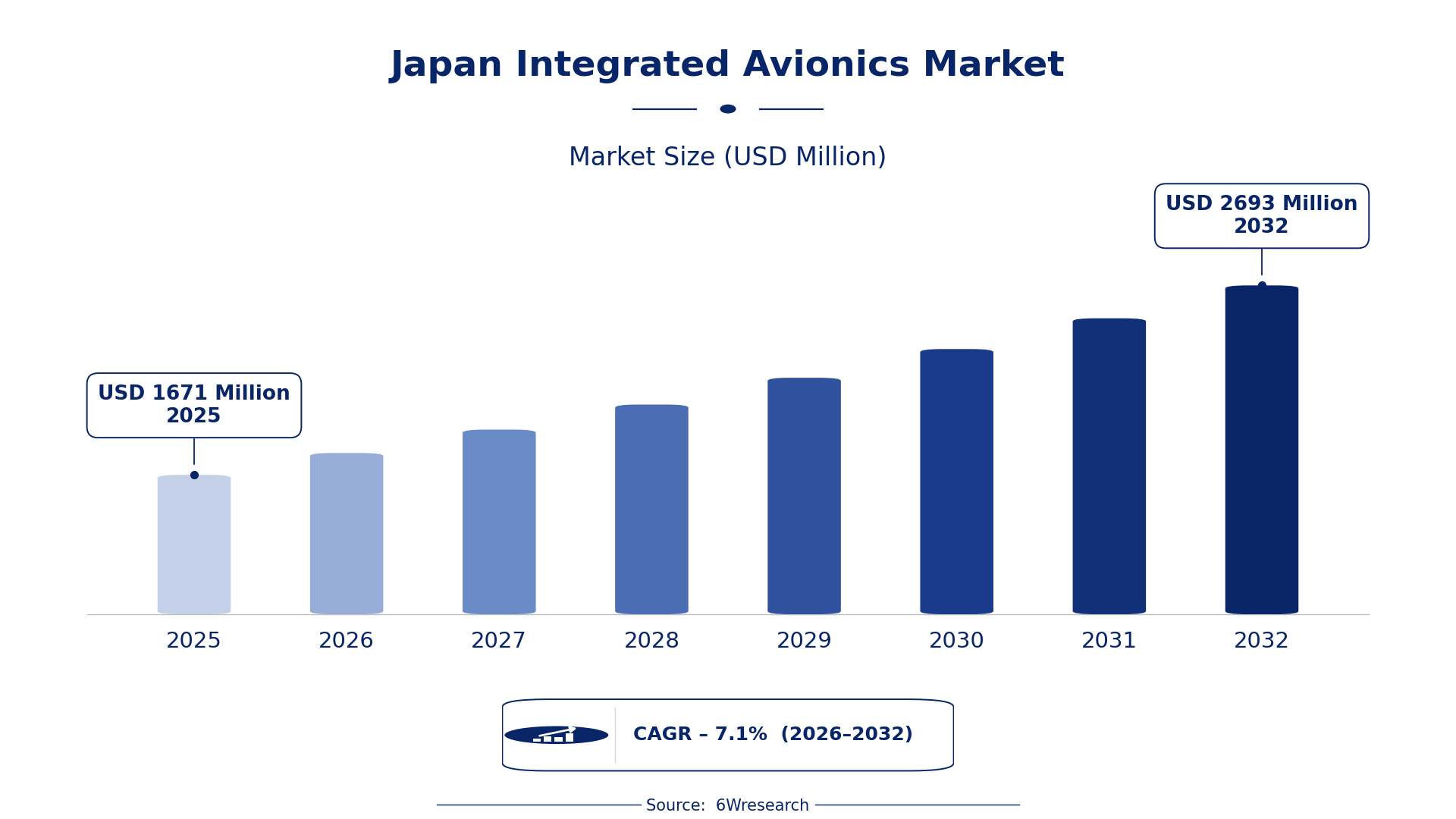
According to 6Wresearch internal database and industry insights, the Japan Integrated Avionics Market was valued at USD 1,671 Million in 2025 and is projected to reach USD 2,693 Million by 2032, growing at a CAGR of approximately 7.1% during 2026–2032.
Japan Integrated Avionics Market Highlights
| Report Metric | Details |
| Report Name | Japan Integrated Avionics Market (2026-2032) |
| Market Size 2025 | USD 1,671 Million |
| Market Size 2032 | USD 2,693 Million |
| Absolute Growth 2025–2032 | USD 1,022 Million |
| CAGR 2026–2032 | 7.1% |
| Peak Annual Growth | 7.8% in 2032 |
| Forecast Period | 2026–2032 |
| Historical Data | 2022–2025 |
| Base Year | 2025 |
| Leading Platform Type, 2025 | Commercial Aircraft (47% share) |
| Leading Integration Level, 2025 | Fully Integrated (40% share) |
| Leading System Type, 2025 | Navigation (44% share) |
| Leading End User, 2025 | OEMs (42% share) |
| Leading Distribution Channel, 2025 | Tier 1 Suppliers (35% share) |
| Fastest-Growing Platform Type | UAVs (9.9% CAGR) |
| Fastest-Growing System Type | Communication (10.4% CAGR) |
| Fastest-Growing End User | Aerospace Startups (9.1% CAGR) |
| Fastest-Growing Distribution Channel | Direct Sales (9.3% CAGR) |
| Growing Sector | UAVs |
| Key End Users | OEMs, Defense Contractors, Aerospace Startups |
Japan Integrated Avionics Market Year-wise Growth Rate and Key Drivers (2022–2032)
This graph illustrates the annual growth rates of the market from 2022 to 2032, highlighting a steady upward trajectory and projected market expansion over the forecast period.
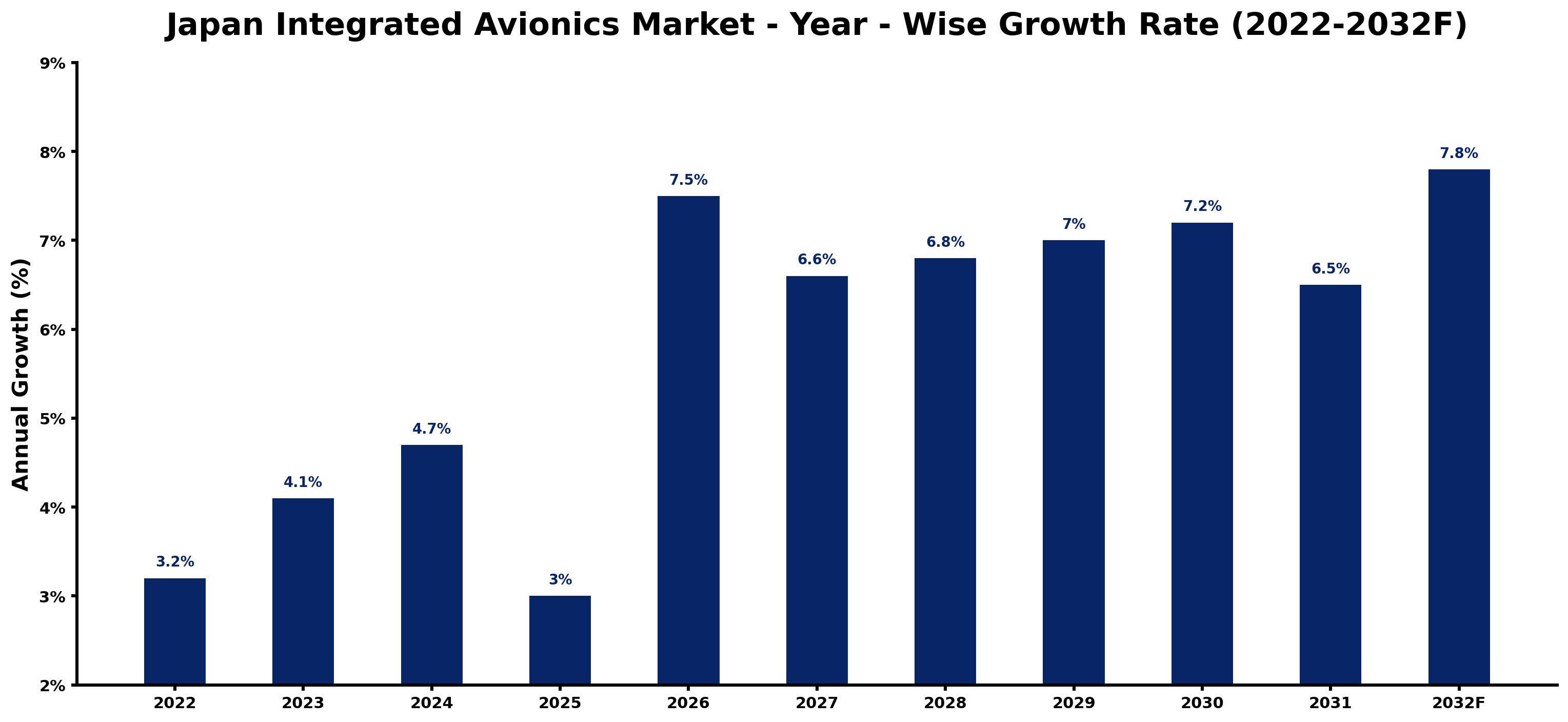
Annual growth estimates for each year appear below with the principal reason behind them, explaining the shifts that set the pace of the market.
| Year | Estimated Annual Growth (%) | Market Rationale |
| 2022 | 3.2 | The market experienced steady growth, driven by ongoing demand for avionics systems. |
| 2023 | 4.1 | Growth accelerated due to increased investments in aerospace technology and military upgrades. |
| 2024 | 4.7 | Demand continued to rise as manufacturers focused on improving aircraft safety features. |
| 2025 | 3.0 | Growth slowed as the market adjusted to previous high levels of investment and production. |
| 2026 | 7.5 | A surge in UAV usage and military contracts is expected to boost growth in the coming years. |
| 2027 | 6.6 | Growth is projected to moderate as the market stabilises after rapid expansion in UAV technology. |
| 2028 | 6.8 | Demand is anticipated to increase as innovations in communication systems gain traction. |
| 2029 | 7.0 | A rise in commercial aircraft orders will contribute to a stronger growth rate. |
| 2030 | 7.2 | Growth will continue as modernization efforts in the aerospace sector progress. |
| 2031 | 6.5 | The market will see a slowdown as previous growth rates normalise. |
| 2032 | 7.8 | A peak in growth is anticipated due to substantial investments in next-generation avionics. |
Note: Market size estimations and growth projections presented in this report are based on 6Wresearch's proprietary forecasting methodology, utilizing the latest available industry data, government publications, and primary research inputs.
Japan Integrated Avionics Market Synopsis
Integrated avionics are electronic systems that improve aircraft navigation, communication, and flight management. In Japan, the Integrated Avionics Market is driven by demand from domestic manufacturers and defense contractors. Factors such as the ongoing modernization of military aircraft, increased UAV usage, and rising investments in avionics technology are propelling growth. The Tokyo region serves as a hub for avionics manufacturing, reflecting the sector's expansion and innovation.
Market Dynamics Impact Analysis (2026–2032)
| Factor | Type | Impact | Primary Segment Affected |
| Rising demand for UAVs in surveillance and logistics operations | Driver | High | UAVs |
| Increased funding for avionics upgrades in the defense budget | Driver | High | Military Aircraft |
| Growing interest in UAV technology among aerospace startups | Opportunity | High | UAVs |
| Investment in avionics systems for commercial aircraft modernization | Opportunity | High | Commercial Aircraft |
| Compliance with stringent JIS Q 9001 standards | Restraint | Medium | Commercial Aircraft |
| High costs associated with advanced avionics systems development | Restraint | Medium | Commercial Aircraft |
| Challenges in integrating new technologies into existing aircraft | Challenge | High | Military Aircraft |
| Competition from international avionics manufacturers | Challenge | Medium | Commercial Aircraft |
Evaluation of Drivers in Japan Integrated Avionics Market (2026–2032)
The factors lifting demand, and the evidence behind each, are summarised below.
| Drivers | Primary Segment Affected | Why It Matters (Evidence) |
| Increased military spending on avionics upgrades | Military Aircraft | Japan's defense budget for 2023 includes funding for avionics upgrades, leading to higher procurement by defense contractors. |
| Surge in UAV adoption for logistics and surveillance | UAVs | The Japanese government aims to increase UAV usage by 30% by 2025, driving demand for integrated avionics systems. |
| Rising demand for safety and efficiency in commercial aviation | Commercial Aircraft | The average age of commercial aircraft in Japan is approximately 12 years, necessitating upgrades to integrated avionics. |
| Growing investments in aerospace startups focusing on avionics | Aerospace Startups | Government funding for small aerospace startups is encouraging innovation in avionics solutions. |
| Advancements in communication technologies for air traffic management | Communication | ISO 9001 is a standard commonly adopted in avionics production, improving system reliability and performance. |
Spending rises because military expenditure on avionics upgrades has surged, with Japan's defense budget for 2023 allocating funds for this purpose. The average age of commercial aircraft in Japan is about 12 years, prompting operators to invest in modern avionics for improved safety. Advances in communication technologies are vital for air traffic management, resulting in higher procurement of integrated avionics systems.
Evaluation of Restraints in Japan Integrated Avionics Market
The table below lists the restraints and the evidence behind each.
| Market Restraint | Primary Segment Affected | Why It Matters (Evidence) |
| Compliance with JIS Q 9001 standards increases production costs | Commercial Aircraft | Producers must invest in quality assurance to meet JIS Q 9001 standards, raising overall production costs. |
| High development costs for advanced avionics systems | Commercial Aircraft | The complexity of integrating new technologies leads to increased R&D expenditures for manufacturers. |
| Integration challenges with existing aircraft systems | Military Aircraft | New technologies must be compatible with legacy systems, complicating upgrades and increasing costs. |
| Intense competition from international avionics manufacturers | Commercial Aircraft | Domestic producers face pressure from established global players, impacting market share and pricing strategies. |
| Market saturation in certain avionics segments | UAVs | As UAV technology matures, the market faces saturation, limiting growth opportunities for new entrants. |
Japan Integrated Avionics Market Challenges
Producers in Japan's avionics market face supply chain disruptions due to reliance on a limited number of local suppliers, which can delay production timelines by up to six months. Rising raw material costs have inflated average production expenses by 15%, impacting profit margins for manufacturers. Compliance with JIS Q 9001 standards requires extensive documentation and quality checks, adding costs that can reach 10% of total project budgets for manufacturers. Skills shortages in advanced avionics technology hinder innovation, leading to potential project delays that can exceed a year for defense contractors.
Trends in the Japan Integrated Avionics Market
Below are the shifts with the largest effect on the Japan Integrated Avionics Market.
- Shift from Traditional to Advanced UAV Systems: Aerospace startups are increasingly focusing on advanced UAV systems, with a projected 30% increase in usage by 2025. This shift reflects a growing demand for surveillance and logistics capabilities, prompting suppliers to innovate.
- Transition from Modular to Fully Integrated Systems: The trend towards fully integrated avionics systems is becoming clear as manufacturers seek to improve efficiency. By 2025, fully integrated systems are expected to dominate, driven by the need for weight reduction and enhanced performance.
- Emergence of Communication as a Core System Type: Communication systems are gaining prominence, with a CAGR of 10.4% projected from 2026 to 2032. This trend is supported by advancements in air traffic management technologies, necessitating more sophisticated avionics solutions.
- Increased Focus on Safety Standards in Avionics: The Aerospace Industry Association of Japan promotes stringent avionics standards, with compliance expected to rise. This focus on safety is important as the average age of commercial aircraft remains around 12 years.
Investment Opportunities in the Japan Integrated Avionics Market
The opportunities below stand out in the Japan Integrated Avionics Market for new entrants and existing suppliers.
- Now is the Time for UAV Integration: With the government's target to boost UAV usage by 30% by 2025, there is an opportunity for investment in UAV avionics systems. Collaborating with aerospace startups in Tokyo can facilitate market entry.
- Investing in Communication Technologies: The rising need for advanced communication systems presents an opportunity for suppliers to develop effective solutions. Engaging with defense contractors can enhance market presence and drive sales.
- Commercial Aircraft Modernization Initiatives: The aging fleet of commercial aircraft creates a pressing need for avionics upgrades. Suppliers can target OEMs in the Tokyo region to meet this demand effectively.
- Support for Aerospace Startups: Government funding for small aerospace startups is an opportunity for investment in new avionics solutions. Partnering with local firms can streamline entry into the market.
Government Initiatives in the Japan Integrated Avionics Market
The Integrated Avionics Market in Japan is significantly influenced by the Industrial Standardization Act, which governs product and test standards, ensuring compliance with JIS Q 9001. This regulation mandates rigorous quality checks and documentation for avionics systems, impacting production processes and costs for manufacturers. Additionally, the GX Basic Policy aims for JPY 150 trillion in public-private investment over ten years, promoting innovation in the aerospace sector, which includes avionics upgrades and technology advancements.
The Ministry of Economy, Trade and Industry (METI) plays a crucial role in funding aerospace innovation projects and approving initiatives that enhance the avionics landscape. METI's support for small aerospace startups has led to increased funding opportunities, enabling new entrants to develop advanced avionics technologies. This backing is essential for creating a competitive environment, as it encourages collaboration between established manufacturers and emerging players in the market.
Future Insight of the Japan Integrated Avionics Market
A shift towards increased UAV usage will drive suppliers to innovate and adapt their offerings. By 2032, advancements in avionics technology will enhance aircraft performance and safety, fostering a competitive market. The total market for avionics in Japan is projected to reach $2 billion by 2025, reflecting strong demand for modern systems. As the Tokyo International Air Show showcases new technologies, buyers will benefit from improved systems that streamline operations and enhance communication with ground control.
Market Segmentation Analysis
Japan Integrated Avionics Market report covers a detailed analysis of the following market segments:
By Platform Type – Commercial Aircraft Leads, UAVs Expected to Grow Fastest
According to Saurav Kr Singh, Senior Research Analyst at 6Wresearch, with 47% of platform type revenue in 2025, Commercial Aircraft was the largest category. The commercial aircraft segment holds the largest share due to its critical role in passenger safety and navigation, with an estimated 25,000 registered aircraft in Japan. This extensive installed base creates a strong demand for integrated avionics systems tailored for commercial use. The quickest growth will come from UAVs, forecast to expand at a CAGR of 9.9% between 2026 and 2032. UAVs are experiencing rapid growth driven by increasing applications in surveillance and logistics, with the Japanese government aiming to boost UAV usage by 30% by 2025. This trend indicates a shift towards more advanced avionics solutions for these platforms. Suppliers should focus on developing tailored solutions for UAVs to capitalise on this growing market.
By Integration Level – Fully Integrated Leads and Records the Fastest Growth
Fully Integrated took 40% of integration level revenue in 2025, more than any other category. Fully integrated systems dominate the market due to their critical role in modern aircraft design, which enhances performance and safety. Their widespread adoption among manufacturers, particularly in the Tokyo region, solidifies their leading position. Fully Integrated is also forecast to expand faster than any other category, at a CAGR of 9.2% over 2026–2032. The fully integrated segment is also the fastest-growing, driven by rising demand for advanced avionics across various aircraft types. As the aerospace sector continues to innovate, this segment's growth will likely maintain its rapid pace. Suppliers must focus on advancing fully integrated systems to satisfy the increasing demand in the aerospace sector.
By System Type – Navigation Leads, Communication Expected to Grow Fastest
Navigation held 44% of the Japan Integrated Avionics Market by system type in 2025. Navigation systems lead the market as they are fundamental for all aircraft operations, ensuring safe and efficient travel. Their essential function in both commercial and military aviation underpins their strong market presence. Over 2026–2032, Communication is expected to post the fastest growth, at a CAGR of 10.4%. Communication systems are witnessing rapid growth, spurred by the necessity for enhanced air traffic management and connectivity. As air travel volumes increase, the demand for sophisticated communication solutions is expected to rise significantly. Buyers should prioritise investments in advanced communication systems to meet air traffic management standards.
By End User – OEMs Lead, Aerospace Startups Expected to Grow Fastest
OEMs accounted for 42% of the market by end user in 2025. OEMs hold the largest share as they are the primary manufacturers of avionics, supplying systems for commercial and military aircraft. Their established relationships with suppliers enable them to effectively drive demand for integrated avionics solutions. Aerospace Startups are projected to grow fastest, at a CAGR of 9.1% during 2026–2032. Aerospace startups are the fastest-growing segment, emerging as dynamic players in the market. Their emphasis on new technologies allows them to capitalise on niche opportunities within the evolving aerospace landscape. Suppliers should explore partnerships with aerospace startups to leverage their innovative approaches and broaden market access.
By Distribution Channel – Tier 1 Suppliers Lead, Direct Sales Expected to Grow Fastest
In 2025, Tier 1 Suppliers led the distribution channel split with a 35% share. Tier 1 suppliers are the leading channel as they serve as major suppliers to OEMs, ensuring the distribution of integrated avionics systems. Their established networks and reliability position them as the preferred choice for manufacturers in Japan. The quickest growth will come from Direct Sales, forecast to expand at a CAGR of 9.3% between 2026 and 2032. Direct sales are rapidly gaining traction as a distribution channel due to the increasing demand for personalised service and direct customer engagement. This trend indicates a shift towards more tailored solutions in the avionics market. Suppliers should enhance their direct sales strategies to strengthen customer relationships and address specific requirements.
Key Attractiveness of the Report
- 10 Years of Market Numbers
- Historical Data Starting from 2022 to 2025
- Base Year 2025
- Forecast Data until 2032
- Key Performance Indicators Impacting the Market
- Major Upcoming Developments and Projects
Key Highlights of the Report:
- Japan Integrated Avionics Market Outlook
- Market Size of Japan Integrated Avionics Market, 2025
- Forecast of Japan Integrated Avionics Market, 2032
- Historical Data and Forecast of Japan Integrated Avionics Revenues & Volume for the Period 2022-2032F
- Japan Integrated Avionics Market Trend Evolution
- Japan Integrated Avionics Market Drivers and Challenges
- Japan Integrated Avionics Price Trends
- Japan Integrated Avionics Porter's Five Forces
- Japan Integrated Avionics Industry Life Cycle
- Historical Data and Forecast of Japan Integrated Avionics Market Revenues & Volume By Platform Type for the Period 2022-2032F
- Historical Data and Forecast of Japan Integrated Avionics Market Revenues & Volume By Commercial Aircraft for the Period 2022-2032F
- Historical Data and Forecast of Japan Integrated Avionics Market Revenues & Volume By Military Aircraft for the Period 2022-2032F
- Historical Data and Forecast of Japan Integrated Avionics Market Revenues & Volume By UAVs for the Period 2022-2032F
- Historical Data and Forecast of Japan Integrated Avionics Market Revenues & Volume By Business Jets for the Period 2022-2032F
- Historical Data and Forecast of Japan Integrated Avionics Market Revenues & Volume By Integration Level for the Period 2022-2032F
- Historical Data and Forecast of Japan Integrated Avionics Market Revenues & Volume By Federated to Integrated for the Period 2022-2032F
- Historical Data and Forecast of Japan Integrated Avionics Market Revenues & Volume By Fully Integrated for the Period 2022-2032F
- Historical Data and Forecast of Japan Integrated Avionics Market Revenues & Volume By Semi-Integrated for the Period 2022-2032F
- Historical Data and Forecast of Japan Integrated Avionics Market Revenues & Volume By Modular Integrated for the Period 2022-2032F
- Historical Data and Forecast of Japan Integrated Avionics Market Revenues & Volume By System Type for the Period 2022-2032F
- Historical Data and Forecast of Japan Integrated Avionics Market Revenues & Volume By Navigation for the Period 2022-2032F
- Historical Data and Forecast of Japan Integrated Avionics Market Revenues & Volume By Mission Systems for the Period 2022-2032F
- Historical Data and Forecast of Japan Integrated Avionics Market Revenues & Volume By Communication for the Period 2022-2032F
- Historical Data and Forecast of Japan Integrated Avionics Market Revenues & Volume By Flight Management for the Period 2022-2032F
- Historical Data and Forecast of Japan Integrated Avionics Market Revenues & Volume By End User for the Period 2022-2032F
- Historical Data and Forecast of Japan Integrated Avionics Market Revenues & Volume By OEMs for the Period 2022-2032F
- Historical Data and Forecast of Japan Integrated Avionics Market Revenues & Volume By Defense Contractors for the Period 2022-2032F
- Historical Data and Forecast of Japan Integrated Avionics Market Revenues & Volume By Aerospace Startups for the Period 2022-2032F
- Historical Data and Forecast of Japan Integrated Avionics Market Revenues & Volume By Avionics Manufacturers for the Period 2022-2032F
- Historical Data and Forecast of Japan Integrated Avionics Market Revenues & Volume By Distribution Channel for the Period 2022-2032F
- Historical Data and Forecast of Japan Integrated Avionics Market Revenues & Volume By Tier 1 Suppliers for the Period 2022-2032F
- Historical Data and Forecast of Japan Integrated Avionics Market Revenues & Volume By Direct Sales for the Period 2022-2032F
- Historical Data and Forecast of Japan Integrated Avionics Market Revenues & Volume By Online Platforms for the Period 2022-2032F
- Historical Data and Forecast of Japan Integrated Avionics Market Revenues & Volume By OEM Alliances for the Period 2022-2032F
- Japan Integrated Avionics Import Export Trade Statistics
- Market Opportunity Assessment By Platform Type
- Market Opportunity Assessment By Integration Level
- Market Opportunity Assessment By System Type
- Market Opportunity Assessment By End User
- Market Opportunity Assessment By Distribution Channel
- Japan Integrated Avionics Top Companies Market Share
- Japan Integrated Avionics Competitive Benchmarking By Technical and Operational Parameters
- Japan Integrated Avionics Company Profiles
- Japan Integrated Avionics Key Strategic Recommendations
Market Covered
Coverage by segment is as follows.
By Platform Type
- Commercial Aircraft
- Military Aircraft
- UAVs
- Business Jets
By Integration Level
- Federated to Integrated
- Fully Integrated
- Semi-Integrated
- Modular Integrated
By System Type
- Navigation
- Mission Systems
- Communication
- Flight Management
By End User
- OEMs
- Defense Contractors
- Aerospace Startups
- Avionics Manufacturers
By Distribution Channel
- Tier 1 Suppliers
- Direct Sales
- Online Platforms
- OEM Alliances































