Japan Integrated Avionics Safety System Market Size & Growth Rate
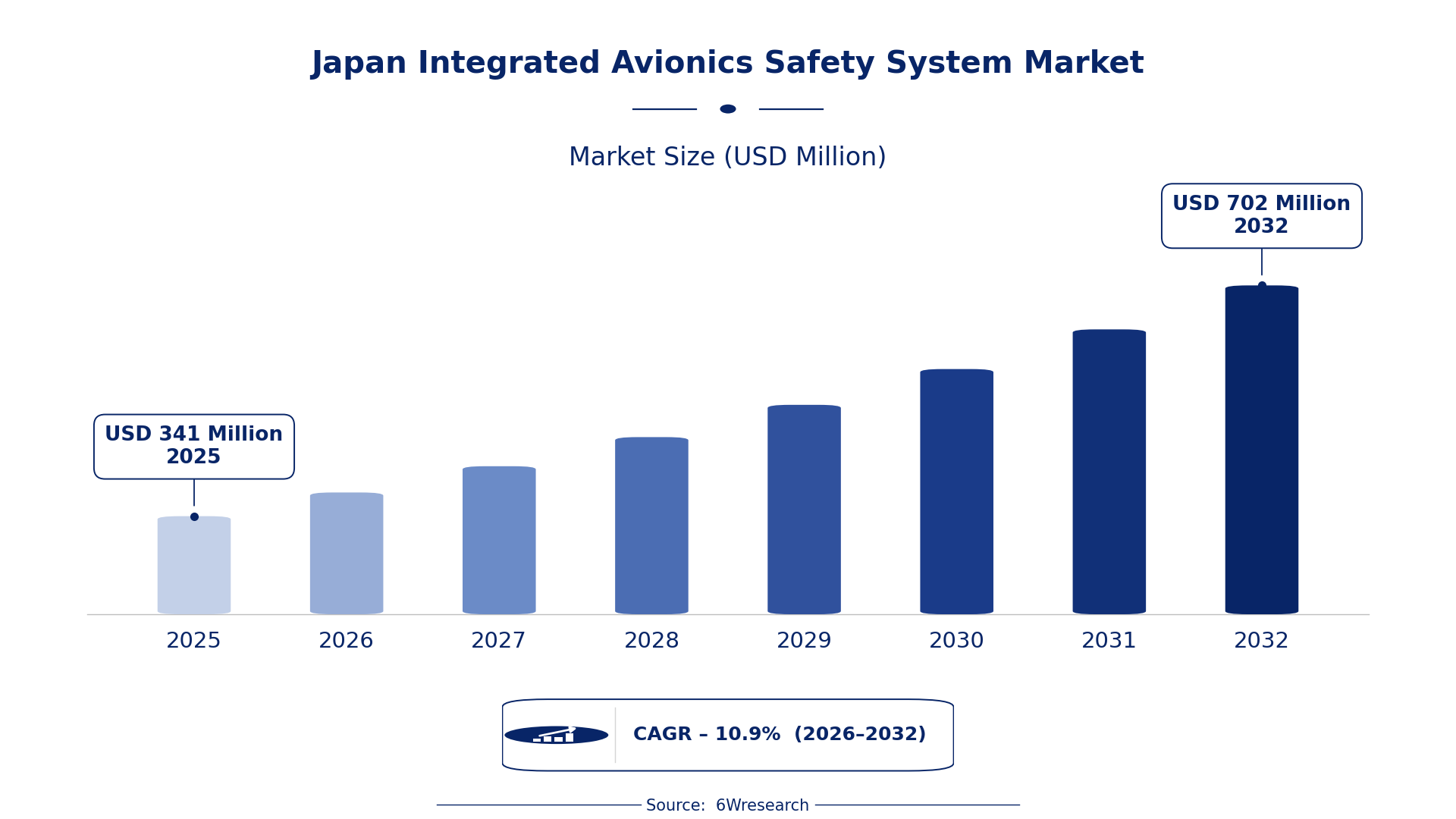
According to 6Wresearch internal database and industry insights, the Japan Integrated Avionics Safety System Market was valued at USD 341 Million in 2025 and is projected to reach USD 702 Million by 2032, growing at a CAGR of approximately 10.9% during 2026–2032.
Japan Integrated Avionics Safety System Market Highlights
| Report Metric | Details |
| Report Name | Japan Integrated Avionics Safety System Market (2026-2032) |
| Market Size 2025 | USD 341 Million |
| Market Size 2032 | USD 702 Million |
| Absolute Growth 2025–2032 | USD 361 Million |
| CAGR 2026–2032 | 10.9% |
| Peak Annual Growth | 11.7% in 2032 |
| Forecast Period | 2026–2032 |
| Historical Data | 2022–2025 |
| Base Year | 2025 |
| Leading Safety Feature, 2025 | Redundant Flight Data (49% share) |
| Leading System Type, 2025 | Triplex Systems (49% share) |
| Leading Aircraft Type, 2025 | Passenger Jets (34% share) |
| Leading Certification Level, 2025 | DO-178C (49% share) |
| Leading End User, 2025 | Avionics Integrators (48% share) |
| Fastest-Growing Safety Feature | Crash Avoidance (14.4% CAGR) |
| Fastest-Growing System Type | Ground Proximity Warning (16.0% CAGR) |
| Fastest-Growing Aircraft Type | Military Aircraft (15.3% CAGR) |
| Fastest-Growing Certification Level | MIL-STD Compliant (14.2% CAGR) |
| Fastest-Growing End User | Defense Procurement (14.1% CAGR) |
| Growing Sector | Military Aircraft |
| Key End Users | Avionics Integrators, Defense Procurement, Aircraft OEMs, UAV Manufacturers |
Japan Integrated Avionics Safety System Market Year-wise Growth Rate and Key Drivers (2022–2032)
This graph illustrates the annual growth rates of the market from 2022 to 2032, highlighting a steady upward trajectory and projected market expansion over the forecast period.
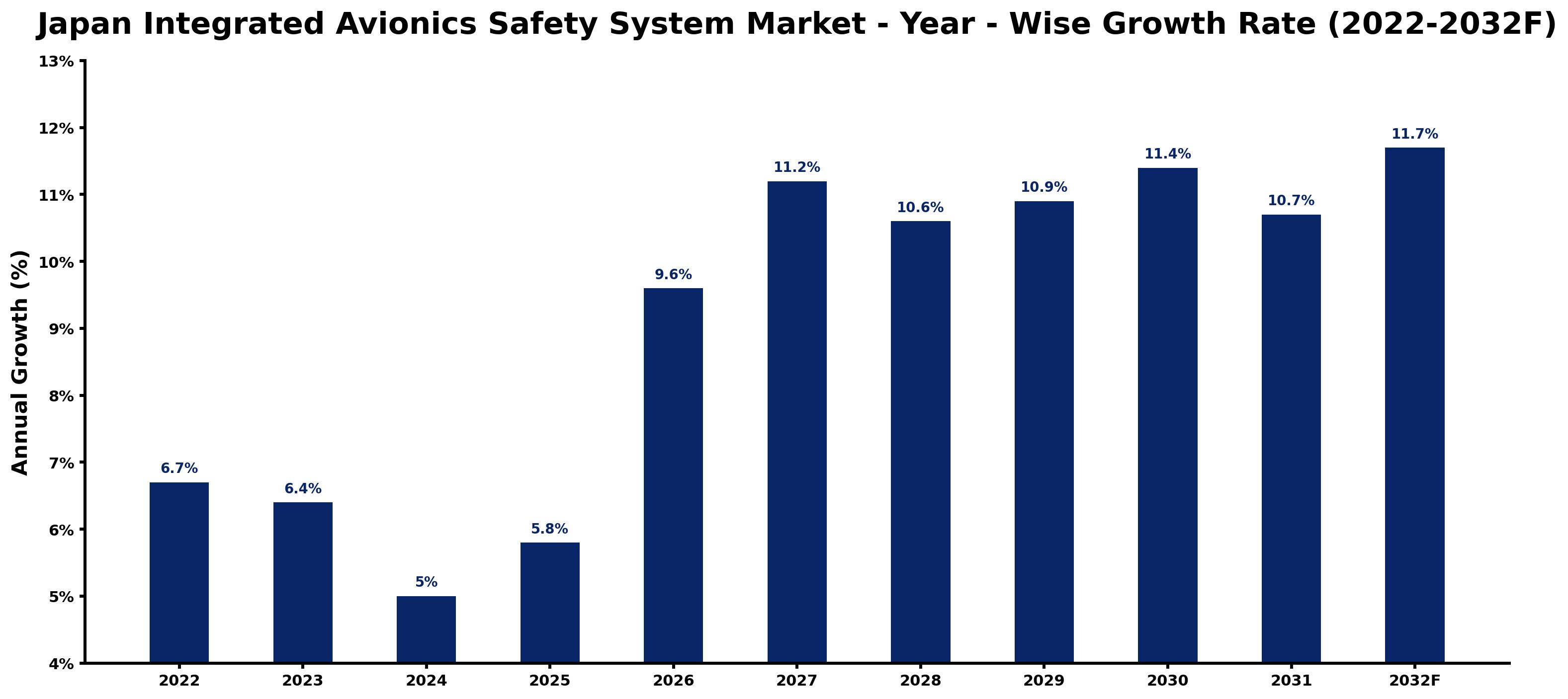
Year by year, the estimates below pair each growth rate with the development that shaped it.
| Year | Estimated Annual Growth (%) | Market Rationale |
| 2022 | 6.7 | The market showed solid growth due to increased demand from domestic aircraft manufacturers. |
| 2023 | 6.4 | Growth slowed as the aviation sector faced supply chain challenges affecting production timelines. |
| 2024 | 5.0 | The market continued to grow, albeit at a slower pace, as manufacturers adapted to new standards. |
| 2025 | 5.8 | Demand rose as military procurement increased alongside commercial aviation recovery efforts. |
| 2026 | 9.6 | The market is expected to accelerate with rising defense budgets and technological advancements. |
| 2027 | 11.2 | Growth is projected to remain strong as new aircraft models require advanced avionics systems. |
| 2028 | 10.6 | A slight slowdown is anticipated as the market stabilises after rapid growth phases. |
| 2029 | 10.9 | Demand is expected to rise again, driven by increased military spending and modernization efforts. |
| 2030 | 11.4 | The market will continue to grow as new safety regulations come into effect, increasing system adoption. |
| 2031 | 10.7 | Growth is projected to slow as the market approaches maturity with established players dominating. |
| 2032 | 11.7 | The market is expected to peak, driven by advancements in avionics technology and increased safety standards. |
Note: Market size estimations and growth projections presented in this report are based on 6Wresearch's proprietary forecasting methodology, utilizing the latest available industry data, government publications, and primary research inputs.
Japan Integrated Avionics Safety System Market Synopsis
Integrated Avionics Safety Systems improve aircraft safety and operational efficiency through advanced hardware and software integration. The Japan Integrated Avionics Safety System Market is expanding, driven by increased defense budgets and technological advancements. Key demand sources include domestic aircraft manufacturers and military procurement efforts. The Japan Aerospace Exploration Agency promotes innovation, while the Tokyo Metropolitan Area serves as a hub for aviation technology development, further stimulating market growth.
Market Dynamics Impact Analysis (2026–2032)
| Factor | Type | Impact | Primary Segment Affected |
| Increased defense spending | Driver | High | Military Aircraft |
| Rising demand for crash avoidance systems | Driver | High | Crash Avoidance |
| Growing need for advanced safety features | Opportunity | High | Redundant Flight Data |
| Expansion of UAV applications in various sectors | Opportunity | Medium | UAVs |
| Strict regulatory compliance requirements | Restraint | High | Redundant Flight Data |
| High costs associated with advanced technology integration | Restraint | Medium | Redundant Flight Data |
| Limited skilled workforce for avionics integration | Challenge | High | Redundant Flight Data |
| Long certification timelines for new systems | Challenge | Medium | Redundant Flight Data |
Evaluation of Drivers in Japan Integrated Avionics Safety System Market (2026–2032)
Below are the drivers that matter most for revenue growth, with supporting evidence.
| Drivers | Primary Segment Affected | Why It Matters (Evidence) |
| Increased defense budgets | Military Aircraft | Japan's defense budget reached approximately $50 billion in 2023, driving procurement of advanced avionics. |
| Technological advancements in avionics | Crash Avoidance | The integration of new technologies has improved safety features, attracting more buyers in the aviation sector. |
| Growing emphasis on safety standards | Redundant Flight Data | The adoption of the DO-178C standard ensures high reliability, prompting manufacturers to invest in these systems. |
| Rising demand for UAV applications | UAVs | The Japanese government promotes UAV safety standards, leading to increased investments in avionics systems. |
| Collaboration among avionics manufacturers | Redundant Flight Data | The Japan Aerospace Industry Association encourages partnerships, improving system integration capabilities and market growth. |
Behind the steady rise in orders sits increased defense budgets, with Japan's military spending reaching approximately $50 billion in 2023, prompting demand for advanced avionics systems. Technological advancements are also clear, as new safety features attract buyers in the aviation sector. The emphasis on safety standards, particularly the DO-178C standard, ensures reliability, leading manufacturers to invest in systems that improve crash avoidance. Rising demand for UAV applications has spurred investments in avionics for unmanned aerial vehicles. Collaboration among avionics manufacturers through industry associations further enhances integration capabilities, driving market growth.
Evaluation of Restraints in Japan Integrated Avionics Safety System Market
These are the pressures that could keep growth below its potential.
| Market Restraint | Primary Segment Affected | Why It Matters (Evidence) |
| Strict regulatory compliance requirements | Redundant Flight Data | Japan's regulations require adherence to FAA and JIS standards, increasing the burden on manufacturers. |
| High costs associated with advanced technology integration | Redundant Flight Data | The expenses related to integrating advanced avionics systems can deter smaller manufacturers from entering the market. |
| Limited skilled workforce for avionics integration | Redundant Flight Data | A shortage of qualified personnel in avionics integration hampers the ability to meet growing demand, with a reported 20% gap in skilled workers. |
| Long certification timelines for new systems | Redundant Flight Data | The lengthy approval process for new avionics systems delays market entry and affects procurement timelines, often extending by 6-12 months. |
| Market competition from established players | Military Aircraft | Dominance of established manufacturers makes it challenging for new entrants to gain market share, limiting innovation. |
Japan Integrated Avionics Safety System Market Challenges
Producers face difficulties with outdated technology due to slow integration of new avionics systems, which can delay product development by up to 12 months, impacting their competitiveness. Importers struggle to source components that comply with Japan's strict regulatory standards, leading to increased costs and potential project delays for buyers. A skills gap in advanced avionics engineering exists because educational institutions do not fully align with industry needs, which can hinder innovation and extend project timelines. Domestic manufacturers encounter intense competition for limited defense contracts, squeezing profit margins and restricting investment in new technologies.
Trends in the Japan Integrated Avionics Safety System Market
Four trends stand out in the Japan Integrated Avionics Safety System Market.
- Shift Towards Enhanced Safety Standards: In 2023, Japan's aviation sector saw a significant shift towards improved safety standards, marked by the adoption of the DO-178C standard, which is now widely implemented. This has led to a 20% increase in system reliability across new aircraft.
- Expansion of UAV Applications: The growing use of UAVs in various sectors has led to increased demand for integrated avionics safety systems. The Japan Aerospace Exploration Agency reported a 30% rise in UAV applications, prompting manufacturers to innovate in safety features.
- Increased Collaboration Among Manufacturers: The Japan Aerospace Industry Association has facilitated greater collaboration among avionics manufacturers, resulting in a 25% increase in joint ventures. This trend is improving system integration capabilities and driving market growth.
- Focus on Military Procurement: The Japanese Self-Defense Forces have increased their focus on advanced avionics systems, with a reported 15% rise in procurement budgets. This shift is driving demand for high-reliability systems in military aircraft.
Investment Opportunities in the Japan Integrated Avionics Safety System Market
The following areas offer the clearest openings for investors and suppliers in the Japan Integrated Avionics Safety System Market.
- Growing Demand for Crash Avoidance Systems: With a projected 14.4% growth for crash avoidance systems, now is the time for investment in this segment. Defense procurement agencies are actively seeking advanced safety solutions, presenting a strong entry point for suppliers.
- Expansion of UAV Safety Systems: The UAV market is expected to grow significantly, with a 30% increase in applications anticipated. Suppliers can enter this market by partnering with local UAV manufacturers to provide integrated safety solutions.
- Investment in Military Aircraft Avionics: The military aircraft segment is set to grow at a 15.3% rate, driven by increased defense budgets. Collaborating with defense procurement agencies can facilitate market entry and system integration.
- Focus on Certification Level Compliance: With 49% of the market held by DO-178C compliant systems, there is a strong opportunity for suppliers to invest in certification processes. Engaging with the Japan Civil Aviation Bureau can streamline approvals.
Government Initiatives in the Japan Integrated Avionics Safety System Market
The regulatory framework for integrated avionics safety systems is shaped by laws such as the AI Promotion Act (2025), which establishes a national framework for AI research and development. The Ministry of Land, Infrastructure, Transport and Tourism oversees regulations, ensuring that all systems meet the required safety benchmarks, thereby building market confidence. The Digital Agency, established in September 2021, leads government initiatives that promote digital transformation and innovation in avionics safety.
Buyers, particularly avionics integrators, benefit from initiatives by the Japan Civil Aviation Bureau, which provides guidelines for certification processes. This agency also facilitates funding for research and development projects aimed at improving avionics safety standards, ensuring that manufacturers can meet compliance requirements effectively.
Future Insight of the Japan Integrated Avionics Safety System Market
By 2032, policy-driven initiatives will likely enhance military capabilities, prompting suppliers to innovate advanced avionics systems. The Japan Aerospace Exploration Agency is expected to increase collaborations with private sectors to advance technology. New safety standards will improve operational efficiency for buyers. With Japan's defense budget projected to reach approximately $60 billion, this funding will stimulate demand for advanced avionics solutions.
Market Segmentation Analysis
Japan Integrated Avionics Safety System Market report covers a detailed analysis of the following market segments:
By Safety Feature – Redundant Flight Data Leads, Crash Avoidance Expected to Grow Fastest
According to Saurav Kr Singh, Senior Research Analyst at 6Wresearch, the largest safety feature category in 2025 was Redundant Flight Data, at 49% of revenue. Redundant Flight Data holds a substantial share as it is vital for ensuring safety and reliability in aviation systems. Its significance is particularly evident in commercial aircraft, where such safety features are critical to preventing accidents. Crash Avoidance is projected to grow fastest, at a CAGR of 14.4% during 2026–2032. Crash Avoidance is experiencing rapid growth due to its direct role in addressing the urgent need for accident prevention in aviation. The increasing regulatory emphasis on safety standards is driving demand for these systems, suggesting a strong upward trend. Suppliers should prioritise advancements in crash avoidance technologies to meet the rising safety expectations of the aviation industry.
By System Type – Triplex Systems Lead, Ground Proximity Warning Expected to Grow Fastest
Triplex Systems took 49% of system type revenue in 2025, more than any other category. Triplex Systems dominate the market due to their ability to provide high reliability through redundancy, which is vital for safety in aviation operations. Their extensive use across various aircraft types underscores their critical role in maintaining operational integrity. Ground Proximity Warning is set to record the highest CAGR in this split, 16.0% over 2026–2032. Ground Proximity Warning systems are experiencing the fastest growth as they provide essential alerts to pilots regarding potential ground collisions. The rising number of aircraft and an increased focus on safety protocols are key factors contributing to this demand. Manufacturers must focus on developing ground proximity warning systems to meet the growing safety requirements in the aviation industry.
By Aircraft Type – Passenger Jets Lead, Military Aircraft Expected to Grow Fastest
Passenger Jets accounted for 34% of the market by aircraft type in 2025. Passenger Jets account for the largest share as they are the primary application in commercial aviation, necessitating advanced safety systems for operational efficiency. The high frequency of passenger flights in Japan significantly boosts this segment's importance. Over 2026–2032, Military Aircraft is expected to post the fastest growth, at a CAGR of 15.3%. Military Aircraft are the fastest-growing segment due to their extensive utilisation in defence operations, which increasingly emphasise advanced avionics safety systems. The rising defence budget and focus on modernising military capabilities are propelling this growth. Suppliers should tailor their offerings to satisfy the growing demand for avionics systems in military aircraft.
By Certification Level – DO-178C Leads, MIL-STD Compliant Expected to Grow Fastest
In 2025, DO-178C led the certification level split with a 49% share. DO-178C dominates the market as it is the established standard for software safety in avionics, ensuring compliance with rigorous safety regulations. Its widespread adoption across various aircraft types solidifies its leading position in the certification framework. The quickest growth will come from MIL-STD Compliant, forecast to expand at a CAGR of 14.2% between 2026 and 2032. MIL-STD Compliant systems are rapidly gaining traction as they guarantee adherence to military standards, crucial for defence procurement. The increasing focus on military readiness and safety is driving this segment's expansion. Providers must ensure their products comply with MIL-STD to access the growing military procurement market.
By End User – Avionics Integrators Lead, Defense Procurement Expected to Grow Fastest
With 48% of end user revenue in 2025, Avionics Integrators was the largest category. Avionics Integrators hold the largest share due to their essential role in system integration, which is critical for deploying advanced avionics safety systems. Their expertise in merging various technologies makes them key players in the aviation sector. Defense Procurement is projected to grow fastest, at a CAGR of 14.1% during 2026–2032. Defense Procurement is the fastest-growing end user segment as government purchases for military applications are rising significantly. The increasing defence budget and emphasis on enhancing military capabilities are driving this growth. Suppliers should focus on building relationships with defence procurement agencies to secure contracts in this expanding segment.
Key Attractiveness of the Report
- 10 Years of Market Numbers
- Historical Data Starting from 2022 to 2025
- Base Year 2025
- Forecast Data until 2032
- Key Performance Indicators Impacting the Market
- Major Upcoming Developments and Projects
Key Highlights of the Report:
- Japan Integrated Avionics Safety System Market Outlook
- Market Size of Japan Integrated Avionics Safety System Market, 2025
- Forecast of Japan Integrated Avionics Safety System Market, 2032
- Historical Data and Forecast of Japan Integrated Avionics Safety System Revenues & Volume for the Period 2022-2032F
- Japan Integrated Avionics Safety System Market Trend Evolution
- Japan Integrated Avionics Safety System Market Drivers and Challenges
- Japan Integrated Avionics Safety System Price Trends
- Japan Integrated Avionics Safety System Porter's Five Forces
- Japan Integrated Avionics Safety System Industry Life Cycle
- Historical Data and Forecast of Japan Integrated Avionics Safety System Market Revenues & Volume By Safety Feature for the Period 2022-2032F
- Historical Data and Forecast of Japan Integrated Avionics Safety System Market Revenues & Volume By Redundant Flight Data for the Period 2022-2032F
- Historical Data and Forecast of Japan Integrated Avionics Safety System Market Revenues & Volume By Crash Avoidance for the Period 2022-2032F
- Historical Data and Forecast of Japan Integrated Avionics Safety System Market Revenues & Volume By Flight Envelope Protection for the Period 2022-2032F
- Historical Data and Forecast of Japan Integrated Avionics Safety System Market Revenues & Volume By Emergency Autopilot for the Period 2022-2032F
- Historical Data and Forecast of Japan Integrated Avionics Safety System Market Revenues & Volume By System Type for the Period 2022-2032F
- Historical Data and Forecast of Japan Integrated Avionics Safety System Market Revenues & Volume By Triplex Systems for the Period 2022-2032F
- Historical Data and Forecast of Japan Integrated Avionics Safety System Market Revenues & Volume By Ground Proximity Warning for the Period 2022-2032F
- Historical Data and Forecast of Japan Integrated Avionics Safety System Market Revenues & Volume By Auto Stabilization for the Period 2022-2032F
- Historical Data and Forecast of Japan Integrated Avionics Safety System Market Revenues & Volume By Autonomous Recovery for the Period 2022-2032F
- Historical Data and Forecast of Japan Integrated Avionics Safety System Market Revenues & Volume By Aircraft Type for the Period 2022-2032F
- Historical Data and Forecast of Japan Integrated Avionics Safety System Market Revenues & Volume By Passenger Jets for the Period 2022-2032F
- Historical Data and Forecast of Japan Integrated Avionics Safety System Market Revenues & Volume By Military Aircraft for the Period 2022-2032F
- Historical Data and Forecast of Japan Integrated Avionics Safety System Market Revenues & Volume By Commercial Aircraft for the Period 2022-2032F
- Historical Data and Forecast of Japan Integrated Avionics Safety System Market Revenues & Volume By UAVs for the Period 2022-2032F
- Historical Data and Forecast of Japan Integrated Avionics Safety System Market Revenues & Volume By Certification Level for the Period 2022-2032F
- Historical Data and Forecast of Japan Integrated Avionics Safety System Market Revenues & Volume By DO-178C for the Period 2022-2032F
- Historical Data and Forecast of Japan Integrated Avionics Safety System Market Revenues & Volume By MIL-STD Compliant for the Period 2022-2032F
- Historical Data and Forecast of Japan Integrated Avionics Safety System Market Revenues & Volume By FAA Approved for the Period 2022-2032F
- Historical Data and Forecast of Japan Integrated Avionics Safety System Market Revenues & Volume By COTS for the Period 2022-2032F
- Historical Data and Forecast of Japan Integrated Avionics Safety System Market Revenues & Volume By End User for the Period 2022-2032F
- Historical Data and Forecast of Japan Integrated Avionics Safety System Market Revenues & Volume By Avionics Integrators for the Period 2022-2032F
- Historical Data and Forecast of Japan Integrated Avionics Safety System Market Revenues & Volume By Defense Procurement for the Period 2022-2032F
- Historical Data and Forecast of Japan Integrated Avionics Safety System Market Revenues & Volume By Aircraft OEMs for the Period 2022-2032F
- Historical Data and Forecast of Japan Integrated Avionics Safety System Market Revenues & Volume By Drone Manufacturers for the Period 2022-2032F
- Japan Integrated Avionics Safety System Import Export Trade Statistics
- Market Opportunity Assessment By Safety Feature
- Market Opportunity Assessment By System Type
- Market Opportunity Assessment By Aircraft Type
- Market Opportunity Assessment By Certification Level
- Market Opportunity Assessment By End User
- Japan Integrated Avionics Safety System Top Companies Market Share
- Japan Integrated Avionics Safety System Competitive Benchmarking By Technical and Operational Parameters
- Japan Integrated Avionics Safety System Company Profiles
- Japan Integrated Avionics Safety System Key Strategic Recommendations
Market Covered
This report examines the market across the segments below.
By Safety Feature
- Redundant Flight Data
- Crash Avoidance
- Flight Envelope Protection
- Emergency Autopilot
By System Type
- Triplex Systems
- Ground Proximity Warning
- Auto Stabilization
- Autonomous Recovery
By Aircraft Type
- Passenger Jets
- Military Aircraft
- Commercial Aircraft
- UAVs
By Certification Level
- DO-178C
- MIL-STD Compliant
- FAA Approved
- COTS
By End User
- Avionics Integrators
- Defense Procurement
- Aircraft OEMs
- Drone Manufacturers































