Japan Integrated Chassis Systems Market Size & Growth Rate
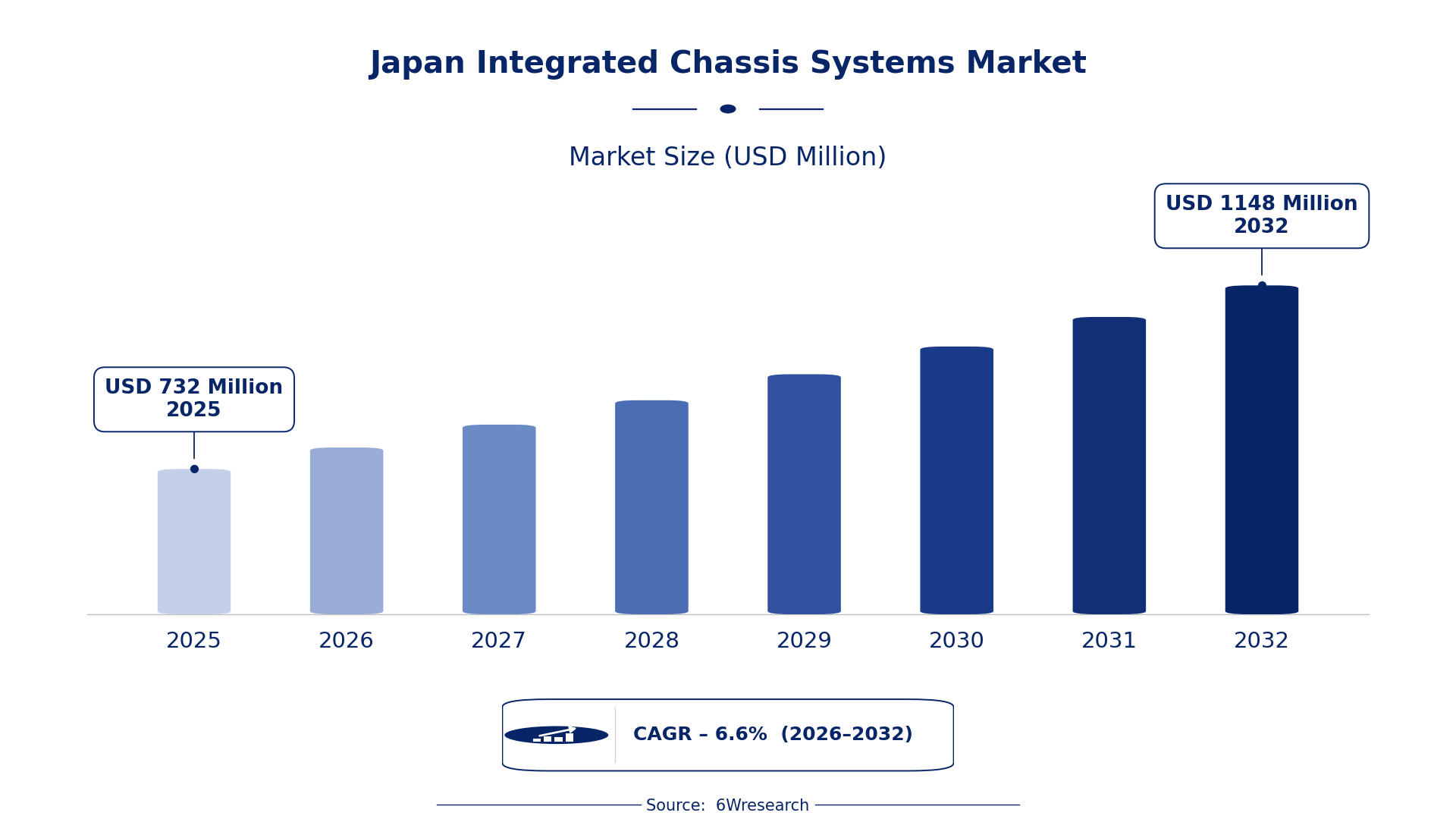
According to 6Wresearch internal database and industry insights, the Japan Integrated Chassis Systems Market was valued at USD 732 Million in 2025 and is projected to reach USD 1,148 Million by 2032, growing at a CAGR of approximately 6.6% during 2026–2032.
Japan Integrated Chassis Systems Market Highlights
| Report Metric | Details |
| Report Name | Japan Integrated Chassis Systems Market (2026-2032) |
| Market Size 2025 | USD 732 Million |
| Market Size 2032 | USD 1,148 Million |
| Absolute Growth 2025–2032 | USD 416 Million |
| CAGR 2026–2032 | 6.6% |
| Peak Annual Growth | 8.2% in 2029 |
| Forecast Period | 2026–2032 |
| Historical Data | 2022–2025 |
| Base Year | 2025 |
| Leading System Type, 2025 | Active Suspension (43% share) |
| Leading Technology Type, 2025 | Electronic Control Units (44% share) |
| Leading Vehicle Type, 2025 | Passenger Cars (50% share) |
| Leading Distribution Channel, 2025 | OEMs (39% share) |
| Leading End User, 2025 | Car Manufacturers (49% share) |
| Fastest-Growing Technology Type | Mechatronics (9.2% CAGR) |
| Fastest-Growing Vehicle Type | EVs (9.6% CAGR) |
| Fastest-Growing Distribution Channel | Aftermarket (8.2% CAGR) |
| Fastest-Growing End User | Performance Vehicles (8.4% CAGR) |
| Growing Sector | automotive |
| Key End Users | car manufacturers, fleet operators, automotive suppliers |
Japan Integrated Chassis Systems Market Year-wise Growth Rate and Key Drivers (2022–2032)
This graph illustrates the annual growth rates of the market from 2022 to 2032, highlighting a steady upward trajectory and projected market expansion over the forecast period.
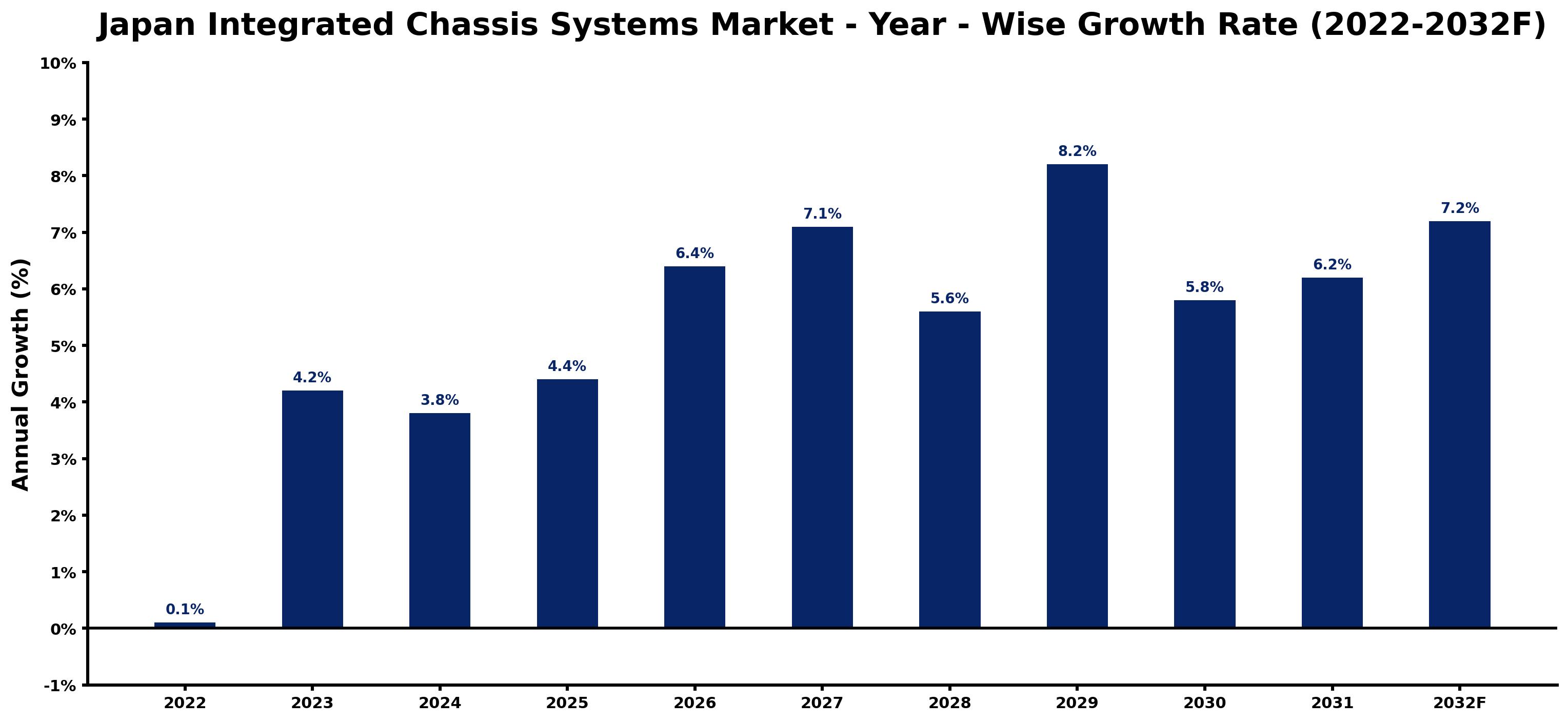
The table below sets out the estimated growth rate for each year and the main factor behind it.
| Year | Estimated Annual Growth (%) | Market Rationale |
| 2022 | 0.1 | The market experienced minimal growth due to a recovering automotive sector. |
| 2023 | 4.2 | Growth accelerated as demand for integrated chassis systems increased. |
| 2024 | 3.8 | The market saw slower growth as supply chain issues affected production rates. |
| 2025 | 4.4 | Demand surged as manufacturers adopted advanced chassis technologies for improved performance. |
| 2026 | 6.4 | Growth is expected to continue as investments in automotive innovation increase. |
| 2027 | 7.1 | The market is projected to expand further with rising consumer preference for vehicle safety features. |
| 2028 | 5.6 | Growth is anticipated to slow slightly as manufacturers adjust to market saturation. |
| 2029 | 8.2 | The peak growth year is driven by advancements in vehicle technology. |
| 2030 | 5.8 | Growth is projected to moderate as the market stabilises after reaching peak demand. |
| 2031 | 6.2 | Demand is expected to increase again as new technologies are integrated into vehicles. |
| 2032 | 7.2 | The market is projected to continue growing as electric vehicle adoption drives chassis system improvements. |
Note: Market size estimations and growth projections presented in this report are based on 6Wresearch's proprietary forecasting methodology, utilizing the latest available industry data, government publications, and primary research inputs.
Japan Integrated Chassis Systems Market Synopsis
Integrated Chassis Systems are advanced automotive technologies that improve vehicle performance and safety through a combination of mechanical, electronic, and software components. With over 8 million vehicles produced in Japan in 2022, the Japan Integrated Chassis Systems Market is growing due to strong demand from domestic car manufacturers and increasing exports. Key factors driving this growth include rising electric vehicle adoption, advancements in mechatronics technology, and government initiatives promoting advanced vehicle technologies.
Market Dynamics Impact Analysis (2026–2032)
| Factor | Type | Impact | Primary Segment Affected |
| Rising adoption of electric vehicles | Driver | High | EVs |
| Advancements in mechatronics technology | Driver | High | Mechatronics |
| Growing demand for enhanced vehicle safety standards | Opportunity | High | Brake & Stability Ctrl |
| Increasing investments in automotive R&D | Opportunity | Medium | Active Suspension |
| Supply chain disruptions affecting component availability | Restraint | High | Electronic Control Units |
| High costs associated with advanced technology integration | Restraint | Medium | Integrated Steering |
| Limited consumer awareness of advanced chassis benefits | Challenge | Medium | Passenger Cars |
| Competition from international automotive markets | Challenge | High | Car Manufacturers |
Evaluation of Drivers in Japan Integrated Chassis Systems Market (2026–2032)
The following drivers explain most of the expected growth.
| Drivers | Primary Segment Affected | Why It Matters (Evidence) |
| Increased production of electric vehicles | EVs | The Japanese government aims for 20% EV adoption by 2025, driving demand for integrated systems. |
| Technological advancements in mechatronics | Mechatronics | Japan leads in mechatronics, with over 150 million electronic control units installed, enhancing vehicle performance. |
| Rising consumer safety expectations | Brake & Stability Ctrl | The Heavy Vehicle Safety Regulation was updated in 2023, mandating advanced safety features in new vehicles. |
| Growing automotive exports | Passenger Cars | Japan produced over 8 million vehicles in 2022, increasing the need for advanced chassis systems. |
| Investment in autonomous vehicle technology | Active Suspension | The government allocated funding for R&D in autonomous technologies, boosting demand for integrated systems. |
Spending rises because the Japanese automotive market is increasingly focused on electric vehicles, targeting 20% adoption by 2025. The production of over 8 million vehicles in 2022 has heightened demand for integrated chassis systems. Advancements in mechatronics technology, with over 150 million electronic control units in use, improve vehicle performance and safety.
Evaluation of Restraints in Japan Integrated Chassis Systems Market
Below are the constraints most often cited by buyers and suppliers, with the segment each affects.
| Market Restraint | Primary Segment Affected | Why It Matters (Evidence) |
| Supply chain disruptions affecting component availability | Electronic Control Units | In 2022, global supply chain issues limited the availability of critical components, delaying production. |
| High costs associated with advanced technology integration | Integrated Steering | Integration costs for advanced chassis systems can exceed 10% of total vehicle costs, impacting affordability. |
| Limited consumer awareness of advanced chassis benefits | Passenger Cars | Many consumers lack knowledge about the advantages of integrated chassis systems, hindering market growth. |
| Competition from international automotive markets | Car Manufacturers | International competitors are increasingly offering advanced chassis technologies, challenging local manufacturers' market share. |
| Regulatory compliance costs for new technologies | Active Suspension | Compliance with updated safety regulations can increase development costs by up to 15%. |
Japan Integrated Chassis Systems Market Challenges
Producers face increased costs due to compliance with ISO 26262, which can raise development expenses by up to 15% and delay product launches. Integration complexities in advanced chassis systems can extend development cycles, resulting in delays of up to six months for producers. Recent updates to the Heavy Vehicle Safety Regulation require additional testing, adding costs that can reach 10% of total project budgets for producers. Supply chain disruptions in sourcing electronic components can lead to production halts, forcing buyers to confront potential delivery delays of up to three months.
Trends in the Japan Integrated Chassis Systems Market
The trends below show where the Japan Integrated Chassis Systems Market is heading.
- Transition to Electric Vehicles: The automotive industry is shifting towards electric vehicles, with an adoption rate of 10% in 2023. This trend drives demand for integrated chassis systems that improve performance and safety.
- Implementation of New Safety Regulations: The Heavy Vehicle Safety Regulation updated in 2023 mandates advanced chassis systems for new vehicles. This regulation is set to increase the market for safety technologies as manufacturers adapt.
- Focus on Mechatronics Integration: Japan is leading in mechatronics technology, with a significant number of electronic control units installed in vehicles. This trend encourages manufacturers to adopt integrated systems for better performance.
- Expansion of Aftermarket Services: The aftermarket segment is gaining traction, projected to grow at 8.2% from 2026 to 2032. This growth is driven by the need for upgrades and improvements in existing vehicles.
Investment Opportunities in the Japan Integrated Chassis Systems Market
The openings below show where demand in the Japan Integrated Chassis Systems Market is visible and how suppliers can enter.
- Gap in Electric Vehicle Infrastructure Investment: With the target of 20% EV adoption by 2025, there is a gap in infrastructure. Car manufacturers need to invest in charging stations and battery technologies, creating opportunities for suppliers.
- Increased R&D Investment in Advanced Technologies: The Japanese automotive sector is projected to invest over 1 trillion yen in R&D by 2025. This investment opens avenues for technology providers to collaborate with manufacturers.
- Rising Demand for Performance Improvements: The performance vehicle segment is expanding, with a projected growth rate of 8.4%. Suppliers can target this niche market by offering advanced chassis systems tailored for high-performance applications.
- Development of Smart Vehicle Technologies: The push for smart vehicle technologies is increasing, with government funding for R&D in autonomous systems. This creates opportunities for companies specialising in integrated chassis systems.
Government Initiatives in the Japan Integrated Chassis Systems Market
The Electrical Appliance and Material Safety Act, enacted in 1961, regulates the safety of electrical components in vehicles. This law ensures that integrated chassis systems meet safety standards, promoting consumer confidence in automotive technologies. More recent measures include the Semiconductor and Digital Industry Strategy from June 2021, which aims to secure domestic semiconductor manufacturing, essential for automotive electronics.
The Ministry of Land, Infrastructure, Transport and Tourism oversees the implementation of advanced vehicle technology programs. In 2023, they launched initiatives to promote the adoption of integrated chassis systems, funding research projects that improve vehicle safety and performance. This support helps car manufacturers integrate advanced technologies into their production processes.
Future Insight of the Japan Integrated Chassis Systems Market
Advanced vehicle technologies will transform demand by 2032, with government funding for autonomous vehicle research driving innovation. The Japanese automotive market's projected investment of over 1 trillion yen in R&D will improve integrated chassis systems. New JIS standards will establish higher quality and safety benchmarks, shaping buyer preferences. Collaboration among automotive manufacturers in the Tokyo region will streamline supply chains, creating efficiencies for both buyers and suppliers.
Market Segmentation Analysis
Japan Integrated Chassis Systems Market report covers a detailed analysis of the following market segments:
By System Type – Active Suspension Leads and Records the Fastest Growth
According to Saurav Kr Singh, Senior Research Analyst at 6Wresearch, Active Suspension held 43% of the Japan Integrated Chassis Systems Market by system type in 2025. Active Suspension captures the largest share as it directly improves ride comfort and handling, essential for the production of over 8 million vehicles in Japan. Its widespread adoption across various vehicle models illustrates its critical role in enhancing driving performance. Its lead should widen, with a projected CAGR of 9.3% during 2026–2032, the highest in this split. Active Suspension will continue to grow as it is increasingly recognised for its importance in optimising vehicle dynamics, especially with the automotive sector's emphasis on ride quality. This technology's established market presence ensures that demand will keep rising alongside ongoing R&D efforts. Suppliers should focus on advancing Active Suspension technologies to meet the escalating demand from automotive manufacturers.
By Technology Type – Electronic Control Units Lead, Mechatronics Expected to Grow Fastest
Electronic Control Units took 44% of technology type revenue in 2025, more than any other category. Electronic Control Units lead the market due to their essential role in managing vehicle functions that ensure safety and performance in modern automotive applications. Their presence in over 150 million vehicles underscores their importance in the automotive sector. Mechatronics are projected to grow fastest, at a CAGR of 9.2% during 2026–2032. Mechatronics is rapidly gaining traction as it effectively integrates mechanical and electronic systems, significantly enhancing vehicle performance. The automotive industry's commitment to advanced technologies will drive the demand for mechatronic solutions. Buyers should invest in cutting-edge mechatronic technologies to maintain competitiveness in the automotive landscape.
By Vehicle Type – Passenger Cars Lead, EVs Expected to Grow Fastest
In 2025, Passenger Cars led the vehicle type split with a 50% share. Passenger Cars represent the largest segment as they account for the majority of the registered vehicles in Japan, with over 78 million cars on the road. This high volume drives the demand for integrated chassis systems tailored for everyday use and comfort. EVs are set to record the highest CAGR in this split, 9.6% over 2026–2032. The EV segment is growing swiftly, fueled by government initiatives to increase electric vehicle adoption to 20% by 2025. As consumer interest in eco-friendly vehicles rises, the demand for advanced chassis systems in EVs will likely accelerate. Manufacturers should prioritise the development of chassis systems specifically designed for electric vehicles to capture this expanding market.
By Distribution Channel – OEMs Lead, Aftermarket Expected to Grow Fastest
OEMs accounted for 39% of the market by distribution channel in 2025. OEMs are the dominant distribution channel for integrated chassis systems, responsible for the initial assembly and integration of these components in vehicles. Their leading position is reinforced by the scale of production and the necessity for high-quality parts during manufacturing. Over 2026–2032, Aftermarket is expected to post the fastest growth, at a CAGR of 8.2%. The Aftermarket is witnessing robust growth as vehicle owners increasingly seek to upgrade their systems for enhanced performance and safety. This trend reflects a growing consumer preference for improving vehicle capabilities post-purchase. Suppliers should enhance their aftermarket offerings to cater to the rising demand for vehicle upgrades.
By End User – Car Manufacturers Lead, Performance Vehicles Expected to Grow Fastest
With 49% of end user revenue in 2025, Car Manufacturers was the largest category. Car Manufacturers are the primary end users of integrated chassis systems, as they are the main purchasers for new vehicle production. Their continuous innovation and high production volumes create a steady demand for advanced automotive technologies. The quickest growth will come from Performance Vehicles, forecast to expand at a CAGR of 8.4% between 2026 and 2032. Performance Vehicles are emerging as a rapidly growing segment, driven by increasing consumer interest in high-end modifications and customisation. This niche market is attracting investments aimed at boosting performance features, indicating strong future growth potential. Suppliers should explore partnerships with performance vehicle manufacturers to leverage this expanding market.
Key Attractiveness of the Report
- 10 Years of Market Numbers
- Historical Data Starting from 2022 to 2025
- Base Year 2025
- Forecast Data until 2032
- Key Performance Indicators Impacting the Market
- Major Upcoming Developments and Projects
Key Highlights of the Report:
- Japan Integrated Chassis Systems Market Outlook
- Market Size of Japan Integrated Chassis Systems Market, 2025
- Forecast of Japan Integrated Chassis Systems Market, 2032
- Historical Data and Forecast of Japan Integrated Chassis Systems Revenues & Volume for the Period 2022-2032F
- Japan Integrated Chassis Systems Market Trend Evolution
- Japan Integrated Chassis Systems Market Drivers and Challenges
- Japan Integrated Chassis Systems Price Trends
- Japan Integrated Chassis Systems Porter's Five Forces
- Japan Integrated Chassis Systems Industry Life Cycle
- Historical Data and Forecast of Japan Integrated Chassis Systems Market Revenues & Volume By System Type for the Period 2022-2032F
- Historical Data and Forecast of Japan Integrated Chassis Systems Market Revenues & Volume By Active Suspension for the Period 2022-2032F
- Historical Data and Forecast of Japan Integrated Chassis Systems Market Revenues & Volume By Brake & Stability Ctrl for the Period 2022-2032F
- Historical Data and Forecast of Japan Integrated Chassis Systems Market Revenues & Volume By Integrated Steering for the Period 2022-2032F
- Historical Data and Forecast of Japan Integrated Chassis Systems Market Revenues & Volume By Thermal Management for the Period 2022-2032F
- Historical Data and Forecast of Japan Integrated Chassis Systems Market Revenues & Volume By Technology Type for the Period 2022-2032F
- Historical Data and Forecast of Japan Integrated Chassis Systems Market Revenues & Volume By Mechatronics for the Period 2022-2032F
- Historical Data and Forecast of Japan Integrated Chassis Systems Market Revenues & Volume By Electronic Control Units for the Period 2022-2032F
- Historical Data and Forecast of Japan Integrated Chassis Systems Market Revenues & Volume By Steer-by-Wire for the Period 2022-2032F
- Historical Data and Forecast of Japan Integrated Chassis Systems Market Revenues & Volume By Centralized System for the Period 2022-2032F
- Historical Data and Forecast of Japan Integrated Chassis Systems Market Revenues & Volume By Vehicle Type for the Period 2022-2032F
- Historical Data and Forecast of Japan Integrated Chassis Systems Market Revenues & Volume By Passenger Cars for the Period 2022-2032F
- Historical Data and Forecast of Japan Integrated Chassis Systems Market Revenues & Volume By EVs for the Period 2022-2032F
- Historical Data and Forecast of Japan Integrated Chassis Systems Market Revenues & Volume By SUVs for the Period 2022-2032F
- Historical Data and Forecast of Japan Integrated Chassis Systems Market Revenues & Volume By Heavy Trucks for the Period 2022-2032F
- Historical Data and Forecast of Japan Integrated Chassis Systems Market Revenues & Volume By Distribution Channel for the Period 2022-2032F
- Historical Data and Forecast of Japan Integrated Chassis Systems Market Revenues & Volume By OEMs for the Period 2022-2032F
- Historical Data and Forecast of Japan Integrated Chassis Systems Market Revenues & Volume By Tier-1 Suppliers for the Period 2022-2032F
- Historical Data and Forecast of Japan Integrated Chassis Systems Market Revenues & Volume By Aftermarket for the Period 2022-2032F
- Historical Data and Forecast of Japan Integrated Chassis Systems Market Revenues & Volume By Fleet Management for the Period 2022-2032F
- Historical Data and Forecast of Japan Integrated Chassis Systems Market Revenues & Volume By End User for the Period 2022-2032F
- Historical Data and Forecast of Japan Integrated Chassis Systems Market Revenues & Volume By Car Manufacturers for the Period 2022-2032F
- Historical Data and Forecast of Japan Integrated Chassis Systems Market Revenues & Volume By Performance Vehicles for the Period 2022-2032F
- Historical Data and Forecast of Japan Integrated Chassis Systems Market Revenues & Volume By Vehicle Modifiers for the Period 2022-2032F
- Historical Data and Forecast of Japan Integrated Chassis Systems Market Revenues & Volume By Fleet Operators for the Period 2022-2032F
- Japan Integrated Chassis Systems Import Export Trade Statistics
- Market Opportunity Assessment By System Type
- Market Opportunity Assessment By Technology Type
- Market Opportunity Assessment By Vehicle Type
- Market Opportunity Assessment By Distribution Channel
- Market Opportunity Assessment By End User
- Japan Integrated Chassis Systems Top Companies Market Share
- Japan Integrated Chassis Systems Competitive Benchmarking By Technical and Operational Parameters
- Japan Integrated Chassis Systems Company Profiles
- Japan Integrated Chassis Systems Key Strategic Recommendations
Market Covered
The study includes the following segmentation.
By System Type
- Active Suspension
- Brake & Stability Ctrl
- Integrated Steering
- Thermal Management
By Technology Type
- Mechatronics
- Electronic Control Units
- Steer-by-Wire
- Centralized System
By Vehicle Type
- Passenger Cars
- EVs
- SUVs
- Heavy Trucks
By Distribution Channel
- OEMs
- Tier-1 Suppliers
- Aftermarket
- Fleet Management
By End User
- Car Manufacturers
- Performance Vehicles
- Vehicle Modifiers
- Fleet Operators































