Japan Integrated Circuit Automotive Application Market Size & Growth Rate
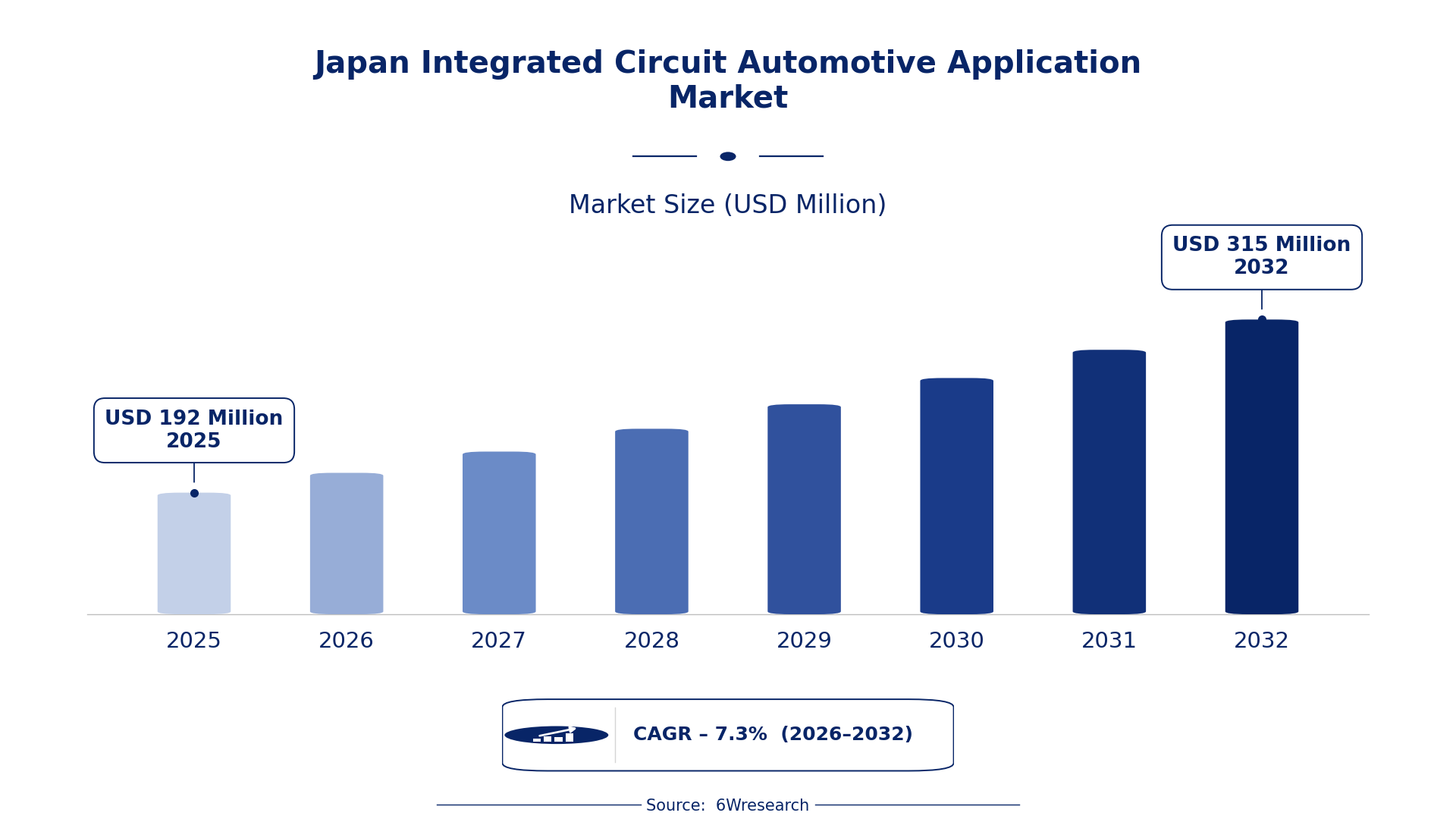
According to 6Wresearch internal database and industry insights, the Japan Integrated Circuit Automotive Application Market was valued at USD 192 Million in 2025 and is projected to reach USD 315 Million by 2032, growing at a CAGR of approximately 7.3% during 2026–2032.
Japan Integrated Circuit Automotive Application Market Highlights
| Report Metric | Details |
| Report Name | Japan Integrated Circuit Automotive Application Market (2026-2032) |
| Market Size 2025 | USD 192 Million |
| Market Size 2032 | USD 315 Million |
| Absolute Growth 2025–2032 | USD 123 Million |
| CAGR 2026–2032 | 7.3% |
| Peak Annual Growth | 8.5% in 2026 |
| Forecast Period | 2026–2032 |
| Historical Data | 2022–2025 |
| Base Year | 2025 |
| Leading IC Type, 2025 | Power Management ICs (44% share) |
| Leading Application Area, 2025 | Battery Management (37% share) |
| Leading Vehicle Type, 2025 | Electric Vehicles (42% share) |
| Leading Distribution Channel, 2025 | Tier-1 Suppliers (48% share) |
| Leading End User, 2025 | Automotive OEMs (40% share) |
| Fastest-Growing IC Type | Sensor ICs (10.3% CAGR) |
| Fastest-Growing Application Area | ADAS (8.6% CAGR) |
| Fastest-Growing Vehicle Type | SUVs (10.2% CAGR) |
| Fastest-Growing Distribution Channel | Distributors (9.5% CAGR) |
| Fastest-Growing End User | Electronics Assemblers (9.2% CAGR) |
| Growing Sector | Electric Vehicles |
| Key End Users | Automotive OEMs, ECU Manufacturers, Semiconductor Vendors |
Japan Integrated Circuit Automotive Application Market Year-wise Growth Rate and Key Drivers (2022–2032)
This graph illustrates the annual growth rates of the market from 2022 to 2032, highlighting a steady upward trajectory and projected market expansion over the forecast period.
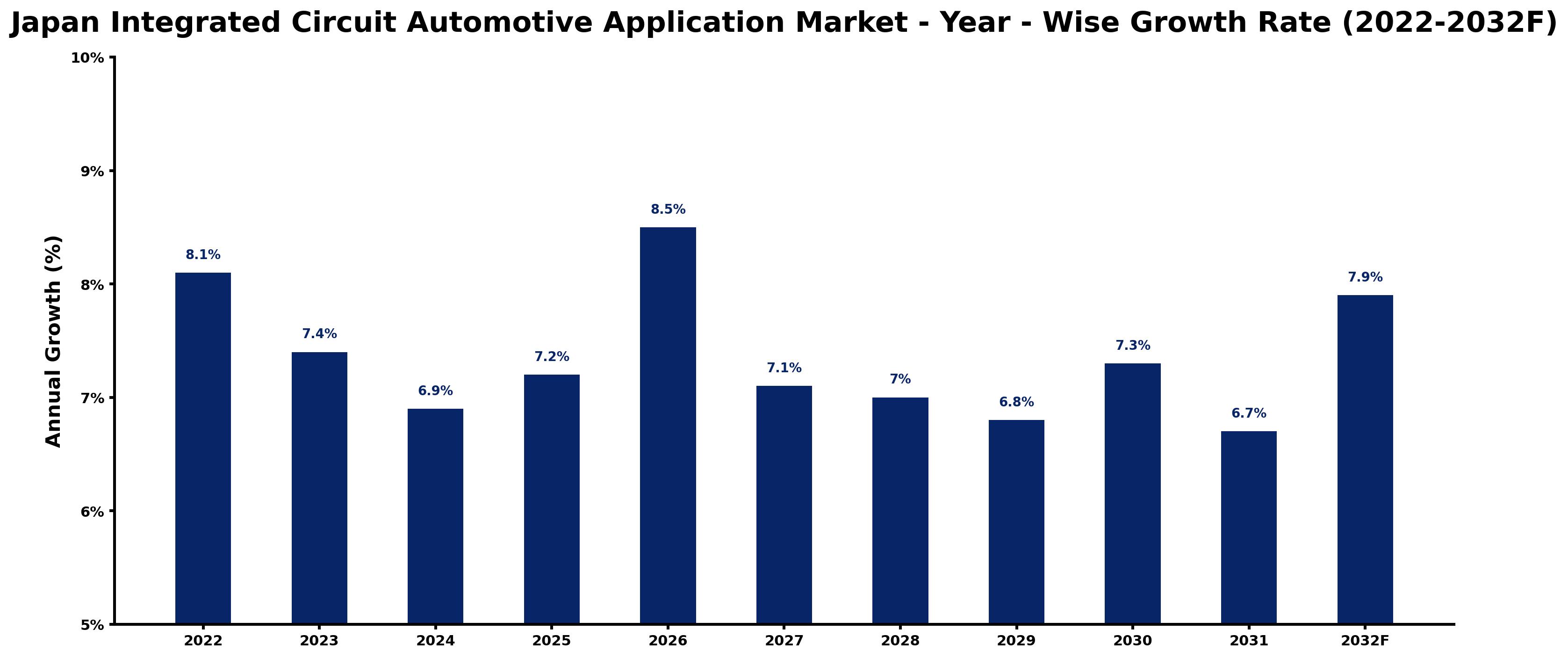
Below, each year's estimated growth is shown next to the factor that most influenced it.
| Year | Estimated Annual Growth (%) | Market Rationale |
| 2022 | 8.1 | The market experienced strong demand due to vehicle production levels. |
| 2023 | 7.4 | Growth slowed as manufacturers adjusted to supply chain challenges. |
| 2024 | 6.9 | Continued supply chain issues constrained growth despite high demand. |
| 2025 | 7.2 | Demand increased as the automotive sector focused on electrification. |
| 2026 | 8.5 | Growth accelerated with rising investments in electric vehicle technology. |
| 2027 | 7.1 | A slight slowdown occurred as the market stabilised after rapid growth. |
| 2028 | 7.0 | Growth continued to moderate as the market adjusted to new norms. |
| 2029 | 6.8 | Demand remained steady, reflecting ongoing investments in automotive technology. |
| 2030 | 7.3 | Growth picked up again with a renewed focus on decarbonisation efforts. |
| 2031 | 6.7 | The market experienced a slowdown as the electrification trend matured. |
| 2032 | 7.9 | Demand surged as new technologies and standards were adopted. |
Note: Market size estimations and growth projections presented in this report are based on 6Wresearch's proprietary forecasting methodology, utilizing the latest available industry data, government publications, and primary research inputs.
Japan Integrated Circuit Automotive Application Market Synopsis
Integrated Circuit Automotive Applications are semiconductor devices essential for controlling electronic systems in vehicles. These devices are manufactured using silicon wafers and photolithography, focusing on power management, sensor integration, and communication. The Japan Integrated Circuit Automotive Application Market is expanding due to increased vehicle production and investments in electric vehicle technology. In 2022, Japan produced 8.5 million vehicles, and the government aims for 1 million electric vehicles by 2025, driving demand for advanced integrated circuits.
Market Dynamics Impact Analysis (2026–2032)
| Factor | Type | Impact | Primary Segment Affected |
| Rising vehicle production and electrification initiatives | Driver | High | Power Management ICs |
| Increased adoption of advanced driver-assistance systems (ADAS) | Driver | High | ADAS |
| Growing demand for electric vehicles (EVs) | Opportunity | High | Electric Vehicles |
| Investment in semiconductor manufacturing capabilities | Opportunity | Medium | Semiconductor Vendors |
| Supply chain disruptions affecting production schedules | Restraint | High | Microcontrollers |
| High costs associated with advanced semiconductor technologies | Restraint | Medium | Sensor ICs |
| Limited availability of skilled workforce in semiconductor manufacturing | Challenge | High | Semiconductor Vendors |
| Intense competition leading to pricing pressures | Challenge | Medium | Automotive OEMs |
Evaluation of Drivers in Japan Integrated Circuit Automotive Application Market (2026–2032)
Key forces behind demand, with the segment each one moves most, are listed below.
| Drivers | Primary Segment Affected | Why It Matters (Evidence) |
| Increased vehicle production | Power Management ICs | Japan produced 8.5 million vehicles in 2022, boosting demand for energy-efficient ICs. |
| Expansion of ADAS features in new vehicles | ADAS | 35% of new vehicles in Japan were equipped with ADAS features in 2022. |
| Rising electric vehicle adoption | Electric Vehicles | The government targets 1 million electric vehicles by 2025, driving IC demand. |
| Investment in semiconductor manufacturing | Semiconductor Vendors | Japan's automotive sector is projected to invest ¥1 trillion in electrification by 2025. |
| Technological advancements in automotive electronics | Microcontrollers | The average lifespan of a microcontroller in automotive applications is around 10 years. |
Several shifts outside the market lift sales. In 2022, Japan produced 8.5 million vehicles, increasing the need for advanced semiconductor solutions. The target of 1 million electric vehicles by 2025 is driving demand for Battery Management ICs. Manufacturers are investing in Sensor ICs to meet safety standards, as 35% of new vehicles are equipped with ADAS features. The automotive sector's projected ¥1 trillion investment in electrification by 2025 will stimulate demand for Microcontrollers, vital for vehicle control systems.
Evaluation of Restraints in Japan Integrated Circuit Automotive Application Market
The table below lists the restraints and the evidence behind each.
| Market Restraint | Primary Segment Affected | Why It Matters (Evidence) |
| Supply chain disruptions | Microcontrollers | Supply chain issues have delayed production schedules, impacting the availability of critical components. |
| High costs of advanced semiconductor technologies | Sensor ICs | The rising costs of manufacturing advanced ICs have constrained budget allocations for automotive applications. |
| Limited availability of skilled workforce | Semiconductor Vendors | A shortage of skilled workers in semiconductor manufacturing has hindered production capabilities. |
| Regulatory compliance costs | ADAS | Compliance with standards such as ISO 26262 increases operational costs for manufacturers. |
| Market saturation in traditional vehicle segments | Power Management ICs | The increasing saturation of traditional vehicle segments limits growth opportunities for ICs. |
Japan Integrated Circuit Automotive Application Market Challenges
High production costs for integrated circuits present a major challenge, driven by expensive raw materials and intricate manufacturing processes. Domestic automotive manufacturers are facing a 15% rise in component costs, putting pressure on their budgets and leading to higher vehicle prices. Technological limitations stem from inadequate investment in R&D, delaying product development for suppliers who must adapt to changing industry standards. Competition is intensifying as international players offer lower prices, forcing local producers to reduce margins, which undermines profitability and threatens their market share. Buyers are facing hurdles due to the slow uptake of electric vehicles, limiting the demand for automotive ICs and constraining growth opportunities.
Trends in the Japan Integrated Circuit Automotive Application Market
Four trends stand out in the Japan Integrated Circuit Automotive Application Market.
- Shift Towards Electric Vehicles: Since 2023, the automotive sector has increasingly focused on electric vehicles, with a target of 1 million EVs by 2025. This shift is driving demand for advanced Integrated Circuit Automotive Applications, particularly in Battery Management systems.
- Emergence of Advanced Driver-Assistance Systems: The adoption of ADAS features has surged since 2022, with 35% of new vehicles equipped with these technologies. This trend is pushing manufacturers to invest in Sensor ICs to meet safety standards.
- Transition to Smart Vehicle Communication: The integration of smart communication systems in vehicles has accelerated since 2023, necessitating advanced Communication ICs. This trend is reflected in the growing demand for telematics solutions.
- Focus on Sustainability in Automotive Manufacturing: Starting in 2023, the automotive sector is prioritising sustainability, aiming for a 46% reduction in greenhouse gas emissions by 2030. This goal is driving investments in energy-efficient Integrated Circuit Automotive Applications.
Investment Opportunities in the Japan Integrated Circuit Automotive Application Market
The openings below show where demand in the Japan Integrated Circuit Automotive Application Market is visible and how suppliers can enter.
- Automotive OEMs Seeking Advanced ICs: With the automotive sector projected to invest ¥1 trillion in electrification by 2025, there is strong demand for advanced Integrated Circuit Automotive Applications, especially from Automotive OEMs.
- Growing Need for Battery Management Systems: As the number of electric vehicles in Japan is expected to reach 1 million by 2025, there is an opportunity to supply Battery Management ICs to satisfy this demand.
- Investment in Semiconductor Manufacturing: The Japanese government's commitment to achieving net-zero emissions by 2050 creates opportunities for suppliers of semiconductor technologies, particularly in the Tokyo region.
- Expansion of ADAS Features in New Vehicles: As 35% of new vehicles were equipped with ADAS features in 2022, suppliers can capitalise on the rising demand for Sensor ICs to improve vehicle safety.
Government Initiatives in the Japan Integrated Circuit Automotive Application Market
The GX Basic Policy adopted in 2023 aims for JPY 150 trillion in public and private decarbonisation investment over 10 years, impacting Integrated Circuit Automotive Application producers. This policy encourages manufacturers to invest in energy-efficient technologies and comply with environmental standards.
In 2023, the Japanese government launched a program to promote electric vehicle adoption, targeting 1 million EVs by 2025. The Ministry of Economy, Trade and Industry (METI) oversees this initiative, providing funding and support for manufacturers to improve their IC capabilities.
Future Insight of the Japan Integrated Circuit Automotive Application Market
Japan's commitment to decarbonisation will reshape the automotive sector by 2032, driven by substantial public and private investments. Anticipated investments of ¥1 trillion in electrification will lead to advancements in semiconductor technology, enabling suppliers to produce more efficient integrated circuits. New standards, such as ISO 26262, will improve safety and reliability, boosting consumer confidence in automotive innovations. As the number of electric vehicles is projected to reach 1 million by 2025, buyers will benefit from a wider array of advanced features, enhancing their purchasing options.
Market Segmentation Analysis
Japan Integrated Circuit Automotive Application Market report covers a detailed analysis of the following market segments:
By IC Type – Power Management ICs Lead, Sensor ICs Expected to Grow Fastest
According to Saurav Kr Singh, Senior Research Analyst at 6Wresearch, in 2025, Power Management ICs led the ic type split with a 44% share. Power Management ICs hold the largest share due to their critical role in enhancing energy efficiency in vehicles, especially as Japan aims for significant greenhouse gas reductions. The increasing production of electric vehicles, which heavily rely on these components, further reinforces their leading position. Sensor ICs are projected to grow fastest, at a CAGR of 10.3% during 2026–2032. Sensor ICs are experiencing rapid growth, driven by their essential function in ensuring vehicle safety and performance, particularly with the rise of advanced driver-assistance systems. The implementation of safety standards like ISO 26262 is propelling demand for these components, ensuring their continued expansion. Suppliers should prioritise the development of power management and sensor ICs to align with market trends.
By Application Area – Battery Management Leads, ADAS Expected to Grow Fastest
Battery Management accounted for 37% of the market by application area in 2025. Battery Management leads the segment as it is crucial for the performance of electric vehicles, which is increasingly vital in Japan's decarbonisation efforts. The automotive sector's planned investment of ¥1 trillion in electrification by 2025 highlights the importance of this area. The quickest growth will come from ADAS, forecast to expand at a CAGR of 8.6% between 2026 and 2032. ADAS is the fastest-growing application area, spurred by the rising demand for advanced safety features in vehicles, as showcased at the Tokyo Motor Show 2023. The growing integration of ADAS in new vehicle models is driving this segment's rapid expansion. Manufacturers must focus on enhancing battery management and ADAS technologies to meet evolving automotive standards.
By Vehicle Type – Electric Vehicles Lead, SUVs Expected to Grow Fastest
The largest vehicle type category in 2025 was Electric Vehicles, at 42% of revenue. Electric Vehicles dominate the market as they represent a rapidly expanding sector requiring advanced integrated circuits for their sophisticated electronic systems. The Japanese government's target of 1 million electric vehicles by 2025 significantly boosts this segment, reinforcing its leadership. SUVs are set to record the highest CAGR in this split, 10.2% over 2026–2032. SUVs are witnessing the fastest growth, reflecting a shift in consumer preferences towards larger vehicles that require moderate demand for integrated circuits. This trend indicates a diversification in vehicle offerings that suppliers must address to remain competitive. Suppliers need to adapt their product lines to support the increasing demand for electric vehicles and the growing SUV market.
By Distribution Channel – Tier-1 Suppliers Lead, Distributors Expected to Grow Fastest
Tier-1 Suppliers took 48% of distribution channel revenue in 2025, more than any other category. Tier-1 Suppliers are the primary channel for IC distribution, playing a direct role in delivering essential components to automotive manufacturers. Their established relationships with OEMs ensure consistent demand for integrated circuits, maintaining their leading position in the market. Over 2026–2032, Distributors are expected to post the fastest growth, at a CAGR of 9.5%. Distributors are becoming increasingly important, providing indirect support in the supply chain and facilitating the availability of ICs to various manufacturers. Their expanding network enhances market reach for suppliers, indicating a shift in distribution dynamics. Suppliers should strengthen partnerships with both Tier-1 suppliers and distributors to optimise their market presence.
By End User – Automotive OEMs Lead, Electronics Assemblers Expected to Grow Fastest
Automotive OEMs held 40% of the Japan Integrated Circuit Automotive Application Market by end user in 2025. Automotive OEMs are the largest end users of integrated circuits, directly incorporating these components into vehicle production. Their significant purchasing power shapes the demand for various IC types essential for vehicle functionality, ensuring their top position in the market. Electronics Assemblers are projected to grow fastest, at a CAGR of 9.2% during 2026–2032. Electronics Assemblers are experiencing the fastest growth due to their supporting role in the assembly of automotive systems, particularly as vehicle complexity increases. Their involvement in the production process highlights the need for efficient supply chains, driving their rapid expansion. Suppliers must ensure their products meet the specific requirements of both OEMs and electronics assemblers to capture market opportunities.
Key Attractiveness of the Report
- 10 Years of Market Numbers
- Historical Data Starting from 2022 to 2025
- Base Year 2025
- Forecast Data until 2032
- Key Performance Indicators Impacting the Market
- Major Upcoming Developments and Projects
Key Highlights of the Report:
- Japan Integrated Circuit Automotive Application Market Outlook
- Market Size of Japan Integrated Circuit Automotive Application Market, 2025
- Forecast of Japan Integrated Circuit Automotive Application Market, 2032
- Historical Data and Forecast of Japan Integrated Circuit Automotive Application Revenues & Volume for the Period 2022-2032F
- Japan Integrated Circuit Automotive Application Market Trend Evolution
- Japan Integrated Circuit Automotive Application Market Drivers and Challenges
- Japan Integrated Circuit Automotive Application Price Trends
- Japan Integrated Circuit Automotive Application Porter's Five Forces
- Japan Integrated Circuit Automotive Application Industry Life Cycle
- Historical Data and Forecast of Japan Integrated Circuit Automotive Application Market Revenues & Volume By IC Type for the Period 2022-2032F
- Historical Data and Forecast of Japan Integrated Circuit Automotive Application Market Revenues & Volume By Power Management ICs for the Period 2022-2032F
- Historical Data and Forecast of Japan Integrated Circuit Automotive Application Market Revenues & Volume By Sensor ICs for the Period 2022-2032F
- Historical Data and Forecast of Japan Integrated Circuit Automotive Application Market Revenues & Volume By Communication ICs for the Period 2022-2032F
- Historical Data and Forecast of Japan Integrated Circuit Automotive Application Market Revenues & Volume By Microcontrollers for the Period 2022-2032F
- Historical Data and Forecast of Japan Integrated Circuit Automotive Application Market Revenues & Volume By Application Area for the Period 2022-2032F
- Historical Data and Forecast of Japan Integrated Circuit Automotive Application Market Revenues & Volume By Battery Management for the Period 2022-2032F
- Historical Data and Forecast of Japan Integrated Circuit Automotive Application Market Revenues & Volume By ADAS for the Period 2022-2032F
- Historical Data and Forecast of Japan Integrated Circuit Automotive Application Market Revenues & Volume By Infotainment for the Period 2022-2032F
- Historical Data and Forecast of Japan Integrated Circuit Automotive Application Market Revenues & Volume By Engine Control Units for the Period 2022-2032F
- Historical Data and Forecast of Japan Integrated Circuit Automotive Application Market Revenues & Volume By Vehicle Type for the Period 2022-2032F
- Historical Data and Forecast of Japan Integrated Circuit Automotive Application Market Revenues & Volume By Electric Vehicles for the Period 2022-2032F
- Historical Data and Forecast of Japan Integrated Circuit Automotive Application Market Revenues & Volume By SUVs for the Period 2022-2032F
- Historical Data and Forecast of Japan Integrated Circuit Automotive Application Market Revenues & Volume By Passenger Cars for the Period 2022-2032F
- Historical Data and Forecast of Japan Integrated Circuit Automotive Application Market Revenues & Volume By Commercial Vehicles for the Period 2022-2032F
- Historical Data and Forecast of Japan Integrated Circuit Automotive Application Market Revenues & Volume By Distribution Channel for the Period 2022-2032F
- Historical Data and Forecast of Japan Integrated Circuit Automotive Application Market Revenues & Volume By Tier-1 Suppliers for the Period 2022-2032F
- Historical Data and Forecast of Japan Integrated Circuit Automotive Application Market Revenues & Volume By Distributors for the Period 2022-2032F
- Historical Data and Forecast of Japan Integrated Circuit Automotive Application Market Revenues & Volume By Online Platforms for the Period 2022-2032F
- Historical Data and Forecast of Japan Integrated Circuit Automotive Application Market Revenues & Volume By Semiconductor Vendors for the Period 2022-2032F
- Historical Data and Forecast of Japan Integrated Circuit Automotive Application Market Revenues & Volume By End User for the Period 2022-2032F
- Historical Data and Forecast of Japan Integrated Circuit Automotive Application Market Revenues & Volume By Automotive OEMs for the Period 2022-2032F
- Historical Data and Forecast of Japan Integrated Circuit Automotive Application Market Revenues & Volume By Electronics Assemblers for the Period 2022-2032F
- Historical Data and Forecast of Japan Integrated Circuit Automotive Application Market Revenues & Volume By ECU Manufacturers for the Period 2022-2032F
- Historical Data and Forecast of Japan Integrated Circuit Automotive Application Market Revenues & Volume By Telematics Providers for the Period 2022-2032F
- Japan Integrated Circuit Automotive Application Import Export Trade Statistics
- Market Opportunity Assessment By IC Type
- Market Opportunity Assessment By Application Area
- Market Opportunity Assessment By Vehicle Type
- Market Opportunity Assessment By Distribution Channel
- Market Opportunity Assessment By End User
- Japan Integrated Circuit Automotive Application Top Companies Market Share
- Japan Integrated Circuit Automotive Application Competitive Benchmarking By Technical and Operational Parameters
- Japan Integrated Circuit Automotive Application Company Profiles
- Japan Integrated Circuit Automotive Application Key Strategic Recommendations
Market Covered
Segments analysed in this report are listed below.
By IC Type
- Power Management ICs
- Sensor ICs
- Communication ICs
- Microcontrollers
By Application Area
- Battery Management
- ADAS
- Infotainment
- Engine Control Units
By Vehicle Type
- Electric Vehicles
- SUVs
- Passenger Cars
- Commercial Vehicles
By Distribution Channel
- Tier-1 Suppliers
- Distributors
- Online Platforms
- Semiconductor Vendors
By End User
- Automotive OEMs
- Electronics Assemblers
- ECU Manufacturers
- Telematics Providers































