Japan Integrated Defense Network Market Size & Growth Rate
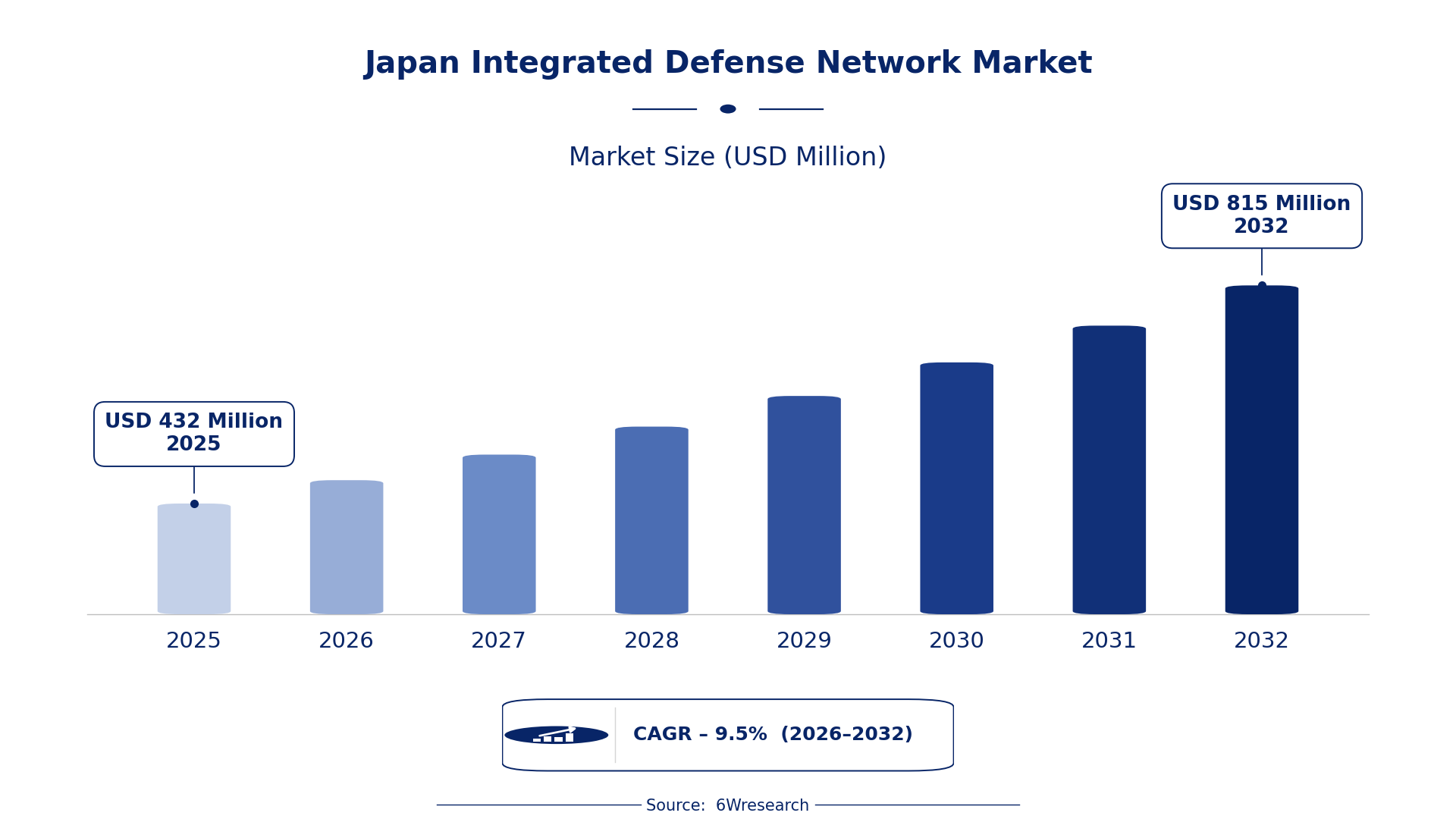
According to 6Wresearch internal database and industry insights, the Japan Integrated Defense Network Market was valued at USD 432 Million in 2025 and is projected to reach USD 815 Million by 2032, growing at a CAGR of approximately 9.5% during 2026–2032.
Japan Integrated Defense Network Market Highlights
| Report Metric | Details |
| Report Name | Japan Integrated Defense Network Market (2026-2032) |
| Market Size 2025 | USD 432 Million |
| Market Size 2032 | USD 815 Million |
| Absolute Growth 2025–2032 | USD 383 Million |
| CAGR 2026–2032 | 9.5% |
| Peak Annual Growth | 10.4% in 2028 |
| Forecast Period | 2026–2032 |
| Historical Data | 2022–2025 |
| Base Year | 2025 |
| Leading Network Type, 2025 | Tactical Defense WAN (40% share) |
| Leading Component Systems, 2025 | Satellite + Radio Link (36% share) |
| Leading Security Layer, 2025 | Encrypted Layer 2/3 (39% share) |
| Leading Application Area, 2025 | Battlefield Communication (49% share) |
| Leading End User, 2025 | Armed Forces (36% share) |
| Fastest-Growing Network Type | Homeland Defense Grid (12.9% CAGR) |
| Fastest-Growing Component Systems | Radar + C2 + AI Analytics (14.2% CAGR) |
| Fastest-Growing Security Layer | Intrusion Detection (12.6% CAGR) |
| Fastest-Growing Application Area | Border Security (11.0% CAGR) |
| Fastest-Growing End User | National Agencies (11.8% CAGR) |
| Growing Sector | defense technology |
| Key End Users | armed forces, national agencies, military commands, civil defense units |
Japan Integrated Defense Network Market Year-wise Growth Rate and Key Drivers (2022–2032)
This graph illustrates the annual growth rates of the market from 2022 to 2032, highlighting a steady upward trajectory and projected market expansion over the forecast period.
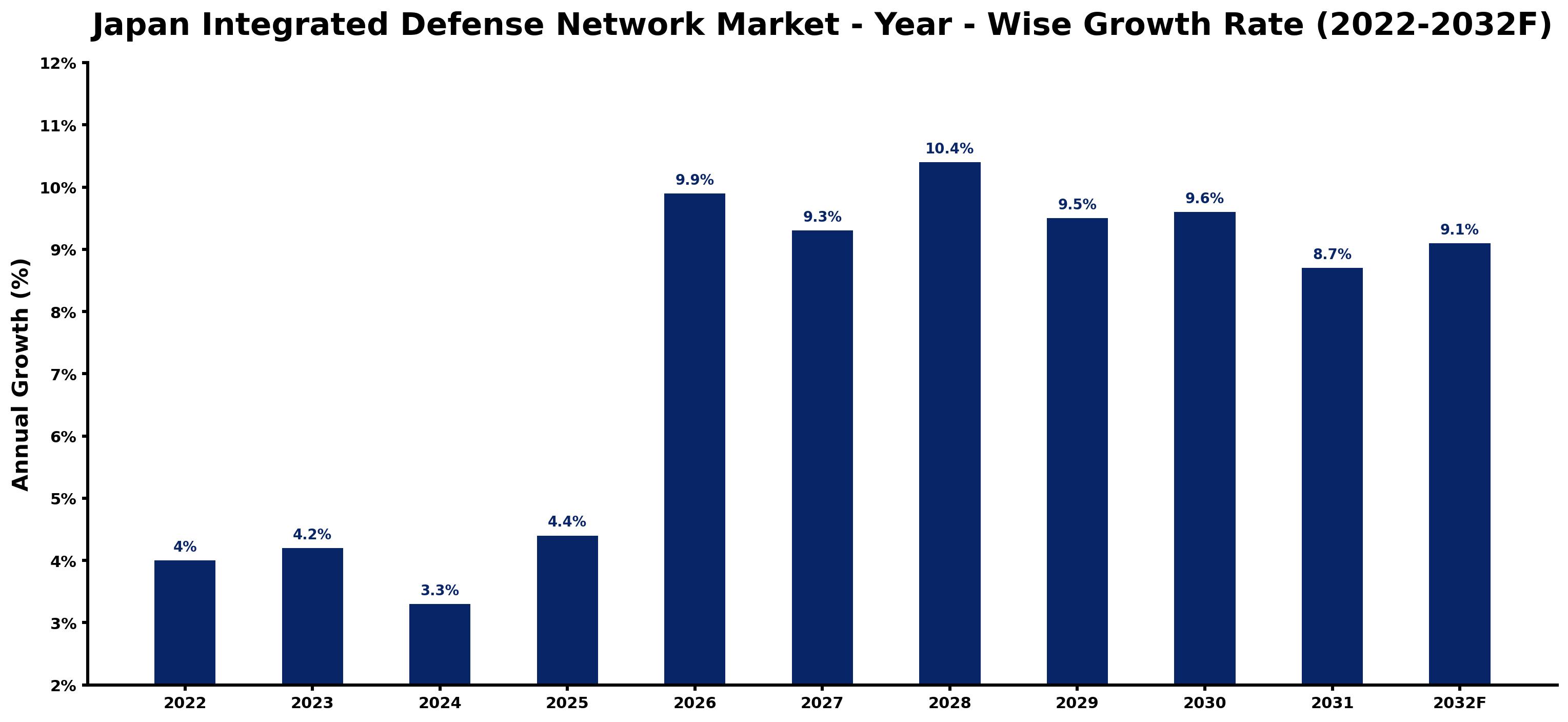
The yearly estimates that follow link every growth rate to its principal driver, so readers can see why the pace changed in each period.
| Year | Estimated Annual Growth (%) | Market Rationale |
| 2022 | 4.0 | The market showed steady growth, reflecting ongoing security needs. |
| 2023 | 4.2 | Demand increased due to heightened national security concerns following regional tensions. |
| 2024 | 3.3 | Growth slowed as investments in infrastructure began to stabilise. |
| 2025 | 4.4 | Demand surged with the implementation of new defense strategies. |
| 2026 | 9.9 | The market is expected to grow rapidly as multi-domain operations gain traction. |
| 2027 | 9.3 | Growth will slow slightly as the market adjusts to new technologies. |
| 2028 | 10.4 | A peak in growth is anticipated as advanced systems are deployed. |
| 2029 | 9.5 | The market is projected to grow at a slower rate as saturation approaches. |
| 2030 | 9.6 | Demand will rise again as new technologies improve operational capabilities. |
| 2031 | 8.7 | Growth is expected to slow as the market matures and stabilises. |
| 2032 | 9.1 | The market will continue to expand with ongoing investments in defense. |
Note: Market size estimations and growth projections presented in this report are based on 6Wresearch's proprietary forecasting methodology, utilizing the latest available industry data, government publications, and primary research inputs.
Japan Integrated Defense Network Market Synopsis
Integrated Defense Networks are sophisticated systems that unify various defense technologies, including satellite communications and radar systems. These networks improve battlefield communication, ensure border security, and support joint military operations. The Japan Integrated Defense Network Market is expanding due to increased national defense spending, approximately 6.8 trillion JPY for 2023, and the emphasis on multi-domain operations, driving demand from armed forces and national agencies for improved operational capabilities.
Market Dynamics Impact Analysis (2026–2032)
| Factor | Type | Impact | Primary Segment Affected |
| Increased defense budget allocations are driving demand for advanced communication systems. | Driver | High | Tactical Defense WAN |
| The push for multi-domain operations enhances the need for integrated defense solutions. | Driver | High | Multi-domain Ops Net |
| Growing investments in cybersecurity create opportunities for integrated defense networks. | Opportunity | High | Cyber-resilient |
| The focus on enhancing domestic production capabilities presents opportunities for suppliers. | Opportunity | Medium | Tactical Defense WAN |
| High costs of technology integration can limit access for smaller agencies. | Restraint | High | Homeland Defense Grid |
| Complex regulatory requirements may slow down deployment of new systems. | Restraint | Medium | Tactical Defense WAN |
| Limited supply chain resilience can affect timely delivery of components. | Challenge | High | Tactical Defense WAN |
| A shortage of skilled personnel in cybersecurity poses risks to network effectiveness. | Challenge | Medium | Cyber-resilient |
Evaluation of Drivers in Japan Integrated Defense Network Market (2026–2032)
Below are the drivers that matter most for revenue growth, with supporting evidence.
| Drivers | Primary Segment Affected | Why It Matters (Evidence) |
| Increased defense spending | Tactical Defense WAN | Japan's defense budget of approximately 6.8 trillion JPY drives demand for secure communication systems. |
| Implementation of multi-domain operations | Multi-domain Ops Net | The Economic Security Promotion Act (2022) supports integrated networks for effective coordination among forces. |
| Cybersecurity initiatives | Cyber-resilient | The Ministry of Internal Affairs and Communications allocates significant resources to bolster cybersecurity, increasing demand for secure defense networks. |
| Technological advancements in satellite communications | Satellite + Radio Link | Collaboration on satellite technology improves remote communication capabilities, enhancing operational effectiveness. |
| Joint military exercises with allied nations | Joint Operations | Participation in joint exercises increases the need for integrated defense networks to ensure operational compatibility. |
Much of the new demand traces back to Japan's defense budget, which is approximately 6.8 trillion JPY for 2023, enabling investments in advanced communication technologies. Collaboration on satellite technology improves remote communication capabilities, leading to increased purchases from military commands. Joint military exercises with allied nations create a need for integrated systems to ensure interoperability, prompting armed forces to invest in advanced solutions.
Evaluation of Restraints in Japan Integrated Defense Network Market
The following restraints limit how fast demand can grow.
| Market Restraint | Primary Segment Affected | Why It Matters (Evidence) |
| High costs associated with technology integration limit access for smaller agencies. | Homeland Defense Grid | The investment required for advanced systems can deter smaller national agencies from upgrading their infrastructure. |
| Complex regulatory requirements can delay deployment of new systems. | Tactical Defense WAN | Producers must navigate stringent regulations, which can slow the introduction of new technologies. |
| Supply chain vulnerabilities may impact timely delivery of components. | Tactical Defense WAN | Disruptions in the supply chain can lead to delays in the procurement of essential technologies. |
| Shortage of skilled personnel in cybersecurity affects network effectiveness. | Cyber-resilient | The lack of trained professionals can hinder the implementation of effective security measures. |
| Limited collaboration among defense contractors may restrict innovation. | Inter-service Integration | Insufficient partnerships can lead to slower advancements in integrated defense technologies. |
Japan Integrated Defense Network Market Challenges
Japan's defense budget for 2023 stands at approximately 6.8 trillion JPY, which limits buyers' capacity to invest in advanced integrated defense technologies. Regulatory compliance with ISO/IEC 27001 raises operational costs for suppliers, resulting in project delays that can extend timelines by up to 15%. Competition among domestic contractors drives down prices, constraining profit margins and stifling innovation in the sector. Buyers face challenges in resource allocation across 47 prefectures, complicating the distribution of defense resources for approximately 250,000 active personnel.
Trends in the Japan Integrated Defense Network Market
Below are the shifts with the largest effect on the Japan Integrated Defense Network Market.
- Shift towards Cybersecurity Initiatives: National agencies are prioritising cybersecurity measures, driven by the 2023 Cyber Defense Strategy. This shift is apparent as the Ministry of Internal Affairs and Communications increases funding for cybersecurity initiatives, with a budget allocation of 10 billion JPY.
- Transition from Traditional to Integrated Defense Systems: The Tokyo Metropolitan Area is experiencing a transition towards integrated defense systems, with a focus on multi-domain operations. This trend is supported by the Economic Security Promotion Act, which aims to improve operational efficiency across 47 prefectures.
- Emergence of AI-Powered Security Solutions: The adoption of AI-powered security solutions is gaining traction, particularly within the Cyber-resilient segment. The National Police Agency is implementing these technologies to improve law enforcement capabilities, with a projected investment of 5 billion JPY by 2025.
- Growing Demand for Joint Operations: The need for joint operations is increasing, particularly among the Armed Forces. This demand is reflected in the participation of Japan's military in joint exercises, with over 30 exercises conducted annually.
Investment Opportunities in the Japan Integrated Defense Network Market
Several openings in the Japan Integrated Defense Network Market merit attention from investors.
- Investment in Cybersecurity Solutions: The growing focus on cybersecurity presents an opportunity to supply advanced security solutions, particularly for national agencies. With an expected investment of 10 billion JPY in cybersecurity initiatives, local partnerships can facilitate market entry.
- Supply of Integrated Defense Technologies: There is an opportunity to provide integrated defense technologies to improve operational capabilities for armed forces. The ongoing emphasis on multi-domain operations supports this need, making it an ideal time for joint ventures.
- Development of Advanced Communication Systems: The demand for advanced communication systems is rising, particularly in tactical operations. With the Self-Defense Forces operating in 47 prefectures, suppliers can enter the market through local partnerships.
- Strengthening Domestic Production Capabilities: The Economic Security Promotion Act aims to strengthen domestic production capabilities, creating opportunities for suppliers. The projected investment of 6.8 trillion JPY in defense spending highlights the urgency for local collaborations.
Government Initiatives in the Japan Integrated Defense Network Market
The Economic Security Promotion Act (2022) supports supply-chain resilience for critical products, ensuring that buyers can rely on domestic sources for essential defense technologies. This act encourages manufacturers to invest in local capabilities, securing the supply chains for integrated defense networks.
The National Security Council oversees the integration of defense networks and approves funding for relevant projects. With a budget allocation of 10 billion JPY for cybersecurity initiatives, the council ensures that defense infrastructure meets national security needs.
Future Insight of the Japan Integrated Defense Network Market
The Cyber Defense Strategy will enhance cybersecurity measures for integrated defense networks by 2032. Collaboration with the Japan Aerospace Exploration Agency will improve satellite technology, leading to better communication capabilities for military operations. Increased domestic production capabilities from the Defense Technology Strategy will allow suppliers to cater more effectively to buyers' needs. Enhanced integration efforts overseen by the National Security Council will streamline operations across various defense agencies.
Market Segmentation Analysis
Japan Integrated Defense Network Market report covers a detailed analysis of the following market segments:
By Network Type – Tactical Defense WAN Leads, Homeland Defense Grid Expected to Grow Fastest
According to Saurav Kr Singh, Senior Research Analyst at 6Wresearch, the largest network type category in 2025 was Tactical Defense WAN, at 40% of revenue. The Tactical Defense WAN holds the largest share as it directly enables secure communication in tactical operations, which is essential for the Self-Defense Forces operating throughout Japan. This network facilitates effective coordination and response during military engagements across various regions, ensuring operational effectiveness. The quickest growth will come from Homeland Defense Grid, forecast to expand at a CAGR of 12.9% between 2026 and 2032. The Homeland Defense Grid is experiencing rapid growth due to its critical role in supporting national security infrastructure, as highlighted by recent initiatives from the Ministry of Defense. The increasing focus on protecting borders and critical assets is driving this segment's expansion, ensuring its relevance in future operations. Suppliers should prioritise enhancing capabilities within the Homeland Defense Grid to meet the rising demand for security solutions.
By Component Systems – Satellite + Radio Link Leads, Radar + C2 + AI Analytics Expected to Grow Fastest
Satellite + Radio Link accounted for 36% of the market by component systems in 2025. The Satellite + Radio Link segment leads the market as it is vital for remote communication capabilities, allowing effective operations across Japan's varied geographical landscape. This component is indispensable for maintaining connectivity, especially in remote areas where armed forces operate, ensuring seamless communication. Over 2026–2032, Radar + C2 + AI Analytics is expected to post the fastest growth, at a CAGR of 14.2%. Radar + C2 + AI Analytics is the fastest-growing segment, as it integrates essential surveillance and command functions that are increasingly required for modern defence strategies. The demand for advanced threat detection and response capabilities is propelling this segment's rapid growth, indicating a shift towards more sophisticated systems. Buyers will gain from investing in advanced integrated systems that improve operational efficiency and responsiveness.
By Security Layer – Encrypted Layer 2/3 Leads, Intrusion Detection Expected to Grow Fastest
Encrypted Layer 2/3 held 39% of the Japan Integrated Defense Network Market by security layer in 2025. The Encrypted Layer 2/3 dominates the market due to its critical role in ensuring data security within the network, which is paramount for the integrity of defence operations. This layer is widely implemented across various defence platforms to protect sensitive information. Intrusion Detection is set to record the highest CAGR in this split, 12.6% over 2026–2032. Intrusion Detection is the fastest-growing segment as it directly addresses the increasing need to detect unauthorized access attempts, particularly in light of the Cyber Defense Strategy initiated in 2023. The heightened focus on cybersecurity measures accelerates its adoption. Suppliers must prioritise advancements in intrusion detection technologies to meet evolving security requirements.
By Application Area – Battlefield Communication Leads, Border Security Expected to Grow Fastest
In 2025, Battlefield Communication led the application area split with a 49% share. Battlefield Communication is the leading application area, crucial for operational success in military engagements, ensuring effective communication among forces during missions. This capability is vital for maintaining coordination and situational awareness in dynamic environments, directly impacting mission outcomes. Border Security is projected to grow fastest, at a CAGR of 11.0% during 2026–2032. Border Security is the fastest-growing application area, driven by the urgent need to protect national borders from various threats and enhance surveillance capabilities. The heightened emphasis on national security initiatives is accelerating the growth of this segment, reflecting changing security priorities. Investments in border security technologies will be crucial for suppliers to align with national security priorities.
By End User – Armed Forces Lead, National Agencies Expected to Grow Fastest
Armed Forces took 36% of end user revenue in 2025, more than any other category. The Armed Forces represent the largest end user of integrated defense networks, as they are the primary users of these systems for operational effectiveness. Their extensive deployment across various military operations underscores the importance of these networks. The quickest growth will come from National Agencies, forecast to expand at a CAGR of 11.8% between 2026 and 2032. National Agencies are the fastest-growing end user segment, utilising networks for national security purposes, particularly in areas such as cybersecurity and crisis management. The expanding role of these agencies in defence initiatives drives their rapid adoption of integrated systems. Suppliers should tailor solutions to meet the specific needs of national agencies to capture this growing market.
Key Attractiveness of the Report
- 10 Years of Market Numbers
- Historical Data Starting from 2022 to 2025
- Base Year 2025
- Forecast Data until 2032
- Key Performance Indicators Impacting the Market
- Major Upcoming Developments and Projects
Key Highlights of the Report:
- Japan Integrated Defense Network Market Outlook
- Market Size of Japan Integrated Defense Network Market, 2025
- Forecast of Japan Integrated Defense Network Market, 2032
- Historical Data and Forecast of Japan Integrated Defense Network Revenues & Volume for the Period 2022-2032F
- Japan Integrated Defense Network Market Trend Evolution
- Japan Integrated Defense Network Market Drivers and Challenges
- Japan Integrated Defense Network Price Trends
- Japan Integrated Defense Network Porter's Five Forces
- Japan Integrated Defense Network Industry Life Cycle
- Historical Data and Forecast of Japan Integrated Defense Network Market Revenues & Volume By Network Type for the Period 2022-2032F
- Historical Data and Forecast of Japan Integrated Defense Network Market Revenues & Volume By Tactical Defense WAN for the Period 2022-2032F
- Historical Data and Forecast of Japan Integrated Defense Network Market Revenues & Volume By Homeland Defense Grid for the Period 2022-2032F
- Historical Data and Forecast of Japan Integrated Defense Network Market Revenues & Volume By Multi-domain Ops Net for the Period 2022-2032F
- Historical Data and Forecast of Japan Integrated Defense Network Market Revenues & Volume By Crisis Management Net for the Period 2022-2032F
- Historical Data and Forecast of Japan Integrated Defense Network Market Revenues & Volume By Component Systems for the Period 2022-2032F
- Historical Data and Forecast of Japan Integrated Defense Network Market Revenues & Volume By Satellite + Radio Link for the Period 2022-2032F
- Historical Data and Forecast of Japan Integrated Defense Network Market Revenues & Volume By Radar + C2 + AI Analytics for the Period 2022-2032F
- Historical Data and Forecast of Japan Integrated Defense Network Market Revenues & Volume By Inter-service Integration for the Period 2022-2032F
- Historical Data and Forecast of Japan Integrated Defense Network Market Revenues & Volume By Mobile Command + Sensor Fusion for the Period 2022-2032F
- Historical Data and Forecast of Japan Integrated Defense Network Market Revenues & Volume By Security Layer for the Period 2022-2032F
- Historical Data and Forecast of Japan Integrated Defense Network Market Revenues & Volume By Encrypted Layer 2/3 for the Period 2022-2032F
- Historical Data and Forecast of Japan Integrated Defense Network Market Revenues & Volume By Intrusion Detection for the Period 2022-2032F
- Historical Data and Forecast of Japan Integrated Defense Network Market Revenues & Volume By Cyber-resilient for the Period 2022-2032F
- Historical Data and Forecast of Japan Integrated Defense Network Market Revenues & Volume By AI-Powered Security for the Period 2022-2032F
- Historical Data and Forecast of Japan Integrated Defense Network Market Revenues & Volume By Application Area for the Period 2022-2032F
- Historical Data and Forecast of Japan Integrated Defense Network Market Revenues & Volume By Battlefield Communication for the Period 2022-2032F
- Historical Data and Forecast of Japan Integrated Defense Network Market Revenues & Volume By Border Security for the Period 2022-2032F
- Historical Data and Forecast of Japan Integrated Defense Network Market Revenues & Volume By Joint Operations for the Period 2022-2032F
- Historical Data and Forecast of Japan Integrated Defense Network Market Revenues & Volume By Disaster Response for the Period 2022-2032F
- Historical Data and Forecast of Japan Integrated Defense Network Market Revenues & Volume By End User for the Period 2022-2032F
- Historical Data and Forecast of Japan Integrated Defense Network Market Revenues & Volume By Armed Forces for the Period 2022-2032F
- Historical Data and Forecast of Japan Integrated Defense Network Market Revenues & Volume By National Agencies for the Period 2022-2032F
- Historical Data and Forecast of Japan Integrated Defense Network Market Revenues & Volume By Military Commands for the Period 2022-2032F
- Historical Data and Forecast of Japan Integrated Defense Network Market Revenues & Volume By Civil Defense Units for the Period 2022-2032F
- Japan Integrated Defense Network Import Export Trade Statistics
- Market Opportunity Assessment By Network Type
- Market Opportunity Assessment By Component Systems
- Market Opportunity Assessment By Security Layer
- Market Opportunity Assessment By Application Area
- Market Opportunity Assessment By End User
- Japan Integrated Defense Network Top Companies Market Share
- Japan Integrated Defense Network Competitive Benchmarking By Technical and Operational Parameters
- Japan Integrated Defense Network Company Profiles
- Japan Integrated Defense Network Key Strategic Recommendations
Market Covered
The study includes the following segmentation.
By Network Type
- Tactical Defense WAN
- Homeland Defense Grid
- Multi-domain Ops Net
- Crisis Management Net
By Component Systems
- Satellite + Radio Link
- Radar + C2 + AI Analytics
- Inter-service Integration
- Mobile Command + Sensor Fusion
By Security Layer
- Encrypted Layer 2/3
- Intrusion Detection
- Cyber-resilient
- AI-Powered Security
By Application Area
- Battlefield Communication
- Border Security
- Joint Operations
- Disaster Response
By End User
- Armed Forces
- National Agencies
- Military Commands
- Civil Defense Units































