Japan Integrated Electrical System Market Size & Growth Rate
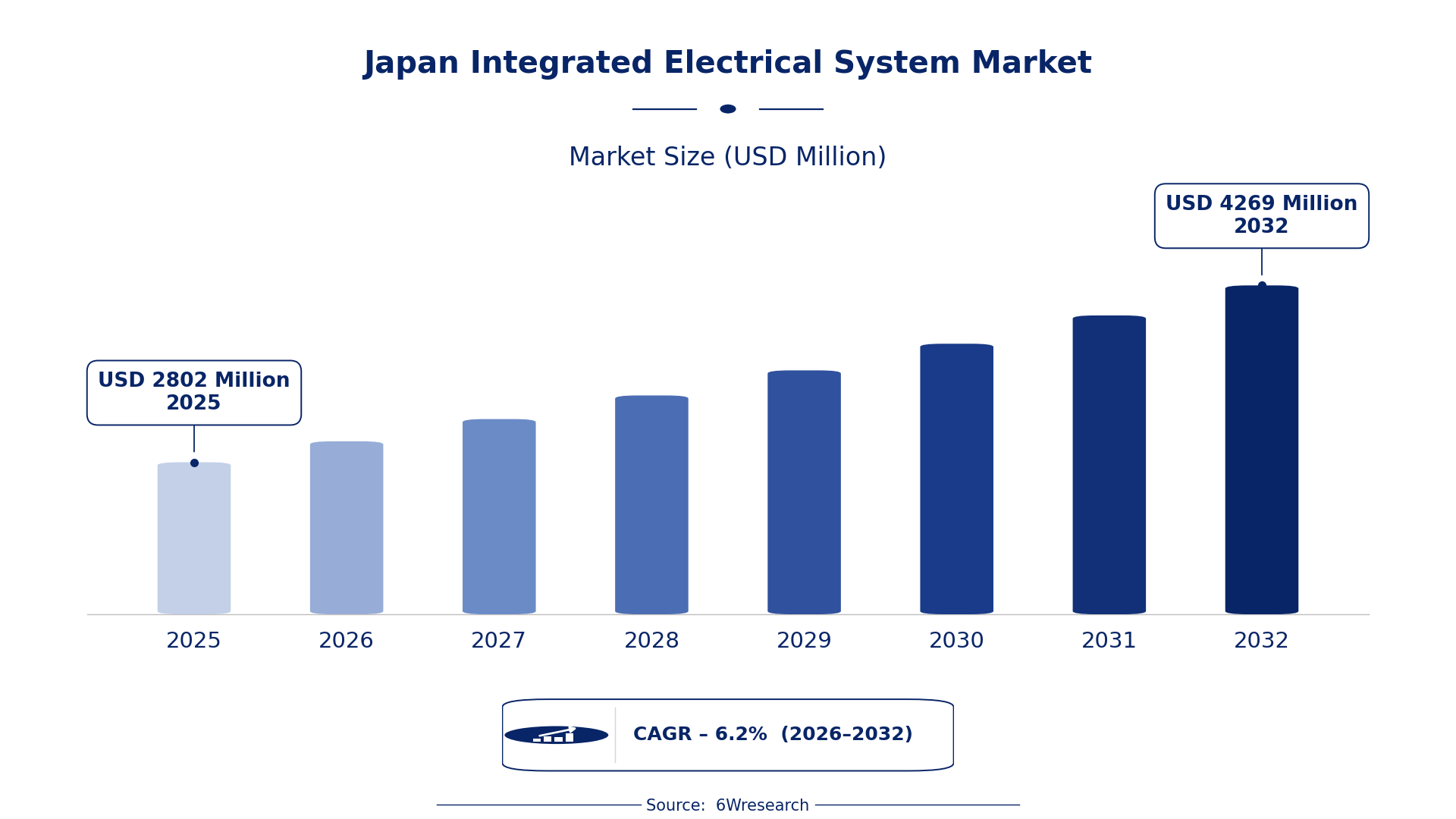
According to 6Wresearch internal database and industry insights, the Japan Integrated Electrical System Market was valued at USD 2,802 Million in 2025 and is projected to reach USD 4,269 Million by 2032, growing at a CAGR of approximately 6.2% during 2026–2032.
Japan Integrated Electrical System Market Highlights
| Report Metric | Details |
| Report Name | Japan Integrated Electrical System Market (2026-2032) |
| Market Size 2025 | USD 2,802 Million |
| Market Size 2032 | USD 4,269 Million |
| Absolute Growth 2025–2032 | USD 1,467 Million |
| CAGR 2026–2032 | 6.2% |
| Peak Annual Growth | 7.2% in 2028 |
| Forecast Period | 2026–2032 |
| Historical Data | 2022–2025 |
| Base Year | 2025 |
| Leading System Type, 2025 | High-Voltage Systems (49% share) |
| Leading Power Level, 2025 | >1000V (41% share) |
| Leading Integration Area, 2025 | Industrial Plants (47% share) |
| Leading End User Industry, 2025 | Utilities & Factories (48% share) |
| Leading Distribution Channel, 2025 | Turnkey Installers (42% share) |
| Fastest-Growing System Type | Low-Voltage Systems (9.4% CAGR) |
| Fastest-Growing Power Level | <600V (8.9% CAGR) |
| Fastest-Growing Integration Area | Smart Buildings (7.8% CAGR) |
| Fastest-Growing End User Industry | Energy Companies (8.1% CAGR) |
| Fastest-Growing Distribution Channel | EPC Contractors (8.2% CAGR) |
| Growing Sector | Smart Buildings |
| Key End Users | Utilities, Factories, Energy Companies, Construction Firms |
Japan Integrated Electrical System Market Year-wise Growth Rate and Key Drivers (2022–2032)
This graph illustrates the annual growth rates of the market from 2022 to 2032, highlighting a steady upward trajectory and projected market expansion over the forecast period.
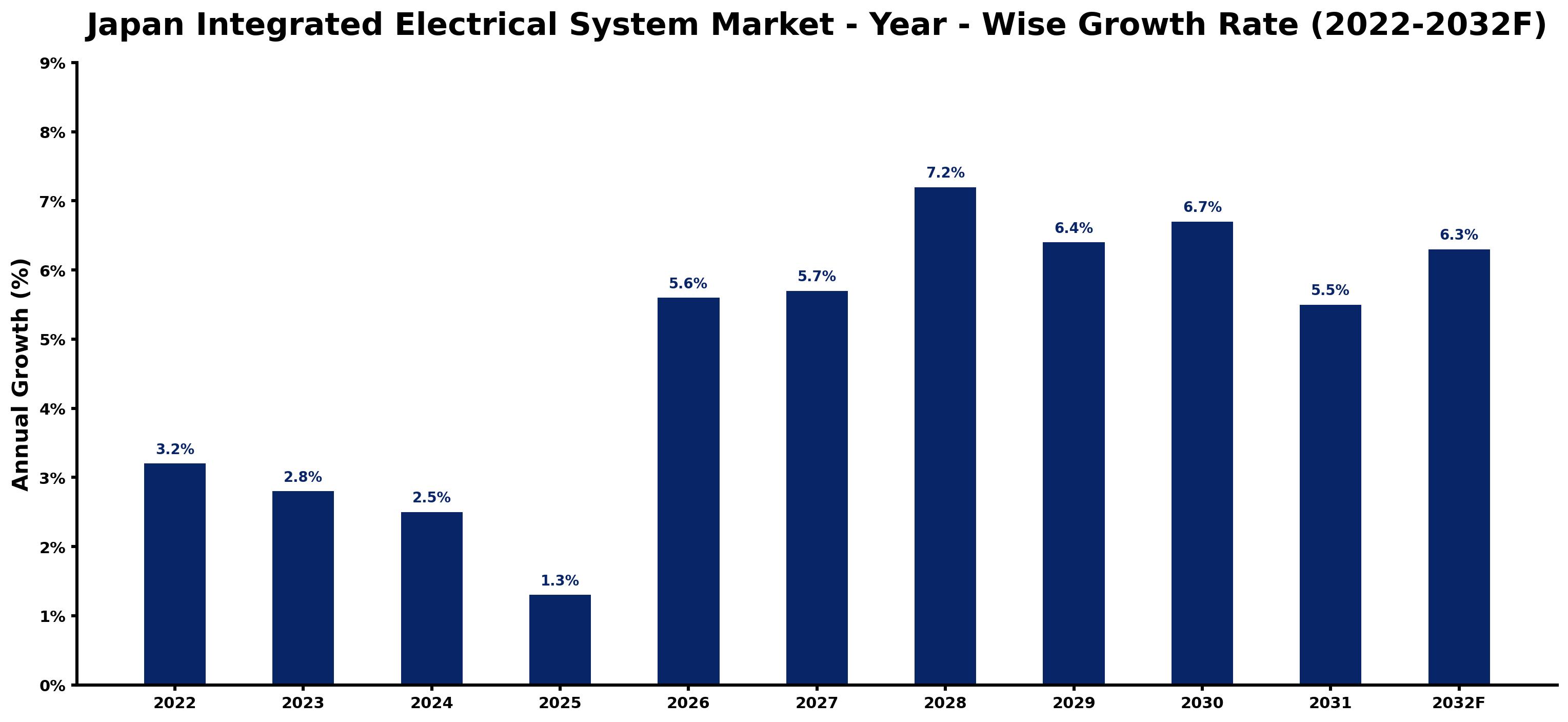
The table below sets out the estimated growth rate for each year and the main factor behind it.
| Year | Estimated Annual Growth (%) | Market Rationale |
| 2022 | 3.2 | The market experienced stable growth due to strong domestic demand for integrated electrical systems. |
| 2023 | 2.8 | Growth slowed as energy efficiency investments faced delays in implementation across various sectors. |
| 2024 | 2.5 | The market continued to slow as infrastructure projects faced budget constraints and planning challenges. |
| 2025 | 1.3 | Growth remained modest as the construction industry shifted focus towards energy-efficient technologies. |
| 2026 | 5.6 | Demand is expected to rise with increased investments in smart buildings and renewable energy projects. |
| 2027 | 5.7 | Growth will continue to increase as energy companies expand their integration of advanced electrical systems. |
| 2028 | 7.2 | The market is projected to peak as the Smart City initiative gains traction, driving further investments. |
| 2029 | 6.4 | Growth will decelerate slightly as market saturation in urban areas begins to take effect. |
| 2030 | 6.7 | Demand is expected to rebound as the government reinforces its commitment to carbon reduction targets. |
| 2031 | 5.5 | Growth will stabilise as the market adjusts to new energy management standards and regulations. |
| 2032 | 6.3 | The market is expected to expand as investments in renewable energy setups continue to grow. |
Note: Market size estimations and growth projections presented in this report are based on 6Wresearch's proprietary forecasting methodology, utilizing the latest available industry data, government publications, and primary research inputs.
Japan Integrated Electrical System Market Synopsis
Integrated Electrical Systems are crucial for the effective distribution and management of electrical power in Japan. These systems are utilised in industrial plants, smart buildings, and renewable energy setups. The Japan Integrated Electrical System Market is growing due to rising investments in energy efficiency, smart technologies, and renewable energy initiatives. As of 2023, over 60% of new buildings incorporate low-voltage systems, indicating a shift towards integrated solutions that improve operational efficiency.
Market Dynamics Impact Analysis (2026–2032)
| Factor | Type | Impact | Primary Segment Affected |
| Increased investments in smart technologies | Driver | High | Smart Buildings |
| Growing demand for renewable energy solutions | Driver | High | Renewable Setups |
| Expansion of the Smart City initiative | Opportunity | High | Smart Buildings |
| Rising infrastructure investments projected at ¥5 trillion by 2025 | Opportunity | High | Industrial Plants |
| Budget constraints affecting infrastructure projects | Restraint | High | Utilities & Factories |
| Delays in energy efficiency technology adoption | Restraint | Medium | Buildings |
| Competition among suppliers for market share | Challenge | High | High-Voltage Systems |
| Technological advancements requiring constant updates | Challenge | Medium | Low-Voltage Systems |
Evaluation of Drivers in Japan Integrated Electrical System Market (2026–2032)
Key forces behind demand, with the segment each one moves most, are listed below.
| Drivers | Primary Segment Affected | Why It Matters (Evidence) |
| Rising investments in smart buildings | Smart Buildings | Over 1,200 smart buildings were established in Japan by 2023, driving demand for integrated systems. |
| Increased focus on renewable energy | Energy Companies | Energy companies are investing in hybrid electrical units to improve grid stability and management. |
| Government initiatives promoting energy efficiency | Buildings | A program launched in 2023 aims to promote energy-efficient technologies, further fuelling demand. |
| Growing urban population density | Utilities & Factories | High population density in urban areas raises the demand for smart systems in buildings. |
| Expansion of energy companies' infrastructure | Energy Companies | Energy companies are investing in hybrid electrical units to enhance grid stability and management. |
The market is expanding due to increased investments in smart buildings, with over 1,200 established by 2023. A heightened focus on renewable energy is expected to drive demand for integrated electrical systems, especially in urban areas. The high population density necessitates smart systems in buildings, while energy companies are investing in hybrid electrical units to enhance grid stability.
Evaluation of Restraints in Japan Integrated Electrical System Market
These restraints slow adoption and weigh on supplier margins.
| Market Restraint | Primary Segment Affected | Why It Matters (Evidence) |
| Budget constraints affecting infrastructure projects | Utilities & Factories | The construction industry is set to invest ¥5 trillion by 2025, but budget constraints may limit project scope. |
| Delays in energy efficiency technology adoption | Buildings | Slow adoption of new technologies hampers the growth of integrated electrical systems in residential and commercial sectors. |
| Intense competition among suppliers | High-Voltage Systems | Pricing pressures from competition for market share affect profitability for suppliers in the high-voltage segment. |
| Technological advancements requiring constant updates | Low-Voltage Systems | Suppliers must continuously invest in R&D to keep pace with evolving standards and technologies. |
| Regulatory compliance challenges | Smart Buildings | Compliance with JIS standards can be complex, requiring significant investment from manufacturers. |
Japan Integrated Electrical System Market Challenges
Producers of integrated electrical systems face intense competition in urban areas, leading to price reductions and tighter profit margins for manufacturers. Skills shortages in advanced electrical technologies impede innovation, resulting in project delays for infrastructure providers. Compliance with JIS standards complicates manufacturing processes, increasing operational costs by up to 15% for smaller firms. Rising material costs disrupt budgeting, causing project delays for buyers as they adapt to unpredictable timelines.
Trends in the Japan Integrated Electrical System Market
Several trends are reshaping the Japan Integrated Electrical System Market; the most important are set out below.
- Shift Towards Smart Building Integration: The Smart City initiative is driving the integration of advanced electrical systems in urban developments, with over 1,200 smart buildings established by 2023. This trend promotes efficiency and sustainability in urban planning.
- Growing Demand for Renewable Energy Solutions: Energy companies are increasingly integrating hybrid electrical units to improve grid stability, reflecting a broader shift towards renewable energy. This trend is likely to grow as Japan aims for a 26% reduction in carbon emissions by 2030.
- Transition from Low-Voltage to High-Voltage Systems: Utilities are increasingly adopting high-voltage systems for large-scale applications, with >1000V systems holding a 41% market share in 2025. This shift supports the growing need for efficient power distribution.
- Increased Focus on Energy Efficiency Standards: The Building Energy Efficiency Act mandates new buildings to meet energy standards by April 2025, driving demand for integrated electrical systems that comply with these regulations.
Investment Opportunities in the Japan Integrated Electrical System Market
Investors looking at the Japan Integrated Electrical System Market should consider the following areas.
- Timing for Smart Building Investments: With over 60% of new buildings incorporating low-voltage systems as of 2023, this is an opportune moment to invest in energy-efficient technologies. Construction firms are key buyers, and forming partnerships can facilitate market entry.
- Entry into Renewable Energy Market: The renewable energy sector is projected to grow, presenting opportunities for suppliers of integrated systems. Collaborating with energy companies can improve market penetration and expand offerings.
- Demand for Energy Management Solutions: As energy companies invest in hybrid electrical units, opportunities exist for suppliers to provide advanced solutions. Engaging with utilities can open new avenues for collaboration and innovation.
- Infrastructure Investment Surge: With the construction industry projected to invest ¥5 trillion by 2025, suppliers should focus on turnkey solutions for industrial plants to capitalize on this increasing demand.
Government Initiatives in the Japan Integrated Electrical System Market
The Electrical Appliance and Material Safety Act of 1961 ensures compliance for manufacturers regarding the safety of electrical appliances and materials. The Building Energy Efficiency Act, amended in 2022, mandates that all new buildings meet energy standards by April 2025, promoting the adoption of energy-efficient technologies.
The Ministry of Economy, Trade and Industry oversees the implementation of energy efficiency standards and funds initiatives to support the adoption of advanced electrical systems. Their programmes aim to facilitate the integration of smart technologies in urban developments, benefiting both producers and buyers.
Future Insight of the Japan Integrated Electrical System Market
A shift towards energy-efficient technologies will transform the market, driven by government initiatives. The Smart City initiative will encourage the integration of advanced electrical systems in urban developments. Investment in infrastructure is projected to reach ¥5 trillion by 2025, stimulating demand for integrated systems. Energy companies will increasingly concentrate on hybrid electrical units to improve grid stability, enabling suppliers to offer more reliable solutions.
Market Segmentation Analysis
Japan Integrated Electrical System Market report covers a detailed analysis of the following market segments:
By System Type – High-Voltage Systems Lead, Low-Voltage Systems Expected to Grow Fastest
According to Saurav Kr Singh, Senior Research Analyst at 6Wresearch, with 49% of system type revenue in 2025, High-Voltage Systems was the largest category. High-voltage systems are vital for power distribution in industrial settings, catering to Japan's substantial energy needs. Their extensive installations in the Tokyo metropolitan area underscore their importance in supporting large-scale operations across various sectors. Low-Voltage Systems are projected to grow fastest, at a CAGR of 9.4% during 2026–2032. The low-voltage systems segment is experiencing rapid growth due to their widespread application in new constructions, with over 60% of recent projects incorporating these systems. This trend is propelled by a heightened focus on energy efficiency in urban development. Suppliers should focus on expanding low-voltage product lines to capture the growing demand in residential and commercial sectors.
By Power Level – >1000V Leads, <600V Expected to Grow Fastest
>1000V held 41% of the Japan Integrated Electrical System Market by power level in 2025. The >1000V segment is essential for large-scale industrial applications, which are foundational to Japan's economy and energy infrastructure. This high demand from utilities and factories ensures that this segment maintains its leading position. Over 2026–2032, <600V is expected to post the fastest growth, at a CAGR of 8.9%. The <600V segment is growing quickly as it is commonly used in residential and commercial sectors, reflecting the increasing focus on energy-efficient technologies. This growth is further supported by government initiatives promoting energy management systems. Buyers should consider investing in <600V solutions to align with the trend towards energy efficiency in new developments.
By Integration Area – Industrial Plants Lead, Smart Buildings Expected to Grow Fastest
Industrial Plants accounted for 47% of the market by integration area in 2025. Industrial plants are major users of integrated systems, driving the demand for high-voltage solutions that enhance operational efficiency. The sector's reliance on advanced electrical systems solidifies its leading position in the market. The quickest growth will come from Smart Buildings, forecast to expand at a CAGR of 7.8% between 2026 and 2032. Smart buildings are increasingly integrating electrical systems to boost operational efficiency, reflecting a broader shift towards sustainable urban environments. The Smart City initiative significantly accelerates this trend by promoting advanced electrical integrations. Suppliers must adapt their offerings to meet the evolving demands of smart building projects.
By End User Industry – Utilities & Factories Lead, Energy Companies Expected to Grow Fastest
The largest end user industry category in 2025 was Utilities & Factories, at 48% of revenue. Utilities and factories are the primary users of high-voltage systems, which are critical for their operational efficiency and power management. This strong demand from established sectors ensures their leading position in the market. Energy Companies are set to record the highest CAGR in this split, 8.1% over 2026–2032. Energy companies are increasingly integrating systems for energy management, driven by the need for improved efficiency and sustainability in their operations. This focus aligns with national goals for reducing carbon emissions, further accelerating growth in this segment. Suppliers should target energy companies to provide solutions that support their energy management objectives.
By Distribution Channel – Turnkey Installers Lead, EPC Contractors Expected to Grow Fastest
In 2025, Turnkey Installers led the distribution channel split with a 42% share. Turnkey installers play a crucial role in deploying integrated systems, acting as a primary channel for connecting with end users across various industries. Their specialised skills ensure effective installations, which helps maintain their leading market position. EPC Contractors are projected to grow fastest, at a CAGR of 8.2% during 2026–2032. EPC contractors are witnessing rapid growth as they manage complex large-scale installations, which are becoming more prevalent. Their ability to oversee comprehensive projects positions them favourably for future market opportunities. Suppliers should strengthen partnerships with EPC contractors to enhance market access and improve project execution.
Key Attractiveness of the Report
- 10 Years of Market Numbers
- Historical Data Starting from 2022 to 2025
- Base Year 2025
- Forecast Data until 2032
- Key Performance Indicators Impacting the Market
- Major Upcoming Developments and Projects
Key Highlights of the Report:
- Japan Integrated Electrical System Market Outlook
- Market Size of Japan Integrated Electrical System Market, 2025
- Forecast of Japan Integrated Electrical System Market, 2032
- Historical Data and Forecast of Japan Integrated Electrical System Revenues & Volume for the Period 2022-2032F
- Japan Integrated Electrical System Market Trend Evolution
- Japan Integrated Electrical System Market Drivers and Challenges
- Japan Integrated Electrical System Price Trends
- Japan Integrated Electrical System Porter's Five Forces
- Japan Integrated Electrical System Industry Life Cycle
- Historical Data and Forecast of Japan Integrated Electrical System Market Revenues & Volume By System Type for the Period 2022-2032F
- Historical Data and Forecast of Japan Integrated Electrical System Market Revenues & Volume By High-Voltage Systems for the Period 2022-2032F
- Historical Data and Forecast of Japan Integrated Electrical System Market Revenues & Volume By Low-Voltage Systems for the Period 2022-2032F
- Historical Data and Forecast of Japan Integrated Electrical System Market Revenues & Volume By Hybrid Electrical Units for the Period 2022-2032F
- Historical Data and Forecast of Japan Integrated Electrical System Market Revenues & Volume By Modular Wiring Systems for the Period 2022-2032F
- Historical Data and Forecast of Japan Integrated Electrical System Market Revenues & Volume By Power Level for the Period 2022-2032F
- Historical Data and Forecast of Japan Integrated Electrical System Market Revenues & Volume By >1000V for the Period 2022-2032F
- Historical Data and Forecast of Japan Integrated Electrical System Market Revenues & Volume By <600V for the Period 2022-2032F
- Historical Data and Forecast of Japan Integrated Electrical System Market Revenues & Volume By AC/DC Combo for the Period 2022-2032F
- Historical Data and Forecast of Japan Integrated Electrical System Market Revenues & Volume By Plug-and-Play for the Period 2022-2032F
- Historical Data and Forecast of Japan Integrated Electrical System Market Revenues & Volume By Integration Area for the Period 2022-2032F
- Historical Data and Forecast of Japan Integrated Electrical System Market Revenues & Volume By Industrial Plants for the Period 2022-2032F
- Historical Data and Forecast of Japan Integrated Electrical System Market Revenues & Volume By Buildings for the Period 2022-2032F
- Historical Data and Forecast of Japan Integrated Electrical System Market Revenues & Volume By Renewable Setups for the Period 2022-2032F
- Historical Data and Forecast of Japan Integrated Electrical System Market Revenues & Volume By Smart Buildings for the Period 2022-2032F
- Historical Data and Forecast of Japan Integrated Electrical System Market Revenues & Volume By End User Industry for the Period 2022-2032F
- Historical Data and Forecast of Japan Integrated Electrical System Market Revenues & Volume By Utilities & Factories for the Period 2022-2032F
- Historical Data and Forecast of Japan Integrated Electrical System Market Revenues & Volume By Construction Firms for the Period 2022-2032F
- Historical Data and Forecast of Japan Integrated Electrical System Market Revenues & Volume By Energy Companies for the Period 2022-2032F
- Historical Data and Forecast of Japan Integrated Electrical System Market Revenues & Volume By Infrastructure Providers for the Period 2022-2032F
- Historical Data and Forecast of Japan Integrated Electrical System Market Revenues & Volume By Distribution Channel for the Period 2022-2032F
- Historical Data and Forecast of Japan Integrated Electrical System Market Revenues & Volume By Turnkey Installers for the Period 2022-2032F
- Historical Data and Forecast of Japan Integrated Electrical System Market Revenues & Volume By Panel Builders for the Period 2022-2032F
- Historical Data and Forecast of Japan Integrated Electrical System Market Revenues & Volume By EPC Contractors for the Period 2022-2032F
- Historical Data and Forecast of Japan Integrated Electrical System Market Revenues & Volume By Smart System Vendors for the Period 2022-2032F
- Japan Integrated Electrical System Import Export Trade Statistics
- Market Opportunity Assessment By System Type
- Market Opportunity Assessment By Power Level
- Market Opportunity Assessment By Integration Area
- Market Opportunity Assessment By End User Industry
- Market Opportunity Assessment By Distribution Channel
- Japan Integrated Electrical System Top Companies Market Share
- Japan Integrated Electrical System Competitive Benchmarking By Technical and Operational Parameters
- Japan Integrated Electrical System Company Profiles
- Japan Integrated Electrical System Key Strategic Recommendations
Market Covered
Segments analysed in this report are listed below.
By System Type
- High-Voltage Systems
- Low-Voltage Systems
- Hybrid Electrical Units
- Modular Wiring Systems
By Power Level
- >1000V
- <600V
- AC/DC Combo
- Plug-and-Play
By Integration Area
- Industrial Plants
- Buildings
- Renewable Setups
- Smart Buildings
By End User Industry
- Utilities & Factories
- Construction Firms
- Energy Companies
- Infrastructure Providers
By Distribution Channel
- Turnkey Installers
- Panel Builders
- EPC Contractors
- Smart System Vendors































