Japan Integrated Flight Deck System Market Size & Growth Rate
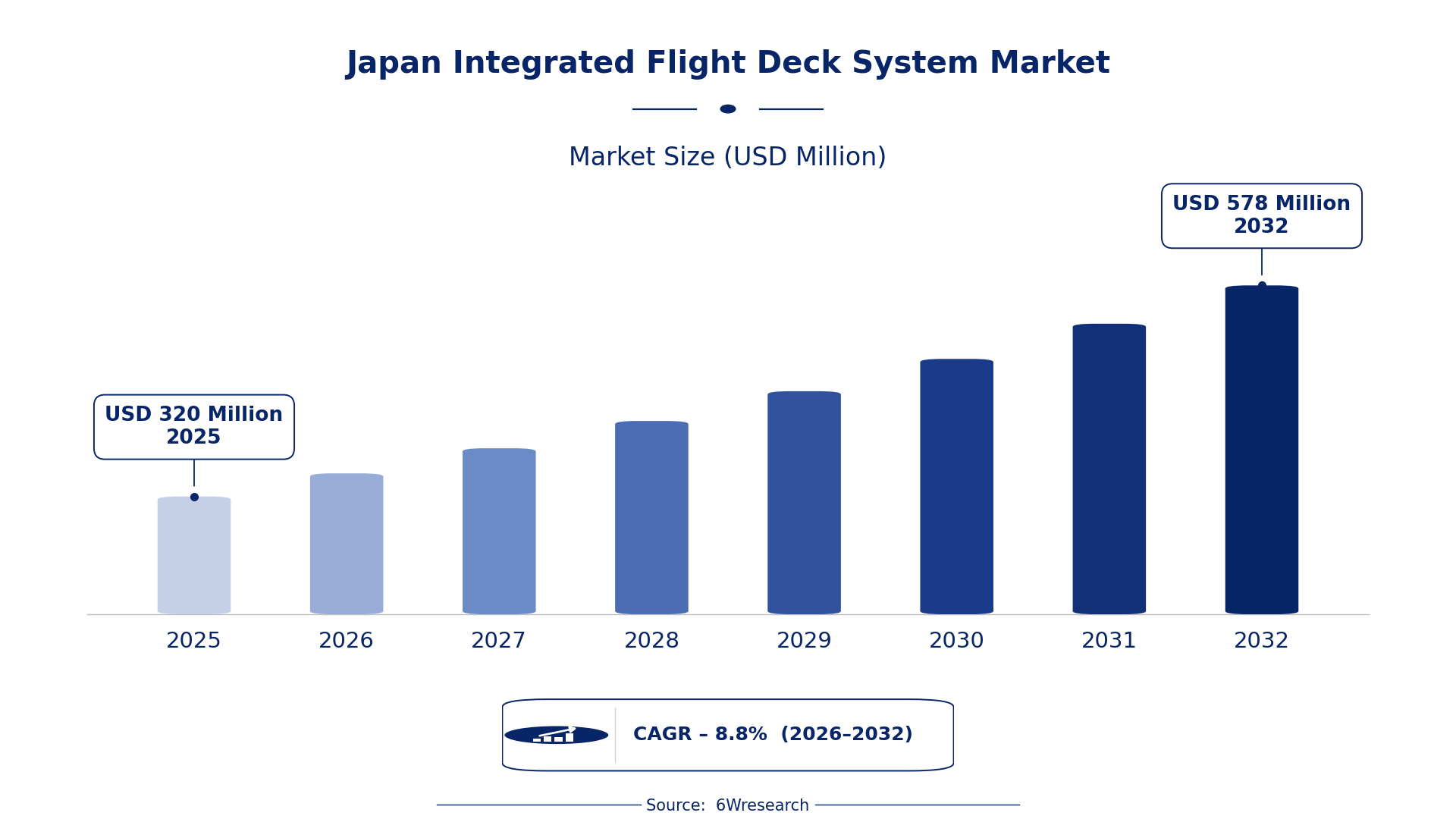
According to 6Wresearch internal database and industry insights, the Japan Integrated Flight Deck System Market was valued at USD 320 Million in 2025 and is projected to reach USD 578 Million by 2032, growing at a CAGR of approximately 8.8% during 2026–2032.
Japan Integrated Flight Deck System Market Highlights
| Report Metric | Details |
| Report Name | Japan Integrated Flight Deck System Market (2026-2032) |
| Market Size 2025 | USD 320 Million |
| Market Size 2032 | USD 578 Million |
| Absolute Growth 2025–2032 | USD 258 Million |
| CAGR 2026–2032 | 8.8% |
| Peak Annual Growth | 10.0% in 2032 |
| Forecast Period | 2026–2032 |
| Historical Data | 2022–2025 |
| Base Year | 2025 |
| Leading System Type, 2025 | Multi-Function Displays (51% share) |
| Leading Avionics Architecture, 2025 | Open Architecture (34% share) |
| Leading Aircraft Class, 2025 | Wide-body Aircraft (35% share) |
| Leading Technology Integration, 2025 | Fully Digital (36% share) |
| Leading End User, 2025 | Aircraft OEMs (42% share) |
| Fastest-Growing System Type | Touchscreen Controls (12.4% CAGR) |
| Fastest-Growing Aircraft Class | Fighters (11.6% CAGR) |
| Fastest-Growing Technology Integration | Modular Avionics (12.6% CAGR) |
| Fastest-Growing End User | Military Clients (11.7% CAGR) |
| Growing Sector | military aviation |
| Key End Users | Aircraft OEMs, Airline Operators, Military Clients |
Japan Integrated Flight Deck System Market Year-wise Growth Rate and Key Drivers (2022–2032)
This graph illustrates the annual growth rates of the market from 2022 to 2032, highlighting a steady upward trajectory and projected market expansion over the forecast period.
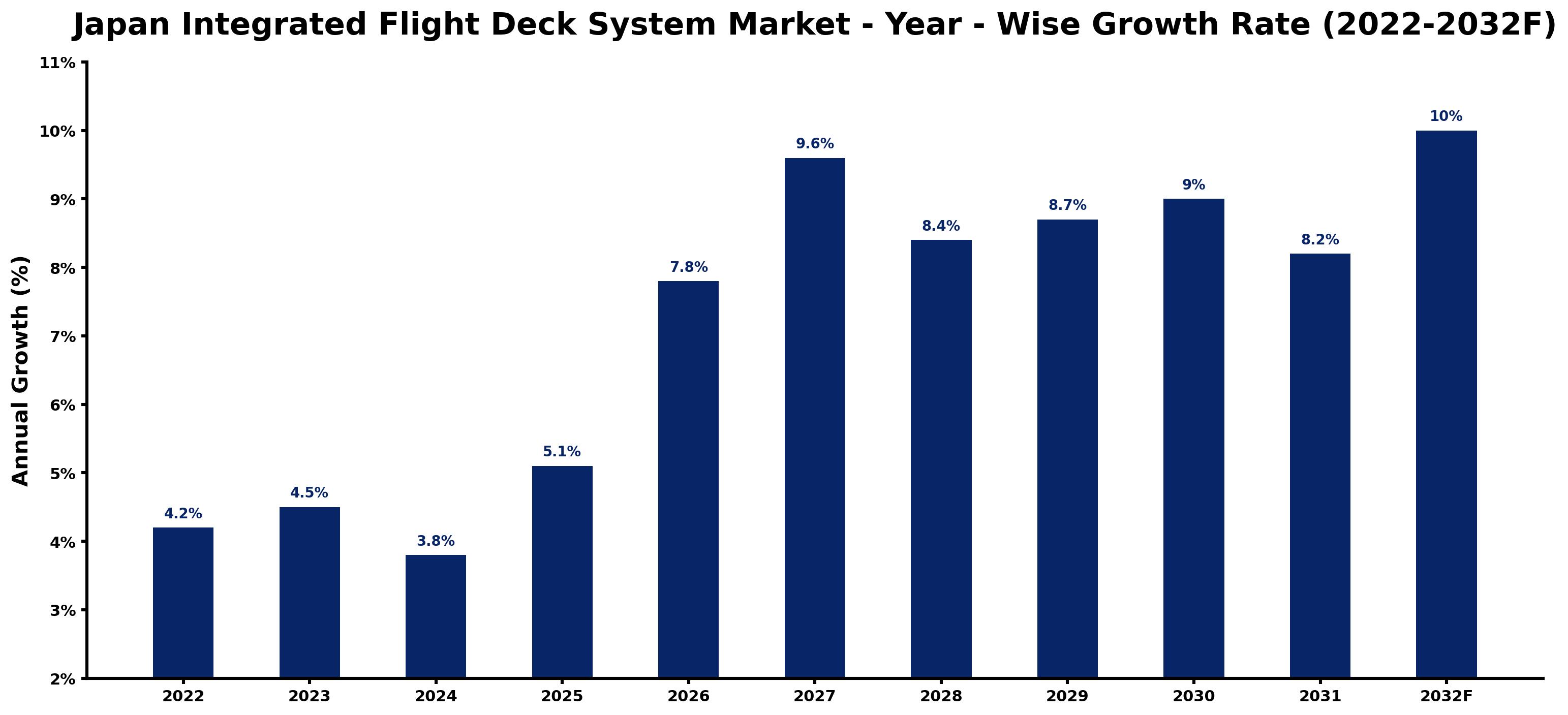
Each row of the following table gives one year's estimated growth and the event or demand shift that explains it.
| Year | Estimated Annual Growth (%) | Market Rationale |
| 2022 | 4.2 | The market experienced steady growth due to ongoing demand from military clients and aircraft OEMs. |
| 2023 | 4.5 | Growth accelerated as Japan's defense budget allocated more funds for advanced avionics systems. |
| 2024 | 3.8 | Growth slowed slightly as some military contracts reached completion, impacting procurement rates. |
| 2025 | 5.1 | Demand surged as the market reached its historical peak, driven by increased orders from commercial airlines. |
| 2026 | 7.8 | A strong rise in orders from military clients is expected to boost market growth. |
| 2027 | 9.6 | Demand continues to rise as military clients invest in modern avionics for improved operational capabilities. |
| 2028 | 8.4 | Growth slows as the market stabilises after rapid expansion, maintaining solid demand from aircraft OEMs. |
| 2029 | 8.7 | A slight increase in growth is anticipated as new contracts emerge in the military sector. |
| 2030 | 9.0 | Demand is expected to remain strong as advancements in technology drive further purchases. |
| 2031 | 8.2 | Growth slows as the market approaches maturity, with steady demand from existing clients. |
| 2032 | 10.0 | The market is projected to peak as new military contracts and technology upgrades drive demand. |
Note: Market size estimations and growth projections presented in this report are based on 6Wresearch's proprietary forecasting methodology, utilizing the latest available industry data, government publications, and primary research inputs.
Japan Integrated Flight Deck System Market Synopsis
Integrated Flight Deck Systems are sophisticated avionics solutions that improve pilot situational awareness through navigation and communication technologies. The Japan Integrated Flight Deck System Market is expanding due to increased military spending, demand from domestic aircraft manufacturers, and technological advancements. In 2023, Japan's defense budget allocated substantial funds for military avionics, while the Tokyo region remains a hub for aviation technology development, promoting innovation and collaboration among industry players. This growth is supported by over 1,000 registered aircraft operators, driving demand for advanced cockpit solutions.
Market Dynamics Impact Analysis (2026–2032)
| Factor | Type | Impact | Primary Segment Affected |
| Increased military spending drives demand for advanced avionics systems. | Driver | High | Glass Cockpit Systems |
| Technological advancements in avionics enhance operational capabilities. | Driver | High | Multi-Function Displays |
| Growing military contracts present opportunities for suppliers to expand. | Opportunity | High | Mission-Centric Systems |
| Emerging technologies like touchscreen controls create new market potential. | Opportunity | Medium | Touchscreen Controls |
| High competition among suppliers can limit profit margins. | Restraint | Medium | ARINC 661 |
| Regulatory compliance requirements can delay product development timelines. | Restraint | High | Open Architecture |
| Talent shortages in avionics engineering can hinder project progress. | Challenge | High | Fully Digital |
| Rising material costs impact production budgets for manufacturers. | Challenge | Medium | Modular Avionics |
Evaluation of Drivers in Japan Integrated Flight Deck System Market (2026–2032)
These are the developments adding the most demand over the forecast period.
| Drivers | Primary Segment Affected | Why It Matters (Evidence) |
| Increased military contracts for advanced avionics systems. | Glass Cockpit Systems | Japan's defense budget allocated substantial funds in 2023, boosting procurement from military clients. |
| Technological advancements in avionics improve operational capabilities. | Multi-Function Displays | A growing number of registered aircraft operators in Japan is increasing market size. |
| Growing demand from commercial airlines for modern cockpit solutions. | Narrow-body Jets | Japan has over 1,000 registered aircraft operators, driving demand for modern cockpit solutions. |
| Emerging technologies like touchscreen controls are gaining traction. | Touchscreen Controls | The Tokyo Metropolitan Government promotes aerospace innovation through various programs. |
| ISO 9001 certification is common among Japanese avionics manufacturers. | ARINC 661 | This standard ensures quality and reliability, attracting more buyers in the market. |
Orders continue to rise as military contracts increase, with Japan's defence budget allocating substantial funds for avionics systems in 2023. A growing number of registered aircraft operators in Japan fuels demand for modern cockpit solutions, particularly in narrow-body jets. The presence of over 1,000 registered aircraft operators is anticipated to further stimulate demand for advanced technologies. Manufacturers are responding to this trend by investing in new solutions, such as modular avionics systems, to meet evolving operational needs.
Evaluation of Restraints in Japan Integrated Flight Deck System Market
Below are the constraints most often cited by buyers and suppliers, with the segment each affects.
| Market Restraint | Primary Segment Affected | Why It Matters (Evidence) |
| High competition among suppliers limits profit margins. | ARINC 661 | Numerous manufacturers in Japan create price competition that squeezes margins for suppliers. |
| Regulatory compliance requirements delay product development timelines. | Open Architecture | Strict safety and quality standards extend time to market for manufacturers. |
| Talent shortages in avionics engineering hinder project progress. | Fully Digital | The demand for skilled engineers exceeds supply, impacting project timelines and costs. |
| Rising material costs impact production budgets for manufacturers. | Modular Avionics | Increased prices for components lead to higher overall production costs. |
| Economic fluctuations can affect aviation spending. | Multi-Function Displays | Changes in the economy may lead to reduced budgets for military and commercial clients. |
Japan Integrated Flight Deck System Market Challenges
A shortage of qualified engineers in Japan's aerospace sector hinders manufacturers' ability to deliver Integrated Flight Deck Systems, potentially delaying projects by up to six months for buyers. Suppliers encounter technological challenges due to reliance on outdated avionics, raising upgrade costs by approximately 15% and reducing their market competitiveness. Intense competition from international markets pressures local producers to lower prices, risking profit margins by as much as 20%. Buyers face longer lead times for advanced avionics, as military contracts consume resources and postpone deliveries for commercial aircraft manufacturers.
Trends in the Japan Integrated Flight Deck System Market
Below are the shifts with the largest effect on the Japan Integrated Flight Deck System Market.
- Shift from Traditional to Advanced Avionics Systems: Japan's aerospace sector is moving towards advanced avionics systems, with a notable increase in demand for Glass Cockpit Systems. In 2023, military contracts for modern avionics surged, reflecting a shift in operational needs.
- Emergence of Touchscreen Controls in Aviation: Touchscreen controls are becoming more common in modern aircraft, particularly in military applications. The Tokyo region is seeing growth in this technology segment, indicating a rising acceptance among pilots.
- Increased Focus on Modular Avionics: Modular avionics systems are gaining popularity as they allow for upgrades and flexibility. Japan's defence budget supports this trend, with significant investments in modular technology expected to rise in the coming years.
- Expansion of Military Contracts for Avionics: Military contracts for avionics systems are expanding, particularly for Fighters. Japan's defence budget allocated substantial funds in 2023, driving demand for advanced technologies in military applications.
Investment Opportunities in the Japan Integrated Flight Deck System Market
The following opportunities in the Japan Integrated Flight Deck System Market pair current demand with a clear way in.
- Timing for Investment in Touchscreen Controls: With a projected rise in demand, now is the ideal time to invest in touchscreen controls. Military clients are increasingly seeking modern cockpit solutions to improve operational efficiency.
- Supply of Modular Avionics Systems: The demand for modular avionics systems is increasing, with a growing need for flexible solutions that allow for upgrades and adaptability. Aircraft OEMs are seeking such systems to meet evolving operational requirements.
- Entry into the Military Avionics Market: The military sector is expanding, presenting opportunities for suppliers to enter this market. Collaborating with local partners can facilitate access to military contracts and enhance competitiveness.
- Investment in Advanced Avionics Technology: Japan's defence budget allocated substantial funds for avionics in 2023, creating an opportunity for suppliers. Focusing on new technologies can attract military clients looking for improved capabilities.
Government Initiatives in the Japan Integrated Flight Deck System Market
The Electrical Appliance and Material Safety Act (1961; METI) regulates the safety of electrical appliances, ensuring that avionics systems meet strict safety standards. The Building Energy Efficiency Act (2015, amended 2022) requires new buildings to comply with energy efficiency standards, influencing the design of aviation facilities and impacting the Integrated Flight Deck System market.
The Japan Aerospace Exploration Agency oversees various aviation technology projects, funding initiatives that promote innovation in the sector. The Ministry of Economy, Trade and Industry supports aerospace firms through grants and programs aimed at improving competitiveness and technological advancement, directly benefiting Integrated Flight Deck System producers.
Future Insight of the Japan Integrated Flight Deck System Market
By 2032, commercial aircraft manufacturers will gain from advancements in avionics as the defence budget increases, stimulating innovation across the sector. New standards will emerge, facilitating better integration of technologies and improving operational efficiency for suppliers. The Tokyo region will strengthen its position as a hub for aerospace advancements, encouraging collaboration that accelerates development. As Japan's population continues to engage with aviation, demand for modern flight systems will rise, presenting opportunities for both buyers and suppliers.
Market Segmentation Analysis
Japan Integrated Flight Deck System Market report covers a detailed analysis of the following market segments:
By System Type – Multi-Function Displays Lead, Touchscreen Controls Expected to Grow Fastest
According to Saurav Kr Singh, Senior Research Analyst at 6Wresearch, Multi-Function Displays held 51% of the Japan Integrated Flight Deck System Market by system type in 2025. Multi-Function Displays lead the market due to their essential role in providing critical flight information to pilots, which is vital for safe aircraft operations. With over 1,000 registered aircraft operators in Japan, these displays are widely used across various aircraft configurations. Over 2026–2032, Touchscreen Controls are expected to post the fastest growth, at a CAGR of 12.4%. Touchscreen Controls are rapidly gaining popularity as they provide intuitive interfaces for pilots, enhancing usability and efficiency in newer aircraft models. As technology advances, the integration of touchscreen controls is expected to accelerate, further improving pilot interaction with flight systems. Suppliers should prioritise the development of touchscreen technologies to cater to the increasing demand in the aviation sector.
By Avionics Architecture – Open Architecture Leads and Records the Fastest Growth
In 2025, Open Architecture led the avionics architecture split with a 34% share. Open Architecture holds the largest market share as it enables the integration of various avionics components, making it a preferred choice among manufacturers. This flexibility is crucial for addressing the diverse requirements of Japan's aerospace sector, especially in military applications. Its lead should widen, with a projected CAGR of 11.5% during 2026–2032, the highest in this split. The growth of Open Architecture will continue to be robust, as it allows for seamless upgrades and incorporation of new technologies. This trend is likely to be reinforced by ongoing military contracts that necessitate advanced avionics systems. Suppliers must focus on Open Architecture solutions to align with market demands and technological advancements.
By Aircraft Class – Wide-body Aircraft Leads, Fighters Expected to Grow Fastest
Wide-body Aircraft accounted for 35% of the market by aircraft class in 2025. Wide-body Aircraft account for the largest segment due to their critical role in long-haul flights, essential for connecting Japan to international markets. The demand for these aircraft is bolstered by Japan's active aerospace industry and substantial passenger traffic. The quickest growth will come from Fighters, forecast to expand at a CAGR of 11.6% between 2026 and 2032. Fighters are witnessing rapid growth as military budgets increase, particularly within Japan's defence sector. The emphasis on enhancing military capabilities drives the demand for advanced avionics in fighter aircraft, ensuring sustained investment in this area. Manufacturers should concentrate on developing specialised avionics for fighters to capitalise on the rising military demand.
By Technology Integration – Fully Digital Leads, Modular Avionics Expected to Grow Fastest
With 36% of technology integration revenue in 2025, Fully Digital was the largest category. Fully Digital systems dominate the market as they represent the standard technology in modern flight decks, offering enhanced functionality and reliability. This widespread adoption reflects Japan's commitment to modernising its aviation infrastructure and improving operational efficiency. Modular Avionics are projected to grow fastest, at a CAGR of 12.6% during 2026–2032. Modular Avionics are poised for rapid growth, allowing for upgrades and flexibility in systems, which is increasingly important for both commercial and military applications. This adaptability is likely to attract more buyers seeking future-proof solutions. Suppliers should invest in modular designs to meet the changing needs of aircraft manufacturers.
By End User – Aircraft OEMs Lead, Military Clients Expected to Grow Fastest
The largest end user category in 2025 was Aircraft OEMs, at 42% of revenue. Aircraft OEMs are the primary users of integrated flight deck systems, holding the largest market share as they design and manufacture aircraft for various applications. Their central role in the aviation supply chain ensures consistent demand for advanced avionics solutions, particularly as new models are developed. Over 2026–2032, Military Clients are expected to post the fastest growth, at a CAGR of 11.7%. Military Clients are driving significant growth in the market as defence budgets expand, leading to increased procurement of advanced avionics systems. This trend is expected to persist as Japan enhances its military capabilities and invests in modern technologies. Suppliers should strengthen relationships with military clients to secure contracts and expand their market presence.
Key Attractiveness of the Report
- 10 Years of Market Numbers
- Historical Data Starting from 2022 to 2025
- Base Year 2025
- Forecast Data until 2032
- Key Performance Indicators Impacting the Market
- Major Upcoming Developments and Projects
Key Highlights of the Report:
- Japan Integrated Flight Deck System Market Outlook
- Market Size of Japan Integrated Flight Deck System Market, 2025
- Forecast of Japan Integrated Flight Deck System Market, 2032
- Historical Data and Forecast of Japan Integrated Flight Deck System Revenues & Volume for the Period 2022-2032F
- Japan Integrated Flight Deck System Market Trend Evolution
- Japan Integrated Flight Deck System Market Drivers and Challenges
- Japan Integrated Flight Deck System Price Trends
- Japan Integrated Flight Deck System Porter's Five Forces
- Japan Integrated Flight Deck System Industry Life Cycle
- Historical Data and Forecast of Japan Integrated Flight Deck System Market Revenues & Volume By System Type for the Period 2022-2032F
- Historical Data and Forecast of Japan Integrated Flight Deck System Market Revenues & Volume By Glass Cockpit Systems for the Period 2022-2032F
- Historical Data and Forecast of Japan Integrated Flight Deck System Market Revenues & Volume By Multi-Function Displays for the Period 2022-2032F
- Historical Data and Forecast of Japan Integrated Flight Deck System Market Revenues & Volume By Mission-Centric Systems for the Period 2022-2032F
- Historical Data and Forecast of Japan Integrated Flight Deck System Market Revenues & Volume By Touchscreen Controls for the Period 2022-2032F
- Historical Data and Forecast of Japan Integrated Flight Deck System Market Revenues & Volume By Avionics Architecture for the Period 2022-2032F
- Historical Data and Forecast of Japan Integrated Flight Deck System Market Revenues & Volume By ARINC 661 for the Period 2022-2032F
- Historical Data and Forecast of Japan Integrated Flight Deck System Market Revenues & Volume By Open Architecture for the Period 2022-2032F
- Historical Data and Forecast of Japan Integrated Flight Deck System Market Revenues & Volume By Proprietary OS for the Period 2022-2032F
- Historical Data and Forecast of Japan Integrated Flight Deck System Market Revenues & Volume By Fly-by-Wire Integrated for the Period 2022-2032F
- Historical Data and Forecast of Japan Integrated Flight Deck System Market Revenues & Volume By Aircraft Class for the Period 2022-2032F
- Historical Data and Forecast of Japan Integrated Flight Deck System Market Revenues & Volume By Narrow-body Jets for the Period 2022-2032F
- Historical Data and Forecast of Japan Integrated Flight Deck System Market Revenues & Volume By Wide-body Aircraft for the Period 2022-2032F
- Historical Data and Forecast of Japan Integrated Flight Deck System Market Revenues & Volume By Fighters for the Period 2022-2032F
- Historical Data and Forecast of Japan Integrated Flight Deck System Market Revenues & Volume By BizJets for the Period 2022-2032F
- Historical Data and Forecast of Japan Integrated Flight Deck System Market Revenues & Volume By Technology Integration for the Period 2022-2032F
- Historical Data and Forecast of Japan Integrated Flight Deck System Market Revenues & Volume By Fully Digital for the Period 2022-2032F
- Historical Data and Forecast of Japan Integrated Flight Deck System Market Revenues & Volume By Modular Avionics for the Period 2022-2032F
- Historical Data and Forecast of Japan Integrated Flight Deck System Market Revenues & Volume By Secure Comms Enabled for the Period 2022-2032F
- Historical Data and Forecast of Japan Integrated Flight Deck System Market Revenues & Volume By Ergonomic Design for the Period 2022-2032F
- Historical Data and Forecast of Japan Integrated Flight Deck System Market Revenues & Volume By End User for the Period 2022-2032F
- Historical Data and Forecast of Japan Integrated Flight Deck System Market Revenues & Volume By Aircraft OEMs for the Period 2022-2032F
- Historical Data and Forecast of Japan Integrated Flight Deck System Market Revenues & Volume By Airline Operators for the Period 2022-2032F
- Historical Data and Forecast of Japan Integrated Flight Deck System Market Revenues & Volume By Military Clients for the Period 2022-2032F
- Historical Data and Forecast of Japan Integrated Flight Deck System Market Revenues & Volume By Luxury Jet Builders for the Period 2022-2032F
- Japan Integrated Flight Deck System Import Export Trade Statistics
- Market Opportunity Assessment By System Type
- Market Opportunity Assessment By Avionics Architecture
- Market Opportunity Assessment By Aircraft Class
- Market Opportunity Assessment By Technology Integration
- Market Opportunity Assessment By End User
- Japan Integrated Flight Deck System Top Companies Market Share
- Japan Integrated Flight Deck System Competitive Benchmarking By Technical and Operational Parameters
- Japan Integrated Flight Deck System Company Profiles
- Japan Integrated Flight Deck System Key Strategic Recommendations
Market Covered
Coverage by segment is as follows.
By System Type
- Glass Cockpit Systems
- Multi-Function Displays
- Mission-Centric Systems
- Touchscreen Controls
By Avionics Architecture
- ARINC 661
- Open Architecture
- Proprietary OS
- Fly-by-Wire Integrated
By Aircraft Class
- Narrow-body Jets
- Wide-body Aircraft
- Fighters
- BizJets
By Technology Integration
- Fully Digital
- Modular Avionics
- Secure Comms Enabled
- Ergonomic Design
By End User
- Aircraft OEMs
- Airline Operators
- Military Clients
- Luxury Jet Builders































