Japan Integrated Flight Display Market Size & Growth Rate
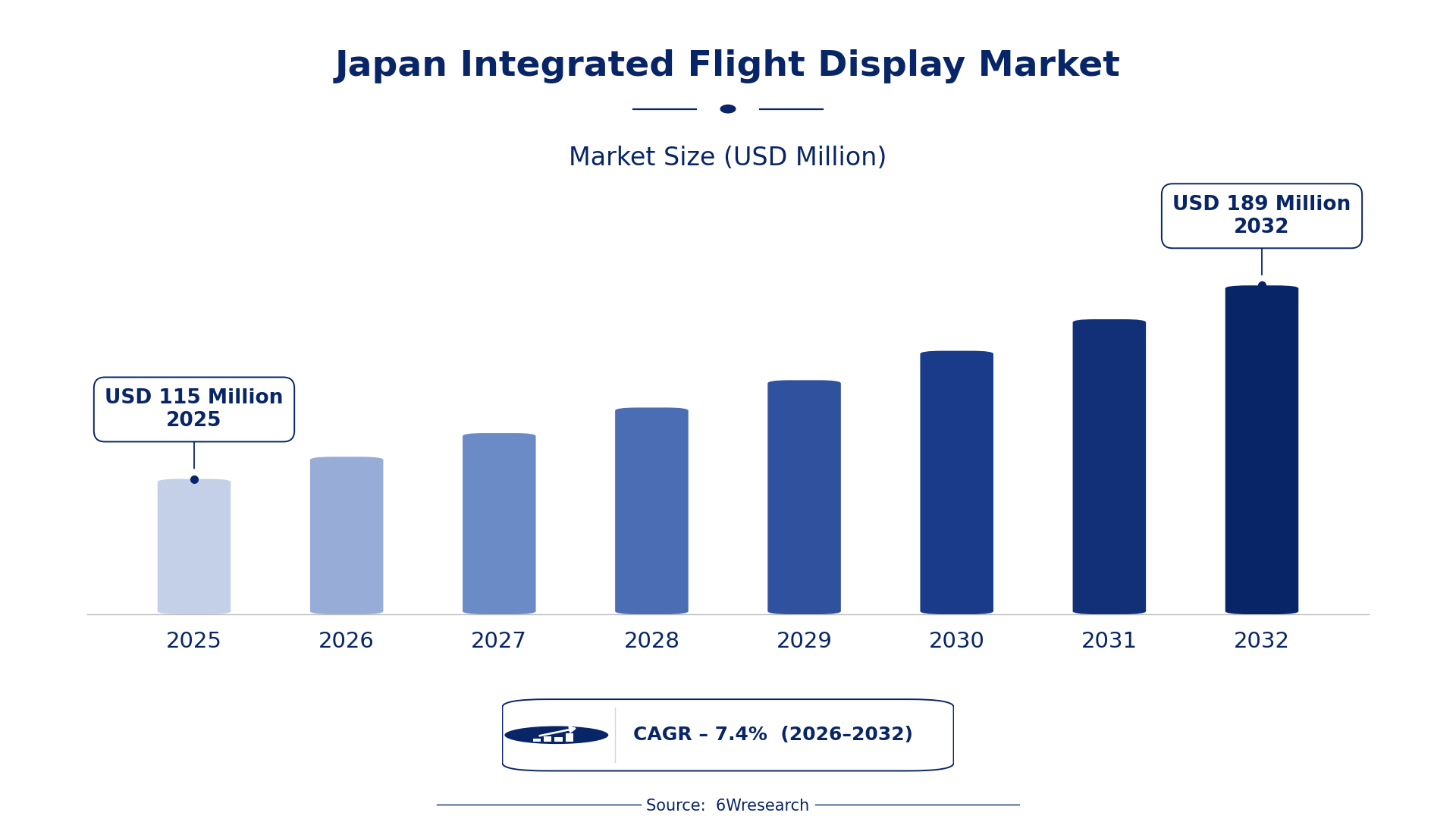
According to 6Wresearch internal database and industry insights, the Japan Integrated Flight Display Market was valued at USD 115 Million in 2025 and is projected to reach USD 189 Million by 2032, growing at a CAGR of approximately 7.4% during 2026–2032.
Japan Integrated Flight Display Market Highlights
| Report Metric | Details |
| Report Name | Japan Integrated Flight Display Market (2026-2032) |
| Market Size 2025 | USD 115 Million |
| Market Size 2032 | USD 189 Million |
| Absolute Growth 2025–2032 | USD 74 Million |
| CAGR 2026–2032 | 7.4% |
| Peak Annual Growth | 8.6% in 2028 |
| Forecast Period | 2026–2032 |
| Historical Data | 2022–2025 |
| Base Year | 2025 |
| Leading Display Type, 2025 | PFD (Primary) (51% share) |
| Leading Interface Type, 2025 | Touch & Knob Combo (49% share) |
| Leading Aircraft Type, 2025 | Commercial Aircraft (50% share) |
| Leading Display Technology, 2025 | LCD/OLED (41% share) |
| Leading End User, 2025 | Airlines (40% share) |
| Fastest-Growing Display Type | MFD (Multifunction) (10.1% CAGR) |
| Fastest-Growing Aircraft Type | Military Aircraft (10.3% CAGR) |
| Fastest-Growing Display Technology | High-Brightness Panels (10.8% CAGR) |
| Fastest-Growing End User | Defense Users (9.3% CAGR) |
| Growing Sector | Aviation |
| Key End Users | Airlines, Defense Users, Military, Aircraft Manufacturers |
Japan Integrated Flight Display Market Year-wise Growth Rate and Key Drivers (2022–2032)
This graph illustrates the annual growth rates of the market from 2022 to 2032, highlighting a steady upward trajectory and projected market expansion over the forecast period.
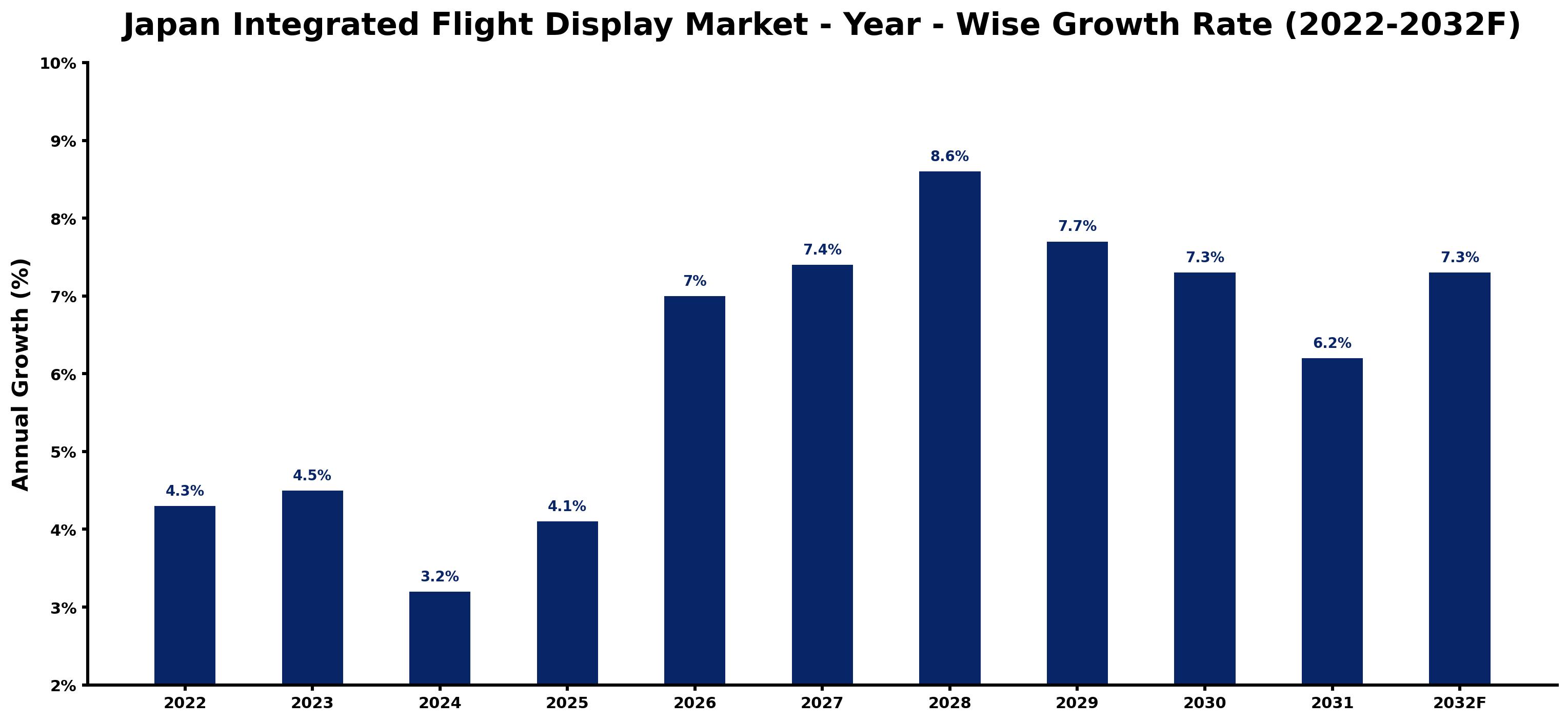
The table below sets out the estimated growth rate for each year and the main factor behind it.
| Year | Estimated Annual Growth (%) | Market Rationale |
| 2022 | 4.3 | The aviation market experienced steady demand from domestic airlines and military operations. |
| 2023 | 4.5 | Demand for advanced avionics grew, supported by an increase in air passenger numbers. |
| 2024 | 3.2 | Demand slowed as airlines focused on operational efficiency amid rising costs. |
| 2025 | 4.1 | Growth resumed as airlines upgraded their fleets and sought modern avionics solutions. |
| 2026 | 7.0 | A surge in military aircraft demand is expected to contribute to a faster growth rate. |
| 2027 | 7.4 | Increased investments in avionics technology will drive further demand in the market. |
| 2028 | 8.6 | The peak growth year will see heightened interest in advanced display technologies. |
| 2029 | 7.7 | Growth will moderate as the market begins to stabilise after rapid expansion. |
| 2030 | 7.3 | Demand will continue to grow, albeit at a slower pace due to market saturation. |
| 2031 | 6.2 | A slowdown in growth rate will reflect a maturing market with established players. |
| 2032 | 7.3 | The market is projected to rebound with renewed interest in advanced avionics solutions. |
Note: Market size estimations and growth projections presented in this report are based on 6Wresearch's proprietary forecasting methodology, utilizing the latest available industry data, government publications, and primary research inputs.
Japan Integrated Flight Display Market Synopsis
Integrated Flight Displays (IFDs) are sophisticated avionics systems that consolidate flight data into a unified visual interface, essential for navigation and situational awareness. The Japan Integrated Flight Display Market is expanding due to rising air passenger numbers, with approximately 50 million in 2022, and increasing military aircraft operations. Ongoing technological advancements and investments in aviation safety are driving demand, particularly from domestic airlines and military users, creating a dynamic environment for suppliers.
Market Dynamics Impact Analysis (2026–2032)
| Factor | Type | Impact | Primary Segment Affected |
| Rising air passenger numbers are driving demand for advanced avionics systems. | Driver | High | Commercial Aircraft |
| Military aircraft upgrades are increasing demand for Integrated Flight Displays. | Driver | High | Military Aircraft |
| The need for modern avionics solutions presents opportunities for suppliers in Japan. | Opportunity | High | Commercial Aircraft |
| Investment in aviation technology development is creating new market opportunities. | Opportunity | High | Defense Users |
| High costs of advanced avionics may deter some smaller airlines from upgrading. | Restraint | Medium | Airlines |
| Limited availability of skilled technicians can slow down installation processes. | Restraint | Medium | Defense Users |
| Compliance with stringent aviation regulations can increase operational costs. | Challenge | High | Commercial Aircraft |
| Technological advancements require continuous investment, straining budgets. | Challenge | High | Military Aircraft |
Evaluation of Drivers in Japan Integrated Flight Display Market (2026–2032)
The table below links each growth driver to the segment it affects and the evidence for it.
| Drivers | Primary Segment Affected | Why It Matters (Evidence) |
| Increasing air passenger numbers fuel demand for Integrated Flight Displays. | Commercial Aircraft | Japan's aviation market saw approximately 50 million air passengers in 2022, prompting airlines to upgrade their avionics. |
| Upgrades to military aircraft are driving demand for advanced avionics systems. | Military Aircraft | Modernisation efforts necessitate advanced IFDs for improved situational awareness and operational capability. |
| Technological advancements in display technologies are expanding product offerings. | PFD (Primary) | Research initiatives are leading to new IFD solutions that improve navigation and safety features. |
| Growing focus on aviation safety standards is pushing for better avionics. | Airlines | Regulatory bodies enforce safety standards, prompting airlines to adopt advanced IFDs to ensure compliance. |
| Investment in aircraft maintenance and upgrades is rising in key regions. | PFD (Primary) | Tokyo and Osaka are critical hubs for airline operations, increasing demand for modern avionics. |
Most of the extra volume comes from the increasing number of air passengers, with Japan's aviation market accommodating approximately 50 million in 2022. This surge compels airlines to invest in advanced avionics to improve navigation and safety. Upgrades to military aircraft are also contributing to demand, necessitating advanced systems for enhanced operational capabilities. Ongoing research is generating new solutions that improve navigation and safety features.
Evaluation of Restraints in Japan Integrated Flight Display Market
These are the pressures that could keep growth below its potential.
| Market Restraint | Primary Segment Affected | Why It Matters (Evidence) |
| High costs associated with advanced avionics may limit upgrades for smaller airlines. | Airlines | The financial burden of implementing modern IFDs can deter smaller operators from investing. |
| A shortage of skilled technicians can hinder installation and maintenance processes. | Defense Users | Limited workforce availability affects timely upgrades and operational readiness of military aircraft. |
| Compliance with aviation safety regulations can increase operational costs for airlines. | Commercial Aircraft | Stringent regulations require ongoing investments in safety and technology, impacting profitability. |
| Market saturation may limit growth opportunities for new entrants in the IFD sector. | PFD (Primary) | Established players dominate the market, making it challenging for newcomers to gain traction. |
| Technological advancements require continuous investment, straining budgets for military users. | Military Aircraft | Budget constraints can limit the ability to adopt the latest avionics technologies. |
Japan Integrated Flight Display Market Challenges
Japan's aviation market served approximately 50 million air passengers in 2022, creating cost pressures for manufacturers who must invest in continual upgrades to meet safety standards. Compliance with ISO 9001 incurs additional expenses, inflating production costs for suppliers and reducing profit margins. Stringent oversight by the Japan Civil Aviation Bureau can delay the approval process for new integrated flight displays, extending time-to-market for producers and impacting delivery schedules for airlines. Supply chain disruptions arise from reliance on specific high-tech components, leading to shortages that can delay production timelines for manufacturers and affect service availability for operators.
Trends in the Japan Integrated Flight Display Market
These developments are changing demand patterns in the Japan Integrated Flight Display Market.
- Shift towards High-Brightness Panels in Avionics: Airlines are increasingly adopting High-Brightness Panels to improve visibility in bright conditions. This trend is projected to grow at a CAGR of 10.8%, improving safety and operational efficiency in commercial aircraft.
- Increased Military Focus on Advanced Avionics: Defense Users are prioritising advanced avionics, with Military Aircraft projected to grow at a CAGR of 10.3%. This shift is driven by the need for improved situational awareness and operational capabilities.
- Adoption of Touch & Knob Combo Interfaces: Airlines are favouring Touch & Knob Combo interfaces, which are expected to grow at 8.9% through 2032. This user-friendly design improves pilot interaction and operational efficiency in commercial aircraft.
- Integration of LCD/OLED Technologies: The preference for LCD/OLED technologies remains strong, holding a 41% market share in 2025. This trend underscores the demand for high-quality display solutions in aviation.
Investment Opportunities in the Japan Integrated Flight Display Market
Several openings in the Japan Integrated Flight Display Market merit attention from investors.
- Tokyo as a Hub for Avionics Development: Tokyo's focus on aviation technology development presents a strong opportunity, with funding programs supporting innovation. This environment encourages suppliers to invest in advanced IFD technologies.
- Defense Users Seeking Modern Avionics Solutions: With a projected growth of 9.3% for Defense Users, there is a clear opportunity to supply advanced avionics systems. Collaborating with military facilities can facilitate market entry.
- Investment Gap in Advanced Display Technologies: A gap in the market for modern avionics solutions exists, with demand outpacing supply. Suppliers can target commercial airlines looking to upgrade their systems.
- Supply of High-Brightness Panels: The increasing demand for High-Brightness Panels offers a promising opportunity for manufacturers. Engaging with aviation technology conferences can provide insights into market needs.
Government Initiatives in the Japan Integrated Flight Display Market
The Electrical Appliance and Material Safety Act regulates the safety of electrical appliances, including Integrated Flight Displays, ensuring compliance with safety standards. This law mandates rigorous testing and certification processes for manufacturers, creating a safer aviation environment. The Industrial Standardization Act governs JIS product standards, ensuring that IFDs meet quality benchmarks critical for aviation safety and operational efficiency.
The Japan Civil Aviation Bureau oversees the implementation of aviation regulations, ensuring that Integrated Flight Displays comply with safety standards. This agency conducts regular inspections and certifications, allowing airlines to operate safely and efficiently. The Japan Aerospace Industry Association supports collaboration among manufacturers, facilitating the exchange of best practices and technological advancements.
Future Insight of the Japan Integrated Flight Display Market
Airlines will see enhanced operational capabilities by 2032 as Japan's air traffic control systems incorporate advanced display technologies. The Ministry of Defense plans to modernise military aircraft with upgraded avionics, improving mission readiness. Research initiatives from the Japan Aerospace Exploration Agency will drive advancements in flight display technology. With over 1,500 commercial aircraft needing modern avionics, the demand for high-quality integrated flight displays will grow, opening new avenues for suppliers in the aviation sector.
Market Segmentation Analysis
Japan Integrated Flight Display Market report covers a detailed analysis of the following market segments:
By Display Type – PFD (Primary) Leads, MFD (Multifunction) Expected to Grow Fastest
According to Saurav Kr Singh, Senior Research Analyst at 6Wresearch, the largest display type category in 2025 was PFD (Primary), at 51% of revenue. The PFD (Primary Flight Display) segment holds the largest share due to its essential role in pilot navigation and control across various aircraft types. Its presence in over 1,500 commercial aircraft in Japan highlights its importance in maintaining flight safety and operational effectiveness. Over 2026–2032, MFD (Multifunction) is expected to post the fastest growth, at a CAGR of 10.1%. The MFD (Multifunction Display) segment is experiencing rapid growth as it integrates multiple data sources, significantly enhancing situational awareness for pilots. As aviation operations grow increasingly complex, the demand for MFDs is likely to surge, which will further solidify the PFD segment's lead. Suppliers should focus on advancing MFD technologies to meet the rising demand for enhanced situational awareness in aviation.
By Interface Type – Touch & Knob Combo Leads and Records the Fastest Growth
With 49% of interface type revenue in 2025, Touch & Knob Combo was the largest category. The Touch & Knob Combo interface type leads the market because it provides an intuitive and efficient way for pilots to interact with integrated flight displays. Its widespread adoption among pilots for its effectiveness in critical situations underscores its dominance in the market. The same category is also set to grow fastest, at a CAGR of 8.9% during 2026–2032. The Touch & Knob Combo is also the fastest-growing interface type, as its versatility allows for the incorporation of various functionalities that align with evolving pilot preferences. This trend indicates that suppliers should prioritise ongoing enhancements to improve user experience. Buyers can anticipate improvements in interface technologies that will enhance operational efficiency and user satisfaction.
By Aircraft Type – Commercial Aircraft Leads, Military Aircraft Expected to Grow Fastest
Commercial Aircraft accounted for 50% of the market by aircraft type in 2025. Commercial Aircraft represent the largest share of the market as they are the primary users of integrated flight displays for passenger transport, with over 100 airlines operating in Japan. The installed base of commercial aircraft exceeds 1,500, driving consistent demand for IFDs. The quickest growth will come from Military Aircraft, forecast to expand at a CAGR of 10.3% between 2026 and 2032. Military Aircraft are the fastest-growing segment, as they are integral for defense operations and situational awareness, with increased government budgets for upgrading military avionics. This growth is expected to continue as defence strategies evolve. Suppliers should target military applications to capitalise on the increasing demand for advanced avionics in defence operations.
By Display Technology – LCD/OLED Leads, High-Brightness Panels Expected to Grow Fastest
LCD/OLED held 41% of the Japan Integrated Flight Display Market by display technology in 2025. LCD/OLED technology leads the market due to its clarity and widespread use in integrated flight displays across various aircraft types. This technology is favoured for its reliability and performance in diverse operational conditions. High-Brightness Panels are set to record the highest CAGR in this split, 10.8% over 2026–2032. High-Brightness Panels are experiencing the fastest growth, as they are necessary for visibility in bright conditions, which is critical for flight safety. The increasing focus on safety standards in aviation will further drive this segment's expansion. Suppliers must invest in developing high-brightness solutions to meet the demands of modern aviation environments.
By End User – Airlines Lead, Defense Users Expected to Grow Fastest
Airlines took 40% of end user revenue in 2025, more than any other category. Airlines represent the largest end user of integrated flight displays, driven by the necessity for advanced avionics in passenger transport. The high volume of air traffic in Japan highlights the critical reliance on IFDs by commercial operators to maintain safety and efficiency. Over 2026–2032, Defense Users are expected to post the fastest growth, at a CAGR of 9.3%. Defense Users are the fastest-growing end-user segment, as military applications increasingly require advanced avionics for essential operations. The government's commitment to upgrading military systems will support sustained growth in this segment. Suppliers should adapt their offerings to meet the rising demands of defence users for advanced integrated flight displays.
Key Attractiveness of the Report
- 10 Years of Market Numbers
- Historical Data Starting from 2022 to 2025
- Base Year 2025
- Forecast Data until 2032
- Key Performance Indicators Impacting the Market
- Major Upcoming Developments and Projects
Key Highlights of the Report:
- Japan Integrated Flight Display Market Outlook
- Market Size of Japan Integrated Flight Display Market, 2025
- Forecast of Japan Integrated Flight Display Market, 2032
- Historical Data and Forecast of Japan Integrated Flight Display Revenues & Volume for the Period 2022-2032F
- Japan Integrated Flight Display Market Trend Evolution
- Japan Integrated Flight Display Market Drivers and Challenges
- Japan Integrated Flight Display Price Trends
- Japan Integrated Flight Display Porter's Five Forces
- Japan Integrated Flight Display Industry Life Cycle
- Historical Data and Forecast of Japan Integrated Flight Display Market Revenues & Volume By Display Type for the Period 2022-2032F
- Historical Data and Forecast of Japan Integrated Flight Display Market Revenues & Volume By PFD (Primary) for the Period 2022-2032F
- Historical Data and Forecast of Japan Integrated Flight Display Market Revenues & Volume By MFD (Multifunction) for the Period 2022-2032F
- Historical Data and Forecast of Japan Integrated Flight Display Market Revenues & Volume By EICAS Systems for the Period 2022-2032F
- Historical Data and Forecast of Japan Integrated Flight Display Market Revenues & Volume By HUD Integration for the Period 2022-2032F
- Historical Data and Forecast of Japan Integrated Flight Display Market Revenues & Volume By Interface Type for the Period 2022-2032F
- Historical Data and Forecast of Japan Integrated Flight Display Market Revenues & Volume By Touch & Knob Combo for the Period 2022-2032F
- Historical Data and Forecast of Japan Integrated Flight Display Market Revenues & Volume By Joystick Controlled for the Period 2022-2032F
- Historical Data and Forecast of Japan Integrated Flight Display Market Revenues & Volume By Button-Driven Interface for the Period 2022-2032F
- Historical Data and Forecast of Japan Integrated Flight Display Market Revenues & Volume By AR/Overlay Enabled for the Period 2022-2032F
- Historical Data and Forecast of Japan Integrated Flight Display Market Revenues & Volume By Aircraft Type for the Period 2022-2032F
- Historical Data and Forecast of Japan Integrated Flight Display Market Revenues & Volume By Commercial Aircraft for the Period 2022-2032F
- Historical Data and Forecast of Japan Integrated Flight Display Market Revenues & Volume By Helicopters for the Period 2022-2032F
- Historical Data and Forecast of Japan Integrated Flight Display Market Revenues & Volume By Military Aircraft for the Period 2022-2032F
- Historical Data and Forecast of Japan Integrated Flight Display Market Revenues & Volume By Business Jets for the Period 2022-2032F
- Historical Data and Forecast of Japan Integrated Flight Display Market Revenues & Volume By Display Technology for the Period 2022-2032F
- Historical Data and Forecast of Japan Integrated Flight Display Market Revenues & Volume By LCD/OLED for the Period 2022-2032F
- Historical Data and Forecast of Japan Integrated Flight Display Market Revenues & Volume By TFT-LCD for the Period 2022-2032F
- Historical Data and Forecast of Japan Integrated Flight Display Market Revenues & Volume By High-Brightness Panels for the Period 2022-2032F
- Historical Data and Forecast of Japan Integrated Flight Display Market Revenues & Volume By Holographic Display for the Period 2022-2032F
- Historical Data and Forecast of Japan Integrated Flight Display Market Revenues & Volume By End User for the Period 2022-2032F
- Historical Data and Forecast of Japan Integrated Flight Display Market Revenues & Volume By Airlines for the Period 2022-2032F
- Historical Data and Forecast of Japan Integrated Flight Display Market Revenues & Volume By Defense Users for the Period 2022-2032F
- Historical Data and Forecast of Japan Integrated Flight Display Market Revenues & Volume By Air Forces for the Period 2022-2032F
- Historical Data and Forecast of Japan Integrated Flight Display Market Revenues & Volume By Jet Owners for the Period 2022-2032F
- Japan Integrated Flight Display Import Export Trade Statistics
- Market Opportunity Assessment By Display Type
- Market Opportunity Assessment By Interface Type
- Market Opportunity Assessment By Aircraft Type
- Market Opportunity Assessment By Display Technology
- Market Opportunity Assessment By End User
- Japan Integrated Flight Display Top Companies Market Share
- Japan Integrated Flight Display Competitive Benchmarking By Technical and Operational Parameters
- Japan Integrated Flight Display Company Profiles
- Japan Integrated Flight Display Key Strategic Recommendations
Market Covered
This report examines the market across the segments below.
By Display Type
- PFD (Primary)
- MFD (Multifunction)
- EICAS Systems
- HUD Integration
By Interface Type
- Touch & Knob Combo
- Joystick Controlled
- Button-Driven Interface
- AR/Overlay Enabled
By Aircraft Type
- Commercial Aircraft
- Helicopters
- Military Aircraft
- Business Jets
By Display Technology
- LCD/OLED
- TFT-LCD
- High-Brightness Panels
- Holographic Display
By End User
- Airlines
- Defense Users
- Air Forces
- Jet Owners































