Japan Integrated Lidar SoC Market Size & Growth Rate
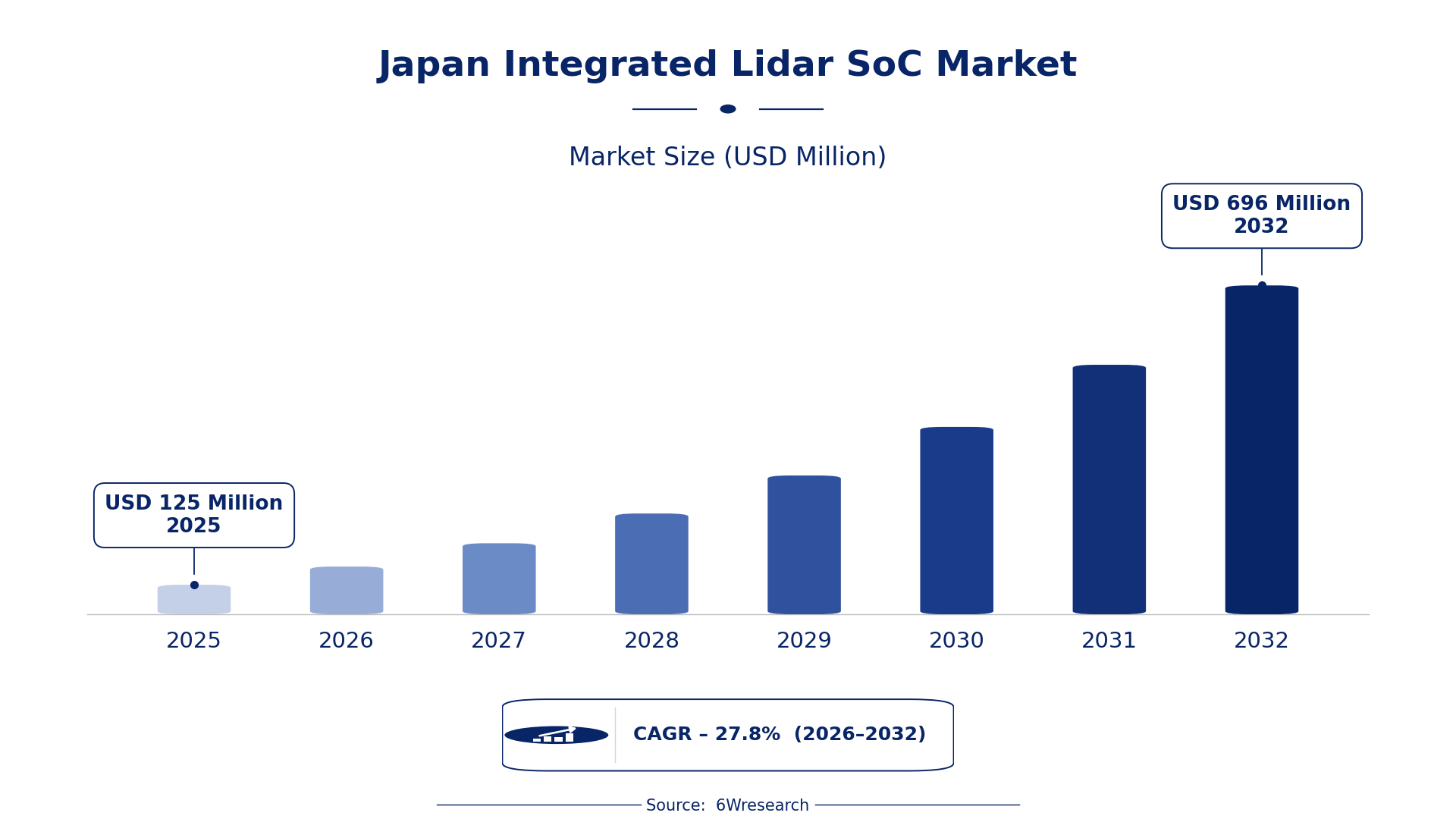
According to 6Wresearch internal database and industry insights, the Japan Integrated Lidar SoC Market was valued at USD 125 Million in 2025 and is projected to reach USD 696 Million by 2032, growing at a CAGR of approximately 27.8% during 2026–2032.
Japan Integrated Lidar SoC Market Highlights
| Report Metric | Details |
| Report Name | Japan Integrated Lidar SoC Market (2026-2032) |
| Market Size 2025 | USD 125 Million |
| Market Size 2032 | USD 696 Million |
| Absolute Growth 2025–2032 | USD 571 Million |
| CAGR 2026–2032 | 27.8% |
| Peak Annual Growth | 31.1% in 2029 |
| Forecast Period | 2026–2032 |
| Historical Data | 2022–2025 |
| Base Year | 2025 |
| Leading SoC Type, 2025 | FMCW LiDAR SoCs (44% share) |
| Leading Application Area, 2025 | ADAS Systems (47% share) |
| Leading Detection Range, 2025 | Mid to Long Range (48% share) |
| Leading Technology Platform, 2025 | CMOS-based (42% share) |
| Leading End User, 2025 | Automotive OEMs (47% share) |
| Fastest-Growing SoC Type | Edge-AI Lidar SoCs (41.2% CAGR) |
| Fastest-Growing Application Area | Drones & Robotics (35.8% CAGR) |
| Fastest-Growing Technology Platform | AI-Optimized SiP (30.0% CAGR) |
| Fastest-Growing End User | UAV Makers (38.1% CAGR) |
| Growing Sector | automotive safety systems |
| Key End Users | automotive OEMs, robotics manufacturers, UAV makers, smart factory vendors |
Japan Integrated Lidar SoC Market Year-wise Growth Rate and Key Drivers (2022–2032)
This graph illustrates the annual growth rates of the market from 2022 to 2032, highlighting a steady upward trajectory and projected market expansion over the forecast period.
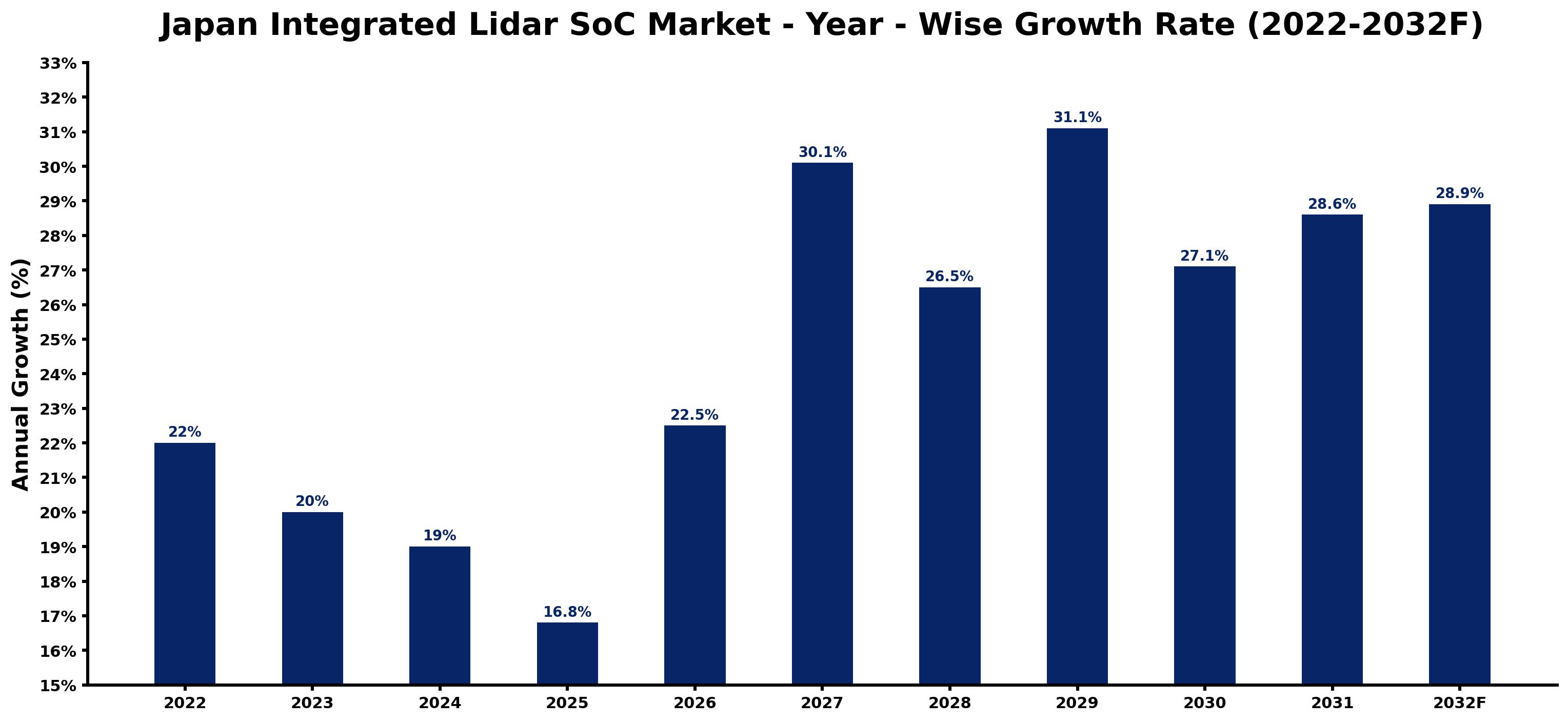
Annual growth estimates for each year appear below with the principal reason behind them, explaining the shifts that set the pace of the market.
| Year | Estimated Annual Growth (%) | Market Rationale |
| 2022 | 22.0 | The market exhibited strong growth due to increased adoption of advanced safety features in vehicles. |
| 2023 | 20.0 | Growth slowed as manufacturers adjusted to supply chain challenges affecting production rates. |
| 2024 | 19.0 | Market expansion continued but at a reduced pace as competition intensified among technology providers. |
| 2025 | 16.8 | Demand growth decelerated as market saturation began in certain automotive segments. |
| 2026 | 22.5 | Growth is expected to accelerate again as new applications in robotics and automation emerge. |
| 2027 | 30.1 | Demand is projected to surge with increased investment in autonomous vehicle technologies and applications. |
| 2028 | 26.5 | Market growth is anticipated to slow as manufacturers face challenges in scaling production capabilities. |
| 2029 | 31.1 | The market is expected to peak with advancements in LiDAR technology driving widespread adoption. |
| 2030 | 27.1 | Growth will moderate as the market begins to stabilise after rapid expansion in previous years. |
| 2031 | 28.6 | Demand is expected to increase with further integration of LiDAR in smart transportation solutions. |
| 2032 | 28.9 | Growth will continue as new use cases in industrial safety and automation develop. |
Note: Market size estimations and growth projections presented in this report are based on 6Wresearch's proprietary forecasting methodology, utilizing the latest available industry data, government publications, and primary research inputs.
Japan Integrated Lidar SoC Market Synopsis
Integrated LiDAR SoCs are semiconductor devices that combine laser emission and detection on a single chip, essential for applications in autonomous navigation and automotive safety systems. The Japan Integrated Lidar SoC Market is experiencing growth, driven by the automotive sector's demand for advanced safety features, with over 4 million vehicles equipped annually. The Smart Mobility Strategy launched in 2023 promotes the integration of LiDAR technologies, supporting the market's expansion prospects.
Market Dynamics Impact Analysis (2026–2032)
| Factor | Type | Impact | Primary Segment Affected |
| Increased adoption of advanced driver-assistance systems | Driver | High | ADAS Systems |
| Growing demand for autonomous navigation technologies | Driver | High | Autonomous Navigation |
| Rising investment in robotics applications | Opportunity | High | Drones & Robotics |
| Expansion of smart transportation initiatives | Opportunity | Medium | ADAS Systems |
| Supply chain disruptions affecting semiconductor availability | Restraint | High | FMCW LiDAR SoCs |
| Intense competition among technology providers leading to price pressures | Restraint | Medium | TOF-Based SoCs |
| Challenges in scaling production capabilities for new technologies | Challenge | High | Edge-AI Lidar SoCs |
| Regulatory hurdles in the automotive sector impacting deployment | Challenge | Medium | Hybrid LiDAR SoCs |
Evaluation of Drivers in Japan Integrated Lidar SoC Market (2026–2032)
These are the developments adding the most demand over the forecast period.
| Drivers | Primary Segment Affected | Why It Matters (Evidence) |
| Growing number of vehicles equipped with advanced safety features | ADAS Systems | Japan's automotive sector sees over 4 million vehicles equipped annually, increasing demand for LiDAR integration. |
| Investment in autonomous navigation technologies | Autonomous Navigation | Increased funding for research initiatives boosts demand for LiDAR applications in autonomous systems. |
| Rising robotics market valued at over $7 billion | Drones & Robotics | LiDAR technology is essential for automation, driving purchases among robotics manufacturers. |
| Increased focus on smart transportation solutions | ADAS Systems | The Smart Mobility Strategy aims to promote vehicle safety, leading to higher LiDAR adoption. |
| Expansion of industry standards like ISO 26262 | FMCW LiDAR SoCs | Adoption of functional safety standards in automotive applications drives demand for compliant LiDAR systems. |
Purchasing is picking up as Japan's automotive sector sees over 4 million vehicles equipped with advanced safety features annually, driving demand for LiDAR integration in automotive safety systems. The robotics market, valued at over $7 billion, relies heavily on LiDAR for automation, increasing purchases among manufacturers. The focus on smart transportation solutions promotes the need for LiDAR technologies. The adoption of ISO 26262 standards in automotive applications drives demand for compliant systems, ensuring safety and reliability in new vehicle models.
Evaluation of Restraints in Japan Integrated Lidar SoC Market
The table below lists the restraints and the evidence behind each.
| Market Restraint | Primary Segment Affected | Why It Matters (Evidence) |
| Supply chain disruptions affecting semiconductor availability | FMCW LiDAR SoCs | Supply chain disruptions have delayed production, impacting the availability of LiDAR systems. |
| Intense competition among technology providers affecting pricing strategies | TOF-Based SoCs | Price competition among providers has reduced margins, affecting investment in new technologies. |
| Challenges in scaling production capabilities for new technologies | Edge-AI Lidar SoCs | Manufacturers face difficulties in meeting rising demand due to limitations in production capacity. |
| Regulatory hurdles in the automotive sector impacting deployment | Hybrid LiDAR SoCs | Compliance with evolving regulations can delay the introduction of new LiDAR technologies. |
| Market saturation in certain automotive segments | ADAS Systems | As more vehicles adopt existing technologies, growth rates may slow due to reduced new demand. |
Japan Integrated Lidar SoC Market Challenges
Buyers in the automotive sector encounter delays due to limited domestic production of integrated LiDAR SoCs, hindering the rollout of advanced safety features in over 4 million vehicles annually. Suppliers face high compliance costs associated with the ISO 26262 standard, which raises prices for these systems and squeezes profit margins. A shortage of skilled professionals in semiconductor design limits suppliers' capacity to innovate, resulting in extended development timelines for new technologies. Integration challenges with existing systems complicate buyers' efforts, causing setbacks in adopting smart transportation solutions that rely on advanced functionalities.
Trends in the Japan Integrated Lidar SoC Market
Below are the shifts with the largest effect on the Japan Integrated Lidar SoC Market.
- Shift towards Advanced Driver-Assistance Systems: Automotive OEMs are increasingly incorporating LiDAR into ADAS, with over 60% of new models featuring this technology, reflecting a change in vehicle safety standards.
- Emergence of AI-Optimized LiDAR Solutions: The development of AI-Optimized SiP technology is gaining momentum, with a projected CAGR of 30.0%, enhancing processing capabilities for autonomous applications.
- Growing Demand for Robotics Applications: The robotics sector is witnessing a surge in LiDAR adoption, with the market valued at over $7 billion, indicating a strong trend towards automation.
- Expansion of Smart Mobility Initiatives: The Tokyo region is evolving into a hub for smart mobility, with the Smart Mobility Strategy promoting LiDAR technologies to improve urban transportation solutions.
Investment Opportunities in the Japan Integrated Lidar SoC Market
Where to invest in the Japan Integrated Lidar SoC Market: the main openings are set out below.
- Joint Ventures for Technology Development: Establishing joint ventures with local universities can drive the development of advanced LiDAR technologies, addressing a market gap in Japan's robotics sector, valued at over $7 billion.
- Supply of AI-Optimized LiDAR Systems: The Japanese market for drones is anticipated to grow significantly, with LiDAR being a key technology for UAV makers, creating opportunities for suppliers.
- Focus on Industrial Safety Solutions: Investing in LiDAR applications for industrial safety systems can meet the increasing demand in manufacturing sectors, supported by government initiatives.
- Enhancement of Smart Transportation Solutions: Investing in LiDAR for smart transportation solutions can tackle the rising need for efficient urban mobility, particularly in the Tokyo region.
Government Initiatives in the Japan Integrated Lidar SoC Market
The Semiconductor and Digital Industry Strategy launched by METI in June 2021 aims to secure domestic semiconductor manufacturing, strengthening the capabilities of Integrated LiDAR SoCs. This strategy complements existing laws by focusing on the resilience of the semiconductor supply chain, ensuring that producers can meet the demand for advanced technologies across various sectors.
The New Energy and Industrial Technology Development Organization (NEDO) funds projects focusing on advanced LiDAR applications, enabling buyers in the automotive and robotics sectors to access new technologies. This funding supports research and development efforts, ensuring that manufacturers can implement the latest innovations in their products.
Future Insight of the Japan Integrated Lidar SoC Market
Changes by 2032 will primarily benefit automotive buyers as they transition to more advanced integrated LiDAR systems, driven by initiatives like the 'Smart Mobility Strategy'. The robotics market will expand significantly, with advancements improving automation processes. Increased funding from the Ministry of Economy, Trade and Industry will support the development of AI-optimized solutions, creating new opportunities for suppliers. As demand for smart transportation rises, buyers will gain access to safer and more efficient vehicles equipped with cutting-edge technologies.
Market Segmentation Analysis
Japan Integrated Lidar SoC Market report covers a detailed analysis of the following market segments:
By SoC Type – FMCW LiDAR SoCs Lead, Edge-AI Lidar SoCs Expected to Grow Fastest
According to Prakhar Dixit, Senior Research Analyst at 6Wresearch, the largest soc type category in 2025 was FMCW LiDAR SoCs, at 44% of revenue. FMCW LiDAR SoCs hold the largest share due to their critical role in automotive and robotics applications, where accurate distance measurement is vital. For instance, over 4 million vehicles equipped with advanced safety features in Japan rely on FMCW technology annually. Edge-AI Lidar SoCs are projected to grow fastest, at a CAGR of 41.2% during 2026–2032. The growth of Edge-AI Lidar SoCs is propelled by the increasing need for real-time data processing in autonomous systems, as indicated by the government's 'Smart Mobility Strategy' promoting these technologies. This segment's expansion will further strengthen the dominance of FMCW LiDAR SoCs as they integrate advanced functionalities. Suppliers should focus on developing FMCW and Edge-AI technologies to address the growing demand in automotive and robotics.
By Application Area – ADAS Systems Lead, Drones & Robotics Expected to Grow Fastest
ADAS Systems accounted for 47% of the market by application area in 2025. ADAS Systems lead the market as they are crucial for advanced driver-assistance features, with many new automotive models integrating these systems. The widespread adoption of the ISO 26262 standard ensures the safety and reliability of these applications. The quickest growth will come from Drones & Robotics, forecast to expand at a CAGR of 35.8% between 2026 and 2032. Drones & Robotics are experiencing rapid growth due to their extensive use in UAVs for navigation and obstacle detection, supported by a robotics market valued at over $7 billion. This surge in drones and robotics will further bolster the established ADAS segment. Buyers should consider investing in ADAS and drone technologies to leverage advancements in safety and automation.
By Detection Range – Mid to Long Range Leads and Records the Fastest Growth
Mid to Long Range held 48% of the Japan Integrated Lidar SoC Market by detection range in 2025. Mid to Long Range detection is vital for automotive and industrial applications that require extended detection capabilities, making it the leading segment. This range is essential for ensuring safety and efficiency in various operational environments. Mid to Long Range is also forecast to expand faster than any other category, at a CAGR of 29.4% over 2026–2032. The Mid to Long Range segment also leads in growth due to its applications in both automotive and industrial sectors, where the demand for enhanced detection continues to rise. As this segment grows, it reinforces its leadership position. Suppliers must focus on developing solutions that maximise mid to long-range detection capabilities to meet market needs.
By Technology Platform – CMOS-based Leads, AI-Optimized SiP Expected to Grow Fastest
With 42% of technology platform revenue in 2025, CMOS-based was the largest category. CMOS-based technology is the leading platform for LiDAR solutions due to its cost-effectiveness and widespread adoption across various applications. Its dominance is reflected in the substantial number of devices utilising this technology in multiple sectors. AI-Optimized SiP is set to record the highest CAGR in this split, 30.0% over 2026–2032. AI-Optimized SiP technology is rapidly expanding as it enhances processing capabilities for LiDAR applications, aligning with the demand for smarter systems in autonomous navigation. This growth will further solidify the position of CMOS-based solutions as they incorporate AI functionalities. Suppliers should invest in AI-Optimized SiP technologies to remain competitive in the evolving market.
By End User – Automotive OEMs Lead, UAV Makers Expected to Grow Fastest
Automotive OEMs took 47% of end user revenue in 2025, more than any other category. Automotive OEMs represent the largest share of the market as they are primary consumers of LiDAR for vehicle safety and navigation systems. The concentration of automotive innovation in regions like Tokyo underscores the significance of this segment. UAV Makers are projected to grow fastest, at a CAGR of 38.1% during 2026–2032. UAV Makers are the fastest-growing end user group, driven by the increasing demand for drones and UAV technology across various applications. This growth will complement the established automotive segment, enhancing the overall market. Buyers should seek partnerships with UAV makers to capitalise on the rising demand for drone technologies.
Key Attractiveness of the Report
- 10 Years of Market Numbers
- Historical Data Starting from 2022 to 2025
- Base Year 2025
- Forecast Data until 2032
- Key Performance Indicators Impacting the Market
- Major Upcoming Developments and Projects
Key Highlights of the Report:
- Japan Integrated Lidar SoC Market Outlook
- Market Size of Japan Integrated Lidar SoC Market, 2025
- Forecast of Japan Integrated Lidar SoC Market, 2032
- Historical Data and Forecast of Japan Integrated Lidar SoC Revenues & Volume for the Period 2022-2032F
- Japan Integrated Lidar SoC Market Trend Evolution
- Japan Integrated Lidar SoC Market Drivers and Challenges
- Japan Integrated Lidar SoC Price Trends
- Japan Integrated Lidar SoC Porter's Five Forces
- Japan Integrated Lidar SoC Industry Life Cycle
- Historical Data and Forecast of Japan Integrated Lidar SoC Market Revenues & Volume By SoC Type for the Period 2022-2032F
- Historical Data and Forecast of Japan Integrated Lidar SoC Market Revenues & Volume By FMCW LiDAR SoCs for the Period 2022-2032F
- Historical Data and Forecast of Japan Integrated Lidar SoC Market Revenues & Volume By TOF-Based SoCs for the Period 2022-2032F
- Historical Data and Forecast of Japan Integrated Lidar SoC Market Revenues & Volume By Hybrid LiDAR SoCs for the Period 2022-2032F
- Historical Data and Forecast of Japan Integrated Lidar SoC Market Revenues & Volume By Edge-AI Lidar SoCs for the Period 2022-2032F
- Historical Data and Forecast of Japan Integrated Lidar SoC Market Revenues & Volume By Application Area for the Period 2022-2032F
- Historical Data and Forecast of Japan Integrated Lidar SoC Market Revenues & Volume By Autonomous Navigation for the Period 2022-2032F
- Historical Data and Forecast of Japan Integrated Lidar SoC Market Revenues & Volume By ADAS Systems for the Period 2022-2032F
- Historical Data and Forecast of Japan Integrated Lidar SoC Market Revenues & Volume By Drones & Robotics for the Period 2022-2032F
- Historical Data and Forecast of Japan Integrated Lidar SoC Market Revenues & Volume By Industrial Safety for the Period 2022-2032F
- Historical Data and Forecast of Japan Integrated Lidar SoC Market Revenues & Volume By Detection Range for the Period 2022-2032F
- Historical Data and Forecast of Japan Integrated Lidar SoC Market Revenues & Volume By Short to Mid Range for the Period 2022-2032F
- Historical Data and Forecast of Japan Integrated Lidar SoC Market Revenues & Volume By Mid to Long Range for the Period 2022-2032F
- Historical Data and Forecast of Japan Integrated Lidar SoC Market Revenues & Volume By Ultra-short Range for the Period 2022-2032F
- Historical Data and Forecast of Japan Integrated Lidar SoC Market Revenues & Volume By Variable for the Period 2022-2032F
- Historical Data and Forecast of Japan Integrated Lidar SoC Market Revenues & Volume By Technology Platform for the Period 2022-2032F
- Historical Data and Forecast of Japan Integrated Lidar SoC Market Revenues & Volume By Silicon Photonics for the Period 2022-2032F
- Historical Data and Forecast of Japan Integrated Lidar SoC Market Revenues & Volume By CMOS-based for the Period 2022-2032F
- Historical Data and Forecast of Japan Integrated Lidar SoC Market Revenues & Volume By MEMS for the Period 2022-2032F
- Historical Data and Forecast of Japan Integrated Lidar SoC Market Revenues & Volume By AI-Optimized SiP for the Period 2022-2032F
- Historical Data and Forecast of Japan Integrated Lidar SoC Market Revenues & Volume By End User for the Period 2022-2032F
- Historical Data and Forecast of Japan Integrated Lidar SoC Market Revenues & Volume By Robot OEMs for the Period 2022-2032F
- Historical Data and Forecast of Japan Integrated Lidar SoC Market Revenues & Volume By Automotive OEMs for the Period 2022-2032F
- Historical Data and Forecast of Japan Integrated Lidar SoC Market Revenues & Volume By UAV Makers for the Period 2022-2032F
- Historical Data and Forecast of Japan Integrated Lidar SoC Market Revenues & Volume By Smart Factory Vendors for the Period 2022-2032F
- Japan Integrated Lidar SoC Import Export Trade Statistics
- Market Opportunity Assessment By SoC Type
- Market Opportunity Assessment By Application Area
- Market Opportunity Assessment By Detection Range
- Market Opportunity Assessment By Technology Platform
- Market Opportunity Assessment By End User
- Japan Integrated Lidar SoC Top Companies Market Share
- Japan Integrated Lidar SoC Competitive Benchmarking By Technical and Operational Parameters
- Japan Integrated Lidar SoC Company Profiles
- Japan Integrated Lidar SoC Key Strategic Recommendations
Market Covered
The report covers the following segments.
By SoC Type
- FMCW LiDAR SoCs
- TOF-Based SoCs
- Hybrid LiDAR SoCs
- Edge-AI Lidar SoCs
By Application Area
- Autonomous Navigation
- ADAS Systems
- Drones & Robotics
- Industrial Safety
By Detection Range
- Short to Mid Range
- Mid to Long Range
- Ultra-short Range
- Variable
By Technology Platform
- Silicon Photonics
- CMOS-based
- MEMS
- AI-Optimized SiP
By End User
- Robot OEMs
- Automotive OEMs
- UAV Makers
- Smart Factory Vendors































