Japan Internet Protocol Television (IPTV) Market Size & Growth Rate
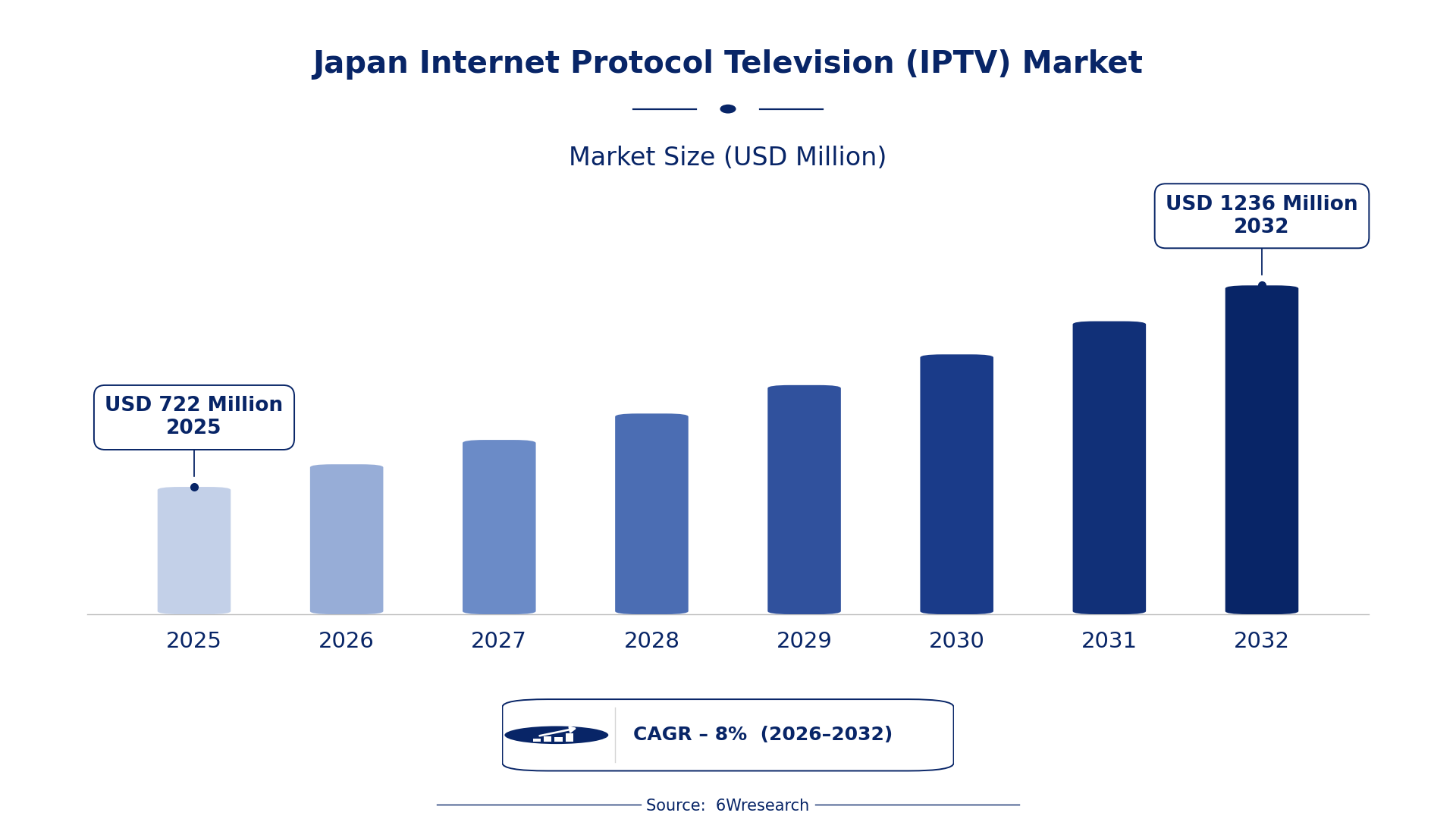
According to 6Wresearch internal database and industry insights, the Japan Internet Protocol Television (IPTV) Market was valued at USD 722 Million in 2025 and is projected to reach USD 1,236 Million by 2032, growing at a CAGR of approximately 8% during 2026–2032.
Japan Internet Protocol Television (IPTV) Market Highlights
| Report Metric | Details |
| Report Name | Japan Internet Protocol Television (IPTV) Market (2026-2032) |
| Market Size 2025 | USD 722 Million |
| Market Size 2032 | USD 1,236 Million |
| Absolute Growth 2025–2032 | USD 514 Million |
| CAGR 2026–2032 | 8% |
| Peak Annual Growth | 8.9% in 2027 |
| Forecast Period | 2026–2032 |
| Historical Data | 2022–2025 |
| Base Year | 2025 |
| Leading Industry Vertical, 2025 | Media and Entertainment (38% share) |
| Leading Component, 2025 | Hardware (42% share) |
| Leading Application, 2025 | Non-Linear TV (58% share) |
| Leading Device Type, 2025 | Smart Phones and Tablets (40% share) |
| Leading Transmission Type, 2025 | Wired (61% share) |
| Fastest-Growing Industry Vertical | Advertising and Marketing (10.6% CAGR) |
| Fastest-Growing Component | Software (11.2% CAGR) |
| Fastest-Growing Application | Linear TV (10.1% CAGR) |
| Fastest-Growing Device Type | Smart TV (11.4% CAGR) |
| Fastest-Growing Transmission Type | Wireless (11.1% CAGR) |
| Growing Sector | Media and Entertainment |
| Key End Users | Media companies, Telecom providers, Healthcare institutions |
Japan Internet Protocol Television (IPTV) Market Year-wise Growth Rate and Key Drivers (2022–2032)
This graph illustrates the annual growth rates of the market from 2022 to 2032, highlighting a steady upward trajectory and projected market expansion over the forecast period.
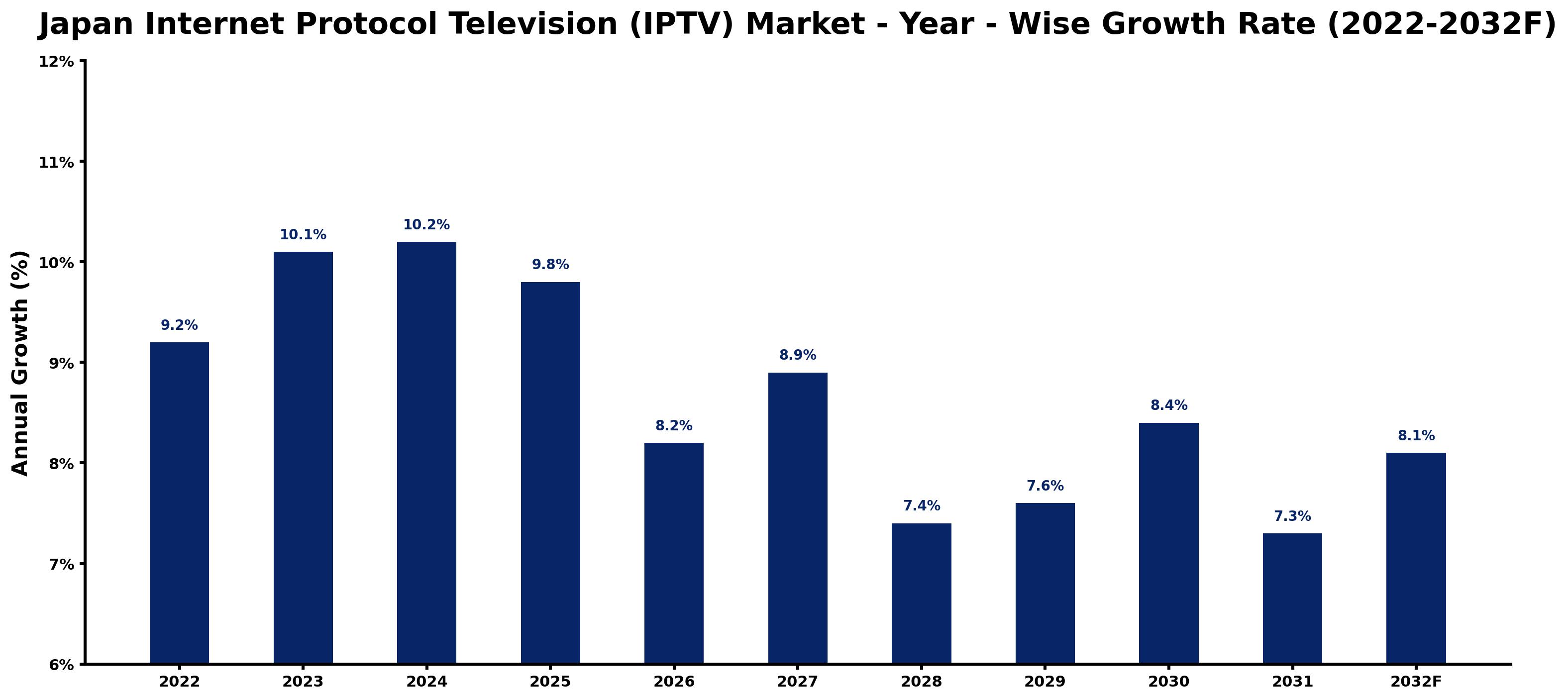
The yearly estimates that follow link every growth rate to its principal driver, so readers can see why the pace changed in each period.
| Year | Estimated Annual Growth (%) | Market Rationale |
| 2022 | 9.2 | The market experienced steady growth due to increasing adoption of IPTV services. |
| 2023 | 10.1 | Demand surged as households opted for on-demand content offerings. |
| 2024 | 10.2 | Growth continued as users preferred non-linear viewing options. |
| 2025 | 9.8 | The market saw a slowdown as competition intensified among providers. |
| 2026 | 8.2 | Growth is expected to slow as consumer preferences shift towards mobile access. |
| 2027 | 8.9 | Demand is projected to rebound with new content delivery methods. |
| 2028 | 7.4 | Growth will decelerate as market saturation begins to affect subscriptions. |
| 2029 | 7.6 | A slight increase in growth is anticipated as new content partnerships emerge. |
| 2030 | 8.4 | Demand will rise again with advancements in streaming technology. |
| 2031 | 7.3 | Growth is expected to slow as the market reaches a more mature stage. |
| 2032 | 8.1 | A resurgence in demand is projected as new interactive features attract users. |
Note: Market size estimations and growth projections presented in this report are based on 6Wresearch's proprietary forecasting methodology, utilizing the latest available industry data, government publications, and primary research inputs.
Japan Internet Protocol Television (IPTV) Market Synopsis
Internet Protocol Television (IPTV) delivers television content via internet connections, encoding video into IP packets. It serves the media and entertainment sector, offering on-demand video, live broadcasts, and interactive features. The Japan Internet Protocol Television (IPTV) Market is growing as consumer preference shifts towards on-demand content, with over 70% of users favouring this format. The Tokyo region leads in usage, accounting for 30% of the total market, while government support for digital infrastructure propels further growth.
Market Dynamics Impact Analysis (2026–2032)
| Factor | Type | Impact | Primary Segment Affected |
| Increasing consumer preference for on-demand content | Driver | High | Non-Linear TV |
| Growth in broadband infrastructure and internet speeds | Driver | High | IT and Telecom |
| Expansion of advertising revenue through IPTV platforms | Opportunity | Medium | Advertising and Marketing |
| Rising demand for interactive television features | Opportunity | Medium | Media and Entertainment |
| Intense competition among service providers | Restraint | High | Service |
| High costs associated with content licensing and acquisition | Restraint | High | Software |
| Limited adoption in niche sectors like healthcare | Challenge | Medium | Healthcare |
| Challenges in ensuring content accessibility standards | Challenge | Medium | Hardware |
Evaluation of Drivers in Japan Internet Protocol Television (IPTV) Market (2026–2032)
The table below links each growth driver to the segment it affects and the evidence for it.
| Drivers | Primary Segment Affected | Why It Matters (Evidence) |
| Growing number of IPTV subscribers | Media and Entertainment | In 2023, Japan had over 40 million IPTV subscribers, driving demand for diverse content. |
| Expansion of broadband services | IT and Telecom | The average bitrate for IPTV streaming in Japan is 5 Mbps, facilitating smoother content delivery. |
| Increased investment in content production | Software | 60% of IPTV content is sourced domestically, enhancing local content availability. |
| Rising advertising revenue from IPTV | Advertising and Marketing | Advertising revenue from IPTV reached ¥100 billion in 2023, attracting more advertisers. |
| Adoption of smart devices for IPTV access | Smart TV | 40% of users access IPTV via Smart TVs, increasing demand for compatible content. |
Orders keep climbing as the number of IPTV subscribers in Japan surpassed 40 million in 2023, boosting demand for diverse offerings. The expansion of broadband services has made streaming more accessible, with an average bitrate for IPTV streaming at 5 Mbps. The rise of smart devices drives demand for tailored content delivery methods, as 60% of IPTV content is sourced domestically. The average viewing time for IPTV in Japan is 2 hours per day, indicating a growing interest in interactive features.
Evaluation of Restraints in Japan Internet Protocol Television (IPTV) Market
These restraints slow adoption and weigh on supplier margins.
| Market Restraint | Primary Segment Affected | Why It Matters (Evidence) |
| Intense competition among IPTV service providers | Service | Increased competition leads to price wars, affecting profitability for providers. |
| High costs of content licensing | Software | Content acquisition costs can limit the variety of offerings available to users. |
| Limited adoption in the healthcare sector | Healthcare | The healthcare sector's minimal use of IPTV restricts market growth opportunities. |
| Challenges in meeting accessibility standards | Hardware | Compliance with standards like JIS X 8341-3:2016 can increase operational costs. |
| Technological barriers for older demographics | Media and Entertainment | Older users may struggle with new technology, limiting their engagement with IPTV. |
Japan Internet Protocol Television (IPTV) Market Challenges
In 2023, the average household spends about ¥3,000 monthly on IPTV services, which strains budgets for many consumers amid rising living costs. A shortage of skilled technicians hinders producers' ability to develop advanced features, resulting in delayed service enhancements that frustrate users. Many producers face challenges with outdated technology, preventing them from adopting the latest streaming standards, which detracts from the viewing experience for buyers. In the competitive Tokyo region, where 30% of IPTV usage occurs, aggressive pricing strategies compel providers to compromise on service quality, ultimately disappointing consumers.
Trends in the Japan Internet Protocol Television (IPTV) Market
Below are the shifts with the largest effect on the Japan Internet Protocol Television (IPTV) Market.
- Shift from Traditional to On-Demand Viewing: Tokyo is experiencing a shift towards on-demand viewing, with 70% of IPTV users preferring this format. This trend reflects changing consumer habits and increases the need for diverse content offerings.
- Growth of Interactive Features in IPTV: In 2023, the average viewing time for IPTV in Japan was 2 hours per day, indicating a growing interest in interactive features. This trend encourages providers to innovate and improve user engagement.
- Rise of Smart Devices for IPTV Access: The adoption of Smart TVs is increasing, with 40% of users accessing IPTV through these devices. This shift drives demand for content tailored to smart device capabilities.
- Expansion of Local Content Production: The government’s support for domestic content has led to 60% of IPTV content being sourced locally. This trend boosts the local media industry and enhances viewer choice.
Investment Opportunities in the Japan Internet Protocol Television (IPTV) Market
The opportunities below stand out in the Japan Internet Protocol Television (IPTV) Market for new entrants and existing suppliers.
- Healthcare Providers Seeking IPTV Solutions: Healthcare providers are increasingly looking for IPTV solutions for patient information dissemination, with the healthcare sector starting to adopt this technology. This presents a notable opportunity for service providers.
- Investment in Interactive Content Development: With 70% of users preferring on-demand content, there is a growing need for interactive content development. Collaborating with media companies can facilitate entry into this market.
- Partnerships with Local Content Creators: The demand for locally sourced content is rising, with 60% of IPTV content coming from domestic sources. Forming partnerships with local creators can improve content offerings.
- Focus on Digital Infrastructure Enhancement: The government's strategy to enhance digital infrastructure by 2025 presents opportunities for IPTV providers to expand their services. Investing in infrastructure can improve service delivery.
Government Initiatives in the Japan Internet Protocol Television (IPTV) Market
The framework for IPTV in Japan is shaped by various laws, including the Medical Care Act of 1948, which sets standards for healthcare facilities, and the AI Promotion Act of 2025, which establishes guidelines for AI use in media. These laws influence how IPTV services are developed and delivered, ensuring compliance with national standards.
The Ministry of Internal Affairs and Communications oversees IPTV regulations, approving new service providers and funding initiatives aimed at improving digital infrastructure. The Digital Agency, established in 2021, supports projects that improve IPTV accessibility and user experience.
Future Insight of the Japan Internet Protocol Television (IPTV) Market
By 2032, households will increasingly rely on IPTV for diverse content delivery, reshaping entertainment consumption patterns. The average viewing time is expected to increase, further driving demand for on-demand content, which currently attracts 70% of users. Standards like JIS X 8341-3:2016 will enhance accessibility features, benefiting a broader audience. As IPTV channels exceed 300, suppliers will need to innovate continuously to maintain subscriber engagement and satisfaction.
Market Segmentation Analysis
Japan Internet Protocol Television (IPTV) Market report covers a detailed analysis of the following market segments:
By Industry Vertical – Media and Entertainment Leads, Advertising and Marketing Expected to Grow Fastest
According to Vasudha, AM at 6Wresearch, Media and Entertainment took 38% of industry vertical revenue in 2025, more than any other category. The media and entertainment sector holds the largest share in Japan's IPTV market, primarily due to its vast subscriber base of over 40 million. This sector effectively caters to the high demand for on-demand content, with 70% of users opting for such services. Advertising and Marketing is set to record the highest CAGR in this split, 10.6% over 2026–2032. The advertising and marketing segment is witnessing rapid growth, spurred by advertising revenue from IPTV reaching ¥100 billion in 2023. The presence of over 300 IPTV channels creates ample opportunities for targeted advertising, driving this segment's expansion. This trend suggests that suppliers should focus on enhancing advertising capabilities within IPTV platforms to capitalise on the increasing demand.
By Component – Hardware Leads, Software Expected to Grow Fastest
In 2025, Hardware led the component split with a 42% share. Hardware is the predominant component in the IPTV market, as it is crucial for the effective delivery of IPTV services. The reliance on various hardware devices ensures a seamless viewing experience for the extensive subscriber base in Japan. Over 2026–2032, Software is expected to post the fastest growth, at a CAGR of 11.2%. Software is the fastest-growing component, largely due to the rising need for efficient content management and delivery systems. As the IPTV market continues to expand, the demand for advanced software solutions to support these services is on the rise. Suppliers need to prioritise the development of robust software solutions to address the increasing requirements of IPTV service providers.
By Application – Non-Linear TV Leads, Linear TV Expected to Grow Fastest
With 58% of application revenue in 2025, Non-Linear TV was the largest category. Non-linear TV is the dominant application in Japan's IPTV market, as it caters to the increasing preference for on-demand viewing among subscribers. This application effectively serves the needs of users who seek flexibility in their viewing habits. Linear TV is projected to grow fastest, at a CAGR of 10.1% during 2026–2032. Linear TV is the fastest-growing application, as traditional IPTV service offerings are being revitalised to attract new subscribers. The resurgence of interest in scheduled programming is contributing to this growth. This growth suggests that suppliers should balance their offerings between non-linear and linear TV to cater to diverse viewer preferences.
By Device Type – Smart Phones and Tablets Lead, Smart TV Expected to Grow Fastest
Smart Phones and Tablets held 40% of the Japan Internet Protocol Television (IPTV) Market by device type in 2025. Smart phones and tablets lead the device type segment, as they are widely used for accessing IPTV services among the Japanese population. Their portability and convenience make them the preferred choice for many subscribers. The quickest growth will come from Smart TV, forecast to expand at a CAGR of 11.4% between 2026 and 2032. Smart TVs are the fastest-growing device type, driven by the increasing availability of IPTV-compatible models in the market. As more households adopt smart TVs, the demand for IPTV services through these devices is expected to rise. This indicates that suppliers should focus on optimising IPTV services for smart TV platforms to capture the growing user base.
By Transmission Type – Wired Leads, Wireless Expected to Grow Fastest
The largest transmission type category in 2025 was Wired, at 61% of revenue. Wired transmission is the leading method for IPTV delivery, as it provides a stable and reliable connection essential for streaming high-quality content. This method supports the primary transmission needs of the extensive IPTV subscriber base in Japan. Wireless is set to record the highest CAGR in this split, 11.1% over 2026–2032. Wireless transmission is the fastest-growing type, as advancements in wireless technology are making it more viable for IPTV delivery. The increasing number of users accessing IPTV through mobile devices is further driving this trend. This suggests that suppliers should invest in improving wireless transmission technologies to accommodate the growing demand for mobile IPTV access.
Key Attractiveness of the Report
- 10 Years of Market Numbers
- Historical Data Starting from 2022 to 2025
- Base Year 2025
- Forecast Data until 2032
- Key Performance Indicators Impacting the Market
- Major Upcoming Developments and Projects
Key Highlights of the Report:
- Japan Internet Protocol Television (IPTV) Market Outlook
- Market Size of Japan Internet Protocol Television (IPTV) Market, 2025
- Forecast of Japan Internet Protocol Television (IPTV) Market, 2032
- Historical Data and Forecast of Japan Internet Protocol Television (IPTV) Revenues & Volume for the Period 2022-2032
- Japan Internet Protocol Television (IPTV) Market Trend Evolution
- Japan Internet Protocol Television (IPTV) Market Drivers and Challenges
- Japan Internet Protocol Television (IPTV) Price Trends
- Japan Internet Protocol Television (IPTV) Porter's Five Forces
- Japan Internet Protocol Television (IPTV) Industry Life Cycle
- Historical Data and Forecast of Japan Internet Protocol Television (IPTV) Market Revenues & Volume By Industry Vertical for the Period 2022-2032
- Historical Data and Forecast of Japan Internet Protocol Television (IPTV) Market Revenues & Volume By Media and Entertainment for the Period 2022-2032
- Historical Data and Forecast of Japan Internet Protocol Television (IPTV) Market Revenues & Volume By Advertising and Marketing for the Period 2022-2032
- Historical Data and Forecast of Japan Internet Protocol Television (IPTV) Market Revenues & Volume By IT and Telecom for the Period 2022-2032
- Historical Data and Forecast of Japan Internet Protocol Television (IPTV) Market Revenues & Volume By Healthcare for the Period 2022-2032
- Historical Data and Forecast of Japan Internet Protocol Television (IPTV) Market Revenues & Volume By Others for the Period 2022-2032
- Historical Data and Forecast of Japan Internet Protocol Television (IPTV) Market Revenues & Volume By Component for the Period 2022-2032
- Historical Data and Forecast of Japan Internet Protocol Television (IPTV) Market Revenues & Volume By Hardware for the Period 2022-2032
- Historical Data and Forecast of Japan Internet Protocol Television (IPTV) Market Revenues & Volume By Software for the Period 2022-2032
- Historical Data and Forecast of Japan Internet Protocol Television (IPTV) Market Revenues & Volume By Service for the Period 2022-2032
- Historical Data and Forecast of Japan Internet Protocol Television (IPTV) Market Revenues & Volume By Application for the Period 2022-2032
- Historical Data and Forecast of Japan Internet Protocol Television (IPTV) Market Revenues & Volume By Non-Linear TV for the Period 2022-2032
- Historical Data and Forecast of Japan Internet Protocol Television (IPTV) Market Revenues & Volume By Linear TV for the Period 2022-2032
- Historical Data and Forecast of Japan Internet Protocol Television (IPTV) Market Revenues & Volume By Device Type for the Period 2022-2032
- Historical Data and Forecast of Japan Internet Protocol Television (IPTV) Market Revenues & Volume By Smart Phones and Tablets for the Period 2022-2032
- Historical Data and Forecast of Japan Internet Protocol Television (IPTV) Market Revenues & Volume By Smart TV for the Period 2022-2032
- Historical Data and Forecast of Japan Internet Protocol Television (IPTV) Market Revenues & Volume By Desktops and Laptops for the Period 2022-2032
- Historical Data and Forecast of Japan Internet Protocol Television (IPTV) Market Revenues & Volume By Transmission Type for the Period 2022-2032
- Historical Data and Forecast of Japan Internet Protocol Television (IPTV) Market Revenues & Volume By Wired for the Period 2022-2032
- Historical Data and Forecast of Japan Internet Protocol Television (IPTV) Market Revenues & Volume By Wireless for the Period 2022-2032
- Japan Internet Protocol Television (IPTV) Import Export Trade Statistics
- Market Opportunity Assessment By Industry Vertical
- Market Opportunity Assessment By Component
- Market Opportunity Assessment By Application
- Market Opportunity Assessment By Device Type
- Market Opportunity Assessment By Transmission Type
- Japan Internet Protocol Television (IPTV) Top Companies Market Share
- Japan Internet Protocol Television (IPTV) Competitive Benchmarking By Technical and Operational Parameters
- Japan Internet Protocol Television (IPTV) Company Profiles
- Japan Internet Protocol Television (IPTV) Key Strategic Recommendations
Market Covered
The following segment groups are covered in the report.
By Industry Vertical
- Media and Entertainment
- Advertising and Marketing
- IT and Telecom
- Healthcare
- Others
By Component
- Hardware
- Software
- Service
By Application
- Non-Linear TV
- Linear TV
By Device Type
- Smart Phones and Tablets
- Smart TV
- Desktops and Laptops
By Transmission Type
- Wired
- Wireless































