Japan IoT Antenna Market Size & Growth Rate
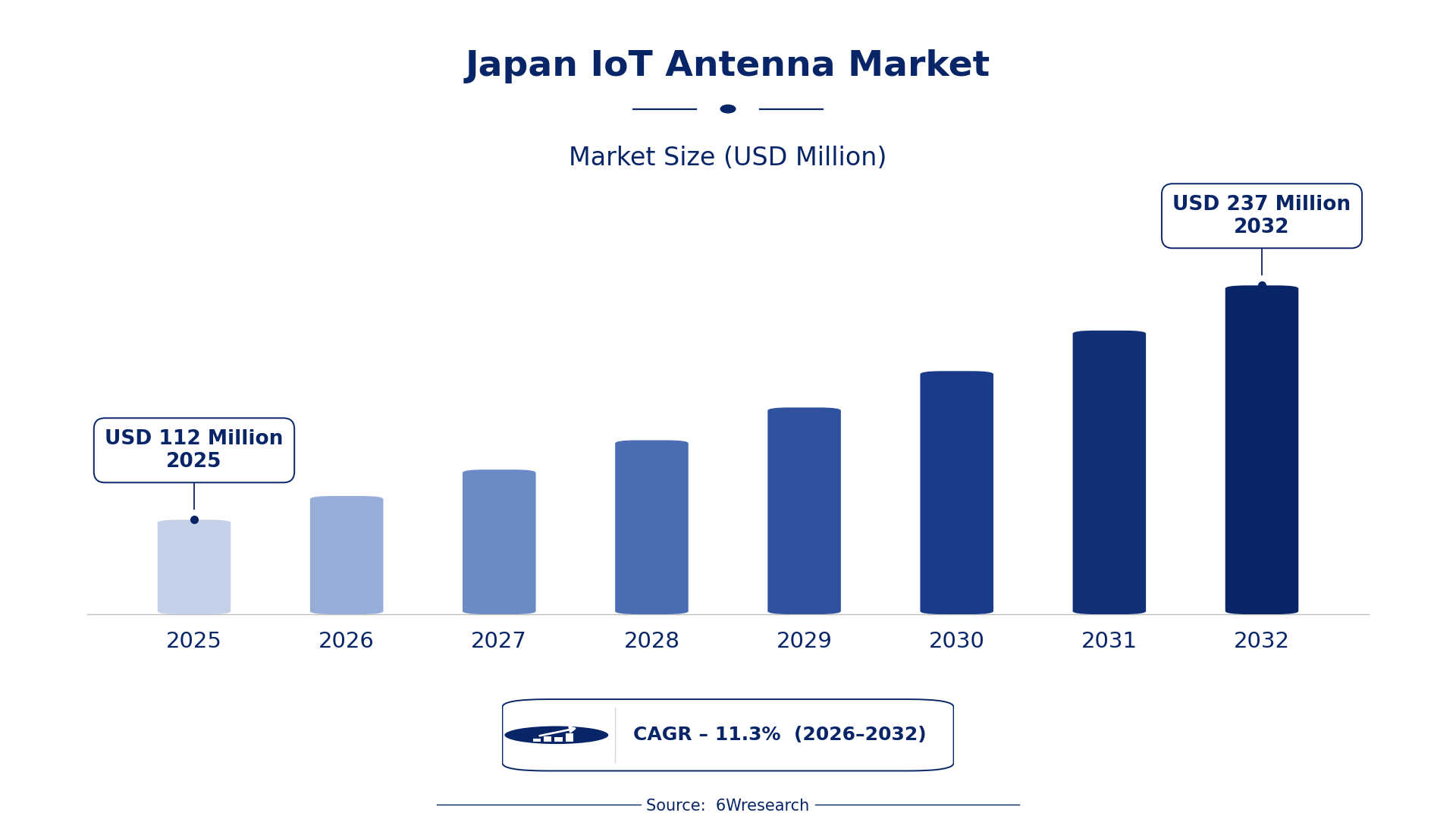
According to 6Wresearch internal database and industry insights, the Japan IoT Antenna Market was valued at USD 112 Million in 2025 and is projected to reach USD 237 Million by 2032, growing at a CAGR of approximately 11.3% during 2026–2032.
Japan IoT Antenna Market Highlights
| Report Metric | Details |
| Report Name | Japan IoT Antenna Market (2026-2032) |
| Market Size 2025 | USD 112 Million |
| Market Size 2032 | USD 237 Million |
| Absolute Growth 2025–2032 | USD 125 Million |
| CAGR 2026–2032 | 11.3% |
| Peak Annual Growth | 12.1% in 2026 |
| Forecast Period | 2026–2032 |
| Historical Data | 2022–2025 |
| Base Year | 2025 |
| Leading Antenna Type, 2025 | PCB Antennas (49% share) |
| Leading Frequency Band, 2025 | 2.4 GHz (41% share) |
| Leading Application Area, 2025 | Industrial IoT (40% share) |
| Leading Connectivity Standard, 2025 | Cellular IoT (43% share) |
| Leading End User, 2025 | IoT Device Makers (38% share) |
| Fastest-Growing Antenna Type | Chip Antennas (15.5% CAGR) |
| Fastest-Growing Frequency Band | NB-IoT (15.2% CAGR) |
| Fastest-Growing Application Area | Wearables (13.9% CAGR) |
| Fastest-Growing Connectivity Standard | LoRaWAN (15.4% CAGR) |
| Fastest-Growing End User | Industrial Integrators (14.5% CAGR) |
| Growing Sector | IoT Device Makers |
| Key End Users | IoT Device Makers, Consumer OEMs, Industrial Integrators, GPS Equipment Vendors |
Japan IoT Antenna Market Year-wise Growth Rate and Key Drivers (2022–2032)
This graph illustrates the annual growth rates of the market from 2022 to 2032, highlighting a steady upward trajectory and projected market expansion over the forecast period.
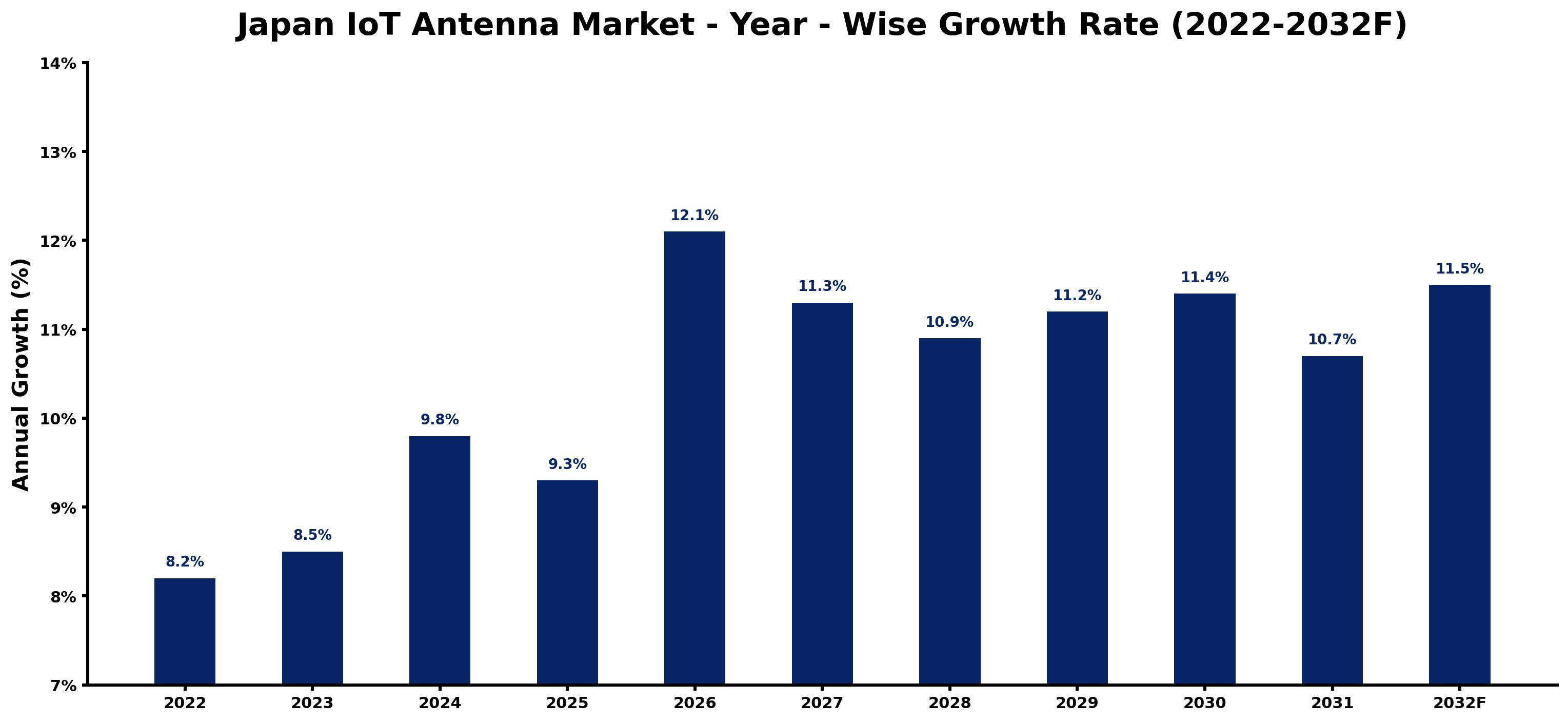
Annual growth estimates for each year appear below with the principal reason behind them, explaining the shifts that set the pace of the market.
| Year | Estimated Annual Growth (%) | Market Rationale |
| 2022 | 8.2 | Demand was steady, driven by advancements in IoT technology and connectivity standards. |
| 2023 | 8.5 | Growth accelerated due to increased investments in smart infrastructure and industrial IoT applications. |
| 2024 | 9.8 | The market saw continued expansion, supported by rising adoption of IoT devices in various sectors. |
| 2025 | 9.3 | Growth slowed slightly as market maturation occurred, yet demand for smart meters remained strong. |
| 2026 | 12.1 | A surge in demand is expected to be driven by the introduction of new connectivity standards and applications. |
| 2027 | 11.3 | Growth is projected to decelerate as competition intensifies among IoT antenna manufacturers and suppliers. |
| 2028 | 10.9 | The market is expected to continue growing, supported by ongoing investments in industrial IoT and smart cities. |
| 2029 | 11.2 | Demand is anticipated to increase again, fueled by the expansion of Cellular IoT connections across sectors. |
| 2030 | 11.4 | Growth is expected to remain strong as the government aims for 50% IoT device penetration by 2030. |
| 2031 | 10.7 | A slight slowdown is projected as the market adjusts to new technological standards and consumer needs. |
| 2032 | 11.5 | Demand is expected to rise again, driven by the increasing number of IoT devices and applications. |
Note: Market size estimations and growth projections presented in this report are based on 6Wresearch's proprietary forecasting methodology, utilizing the latest available industry data, government publications, and primary research inputs.
Japan IoT Antenna Market Synopsis
IoT antennas are critical components for wireless communication in Internet of Things applications, enabling connectivity in devices such as smart meters and wearables. The Japan IoT Antenna Market is expanding due to rising demand from IoT device manufacturers and improvements in connectivity standards.
Market Dynamics Impact Analysis (2026–2032)
| Factor | Type | Impact | Primary Segment Affected |
| Rising adoption of smart meters | Driver | High | Smart Meters |
| Expansion of industrial IoT applications | Driver | High | Industrial IoT |
| Growing need for low-power wide-area networks | Opportunity | High | NB-IoT |
| Increasing demand for wearable technology | Opportunity | High | Wearables |
| Competition among manufacturers leading to price pressures | Restraint | Medium | PCB Antennas |
| Maturation of the IoT market causing slower growth rates | Restraint | Medium | Chip Antennas |
| Challenges in meeting evolving connectivity standards | Challenge | High | Cellular IoT |
| Supply chain disruptions affecting production timelines | Challenge | Medium | Embedded Antennas |
Evaluation of Drivers in Japan IoT Antenna Market (2026–2032)
The following drivers explain most of the expected growth.
| Drivers | Primary Segment Affected | Why It Matters (Evidence) |
| Increased investment in smart infrastructure | Industrial IoT | This investment is driving demand for IoT antennas, with over 30% of households now equipped with smart meters. |
| Growing adoption of wearables in urban areas | Wearables | As wearable technology expands, demand for compact antennas rises, with urban areas projected to see growth of 20% annually. |
| Expansion of Cellular IoT connections | Cellular IoT | With a projected annual growth rate of 20%, more devices are connecting, increasing antenna demand. |
| Implementation of the IoT Acceleration Consortium | Smart Meters | This initiative promotes IoT adoption, leading to a higher demand for antennas in smart meter applications. |
| Development of the NB-IoT standard | NB-IoT | As a low-power solution, its adoption is increasing, driving demand for specialized antennas. |
What keeps demand rising is the increased investment in smart infrastructure, which has led to over 30% of households in Japan being equipped with smart meters. Urban areas are experiencing growth in wearable technology, driving the need for compact antennas as more consumers adopt fitness and health tracking devices. The expansion of Cellular IoT connections is projected to grow by 20% annually, resulting in a surge of connected devices requiring antennas. The implementation of the IoT Acceleration Consortium promotes IoT adoption, which increases demand for antennas in smart meter applications. The development and adoption of the NB-IoT standard are increasing the need for specialized antennas in various sectors.
Evaluation of Restraints in Japan IoT Antenna Market
These are the pressures that could keep growth below its potential.
| Market Restraint | Primary Segment Affected | Why It Matters (Evidence) |
| Intense competition among manufacturers | PCB Antennas | This competition leads to price pressures, affecting profitability for producers in the sector. |
| Market maturation causing slower growth rates | Chip Antennas | As the market matures, growth rates are stabilising, impacting investment decisions. |
| Challenges in meeting evolving connectivity standards | Cellular IoT | Manufacturers must continuously adapt to new standards, which can delay product development. |
| Supply chain disruptions affecting production timelines | Embedded Antennas | These disruptions can lead to delays in product availability, impacting buyers' operations. |
| Limited awareness of IoT benefits among potential users | Smart Meters | This limits the adoption of smart technologies, affecting antenna demand in the sector. |
Japan IoT Antenna Market Challenges
Producers face regulatory hurdles from the Ministry of Internal Affairs and Communications, which can delay product approvals by up to six months, restricting their market entry. Buyers encounter challenges due to rising costs associated with the increasing complexity of IoT technology, resulting in an average 15% increase in device prices that strains budgets. Technology adoption is hindered by a lack of standardisation, particularly with ISO/IEC 30141, causing integration delays that can stall projects for manufacturers. High infrastructure costs, with 10 billion yen allocated by the government, impose financial constraints on distributors, limiting their ability to expand product offerings.
Trends in the Japan IoT Antenna Market
Below are the shifts with the largest effect on the Japan IoT Antenna Market.
- Transition from Traditional to Smart Meters: IoT Device Makers are increasingly adopting smart meters, with over 30% of households now equipped with them, improving energy management capabilities.
- Shift towards Wearable Technology: Urban areas are projected to see growth in wearables, with the demand for compact antennas rising as more consumers adopt fitness and health tracking devices.
- Expansion of LoRaWAN Networks: LoRaWAN networks are expanding in rural Japan, particularly for agricultural applications, facilitating long-range communication and increasing antenna demand.
- Growth of Cellular IoT Applications: The Tokyo metropolitan area is leading in Cellular IoT investments, with connections projected to grow by 20% annually, driving demand for compatible antennas.
Investment Opportunities in the Japan IoT Antenna Market
The following areas offer the clearest openings for investors and suppliers in the Japan IoT Antenna Market.
- Investment in Smart Meter Infrastructure: IoT Device Makers need to invest in smart meter technology, with over 30% of households already using them, creating a market opportunity worth 10 billion yen.
- Expansion of Wearable Technology: With urban areas projected to see growth in wearables, there is a need for compact antennas, especially among health and fitness device manufacturers.
- Development of NB-IoT Solutions: The timing is right for investments in NB-IoT solutions, as the government aims for 50% IoT device penetration by 2030, creating a demand for specialised antennas.
- Partnerships for IoT Solutions: Local partnerships are essential for entering the IoT market, particularly in Tokyo, where investments in smart infrastructure are increasing.
Government Initiatives in the Japan IoT Antenna Market
The Semiconductor and Digital Industry Strategy, established by METI in June 2021, aims to secure domestic semiconductor manufacturing, which is vital for IoT antenna production. This strategy supports the growth of the IoT sector by ensuring a reliable supply of essential components, with the government allocating 10 billion yen for IoT infrastructure development.
The Ministry of Internal Affairs and Communications oversees IoT regulations and approves initiatives that promote IoT adoption. The government has allocated substantial resources for IoT infrastructure development, improving the capabilities of producers and buyers in the IoT antenna market.
Future Insight of the Japan IoT Antenna Market
By 2032, suppliers will benefit from improved connectivity as government investments in IoT infrastructure progress, enhancing communication across sectors. The number of IoT devices is expected to surpass 1 billion, driving demand for IoT antennas. New connectivity standards will streamline integration processes, allowing producers to offer more effective solutions. The expansion of industrial IoT applications will create fresh opportunities for buyers, enabling them to leverage advanced technologies in their operations.
Market Segmentation Analysis
Japan IoT Antenna Market report covers a detailed analysis of the following market segments:
By Antenna Type – PCB Antennas Lead, Chip Antennas Expected to Grow Fastest
According to Saurav Kr Singh, Senior Research Analyst at 6Wresearch, PCB Antennas took 49% of antenna type revenue in 2025, more than any other category. PCB antennas dominate the market due to their widespread application in various IoT devices, including smart meters and industrial systems. Their reliability and versatility make them the preferred choice for manufacturers across diverse sectors in Japan. The quickest growth will come from Chip Antennas, forecast to expand at a CAGR of 15.5% between 2026 and 2032. Chip antennas are experiencing rapid growth because their compact size is ideal for wearable technology, which is projected to expand significantly in urban areas. This trend reflects the increasing consumer interest in health and fitness tracking devices. Suppliers should focus on developing compact antenna solutions to meet the rising demand in the wearable segment.
By Frequency Band – 2.4 GHz Leads, NB-IoT Expected to Grow Fastest
With 41% of frequency band revenue in 2025, 2.4 GHz was the largest category. The 2.4 GHz frequency band holds the largest share as it is extensively used for consumer devices like wearables, which have a substantial installed base in Japan. Its broad compatibility with various applications reinforces its dominant market position. NB-IoT is projected to grow fastest, at a CAGR of 15.2% during 2026–2032. NB-IoT is witnessing swift growth due to its suitability for low-power wide-area networks, crucial for the anticipated increase in IoT devices expected to surpass 1 billion by 2025. This growth is propelled by the need for efficient connectivity solutions in both urban and rural environments. Buyers should consider investing in NB-IoT solutions to leverage the expanding IoT ecosystem.
By Application Area – Industrial IoT Leads, Wearables Expected to Grow Fastest
Industrial IoT held 40% of the Japan IoT Antenna Market by application area in 2025. Industrial IoT leads the market as it is integral for automation and monitoring in various industries, including manufacturing, which is a key sector in Japan. The extensive adoption of IoT technologies in industrial applications ensures a strong demand for related antennas. Wearables are set to record the highest CAGR in this split, 13.9% over 2026–2032. Wearables are the fastest-growing application area, driven by the rising popularity of health and fitness tracking technologies among consumers. This segment's growth is supported by urbanisation and the increasing focus on personal health. Suppliers must adapt their offerings to cater to the growing demand in the wearable technology sector.
By Connectivity Standard – Cellular IoT Leads, LoRaWAN Expected to Grow Fastest
Cellular IoT accounted for 43% of the market by connectivity standard in 2025. Cellular IoT is the leading connectivity standard as it is essential for mobile and remote IoT applications, particularly in Japan's densely populated urban areas. The existing infrastructure and regulatory support further enhance its market share. Over 2026–2032, LoRaWAN is expected to post the fastest growth, at a CAGR of 15.4%. LoRaWAN is rapidly gaining traction as it is a key standard for rural IoT applications, especially in agriculture where connectivity is vital. The expansion of LoRaWAN networks in rural Japan significantly contributes to its growth. Buyers should explore LoRaWAN solutions to optimise connectivity in rural IoT deployments.
By End User – IoT Device Makers Lead, Industrial Integrators Expected to Grow Fastest
In 2025, IoT Device Makers led the end user split with a 38% share. IoT device makers constitute the largest end-user group as they are the primary consumers of various antenna types needed for diverse IoT applications. Their critical role in the supply chain ensures a consistent demand for antennas within the market. The quickest growth will come from Industrial Integrators, forecast to expand at a CAGR of 14.5% between 2026 and 2032. Industrial integrators are the fastest-growing end-user segment as they increasingly incorporate antennas into larger IoT solutions for automation and monitoring. This trend is propelled by the drive for efficiency and innovation in industrial processes. Suppliers should focus on industrial integrators to capitalise on the rising demand for integrated IoT solutions.
Key Attractiveness of the Report
- 10 Years of Market Numbers
- Historical Data Starting from 2022 to 2025
- Base Year 2025
- Forecast Data until 2032
- Key Performance Indicators Impacting the Market
- Major Upcoming Developments and Projects
Key Highlights of the Report:
- Japan IoT Antenna Market Outlook
- Market Size of Japan IoT Antenna Market, 2025
- Forecast of Japan IoT Antenna Market, 2032
- Historical Data and Forecast of Japan IoT Antenna Revenues & Volume for the Period 2022-2032F
- Japan IoT Antenna Market Trend Evolution
- Japan IoT Antenna Market Drivers and Challenges
- Japan IoT Antenna Price Trends
- Japan IoT Antenna Porter's Five Forces
- Japan IoT Antenna Industry Life Cycle
- Historical Data and Forecast of Japan IoT Antenna Market Revenues & Volume By Antenna Type for the Period 2022-2032F
- Historical Data and Forecast of Japan IoT Antenna Market Revenues & Volume By PCB Antennas for the Period 2022-2032F
- Historical Data and Forecast of Japan IoT Antenna Market Revenues & Volume By Chip Antennas for the Period 2022-2032F
- Historical Data and Forecast of Japan IoT Antenna Market Revenues & Volume By Patch Antennas for the Period 2022-2032F
- Historical Data and Forecast of Japan IoT Antenna Market Revenues & Volume By Embedded Antennas for the Period 2022-2032F
- Historical Data and Forecast of Japan IoT Antenna Market Revenues & Volume By Frequency Band for the Period 2022-2032F
- Historical Data and Forecast of Japan IoT Antenna Market Revenues & Volume By Sub-GHz for the Period 2022-2032F
- Historical Data and Forecast of Japan IoT Antenna Market Revenues & Volume By 2.4 GHz for the Period 2022-2032F
- Historical Data and Forecast of Japan IoT Antenna Market Revenues & Volume By 5 GHz for the Period 2022-2032F
- Historical Data and Forecast of Japan IoT Antenna Market Revenues & Volume By NB-IoT for the Period 2022-2032F
- Historical Data and Forecast of Japan IoT Antenna Market Revenues & Volume By Application Area for the Period 2022-2032F
- Historical Data and Forecast of Japan IoT Antenna Market Revenues & Volume By Smart Meters for the Period 2022-2032F
- Historical Data and Forecast of Japan IoT Antenna Market Revenues & Volume By Wearables for the Period 2022-2032F
- Historical Data and Forecast of Japan IoT Antenna Market Revenues & Volume By Industrial IoT for the Period 2022-2032F
- Historical Data and Forecast of Japan IoT Antenna Market Revenues & Volume By Asset Tracking Devices for the Period 2022-2032F
- Historical Data and Forecast of Japan IoT Antenna Market Revenues & Volume By Connectivity Standard for the Period 2022-2032F
- Historical Data and Forecast of Japan IoT Antenna Market Revenues & Volume By LoRaWAN for the Period 2022-2032F
- Historical Data and Forecast of Japan IoT Antenna Market Revenues & Volume By Bluetooth, Zigbee for the Period 2022-2032F
- Historical Data and Forecast of Japan IoT Antenna Market Revenues & Volume By Wi-Fi for the Period 2022-2032F
- Historical Data and Forecast of Japan IoT Antenna Market Revenues & Volume By Cellular IoT for the Period 2022-2032F
- Historical Data and Forecast of Japan IoT Antenna Market Revenues & Volume By End User for the Period 2022-2032F
- Historical Data and Forecast of Japan IoT Antenna Market Revenues & Volume By IoT Device Makers for the Period 2022-2032F
- Historical Data and Forecast of Japan IoT Antenna Market Revenues & Volume By Consumer OEMs for the Period 2022-2032F
- Historical Data and Forecast of Japan IoT Antenna Market Revenues & Volume By Industrial Integrators for the Period 2022-2032F
- Historical Data and Forecast of Japan IoT Antenna Market Revenues & Volume By GPS Equipment Vendors for the Period 2022-2032F
- Japan IoT Antenna Import Export Trade Statistics
- Market Opportunity Assessment By Antenna Type
- Market Opportunity Assessment By Frequency Band
- Market Opportunity Assessment By Application Area
- Market Opportunity Assessment By Connectivity Standard
- Market Opportunity Assessment By End User
- Japan IoT Antenna Top Companies Market Share
- Japan IoT Antenna Competitive Benchmarking By Technical and Operational Parameters
- Japan IoT Antenna Company Profiles
- Japan IoT Antenna Key Strategic Recommendations
Market Covered
Coverage by segment is as follows.
By Antenna Type
- PCB Antennas
- Chip Antennas
- Patch Antennas
- Embedded Antennas
By Frequency Band
- Sub-GHz
- 2.4 GHz
- 5 GHz
- NB-IoT
By Application Area
- Smart Meters
- Wearables
- Industrial IoT
- Asset Tracking Devices
By Connectivity Standard
- LoRaWAN
- Bluetooth
- Zigbee
- Wi-Fi
- Cellular IoT
By End User
- IoT Device Makers
- Consumer OEMs
- Industrial Integrators
- GPS Equipment Vendors































