Japan IoT Asset Tracking Market Size & Growth Rate
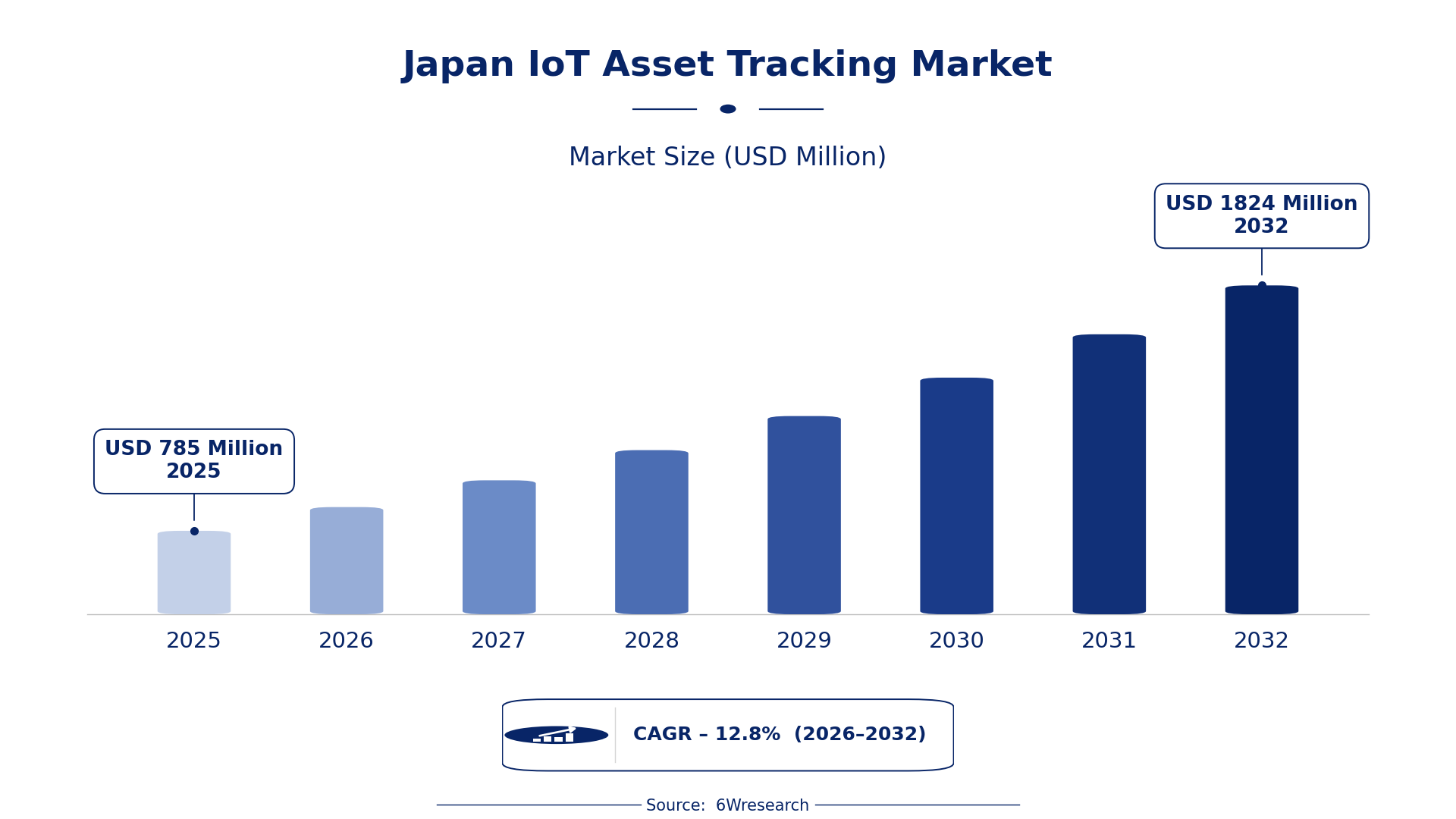
According to 6Wresearch internal database and industry insights, the Japan IoT Asset Tracking Market was valued at USD 785 Million in 2025 and is projected to reach USD 1,824 Million by 2032, growing at a CAGR of approximately 12.8% during 2026–2032.
Japan IoT Asset Tracking Market Highlights
| Report Metric | Details |
| Report Name | Japan IoT Asset Tracking Market (2026-2032) |
| Market Size 2025 | USD 785 Million |
| Market Size 2032 | USD 1,824 Million |
| Absolute Growth 2025–2032 | USD 1,039 Million |
| CAGR 2026–2032 | 12.8% |
| Peak Annual Growth | 13.7% in 2026 |
| Forecast Period | 2026–2032 |
| Historical Data | 2022–2025 |
| Base Year | 2025 |
| Leading Technology Type, 2025 | GPS-Based (43% share) |
| Leading Connectivity Type, 2025 | Cellular (LTE-M/NB-IoT) (36% share) |
| Leading Asset Type, 2025 | Vehicle Fleet (48% share) |
| Leading End User Industry, 2025 | Logistics (47% share) |
| Leading Distribution Channel, 2025 | SaaS Platforms (35% share) |
| Fastest-Growing Technology Type | RFID-Based (17.3% CAGR) |
| Fastest-Growing Connectivity Type | Wi-Fi/Bluetooth (18.0% CAGR) |
| Fastest-Growing Asset Type | Warehoused Goods (17.5% CAGR) |
| Fastest-Growing End User Industry | Retail (15.9% CAGR) |
| Fastest-Growing Distribution Channel | IoT Providers (16.0% CAGR) |
| Growing Sector | Logistics |
| Key End Users | Logistics, Retail, Agriculture, Shipping |
Japan IoT Asset Tracking Market Year-wise Growth Rate and Key Drivers (2022–2032)
This graph illustrates the annual growth rates of the market from 2022 to 2032, highlighting a steady upward trajectory and projected market expansion over the forecast period.
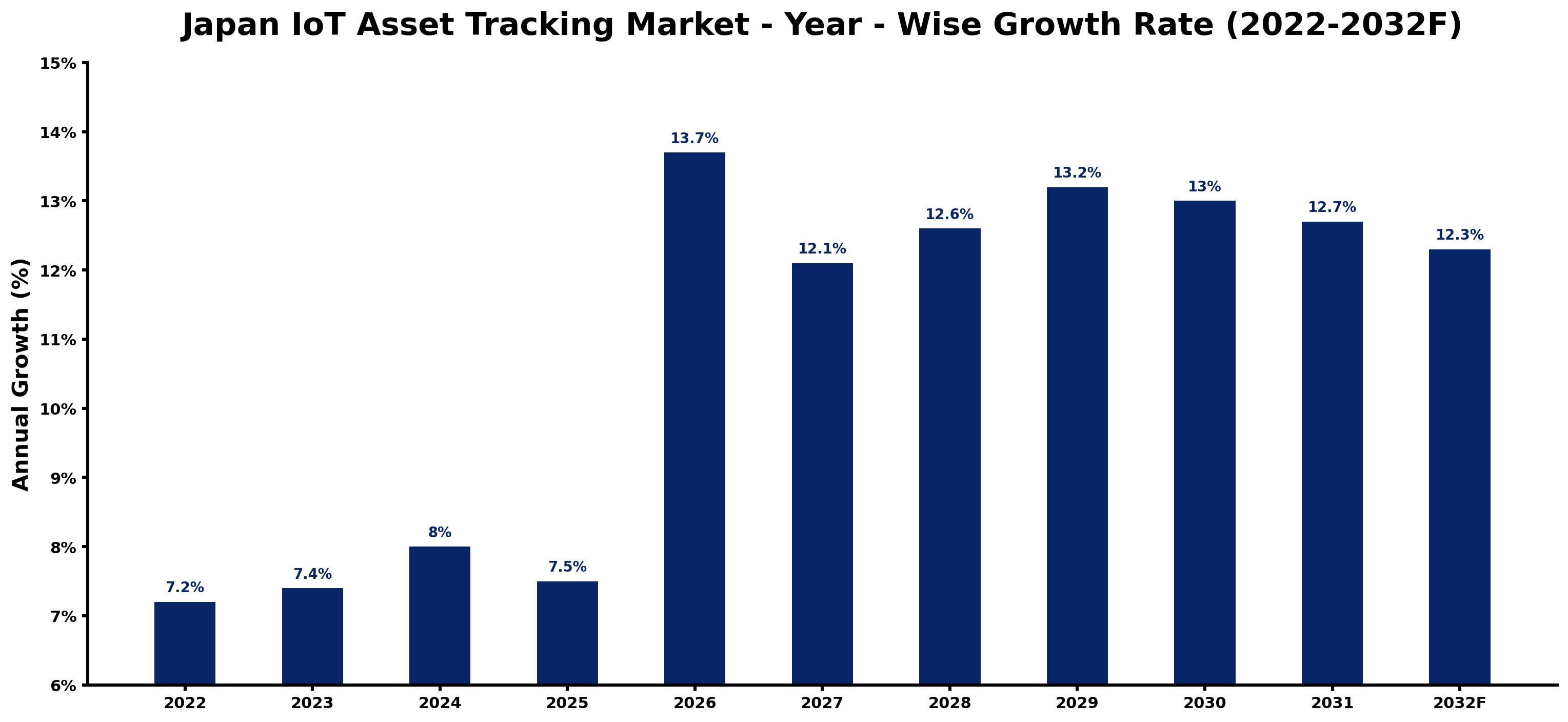
Below, each year's estimated growth is shown next to the factor that most influenced it.
| Year | Estimated Annual Growth (%) | Market Rationale |
| 2022 | 7.2 | The market experienced steady growth due to increasing adoption of IoT technologies across sectors. |
| 2023 | 7.4 | Demand for asset tracking solutions rose as logistics companies sought efficiency improvements. |
| 2024 | 8.0 | Infrastructure investments supported faster growth in the IoT asset tracking sector. |
| 2025 | 7.5 | The growth rate slowed as market saturation began to impact new investments. |
| 2026 | 13.7 | Rapid technological advancements in IoT drove growth in asset tracking solutions. |
| 2027 | 12.1 | Growth slowed slightly as the market began to stabilise after recent peaks. |
| 2028 | 12.6 | The introduction of new tracking technologies spurred renewed interest in asset management. |
| 2029 | 13.2 | Increased focus on sustainability in logistics boosted demand for tracking solutions. |
| 2030 | 13.0 | Growth moderated as the market adjusted to previous high levels of investment. |
| 2031 | 12.7 | The market continued to grow, driven by ongoing infrastructure enhancements and technology adoption. |
| 2032 | 12.3 | Demand remained strong as industries increasingly relied on IoT for operational efficiency. |
Note: Market size estimations and growth projections presented in this report are based on 6Wresearch's proprietary forecasting methodology, utilizing the latest available industry data, government publications, and primary research inputs.
Japan IoT Asset Tracking Market Synopsis
IoT Asset Tracking is a technology that integrates sensors, software, and communication methods to monitor assets in real-time. The Japan IoT Asset Tracking Market is driven by the logistics and retail sectors' demand for efficient asset management. Key factors include the increasing number of IoT devices, with 2.5 billion in 2022, and substantial investments in IoT infrastructure, such as the 1 billion yen budget for development initiatives announced in 2023.
Market Dynamics Impact Analysis (2026–2032)
| Factor | Type | Impact | Primary Segment Affected |
| Growing adoption of IoT technologies in logistics and retail sectors | Driver | High | Logistics |
| Increased investment in IoT infrastructure by the government | Driver | High | Retail |
| Rising demand for efficient inventory management solutions | Opportunity | High | Warehoused Goods |
| Expansion of IoT applications in agriculture and maritime sectors | Opportunity | Medium | Agricultural Equipment |
| Challenges in integrating new technologies with existing systems | Restraint | High | Vehicle Fleet |
| Limited awareness of IoT benefits among smaller businesses | Restraint | Medium | Logistics |
| High initial investment costs for implementing IoT solutions | Challenge | High | SaaS Platforms |
| Competition from alternative asset management technologies | Challenge | Medium | IoT Providers |
Evaluation of Drivers in Japan IoT Asset Tracking Market (2026–2032)
Demand rests on the following drivers, each shown with the segment it touches most.
| Drivers | Primary Segment Affected | Why It Matters (Evidence) |
| Increasing number of IoT devices in logistics | Logistics | In 2022, Japan had 2.5 billion IoT devices, driving demand for tracking solutions. |
| Government initiatives to improve IoT infrastructure | Retail | The 2023 budget of 1 billion yen for IoT development supports retail technology adoption. |
| Growing focus on real-time inventory management | Warehoused Goods | Over 60% of retailers are investing in IoT solutions, improving inventory efficiency. |
| Rising demand for fleet management solutions | Vehicle Fleet | The logistics industry, valued at over 10 trillion yen, relies heavily on efficient fleet tracking. |
| Adoption of standards like ISO 9001 | SaaS Platforms | Many companies in the sector adopt ISO 9001 to ensure quality in asset tracking solutions. |
Most of the extra volume comes from the logistics sector, which increasingly adopts IoT technologies to improve operational efficiency. In 2022, the average adoption rate of IoT technologies in logistics was around 70%, prompting companies to invest in advanced tracking solutions. The 1 billion yen budget for IoT development in 2023 supports this growth. Retailers are also responding to the demand for efficient inventory management, with over 60% investing in IoT solutions. The integration of standards like ISO 9001 ensures quality, driving further adoption in the sector.
Evaluation of Restraints in Japan IoT Asset Tracking Market
Several factors work against faster growth; the main ones are summarised below.
| Market Restraint | Primary Segment Affected | Why It Matters (Evidence) |
| Integration challenges with existing systems | Vehicle Fleet | Many logistics companies struggle to integrate new IoT solutions with legacy systems, delaying implementation. |
| Limited awareness of IoT benefits | Logistics | Smaller businesses often lack knowledge about the advantages of IoT, hindering market growth. |
| High initial investment costs | SaaS Platforms | The costs associated with implementing IoT solutions can deter smaller firms from adoption. |
| Competition from alternative technologies | IoT Providers | Emerging asset management technologies pose a challenge to traditional IoT solutions. |
| Data privacy concerns among users | Retail | Concerns regarding data security can impede the adoption of IoT tracking technologies. |
Japan IoT Asset Tracking Market Challenges
Buyers in the logistics sector face high costs due to outdated asset tracking systems, which can escalate expenses by 15%. Competition intensifies as firms struggle to adopt IoT technologies, risking a 20% loss in market share to more agile competitors. Supply chain disruptions arise from limited integration of IoT devices, causing delays in inventory management that can extend lead times by 30%. Skills shortages in IoT expertise hinder producers from fully utilising technology, resulting in a 25% increase in project implementation times and escalating costs for buyers.
Trends in the Japan IoT Asset Tracking Market
The shifts below are changing how Japan IoT Asset Tracking Market products are bought and supplied.
- Shift from Traditional to IoT-Based Inventory Management: Retailers are increasingly adopting IoT solutions for inventory management, with over 60% investing in such technologies. This shift reflects the need for real-time tracking to improve efficiency.
- Transition from Manual to Automated Asset Tracking: In logistics, companies are moving towards automated asset tracking systems, with the average adoption rate of IoT technologies at around 70%. This trend is particularly visible in Tokyo's logistics hubs.
- Emergence of Advanced Tracking Solutions in Agriculture: The Agricultural Ministry's support for IoT adoption is reshaping farming practices, with subsidies and training programs promoting technology use. In 2023, the average installed base of IoT tracking devices in agriculture reached substantial levels.
- Prioritisation of Sustainability in Logistics: Logistics companies are focusing on sustainable practices, with the Japan Logistics System Association promoting IoT integration to optimise operations. This aligns with the sector's value exceeding 10 trillion yen.
Investment Opportunities in the Japan IoT Asset Tracking Market
Investors looking at the Japan IoT Asset Tracking Market should consider the following areas.
- Investment in IoT Solutions for Logistics: Tokyo's logistics sector is ripe for investment, with over 10 trillion yen in value. Companies can enter through partnerships with local firms to improve tracking capabilities.
- Expansion of IoT in Retail Inventory Management: With over 60% of retailers investing in IoT solutions, there is an opportunity for technology providers. Collaborating with local retailers can facilitate market entry.
- Growth in Agricultural IoT Applications: The Agricultural Ministry's subsidies for IoT adoption create a gap for technology providers. Engaging with agricultural cooperatives can open new avenues for investment.
- Development of Maritime IoT Tracking Solutions: The Maritime Safety Agency is promoting IoT for asset tracking, presenting opportunities for companies to develop solutions. Targeting maritime hubs can enhance market presence.
Government Initiatives in the Japan IoT Asset Tracking Market
Digital Agency initiatives focus on improving IoT infrastructure, with the establishment of common system standards since September 2021. The agency's efforts aim to streamline IoT integration across sectors, benefiting producers and buyers alike.
The Ministry of Internal Affairs and Communications funds various IoT development projects, including the 1 billion yen budget announced in 2023. This funding supports initiatives that enhance the capabilities of IoT technologies in logistics and retail.
Future Insight of the Japan IoT Asset Tracking Market
By 2032, government initiatives will drive improvements in IoT infrastructure, prompting suppliers to invest in advanced tracking solutions. The launch of a budget for IoT development initiatives will support integration across various sectors, enhancing operational efficiencies. As the number of IoT devices in Japan reaches an estimated 5 billion, buyers will gain access to real-time data analytics capabilities. The promotion of IoT standardisation will streamline processes, ensuring higher reliability and performance in asset tracking.
Market Segmentation Analysis
Japan IoT Asset Tracking Market report covers a detailed analysis of the following market segments:
By Technology Type – GPS-Based Leads, RFID-Based Expected to Grow Fastest
According to Saurav Kr Singh, Senior Research Analyst at 6Wresearch, with 43% of technology type revenue in 2025, GPS-Based was the largest category. GPS-Based technology holds the largest share due to its precise location tracking capabilities, crucial for logistics operations across Japan. The average installed base of GPS devices in logistics facilities highlights its extensive use in the sector. The quickest growth will come from RFID-Based, forecast to expand at a CAGR of 17.3% between 2026 and 2032. The RFID-Based segment is experiencing rapid growth as it facilitates quick identification and tracking of goods, particularly in retail environments. The substantial investment from over 60% of retailers in IoT solutions for inventory management is a key factor driving this expansion. Suppliers should focus on developing RFID solutions to meet the increasing demand in the retail sector.
By Connectivity Type – Cellular (LTE-M/NB-IoT) Leads, Wi-Fi/Bluetooth Expected to Grow Fastest
In 2025, Cellular (LTE-M/NB-IoT) led the connectivity type split with a 36% share. Cellular (LTE-M/NB-IoT) technology leads the market as it supports real-time tracking over cellular networks, which is essential for logistics operations. The average adoption rate of IoT technologies in logistics, around 70%, reflects this preference for cellular connectivity. Over 2026–2032, Wi-Fi/Bluetooth is expected to post the fastest growth, at a CAGR of 18.0%. Wi-Fi/Bluetooth is the fastest-growing segment due to its effectiveness for short-range tracking within facilities. The rising integration of these technologies in warehouse management systems is significantly contributing to this growth. Buyers may seek to incorporate Wi-Fi/Bluetooth solutions for efficient short-range asset tracking.
By Asset Type – Vehicle Fleet Leads, Warehoused Goods Expected to Grow Fastest
Vehicle Fleet accounted for 48% of the market by asset type in 2025. The Vehicle Fleet segment leads the market as it is critical for managing and optimizing fleet operations, particularly in the logistics industry. The logistics sector, valued at over 10 trillion yen, heavily relies on effective fleet management. Warehoused Goods are set to record the highest CAGR in this split, 17.5% over 2026–2032. Warehoused Goods are the fastest-growing asset type, essential for inventory management in warehouses. The substantial increase in IoT devices, with an estimated 500,000 units in warehouses, is driving this segment's growth. Suppliers should prioritise solutions tailored for warehoused goods to capitalise on this growth opportunity.
By End User Industry – Logistics Leads, Retail Expected to Grow Fastest
The largest end user industry category in 2025 was Logistics, at 47% of revenue. Logistics is the primary end-user industry for IoT asset tracking technologies, largely due to its direct application in supply chain management. Government initiatives aimed at enhancing IoT infrastructure further support the growth of this sector. Retail is projected to grow fastest, at a CAGR of 15.9% during 2026–2032. The Retail sector is experiencing rapid growth as it utilises asset tracking for inventory and supply chain management. With over 60% of retailers investing in IoT solutions, this trend is expected to continue. Suppliers must develop tailored solutions for the retail industry to address increasing demands.
By Distribution Channel – SaaS Platforms Lead, IoT Providers Expected to Grow Fastest
SaaS Platforms took 35% of distribution channel revenue in 2025, more than any other category. SaaS Platforms dominate the distribution channel as they provide essential software solutions for asset tracking, making them highly attractive to businesses. This trend is evident in the rising adoption of cloud-based solutions across various sectors. The quickest growth will come from IoT Providers, forecast to expand at a CAGR of 16.0% between 2026 and 2032. IoT Providers are witnessing the fastest growth as they offer technologies and services specifically tailored for asset tracking needs. The government's budget allocation of 1 billion yen for IoT development initiatives is likely to further stimulate this segment. Buyers may prefer to engage with IoT providers for comprehensive asset tracking solutions.
Key Attractiveness of the Report
- 10 Years of Market Numbers
- Historical Data Starting from 2022 to 2025
- Base Year 2025
- Forecast Data until 2032
- Key Performance Indicators Impacting the Market
- Major Upcoming Developments and Projects
Key Highlights of the Report:
- Japan IoT Asset Tracking Market Outlook
- Market Size of Japan IoT Asset Tracking Market, 2025
- Forecast of Japan IoT Asset Tracking Market, 2032
- Historical Data and Forecast of Japan IoT Asset Tracking Revenues & Volume for the Period 2022-2032F
- Japan IoT Asset Tracking Market Trend Evolution
- Japan IoT Asset Tracking Market Drivers and Challenges
- Japan IoT Asset Tracking Price Trends
- Japan IoT Asset Tracking Porter's Five Forces
- Japan IoT Asset Tracking Industry Life Cycle
- Historical Data and Forecast of Japan IoT Asset Tracking Market Revenues & Volume By Technology Type for the Period 2022-2032F
- Historical Data and Forecast of Japan IoT Asset Tracking Market Revenues & Volume By GPS-Based for the Period 2022-2032F
- Historical Data and Forecast of Japan IoT Asset Tracking Market Revenues & Volume By RFID-Based for the Period 2022-2032F
- Historical Data and Forecast of Japan IoT Asset Tracking Market Revenues & Volume By LoRaWAN-Based for the Period 2022-2032F
- Historical Data and Forecast of Japan IoT Asset Tracking Market Revenues & Volume By Satellite-Linked for the Period 2022-2032F
- Historical Data and Forecast of Japan IoT Asset Tracking Market Revenues & Volume By Connectivity Type for the Period 2022-2032F
- Historical Data and Forecast of Japan IoT Asset Tracking Market Revenues & Volume By Cellular (LTE-M/NB-IoT) for the Period 2022-2032F
- Historical Data and Forecast of Japan IoT Asset Tracking Market Revenues & Volume By Wi-Fi/Bluetooth for the Period 2022-2032F
- Historical Data and Forecast of Japan IoT Asset Tracking Market Revenues & Volume By LPWAN for the Period 2022-2032F
- Historical Data and Forecast of Japan IoT Asset Tracking Market Revenues & Volume By GNSS for the Period 2022-2032F
- Historical Data and Forecast of Japan IoT Asset Tracking Market Revenues & Volume By Asset Type for the Period 2022-2032F
- Historical Data and Forecast of Japan IoT Asset Tracking Market Revenues & Volume By Vehicle Fleet for the Period 2022-2032F
- Historical Data and Forecast of Japan IoT Asset Tracking Market Revenues & Volume By Warehoused Goods for the Period 2022-2032F
- Historical Data and Forecast of Japan IoT Asset Tracking Market Revenues & Volume By Agricultural Equipment for the Period 2022-2032F
- Historical Data and Forecast of Japan IoT Asset Tracking Market Revenues & Volume By Maritime Assets for the Period 2022-2032F
- Historical Data and Forecast of Japan IoT Asset Tracking Market Revenues & Volume By End User Industry for the Period 2022-2032F
- Historical Data and Forecast of Japan IoT Asset Tracking Market Revenues & Volume By Logistics for the Period 2022-2032F
- Historical Data and Forecast of Japan IoT Asset Tracking Market Revenues & Volume By Retail for the Period 2022-2032F
- Historical Data and Forecast of Japan IoT Asset Tracking Market Revenues & Volume By Agriculture for the Period 2022-2032F
- Historical Data and Forecast of Japan IoT Asset Tracking Market Revenues & Volume By Shipping for the Period 2022-2032F
- Historical Data and Forecast of Japan IoT Asset Tracking Market Revenues & Volume By Distribution Channel for the Period 2022-2032F
- Historical Data and Forecast of Japan IoT Asset Tracking Market Revenues & Volume By SaaS Platforms for the Period 2022-2032F
- Historical Data and Forecast of Japan IoT Asset Tracking Market Revenues & Volume By IoT Providers for the Period 2022-2032F
- Historical Data and Forecast of Japan IoT Asset Tracking Market Revenues & Volume By Network Operators for the Period 2022-2032F
- Historical Data and Forecast of Japan IoT Asset Tracking Market Revenues & Volume By System Integrators for the Period 2022-2032F
- Japan IoT Asset Tracking Import Export Trade Statistics
- Market Opportunity Assessment By Technology Type
- Market Opportunity Assessment By Connectivity Type
- Market Opportunity Assessment By Asset Type
- Market Opportunity Assessment By End User Industry
- Market Opportunity Assessment By Distribution Channel
- Japan IoT Asset Tracking Top Companies Market Share
- Japan IoT Asset Tracking Competitive Benchmarking By Technical and Operational Parameters
- Japan IoT Asset Tracking Company Profiles
- Japan IoT Asset Tracking Key Strategic Recommendations
Market Covered
The following segment groups are covered in the report.
By Technology Type
- GPS-Based
- RFID-Based
- LoRaWAN-Based
- Satellite-Linked
By Connectivity Type
- Cellular (LTE-M/NB-IoT)
- Wi-Fi/Bluetooth
- LPWAN
- GNSS
By Asset Type
- Vehicle Fleet
- Warehoused Goods
- Agricultural Equipment
- Maritime Assets
By End User Industry
- Logistics
- Retail
- Agriculture
- Shipping
By Distribution Channel
- SaaS Platforms
- IoT Providers
- Network Operators
- System Integrators































