Japan IoT-Based Transit Monitoring Market Size & Growth Rate
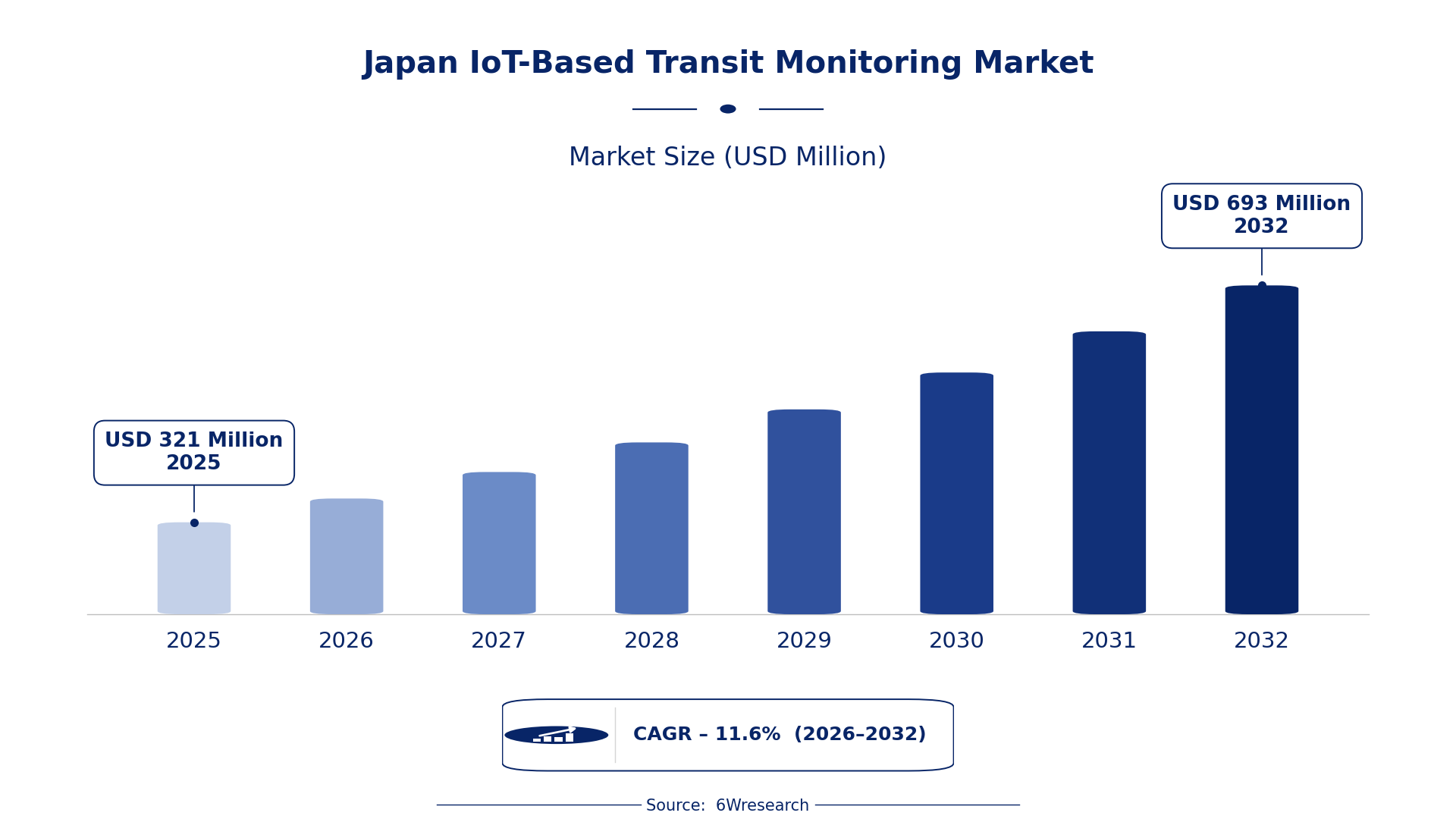
According to 6Wresearch internal database and industry insights, the Japan IoT-Based Transit Monitoring Market was valued at USD 321 Million in 2025 and is projected to reach USD 693 Million by 2032, growing at a CAGR of approximately 11.6% during 2026–2032.
Japan IoT-Based Transit Monitoring Market Highlights
| Report Metric | Details |
| Report Name | Japan IoT-Based Transit Monitoring Market (2026-2032) |
| Market Size 2025 | USD 321 Million |
| Market Size 2032 | USD 693 Million |
| Absolute Growth 2025–2032 | USD 372 Million |
| CAGR 2026–2032 | 11.6% |
| Peak Annual Growth | 14.1% in 2032 |
| Forecast Period | 2026–2032 |
| Historical Data | 2022–2025 |
| Base Year | 2025 |
| Leading Monitoring Type, 2025 | GPS + Video Analytics (46% share) |
| Leading Connectivity Method, 2025 | LTE/5G (44% share) |
| Leading Vehicle Type, 2025 | Public Buses (43% share) |
| Leading Data Usage, 2025 | Real-Time Navigation (42% share) |
| Leading End User, 2025 | Transit Authorities (49% share) |
| Fastest-Growing Monitoring Type | RFID-Based Monitoring (17.2% CAGR) |
| Fastest-Growing Connectivity Method | Wi-Fi (16.9% CAGR) |
| Fastest-Growing Vehicle Type | Trains (16.4% CAGR) |
| Fastest-Growing Data Usage | Entry/Exit Logs (16.5% CAGR) |
| Fastest-Growing End User | Metro Operators (15.1% CAGR) |
| Growing Sector | public transit |
| Key End Users | transit authorities, metro operators, school districts, fleet managers |
Japan IoT-Based Transit Monitoring Market Year-wise Growth Rate and Key Drivers (2022–2032)
This graph illustrates the annual growth rates of the market from 2022 to 2032, highlighting a steady upward trajectory and projected market expansion over the forecast period.
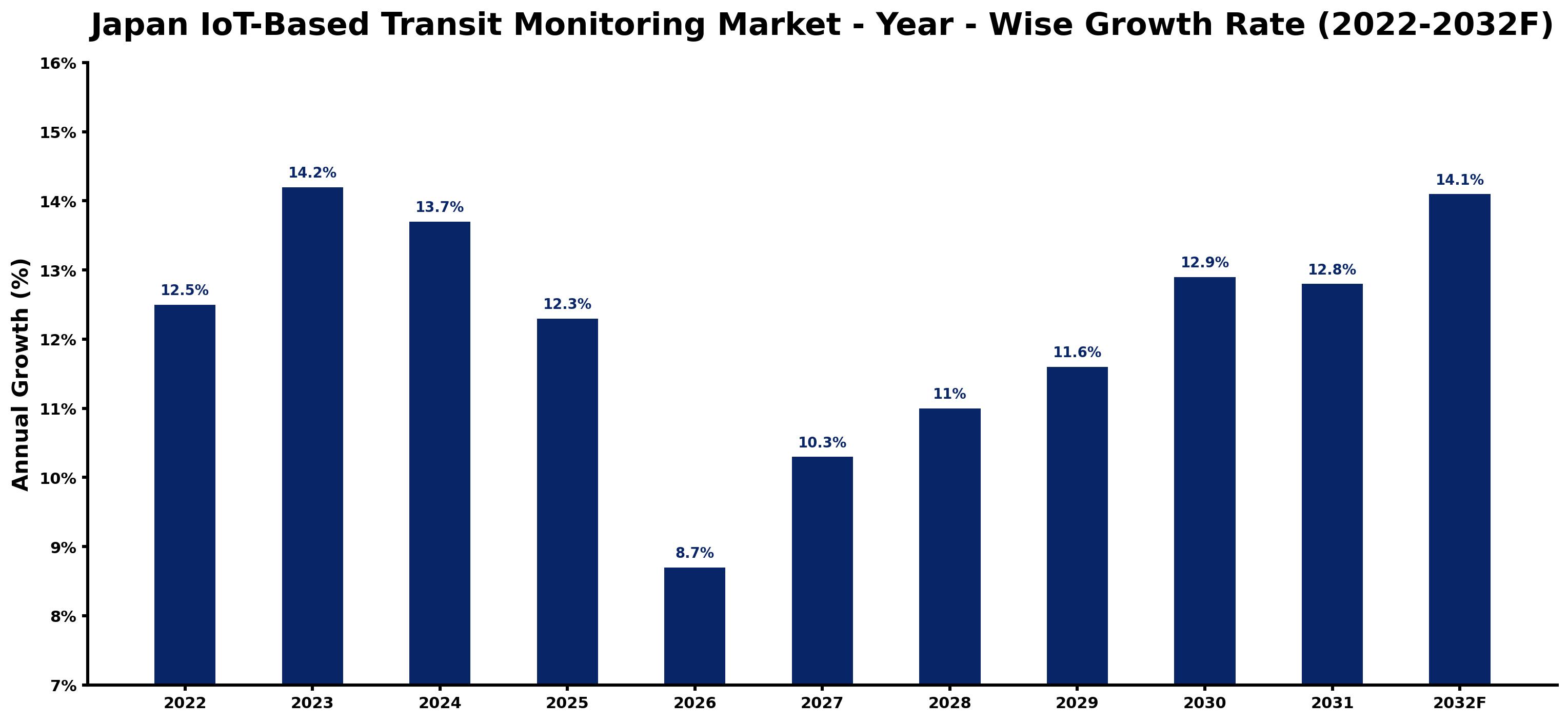
The table below sets out the estimated growth rate for each year and the main factor behind it.
| Year | Estimated Annual Growth (%) | Market Rationale |
| 2022 | 12.5 | The market experienced solid growth due to increased adoption of IoT technologies. |
| 2023 | 14.2 | Demand surged as Tokyo Metro expanded its IoT transit monitoring systems. |
| 2024 | 13.7 | Growth slowed as the market adjusted to previous rapid expansions. |
| 2025 | 12.3 | Continued investment in smart transit technologies maintained positive growth. |
| 2026 | 8.7 | Growth is expected to slow as the market stabilises after high peaks in previous years. |
| 2027 | 10.3 | Demand is projected to increase as new projects in urban areas begin implementation. |
| 2028 | 11.0 | Growth is expected to accelerate with rising public transit usage and technology adoption. |
| 2029 | 11.6 | Demand will rise as more transit authorities implement real-time monitoring. |
| 2030 | 12.9 | Growth is projected to continue as advancements in IoT technologies improve services. |
| 2031 | 12.8 | Growth will slow slightly as the market matures and competition intensifies. |
| 2032 | 14.1 | Demand is expected to rise sharply as new smart city initiatives launch. |
Note: Market size estimations and growth projections presented in this report are based on 6Wresearch's proprietary forecasting methodology, utilizing the latest available industry data, government publications, and primary research inputs.
Japan IoT-Based Transit Monitoring Market Synopsis
IoT-Based Transit Monitoring utilises interconnected devices to improve public transit efficiency and safety. This includes real-time vehicle tracking and passenger safety monitoring. The Japan IoT-Based Transit Monitoring Market is expanding due to investments from transit authorities and the adoption of advanced technologies. With over 1,200 public bus operators in Japan and ongoing smart city initiatives, the market is projected to grow, reaching USD 693 million by 2032.
Market Dynamics Impact Analysis (2026–2032)
| Factor | Type | Impact | Primary Segment Affected |
| Increased investment in smart transit technologies | Driver | High | GPS + Video Analytics |
| Growing urban population leading to higher public transport usage | Driver | High | Public Buses |
| Rising demand for real-time data analytics in transit systems | Opportunity | High | Telematics Tracking |
| Expansion of smart city initiatives focusing on transit efficiency | Opportunity | High | Transit Authorities |
| High implementation costs for IoT systems | Restraint | Medium | RFID-Based Monitoring |
| Challenges in integrating legacy systems with new technologies | Restraint | Medium | Sensor-Driven Alerts |
| Limited availability of skilled workforce for IoT implementation | Challenge | High | Telematics Tracking |
| Regulatory compliance requirements can delay project timelines | Challenge | Medium | GPS + Video Analytics |
Evaluation of Drivers in Japan IoT-Based Transit Monitoring Market (2026–2032)
The main growth drivers and the segments they affect most are set out below.
| Drivers | Primary Segment Affected | Why It Matters (Evidence) |
| Investment in smart transit technologies | GPS + Video Analytics | In 2021, the Tokyo Metropolitan Government invested in smart transit technologies, improving monitoring capabilities. |
| Urban population growth | Public Buses | With over 126 million people in Japan, public transport accounts for over 40% of daily commutes, driving demand for monitoring. |
| Demand for real-time tracking | Telematics Tracking | The implementation of real-time tracking systems by the Tokyo Metropolitan Bureau of Transportation has increased operational efficiency, improving service delivery. |
| Government support for IoT innovations | RFID-Based Monitoring | The National Institute of Advanced Industrial Science and Technology promotes IoT innovations, boosting market growth through funding and resources. |
| Safety concerns in public transit | Sensor-Driven Alerts | The Ministry of Land, Infrastructure, Transport and Tourism oversees safety standards, increasing demand for monitoring solutions to ensure compliance. |
The urban population drives public transport usage, accounting for over 40% of daily commutes, which increases demand for monitoring systems. Real-time tracking systems implemented by the Tokyo Metropolitan Bureau of Transportation have improved operational efficiency, leading to better service delivery.
Evaluation of Restraints in Japan IoT-Based Transit Monitoring Market
Below are the constraints most often cited by buyers and suppliers, with the segment each affects.
| Market Restraint | Primary Segment Affected | Why It Matters (Evidence) |
| High costs of IoT system implementation | RFID-Based Monitoring | The initial investment for IoT systems can be prohibitive for smaller transit operators, limiting adoption. |
| Integration issues with existing systems | Sensor-Driven Alerts | Many transit authorities face challenges integrating new IoT technologies with legacy systems, causing delays. |
| Limited skilled workforce availability | Telematics Tracking | The shortage of professionals skilled in IoT technologies can hinder project execution and efficiency, affecting service delivery. |
| Regulatory compliance complexities | GPS + Video Analytics | Navigating regulatory requirements can slow down the deployment of monitoring systems, delaying benefits for operators. |
| Market competition leading to price pressures | Public Buses | Intense competition among providers can lead to reduced profit margins for transit monitoring solutions. |
Japan IoT-Based Transit Monitoring Market Challenges
In Japan, public bus operators face high operational costs, with expenses increasing by up to 20% annually due to advanced IoT monitoring requirements. Many existing monitoring technologies lack compatibility with newer solutions, delaying upgrades and causing inefficiencies for transit authorities. A shortage of skilled professionals in IoT technology limits the ability of transit companies to fully utilise these systems, potentially reducing operational efficiency by 15%. Compliance with safety regulations from the Ministry of Land, Infrastructure, Transport and Tourism complicates operations, extending project timelines by several months for providers.
Trends in the Japan IoT-Based Transit Monitoring Market
Several trends are reshaping the Japan IoT-Based Transit Monitoring Market; the most important are set out below.
- Transition to Smart Transit Systems: Japan is moving from traditional monitoring methods to smart transit systems, with over 1,200 public bus operators adopting IoT solutions. This shift is evidenced by the Tokyo Metropolitan Bureau of Transportation implementing real-time tracking since 2020.
- Real-Time Navigation Gains Traction: Real-Time Navigation has gained prominence, capturing a 42% market share in 2025. This trend is driven by the need for efficient route optimization, particularly in urban areas with high commuter volumes.
- Focus on Advanced Safety Monitoring: The emphasis on safety monitoring has intensified, particularly in school districts, where IoT systems are increasingly used. In 2022, 7,000 school buses were monitored via IoT systems across Japan.
- Adoption of Low-Power Monitoring Solutions: Zigbee technology is increasingly adopted for low-power monitoring applications in transit systems, supporting energy-efficient operations. This trend aligns with the broader push for sustainability in urban transit.
Investment Opportunities in the Japan IoT-Based Transit Monitoring Market
Below are the investment opportunities with the strongest case in the Japan IoT-Based Transit Monitoring Market.
- Smart City Initiative Investment: With the Japanese government launching a smart city initiative in 2023, there is an opportunity for investment in IoT solutions. Transit authorities can utilise this initiative to improve monitoring systems, which can enhance operational efficiency.
- Collaborative Technology Integration: Partnering with local technology firms can facilitate the integration of IoT solutions in transit systems. This approach is particularly relevant for public bus operators looking to improve operational efficiency and service delivery.
- Growth in Real-Time Monitoring Services: The demand for real-time monitoring services is growing, particularly among transit authorities. Investing in advanced monitoring technologies can effectively meet this rising demand and improve operational outcomes.
- Need for Advanced Safety Solutions: There is a growing need for advanced safety monitoring solutions in school districts. This presents an opportunity for suppliers to develop tailored IoT systems that improve student safety and streamline operations.
Government Initiatives in the Japan IoT-Based Transit Monitoring Market
The Semiconductor and Digital Industry Strategy, implemented by METI in June 2021, aims to secure domestic semiconductor manufacturing, which is vital for IoT devices in transit monitoring. This measure encourages local production and reduces reliance on imports, benefiting transit monitoring providers by ensuring a stable supply of components. The strategy is projected to increase domestic semiconductor capacity by 30% by 2025.
Transit authorities utilise the Economic Security Promotion Act, enacted in 2022, to strengthen supply-chain resilience for critical IoT products. This law supports the procurement of essential technologies, enabling transit operators to implement advanced monitoring systems effectively, with funding allocated to improve infrastructure.
Future Insight of the Japan IoT-Based Transit Monitoring Market
The upcoming smart city initiative will drive the integration of IoT-based transit monitoring in Japan, enhancing efficiency and safety in public transport. By 2032, investments in smart transit technologies will improve real-time tracking systems for over 7,000 school buses currently monitored. The adoption of advanced monitoring technologies will improve safety measures across the extensive railway network. As more public bus operators implement these systems, both operators and passengers will experience considerable benefits.
Market Segmentation Analysis
Japan IoT-Based Transit Monitoring Market report covers a detailed analysis of the following market segments:
By Monitoring Type – GPS + Video Analytics Leads, RFID-Based Monitoring Expected to Grow Fastest
According to Saurav Kr Singh, Senior Research Analyst at 6Wresearch, GPS + Video Analytics took 46% of monitoring type revenue in 2025, more than any other category. GPS and video analytics are vital for providing real-time visual data that enhances the efficiency of transit monitoring. Tokyo Metro's utilisation of these technologies across its lines exemplifies their importance in optimising operations. The quickest growth will come from RFID-Based Monitoring, forecast to expand at a CAGR of 17.2% between 2026 and 2032. The rapid adoption of RFID-based monitoring is fuelled by its effectiveness in tracking vehicle entries and exits, particularly in urban environments. With over 1,200 public bus operators in Japan, the demand for RFID solutions continues to grow. Suppliers should prioritise the development of RFID solutions to meet the increasing demands of transit operators.
By Connectivity Method – LTE/5G Leads, Wi-Fi Expected to Grow Fastest
LTE/5G held 44% of the Japan IoT-Based Transit Monitoring Market by connectivity method in 2025. LTE and 5G technologies are crucial for enabling high-speed data transmission, which is essential for real-time monitoring in transit systems. Their importance is particularly pronounced in urban settings where rapid data processing is necessary for operational safety. Over 2026–2032, Wi-Fi is expected to post the fastest growth, at a CAGR of 16.9%. Wi-Fi is witnessing rapid growth due to its role in facilitating local connectivity within transit hubs, enhancing operational efficiency in busy areas. The ongoing smart city initiatives are further accelerating the implementation of Wi-Fi networks. Buyers should consider integrating Wi-Fi solutions to enhance connectivity and operational efficiency in transit hubs.
By Vehicle Type – Public Buses Lead, Trains Expected to Grow Fastest
The largest vehicle type category in 2025 was Public Buses, at 43% of revenue. Public buses are integral to urban transit systems, necessitating effective monitoring to ensure safety and operational efficiency. The fact that public transport accounts for over 40% of daily commutes in urban Japan underscores the high demand for monitoring solutions. Trains are set to record the highest CAGR in this split, 16.4% over 2026–2032. Trains are experiencing the fastest growth due to their critical role in maintaining safety and efficiency within rail transport. Japan's extensive railway network, spanning over 27,000 kilometres, heavily relies on sophisticated monitoring systems. Suppliers should concentrate on developing tailored solutions specifically for train monitoring to capitalise on this growing market.
By Data Usage – Real-Time Navigation Leads, Entry/Exit Logs Expected to Grow Fastest
In 2025, Real-Time Navigation led the data usage split with a 42% share. Real-time navigation is vital for optimising transit routes and schedules, making it a key area of focus for transit authorities. This is particularly important given the high volume of daily commuters who depend on efficient public transport. Entry/Exit Logs are projected to grow fastest, at a CAGR of 16.5% during 2026–2032. Entry and exit logs are becoming increasingly important for managing passenger flow and safety, especially in busy transit systems. The heightened emphasis on safety standards by authorities is driving this growth. Buyers should invest in systems that improve data collection for entry and exit management.
By End User – Transit Authorities Lead, Metro Operators Expected to Grow Fastest
With 49% of end user revenue in 2025, Transit Authorities was the largest category. Transit authorities are the primary users of monitoring systems, focusing on enhancing public safety and operational efficiency. Their significant role in managing transit operations drives the demand for advanced monitoring technologies. The quickest growth will come from Metro Operators, forecast to expand at a CAGR of 15.1% between 2026 and 2032. Metro operators are witnessing the fastest growth in demand for monitoring technologies, as they require sophisticated systems to ensure efficient operations in densely populated urban areas. Continued investments in smart transit technologies are bolstering this trend. Suppliers should customise their offerings to meet the specific needs of metro operators.
Key Attractiveness of the Report
- 10 Years of Market Numbers
- Historical Data Starting from 2022 to 2025
- Base Year 2025
- Forecast Data until 2032
- Key Performance Indicators Impacting the Market
- Major Upcoming Developments and Projects
Key Highlights of the Report:
- Japan IoT-Based Transit Monitoring Market Outlook
- Market Size of Japan IoT-Based Transit Monitoring Market, 2025
- Forecast of Japan IoT-Based Transit Monitoring Market, 2032
- Historical Data and Forecast of Japan IoT-Based Transit Monitoring Revenues & Volume for the Period 2022-2032F
- Japan IoT-Based Transit Monitoring Market Trend Evolution
- Japan IoT-Based Transit Monitoring Market Drivers and Challenges
- Japan IoT-Based Transit Monitoring Price Trends
- Japan IoT-Based Transit Monitoring Porter's Five Forces
- Japan IoT-Based Transit Monitoring Industry Life Cycle
- Historical Data and Forecast of Japan IoT-Based Transit Monitoring Market Revenues & Volume By Monitoring Type for the Period 2022-2032F
- Historical Data and Forecast of Japan IoT-Based Transit Monitoring Market Revenues & Volume By GPS + Video Analytics for the Period 2022-2032F
- Historical Data and Forecast of Japan IoT-Based Transit Monitoring Market Revenues & Volume By RFID-Based Monitoring for the Period 2022-2032F
- Historical Data and Forecast of Japan IoT-Based Transit Monitoring Market Revenues & Volume By Telematics Tracking for the Period 2022-2032F
- Historical Data and Forecast of Japan IoT-Based Transit Monitoring Market Revenues & Volume By Sensor-Driven Alerts for the Period 2022-2032F
- Historical Data and Forecast of Japan IoT-Based Transit Monitoring Market Revenues & Volume By Connectivity Method for the Period 2022-2032F
- Historical Data and Forecast of Japan IoT-Based Transit Monitoring Market Revenues & Volume By LTE/5G for the Period 2022-2032F
- Historical Data and Forecast of Japan IoT-Based Transit Monitoring Market Revenues & Volume By Wi-Fi for the Period 2022-2032F
- Historical Data and Forecast of Japan IoT-Based Transit Monitoring Market Revenues & Volume By Cellular for the Period 2022-2032F
- Historical Data and Forecast of Japan IoT-Based Transit Monitoring Market Revenues & Volume By Zigbee for the Period 2022-2032F
- Historical Data and Forecast of Japan IoT-Based Transit Monitoring Market Revenues & Volume By Vehicle Type for the Period 2022-2032F
- Historical Data and Forecast of Japan IoT-Based Transit Monitoring Market Revenues & Volume By Public Buses for the Period 2022-2032F
- Historical Data and Forecast of Japan IoT-Based Transit Monitoring Market Revenues & Volume By Trains for the Period 2022-2032F
- Historical Data and Forecast of Japan IoT-Based Transit Monitoring Market Revenues & Volume By School Buses for the Period 2022-2032F
- Historical Data and Forecast of Japan IoT-Based Transit Monitoring Market Revenues & Volume By Private Fleet Vehicles for the Period 2022-2032F
- Historical Data and Forecast of Japan IoT-Based Transit Monitoring Market Revenues & Volume By Data Usage for the Period 2022-2032F
- Historical Data and Forecast of Japan IoT-Based Transit Monitoring Market Revenues & Volume By Real-Time Navigation for the Period 2022-2032F
- Historical Data and Forecast of Japan IoT-Based Transit Monitoring Market Revenues & Volume By Entry/Exit Logs for the Period 2022-2032F
- Historical Data and Forecast of Japan IoT-Based Transit Monitoring Market Revenues & Volume By Speed/Route Tracking for the Period 2022-2032F
- Historical Data and Forecast of Japan IoT-Based Transit Monitoring Market Revenues & Volume By Engine/Condition Status for the Period 2022-2032F
- Historical Data and Forecast of Japan IoT-Based Transit Monitoring Market Revenues & Volume By End User for the Period 2022-2032F
- Historical Data and Forecast of Japan IoT-Based Transit Monitoring Market Revenues & Volume By Transit Authorities for the Period 2022-2032F
- Historical Data and Forecast of Japan IoT-Based Transit Monitoring Market Revenues & Volume By Metro Operators for the Period 2022-2032F
- Historical Data and Forecast of Japan IoT-Based Transit Monitoring Market Revenues & Volume By School Districts for the Period 2022-2032F
- Historical Data and Forecast of Japan IoT-Based Transit Monitoring Market Revenues & Volume By Fleet Managers for the Period 2022-2032F
- Japan IoT-Based Transit Monitoring Import Export Trade Statistics
- Market Opportunity Assessment By Monitoring Type
- Market Opportunity Assessment By Connectivity Method
- Market Opportunity Assessment By Vehicle Type
- Market Opportunity Assessment By Data Usage
- Market Opportunity Assessment By End User
- Japan IoT-Based Transit Monitoring Top Companies Market Share
- Japan IoT-Based Transit Monitoring Competitive Benchmarking By Technical and Operational Parameters
- Japan IoT-Based Transit Monitoring Company Profiles
- Japan IoT-Based Transit Monitoring Key Strategic Recommendations
Market Covered
This report examines the market across the segments below.
By Monitoring Type
- GPS + Video Analytics
- RFID-Based Monitoring
- Telematics Tracking
- Sensor-Driven Alerts
By Connectivity Method
- LTE/5G
- Wi-Fi
- Cellular
- Zigbee
By Vehicle Type
- Public Buses
- Trains
- School Buses
- Private Fleet Vehicles
By Data Usage
- Real-Time Navigation
- Entry/Exit Logs
- Speed/Route Tracking
- Engine/Condition Status
By End User
- Transit Authorities
- Metro Operators
- School Districts
- Fleet Managers































