Japan IoT-Based Trash Collection Market Size & Growth Rate

According to 6Wresearch internal database and industry insights, the Japan IoT-Based Trash Collection Market was valued at USD 133 Million in 2025 and is projected to reach USD 311 Million by 2032, growing at a CAGR of approximately 12.9% during 2026–2032.
Japan IoT-Based Trash Collection Market Highlights
| Report Metric | Details |
| Report Name | Japan IoT-Based Trash Collection Market (2026-2032) |
| Market Size 2025 | USD 133 Million |
| Market Size 2032 | USD 311 Million |
| Absolute Growth 2025–2032 | USD 178 Million |
| CAGR 2026–2032 | 12.9% |
| Peak Annual Growth | 14.5% in 2032 |
| Forecast Period | 2026–2032 |
| Historical Data | 2022–2025 |
| Base Year | 2025 |
| Leading System Type, 2025 | Smart Bin System (49% share) |
| Leading Sensor Type, 2025 | Ultrasonic Fill Sensors (50% share) |
| Leading Connectivity Type, 2025 | LPWAN (37% share) |
| Leading Application Area, 2025 | Urban Collection (49% share) |
| Leading End User, 2025 | Municipal Services (48% share) |
| Fastest-Growing System Type | Route Optimization (18.3% CAGR) |
| Fastest-Growing Sensor Type | GPS + Load Sensors (19.2% CAGR) |
| Fastest-Growing Application Area | Smart Waste Vehicles (15.9% CAGR) |
| Fastest-Growing End User | Waste Collection Firms (16.6% CAGR) |
| Growing Sector | Municipal Services |
| Key End Users | Municipal Services, Waste Collection Firms, City Councils |
Japan IoT-Based Trash Collection Market Year-wise Growth Rate and Key Drivers (2022–2032)
This graph illustrates the annual growth rates of the market from 2022 to 2032, highlighting a steady upward trajectory and projected market expansion over the forecast period.
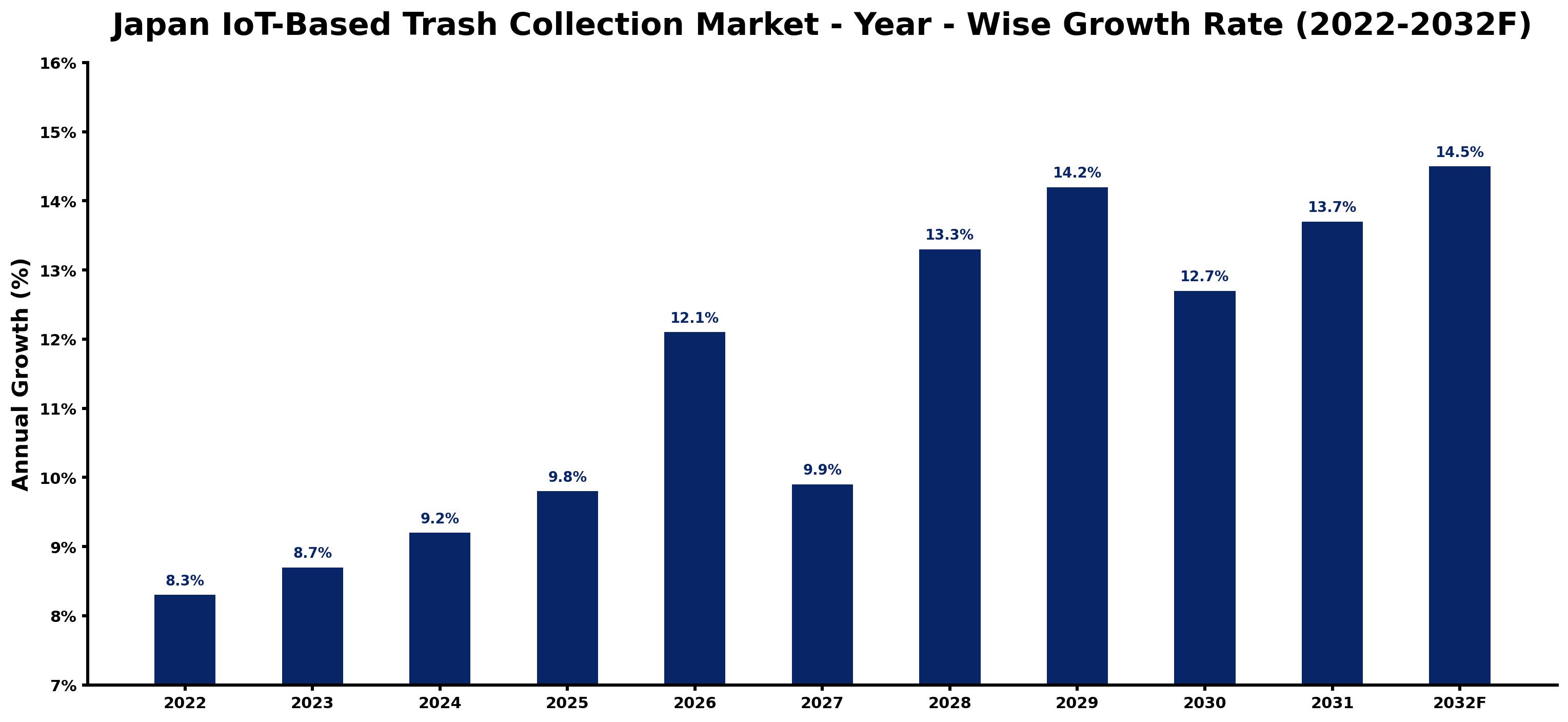
The following figures match every annual growth estimate with the main market development of that year, giving the reasoning behind each rise or slowdown.
| Year | Estimated Annual Growth (%) | Market Rationale |
| 2022 | 8.3 | The market was characterised by steady growth as municipalities began adopting IoT solutions. |
| 2023 | 8.7 | Demand increased due to heightened awareness of waste management efficiency among city councils. |
| 2024 | 9.2 | The introduction of new smart bin systems further accelerated market growth in urban areas. |
| 2025 | 9.8 | Tokyo's initiatives to improve waste collection efficiency spurred further investments in IoT technologies. |
| 2026 | 12.1 | The market will gain momentum as local governments push for IoT adoption by 2025. |
| 2027 | 9.9 | Growth will slow slightly as the market matures and competition intensifies among providers. |
| 2028 | 13.3 | Innovations in smart waste vehicles will drive renewed interest and investment in IoT solutions. |
| 2029 | 14.2 | The anticipated launch of new urban projects will stimulate demand for advanced waste management systems. |
| 2030 | 12.7 | Growth will decelerate as the market stabilises, reflecting a more competitive environment. |
| 2031 | 13.7 | Increased urbanisation will lead to higher demand for efficient waste management solutions. |
| 2032 | 14.5 | The market is projected to peak as smart waste initiatives become standard in urban planning. |
Note: Market size estimations and growth projections presented in this report are based on 6Wresearch's proprietary forecasting methodology, utilizing the latest available industry data, government publications, and primary research inputs.
Japan IoT-Based Trash Collection Market Synopsis
IoT-Based Trash Collection utilises sensors and connectivity to optimise waste management processes. By integrating various sensor types into waste bins and vehicles, it enables real-time monitoring of fill levels and optimises collection routes. The Japan IoT-Based Trash Collection Market is expanding due to a growing urban population of approximately 92 million, driving demand for efficient waste solutions. Initiatives such as the Economic Security Promotion Act support the adoption of smart waste management technologies, propelling this market forward. The implementation of over 500 smart bin systems across major cities further illustrates the commitment to improving waste management efficiency.
Market Dynamics Impact Analysis (2026–2032)
| Factor | Type | Impact | Primary Segment Affected |
| Increasing urban population driving demand for efficient waste management solutions | Driver | High | Urban Collection |
| Growing investment in smart waste management technologies by local governments | Driver | High | Smart Bin System |
| Expansion of smart bin systems across major cities presents new market opportunities | Opportunity | High | Smart Bin System |
| Need for improved waste collection efficiency in densely populated areas | Opportunity | High | Route Optimization |
| High initial investment costs for IoT infrastructure may deter some municipalities | Restraint | Medium | Municipal Services |
| Limited awareness of IoT benefits among smaller waste management firms | Restraint | Medium | Waste Collection Firms |
| Competition among providers may lead to price wars affecting profitability | Challenge | High | Smart Bin System |
| Technological integration challenges may delay IoT implementation | Challenge | Medium | Urban Collection |
Evaluation of Drivers in Japan IoT-Based Trash Collection Market (2026–2032)
These are the developments adding the most demand over the forecast period.
| Drivers | Primary Segment Affected | Why It Matters (Evidence) |
| Urbanisation leading to increased waste generation | Urban Collection | Japan's urban population of approximately 92 million necessitates efficient waste solutions. |
| Government initiatives promoting smart waste management | Smart Bin System | In 2023, the Tokyo Metropolitan Government allocated ¥1 billion for smart waste projects. |
| Technological advancements in IoT sensor capabilities | GPS + Load Sensors | These sensors enhance monitoring and data collection for waste management efficiency. |
| Rising environmental awareness among citizens | Route Optimization | Municipalities are investing in IoT to meet sustainability goals and reduce carbon footprints. |
| Integration of IoT in urban planning initiatives | Smart Waste Vehicles | The Economic Security Promotion Act supports the integration of IoT in urban services. |
Much of the new demand traces back to Japan's growing urban population, which is approximately 92 million. This demographic shift necessitates efficient waste management solutions, prompting municipalities to invest in smart bin systems. Advancements in GPS and load sensors facilitate real-time monitoring, allowing waste collection firms to optimise routes. Growing environmental awareness among citizens drives local governments to adopt IoT technologies to meet sustainability targets, leading to increased investments in smart waste solutions.
Evaluation of Restraints in Japan IoT-Based Trash Collection Market
These restraints slow adoption and weigh on supplier margins.
| Market Restraint | Primary Segment Affected | Why It Matters (Evidence) |
| High initial investment costs for IoT infrastructure | Municipal Services | Many municipalities face budget constraints, limiting their ability to invest in new technologies. |
| Limited awareness of IoT benefits among smaller waste management firms | Waste Collection Firms | Smaller firms may hesitate to adopt new technologies due to perceived complexity and costs. |
| Regulatory compliance challenges for IoT systems | Smart Bin System | Compliance with the JIS Q 15001:2017 standard can be resource-intensive for producers. |
| Data privacy concerns related to IoT devices | Urban Collection | Municipalities must address citizen concerns about data collection and usage. |
| Technological integration challenges may delay IoT implementation | Route Optimization | Existing systems may require significant upgrades to accommodate new IoT technologies. |
Japan IoT-Based Trash Collection Market Challenges
In 2023, municipal services incur higher costs due to a shortage of IoT components, which delays project implementations and raises expenses by up to 15%. A lack of skilled technicians restricts the deployment of these systems, causing inefficiencies that could cost waste management firms 20% in operational productivity. Buyers contend with outdated collection methods, leading to inefficiencies that can waste up to ¥500 million annually in Tokyo alone. Competition from traditional practices hinders the adoption of IoT solutions, resulting in missed opportunities for innovation and cost savings for local governments.
Trends in the Japan IoT-Based Trash Collection Market
The trends below show where the Japan IoT-Based Trash Collection Market is heading.
- Shift to Smart Waste Management in Urban Areas: Cities like Tokyo are increasingly adopting smart waste management technologies, with over 500 smart bin systems implemented. This trend improves operational efficiency and reduces costs for municipal services.
- Increasing Adoption of GPS and Load Sensors: In 2023, the integration of GPS and load sensors in waste vehicles improved route optimisation by 30%. This shift is important for waste collection firms aiming to enhance service delivery.
- Municipal Services Prioritising Sustainability: City councils are now prioritising sustainable waste management practices, driven by public demand for greener solutions. The Economic Security Promotion Act supports this transition with targeted investments.
- Expansion of Smart Bin Systems Across Japan: Osaka has adopted IoT solutions in 200 public waste bins, reflecting a broader trend towards smart waste management. This expansion is important for improving urban waste collection efficiency.
Investment Opportunities in the Japan IoT-Based Trash Collection Market
The opportunities below stand out in the Japan IoT-Based Trash Collection Market for new entrants and existing suppliers.
- Growing Demand for Smart Bin Systems: With over 500 smart bin systems already implemented, the demand for further expansion is clear. Municipal services are looking for reliable partners to improve their waste management capabilities.
- Investment in Route Optimisation Technologies: As cities strive for efficiency, the market for route optimisation technologies is expanding. Waste collection firms are seeking solutions to reduce operational costs and improve service delivery.
- Need for IoT Integration in Urban Planning: The Economic Security Promotion Act highlights the need for IoT integration in urban services. Local governments are actively seeking partnerships to implement these technologies effectively.
- Expansion of Smart Waste Vehicles: The recent pilot project for smart waste vehicles in Yokohama demonstrates a growing market opportunity. Suppliers can engage with municipalities to provide advanced waste collection solutions.
Government Initiatives in the Japan IoT-Based Trash Collection Market
In 2023, the Ministry of the Environment implemented the Smart City Strategy 2022, which encourages local governments to adopt IoT technologies for waste management by 2025. This strategy builds on the Waste Management and Public Cleansing Law, ensuring that municipalities enhance their waste collection practices through smart solutions. By promoting the integration of IoT in urban services, the government aims to improve operational efficiency and reduce costs for municipal services.
In 2023, ¥1 billion was allocated by the Tokyo Metropolitan Government for smart waste projects, overseen by the Ministry of the Environment. This funding supports the development of smart waste vehicles and infrastructure, enabling better waste management practices. Local governments are expected to leverage this investment to enhance their waste collection systems, ultimately benefiting urban populations through improved services.
Future Insight of the Japan IoT-Based Trash Collection Market
Municipal services will increasingly adopt IoT technologies, driven by local government initiatives pushing for smart solutions by 2025. By 2032, over 500 smart bin systems are expected to be operational across Japan, enhancing efficiency for buyers. The integration of advanced data analytics will optimise waste management processes, enabling suppliers to provide more tailored solutions. Government support for smart waste initiatives will create a more sustainable environment for Japan's urban population.
Market Segmentation Analysis
Japan IoT-Based Trash Collection Market report covers a detailed analysis of the following market segments:
By System Type – Smart Bin System Leads, Route Optimization Expected to Grow Fastest
According to Saurav Kr Singh, Senior Research Analyst at 6Wresearch, Smart Bin System held 49% of the Japan IoT-Based Trash Collection Market by system type in 2025. The Smart Bin System commands the largest share due to its extensive implementation in urban settings, with over 500 systems operational in major cities. This technology allows municipalities to monitor bin fill levels in real-time, which is essential for improving waste management efficiency. Route Optimization is set to record the highest CAGR in this split, 18.3% over 2026–2032. Route Optimization is rapidly growing as cities seek to enhance collection efficiency, exemplified by a 30% improvement in Tokyo's waste collection processes. As smart bin systems become more prevalent, the demand for optimised collection routes will continue to rise, solidifying the leader's position. Suppliers should focus on developing advanced route optimisation solutions to meet the increasing demand from municipal services.
By Sensor Type – Ultrasonic Fill Sensors Lead, GPS + Load Sensors Expected to Grow Fastest
Ultrasonic Fill Sensors took 50% of sensor type revenue in 2025, more than any other category. Ultrasonic Fill Sensors lead the market because they provide accurate measurements of fill levels in waste bins, which are vital for effective waste management. Their reliability has led to widespread adoption among municipal services throughout Japan. Over 2026–2032, GPS + Load Sensors are expected to post the fastest growth, at a CAGR of 19.2%. GPS + Load Sensors are experiencing rapid growth as they enable real-time tracking of vehicle locations and load weights, which is crucial for optimising waste collection processes. The expansion of urban areas will further drive the need for precise monitoring, accelerating this segment's growth. Buyers will benefit from investing in advanced sensor technologies to enhance operational efficiency in waste management.
By Connectivity Type – LPWAN Leads and Records the Fastest Growth
With 37% of connectivity type revenue in 2025, LPWAN was the largest category. LPWAN is the leading connectivity type due to its ability to facilitate long-range communication for IoT devices, which is critical for effective waste management solutions. This technology supports the integration of numerous sensors across urban environments. The same category is also set to grow fastest, at a CAGR of 14.5% during 2026–2032. LPWAN is also the fastest-growing connectivity type as its advantages become increasingly recognised, allowing for more efficient data transmission in waste management applications. The simultaneous growth of this segment reinforces its market dominance. Suppliers should prioritise LPWAN solutions to capitalise on the growing demand for efficient connectivity in waste management.
By Application Area – Urban Collection Leads, Smart Waste Vehicles Expected to Grow Fastest
The largest application area category in 2025 was Urban Collection, at 49% of revenue. Urban Collection is the leading application area as it directly addresses the waste management challenges prevalent in densely populated urban regions. With Japan's urban population around 92 million, the focus on efficient waste solutions is paramount. Smart Waste Vehicles are projected to grow fastest, at a CAGR of 15.9% during 2026–2032. Smart Waste Vehicles are gaining traction as cities adopt IoT technologies to improve collection efficiency, highlighted by a pilot project launched in Yokohama. This trend indicates a movement towards more technologically advanced waste management practices. Suppliers must adapt their offerings to include smart waste vehicle technologies to align with the evolving demands of urban waste management.
By End User – Municipal Services Lead, Waste Collection Firms Expected to Grow Fastest
In 2025, Municipal Services led the end user split with a 48% share. Municipal Services represent the largest end user group, being the primary adopters of IoT-based waste management solutions across Japan. Their pivotal role in implementing smart waste technologies significantly drives market growth. Waste Collection Firms are set to record the highest CAGR in this split, 16.6% over 2026–2032. Waste Collection Firms are the fastest-growing end user segment as they increasingly integrate IoT solutions to enhance operational efficiency, reflecting a broader trend towards smart waste management. This growth will further shape the overall market dynamics. Suppliers should tailor their products to meet the specific needs of waste collection firms to capitalise on this expanding market segment.
Key Attractiveness of the Report
- 10 Years of Market Numbers
- Historical Data Starting from 2022 to 2025
- Base Year 2025
- Forecast Data until 2032
- Key Performance Indicators Impacting the Market
- Major Upcoming Developments and Projects
Key Highlights of the Report:
- Japan IoT-Based Trash Collection Market Outlook
- Market Size of Japan IoT-Based Trash Collection Market, 2025
- Forecast of Japan IoT-Based Trash Collection Market, 2032
- Historical Data and Forecast of Japan IoT-Based Trash Collection Revenues & Volume for the Period 2022-2032F
- Japan IoT-Based Trash Collection Market Trend Evolution
- Japan IoT-Based Trash Collection Market Drivers and Challenges
- Japan IoT-Based Trash Collection Price Trends
- Japan IoT-Based Trash Collection Porter's Five Forces
- Japan IoT-Based Trash Collection Industry Life Cycle
- Historical Data and Forecast of Japan IoT-Based Trash Collection Market Revenues & Volume By System Type for the Period 2022-2032F
- Historical Data and Forecast of Japan IoT-Based Trash Collection Market Revenues & Volume By Smart Bin System for the Period 2022-2032F
- Historical Data and Forecast of Japan IoT-Based Trash Collection Market Revenues & Volume By Route Optimization for the Period 2022-2032F
- Historical Data and Forecast of Japan IoT-Based Trash Collection Market Revenues & Volume By Overflow Alert System for the Period 2022-2032F
- Historical Data and Forecast of Japan IoT-Based Trash Collection Market Revenues & Volume By Compactor Monitoring for the Period 2022-2032F
- Historical Data and Forecast of Japan IoT-Based Trash Collection Market Revenues & Volume By Sensor Type for the Period 2022-2032F
- Historical Data and Forecast of Japan IoT-Based Trash Collection Market Revenues & Volume By Ultrasonic Fill Sensors for the Period 2022-2032F
- Historical Data and Forecast of Japan IoT-Based Trash Collection Market Revenues & Volume By GPS + Load Sensors for the Period 2022-2032F
- Historical Data and Forecast of Japan IoT-Based Trash Collection Market Revenues & Volume By Infrared Sensors for the Period 2022-2032F
- Historical Data and Forecast of Japan IoT-Based Trash Collection Market Revenues & Volume By Pressure Sensors for the Period 2022-2032F
- Historical Data and Forecast of Japan IoT-Based Trash Collection Market Revenues & Volume By Connectivity Type for the Period 2022-2032F
- Historical Data and Forecast of Japan IoT-Based Trash Collection Market Revenues & Volume By LPWAN for the Period 2022-2032F
- Historical Data and Forecast of Japan IoT-Based Trash Collection Market Revenues & Volume By Cellular for the Period 2022-2032F
- Historical Data and Forecast of Japan IoT-Based Trash Collection Market Revenues & Volume By LoRaWAN for the Period 2022-2032F
- Historical Data and Forecast of Japan IoT-Based Trash Collection Market Revenues & Volume By Zigbee for the Period 2022-2032F
- Historical Data and Forecast of Japan IoT-Based Trash Collection Market Revenues & Volume By Application Area for the Period 2022-2032F
- Historical Data and Forecast of Japan IoT-Based Trash Collection Market Revenues & Volume By Urban Collection for the Period 2022-2032F
- Historical Data and Forecast of Japan IoT-Based Trash Collection Market Revenues & Volume By Smart Waste Vehicles for the Period 2022-2032F
- Historical Data and Forecast of Japan IoT-Based Trash Collection Market Revenues & Volume By Public Bins for the Period 2022-2032F
- Historical Data and Forecast of Japan IoT-Based Trash Collection Market Revenues & Volume By Industrial Facilities for the Period 2022-2032F
- Historical Data and Forecast of Japan IoT-Based Trash Collection Market Revenues & Volume By End User for the Period 2022-2032F
- Historical Data and Forecast of Japan IoT-Based Trash Collection Market Revenues & Volume By Municipal Services for the Period 2022-2032F
- Historical Data and Forecast of Japan IoT-Based Trash Collection Market Revenues & Volume By Waste Collection Firms for the Period 2022-2032F
- Historical Data and Forecast of Japan IoT-Based Trash Collection Market Revenues & Volume By City Councils for the Period 2022-2032F
- Historical Data and Forecast of Japan IoT-Based Trash Collection Market Revenues & Volume By Waste Disposal Units for the Period 2022-2032F
- Japan IoT-Based Trash Collection Import Export Trade Statistics
- Market Opportunity Assessment By System Type
- Market Opportunity Assessment By Sensor Type
- Market Opportunity Assessment By Connectivity Type
- Market Opportunity Assessment By Application Area
- Market Opportunity Assessment By End User
- Japan IoT-Based Trash Collection Top Companies Market Share
- Japan IoT-Based Trash Collection Competitive Benchmarking By Technical and Operational Parameters
- Japan IoT-Based Trash Collection Company Profiles
- Japan IoT-Based Trash Collection Key Strategic Recommendations
Market Covered
The following segment groups are covered in the report.
By System Type
- Smart Bin System
- Route Optimization
- Overflow Alert System
- Compactor Monitoring
By Sensor Type
- Ultrasonic Fill Sensors
- GPS + Load Sensors
- Infrared Sensors
- Pressure Sensors
By Connectivity Type
- LPWAN
- Cellular
- LoRaWAN
- Zigbee
By Application Area
- Urban Collection
- Smart Waste Vehicles
- Public Bins
- Industrial Facilities
By End User
- Municipal Services
- Waste Collection Firms
- City Councils
- Waste Disposal Units































