Japan IoT Communication Market Size & Growth Rate
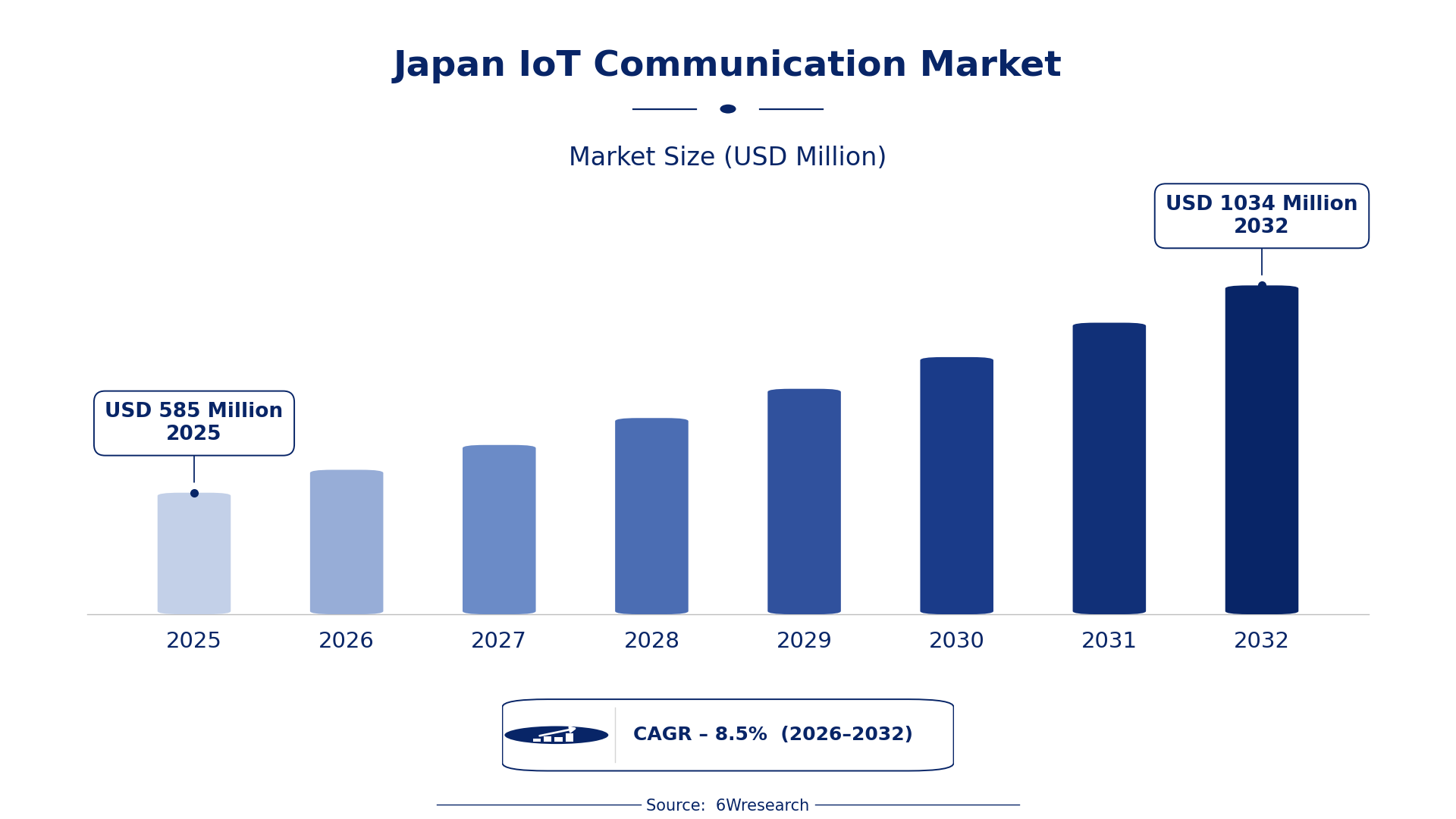
According to 6Wresearch internal database and industry insights, the Japan IoT Communication Market was valued at USD 585 Million in 2025 and is projected to reach USD 1,034 Million by 2032, growing at a CAGR of approximately 8.5% during 2026–2032.
Japan IoT Communication Market Highlights
| Report Metric | Details |
| Report Name | Japan IoT Communication Market (2026-2032) |
| Market Size 2025 | USD 585 Million |
| Market Size 2032 | USD 1,034 Million |
| Absolute Growth 2025–2032 | USD 449 Million |
| CAGR 2026–2032 | 8.5% |
| Peak Annual Growth | 9.7% in 2028 |
| Forecast Period | 2026–2032 |
| Historical Data | 2022–2025 |
| Base Year | 2025 |
| Leading Communication Protocol, 2025 | MQTT (41% share) |
| Leading Network Type, 2025 | 5G (36% share) |
| Leading Application Scope, 2025 | Home Automation (48% share) |
| Leading Bandwidth Requirement, 2025 | High (44% share) |
| Leading End User, 2025 | Smart Home Companies (44% share) |
| Fastest-Growing Communication Protocol | LWM2M (10.7% CAGR) |
| Fastest-Growing Network Type | LPWAN (LoRa/Sigfox) (12.5% CAGR) |
| Fastest-Growing Application Scope | Agriculture (11.6% CAGR) |
| Fastest-Growing Bandwidth Requirement | Ultra Low (11.0% CAGR) |
| Fastest-Growing End User | AgriTech Providers (10.8% CAGR) |
| Growing Sector | smart home applications |
| Key End Users | Smart Home Companies, AgriTech Providers, Utility Companies |
Japan IoT Communication Market Year-wise Growth Rate and Key Drivers (2022–2032)
This graph illustrates the annual growth rates of the market from 2022 to 2032, highlighting a steady upward trajectory and projected market expansion over the forecast period.
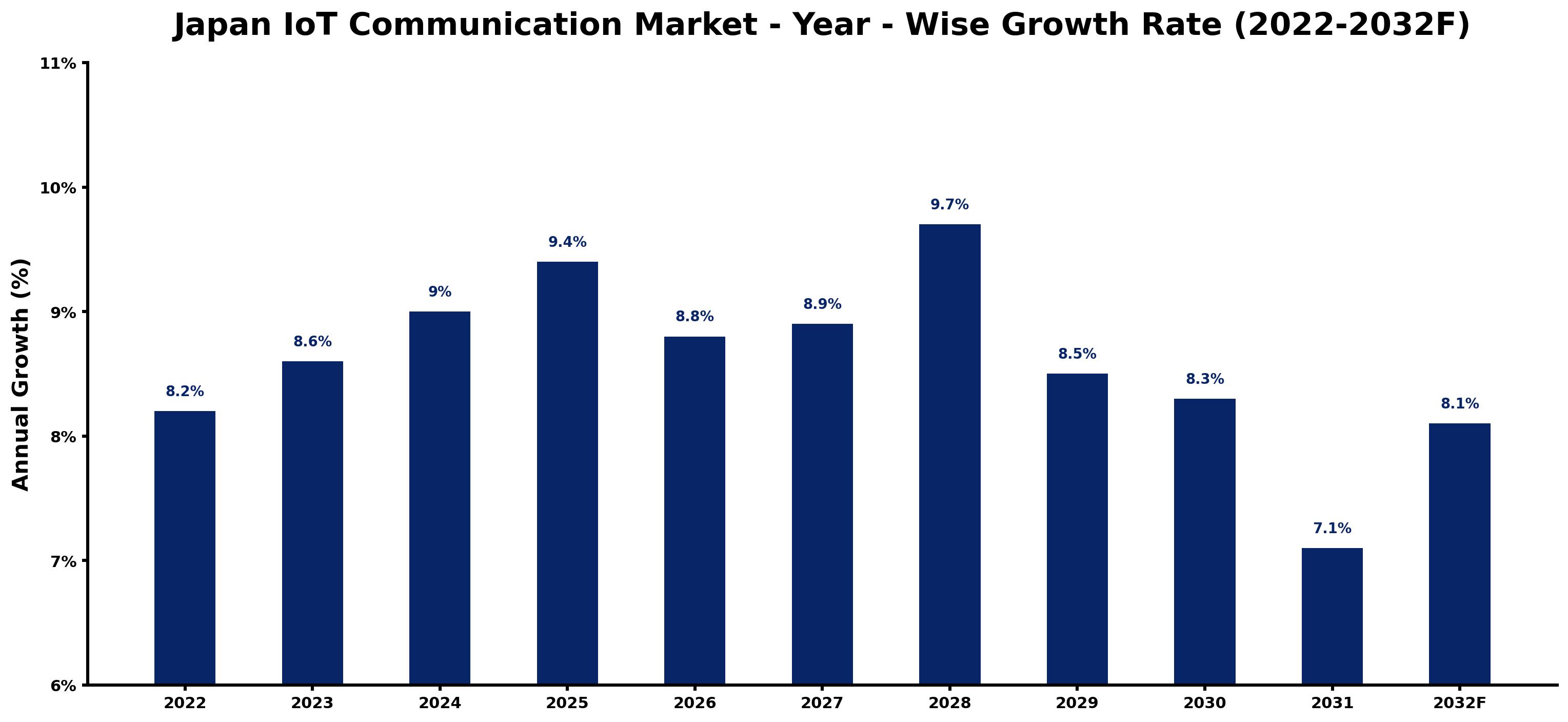
The yearly estimates that follow link every growth rate to its principal driver, so readers can see why the pace changed in each period.
| Year | Estimated Annual Growth (%) | Market Rationale |
| 2022 | 8.2 | The market experienced steady growth, reflecting increasing adoption of IoT technologies. |
| 2023 | 8.6 | Growth accelerated due to rising investments in smart home applications across the country. |
| 2024 | 9.0 | Demand surged as more agricultural sectors integrated IoT for crop monitoring. |
| 2025 | 9.4 | The market peaked with advancements in 5G technology and smart utilities. |
| 2026 | 8.8 | Growth is expected to slow slightly as the market begins to stabilise after rapid expansion. |
| 2027 | 8.9 | A renewed interest in IoT solutions for urban development is expected to boost demand. |
| 2028 | 9.7 | The forecast peak year will see heightened investment in healthcare IoT applications. |
| 2029 | 8.5 | Growth is projected to decelerate as the market adjusts to saturation in some segments. |
| 2030 | 8.3 | Continued investment in smart city projects will contribute to a slower growth rate. |
| 2031 | 7.1 | The market growth rate will decrease as competition intensifies among providers. |
| 2032 | 8.1 | A resurgence in demand for smart home technologies is expected to lead to renewed growth. |
Note: Market size estimations and growth projections presented in this report are based on 6Wresearch's proprietary forecasting methodology, utilizing the latest available industry data, government publications, and primary research inputs.
Japan IoT Communication Market Synopsis
IoT Communication encompasses technologies that enable devices to connect and communicate over the internet, utilising various protocols and network types. Main applications include smart home systems, agricultural monitoring, and utility management. The Japan IoT Communication Market is growing due to rising domestic demand and investments in 5G infrastructure. The smart home market is projected to reach 1.5 million units by 2025, while the agricultural sector increasingly adopts IoT solutions for precision farming, driving further expansion.
Market Dynamics Impact Analysis (2026–2032)
| Factor | Type | Impact | Primary Segment Affected |
| Growing investment in 5G infrastructure | Driver | High | 5G |
| Rising demand for smart home applications | Driver | High | MQTT |
| Expansion of smart city projects | Opportunity | High | MQTT |
| Increased adoption of IoT in agriculture | Opportunity | High | Agriculture |
| High competition among IoT service providers | Restraint | Medium | High |
| Concerns regarding IoT security and privacy | Restraint | High | MQTT |
| Limited interoperability between devices | Challenge | Medium | MQTT |
| Slow adoption of IoT in certain sectors | Challenge | Medium | Low |
Evaluation of Drivers in Japan IoT Communication Market (2026–2032)
Key forces behind demand, with the segment each one moves most, are listed below.
| Drivers | Primary Segment Affected | Why It Matters (Evidence) |
| Investments in 5G technology | 5G | 5G networks are being rolled out across major cities, improving connectivity for IoT devices. |
| Consumer interest in smart home devices | MQTT | The smart home market is expected to reach 1.5 million units by 2025, driving demand. |
| Adoption of IoT in agriculture | MQTT | The agricultural sector is increasingly using IoT for crop monitoring and management, enhancing efficiency. |
| Expansion of LPWAN connections | MQTT | The number of LPWAN connections in Japan is projected to exceed 10 million by 2025, facilitating more IoT applications. |
| Support for IoT initiatives | MQTT | The IoT Acceleration Consortium promotes growth through various programs and funding opportunities. |
Spending rises because investments in 5G technology improve connectivity for IoT devices, with projections indicating that the agricultural sector increasingly adopts IoT solutions for crop monitoring, reflecting a broader trend in precision farming. The smart home market is expected to reach 1.5 million units by 2025, demonstrating strong consumer interest.
Evaluation of Restraints in Japan IoT Communication Market
Several factors work against faster growth; the main ones are summarised below.
| Market Restraint | Primary Segment Affected | Why It Matters (Evidence) |
| High competition among IoT service providers | High | The market is saturated with numerous providers, making differentiation challenging. |
| Concerns regarding IoT security and privacy | MQTT | Growing awareness of cybersecurity risks affects consumer trust and adoption rates. |
| Limited interoperability between devices | MQTT | Incompatibility among devices hinders integration and user experience, impacting overall adoption. |
| Slow adoption of IoT in certain sectors | Low | Some industries remain hesitant to invest in IoT due to perceived complexity and high costs. |
| High costs associated with IoT implementation | High | Initial investment requirements deter smaller companies from adopting IoT solutions. |
Japan IoT Communication Market Challenges
By 2025, Japan's smart home market is projected to reach 1.5 million units, yet buyers face high costs due to limited device compatibility, which can delay installations by up to six months. Regulatory challenges arise from the IoT Security Framework, increasing compliance costs for producers by approximately 20%, leading to higher prices for buyers. Supply chain disruptions occur as manufacturers struggle to source components, potentially delaying deliveries by three months for buyers awaiting new devices. Intense competition among local producers drives prices down, squeezing margins and making it difficult for smaller entrants to sustain operations.
Trends in the Japan IoT Communication Market
The trends below show where the Japan IoT Communication Market is heading.
- Shift Towards Smart Home Automation: The smart home market is evolving, with an expected 1.5 million units by 2025. This shift is driven by consumer demand for convenience and energy efficiency, resulting in increased investments in home automation technologies.
- Increase in Agricultural IoT Applications: The agricultural sector is utilising IoT for precision farming, with a projected growth rate of 11.6% through 2032. This trend reflects the need for improved crop monitoring and resource management.
- Expansion of LPWAN Technologies: LPWAN technologies are gaining traction, with connections expected to exceed 10 million by 2025. This growth supports long-range, low-power IoT applications, particularly in agriculture and smart utilities.
- Government Support for Smart City Initiatives: The Tokyo Metropolitan Government is promoting IoT initiatives for urban development, with funding allocated for smart city projects. This support is set to drive innovation and integration of IoT solutions.
Investment Opportunities in the Japan IoT Communication Market
Several openings in the Japan IoT Communication Market merit attention from investors.
- Partnerships for Smart City Projects: Now is the time to invest in smart city initiatives, with government funding available for projects. Collaborating with local authorities in Tokyo can provide access to opportunities in urban development.
- Investing in Agricultural IoT Solutions: The agricultural sector is ripe for innovation, with increasing demand for IoT applications. Engaging with AgriTech providers in rural areas can facilitate entry into this growing market.
- Development of IoT Security Solutions: As concerns about IoT security rise, there is a pressing need for solutions. Companies can enter this market by partnering with cybersecurity firms to address vulnerabilities.
- Supply of 5G-Enabled Devices: With the rollout of 5G networks, there is a growing demand for compatible devices. Suppliers should focus on developing products that utilise high-speed connectivity for IoT applications.
Government Initiatives in the Japan IoT Communication Market
The New Robot Strategy, established in 2015, aims to expand robot use in various sectors, including agriculture and manufacturing. This strategy has led to increased funding for IoT-related projects, improving the integration of technology in these industries. The AI Promotion Act, enacted in 2025, creates a national framework for AI research and development, further enhancing IoT Communication capabilities and fostering innovation in the sector.
The Ministry of Internal Affairs and Communications oversees the implementation of IoT initiatives, providing funding for smart city projects. The government has allocated resources to foster innovation and support the growth of IoT technologies, benefiting buyers and producers in the market.
Future Insight of the Japan IoT Communication Market
By 2032, buyers in urban development will increasingly adopt IoT solutions, enhancing operational efficiency. The number of LPWAN connections will exceed 10 million, facilitating seamless device connectivity. Investment in healthcare applications will grow, supported by government initiatives and advancements in technology. The Ministry of Internal Affairs and Communications will promote IoT initiatives, creating a more conducive environment for suppliers and buyers alike.
Market Segmentation Analysis
Japan IoT Communication Market report covers a detailed analysis of the following market segments:
By Communication Protocol – MQTT Leads, LWM2M Expected to Grow Fastest
According to Saurav Kr Singh, Senior Research Analyst at 6Wresearch, with 41% of communication protocol revenue in 2025, MQTT was the largest category. MQTT holds the largest share as it is widely used for lightweight messaging in various IoT applications, particularly in smart home systems. Its efficiency and reliability make it a preferred choice among developers in urban areas like Tokyo. LWM2M is projected to grow fastest, at a CAGR of 10.7% during 2026–2032. LWM2M is seeing rapid growth due to its ability to meet the increasing demand for device management and service enablement in IoT ecosystems. The rise in connected devices, especially in smart home technology, drives this adoption. Suppliers should focus on developing solutions that leverage MQTT while also considering the growing importance of LWM2M for device management.
By Network Type – 5G Leads, LPWAN (LoRa/Sigfox) Expected to Grow Fastest
In 2025, 5G led the network type split with a 36% share. 5G dominates the market as it enables high-speed communication essential for advanced IoT applications, particularly in urban settings. The ongoing rollout of 5G networks across major cities in Japan supports innovations across various sectors. Over 2026–2032, LPWAN (LoRa/Sigfox) is expected to post the fastest growth, at a CAGR of 12.5%. LPWAN (LoRa/Sigfox) is experiencing the fastest growth due to its suitability for long-range, low-power IoT applications, especially in agricultural monitoring. The projected increase in LPWAN connections to over 10 million by 2025 highlights this demand. Buyers should invest in LPWAN technologies to capitalise on the growing need for efficient long-range IoT solutions.
By Application Scope – Home Automation Leads, Agriculture Expected to Grow Fastest
The largest application scope category in 2025 was Home Automation, at 48% of revenue. Home Automation leads the market as it is a rapidly growing segment driven by increasing consumer interest in smart home devices and systems. The expected rise to 1.5 million units by 2025 indicates strong market potential in this area. Agriculture is set to record the highest CAGR in this split, 11.6% over 2026–2032. Agriculture is the fastest-growing application scope, propelled by the increasing adoption of IoT for precision farming and monitoring. The agricultural sector's focus on efficiency and productivity through IoT solutions is driving this growth. Suppliers must tailor their offerings to meet the specific needs of the agricultural sector while continuing to support home automation.
By Bandwidth Requirement – High Leads, Ultra Low Expected to Grow Fastest
High took 44% of bandwidth requirement revenue in 2025, more than any other category. High bandwidth is necessary for applications that require substantial data transfer, such as video surveillance in smart homes. This segment's prominence reflects the increasing complexity of IoT applications that demand robust data handling capabilities. The quickest growth will come from Ultra Low, forecast to expand at a CAGR of 11.0% between 2026 and 2032. Ultra Low bandwidth is rapidly gaining traction as it is crucial for battery-powered devices that require minimal energy consumption. The growing prevalence of such devices in the IoT ecosystem fuels this segment's expansion. Suppliers should consider the balance between high and ultra-low bandwidth solutions to cater to diverse IoT applications.
By End User – Smart Home Companies Lead, AgriTech Providers Expected to Grow Fastest
Smart Home Companies accounted for 44% of the market by end user in 2025. Smart Home Companies represent the largest end user group, being pivotal in the IoT ecosystem that drives the adoption of smart technologies. Their emphasis on user-friendly devices significantly contributes to market growth. AgriTech Providers are projected to grow fastest, at a CAGR of 10.8% during 2026–2032. AgriTech Providers are the fastest-growing end user group, focusing on IoT solutions tailored for farming applications. The increasing need for precision agriculture propels the demand for innovative IoT technologies in this sector. Buyers should engage with AgriTech Providers to explore new IoT solutions that enhance agricultural productivity.
Key Attractiveness of the Report
- 10 Years of Market Numbers
- Historical Data Starting from 2022 to 2025
- Base Year 2025
- Forecast Data until 2032
- Key Performance Indicators Impacting the Market
- Major Upcoming Developments and Projects
Key Highlights of the Report:
- Japan IoT Communication Market Outlook
- Market Size of Japan IoT Communication Market, 2025
- Forecast of Japan IoT Communication Market, 2032
- Historical Data and Forecast of Japan IoT Communication Revenues & Volume for the Period 2022-2032F
- Japan IoT Communication Market Trend Evolution
- Japan IoT Communication Market Drivers and Challenges
- Japan IoT Communication Price Trends
- Japan IoT Communication Porter's Five Forces
- Japan IoT Communication Industry Life Cycle
- Historical Data and Forecast of Japan IoT Communication Market Revenues & Volume By Communication Protocol for the Period 2022-2032F
- Historical Data and Forecast of Japan IoT Communication Market Revenues & Volume By MQTT for the Period 2022-2032F
- Historical Data and Forecast of Japan IoT Communication Market Revenues & Volume By CoAP for the Period 2022-2032F
- Historical Data and Forecast of Japan IoT Communication Market Revenues & Volume By DDS for the Period 2022-2032F
- Historical Data and Forecast of Japan IoT Communication Market Revenues & Volume By LWM2M for the Period 2022-2032F
- Historical Data and Forecast of Japan IoT Communication Market Revenues & Volume By Network Type for the Period 2022-2032F
- Historical Data and Forecast of Japan IoT Communication Market Revenues & Volume By Wi-Fi/Cellular for the Period 2022-2032F
- Historical Data and Forecast of Japan IoT Communication Market Revenues & Volume By LPWAN (LoRa/Sigfox) for the Period 2022-2032F
- Historical Data and Forecast of Japan IoT Communication Market Revenues & Volume By 5G for the Period 2022-2032F
- Historical Data and Forecast of Japan IoT Communication Market Revenues & Volume By NB-IoT for the Period 2022-2032F
- Historical Data and Forecast of Japan IoT Communication Market Revenues & Volume By Application Scope for the Period 2022-2032F
- Historical Data and Forecast of Japan IoT Communication Market Revenues & Volume By Home Automation for the Period 2022-2032F
- Historical Data and Forecast of Japan IoT Communication Market Revenues & Volume By Agriculture for the Period 2022-2032F
- Historical Data and Forecast of Japan IoT Communication Market Revenues & Volume By Autonomous Vehicles for the Period 2022-2032F
- Historical Data and Forecast of Japan IoT Communication Market Revenues & Volume By Smart Utilities for the Period 2022-2032F
- Historical Data and Forecast of Japan IoT Communication Market Revenues & Volume By Bandwidth Requirement for the Period 2022-2032F
- Historical Data and Forecast of Japan IoT Communication Market Revenues & Volume By Low for the Period 2022-2032F
- Historical Data and Forecast of Japan IoT Communication Market Revenues & Volume By Ultra Low for the Period 2022-2032F
- Historical Data and Forecast of Japan IoT Communication Market Revenues & Volume By High for the Period 2022-2032F
- Historical Data and Forecast of Japan IoT Communication Market Revenues & Volume By Low for the Period 2022-2032F
- Historical Data and Forecast of Japan IoT Communication Market Revenues & Volume By End User for the Period 2022-2032F
- Historical Data and Forecast of Japan IoT Communication Market Revenues & Volume By Smart Home Companies for the Period 2022-2032F
- Historical Data and Forecast of Japan IoT Communication Market Revenues & Volume By AgriTech Providers for the Period 2022-2032F
- Historical Data and Forecast of Japan IoT Communication Market Revenues & Volume By Automotive OEMs for the Period 2022-2032F
- Historical Data and Forecast of Japan IoT Communication Market Revenues & Volume By Utility Companies for the Period 2022-2032F
- Japan IoT Communication Import Export Trade Statistics
- Market Opportunity Assessment By Communication Protocol
- Market Opportunity Assessment By Network Type
- Market Opportunity Assessment By Application Scope
- Market Opportunity Assessment By Bandwidth Requirement
- Market Opportunity Assessment By End User
- Japan IoT Communication Top Companies Market Share
- Japan IoT Communication Competitive Benchmarking By Technical and Operational Parameters
- Japan IoT Communication Company Profiles
- Japan IoT Communication Key Strategic Recommendations
Market Covered
The following segment groups are covered in the report.
By Communication Protocol
- MQTT
- CoAP
- DDS
- LWM2M
By Network Type
- Wi-Fi/Cellular
- LPWAN (LoRa/Sigfox)
- 5G
- NB-IoT
By Application Scope
- Home Automation
- Agriculture
- Autonomous Vehicles
- Smart Utilities
By Bandwidth Requirement
- Low
- Ultra Low
- High
By End User
- Smart Home Companies
- AgriTech Providers
- Automotive OEMs
- Utility Companies































