Japan IoT Data Security Market Size & Growth Rate
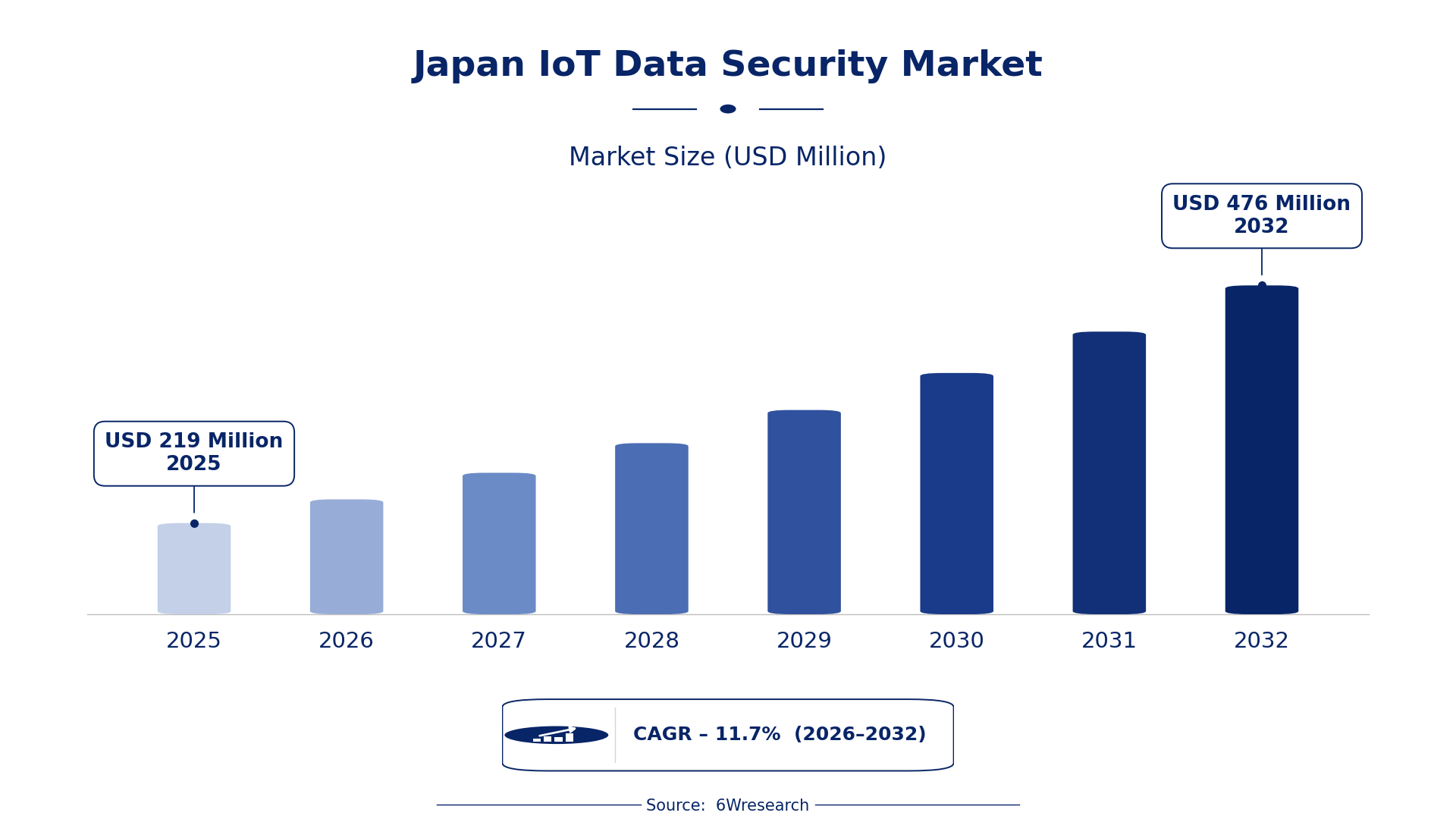
According to 6Wresearch internal database and industry insights, the Japan IoT Data Security Market was valued at USD 219 Million in 2025 and is projected to reach USD 476 Million by 2032, growing at a CAGR of approximately 11.7% during 2026–2032.
Japan IoT Data Security Market Highlights
| Report Metric | Details |
| Report Name | Japan IoT Data Security Market (2026-2032) |
| Market Size 2025 | USD 219 Million |
| Market Size 2032 | USD 476 Million |
| Absolute Growth 2025–2032 | USD 257 Million |
| CAGR 2026–2032 | 11.7% |
| Peak Annual Growth | 13.3% in 2030 |
| Forecast Period | 2026–2032 |
| Historical Data | 2022–2025 |
| Base Year | 2025 |
| Leading Security Layer, 2025 | Device Security (48% share) |
| Leading Technology Type, 2025 | AI Threat Detection (35% share) |
| Leading Application Area, 2025 | Industrial IoT (45% share) |
| Leading End User, 2025 | Telecom Firms (43% share) |
| Leading Distribution Channel, 2025 | Cybersecurity Firms (40% share) |
| Fastest-Growing Security Layer | Cloud Security (16.0% CAGR) |
| Fastest-Growing Application Area | Healthcare IoT (14.9% CAGR) |
| Fastest-Growing End User | Hospitals (15.4% CAGR) |
| Fastest-Growing Distribution Channel | Security Vendors (15.8% CAGR) |
| Growing Sector | Healthcare IoT |
| Key End Users | Telecom Firms, Hospitals, Manufacturing Plants, Cybersecurity Firms |
Japan IoT Data Security Market Year-wise Growth Rate and Key Drivers (2022–2032)
This graph illustrates the annual growth rates of the market from 2022 to 2032, highlighting a steady upward trajectory and projected market expansion over the forecast period.
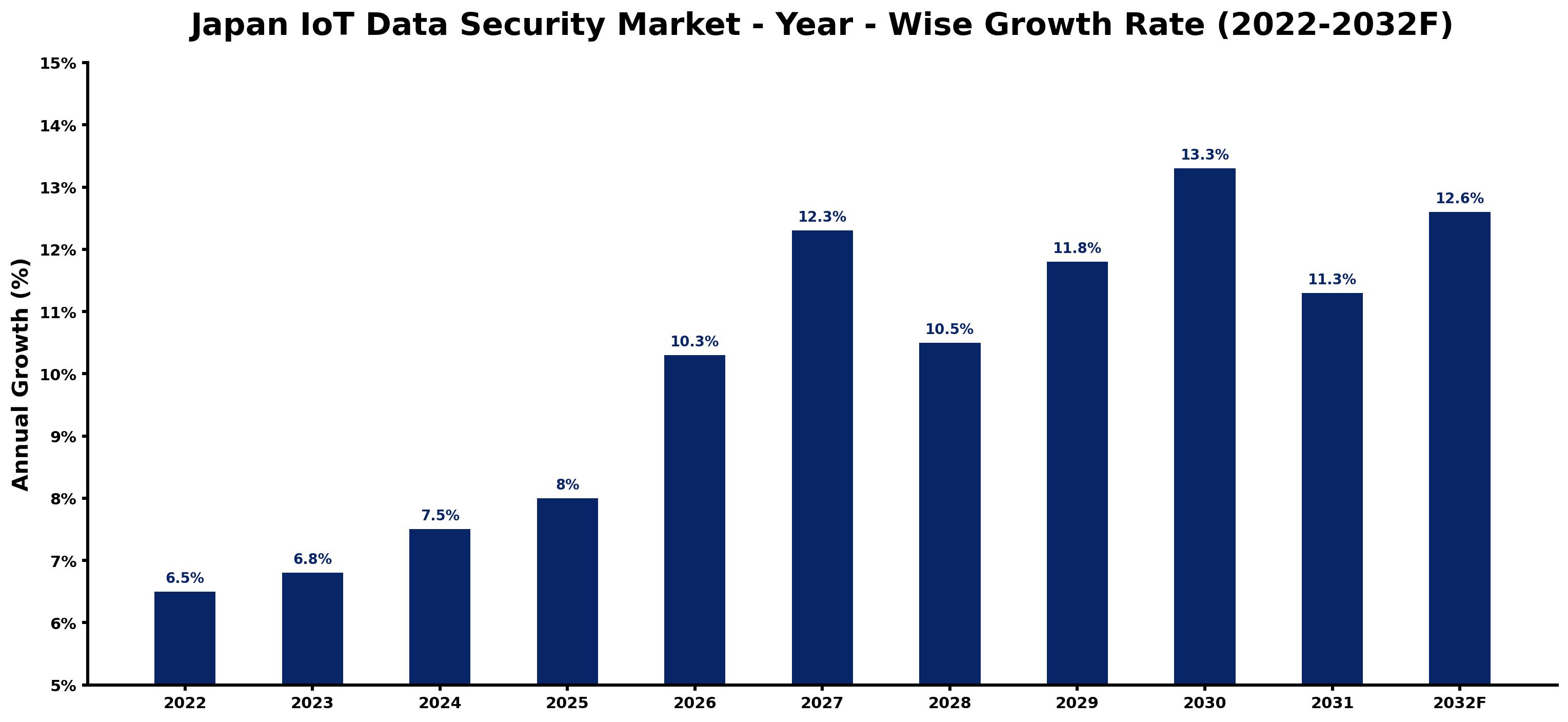
Year by year, the estimates below pair each growth rate with the development that shaped it.
| Year | Estimated Annual Growth (%) | Market Rationale |
| 2022 | 6.5 | The market experienced steady growth as businesses began prioritising IoT security measures. |
| 2023 | 6.8 | Demand increased as more connected devices were deployed across various sectors. |
| 2024 | 7.5 | The rise in cyber threats led to heightened awareness and investment in security solutions. |
| 2025 | 8.0 | The implementation of new security standards drove further adoption of IoT security technologies. |
| 2026 | 10.3 | Growth accelerated as industries recognised the importance of securing their IoT networks. |
| 2027 | 12.3 | Investment in healthcare IoT surged, driven by the need for secure patient data management. |
| 2028 | 10.5 | A slowdown occurred as market growth stabilised after rapid increases in previous years. |
| 2029 | 11.8 | Demand surged again as new regulations prompted businesses to improve their security frameworks. |
| 2030 | 13.3 | The peak growth rate was reached as advanced security technologies gained traction. |
| 2031 | 11.3 | Growth slowed slightly as the market matured and competition intensified. |
| 2032 | 12.6 | The market is projected to continue expanding as new IoT applications emerge. |
Note: Market size estimations and growth projections presented in this report are based on 6Wresearch's proprietary forecasting methodology, utilizing the latest available industry data, government publications, and primary research inputs.
Japan IoT Data Security Market Synopsis
IoT Data Security encompasses technologies and practices designed to protect connected devices and networks from cyber threats. The Japan IoT Data Security Market is expanding, driven by the increasing number of connected devices, expected to exceed 1 billion by 2025, alongside rising demand from sectors such as healthcare and industrial IoT. Government initiatives, including the national strategy for cybersecurity in IoT launched in 2023, stimulate market growth by promoting standards and collaboration among industry players, ensuring a secure environment for IoT applications.
Market Dynamics Impact Analysis (2026–2032)
| Factor | Type | Impact | Primary Segment Affected |
| Rising number of connected devices in various sectors | Driver | High | Device Security |
| Increased focus on healthcare data protection | Driver | High | Healthcare IoT |
| Growing demand for secure smart home devices | Opportunity | High | Consumer IoT |
| Investment in industrial security solutions | Opportunity | High | Industrial IoT |
| Limited awareness of IoT security standards | Restraint | Medium | Cloud Security |
| Slow adoption of advanced security technologies | Restraint | Medium | AI Threat Detection |
| High costs associated with implementing comprehensive security solutions | Challenge | High | Network Security |
| Shortage of skilled cybersecurity professionals | Challenge | Medium | Cybersecurity Firms |
Evaluation of Drivers in Japan IoT Data Security Market (2026–2032)
The factors lifting demand, and the evidence behind each, are summarised below.
| Drivers | Primary Segment Affected | Why It Matters (Evidence) |
| Increased deployment of connected devices | Device Security | The number of connected devices is projected to exceed 1 billion by 2025, driving demand for security solutions. |
| Growing healthcare IoT applications | Healthcare IoT | With projections of 50 million IoT devices in healthcare by 2025, there is a pressing need for data protection. |
| Rising consumer demand for smart home technology | Consumer IoT | The smart home market is expanding rapidly, necessitating secure devices to protect user data. |
| Investment in industrial IoT security measures | Industrial IoT | Manufacturing plants are prioritising security to safeguard operations from cyber threats. |
| Adoption of new cybersecurity standards | Cloud Security | The Ministry of Internal Affairs and Communications promotes IoT security standards, supporting market growth. |
Purchasing is picking up as the number of connected devices in Japan is expected to exceed 1 billion by 2025, leading to a surge in demand for security solutions. The healthcare sector is set to grow, with 50 million devices anticipated, prompting healthcare providers to invest in data protection. In the consumer sector, the rise of smart home applications drives demand for secure devices, while industrial investments are increasing to protect manufacturing processes. The promotion of IoT security standards is further encouraging businesses to adopt advanced measures, ensuring a safer environment for users.
Evaluation of Restraints in Japan IoT Data Security Market
The main factors holding the market back are set out below.
| Market Restraint | Primary Segment Affected | Why It Matters (Evidence) |
| Limited awareness of IoT security standards | Cloud Security | Many businesses remain unaware of the importance of adhering to standards like JIS Q 27001, hindering adoption. |
| Slow adoption of advanced security technologies | AI Threat Detection | Integration of AI Threat Detection is lagging due to high implementation costs that deter investment. |
| High costs associated with implementing security solutions | Network Security | The financial burden of extensive security measures can deter smaller firms from investing adequately. |
| Shortage of skilled cybersecurity professionals | Cybersecurity Firms | The lack of qualified personnel hampers the ability of firms to effectively implement security solutions. |
| Regulatory compliance challenges | Device Security | Navigating complex regulations can delay the deployment of necessary security measures. |
Japan IoT Data Security Market Challenges
A recent incident highlighted that competition among IoT data protection providers can compromise service quality, as firms reduce prices to win contracts. Buyers in Japan face inconsistent protocols, delaying IoT solution deployment in sectors like healthcare, where timely implementation can take up to six months longer. Limited understanding of security standards hampers technology adoption, exposing users to increased cyber threats, which can lead to data breaches costing up to 100 million yen. Compliance costs with JIS Q 27001 can strain small suppliers, consuming up to 15% of their budgets, limiting their ability to invest in innovation.
Trends in the Japan IoT Data Security Market
Buyers and suppliers in the Japan IoT Data Security Market are adjusting to the following trends.
- Shift from Traditional to AI-Driven Security Solutions: Since 2023, there has been a notable shift towards AI Threat Detection in IoT security, with the segment expected to grow at a CAGR of 14.1%. This trend reflects the increasing need for effective security measures in response to evolving cyber threats.
- Transition from Centralised to Decentralised Data Management: The move towards decentralised data management began in 2023, driven by the need for improved security. This approach allows for better data protection across various sectors, including healthcare and industrial applications, as firms seek to mitigate risks associated with centralised systems.
- Healthcare IoT Gaining Prominence: The Healthcare IoT sector is experiencing growth, projected to reach 50 million devices by 2025. This surge is driven by the aging population and the need for secure patient data management, prompting healthcare providers to invest in IoT security.
- Increased Focus on Compliance with Security Standards: Since 2023, compliance with standards such as JIS Q 27001 has become a priority for many firms. This shift is prompted by regulatory requirements and the need to build consumer trust in IoT devices.
Investment Opportunities in the Japan IoT Data Security Market
Several openings in the Japan IoT Data Security Market merit attention from investors.
- Tokyo as a Hub for IoT Security Innovation: Tokyo is emerging as a key hub for IoT security innovation, with 10 billion yen allocated for cybersecurity initiatives in 2023. This funding creates opportunities for firms to develop and implement new security technologies.
- Partnerships with Cybersecurity Firms: The growing demand for security solutions presents opportunities for partnerships with established cybersecurity firms. Collaborating with these firms can provide access to advanced technologies and expertise.
- Investment in Smart Home Security Solutions: With the smart home market expanding, there is a gap in secure device offerings. Firms can capitalise on this by developing effective security solutions tailored for smart home applications.
- Expansion of Industrial IoT Security Solutions: Manufacturing plants are increasingly investing in security measures, creating opportunities for suppliers of industrial IoT security solutions to enter the market.
Government Initiatives in the Japan IoT Data Security Market
The regulatory framework for IoT Data Security in Japan is shaped by several key laws, starting with the Next-Generation Medical Infrastructure Act of 2017, which allows for the anonymisation of medical data. The AI Promotion Act, established in 2025, sets a national framework for AI research and development, promoting the integration of AI in security measures. Additionally, the Digital Agency, established in 2021, leads digital transformation and establishes common system standards for IoT security.
The Digital Agency oversees the implementation of various initiatives aimed at improving IoT security. The agency funds projects that promote industry collaboration and the development of security standards. For instance, the Tokyo Metropolitan Government supports IoT innovation through funding programs, ensuring that local firms can access necessary resources to strengthen their security capabilities.
Future Insight of the Japan IoT Data Security Market
Investment in IoT data protection will rise, driven by the government's 10 billion yen allocation for cybersecurity initiatives in 2023 and the expected growth of Japan's IoT market to 2 trillion yen by 2025. This influx of funding will stimulate demand for advanced protection technologies across sectors. The promotion of collaboration through the Japan IoT Acceleration Consortium will drive innovation. By 2032, integrating effective security measures in healthcare applications will safeguard a projected 50 million IoT devices, ensuring secure connectivity for users.
Market Segmentation Analysis
Japan IoT Data Security Market report covers a detailed analysis of the following market segments:
By Security Layer – Device Security Leads, Cloud Security Expected to Grow Fastest
According to Saurav Kr Singh, Senior Research Analyst at 6Wresearch, the largest security layer category in 2025 was Device Security, at 48% of revenue. Device Security holds the largest share as it is essential for protecting individual devices from breaches, particularly in sectors like healthcare where sensitive data is at risk. The increasing number of connected devices in Japan, projected to exceed 1 billion by 2025, underscores the necessity for robust device security solutions. Cloud Security is set to record the highest CAGR in this split, 16.0% over 2026–2032. Cloud Security is growing rapidly due to the rising importance of protecting data stored in the cloud, especially as businesses shift towards cloud-based solutions. The government's allocation of 10 billion yen for cybersecurity initiatives in 2023 further fuels this demand. Suppliers should prioritise the development of comprehensive cloud security solutions to meet the escalating market needs.
By Technology Type – AI Threat Detection Leads and Records the Fastest Growth
AI Threat Detection accounted for 35% of the market by technology type in 2025. AI Threat Detection leads the market as it is widely used for proactive security measures, enabling timely threat identification and response. Its integration into various IoT applications is crucial for maintaining overall security across multiple sectors. Its lead should widen, with a projected CAGR of 14.1% during 2026–2032, the highest in this split. The growth of AI Threat Detection is propelled by its role as both a leader and fastest segment, with ongoing advancements in technology improving its effectiveness. This dual advantage ensures its market share will continue to expand as more organisations adopt these solutions. Buyers should focus on solutions that incorporate advanced capabilities to effectively counter emerging threats.
By Application Area – Industrial IoT Leads, Healthcare IoT Expected to Grow Fastest
Industrial IoT took 45% of application area revenue in 2025, more than any other category. Industrial IoT is the leading application area due to its critical role in securing manufacturing processes, which increasingly rely on connected devices. The emphasis on operational efficiency and safety in industries drives the demand for effective security solutions. The quickest growth will come from Healthcare IoT, forecast to expand at a CAGR of 14.9% between 2026 and 2032. Healthcare IoT is experiencing the fastest growth as the need for protecting patient data intensifies, particularly with Japan's aging population. The projected rise of IoT devices in healthcare to 50 million by 2025 highlights this urgent requirement. Suppliers must customise their offerings to address the specific security challenges faced by the healthcare sector.
By End User – Telecom Firms Lead, Hospitals Expected to Grow Fastest
In 2025, Telecom Firms led the end user split with a 43% share. Telecom Firms represent the largest end user group as they require robust security for network infrastructure to mitigate cyber threats. The extensive network of connected devices managed by telecom companies necessitates advanced security measures. Over 2026–2032, Hospitals are expected to post the fastest growth, at a CAGR of 15.4%. Hospitals are the fastest-growing end user segment, driven by an increasing demand for secure healthcare applications to safeguard sensitive patient information. The ongoing digital transformation in healthcare amplifies this urgency, ensuring continued investment in security solutions. Vendors should develop specialised products that cater to the unique security challenges faced by hospitals.
By Distribution Channel – Cybersecurity Firms Lead, Security Vendors Expected to Grow Fastest
With 40% of distribution channel revenue in 2025, Cybersecurity Firms was the largest category. Cybersecurity Firms dominate the distribution channel as they specialise in IoT security solutions, providing tailored services that meet the specific needs of various sectors. Their expertise positions them as trusted partners for organisations seeking to enhance their security posture. Security Vendors are set to record the highest CAGR in this split, 15.8% over 2026–2032. Security Vendors are witnessing rapid growth as key providers of IoT security solutions, driven by the increasing adoption of connected devices across industries. Their ability to offer comprehensive security packages attracts a wider customer base. Suppliers should explore partnerships with security vendors to broaden their market reach and improve service offerings.
Key Attractiveness of the Report
- 10 Years of Market Numbers
- Historical Data Starting from 2022 to 2025
- Base Year 2025
- Forecast Data until 2032
- Key Performance Indicators Impacting the Market
- Major Upcoming Developments and Projects
Key Highlights of the Report:
- Japan IoT Data Security Market Outlook
- Market Size of Japan IoT Data Security Market, 2025
- Forecast of Japan IoT Data Security Market, 2032
- Historical Data and Forecast of Japan IoT Data Security Revenues & Volume for the Period 2022-2032F
- Japan IoT Data Security Market Trend Evolution
- Japan IoT Data Security Market Drivers and Challenges
- Japan IoT Data Security Price Trends
- Japan IoT Data Security Porter's Five Forces
- Japan IoT Data Security Industry Life Cycle
- Historical Data and Forecast of Japan IoT Data Security Market Revenues & Volume By Security Layer for the Period 2022-2032F
- Historical Data and Forecast of Japan IoT Data Security Market Revenues & Volume By Device Security for the Period 2022-2032F
- Historical Data and Forecast of Japan IoT Data Security Market Revenues & Volume By Network Security for the Period 2022-2032F
- Historical Data and Forecast of Japan IoT Data Security Market Revenues & Volume By Application Layer for the Period 2022-2032F
- Historical Data and Forecast of Japan IoT Data Security Market Revenues & Volume By Cloud Security for the Period 2022-2032F
- Historical Data and Forecast of Japan IoT Data Security Market Revenues & Volume By Technology Type for the Period 2022-2032F
- Historical Data and Forecast of Japan IoT Data Security Market Revenues & Volume By Hardware Encryption for the Period 2022-2032F
- Historical Data and Forecast of Japan IoT Data Security Market Revenues & Volume By VPN & TLS for the Period 2022-2032F
- Historical Data and Forecast of Japan IoT Data Security Market Revenues & Volume By AI Threat Detection for the Period 2022-2032F
- Historical Data and Forecast of Japan IoT Data Security Market Revenues & Volume By Blockchain-Based Access for the Period 2022-2032F
- Historical Data and Forecast of Japan IoT Data Security Market Revenues & Volume By Application Area for the Period 2022-2032F
- Historical Data and Forecast of Japan IoT Data Security Market Revenues & Volume By Consumer IoT for the Period 2022-2032F
- Historical Data and Forecast of Japan IoT Data Security Market Revenues & Volume By Industrial IoT for the Period 2022-2032F
- Historical Data and Forecast of Japan IoT Data Security Market Revenues & Volume By Healthcare IoT for the Period 2022-2032F
- Historical Data and Forecast of Japan IoT Data Security Market Revenues & Volume By Data Centers for the Period 2022-2032F
- Historical Data and Forecast of Japan IoT Data Security Market Revenues & Volume By End User for the Period 2022-2032F
- Historical Data and Forecast of Japan IoT Data Security Market Revenues & Volume By Smart Home OEMs for the Period 2022-2032F
- Historical Data and Forecast of Japan IoT Data Security Market Revenues & Volume By Manufacturing Plants for the Period 2022-2032F
- Historical Data and Forecast of Japan IoT Data Security Market Revenues & Volume By Hospitals for the Period 2022-2032F
- Historical Data and Forecast of Japan IoT Data Security Market Revenues & Volume By Telecom Firms for the Period 2022-2032F
- Historical Data and Forecast of Japan IoT Data Security Market Revenues & Volume By Distribution Channel for the Period 2022-2032F
- Historical Data and Forecast of Japan IoT Data Security Market Revenues & Volume By Security Vendors for the Period 2022-2032F
- Historical Data and Forecast of Japan IoT Data Security Market Revenues & Volume By Cloud Providers for the Period 2022-2032F
- Historical Data and Forecast of Japan IoT Data Security Market Revenues & Volume By SaaS Providers for the Period 2022-2032F
- Historical Data and Forecast of Japan IoT Data Security Market Revenues & Volume By Cybersecurity Firms for the Period 2022-2032F
- Japan IoT Data Security Import Export Trade Statistics
- Market Opportunity Assessment By Security Layer
- Market Opportunity Assessment By Technology Type
- Market Opportunity Assessment By Application Area
- Market Opportunity Assessment By End User
- Market Opportunity Assessment By Distribution Channel
- Japan IoT Data Security Top Companies Market Share
- Japan IoT Data Security Competitive Benchmarking By Technical and Operational Parameters
- Japan IoT Data Security Company Profiles
- Japan IoT Data Security Key Strategic Recommendations
Market Covered
The following segment groups are covered in the report.
By Security Layer
- Device Security
- Network Security
- Application Layer
- Cloud Security
By Technology Type
- Hardware Encryption
- VPN & TLS
- AI Threat Detection
- Blockchain-Based Access
By Application Area
- Consumer IoT
- Industrial IoT
- Healthcare IoT
- Data Centers
By End User
- Smart Home OEMs
- Manufacturing Plants
- Hospitals
- Telecom Firms
By Distribution Channel
- Security Vendors
- Cloud Providers
- SaaS Providers
- Cybersecurity Firms































