Japan IoT DevOps Market Size & Growth Rate
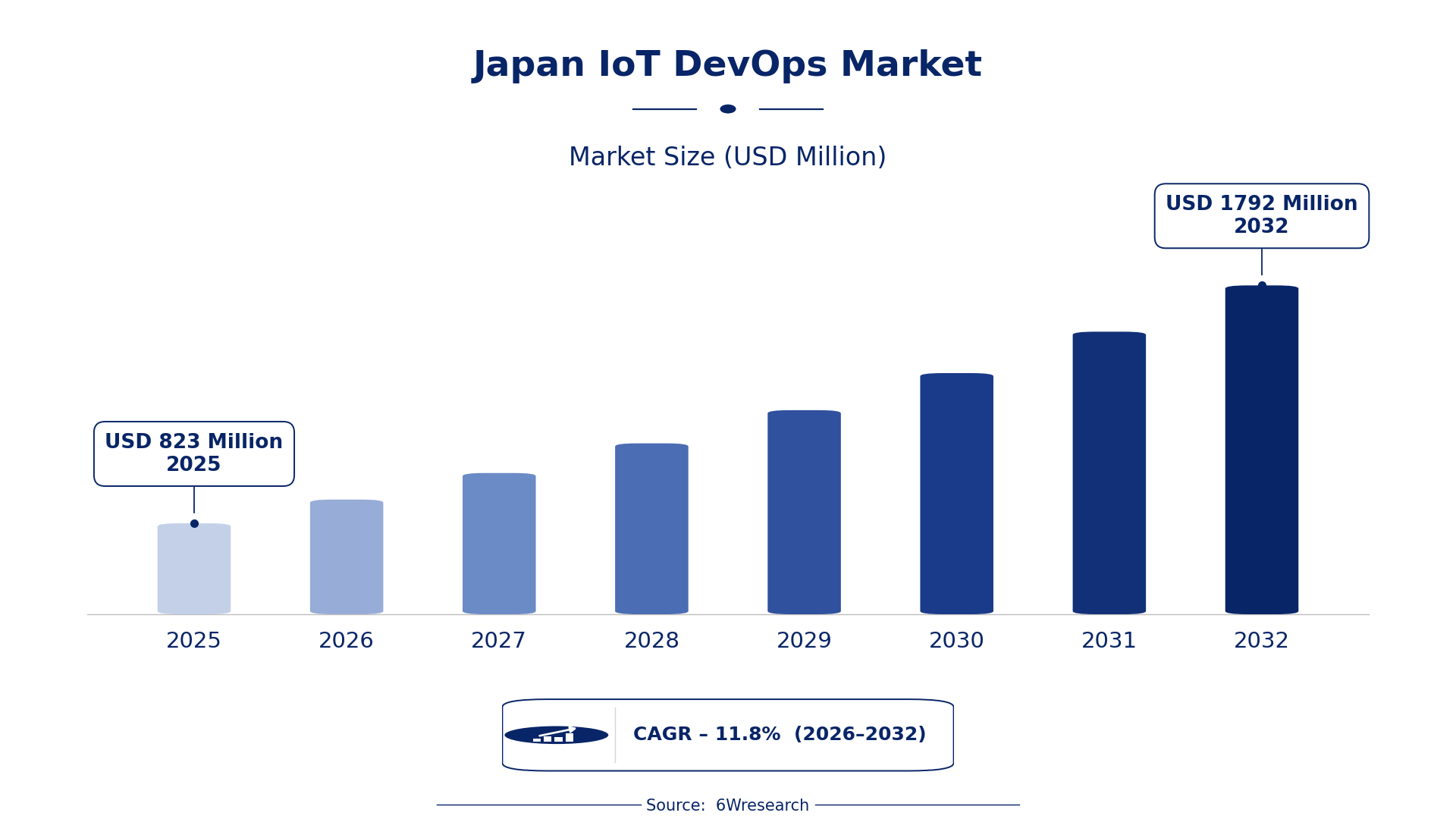
According to 6Wresearch internal database and industry insights, the Japan IoT DevOps Market was valued at USD 823 Million in 2025 and is projected to reach USD 1,792 Million by 2032, growing at a CAGR of approximately 11.8% during 2026–2032.
Japan IoT DevOps Market Highlights
| Report Metric | Details |
| Report Name | Japan IoT DevOps Market (2026-2032) |
| Market Size 2025 | USD 823 Million |
| Market Size 2032 | USD 1,792 Million |
| Absolute Growth 2025–2032 | USD 969 Million |
| CAGR 2026–2032 | 11.8% |
| Peak Annual Growth | 13.1% in 2030 |
| Forecast Period | 2026–2032 |
| Historical Data | 2022–2025 |
| Base Year | 2025 |
| Leading Platform Type, 2025 | CI/CD Platforms (33% share) |
| Leading Deployment Mode, 2025 | Cloud (38% share) |
| Leading Toolset Type, 2025 | Open Source (49% share) |
| Leading End User, 2025 | IoT Device Makers (39% share) |
| Leading Distribution Channel, 2025 | DevOps Vendors (44% share) |
| Fastest-Growing Platform Type | Containerization Tools (17.1% CAGR) |
| Fastest-Growing Deployment Mode | Hybrid (16.5% CAGR) |
| Fastest-Growing Toolset Type | Proprietary (16.7% CAGR) |
| Fastest-Growing End User | System Integrators (15.4% CAGR) |
| Fastest-Growing Distribution Channel | SaaS Marketplaces (15.2% CAGR) |
| Growing Sector | Smart Manufacturing |
| Key End Users | IoT Device Makers, System Integrators, Smart Factory Operators |
Japan IoT DevOps Market Year-wise Growth Rate and Key Drivers (2022–2032)
This graph illustrates the annual growth rates of the market from 2022 to 2032, highlighting a steady upward trajectory and projected market expansion over the forecast period.
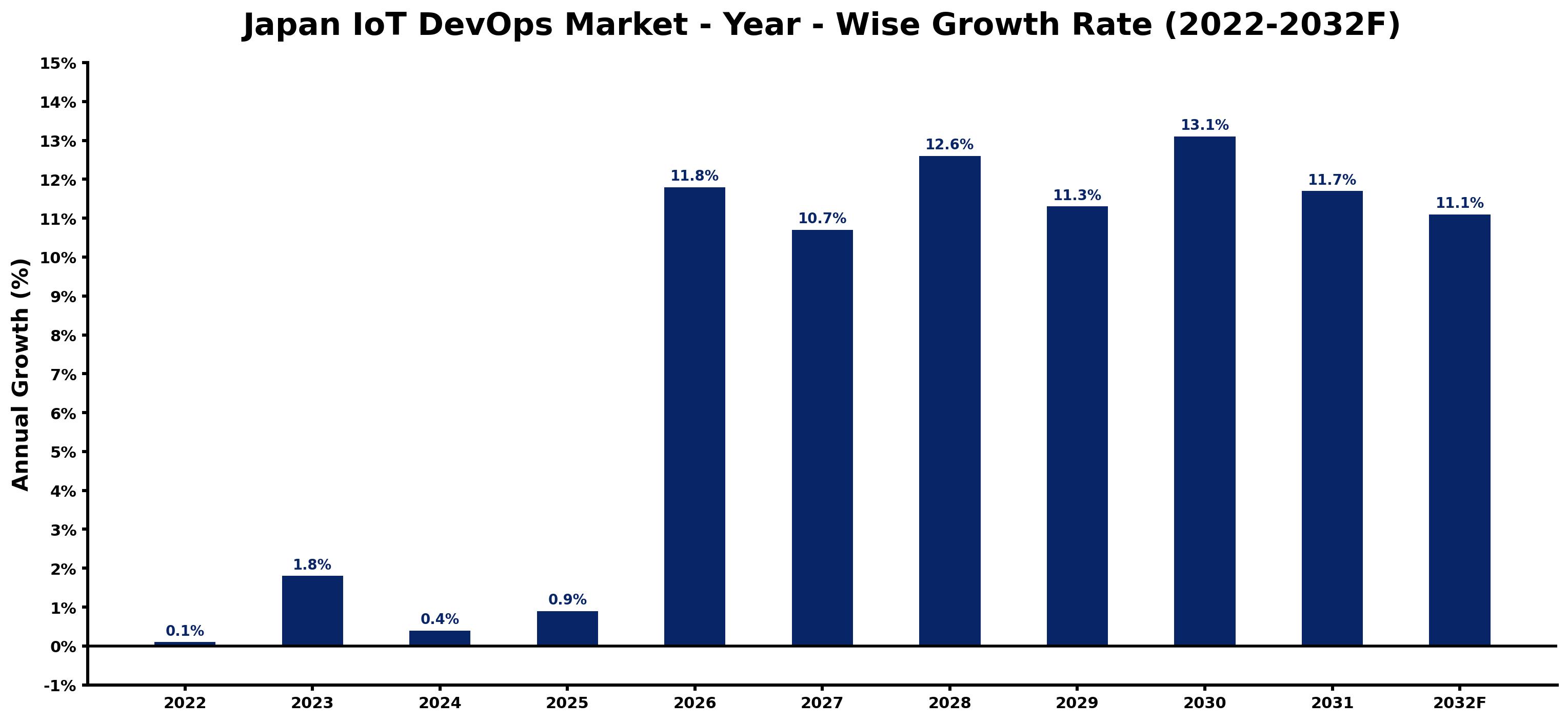
Annual growth estimates for each year appear below with the principal reason behind them, explaining the shifts that set the pace of the market.
| Year | Estimated Annual Growth (%) | Market Rationale |
| 2022 | 0.1 | The market showed minimal growth due to initial adjustments in IoT integration practices. |
| 2023 | 1.8 | Growth accelerated as businesses began adopting more IoT solutions for operational efficiency. |
| 2024 | 0.4 | Growth slowed as companies reassessed their IoT strategies and investments. |
| 2025 | 0.9 | An increase in smart manufacturing initiatives contributed to faster growth. |
| 2026 | 11.8 | The market is projected to expand as 5G technology improves IoT capabilities. |
| 2027 | 10.7 | Growth slows slightly as the market stabilises after rapid expansion. |
| 2028 | 12.6 | Demand rises again as more companies adopt containerization tools for IoT. |
| 2029 | 11.3 | A moderate slowdown occurs as the market adjusts to new technologies. |
| 2030 | 13.1 | Peak growth is expected as IoT applications become more mainstream. |
| 2031 | 11.7 | Growth slows as the market matures and competition increases. |
| 2032 | 11.1 | The market continues to grow steadily as IoT solutions become standard. |
Note: Market size estimations and growth projections presented in this report are based on 6Wresearch's proprietary forecasting methodology, utilizing the latest available industry data, government publications, and primary research inputs.
Japan IoT DevOps Market Synopsis
IoT DevOps integrates practices and tools for continuous integration and delivery of IoT applications, streamlining development processes and ensuring reliability. The Japan IoT DevOps Market is expanding due to substantial investments in smart manufacturing and connected devices, with over 10 million connected devices driving demand. Initiatives like the Smart Factory programme are pushing for productivity improvements through IoT technologies, creating a dynamic environment for growth.
Market Dynamics Impact Analysis (2026–2032)
| Factor | Type | Impact | Primary Segment Affected |
| Increasing investments in smart manufacturing initiatives | Driver | High | CI/CD Platforms |
| Growing adoption of 5G technology enhancing IoT capabilities | Driver | High | Containerization Tools |
| Rising demand for IoT solutions in various sectors | Opportunity | High | Monitoring Tools |
| Expansion of IoT device connectivity in urban areas | Opportunity | Medium | Automation Frameworks |
| Challenges in integrating legacy systems with IoT solutions | Restraint | High | Cloud |
| Concerns over IoT security and data privacy | Restraint | Medium | Edge |
| Shortage of skilled professionals in IoT DevOps | Challenge | High | Open Source |
| High costs associated with implementing IoT solutions | Challenge | Medium | Proprietary |
Evaluation of Drivers in Japan IoT DevOps Market (2026–2032)
Below are the drivers that matter most for revenue growth, with supporting evidence.
| Drivers | Primary Segment Affected | Why It Matters (Evidence) |
| Investment in smart manufacturing | CI/CD Platforms | Japan's IoT market is projected to reach 1 trillion yen by 2025, driving demand for CI/CD tools. |
| Adoption of 5G technology | Containerization Tools | The rollout of 5G is improving connectivity, leading to increased use of containerization in IoT. |
| Need for real-time data processing | Monitoring Tools | With over 10 million connected devices, demand for monitoring tools is rising to ensure system reliability. |
| Automation of repetitive tasks | Automation Frameworks | The Smart Factory initiative is driving automation, increasing the need for efficient frameworks. |
| Focus on cost-effective solutions | Open Source | Growing interest in open-source tools for flexibility and cost savings is driving demand. |
Much of the new demand traces back to the projected growth of Japan's IoT market, which is expected to reach 1 trillion yen by 2025. This surge drives the need for CI/CD platforms, as manufacturers seek to streamline their development processes. The rollout of 5G technology improves connectivity, prompting increased adoption of containerization tools for efficient application deployment. With over 10 million connected devices, the demand for monitoring tools rises to ensure system performance. The push for automation is increasing the need for frameworks that improve operational efficiency.
Evaluation of Restraints in Japan IoT DevOps Market
Several factors work against faster growth; the main ones are summarised below.
| Market Restraint | Primary Segment Affected | Why It Matters (Evidence) |
| Integration challenges with legacy systems | Cloud | Many companies struggle to integrate existing systems with new IoT solutions, hindering cloud adoption. |
| Data privacy concerns | Edge | Growing worries about data security limit the willingness of companies to adopt edge computing solutions. |
| Shortage of skilled professionals | Open Source | The lack of expertise in IoT DevOps hampers the effective implementation of open-source tools. |
| High implementation costs | Proprietary | The investment required for proprietary solutions deters some companies from adopting IoT. |
| Regulatory compliance issues | Monitoring Tools | Navigating complex regulations can slow down the deployment of monitoring tools in IoT applications. |
Japan IoT DevOps Market Challenges
The presence of over 10 million connected IoT devices in Japan creates a technology challenge, as buyers encounter integration complexities that can delay project timelines by up to six months. Intense competition among suppliers leads to price wars, which can erode profit margins by 15%, limiting their ability to invest in innovation. Regulatory challenges arise from the IoT Security Guidelines, imposing compliance costs of up to 20 million yen for smaller firms, hindering market entry. Supply chain disruptions, exacerbated by global events, can result in component shortages, causing significant production downtime for manufacturers.
Trends in the Japan IoT DevOps Market
These developments are changing demand patterns in the Japan IoT DevOps Market.
- Shift Towards Smart Manufacturing: Smart Factory operators are increasingly adopting IoT DevOps to improve productivity, with Japan's IoT market projected to reach 1 trillion yen by 2025.
- Growing Importance of Real-Time Data Processing: The Tokyo region is leading in real-time data processing initiatives, with over 10 million connected IoT devices driving operational efficiency.
- Increased Focus on Open Source Solutions: A trend towards open-source tools is emerging, motivated by the need for flexibility and cost-effectiveness in IoT development, with 49% market share in 2025.
- Adoption of 5G Technology: The rollout of 5G technology is transforming IoT capabilities, enabling faster data transmission and connectivity across Japan, boosting the overall market.
Investment Opportunities in the Japan IoT DevOps Market
Below are the investment opportunities with the strongest case in the Japan IoT DevOps Market.
- Investment in Smart Manufacturing: With Japan's IoT market projected to reach 1 trillion yen by 2025, investing in smart manufacturing solutions presents a strong opportunity for suppliers.
- Supply of Containerization Tools: The demand for containerization tools is rising, particularly among IoT device makers, as companies seek efficient deployment solutions.
- Development of Monitoring Solutions: As IoT device connectivity increases, there is a growing need for monitoring solutions, especially in urban areas like Tokyo, where over 10 million devices are active.
- Focus on Automation Frameworks: Now is the time to invest in automation frameworks, as the Smart Factory initiative drives demand for efficient IoT solutions across various sectors.
Government Initiatives in the Japan IoT DevOps Market
The Plastic Resource Circulation Act promotes the reduction, reuse, and recycling of plastics, impacting IoT producers by encouraging sustainable practices in device manufacturing. The Digital Agency, established in 2021, leads government digital transformation efforts, ensuring IoT solutions comply with common system standards to facilitate market adoption.
The Ministry of Internal Affairs and Communications supports IoT adoption through various initiatives, allocating 100 billion yen for IoT infrastructure development in 2023. The Japan Electronics and Information Technology Industries Association (JEITA) plays a significant role in approving standards and funding projects that promote IoT development.
Future Insight of the Japan IoT DevOps Market
The adoption of 5G technology will reshape demand for IoT solutions, enabling faster data transmission and enhancing user experiences. By 2032, the Smart Factory initiative is expected to increase productivity by 40% for manufacturers, driven by advanced IoT applications. The Japan IoT Acceleration Consortium will facilitate collaboration between startups and established firms, encouraging sector innovation. Government investments in IoT infrastructure, amounting to 100 billion yen in 2023, will create robust IoT environments, supporting future growth.
Market Segmentation Analysis
Japan IoT DevOps Market report covers a detailed analysis of the following market segments:
By Platform Type – CI/CD Platforms Lead, Containerization Tools Expected to Grow Fastest
According to Saurav Kr Singh, Senior Research Analyst at 6Wresearch, CI/CD Platforms took 33% of platform type revenue in 2025, more than any other category. CI/CD platforms are crucial for continuous integration and delivery in IoT projects, making them the top choice for developers. Their widespread implementation in the Tokyo region, a hub for IoT innovation, solidifies their leading position in the market. Over 2026–2032, Containerization Tools are expected to post the fastest growth, at a CAGR of 17.1%. Containerization tools are experiencing rapid growth due to their key role in managing application deployment in IoT environments, particularly among startups. This demand is likely to increase as more organisations adopt agile methodologies for development. Suppliers should focus on enhancing CI/CD platforms while also developing containerization tools to meet the rising demand.
By Deployment Mode – Cloud Leads, Hybrid Expected to Grow Fastest
With 38% of deployment mode revenue in 2025, Cloud was the largest category. Cloud deployment is extensively utilised for scalable IoT solutions and data storage, appealing to many businesses aiming to leverage cloud computing benefits. The Japanese government's substantial investment in IoT infrastructure has significantly accelerated cloud adoption across various sectors. Hybrid is set to record the highest CAGR in this split, 16.5% over 2026–2032. Hybrid deployment is gaining traction as organisations seek tailored solutions that combine cloud and on-premise capabilities. This trend is particularly evident in sectors like smart manufacturing, where flexibility and adaptability are essential. Buyers may benefit from exploring hybrid solutions to optimise their IoT deployments, while suppliers should ensure their offerings are compatible with both cloud and on-premise systems.
By Toolset Type – Open Source Leads, Proprietary Expected to Grow Fastest
Open Source held 49% of the Japan IoT DevOps Market by toolset type in 2025. Open source tools are widely adopted for their flexibility and cost-effectiveness, appealing to a diverse range of developers in Japan's IoT sector. Their popularity is reinforced by community-led initiatives that promote collaboration and shared innovation. Proprietary is projected to grow fastest, at a CAGR of 16.7% during 2026–2032. Proprietary tools are increasingly preferred as organisations seek specialised solutions that cater to their specific needs. This trend is particularly noticeable among larger enterprises investing in tailored IoT applications. Suppliers should consider offering both open source and proprietary options to cater to varying customer preferences.
By End User – IoT Device Makers Lead, System Integrators Expected to Grow Fastest
In 2025, IoT Device Makers led the end user split with a 39% share. IoT device makers are the primary users of IoT DevOps for product development, driving demand for tools that enhance their processes. Their significant presence in Japan's vibrant IoT market underscores their essential role in the ecosystem. The quickest growth will come from System Integrators, forecast to expand at a CAGR of 15.4% between 2026 and 2032. System integrators are experiencing rapid growth as they play a vital role in integrating diverse IoT solutions and platforms for clients. Their increasing involvement in complex projects reflects the rising intricacy of IoT deployments. Suppliers should target IoT device makers while also establishing partnerships with system integrators to expand their market reach.
By Distribution Channel – DevOps Vendors Lead, SaaS Marketplaces Expected to Grow Fastest
The largest distribution channel category in 2025 was DevOps Vendors, at 44% of revenue. DevOps vendors provide essential tools and services for IoT DevOps, making them a key player in the distribution of these solutions. Their established relationships with developers and organisations facilitate widespread adoption of IoT practices. Over 2026–2032, SaaS Marketplaces are expected to post the fastest growth, at a CAGR of 15.2%. SaaS marketplaces are rapidly growing as they offer a variety of IoT DevOps tools, catering to the needs of diverse users. This trend is supported by the increasing preference for subscription-based models among businesses. Suppliers should strengthen their presence in SaaS marketplaces to capture the growing demand for accessible IoT DevOps solutions.
Key Attractiveness of the Report
- 10 Years of Market Numbers
- Historical Data Starting from 2022 to 2025
- Base Year 2025
- Forecast Data until 2032
- Key Performance Indicators Impacting the Market
- Major Upcoming Developments and Projects
Key Highlights of the Report:
- Japan IoT DevOps Market Outlook
- Market Size of Japan IoT DevOps Market, 2025
- Forecast of Japan IoT DevOps Market, 2032
- Historical Data and Forecast of Japan IoT DevOps Revenues & Volume for the Period 2022-2032F
- Japan IoT DevOps Market Trend Evolution
- Japan IoT DevOps Market Drivers and Challenges
- Japan IoT DevOps Price Trends
- Japan IoT DevOps Porter's Five Forces
- Japan IoT DevOps Industry Life Cycle
- Historical Data and Forecast of Japan IoT DevOps Market Revenues & Volume By Platform Type for the Period 2022-2032F
- Historical Data and Forecast of Japan IoT DevOps Market Revenues & Volume By CI/CD Platforms for the Period 2022-2032F
- Historical Data and Forecast of Japan IoT DevOps Market Revenues & Volume By Containerization Tools for the Period 2022-2032F
- Historical Data and Forecast of Japan IoT DevOps Market Revenues & Volume By Monitoring Tools for the Period 2022-2032F
- Historical Data and Forecast of Japan IoT DevOps Market Revenues & Volume By Automation Frameworks for the Period 2022-2032F
- Historical Data and Forecast of Japan IoT DevOps Market Revenues & Volume By Deployment Mode for the Period 2022-2032F
- Historical Data and Forecast of Japan IoT DevOps Market Revenues & Volume By Cloud for the Period 2022-2032F
- Historical Data and Forecast of Japan IoT DevOps Market Revenues & Volume By Hybrid for the Period 2022-2032F
- Historical Data and Forecast of Japan IoT DevOps Market Revenues & Volume By On-Premise for the Period 2022-2032F
- Historical Data and Forecast of Japan IoT DevOps Market Revenues & Volume By Edge for the Period 2022-2032F
- Historical Data and Forecast of Japan IoT DevOps Market Revenues & Volume By Toolset Type for the Period 2022-2032F
- Historical Data and Forecast of Japan IoT DevOps Market Revenues & Volume By Open Source for the Period 2022-2032F
- Historical Data and Forecast of Japan IoT DevOps Market Revenues & Volume By Proprietary for the Period 2022-2032F
- Historical Data and Forecast of Japan IoT DevOps Market Revenues & Volume By AI-Driven for the Period 2022-2032F
- Historical Data and Forecast of Japan IoT DevOps Market Revenues & Volume By Lightweight for the Period 2022-2032F
- Historical Data and Forecast of Japan IoT DevOps Market Revenues & Volume By End User for the Period 2022-2032F
- Historical Data and Forecast of Japan IoT DevOps Market Revenues & Volume By IoT Device Makers for the Period 2022-2032F
- Historical Data and Forecast of Japan IoT DevOps Market Revenues & Volume By System Integrators for the Period 2022-2032F
- Historical Data and Forecast of Japan IoT DevOps Market Revenues & Volume By Smart Factory Operators for the Period 2022-2032F
- Historical Data and Forecast of Japan IoT DevOps Market Revenues & Volume By Network Providers for the Period 2022-2032F
- Historical Data and Forecast of Japan IoT DevOps Market Revenues & Volume By Distribution Channel for the Period 2022-2032F
- Historical Data and Forecast of Japan IoT DevOps Market Revenues & Volume By DevOps Vendors for the Period 2022-2032F
- Historical Data and Forecast of Japan IoT DevOps Market Revenues & Volume By SaaS Marketplaces for the Period 2022-2032F
- Historical Data and Forecast of Japan IoT DevOps Market Revenues & Volume By Tech Consultants for the Period 2022-2032F
- Historical Data and Forecast of Japan IoT DevOps Market Revenues & Volume By Online Platforms for the Period 2022-2032F
- Japan IoT DevOps Import Export Trade Statistics
- Market Opportunity Assessment By Platform Type
- Market Opportunity Assessment By Deployment Mode
- Market Opportunity Assessment By Toolset Type
- Market Opportunity Assessment By End User
- Market Opportunity Assessment By Distribution Channel
- Japan IoT DevOps Top Companies Market Share
- Japan IoT DevOps Competitive Benchmarking By Technical and Operational Parameters
- Japan IoT DevOps Company Profiles
- Japan IoT DevOps Key Strategic Recommendations
Market Covered
Coverage by segment is as follows.
By Platform Type
- CI/CD Platforms
- Containerization Tools
- Monitoring Tools
- Automation Frameworks
By Deployment Mode
- Cloud
- Hybrid
- On-Premise
- Edge
By Toolset Type
- Open Source
- Proprietary
- AI-Driven
- Lightweight
By End User
- IoT Device Makers
- System Integrators
- Smart Factory Operators
- Network Providers
By Distribution Channel
- DevOps Vendors
- SaaS Marketplaces
- Tech Consultants
- Online Platforms































