Japan IoT Edge Power Market Size & Growth Rate
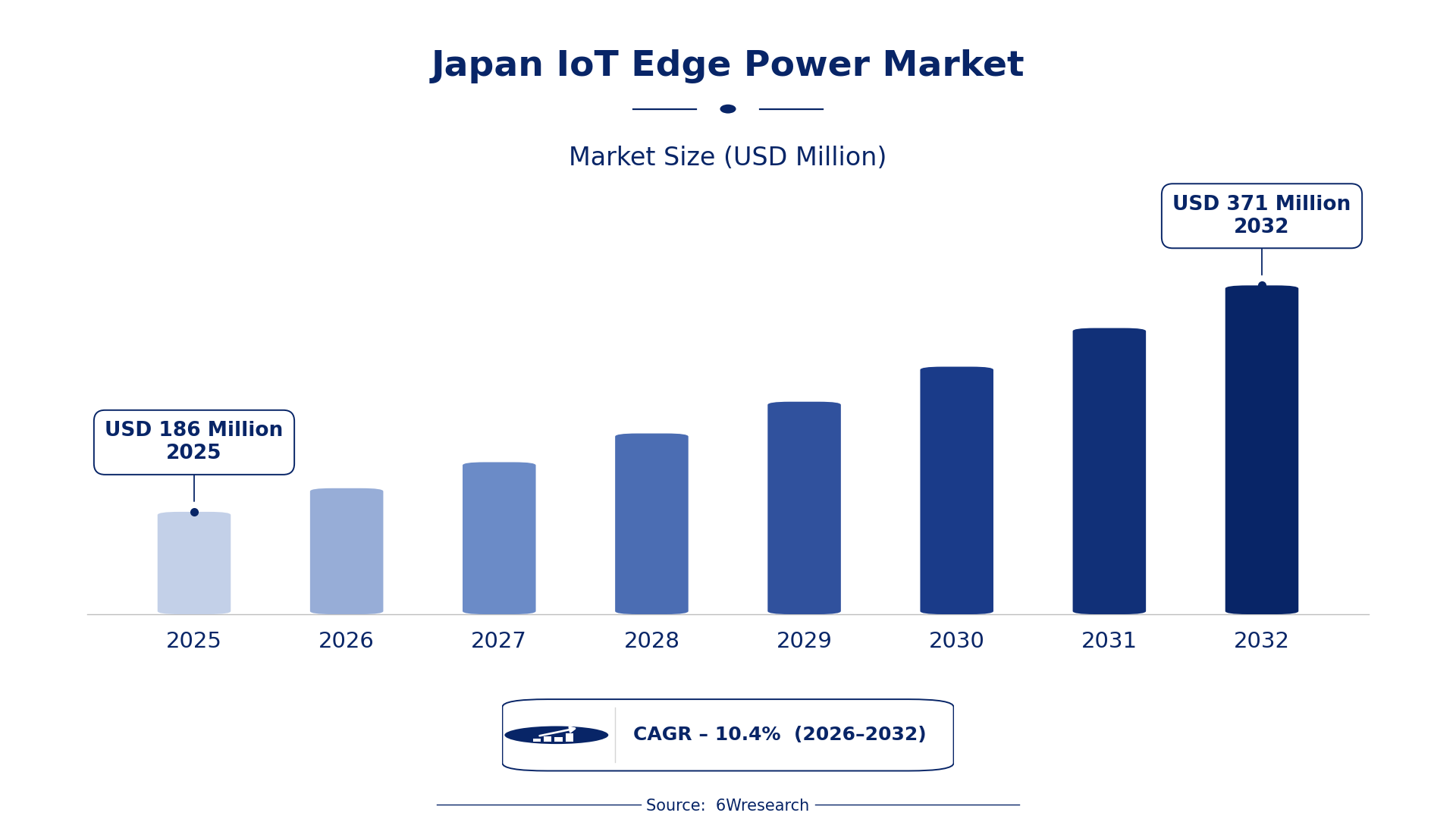
According to 6Wresearch internal database and industry insights, the Japan IoT Edge Power Market was valued at USD 186 Million in 2025 and is projected to reach USD 371 Million by 2032, growing at a CAGR of approximately 10.4% during 2026–2032.
Japan IoT Edge Power Market Highlights
| Report Metric | Details |
| Report Name | Japan IoT Edge Power Market (2026-2032) |
| Market Size 2025 | USD 186 Million |
| Market Size 2032 | USD 371 Million |
| Absolute Growth 2025–2032 | USD 185 Million |
| CAGR 2026–2032 | 10.4% |
| Peak Annual Growth | 11.6% in 2029 |
| Forecast Period | 2026–2032 |
| Historical Data | 2022–2025 |
| Base Year | 2025 |
| Leading Power Source Type, 2025 | Solar Harvesting (44% share) |
| Leading Device Type, 2025 | Microcontroller Nodes (42% share) |
| Leading Energy Management, 2025 | Smart Grid (47% share) |
| Leading Application Area, 2025 | Remote Pipelines (38% share) |
| Leading End User, 2025 | Utility Companies (39% share) |
| Fastest-Growing Device Type | Batteryless Tags (14.8% CAGR) |
| Fastest-Growing Energy Management | Predictive Maintenance (13.8% CAGR) |
| Fastest-Growing Application Area | Retail Asset Tracking (12.4% CAGR) |
| Fastest-Growing End User | Oil & Gas Companies (13.4% CAGR) |
| Growing Sector | Utility Companies |
| Key End Users | Utility Companies, Municipal Planners, Retail Chains, Oil & Gas Companies |
Japan IoT Edge Power Market Year-wise Growth Rate and Key Drivers (2022–2032)
This graph illustrates the annual growth rates of the market from 2022 to 2032, highlighting a steady upward trajectory and projected market expansion over the forecast period.
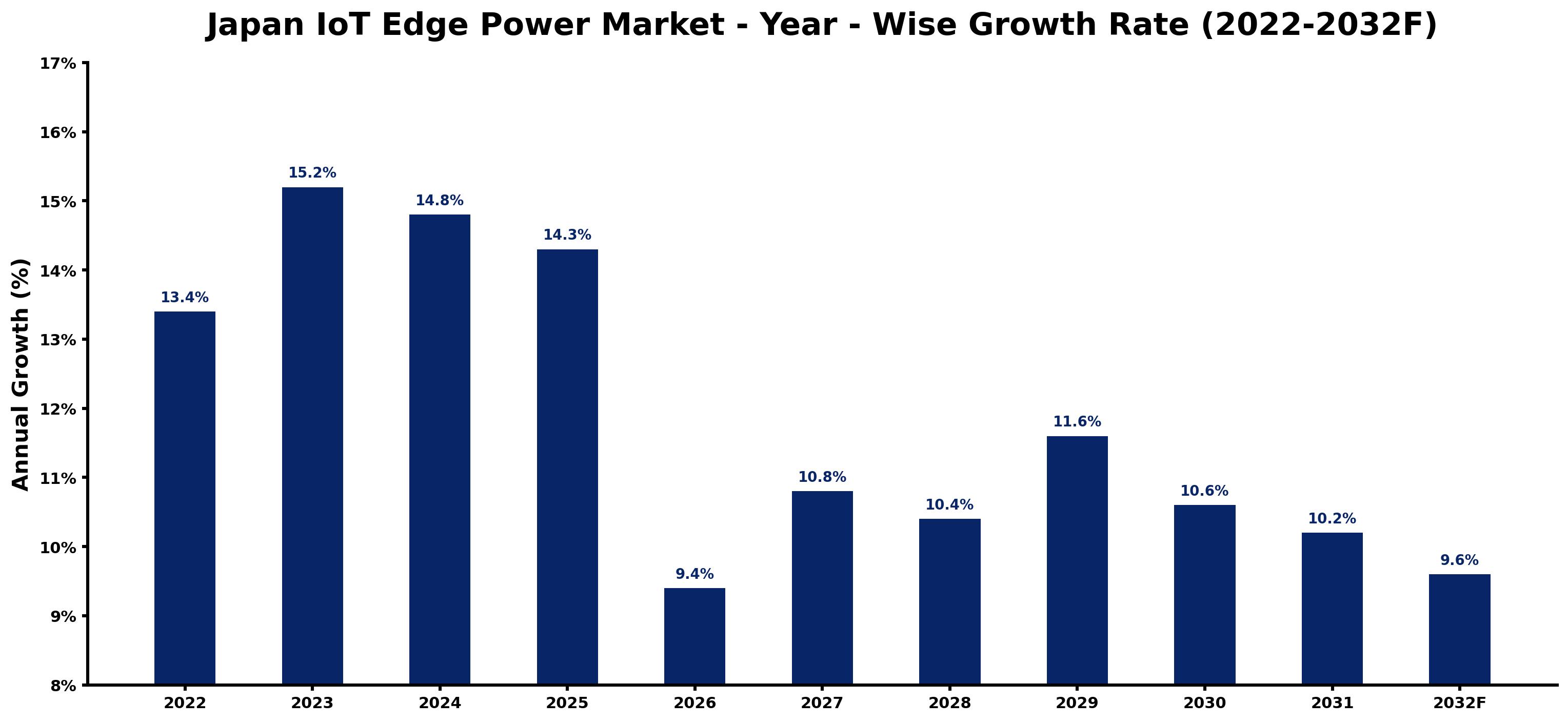
For each year, the table pairs the estimated growth rate with the leading influence on demand, showing how the drivers changed across the period.
| Year | Estimated Annual Growth (%) | Market Rationale |
| 2022 | 13.4 | The market demonstrated strong activity with increasing demand for IoT solutions. |
| 2023 | 15.2 | Growth accelerated due to heightened investments in smart infrastructure projects. |
| 2024 | 14.8 | Demand continued to rise, though at a slower pace as the market matured. |
| 2025 | 14.3 | The market maintained growth, but factors like supply chain issues began to emerge. |
| 2026 | 9.4 | Growth is expected to slow further as market saturation starts affecting new investments. |
| 2027 | 10.8 | Demand is projected to pick up again with renewed focus on energy efficiency initiatives. |
| 2028 | 10.4 | Growth will moderate as competition intensifies among existing players. |
| 2029 | 11.6 | The market is expected to experience a resurgence as new technologies are adopted widely. |
| 2030 | 10.6 | Growth will decelerate slightly as the market begins to stabilise. |
| 2031 | 10.2 | Demand will continue to slow, reflecting a more mature market environment. |
| 2032 | 9.6 | The market is projected to grow steadily as new applications emerge. |
Note: Market size estimations and growth projections presented in this report are based on 6Wresearch's proprietary forecasting methodology, utilizing the latest available industry data, government publications, and primary research inputs.
Japan IoT Edge Power Market Synopsis
IoT Edge Power represents decentralized energy solutions that harness various energy sources for powering edge computing devices. This market is expanding rapidly in Japan, driven by a population of approximately 126 million and investments in smart infrastructure. The GX Basic Policy aims for JPY 150 trillion in decarbonisation investments over ten years, creating strong demand for IoT Edge Power solutions. The integration of renewable energy technologies further supports this growth, improving energy efficiency and smart infrastructure capabilities.
Market Dynamics Impact Analysis (2026–2032)
| Factor | Type | Impact | Primary Segment Affected |
| Rising investments in smart infrastructure | Driver | High | Smart Grid |
| Increased focus on decarbonisation | Driver | High | Solar Harvesting |
| Growing demand for predictive maintenance solutions | Opportunity | High | Predictive Maintenance |
| Expansion of smart city initiatives | Opportunity | High | Remote Pipelines |
| High initial costs of implementation | Restraint | High | Batteryless Tags |
| Limited awareness among potential users | Restraint | Medium | Edge Sensors |
| Compliance with evolving standards | Challenge | High | Microcontroller Nodes |
| Capacity constraints in production | Challenge | Medium | Smart Charging |
Evaluation of Drivers in Japan IoT Edge Power Market (2026–2032)
These are the developments adding the most demand over the forecast period.
| Drivers | Primary Segment Affected | Why It Matters (Evidence) |
| Investment in smart city projects | Smart Grid | Tokyo's allocation of ¥10 billion for renewable energy projects in 2023 drives demand for smart grid solutions. |
| Government decarbonisation initiatives | Solar Harvesting | Japan targets a 46% reduction in greenhouse gas emissions by 2030, boosting solar energy adoption. |
| Increased IoT device deployment | Batteryless Tags | The total installed base of IoT devices reached 1 billion in 2022, creating a need for batteryless solutions. |
| Focus on predictive maintenance technologies | Predictive Maintenance | Utility companies are integrating predictive maintenance to optimise operations and reduce downtime. |
| Rising demand for energy efficiency | Edge Sensors | Renewable energy initiatives are increasing demand for energy-efficient sensors. |
Buyers are adding capacity as investments in smart city projects surge, with Tokyo allocating ¥10 billion for renewable energy projects in 2023. In 2022, the total installed base of IoT devices reached 1 billion, generating substantial demand for batteryless solutions. The push for a 46% reduction in emissions by 2030 is driving solar energy adoption. Utility companies are increasingly integrating predictive maintenance technologies to optimise operations, while rising interest in energy efficiency boosts demand for edge sensors. These trends support the market's growth potential.
Evaluation of Restraints in Japan IoT Edge Power Market
These restraints slow adoption and weigh on supplier margins.
| Market Restraint | Primary Segment Affected | Why It Matters (Evidence) |
| High initial costs of implementation | Batteryless Tags | The adoption of batteryless tags incurs upfront costs that limit uptake among smaller firms. |
| Limited awareness among potential users | Edge Sensors | Many potential users remain unaware of the benefits of edge sensors, hindering market growth. |
| Compliance with evolving standards | Microcontroller Nodes | Producers face challenges in meeting new interoperability standards, which can delay product launches. |
| Capacity constraints in production | Smart Charging | Manufacturers are struggling to scale production to meet demand for smart charging solutions. |
| Market saturation in certain segments | Solar Harvesting | As solar harvesting technologies become mainstream, competition intensifies, impacting profit margins. |
Japan IoT Edge Power Market Challenges
High costs for IoT Edge Power solutions present a major hurdle, as initial investments can exceed JPY 10 million, restricting access for small buyers. Buyers experience delays due to the lack of interoperability standards, with the absence of JIS standards complicating device integration and resulting in operational inefficiencies that can increase costs by 20%. Technology adoption is slowed by insufficient support for smart grid initiatives, causing urban planners to miss out on potential efficiencies and delaying project timelines by up to 12 months. Supply chain issues arise from reliance on imported components, leading to unpredictable lead times that can postpone project launches by several weeks.
Trends in the Japan IoT Edge Power Market
The trends below show where the Japan IoT Edge Power Market is heading.
- Shift towards Smart Grid Technologies: Tokyo is increasingly adopting smart grid technologies, with the government allocating ¥10 billion for renewable energy projects in 2023. This shift improves energy management and efficiency across urban areas.
- Transition from Traditional to Batteryless Tags: Since 2022, there has been a notable shift towards batteryless tags in logistics, driven by their efficiency. Retail chains are adopting these solutions for real-time asset tracking.
- Emergence of Predictive Maintenance: The trend towards predictive maintenance technologies began in 2023, with utility companies integrating these solutions to reduce operational downtime. This approach is expected to improve efficiency across the sector.
- Expansion of Edge Sensor Applications: The use of edge sensors in structural health monitoring of bridges is increasing, as seen in Tokyo's smart city initiatives. This trend supports infrastructure integrity and safety.
Investment Opportunities in the Japan IoT Edge Power Market
The following opportunities in the Japan IoT Edge Power Market pair current demand with a clear way in.
- IoT Edge Power Solutions: With Japan targeting a 46% cut in emissions by 2030, there is strong demand for IoT Edge Power solutions. Utility companies are looking to integrate these technologies to improve grid management.
- Smart Charging Infrastructure: The GX Basic Policy aims to enhance electric vehicle infrastructure by 2030, presenting an opportunity for suppliers to invest in charging solutions. Municipal planners are actively seeking partners for development.
- Predictive Maintenance Technologies: As utility companies adopt predictive maintenance, there is a growing need for advanced IoT solutions. Suppliers can enter this market by partnering with local firms for technology integration.
- Batteryless Tags for Logistics: The increasing adoption of batteryless tags in logistics presents a timely opportunity. Retail chains are seeking efficient tracking solutions, making this an attractive investment area.
Government Initiatives in the Japan IoT Edge Power Market
The GX Promotion Act (2023) establishes a legal framework for decarbonisation efforts, mandating reductions in greenhouse gas emissions. This act compels producers to invest in renewable energy technologies, expanding the market for IoT Edge Power solutions. The government aims for about JPY 150 trillion in public-private decarbonisation investment over ten years, benefiting technology providers and buyers alike.
The Ministry of the Environment oversees initiatives that promote renewable energy since 2018, providing funding for projects that integrate IoT technologies. This support enables utility companies to implement smart grid solutions effectively, with funding allocated to enhance infrastructure efficiency and reliability.
Future Insight of the Japan IoT Edge Power Market
Advancements in energy management systems will transform demand for IoT Edge Power solutions, as cities focus on energy efficiency. By 2032, Japan's total installed base of IoT devices will exceed 2 billion, creating new opportunities for operational improvements. The government's ¥10 billion allocation for renewable energy projects will drive innovation in energy harvesting techniques. Enhanced interoperability standards will streamline device integration, benefiting both buyers and suppliers in the evolving market.
Market Segmentation Analysis
Japan IoT Edge Power Market report covers a detailed analysis of the following market segments:
By Power Source Type – Solar Harvesting Leads and Records the Fastest Growth
According to Saurav Kr Singh, Senior Research Analyst at 6Wresearch, Solar Harvesting accounted for 44% of the market by power source type in 2025. Solar harvesting leads the market because it directly powers devices using solar energy, aligning with Japan's renewable energy goals. The government's investment in decarbonisation initiatives further solidifies its position as a preferred energy source. Its lead should widen, with a projected CAGR of 12.7% during 2026–2032, the highest in this split. The rapid growth of solar harvesting is fuelled by Japan's ambitious greenhouse gas reduction targets, aiming for net zero by 2050. This commitment ensures that solar harvesting will continue to dominate the market. Suppliers should focus on solar harvesting technologies to meet government targets and increasing demand.
By Device Type – Microcontroller Nodes Lead, Batteryless Tags Expected to Grow Fastest
The largest device type category in 2025 was Microcontroller Nodes, at 42% of revenue. Microcontroller nodes lead the market as they are essential for processing data at the edge, enabling effective operations in various sectors. Their widespread use in applications such as smart city initiatives solidifies their dominant position. Over 2026–2032, Batteryless Tags are expected to post the fastest growth, at a CAGR of 14.8%. Batteryless tags are experiencing rapid growth due to their ability to track and monitor assets without the need for batteries, making them particularly suitable for logistics. This trend is fuelled by the demand for energy-efficient solutions in urban environments. Buyers should consider integrating batteryless tags to enhance operational efficiency and reduce maintenance costs.
By Energy Management – Smart Grid Leads, Predictive Maintenance Expected to Grow Fastest
With 47% of energy management revenue in 2025, Smart Grid was the largest category. Smart grid solutions dominate the energy management segment as they integrate IoT devices for improved energy management, crucial for utility companies. Their alignment with Japan's energy policies ensures a strong market presence. The quickest growth will come from Predictive Maintenance, forecast to expand at a CAGR of 13.8% between 2026 and 2032. Predictive maintenance is growing quickly as it leverages data from devices to anticipate failures, thereby reducing downtime. The increasing implementation of IoT technologies in utility operations propels this segment's growth. Suppliers should focus on developing predictive maintenance solutions to cater to the rising demand for efficiency in energy management.
By Application Area – Remote Pipelines Lead, Retail Asset Tracking Expected to Grow Fastest
Remote Pipelines took 38% of application area revenue in 2025, more than any other category. Remote pipelines are the leading application area as they power monitoring devices in isolated locations, ensuring the reliability of critical infrastructure. Their importance in managing energy resources reinforces their top position in the market. Retail Asset Tracking is set to record the highest CAGR in this split, 12.4% over 2026–2032. Retail asset tracking is rapidly expanding as it facilitates real-time tracking of assets, which is vital for optimising inventory management in retail. The ongoing trend towards urbanisation further drives this demand. Suppliers should create retail asset tracking solutions to address the increasing need for effective inventory management.
By End User – Utility Companies Lead, Oil & Gas Companies Expected to Grow Fastest
Utility Companies held 39% of the Japan IoT Edge Power Market by end user in 2025. Utility companies represent the largest end user group as they incorporate IoT for grid management and operational efficiency, essential for modern energy systems. Their extensive infrastructure and ongoing projects guarantee a consistent demand for IoT solutions. Oil & Gas Companies are projected to grow fastest, at a CAGR of 13.4% during 2026–2032. Oil and gas companies are witnessing the fastest growth due to their focus on enhancing operational efficiency and monitoring, especially in remote locations. The sector's increasing emphasis on sustainability accelerates IoT adoption. Suppliers should tailor their offerings to meet the specific operational efficiency needs of oil and gas companies.
Key Attractiveness of the Report
- 10 Years of Market Numbers
- Historical Data Starting from 2022 to 2025
- Base Year 2025
- Forecast Data until 2032
- Key Performance Indicators Impacting the Market
- Major Upcoming Developments and Projects
Key Highlights of the Report:
- Japan IoT Edge Power Market Outlook
- Market Size of Japan IoT Edge Power Market, 2025
- Forecast of Japan IoT Edge Power Market, 2032
- Historical Data and Forecast of Japan IoT Edge Power Revenues & Volume for the Period 2022-2032F
- Japan IoT Edge Power Market Trend Evolution
- Japan IoT Edge Power Market Drivers and Challenges
- Japan IoT Edge Power Price Trends
- Japan IoT Edge Power Porter's Five Forces
- Japan IoT Edge Power Industry Life Cycle
- Historical Data and Forecast of Japan IoT Edge Power Market Revenues & Volume By Power Source Type for the Period 2022-2032F
- Historical Data and Forecast of Japan IoT Edge Power Market Revenues & Volume By Solar Harvesting for the Period 2022-2032F
- Historical Data and Forecast of Japan IoT Edge Power Market Revenues & Volume By RF Energy for the Period 2022-2032F
- Historical Data and Forecast of Japan IoT Edge Power Market Revenues & Volume By Thermal Energy for the Period 2022-2032F
- Historical Data and Forecast of Japan IoT Edge Power Market Revenues & Volume By Piezoelectric for the Period 2022-2032F
- Historical Data and Forecast of Japan IoT Edge Power Market Revenues & Volume By Device Type for the Period 2022-2032F
- Historical Data and Forecast of Japan IoT Edge Power Market Revenues & Volume By Microcontroller Nodes for the Period 2022-2032F
- Historical Data and Forecast of Japan IoT Edge Power Market Revenues & Volume By Batteryless Tags for the Period 2022-2032F
- Historical Data and Forecast of Japan IoT Edge Power Market Revenues & Volume By Edge Sensors for the Period 2022-2032F
- Historical Data and Forecast of Japan IoT Edge Power Market Revenues & Volume By Structural Health Monitors for the Period 2022-2032F
- Historical Data and Forecast of Japan IoT Edge Power Market Revenues & Volume By Energy Management for the Period 2022-2032F
- Historical Data and Forecast of Japan IoT Edge Power Market Revenues & Volume By Off-Grid Optimization for the Period 2022-2032F
- Historical Data and Forecast of Japan IoT Edge Power Market Revenues & Volume By Smart Charging for the Period 2022-2032F
- Historical Data and Forecast of Japan IoT Edge Power Market Revenues & Volume By Smart Grid for the Period 2022-2032F
- Historical Data and Forecast of Japan IoT Edge Power Market Revenues & Volume By Predictive Maintenance for the Period 2022-2032F
- Historical Data and Forecast of Japan IoT Edge Power Market Revenues & Volume By Application Area for the Period 2022-2032F
- Historical Data and Forecast of Japan IoT Edge Power Market Revenues & Volume By Remote Pipelines for the Period 2022-2032F
- Historical Data and Forecast of Japan IoT Edge Power Market Revenues & Volume By Retail Asset Tracking for the Period 2022-2032F
- Historical Data and Forecast of Japan IoT Edge Power Market Revenues & Volume By Power Substations for the Period 2022-2032F
- Historical Data and Forecast of Japan IoT Edge Power Market Revenues & Volume By Bridges/Infrastructure for the Period 2022-2032F
- Historical Data and Forecast of Japan IoT Edge Power Market Revenues & Volume By End User for the Period 2022-2032F
- Historical Data and Forecast of Japan IoT Edge Power Market Revenues & Volume By Oil & Gas Companies for the Period 2022-2032F
- Historical Data and Forecast of Japan IoT Edge Power Market Revenues & Volume By Retail Chains for the Period 2022-2032F
- Historical Data and Forecast of Japan IoT Edge Power Market Revenues & Volume By Utility Companies for the Period 2022-2032F
- Historical Data and Forecast of Japan IoT Edge Power Market Revenues & Volume By Municipal Planners for the Period 2022-2032F
- Japan IoT Edge Power Import Export Trade Statistics
- Market Opportunity Assessment By Power Source Type
- Market Opportunity Assessment By Device Type
- Market Opportunity Assessment By Energy Management
- Market Opportunity Assessment By Application Area
- Market Opportunity Assessment By End User
- Japan IoT Edge Power Top Companies Market Share
- Japan IoT Edge Power Competitive Benchmarking By Technical and Operational Parameters
- Japan IoT Edge Power Company Profiles
- Japan IoT Edge Power Key Strategic Recommendations
Market Covered
Segments analysed in this report are listed below.
By Power Source Type
- Solar Harvesting
- RF Energy
- Thermal Energy
- Piezoelectric
By Device Type
- Microcontroller Nodes
- Batteryless Tags
- Edge Sensors
- Structural Health Monitors
By Energy Management
- Off-Grid Optimization
- Smart Charging
- Smart Grid
- Predictive Maintenance
By Application Area
- Remote Pipelines
- Retail Asset Tracking
- Power Substations
- Bridges/Infrastructure
By End User
- Oil & Gas Companies
- Retail Chains
- Utility Companies
- Municipal Planners































