Japan IoT-Enabled Crop Protection Market Size & Growth Rate
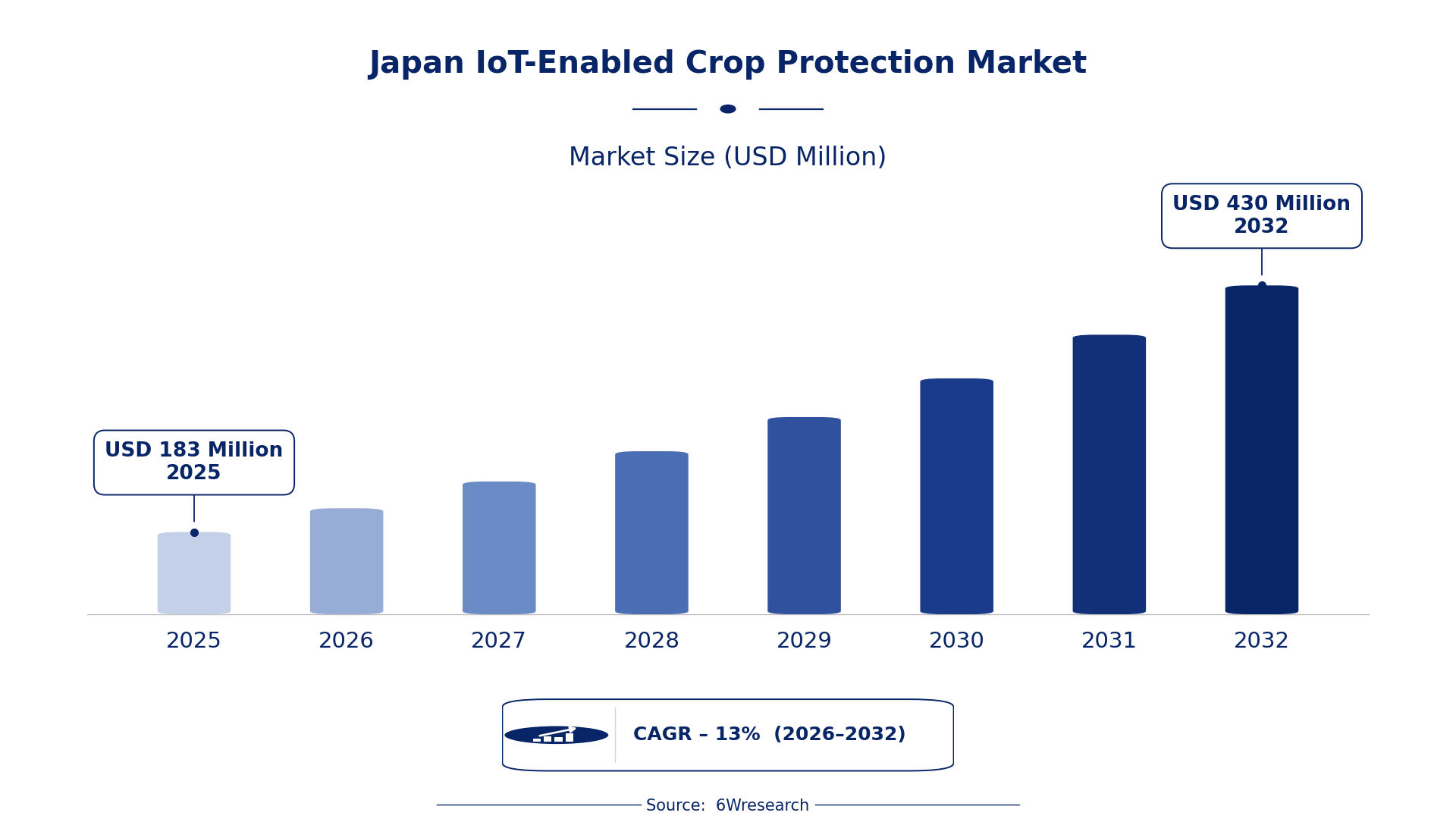
According to 6Wresearch internal database and industry insights, the Japan IoT-Enabled Crop Protection Market was valued at USD 183 Million in 2025 and is projected to reach USD 430 Million by 2032, growing at a CAGR of approximately 13% during 2026–2032.
Japan IoT-Enabled Crop Protection Market Highlights
| Report Metric | Details |
| Report Name | Japan IoT-Enabled Crop Protection Market (2026-2032) |
| Market Size 2025 | USD 183 Million |
| Market Size 2032 | USD 430 Million |
| Absolute Growth 2025–2032 | USD 247 Million |
| CAGR 2026–2032 | 13% |
| Peak Annual Growth | 14.0% in 2032 |
| Forecast Period | 2026–2032 |
| Historical Data | 2022–2025 |
| Base Year | 2025 |
| Leading Protection Method, 2025 | Pest Detection (39% share) |
| Leading Sensor Type, 2025 | Optical Cameras (46% share) |
| Leading Delivery System, 2025 | Drone Sprayers (47% share) |
| Leading Connectivity, 2025 | Cellular/LoRaWAN (50% share) |
| Leading End User, 2025 | AgriTech Firms (48% share) |
| Fastest-Growing Protection Method | Pesticide Scheduling (19.1% CAGR) |
| Fastest-Growing Sensor Type | Environmental Sensors (19.5% CAGR) |
| Fastest-Growing Delivery System | Automated Dispensers (18.7% CAGR) |
| Fastest-Growing Connectivity | LPWAN (17.2% CAGR) |
| Growing Sector | agriculture |
| Key End Users | agri-tech firms, greenhouse farmers, large farm operators |
Japan IoT-Enabled Crop Protection Market Year-wise Growth Rate and Key Drivers (2022–2032)
This graph illustrates the annual growth rates of the market from 2022 to 2032, highlighting a steady upward trajectory and projected market expansion over the forecast period.
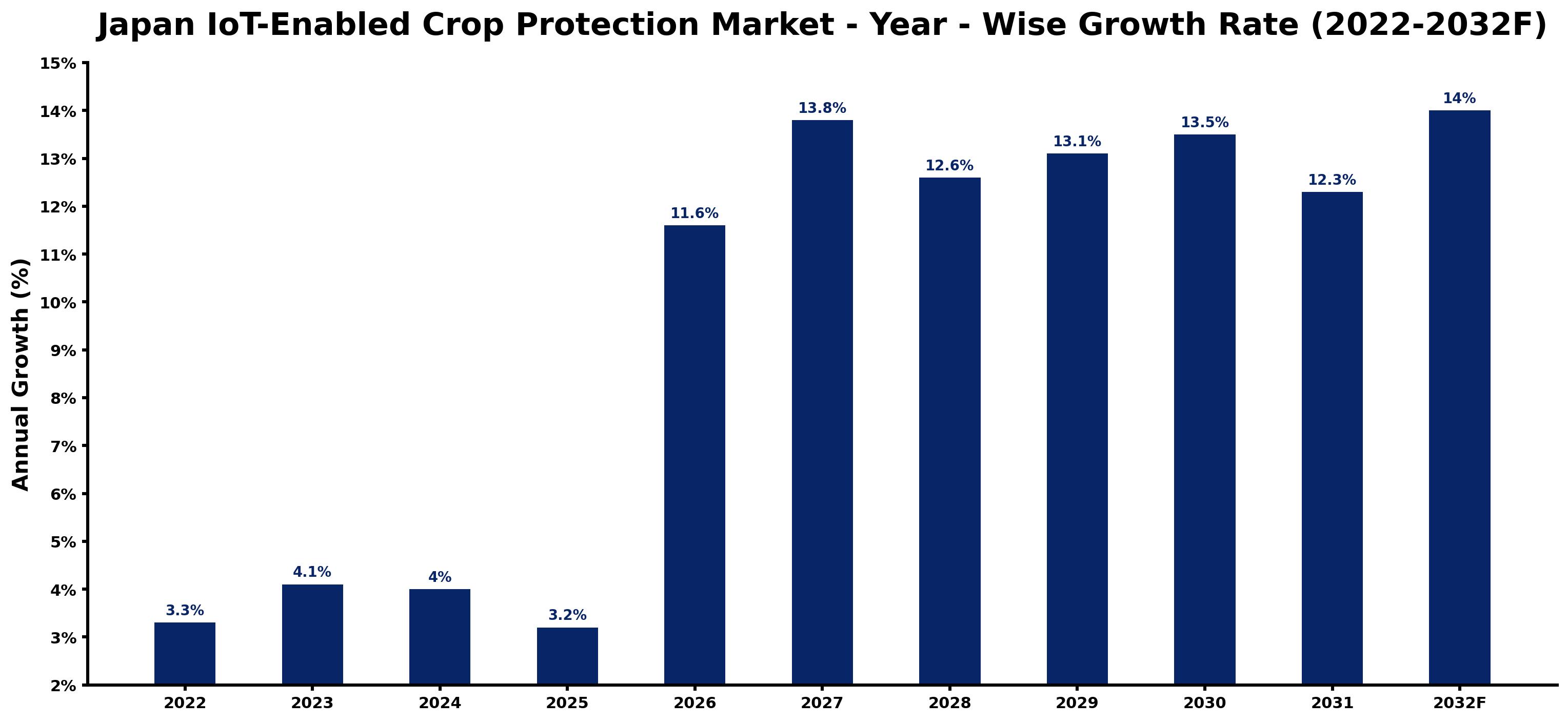
Year by year, the estimates below pair each growth rate with the development that shaped it.
| Year | Estimated Annual Growth (%) | Market Rationale |
| 2022 | 3.3 | The market showed steady growth as agricultural technology adoption increased. |
| 2023 | 4.1 | Demand for IoT solutions rose due to heightened awareness of crop health management. |
| 2024 | 4.0 | Growth slowed as market saturation began to affect new technology uptake. |
| 2025 | 3.2 | The market continued to grow, but at a reduced pace due to economic factors. |
| 2026 | 11.6 | A surge in investment in smart agriculture technologies is expected to boost growth. |
| 2027 | 13.8 | Demand is projected to increase further as more agri-tech firms adopt IoT solutions. |
| 2028 | 12.6 | Growth is expected to slow slightly as the market matures and competition intensifies. |
| 2029 | 13.1 | A resurgence in technology adoption among farmers will drive demand higher again. |
| 2030 | 13.5 | Continued investment in precision farming technologies is projected to support growth. |
| 2031 | 12.3 | Growth is expected to slow as the market reaches a more stable phase of development. |
| 2032 | 14.0 | The market is projected to peak as smart agriculture adoption reaches new heights. |
Note: Market size estimations and growth projections presented in this report are based on 6Wresearch's proprietary forecasting methodology, utilizing the latest available industry data, government publications, and primary research inputs.
Japan IoT-Enabled Crop Protection Market Synopsis
IoT-Enabled Crop Protection utilises advanced technology to monitor crop health through sensors and data analytics, enabling pest detection, disease monitoring, and optimised pesticide application. The Japan IoT-Enabled Crop Protection Market is growing due to rising demand from agri-tech firms and government initiatives aimed at improving agricultural productivity. With a target to increase smart agriculture adoption by 30% by 2025, these factors are driving market expansion.
Market Dynamics Impact Analysis (2026–2032)
| Factor | Type | Impact | Primary Segment Affected |
| Increased adoption of precision farming techniques | Driver | High | Pest Detection |
| Rising investment in smart farming technologies | Driver | High | Pesticide Scheduling |
| Growing interest in sustainable farming practices | Opportunity | High | Disease Monitoring |
| Expansion of agri-tech firms in Japan | Opportunity | Medium | Smart Sprayers |
| High initial investment costs for IoT systems | Restraint | High | Drone Sprayers |
| Limited awareness among traditional farmers | Restraint | Medium | Automated Dispensers |
| Competition from traditional crop protection methods | Challenge | High | Soil-Triggered System |
| Technological integration challenges in existing farms | Challenge | Medium | Vehicle-Mounted |
Evaluation of Drivers in Japan IoT-Enabled Crop Protection Market (2026–2032)
The main growth drivers and the segments they affect most are set out below.
| Drivers | Primary Segment Affected | Why It Matters (Evidence) |
| Increased pest detection capabilities | Pest Detection | IoT-enabled systems can reduce pesticide use by up to 20%, prompting farmers to invest more. |
| Improved efficiency in pesticide application | Pesticide Scheduling | Real-time data analytics allow for precise timing, leading to higher crop yields and reduced waste. |
| Government support for smart agriculture | Disease Monitoring | The government aims to increase smart agriculture adoption by 30% by 2025, encouraging investments. |
| Rising consumer demand for sustainable produce | Smart Sprayers | Farmers are adopting IoT technologies to meet consumer preferences for eco-friendly farming practices. |
| Technological advancements in sensor technology | Drone Sprayers | Recent developments in drone technology are making crop protection more accessible and efficient for farmers. |
The strongest pull on demand comes from the increasing adoption of precision farming techniques, which allow producers to optimise their operations. In 2022, Japan had around 1,000 agri-tech firms utilising IoT solutions, reflecting a growing interest in technology. IoT-enabled pest detection systems can reduce pesticide use by up to 20%, prompting more producers to adopt these systems. Rising consumer demand for sustainably grown produce is also driving investment in smart sprayers that improve efficiency and reduce environmental impact.
Evaluation of Restraints in Japan IoT-Enabled Crop Protection Market
The key brakes on demand, and where they bite hardest, are shown below.
| Market Restraint | Primary Segment Affected | Why It Matters (Evidence) |
| High initial investment costs for IoT systems | Drone Sprayers | Farmers face upfront costs that can exceed ¥50 million, deterring adoption among smaller operators with limited budgets. |
| Limited awareness among traditional farmers | Automated Dispensers | Many traditional farmers lack knowledge of IoT benefits, hindering broader market growth. |
| Preference for established crop protection methods | Soil-Triggered System | Farmers may prefer traditional methods over new technologies, slowing adoption rates. |
| Technological integration challenges in existing farms | Vehicle-Mounted | Integrating new systems with existing farming practices can be complex and costly. |
| Regulatory hurdles for new technologies | Pesticide Scheduling | Compliance with agricultural regulations can delay the introduction of new solutions. |
Japan IoT-Enabled Crop Protection Market Challenges
Japan's agricultural sector currently struggles with a shortage of IoT-enabled crop protection solutions, which hampers producers' ability to monitor crop health effectively. This shortage arises from the high costs of advanced technology adoption, with integrated systems potentially exceeding ¥50 million, placing a financial burden on smaller farms. Increased competition from international agri-tech firms compels local producers to lower prices, risking quality compromises. Slow integration of new technologies, such as the JIS B 9950 standard for agricultural drones, delays operational efficiency for buyers aiming to optimise pesticide application.
Trends in the Japan IoT-Enabled Crop Protection Market
Several trends are reshaping the Japan IoT-Enabled Crop Protection Market; the most important are set out below.
- Shift from Traditional to Smart Farming: Farmers are increasingly adopting smart farming techniques, particularly in the Tohoku region, where IoT technologies are being integrated into crop management. This shift is reflected in the growing number of agri-tech firms, with around 1,000 firms utilising IoT solutions in 2022.
- Rise of Drone Technology in Crop Protection: Drone sprayers are becoming the preferred method for pesticide application among large farm operators. This trend is supported by the JIS B 9950 standard for agricultural drones, which improves operational efficiency and safety.
- Growing Demand for Sustainable Practices: Agri-tech firms are prioritising sustainable farming methods to meet consumer expectations. The government's push for smart agriculture adoption by 30% by 2025 is driving this trend forward.
- Increased Investment in Precision Agriculture: Investment in precision agriculture technologies is surging, particularly in greenhouse farming, which accounts for 15% of Japan's total agricultural output. This trend reflects a broader commitment to improving productivity and sustainability.
Investment Opportunities in the Japan IoT-Enabled Crop Protection Market
Where to invest in the Japan IoT-Enabled Crop Protection Market: the main openings are set out below.
- Tohoku Region as a Hub for Smart Agriculture: The Tohoku region is emerging as a key area for adopting smart agriculture technologies, with growth expected in this market. Companies can invest in local partnerships to tap into this expanding sector.
- Investment in Automated Dispensers: With the average farm size in Japan being about 1.5 hectares, there is a strong opportunity to supply automated dispensers that optimise pesticide application. Agri-tech firms are ideal partners for this investment.
- Expansion of Pest Detection Systems: The increasing need for pest detection systems presents a lucrative opportunity, as IoT-enabled solutions can significantly reduce pesticide use. Targeting greenhouse farmers can yield substantial returns.
- Market for Environmental Sensors: The environmental sensors segment is set for rapid growth, driven by the need for precise monitoring. Investing in this technology now can cater to the increasing demand from agri-tech firms.
Government Initiatives in the Japan IoT-Enabled Crop Protection Market
The New Robot Strategy, introduced in 2015, aimed to expand the use of robotics in agriculture, promoting productivity. This policy has encouraged the integration of IoT technologies in crop protection, improving efficiency and sustainability in farming practices. The AI Promotion Act of 2025 establishes a national framework for AI research and development, supporting the growth of IoT-enabled solutions in agriculture.
The Ministry of Agriculture, Forestry and Fisheries (MAFF) actively promotes smart farming initiatives. In 2023, MAFF launched a subsidy program for smart farming technologies worth ¥10 billion, aimed at encouraging farmers to adopt new solutions. This funding supports the development and implementation of IoT technologies, improving productivity and sustainability in the agricultural sector.
Future Insight of the Japan IoT-Enabled Crop Protection Market
By 2032, agri-tech firms will experience significant advancements in crop management driven by technology integration. Government initiatives, including a subsidy program worth ¥10 billion, will facilitate the adoption of advanced agricultural sensors, improving pest detection and disease monitoring. Precision farming techniques will become commonplace, enhancing productivity and minimising waste. The Tohoku region is set to become a frontrunner in smart agriculture technologies, establishing new standards for efficiency and sustainability in crop management.
Market Segmentation Analysis
Japan IoT-Enabled Crop Protection Market report covers a detailed analysis of the following market segments:
By Protection Method – Pest Detection Leads, Pesticide Scheduling Expected to Grow Fastest
According to Saurav Kr Singh, Senior Research Analyst at 6Wresearch, Pest Detection accounted for 39% of the market by protection method in 2025. Pest Detection holds the largest share because it is essential for identifying pest threats early, which is crucial for maintaining crop health. The implementation of pest detection systems can reduce pesticide use by up to 20%, underscoring its role in sustainable agricultural practices. The quickest growth will come from Pesticide Scheduling, forecast to expand at a CAGR of 19.1% between 2026 and 2032. Pesticide Scheduling is growing rapidly as it optimises pesticide application based on real-time data, significantly enhancing efficiency. The government's initiative to increase smart agriculture adoption by 30% by 2025 is expected to further accelerate this segment's growth. Suppliers should develop advanced scheduling solutions to meet the rising demand for efficient crop management.
By Sensor Type – Optical Cameras Lead, Environmental Sensors Expected to Grow Fastest
With 46% of sensor type revenue in 2025, Optical Cameras was the largest category. Optical Cameras dominate the market due to their widespread use in monitoring crop health and assessing pest threats, making them vital in precision agriculture. Their integration with data analytics platforms enhances their effectiveness in the agri-tech sector. Over 2026–2032, Environmental Sensors are expected to post the fastest growth, at a CAGR of 19.5%. Environmental Sensors are experiencing rapid growth as they provide critical data for optimising crop protection strategies. The agricultural sector's shift towards data-driven decision-making is likely to significantly boost the demand for these sensors. Buyers will gain from investing in advanced sensor technologies to improve crop management and yield outcomes.
By Delivery System – Drone Sprayers Lead, Automated Dispensers Expected to Grow Fastest
The largest delivery system category in 2025 was Drone Sprayers, at 47% of revenue. Drone Sprayers lead the market as they are directly used for applying crop protection products, offering efficiency and precision in pesticide application. Their adoption aligns with government initiatives promoting smart farming technologies. Automated Dispensers are projected to grow fastest, at a CAGR of 18.7% during 2026–2032. Automated Dispensers are witnessing the fastest growth as they enable precise pesticide application, reducing waste and improving effectiveness. The increasing focus on sustainability in agriculture is driving rapid expansion in this segment. Suppliers should prioritise the development of automated systems to meet the growing need for precision in crop protection.
By Connectivity – Cellular/LoRaWAN Leads, LPWAN Expected to Grow Fastest
Cellular/LoRaWAN held 50% of the Japan IoT-Enabled Crop Protection Market by connectivity in 2025. Cellular/LoRaWAN is the leading connectivity method due to its extensive use in data transmission for agricultural applications, facilitating real-time monitoring and management. Its reliability in rural areas makes it a preferred choice among agri-tech firms. LPWAN is set to record the highest CAGR in this split, 17.2% over 2026–2032. LPWAN is experiencing the fastest growth as it supports low-power, long-range communication, which is essential for IoT applications in agriculture. The increasing number of agri-tech firms adopting IoT solutions is driving demand for this connectivity type. Buyers should consider connectivity solutions that enhance data transmission capabilities to improve operational efficiency.
By End User – AgriTech Firms Lead and Record the Fastest Growth
AgriTech Firms took 48% of end user revenue in 2025, more than any other category. AgriTech Firms dominate the end user segment as they are the primary adopters of IoT-enabled solutions for effective crop management. Their focus on leveraging technology for improved agricultural practices drives demand for advanced crop protection methods. AgriTech Firms are also forecast to expand faster than any other category, at a CAGR of 14.4% over 2026–2032. AgriTech Firms are also the fastest-growing segment, as their continuous innovation and integration of IoT technologies lead to enhanced productivity. Their pivotal role in the agricultural sector ensures sustained growth in this area. Suppliers should align their offerings with the needs of agri-tech firms to capitalise on the growing market for IoT-enabled crop protection.
Key Attractiveness of the Report
- 10 Years of Market Numbers
- Historical Data Starting from 2022 to 2025
- Base Year 2025
- Forecast Data until 2032
- Key Performance Indicators Impacting the Market
- Major Upcoming Developments and Projects
Key Highlights of the Report:
- Japan IoT-Enabled Crop Protection Market Outlook
- Market Size of Japan IoT-Enabled Crop Protection Market, 2025
- Forecast of Japan IoT-Enabled Crop Protection Market, 2032
- Historical Data and Forecast of Japan IoT-Enabled Crop Protection Revenues & Volume for the Period 2022-2032F
- Japan IoT-Enabled Crop Protection Market Trend Evolution
- Japan IoT-Enabled Crop Protection Market Drivers and Challenges
- Japan IoT-Enabled Crop Protection Price Trends
- Japan IoT-Enabled Crop Protection Porter's Five Forces
- Japan IoT-Enabled Crop Protection Industry Life Cycle
- Historical Data and Forecast of Japan IoT-Enabled Crop Protection Market Revenues & Volume By Protection Method for the Period 2022-2032F
- Historical Data and Forecast of Japan IoT-Enabled Crop Protection Market Revenues & Volume By Pest Detection for the Period 2022-2032F
- Historical Data and Forecast of Japan IoT-Enabled Crop Protection Market Revenues & Volume By Disease Monitoring for the Period 2022-2032F
- Historical Data and Forecast of Japan IoT-Enabled Crop Protection Market Revenues & Volume By Pesticide Scheduling for the Period 2022-2032F
- Historical Data and Forecast of Japan IoT-Enabled Crop Protection Market Revenues & Volume By Smart Sprayers for the Period 2022-2032F
- Historical Data and Forecast of Japan IoT-Enabled Crop Protection Market Revenues & Volume By Sensor Type for the Period 2022-2032F
- Historical Data and Forecast of Japan IoT-Enabled Crop Protection Market Revenues & Volume By Optical Cameras for the Period 2022-2032F
- Historical Data and Forecast of Japan IoT-Enabled Crop Protection Market Revenues & Volume By Humidity Sensors for the Period 2022-2032F
- Historical Data and Forecast of Japan IoT-Enabled Crop Protection Market Revenues & Volume By Environmental Sensors for the Period 2022-2032F
- Historical Data and Forecast of Japan IoT-Enabled Crop Protection Market Revenues & Volume By Infrared + GPS Sensors for the Period 2022-2032F
- Historical Data and Forecast of Japan IoT-Enabled Crop Protection Market Revenues & Volume By Delivery System for the Period 2022-2032F
- Historical Data and Forecast of Japan IoT-Enabled Crop Protection Market Revenues & Volume By Drone Sprayers for the Period 2022-2032F
- Historical Data and Forecast of Japan IoT-Enabled Crop Protection Market Revenues & Volume By Automated Dispensers for the Period 2022-2032F
- Historical Data and Forecast of Japan IoT-Enabled Crop Protection Market Revenues & Volume By Soil-Triggered System for the Period 2022-2032F
- Historical Data and Forecast of Japan IoT-Enabled Crop Protection Market Revenues & Volume By Vehicle-Mounted for the Period 2022-2032F
- Historical Data and Forecast of Japan IoT-Enabled Crop Protection Market Revenues & Volume By Connectivity for the Period 2022-2032F
- Historical Data and Forecast of Japan IoT-Enabled Crop Protection Market Revenues & Volume By Cellular/LoRaWAN for the Period 2022-2032F
- Historical Data and Forecast of Japan IoT-Enabled Crop Protection Market Revenues & Volume By Wi-Fi + Zigbee for the Period 2022-2032F
- Historical Data and Forecast of Japan IoT-Enabled Crop Protection Market Revenues & Volume By LPWAN for the Period 2022-2032F
- Historical Data and Forecast of Japan IoT-Enabled Crop Protection Market Revenues & Volume By Bluetooth for the Period 2022-2032F
- Historical Data and Forecast of Japan IoT-Enabled Crop Protection Market Revenues & Volume By End User for the Period 2022-2032F
- Historical Data and Forecast of Japan IoT-Enabled Crop Protection Market Revenues & Volume By AgriTech Firms for the Period 2022-2032F
- Historical Data and Forecast of Japan IoT-Enabled Crop Protection Market Revenues & Volume By Greenhouse Farmers for the Period 2022-2032F
- Historical Data and Forecast of Japan IoT-Enabled Crop Protection Market Revenues & Volume By Row Crop Growers for the Period 2022-2032F
- Historical Data and Forecast of Japan IoT-Enabled Crop Protection Market Revenues & Volume By Large Farm Operators for the Period 2022-2032F
- Japan IoT-Enabled Crop Protection Import Export Trade Statistics
- Market Opportunity Assessment By Protection Method
- Market Opportunity Assessment By Sensor Type
- Market Opportunity Assessment By Delivery System
- Market Opportunity Assessment By Connectivity
- Market Opportunity Assessment By End User
- Japan IoT-Enabled Crop Protection Top Companies Market Share
- Japan IoT-Enabled Crop Protection Competitive Benchmarking By Technical and Operational Parameters
- Japan IoT-Enabled Crop Protection Company Profiles
- Japan IoT-Enabled Crop Protection Key Strategic Recommendations
Market Covered
The following segment groups are covered in the report.
By Protection Method
- Pest Detection
- Disease Monitoring
- Pesticide Scheduling
- Smart Sprayers
By Sensor Type
- Optical Cameras
- Humidity Sensors
- Environmental Sensors
- Infrared + GPS Sensors
By Delivery System
- Drone Sprayers
- Automated Dispensers
- Soil-Triggered System
- Vehicle-Mounted
By Connectivity
- Cellular/LoRaWAN
- Wi-Fi + Zigbee
- LPWAN
- Bluetooth
By End User
- AgriTech Firms
- Greenhouse Farmers
- Row Crop Growers
- Large Farm Operators































