Japan IoT-Enabled Home Decor Market Size & Growth Rate
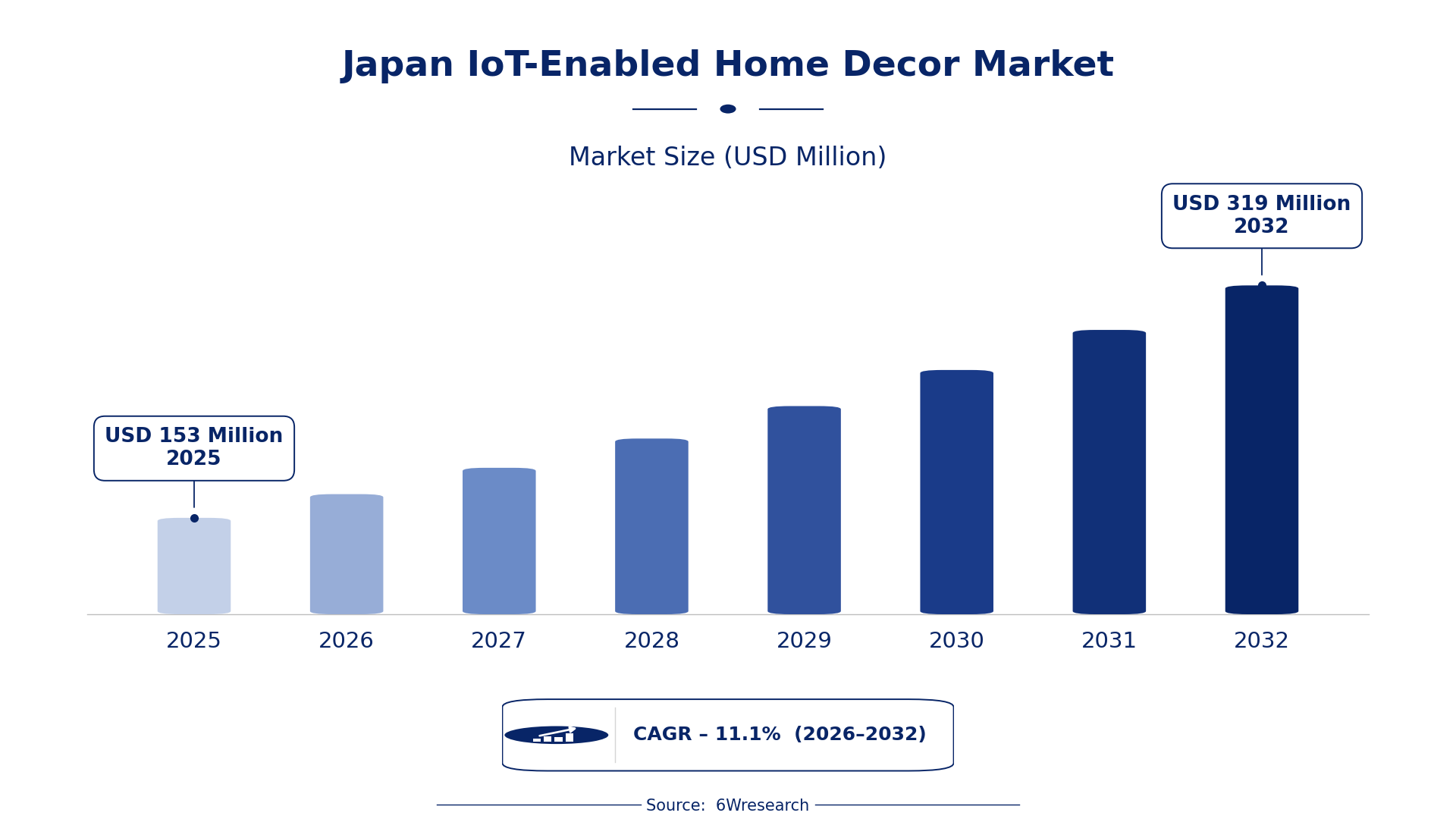
According to 6Wresearch internal database and industry insights, the Japan IoT-Enabled Home Decor Market was valued at USD 153 Million in 2025 and is projected to reach USD 319 Million by 2032, growing at a CAGR of approximately 11.1% during 2026–2032.
Japan IoT-Enabled Home Decor Market Highlights
| Report Metric | Details |
| Report Name | Japan IoT-Enabled Home Decor Market (2026-2032) |
| Market Size 2025 | USD 153 Million |
| Market Size 2032 | USD 319 Million |
| Absolute Growth 2025–2032 | USD 166 Million |
| CAGR 2026–2032 | 11.1% |
| Peak Annual Growth | 11.3% in 2027 |
| Forecast Period | 2026–2032 |
| Historical Data | 2022–2025 |
| Base Year | 2025 |
| Leading Decor Product Type, 2025 | Smart Lighting Fixtures (37% share) |
| Leading Smart Feature, 2025 | App-Controlled Scenes (52% share) |
| Leading Connectivity, 2025 | Wi-Fi (44% share) |
| Leading Power Source, 2025 | Hardwired (46% share) |
| Leading End User, 2025 | Homeowners (48% share) |
| Fastest-Growing Decor Product Type | Ambient Wall Panels (16.0% CAGR) |
| Fastest-Growing Connectivity | Zigbee (14.4% CAGR) |
| Fastest-Growing Power Source | USB/Rechargeable (15.5% CAGR) |
| Fastest-Growing End User | Interior Designers (14.0% CAGR) |
| Growing Sector | smart home products |
| Key End Users | homeowners, urban dwellers, interior designers, apartment residents |
Japan IoT-Enabled Home Decor Market Year-wise Growth Rate and Key Drivers (2022–2032)
This graph illustrates the annual growth rates of the market from 2022 to 2032, highlighting a steady upward trajectory and projected market expansion over the forecast period.
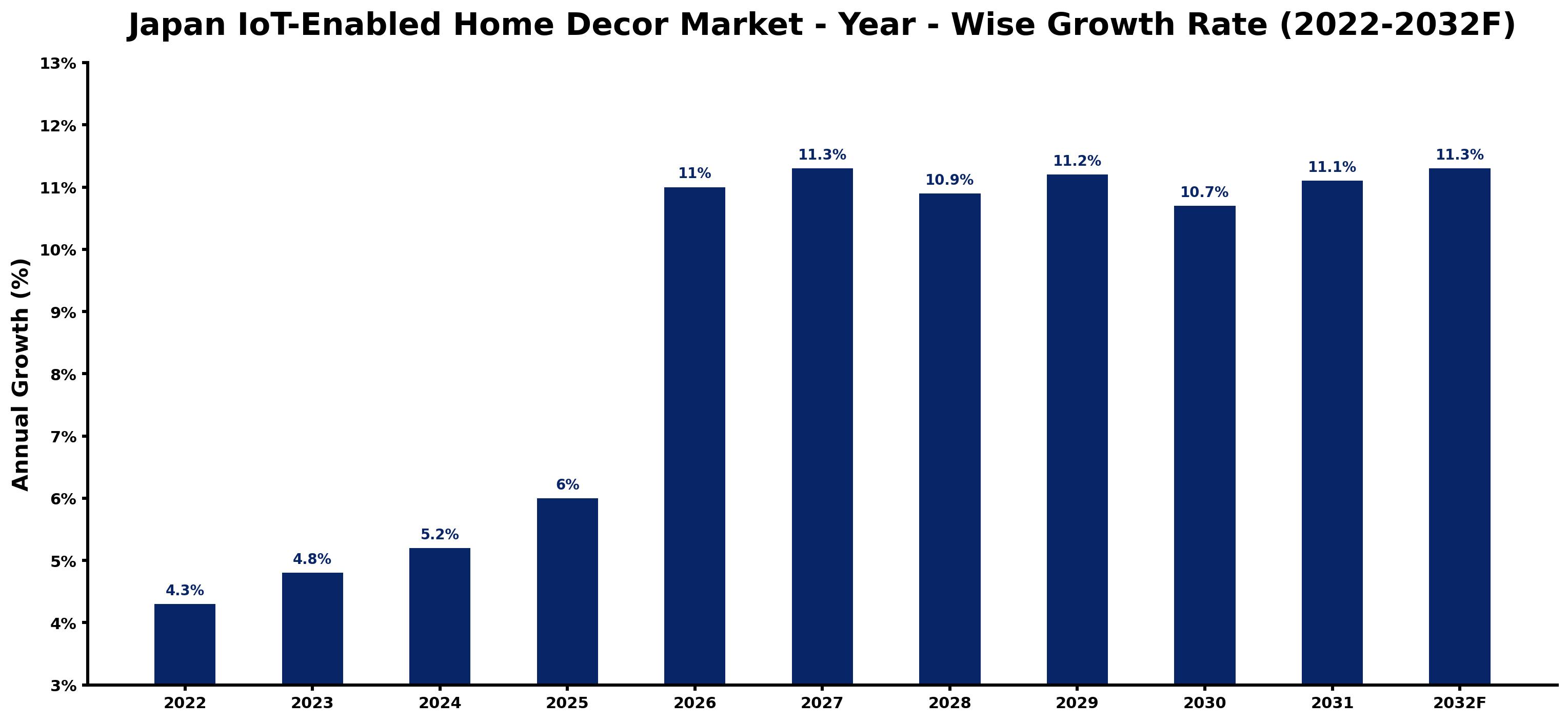
Below, each year's estimated growth is shown next to the factor that most influenced it.
| Year | Estimated Annual Growth (%) | Market Rationale |
| 2022 | 4.3 | The market experienced moderate growth as consumer awareness of smart home products increased. |
| 2023 | 4.8 | Growth accelerated due to rising urbanisation and a shift towards modern living solutions. |
| 2024 | 5.2 | Demand continued to rise as more homeowners adopted smart decor for energy efficiency. |
| 2025 | 6.0 | The market peaked historically as smart lighting fixtures gained popularity among consumers. |
| 2026 | 11.0 | Growth surged as urban dwellers increasingly sought integrated smart home solutions. |
| 2027 | 11.3 | The market reached its peak annual growth due to advancements in decor technology. |
| 2028 | 10.9 | Growth slowed slightly as market saturation began to be felt in urban areas. |
| 2029 | 11.2 | Demand increased again as new products entered the market, attracting more buyers. |
| 2030 | 10.7 | Growth decelerated as competition intensified among existing smart decor providers. |
| 2031 | 11.1 | The market rebounded with renewed interest in smart home renovations and upgrades. |
| 2032 | 11.3 | Growth peaked again as consumer preferences shifted towards more advanced decor solutions. |
Note: Market size estimations and growth projections presented in this report are based on 6Wresearch's proprietary forecasting methodology, utilizing the latest available industry data, government publications, and primary research inputs.
Japan IoT-Enabled Home Decor Market Synopsis
IoT-Enabled Home Decor includes smart products that integrate technology for improved functionality and user experience. The Japan IoT-Enabled Home Decor Market is expanding due to rising urbanisation, with around 37 million urban residents seeking modern living solutions. Households now typically feature 3-5 smart decor products, and government initiatives are promoting smart home technology, further driving demand for these solutions.
Market Dynamics Impact Analysis (2026–2032)
| Factor | Type | Impact | Primary Segment Affected |
| Urbanisation is driving demand for smart home products as urban dwellers seek convenience and aesthetics. | Driver | High | Smart Lighting Fixtures |
| Technological advancements in IoT are enabling new functionalities in home decor products. | Driver | High | Ambient Wall Panels |
| The growing trend of home renovations presents opportunities for suppliers of smart decor products. | Opportunity | High | Decorative Smart Mirrors |
| Increased interest in energy-efficient solutions opens new markets for smart decor providers. | Opportunity | Medium | Smart Clocks |
| High competition among suppliers can lead to price wars, impacting profit margins. | Restraint | High | Smart Lighting Fixtures |
| Consumer hesitation regarding technology adoption may slow market penetration rates. | Restraint | Medium | Ambient Wall Panels |
| Rising costs of advanced materials can limit production capabilities for manufacturers. | Challenge | High | Decorative Smart Mirrors |
| Compliance with safety regulations can increase operational costs for producers. | Challenge | Medium | Smart Clocks |
Evaluation of Drivers in Japan IoT-Enabled Home Decor Market (2026–2032)
The main growth drivers and the segments they affect most are set out below.
| Drivers | Primary Segment Affected | Why It Matters (Evidence) |
| Urbanisation drives demand for smart lighting fixtures that improve home aesthetics and energy efficiency. | Smart Lighting Fixtures | With approximately 37 million urban dwellers in Japan, the need for modern decor solutions is clear. |
| Technological advancements in IoT enable appealing features in ambient wall panels, attracting tech-savvy consumers. | Ambient Wall Panels | The average household in Japan has 3-5 smart decor products installed, indicating a growing market. |
| Rising interest in energy efficiency boosts demand for decorative smart mirrors that offer dual functionality. | Decorative Smart Mirrors | Smart clocks have a 15% adoption rate in urban households, showcasing consumer acceptance of smart decor. |
| Investment in smart home renovations encourages homeowners to adopt smart clocks for time management. | Smart Clocks | Government funding for smart home renovations is boosting market growth by incentivising upgrades. |
| Awareness of smart home technology among homeowners drives demand for app-controlled scenes in decor. | App-Controlled Scenes | The Japan Smart Home Association promotes IoT-enabled home solutions, increasing consumer engagement. |
Purchasing is picking up as urbanisation drives demand for smart lighting fixtures, with approximately 37 million urban dwellers seeking modern solutions. Technological advancements in IoT enable appealing features in ambient wall panels, attracting tech-savvy consumers. Interest in energy efficiency boosts demand for decorative smart mirrors, which combine aesthetics with functionality. Investment in smart home renovations encourages homeowners to adopt smart clocks, improving time management. Awareness of smart home technology among homeowners drives demand for app-controlled scenes, supported by efforts from industry associations.
Evaluation of Restraints in Japan IoT-Enabled Home Decor Market
These are the pressures that could keep growth below its potential.
| Market Restraint | Primary Segment Affected | Why It Matters (Evidence) |
| High competition among suppliers can lead to price wars, impacting profit margins. | Smart Lighting Fixtures | With many players in the market, maintaining competitive pricing is challenging. |
| Consumer hesitation regarding technology adoption may slow market penetration rates. | Ambient Wall Panels | Some consumers remain cautious about integrating technology into their homes. |
| Rising costs of advanced materials can limit production capabilities for manufacturers. | Decorative Smart Mirrors | Increased material costs can lead to higher retail prices, deterring buyers. |
| Compliance with safety regulations can increase operational costs for producers. | Smart Clocks | Manufacturers must invest in testing and certification to meet safety standards. |
| Market saturation in urban areas may limit growth potential for existing products. | App-Controlled Scenes | As more homes adopt smart decor, new customer acquisition becomes difficult. |
Japan IoT-Enabled Home Decor Market Challenges
Japan's regulatory requirements result in considerable delays for suppliers, with approval processes extending market entry by six months. Supply chain disruptions caused by component shortages lead to delivery delays of around 30 days for retailers. Rapid technological changes compel producers to innovate continuously, risking the launch of outdated products that do not meet consumer expectations. A shortage of skilled professionals in the workforce can slow product development cycles by 25%, hindering companies' ability to effectively meet market demands.
Trends in the Japan IoT-Enabled Home Decor Market
The following changes are redrawing the Japan IoT-Enabled Home Decor Market.
- Shift from Traditional Decor to Smart Solutions: Since 2023, homeowners have increasingly chosen smart decor over traditional items, motivated by the desire for convenience and energy efficiency. The average household now possesses 3-5 smart decor products, reflecting a shift in market preferences.
- Urban Dwellers Embracing Smart Technology: In 2023, urban dwellers are swiftly adopting smart home technology, with around 37 million individuals seeking modern living solutions. This trend is transforming the decor market as consumers prioritise functionality and aesthetics.
- Increased Popularity of Decorative Smart Mirrors: The demand for decorative smart mirrors has risen sharply, particularly among urban homeowners. This segment is anticipated to grow, as these products merge technology with contemporary design, appealing to a wide audience.
- Rise of Energy-Efficient Smart Lighting: The average price for smart lighting fixtures in Japan is approximately ¥10,000, indicating a growing trend towards energy-efficient solutions. Consumers are increasingly investing in these products to lower energy consumption.
Investment Opportunities in the Japan IoT-Enabled Home Decor Market
The following opportunities in the Japan IoT-Enabled Home Decor Market pair current demand with a clear way in.
- Gap in Smart Home Renovations: With ¥5 billion allocated for smart home technology development, there is an opportunity for suppliers in urban areas. Homeowners are increasingly seeking modern decor solutions that improve energy efficiency.
- Demand for Smart Clocks: Urban dwellers are increasingly adopting smart clocks, with a 15% adoption rate in 2023. Suppliers can capitalise on this trend by offering features that improve time management.
- Growing Interest in Ambient Wall Panels: As consumers seek to improve their interior design, there is a rising demand for ambient wall panels. Suppliers can enter this market by partnering with interior designers to create tailored solutions.
- Investment in Energy-Efficient Solutions: The current focus on energy efficiency presents an opportunity for suppliers of smart lighting fixtures. Homeowners are looking for products that reduce energy consumption while improving aesthetics.
Government Initiatives in the Japan IoT-Enabled Home Decor Market
The Electrical Appliance and Material Safety Act, established in 1961, governs the safety of electrical appliances sold in Japan. This legislation ensures that IoT-enabled home decor products comply with safety standards, safeguarding consumers and promoting market growth. The Long-Term Care Insurance Act, enacted in 1997, also supports the integration of technology in home environments, especially for the elderly, increasing demand for smart decor solutions.
The Japan Smart Home Association supervises the approval of smart home technology initiatives. In 2023, the government initiated a programme with a ¥5 billion budget to incentivise smart home renovations, benefiting homeowners and encouraging the adoption of IoT-enabled decor products.
Future Insight of the Japan IoT-Enabled Home Decor Market
Government initiatives are set to drive the investment pipeline for smart home technology, particularly in urban renovation projects. By 2032, households are expected to adopt an average of 7 IoT-enabled decor products, generating increased demand for suppliers. The implementation of ISO/IEC 30141:2018 will improve device compatibility across the market. As urban dwellers prioritise energy efficiency, suppliers must adjust their offerings to align with these evolving consumer preferences.
Market Segmentation Analysis
Japan IoT-Enabled Home Decor Market report covers a detailed analysis of the following market segments:
By Decor Product Type – Smart Lighting Fixtures Lead, Ambient Wall Panels Expected to Grow Fastest
According to Saurav Kr Singh, Senior Research Analyst at 6Wresearch, the largest decor product type category in 2025 was Smart Lighting Fixtures, at 37% of revenue. Smart lighting fixtures dominate the market due to their essential role in enhancing ambiance and energy efficiency in homes. Their popularity is reflected in the average installation of three to five smart decor products per household, particularly in urban areas. Ambient Wall Panels are set to record the highest CAGR in this split, 16.0% over 2026–2032. Ambient wall panels are experiencing rapid growth as they combine aesthetic appeal with smart functionality, attracting homeowners looking for modern design solutions. This segment's rise is supported by increasing consumer interest in integrating technology into their living spaces. Suppliers should focus on developing innovative smart lighting solutions to capture the growing demand in the market.
By Smart Feature – App-Controlled Scenes Lead and Record the Fastest Growth
In 2025, App-Controlled Scenes led the smart feature split with a 52% share. App-controlled scenes lead the market as they allow users to easily set moods and control multiple devices simultaneously. This feature has become essential for homeowners seeking convenience in managing their smart home environments. Its lead should widen, with a projected CAGR of 13.1% during 2026–2032, the highest in this split. The growth of app-controlled scenes will continue as they remain popular for their versatility and ease of use in smart home setups. Their dual role as a feature and a primary decor element ensures sustained demand. Suppliers must prioritise user-friendly app development to maintain competitiveness in the smart feature segment.
By Connectivity – Wi-Fi Leads, Zigbee Expected to Grow Fastest
Wi-Fi held 44% of the Japan IoT-Enabled Home Decor Market by connectivity in 2025. Wi-Fi is the leading connectivity option because it is vital for the effective operation of smart decor products in residential settings. Its widespread adoption facilitates easy integration with existing home networks, making it the preferred choice among consumers. Over 2026–2032, Zigbee is expected to post the fastest growth, at a CAGR of 14.4%. Zigbee is gaining traction as it offers efficient smart home network solutions, despite being less common in decor applications. As more devices are designed to support this technology, its market presence is likely to expand significantly. Suppliers should consider incorporating Zigbee technology into their product lines to meet shifting consumer preferences.
By Power Source – Hardwired Leads, USB/Rechargeable Expected to Grow Fastest
With 46% of power source revenue in 2025, Hardwired was the largest category. Hardwired power sources are commonly used for permanent installations of smart decor products, making them the leading choice. Their reliability is particularly appealing to homeowners seeking long-term solutions in their smart home setups. The quickest growth will come from USB/Rechargeable, forecast to expand at a CAGR of 15.5% between 2026 and 2032. USB/rechargeable power sources are gaining traction as they offer convenience for portable devices, appealing to consumers looking for flexibility. This segment is likely to expand rapidly as demand for adaptable solutions increases. Suppliers should focus on developing more USB/rechargeable options to meet the rising demand for portable smart decor.
By End User – Homeowners Lead, Interior Designers Expected to Grow Fastest
Homeowners accounted for 48% of the market by end user in 2025. Homeowners represent the largest segment as they actively seek modern home solutions that incorporate smart technology. Their demand for enhanced living experiences significantly fuels the growth of IoT-enabled home decor products. Interior Designers are set to record the highest CAGR in this split, 14.0% over 2026–2032. Interior designers are becoming increasingly important as they integrate smart decor into their designs, driving growth in this segment. Their ability to create functional and visually appealing spaces will further boost the demand for these products. Suppliers should collaborate with interior designers to better understand market trends and refine their product offerings.
Key Attractiveness of the Report
- 10 Years of Market Numbers
- Historical Data Starting from 2022 to 2025
- Base Year 2025
- Forecast Data until 2032
- Key Performance Indicators Impacting the Market
- Major Upcoming Developments and Projects
Key Highlights of the Report:
- Japan IoT-Enabled Home Decor Market Outlook
- Market Size of Japan IoT-Enabled Home Decor Market, 2025
- Forecast of Japan IoT-Enabled Home Decor Market, 2032
- Historical Data and Forecast of Japan IoT-Enabled Home Decor Revenues & Volume for the Period 2022-2032F
- Japan IoT-Enabled Home Decor Market Trend Evolution
- Japan IoT-Enabled Home Decor Market Drivers and Challenges
- Japan IoT-Enabled Home Decor Price Trends
- Japan IoT-Enabled Home Decor Porter's Five Forces
- Japan IoT-Enabled Home Decor Industry Life Cycle
- Historical Data and Forecast of Japan IoT-Enabled Home Decor Market Revenues & Volume By Decor Product Type for the Period 2022-2032F
- Historical Data and Forecast of Japan IoT-Enabled Home Decor Market Revenues & Volume By Smart Lighting Fixtures for the Period 2022-2032F
- Historical Data and Forecast of Japan IoT-Enabled Home Decor Market Revenues & Volume By Ambient Wall Panels for the Period 2022-2032F
- Historical Data and Forecast of Japan IoT-Enabled Home Decor Market Revenues & Volume By Decorative Smart Mirrors for the Period 2022-2032F
- Historical Data and Forecast of Japan IoT-Enabled Home Decor Market Revenues & Volume By Smart Clocks for the Period 2022-2032F
- Historical Data and Forecast of Japan IoT-Enabled Home Decor Market Revenues & Volume By Smart Feature for the Period 2022-2032F
- Historical Data and Forecast of Japan IoT-Enabled Home Decor Market Revenues & Volume By App-Controlled Scenes for the Period 2022-2032F
- Historical Data and Forecast of Japan IoT-Enabled Home Decor Market Revenues & Volume By Color + Motion Sensing for the Period 2022-2032F
- Historical Data and Forecast of Japan IoT-Enabled Home Decor Market Revenues & Volume By Voice Assistant Enabled for the Period 2022-2032F
- Historical Data and Forecast of Japan IoT-Enabled Home Decor Market Revenues & Volume By IoT Time Sync + Alarms for the Period 2022-2032F
- Historical Data and Forecast of Japan IoT-Enabled Home Decor Market Revenues & Volume By Connectivity for the Period 2022-2032F
- Historical Data and Forecast of Japan IoT-Enabled Home Decor Market Revenues & Volume By Wi-Fi for the Period 2022-2032F
- Historical Data and Forecast of Japan IoT-Enabled Home Decor Market Revenues & Volume By Zigbee for the Period 2022-2032F
- Historical Data and Forecast of Japan IoT-Enabled Home Decor Market Revenues & Volume By Bluetooth + Wi-Fi for the Period 2022-2032F
- Historical Data and Forecast of Japan IoT-Enabled Home Decor Market Revenues & Volume By Cellular/NTP for the Period 2022-2032F
- Historical Data and Forecast of Japan IoT-Enabled Home Decor Market Revenues & Volume By Power Source for the Period 2022-2032F
- Historical Data and Forecast of Japan IoT-Enabled Home Decor Market Revenues & Volume By Hardwired for the Period 2022-2032F
- Historical Data and Forecast of Japan IoT-Enabled Home Decor Market Revenues & Volume By USB/Rechargeable for the Period 2022-2032F
- Historical Data and Forecast of Japan IoT-Enabled Home Decor Market Revenues & Volume By Wired for the Period 2022-2032F
- Historical Data and Forecast of Japan IoT-Enabled Home Decor Market Revenues & Volume By Battery for the Period 2022-2032F
- Historical Data and Forecast of Japan IoT-Enabled Home Decor Market Revenues & Volume By End User for the Period 2022-2032F
- Historical Data and Forecast of Japan IoT-Enabled Home Decor Market Revenues & Volume By Interior Designers for the Period 2022-2032F
- Historical Data and Forecast of Japan IoT-Enabled Home Decor Market Revenues & Volume By Homeowners for the Period 2022-2032F
- Historical Data and Forecast of Japan IoT-Enabled Home Decor Market Revenues & Volume By Apartment Residents for the Period 2022-2032F
- Historical Data and Forecast of Japan IoT-Enabled Home Decor Market Revenues & Volume By Urban Dwellers for the Period 2022-2032F
- Japan IoT-Enabled Home Decor Import Export Trade Statistics
- Market Opportunity Assessment By Decor Product Type
- Market Opportunity Assessment By Smart Feature
- Market Opportunity Assessment By Connectivity
- Market Opportunity Assessment By Power Source
- Market Opportunity Assessment By End User
- Japan IoT-Enabled Home Decor Top Companies Market Share
- Japan IoT-Enabled Home Decor Competitive Benchmarking By Technical and Operational Parameters
- Japan IoT-Enabled Home Decor Company Profiles
- Japan IoT-Enabled Home Decor Key Strategic Recommendations
Market Covered
The following segment groups are covered in the report.
By Decor Product Type
- Smart Lighting Fixtures
- Ambient Wall Panels
- Decorative Smart Mirrors
- Smart Clocks
By Smart Feature
- App-Controlled Scenes
- Color + Motion Sensing
- Voice Assistant Enabled
- IoT Time Sync + Alarms
By Connectivity
- Wi-Fi
- Zigbee
- Bluetooth + Wi-Fi
- Cellular/NTP
By Power Source
- Hardwired
- USB/Rechargeable
- Wired
- Battery
By End User
- Interior Designers
- Homeowners
- Apartment Residents
- Urban Dwellers































